
2027 Fastest Online Master's Degree in Healthcare Management Programs

Co-Founder and Chief Data Scientist
Choosing the fastest online master’s degree in healthcare management is not just about finding the shortest program. You also need to know whether the degree is accredited, whether the curriculum matches your career goal, whether the schedule is realistic while working, and whether the cost makes sense for the leadership roles you want.
The need for healthcare leaders continues to grow. The U.S. needs over 144,700 new healthcare managers by 2032, according to the Bureau of Labor Statistics, as aging populations, digital health systems, reimbursement changes, staffing pressures, and healthcare reform continue to reshape hospitals, clinics, insurers, and public health organizations.
This guide reviews the fastest online master’s degree in healthcare management programs for 2025 and explains how to compare them by speed, cost, accreditation, curriculum, flexibility, and career value. It is designed for working professionals, nurses, administrators, business graduates, and career changers who want to move into healthcare leadership without spending unnecessary time or money.
Quick answer: What is the fastest online master’s in healthcare management?
The fastest online master’s degrees in healthcare management can often be completed in 12 to 18 months by full-time students. Some accelerated MBA or master’s programs use 7-week, 8-week, or competency-based formats to shorten completion time. The best choice is not always the absolute shortest program; it is the fastest accredited program that fits your schedule, budget, career goals, and preferred healthcare focus.
What are the benefits of completing an online master's degree in healthcare management program?
- A graduate degree can support advancement into healthcare leadership roles; medical and health services managers earned a median salary of $110,680, according to BLS data from May 2023.
- The field has strong labor-market momentum, with jobs for health managers projected to grow 28% from 2022 to 2032, much faster than average, according to the BLS.
- Graduates may pursue roles such as hospital administrator, clinical director, healthcare operations manager, medical practice manager, quality improvement leader, or health services manager.
What can I expect from an online master's degree in healthcare management program?
An online master’s in healthcare management prepares students to lead healthcare organizations by combining business training with knowledge of healthcare delivery, regulation, finance, technology, ethics, and operations. Instead of focusing only on clinical care, these programs teach students how to manage people, budgets, quality initiatives, compliance requirements, patient services, and organizational strategy.
Most programs are built for working adults. Many can be completed in 12–18 months, especially when they use accelerated course terms or allow year-round enrollment. Rather than requiring a traditional thesis, programs commonly end with a capstone, applied project, practicum, or strategic management experience that lets students solve a real healthcare leadership problem.
Accreditation matters. Regional institutional accreditation helps confirm that the school meets accepted academic standards. Program or business-school accreditation, when available, can add another layer of credibility, particularly for students comparing healthcare administration, healthcare management, and MBA-based options.
| Program feature | What it usually means for students | Why it matters |
| Accelerated schedule | Shorter terms, year-round courses, or a heavier full-time course load | Can reduce time to graduation, but may increase weekly workload |
| Capstone or practicum | Applied project instead of a thesis | Helps connect coursework to workplace problems and leadership goals |
| Healthcare-specific curriculum | Courses in policy, finance, quality, informatics, compliance, and operations | Builds targeted knowledge for hospitals, clinics, insurers, and care systems |
| MBA format | General business core plus healthcare concentration | Useful for students who want broader business mobility beyond healthcare |
| Specialized master’s format | More direct focus on healthcare systems and administration | Often better for students committed to healthcare leadership roles |
Where can I work with an online master's degree in healthcare management program?
Graduates can work in both clinical and non-clinical healthcare environments. Their responsibilities often involve improving operations, managing teams, overseeing budgets, interpreting regulations, coordinating services, and using data to improve quality and access.
Common employment settings include:
- General medical and surgical hospitals
- Physician offices and group practices
- Outpatient care centers
- Insurance companies and third-party administrators
- Federal, state, and local government agencies
Top-employing states for healthcare managers include:
- California
- Texas
- New York
- Florida
- Pennsylvania
How much can I make with an online master's degree in healthcare management program?
The U.S. Bureau of Labor Statistics reported that medical and health services managers earned a median annual wage of $110,680 in 2023, with the top 10% earning over $185,000. Pay can vary widely based on job title, employer type, geography, years of experience, size of organization, and whether the role includes executive responsibility. A master’s degree may improve eligibility for management roles, but it does not guarantee a specific salary.
Other salary estimates accessed in 2024 include:
- Zippia: $82,000
- Salary.com: $108,866
- ZipRecruiter: $87,095
- Indeed: $91,100
- Payscale: $76,969
- Glassdoor: $94,386
- Fastest online master's degree in healthcare management programs for 2027
- Program length: how quickly can you graduate?
- Online vs. campus healthcare management master’s programs
- Average cost of an online healthcare management master’s degree
- Financial aid options for online graduate students
- Admissions requirements and prerequisites
- Common courses in healthcare management master’s programs
- Healthcare management specializations to consider
- Challenges of online healthcare management programs
- Healthcare management master’s vs. executive MBA
- How to choose the right online program
- Is the degree worth the cost?
- Career paths after an online master’s in healthcare management
- Job outlook for healthcare management graduates
- Skills and certifications that can strengthen career outcomes
Fastest Online Master's Degree in Healthcare Management Programs for 2027
The fastest online healthcare management master’s programs are designed for students who want graduate-level leadership training without a two- or three-year timeline. Many accelerated options compress coursework into 12 to 18 months while still covering healthcare finance, policy, quality improvement, organizational leadership, analytics, and operations.
The programs below include fast online options from accredited institutions. They may be especially useful if you are comparing accelerated online healthcare management programs and want to understand the trade-off between completion speed, total credits, tuition, and accreditation.
| School | Degree | Fastest listed duration | Credits or courses | Cost detail listed |
| Dominican University | Master of Science in Healthcare Management | 12 months | 30 credits | $889/credit |
| University of Arizona | Master of Healthcare Management | As few as 12 months | 30 credits | $1,000/credit |
| University of Michigan–Flint | Master of Science in Health Care Management | 18 months | 30 credits | ~$875/credit in-state |
| Lamar University | MBA in Healthcare Administration | As few as 12 months | 30 credits | $478/credit |
| Murray State University | MBA with Healthcare Administration concentration | 12–14 months | 33 credits | $581.50/credit |
| Western Governors University | MBA in Healthcare Management | ~12 months | 11 courses | ~$4,755 per 6-month term |
| University of Texas Rio Grande Valley | MBA in Health Care Administration | 12 months | 36 credits | ~$472/credit |
| Florida International University | Healthcare MBA | 18 months | 42 credits | ~$1,426/credit |
| Granite State College / UNH CPS | Master of Science in Health Care Management | ~18 months | 30 credits | ~$550/credit in-state |
| Southern New Hampshire University | MBA in Healthcare Management | 15 months | 36 credits | $637/credit |
How do we rank schools?
Research.com rankings use a structured methodology that combines institutional research, program data, and analysis by our editorial and data teams.
We review information from credible education datasets, including the National Center for Education Statistics’ IPEDS database, which provides official information on U.S. colleges and universities. We also consider program-offering data from Peterson’s database, including distance learning information relevant to online students.
Cost and outcomes data from the College Scorecard database help add context around value and student results. The goal is to identify online healthcare management master’s programs that balance speed, credibility, affordability, and academic quality rather than ranking schools by completion time alone.
1. Dominican University – Master of Science in Healthcare Management
Dominican University is a private Catholic university in River Forest, Illinois, founded in 1901. Its Brennan School of Business carries AACSB accreditation, a distinction held by the top 6% of business schools worldwide.
The MS in Healthcare Management is a strong fit for students who want a compact, business-grounded healthcare leadership program with small class environments and close faculty interaction.
- Program cost: $889/credit
- Program duration: 12 months (accelerated option)
- Total credits: 30 credits
- Accreditation: HLC (regional); AACSB (business school)
2. University of Arizona – Master of Healthcare Management (MHM)
The University of Arizona is a public research university in Tucson, Arizona, founded in 1885. Its online Master of Healthcare Management is offered through the Eller College of Management, which is AACSB-accredited.
This program is designed for current and future healthcare leaders who want advanced management training with options related to informatics, innovation, and leadership.
- Program cost: $1,000/credit
- Program duration: As few as 12 months
- Total credits: 30 credits
- Accreditation: HLC (regional); AACSB (Eller College of Management)
3. University of Michigan–Flint – Master of Science in Health Care Management
The University of Michigan–Flint is a regional campus of the University of Michigan, established in 1956. The program combines public health and management training through the Department of Public Health & Health Sciences and the AACSB-accredited School of Management.
This option is well suited to mid-career healthcare professionals who want executive-level business, public health, and leadership preparation with full-time or part-time flexibility.
- Program cost: ~$875/credit in-state (higher for out-of-state)
- Program duration: 18 months (full-time fast track)
- Total credits: 30 credits
- Accreditation: HLC (regional); AACSB (School of Management)
4. Lamar University – MBA in Healthcare Administration
Lamar University is a public university in Beaumont, Texas, founded in 1923 and part of the Texas State University System. Its College of Business holds AACSB International accreditation.
The online MBA in Healthcare Administration uses accelerated 8-week courses and may appeal to working professionals who want a lower-cost MBA structure with healthcare-focused coursework.
- Program cost: $478/credit (flat-rate tuition, including fees)
- Program duration: As few as 12 months
- Total credits: 30 credits (10 courses)
- Accreditation: SACSCOC (regional); AACSB (College of Business)
5. Murray State University – MBA with Concentration in Healthcare Administration
Murray State University is a public university in Murray, Kentucky, founded in 1922. Its Arthur J. Bauernfeind College of Business has held AACSB accreditation since 1981.
The healthcare administration concentration within the online MBA is a practical option for students who want general management training plus healthcare coursework. Free business prerequisite modules can help students without an undergraduate business background prepare for graduate MBA study.
- Program cost: $581.50/credit
- Program duration: 12–14 months accelerated
- Total credits: 33 credits (11 courses)
- Accreditation: SACSCOC (regional); AACSB (College of Business)
6. Western Governors University – MBA in Healthcare Management (Competency-Based)
Western Governors University is a nonprofit online university founded in 1997 and known for competency-based education. It is regionally accredited by NWCCU.
WGU’s MBA in Healthcare Management can be a strong match for highly self-directed learners who want to move quickly through material they already understand. Because tuition is charged by term rather than by credit, students who complete coursework faster may reduce total cost.
- Program cost: ~$4,755 per 6-month term (flat-rate tuition model, no per-credit charges)
- Program duration: ~12 months (highly self-paced – finish in one year if you move quickly)
- Total credits: 11 courses (competency units equivalent to ~33 credits)
- Accreditation: NWCCU (regional institutional accreditation); ACBSP (business programs accreditation)
7. University of Texas Rio Grande Valley – MBA in Health Care Administration
The University of Texas Rio Grande Valley was established in 2013 through the consolidation of legacy UT institutions in South Texas. Its Robert C. Vackar College of Business is AACSB-accredited.
The online MBA in Health Care Administration uses accelerated 7-week courses and multiple start dates, making it a practical option for students who want an affordable, fast business degree with healthcare finance, policy, and management content.
- Program cost: ~$472/credit (Total ~$17,000 for the program)
- Program duration: 12 months (accelerated track)
- Total credits: 36 credits (12 courses)
- Accreditation: SACSCOC (regional); AACSB (Vackar College of Business)
8. Florida International University – Healthcare MBA
Florida International University is a public research university in Miami, Florida, founded in 1965. Its Alvah H. Chapman Jr. Graduate School of Business is AACSB-accredited, and the Healthcare MBA is also CAHME-accredited.
This fully online cohort program is more intensive and credit-heavy than some faster options, but it offers a specialized healthcare MBA structure and includes Lean Six Sigma Yellow and Green Belt certifications as part of the curriculum.
- Program cost: ~$1,426/credit (42 credits; ~$59,892 total tuition)
- Program duration: 18 months (fully online cohort)
- Total credits: 42 credits
- Accreditation: SACSCOC (regional); AACSB (Chapman Graduate School of Business); CAHME (program accreditation)
9. Granite State College (UNH CPS) – Master of Science in Health Care Management
Granite State College is now part of the University of New Hampshire College of Professional Studies. Founded in 1972, it has long focused on adult learners, continuing education, and flexible career-oriented programs.
The online MS in Health Care Management covers healthcare systems, ethics, health policy, finance, and organizational behavior. It may work well for students who want a healthcare-specific master’s from a regionally accredited institution with flexible pacing.
- Program cost: ~$550/credit in-state (approximately $16,480 total in-state; out-of-state ~$18,040)
- Program duration: ~18 months (full-time or faster if taking max course load)
- Total credits: 30 credits
- Accreditation: NECHE (regional)
10. Southern New Hampshire University – MBA in Healthcare Management
Southern New Hampshire University is a private university in Manchester, New Hampshire, founded in 1932 and widely recognized for online education. Its online MBA is ACBSP-accredited.
The MBA in Healthcare Management concentration covers healthcare quality, policy, finance, and management through 10-week courses. It is a flexible option for students who want an applied MBA format and a completion timeline as short as 15 months.
- Program cost: $637/credit
- Program duration: 15 months (as few as 5 terms)
- Total credits: 36 credits (12 courses)
- Accreditation: NECHE (regional); ACBSP (School of Business)
How long does it take to complete an online master's degree in healthcare management program?
Most fast online master’s programs in healthcare management take 12 to 18 months for students who enroll full time. A 30-credit program, such as the University of Michigan–Flint option, can be completed in 18 months on a fast track. Dominican University offers an accelerated 12-month path for its 30-credit MS program.
Program design has a major effect on speed. Some schools use 5–8 week course modules so students can complete more courses per year than they would in a traditional semester calendar. Competency-based programs, such as Western Governors University, let students move at their own pace and may allow faster completion for learners who already have relevant business or healthcare experience.
| Timeline | Typical student profile | Potential trade-off |
| About 12 months | Full-time student with strong time management and few scheduling conflicts | Heavy weekly workload and limited room for breaks |
| 15 to 18 months | Working professional who can handle steady graduate coursework | Still accelerated, but usually more manageable than a one-year plan |
| Part-time pace | Student balancing demanding work, caregiving, or unpredictable shifts | Longer time to completion but lower burnout risk |
| Competency-based pace | Self-motivated learner with prior knowledge or healthcare experience | Requires discipline because progress depends heavily on the student |
How does an online master's degree in healthcare management compare to an on-campus program?
Online and campus-based healthcare management master’s programs can lead to the same credential when they are offered by accredited institutions. Employers generally focus on the school, accreditation, curriculum, experience, and demonstrated skills rather than whether each class met online or in person. Drexel University notes that regional accreditation, institutional reputation, and a traditional campus presence can help employers view online and campus degrees similarly.
The biggest advantage of online study is flexibility. Students can usually continue working, avoid relocation, and schedule coursework around shifts or family responsibilities. Many online degrees also use accelerated or self-paced structures, including options such as an online MBA in Healthcare Management.
Campus programs may offer more face-to-face networking, easier access to local internships, and structured routines. Online programs may reduce commuting, housing, and relocation costs, but students must be comfortable with digital learning, independent planning, and remote collaboration.
| Factor | Online program | On-campus program |
| Flexibility | Best for working adults and students outside commuting range | Best for students who prefer fixed schedules and in-person interaction |
| Networking | Often virtual, cohort-based, or supported through online events | More informal access to classmates, faculty, and campus events |
| Speed | Often offers accelerated modules or year-round starts | May follow traditional semester pacing |
| Cost considerations | May reduce commuting, relocation, and housing expenses | May include more campus-based fees and living expenses |
| Best fit | Independent learners who need flexibility | Learners who want in-person structure and local networking |
What is the average cost of an online master's degree in healthcare management program?
Tuition for fully online master’s programs in healthcare management commonly ranges from $200 to $1,500 per credit in the U.S., depending on the institution and residency status. For a 30-credit degree, that means tuition alone may range from $6,000 to $45,000.
In-state students may pay about $6,500 to $36,000 in total tuition, while out-of-state students could pay up to $75,000. CollegeTuitionCompare reports similar ranges and places median total costs in the mid‐$20,000s. Public and regional universities often provide online options below $600/credit, while private or highly specialized programs may cost more.
Students comparing fast, lower-cost leadership degrees may also review the shortest master's of public administration online options, especially if their long-term goals include healthcare policy, government agencies, nonprofit administration, or public-sector management.
When estimating total cost, look beyond tuition. Ask about technology fees, graduation fees, course materials, proctoring costs, residencies, experiential requirements, and whether tuition is charged by credit, term, or program.
The bar chart below highlights the cost gap between in-state and out-of-state graduate healthcare management tuition. It shows in-state students paying just over $11,000 on average, while out-of-state students face costs above $21,000. For online learners, residency rules can make a major difference in total debt.
What are the financial aid options for students enrolling in an online master's degree in healthcare management program?
Online graduate students may qualify for several types of aid, including federal loans, scholarships, employer tuition assistance, institutional grants, and, in some cases, assistantships or work-study. Under 2023–24 NCES data, about 50% of graduate students receive financial aid, with federal loans such as Grad PLUS and unsubsidized Direct Loans serving as major funding sources.
Some schools offer merit scholarships, need-based awards, healthcare leadership scholarships, or tuition discounts for employees of partner organizations. Professionals looking for lower-cost graduate healthcare options can also compare affordable online MHA programs, many of which share similar coursework with healthcare management degrees.
Students should complete the FAFSA as early as possible because institutional and state funds may be limited. If you are employed in healthcare, ask your HR department whether tuition reimbursement applies to online graduate programs, whether you must remain employed for a certain period after graduation, and whether reimbursement is paid upfront or after course completion.
| Funding option | Best for | Question to ask |
| Federal graduate loans | Students who need broad financing access | What will my monthly repayment look like after graduation? |
| Employer tuition assistance | Healthcare employees seeking advancement | Does my employer require a service commitment after reimbursement? |
| Institutional scholarships | Applicants with strong academic or professional profiles | Is a separate scholarship application required? |
| Graduate assistantships | Students who can commit time to research, teaching, or administrative work | Are assistantships available to online students? |
| Payment plans | Students trying to reduce borrowing | Are there fees, interest, or enrollment deadlines? |
What are the prerequisites for enrolling in an online master's degree in healthcare management program?
Admissions requirements vary by school, but most online healthcare management master’s programs expect applicants to show academic readiness, professional motivation, and the ability to succeed in a graduate online format.
Common requirements include:
- Bachelor’s degree from an accredited institution, often in any major
- Minimum GPA, often 3.0
- Two to three years of professional work experience for some programs
- Official undergraduate transcripts
- Professional resume or CV
- One or more letters of recommendation
- Personal statement or statement of purpose
Some programs waive GRE or GMAT requirements for applicants with strong academic records or substantial professional experience. Career changers may be asked to complete foundational coursework in areas such as accounting, statistics, economics, or management.
Before applying, clarify your goal. For example, nurses considering healthcare leadership may want to compare management programs with clinical graduate pathways and ask, What can you do with a MSN degree? The right prerequisite plan depends on whether you want to lead clinical teams, manage operations, move into policy, or pursue executive administration.
What courses are typically in an online master's degree in healthcare management program?
Healthcare management master’s programs usually blend business, healthcare systems, data, policy, and leadership coursework. The goal is to prepare graduates to make operational decisions in highly regulated, resource-constrained healthcare environments.
- Healthcare Finance and Accounting – Introduces budgeting, reimbursement, financial statements, insurance payment models, return on investment, and financial risk in healthcare organizations.
- Health Policy and Regulation – Examines U.S. healthcare law, payment systems, federal regulations, policy debates, and the effect of regulation on care delivery.
- Organizational Leadership in Healthcare – Covers team leadership, workforce management, governance, communication, conflict resolution, and change management.
- Quality Improvement and Patient Safety – Teaches students how to use metrics, process improvement, risk management, and safety practices to improve care quality.
- Healthcare Information Systems – Explores electronic health records, interoperability, cybersecurity, data architecture, and digital system management. Similar technology foundations appear in many fast-track online HIM degree programs.
- Strategic Planning and Marketing – Focuses on market analysis, service-line planning, stakeholder communication, competitive positioning, and long-term organizational strategy.
- Ethics and Law in Healthcare – Reviews patient rights, confidentiality, compliance, professional ethics, organizational accountability, and legal risk.
- Data Analytics for Healthcare Management – Introduces dashboards, data collection, statistics, reporting, and evidence-based management decisions.
Many programs end with a capstone or practicum that asks students to apply classroom knowledge to a real organizational issue. Students interested in the public-sector side of healthcare may also compare healthcare management coursework with an accelerated online public administration degree, particularly if they want leadership roles in agencies, nonprofit health organizations, or healthcare policy.
The chart below connects this coursework to workplace expectations. A 2025 resume analysis shows that common healthcare management skills include social work, behavioral health, and substance abuse knowledge, reinforcing that effective healthcare leaders often need both operational expertise and patient-centered awareness.
What types of specializations are available in online master's degree in healthcare management programs?
Specializations help students align their master’s program with a specific healthcare leadership path. The right concentration depends on whether you want to manage people, improve quality, oversee compliance, lead digital transformation, or work in a specialized care setting.
- Health Informatics: Focuses on electronic health records, data systems, cybersecurity, analytics, and technology-enabled care operations.
- Healthcare Quality & Patient Safety: Emphasizes risk reduction, safety systems, performance measurement, process improvement, and patient outcomes.
- Health Policy & Management: Covers advocacy, regulation, payment policy, compliance, and the relationship between policy decisions and healthcare delivery.
- Long-Term/Post-Acute Care: Prepares students for leadership in nursing homes, rehabilitation centers, chronic care programs, and post-acute service environments.
- Maternal & Child Health: Focuses on programs serving women, children, infants, and families. This may interest nurses or advanced practice providers who are also comparing the cheapest post master's certificate pediatric nurse practitioner online.
- Environmental & Occupational Health: Addresses workplace safety, environmental risk, occupational health programs, and population-level prevention strategies.
- Healthcare Ethics: Examines patient rights, moral reasoning, organizational responsibility, and ethical decision-making in healthcare settings.
- Healthcare Administration Informatics: Combines leadership and informatics, with attention to implementation, workflow, operations, and system adoption.
Students interested in the technology side of healthcare may also compare healthcare management with the fastest online master's degree in management information systems. Pairing healthcare knowledge with advanced IT and analytics training can be useful for roles involving health data, digital operations, and systems leadership.
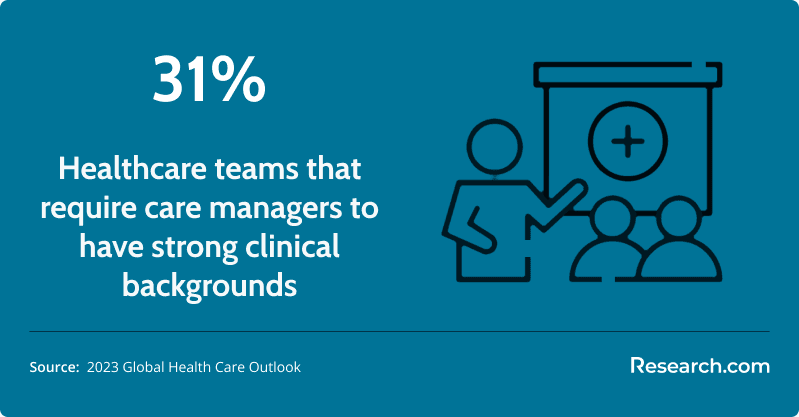
The image below shows why specialization can matter: 31% of healthcare teams now require care managers to have strong clinical backgrounds. Students targeting care coordination, patient services, or clinical operations may benefit from a clinical or patient-centered concentration.
What challenges might you face with online healthcare management programs?
Online healthcare management programs can be flexible, but they are not automatically easier. Students must manage weekly deadlines, group projects, digital platforms, and graduate-level reading without the structure of a physical classroom. Limited face-to-face networking can also be a drawback for students who rely on in-person relationship building.
Common challenges include staying motivated during asynchronous courses, handling technology issues, participating in virtual team projects across time zones, and avoiding isolation. Before enrolling, confirm that the school offers academic advising, library access, career coaching, tutoring, faculty availability, technical support, and opportunities to connect with classmates.
Cost should also be evaluated carefully. If you are comparing healthcare management programs with business alternatives such as cheap online MBA programs, look at accreditation, healthcare coursework, career support, and total program cost rather than tuition alone.
How does an online master's degree in healthcare management compare to an online executive MBA?
An online master’s in healthcare management is usually more specialized, while an executive MBA is broader and often aimed at experienced managers seeking senior leadership development across industries. The better choice depends on your career direction.
| Degree path | Best for | Main advantage | Possible limitation |
| Online master’s in healthcare management | Students committed to healthcare administration, operations, quality, policy, or health systems leadership | Direct focus on healthcare regulations, delivery models, finance, and patient-centered operations | May be less portable outside healthcare than a broad business degree |
| Online executive MBA | Experienced professionals seeking strategic, cross-industry executive training | Broader leadership network and wider business focus | May include less healthcare-specific coursework unless it offers a healthcare concentration |
If your goal is to lead hospitals, clinics, care programs, or health services teams, a healthcare management master’s is usually the more direct credential. If you want senior leadership mobility across multiple industries, an executive MBA may be worth comparing. For affordability-focused options, see the best value for money online MBA executive program guide.
How do you choose the best online master's degree in healthcare management program?
The right program should match your career goal, preferred learning format, budget, and timeline. A fast program is valuable only if you can complete it successfully and the credential supports the roles you want.
- Verify accreditation. Look for regional institutional accreditation and consider whether the program or business school has additional accreditation such as CAHME, AACSB, or ACBSP.
- Confirm the delivery format. Ask whether the program is fully online, requires campus visits, includes synchronous class meetings, or has fieldwork requirements.
- Compare program length and workload. A 12-month plan may require a demanding pace. Programs with fast formats, similar in structure to the shortest online master's in business analytics programs, may help you graduate sooner but require strong time management.
- Review curriculum and electives. Choose courses that support your target role, whether that is operations, policy, finance, quality, informatics, or executive leadership.
- Evaluate faculty and career support. Look for instructors with healthcare leadership experience, career coaching, alumni access, and employer connections.
- Calculate total cost. Include tuition, fees, books, technology requirements, travel, and lost work time if the program is intensive.
- Ask about certification alignment. Some programs include or prepare students for credentials such as Lean Six Sigma, project management, informatics, or healthcare leadership certifications.
- Check outcomes carefully. Review graduation rates, student support, alumni roles, and employer partnerships, but avoid assuming that any degree guarantees a particular job or salary.
| Question to ask before applying | Why it matters |
| Is the institution regionally accredited? | Accreditation affects transferability, financial aid eligibility, and employer confidence. |
| Can I realistically handle the accelerated workload? | Fast programs can become difficult for students with unpredictable work or caregiving schedules. |
| Does the curriculum match my target role? | A policy-focused student and an operations-focused student may need different electives. |
| What is the true total cost? | Per-credit tuition does not always include all fees and required materials. |
| Does the program support online students well? | Advising, career services, and technical support can affect completion and job search outcomes. |
Is an online master's degree in healthcare management a cost-effective investment?
An online master’s in healthcare management can be cost-effective when it helps you qualify for leadership roles, advance within your current organization, or move into a higher-responsibility healthcare position without pausing your career. The return depends on tuition, time to completion, financial aid, employer support, prior experience, local job market, and the type of role you pursue after graduation.
Accelerated programs may reduce opportunity cost by helping students finish sooner. However, faster is not always cheaper if tuition is high, aid is limited, or the workload forces you to reduce paid work. When comparing value, consider accreditation, curriculum quality, career services, employer recognition, and whether the program includes applied projects or competency-based learning. Students exploring fast programs in other business fields may also compare accelerated online degree programs.
What career paths are available for graduates of online master's degree in healthcare management programs?
Graduates can pursue leadership roles in hospitals, clinics, outpatient centers, health systems, long-term care, insurance organizations, public agencies, and consulting firms. Some professionals also combine healthcare expertise with broader leadership training, such as a fast-track online master's in organizational leadership, when targeting executive or cross-functional roles.
Medical and health services managers work in many of these settings. According to BLS, this occupation is projected to grow by 29% from 2023 to 2033, adding around 160,600 new jobs.
Typical advancement paths may include unit manager to quality improvement manager to health services director, or case manager to clinical director to program or nursing director.
Common roles for graduates include:
- Chief Nursing Officer, responsible for nursing strategy, staffing, quality, and policy
- Health Informatics Director, overseeing electronic health records, data systems, and digital workflow improvement
- Patient Care or Clinical Manager, supervising care coordination, case management, or service teams
- Quality Improvement Manager, leading safety, compliance, performance, and process-improvement initiatives
- Operations or Service Manager, managing outpatient, ambulatory, long-term care, or specialty service operations
Salary data for health services managers shows a median pay of $117,960 (2024). MBA-focused students can compare broader advancement options in the guide to career prospects after MBA in Healthcare Management, including executive leadership and strategic consulting roles.
What is the job market like for graduates with an online master's degree in healthcare management?
The job market for healthcare management graduates is strong because healthcare organizations need leaders who understand staffing, finance, regulation, quality, data, and patient-centered operations. The U.S. Bureau of Labor Statistics projects 29% growth from 2023 to 2033 for medical and health services managers, compared with 6% average growth for all occupations. That projection represents about 160,600 new roles over the decade.
Executive and senior management roles can offer high compensation, but they usually require significant experience. Research cited in this guide highlights roles such as hospital CEOs earning up to $258,900 and Health Information Management Directors earning around $79,800. Entry-level MBA healthcare management positions may pay between $40K–$80K, depending on location, organization, and role scope.
The median pay for health services managers in May 2024 was $117,960 annually, with higher earning potential often found in larger hospitals, outpatient centers, and executive-level positions. For a closer look at MBA-related compensation, review the MBA healthcare administration salary resource.
The chart below reinforces the outlook: medical and health services managers are projected to see 29% employment growth, far ahead of many other management roles and the national average. This reflects expanding demand for leaders who can manage complex healthcare organizations.
What supplementary skills and certifications enhance career outcomes?
A master’s degree can build the academic foundation for healthcare leadership, but additional skills and credentials can make a graduate more competitive. Employers increasingly value managers who can use data, lead change, improve processes, understand digital health tools, and communicate across clinical, financial, and administrative teams.
Useful add-ons may include Lean Six Sigma, Project Management Professional (PMP), healthcare informatics credentials, revenue cycle knowledge, data analytics skills, compliance training, and experience with electronic health record systems. Digital fluency is especially important as telehealth, analytics platforms, cybersecurity concerns, and system interoperability shape healthcare operations.
Professionals who want to lead innovation, build new service lines, or manage healthcare ventures may also benefit from entrepreneurial training. The guide on jobs you can get with an entrepreneurship degree offers a broader look at how business-building skills can support healthcare problem-solving.
Common mistakes to avoid when choosing a fast online healthcare management master's program
- Choosing speed over fit. A 12-month program is only useful if you can handle the workload and the curriculum supports your goals.
- Ignoring accreditation. Always verify institutional accreditation and consider program-level or business-school accreditation when comparing similar options.
- Looking only at tuition per credit. Total cost may include fees, books, technology, residencies, and extra terms if you slow down.
- Assuming all online programs are fully asynchronous. Some programs require live sessions, group meetings, practicums, or occasional campus visits.
- Overestimating salary outcomes. Published salary figures are helpful benchmarks, but pay depends on experience, role, employer, location, and leadership responsibility.
- Skipping career services research. Online students should confirm access to advising, job boards, resume help, networking, and alumni support.
- Choosing a specialization too early without a goal. Select informatics, quality, policy, or operations based on the job family you actually want.
Here's What Graduates Have to Say About Their Online Master's Degree in Healthcare Management
- Managing work, family, and graduate school was demanding, but the online format let me keep moving professionally while earning my degree. I was able to apply what I learned to a project at work and was promoted soon after. The flexibility mattered, but so did the fact that the coursework felt practical and relevant. Cordelia
- The program helped me build leadership and strategy skills I could use immediately. The courses were not just abstract theory; they connected directly to the decisions I make in healthcare management. I finished feeling more prepared to take on larger responsibilities. Zephyr
- Studying online taught me how to manage deadlines, collaborate remotely, and stay engaged without relocating. I expected the experience to feel distant, but the virtual classroom was more interactive than I thought. It helped me gain confidence in both healthcare leadership and digital collaboration. Santiago
Key Insights
- Fast online healthcare management master’s programs commonly take 12 to 18 months, but the best program is the one that balances speed with accreditation, workload, cost, and career relevance.
- The field has strong projected demand: medical and health services managers are projected to grow 29% from 2023–2033, with over 160,600 new jobs estimated over the decade.
- Healthcare management pay can be strong, with median pay of $117,960 in May 2024, but salaries vary by experience, location, employer, and leadership level.
- Online programs can be convenient for working professionals, but students should confirm support services, course format, practicum requirements, and technology expectations before enrolling.
- Cost varies widely. Compare total tuition, fees, financial aid, employer reimbursement, and time to completion rather than relying on sticker price alone.
- Average graduate salary can reach $121,882 from top online programs, but salary outcomes should be treated as benchmarks, not guarantees.
- Specializations in informatics, quality improvement, policy, long-term care, and patient safety can help align the degree with specific healthcare leadership roles.
- Certifications such as Lean Six Sigma, project management, informatics, or data analytics can strengthen a graduate’s profile, especially for operations and improvement-focused roles.
References:
- AIU (American Intercontinental University). Master of Healthcare Management (MHCM).
- Bureau of Labor Statistics. Medical and Health Services Managers.
- Bureau of Labor Statistics. Occupational Employment and Wages, 2023: 11-9111 Medical and Health Services Managers.
- College Tuition Compare. Health/Health Care Administration/Management.
- Drexel University. Online Degree vs. Traditional Degree: What's the Difference?
- Education Data Initiative. Average Cost of College & Tuition.
- FIU Online (Florida International University). MBA in Healthcare.
- Glassdoor. Health Care Manager Salary.
- Indeed. Healthcare Manager Salary in the United States.
- Intelligent.com. Are Online Degrees the Same as Traditional Degrees?
- Lamar University. MBA in Healthcare Administration.
- Murray State University. MBA in Healthcare Administration.
- MyDegreeGuide. Online College vs Traditional College.
- NCES (National Center for Education Statistics). IPEDS Trend Generator for CIP Code 51 (Health Professions).
- NCES. Press Release: College Enrollment and Student Aid, July 2023.
- Payscale. Healthcare Manager Salary.
- Salary.com. Healthcare Manager Salary in the United States.
- SNHU (Southern New Hampshire University). MBA in Healthcare Management.
- UNH (University of New Hampshire). MS in Health Care Management.
- University of Arizona Online. Master of Healthcare Management.
- University of Michigan–Flint. MS in Health Care Management.
- University of Texas Rio Grande Valley. MBA in Health Care Administration.
- Western Governors University (WGU). MBA in Healthcare Management.
- Zippia. Healthcare Manager Salary Overview.
- ZipRecruiter. Health Care Manager Salary.
Other Things You Should Know About the Fastest Online Master's Degree in Healthcare Management Programs
Many accelerated online healthcare management master's programs require a capstone project or supervised practicum in the final term. Typical expectations include 3 to 6 credits, an applied healthcare operations or policy project, and approval by a faculty advisor. Some programs also require a minimum GPA, often 3.0, to register for the capstone.
In 2027, universities like Purdue University Global and Southern New Hampshire University offer some of the fastest online master's degrees in healthcare management. Programs can be completed in as little as one year, depending on transfer credits and course load.
To enroll in the fastest online master's degrees in healthcare management in 2027, students typically need a reliable internet connection, updated operating systems, video conferencing capabilities, and compatible software. Specific programs may have additional technology requirements, so check with individual institutions for detailed specifications.


