
2027 Fastest Online Master's Degree in Management Information Systems

Co-Founder and Chief Data Scientist
An online Master’s in Management Information Systems is for people who want to move beyond hands-on technical work and into roles where technology decisions affect budgets, operations, security, and business strategy. The decision is not just “Should I get a master’s?” It is whether the time, tuition, flexibility, curriculum, and career outcomes make sense for your current situation.
This guide explains what online MIS master’s programs usually include, how long they take, what they cost, which schools offer strong options for 2027, and how the degree can support careers in IT management, cybersecurity, analytics, systems analysis, consulting, and technology leadership. It also covers practical selection criteria, common mistakes, ROI considerations, and questions to ask before enrolling.
Quick Answer: Is an Online Master’s in Management Information Systems Worth It?
An online Master’s in Management Information Systems can be worth it if you want a graduate credential that combines business leadership with applied technology management. It is especially useful for professionals aiming for roles such as IT manager, information systems manager, cybersecurity specialist, business intelligence analyst, systems analyst, or technology consultant.
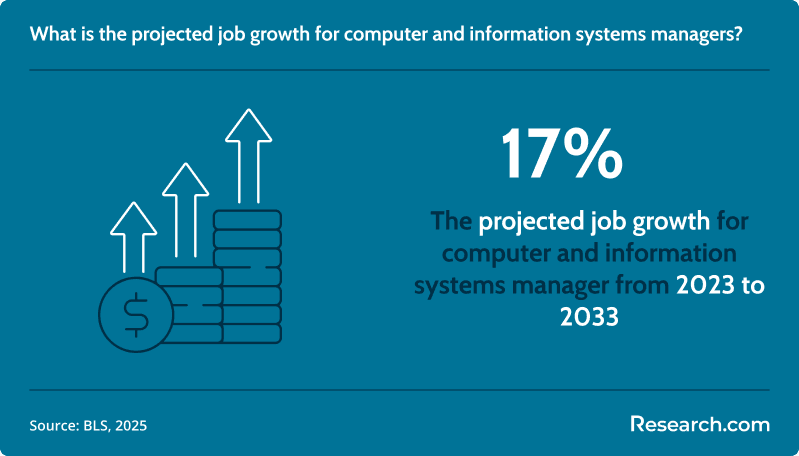
The strongest value usually comes from choosing an accredited program with a relevant curriculum, reasonable tuition, career support, and coursework tied to current employer needs. The job outlook is also favorable: employment for computer and information systems managers is projected to grow 17% from 2023 to 2033.
Key Benefits of an Online Master’s Degree in Management Information Systems
- Career mobility: MIS graduate programs prepare students for roles that connect business needs with technology solutions, including IT project manager, information systems manager, cybersecurity specialist, and business intelligence analyst.
- Strong salary potential: MIS-related roles can offer competitive pay. IT managers typically earn between $50,000 and $149,500 annually. Cybersecurity specialists earn around $93,170 per year, while business intelligence analysts earn about $99,864 annually.
- Flexible study format: Online programs are often built for working adults who need to keep their jobs while completing graduate coursework. Many use recorded lectures, live sessions, virtual teams, and online labs to support remote learning.
- Business and technical skill development: Students learn to evaluate systems, manage projects, analyze organizational data, protect information assets, and communicate technology decisions to business stakeholders.
- Access without relocation: Online delivery lets students compare programs across states without moving, which can expand options for cost, specialization, and school fit.
What Is an Online Master’s Degree in Management Information Systems?
An online Master’s in Management Information Systems is a graduate degree focused on using technology to solve organizational problems. Unlike a purely technical computer science degree, MIS emphasizes how information systems support business operations, decision-making, security, analytics, and strategy.
Most programs combine courses in IT project management, systems analysis, database management, information security, data analytics, enterprise systems, and technology leadership. Many programs require about 30 to 36 credit hours and end with a capstone, applied project, or final portfolio that asks students to solve a real or realistic business technology problem.
The online format varies by school. Some courses are asynchronous, meaning students complete work on their own schedule within weekly deadlines. Others include live virtual meetings, group projects, discussion boards, recorded lectures, and collaborative assignments. This structure can work well for professionals, but it requires discipline and regular time management.
Who Should Consider an Online MIS Master’s Program?
| Good fit if you... | Consider another path if you... |
| Want to move from technical execution into IT leadership, systems management, analytics, or consulting. | Want a deeply theoretical programming, algorithms, or computer architecture curriculum. |
| Need an online format that fits around work or family responsibilities. | Need daily in-person structure, campus labs, or frequent face-to-face networking. |
| Have business experience and want stronger technical credibility. | Only need one specific skill, such as a single cloud platform or security tool. |
| Have technical experience and want stronger management, strategy, and communication skills. | Are not ready to commit to graduate-level writing, projects, and independent study. |
Where Can You Work With an Online Master’s in Management Information Systems?
MIS graduates work in organizations that depend on secure, reliable, and useful information systems. This includes corporations, technology companies, healthcare organizations, financial services firms, government agencies, nonprofits, consulting firms, education providers, and startups.
Common work settings include IT departments, cybersecurity teams, data and analytics groups, enterprise systems teams, business operations units, software implementation groups, and digital transformation offices. Some graduates also use the degree to move into consulting, independent contracting, or leadership roles in specialized sectors such as healthcare technology or education technology.
Computer and information systems managers, one of the major MIS-aligned career categories, are projected to grow at a compound annual growth rate (CAGR) of about 1.7% per year.
How Much Can You Earn With an Online Master’s in Management Information Systems?
Professionals with an online Master’s in Management Information Systems can expect an average salary of around $105,783 per year, with top earners making up to $138,500 annually. Actual earnings depend on role, location, industry, experience, employer size, and certifications.
Entry-level MIS-related professionals commonly earn between $50,000 and $70,000. Experienced managers and specialists can earn $100,000 to $150,000 or more. Location can also matter: cities such as Nome, AK, and Berkeley, CA, offer salaries about 20-24% above the national average.
Advanced degrees and certifications can improve earning potential. Certified professionals can earn up to 30% more and are more likely to receive raises, although individual outcomes are never guaranteed.
| Role or category | Salary information stated | What affects pay |
| IT manager | $50,000 to $149,500 annually | Team size, industry, management scope, infrastructure responsibility |
| Cybersecurity specialist | Around $93,170 per year | Security certifications, incident response experience, risk and compliance knowledge |
| Business intelligence analyst | About $99,864 annually | Analytics tools, SQL skills, data visualization, business domain expertise |
| Online MIS master’s graduate | Average salary around $105,783 per year; top earners up to $138,500 annually | Experience, location, specialization, employer, certifications |
- Best Online Master’s Degrees in Management Information Systems for 2027
- How long does an online MIS master’s degree take?
- Online vs. on-campus MIS master’s programs
- Average cost of an online MIS master’s degree
- Financial aid options for online MIS graduate students
- Admissions requirements and prerequisites
- Common courses in an online MIS master’s program
- MIS specializations and concentration options
- Return on investment for an online MIS master’s degree
- Challenges of earning an MIS master’s online
- Trends shaping online MIS programs
- How to choose the right online MIS master’s program
- Career paths for online MIS master’s graduates
- Job market for MIS master’s graduates
Best Online Master’s Degree in Management Information Systems Programs for 2027
A strong online MIS master’s program should do more than offer convenience. It should combine technology management, business strategy, information security, analytics, systems design, and applied projects in a format that working professionals can complete without pausing their careers. The best programs also make costs, accreditation, transfer policies, and student support easy to evaluate.
Students comparing accelerated online options may notice similarities with other flexible graduate and professional pathways, including online professional writing degree programs, where schedule design and career relevance are central parts of the decision.
How We Rank the Schools
Because a graduate degree requires a serious financial and time commitment, rankings should be based on transparent and verifiable information. Research.com uses data from sources such as the IPEDS database, Peterson's database, the College Scorecard database, and the National Center for Education Statistics.
These sources help evaluate online Master’s in Management Information Systems programs using consistent information on schools, costs, outcomes, and institutional characteristics. For a fuller explanation of the process, see Research.com’s ranking methodology.
1. Dakota State University
Dakota State University offers an MS in Information Systems designed for students who want to strengthen both technical and business capabilities. The program emphasizes the management of applications, the translation of user needs into system requirements, and the use of technologies such as CASE programming and database management.
- Required Credits to Graduate: 30
- Estimated Cost per Semester: $3,365.10 (for online, 9 credits)
- Accreditation: Higher Learning Commission (HLC), Accreditation Council for Business Schools and Programs (ACBSP)
2. Western Governors University
Western Governors University provides an online Master of Science in IT Management for students preparing for leadership roles in technology-driven organizations. The curriculum is informed by industry input and focuses on emerging technologies, global IT issues, project management, and business problem-solving through technology.
- Required Credits to Graduate: WGU uses a competency-based structure rather than traditional credit hours. The program typically includes 10 courses, and students are expected to complete at least 8 competency units per 6-month term.
- Cost: Approximately $4,040 per 6-month term
- Accreditation: Northwest Commission on Colleges and Universities (NWCCU)
3. Kennesaw State University
Kennesaw State University offers a Master of Science in Information Systems for managers and professionals who need to understand how technology shapes enterprise strategy. The program covers technology deployment across organizations, security issues, risk management, and cross-functional partnerships.
- Required Credits to Graduate: 30
- Cost: Approximately $3,877 per 9 credit hours for online (e-tuition) for in-state; varies for out-of-state and on-campus.
- Accreditation: Southern Association of Colleges and Schools Commission on Colleges (SACSCOC); Coles College of Business is accredited by AACSB International.
4. Georgia College & State University
Georgia College & State University delivers an online Master of Management Information Systems focused on managing corporate information resources and serving as a bridge between IT teams and business units. Students study technical tools such as SAP and SQL alongside analysis, project management, and professional communication. The curriculum also aligns with the Certified Information Systems Auditor (CISA) exam.
- Required Credits to Graduate: 30 semester hours
- Cost: Approximately $1,770 per semester (based on 2024-2025 rates for 9 credits for online programs), plus fees.
- Accreditation: SACSCOC; the J. Whitney Bunting College of Business and Technology is accredited by AACSB International.
5. Wilmington University
Wilmington University offers an MS in Information Systems Technologies with a Management concentration. The program is built for students who want to connect business requirements with technology solutions, supervise systems development, manage IT projects, and apply critical thinking in technology environments.
- Required Credits to Graduate: 36 credit hours (12 courses)
- Cost: Approximately $551 per graduate credit hour, plus fees (based on current graduate tuition for online & distance learning).
- Accreditation: Middle States Commission on Higher Education (MSCHE)
6. Minot State University
Minot State University provides an online MS in Information Systems for students preparing for advanced management responsibilities or independent consulting work. The curriculum emphasizes technology forecasting, infrastructure planning, and the management of existing systems in organizational settings.
- Required Credits to Graduate: 30
- Cost: Approximately $4,081.68 per 9 credit hours
- Accreditation: HLC; the business programs, including MSIS, are accredited by the International Accreditation Council for Business Education (IACBE).
7. Liberty University
Liberty University offers an online MS in Information Systems that focuses on designing, evaluating, and improving organizational data networks. The program blends business coursework, management topics, and IT concepts for students who want to support secure and efficient systems in private, public, and nonprofit organizations.
- Required Credits to Graduate: 36
- Cost: Approximately $580 per credit hour
- Accreditation: SACSCOC; the School of Business is accredited by the ACBSP.
8. Colorado State University
Colorado State University offers a STEM-designated Master of Computer Information Systems that combines technical study with business management. The program is designed for students with and without technical backgrounds and includes specialization options such as cybersecurity and IT project management.
- Required Credits to Graduate: 33
- Cost: Approximately $867 per credit hour (graduate tuition for MCIS).
- Accreditation: HLC; the College of Business is accredited by AACSB International.
9. Park University
Park University offers an MBA with a Management Information Systems concentration for students who want a business-centered graduate degree with technology management depth. The program is available fully online or in a blended format and focuses on strategic thinking, collaboration, and technology-enabled leadership.
- Required Credits to Graduate: 33-36 (depending on concentration)
- Cost: Approximately $515 per credit hour
- Accreditation: HLC and ACBSP
10. Purdue Global
Purdue Global offers an online MS in Information Technology for students seeking advancement in the IT field. The program links technology, communication, and business skills, includes learning labs, and offers concentration options such as cybersecurity and project management.
- Required Credits to Graduate: 60 quarter credit hours
- Cost: Approximately $420 per quarter credit hour, plus a per-term resource fee
- Accreditation: HLC; programs in the School of Business and Information Technology are accredited by the ACBSP
The chart below shows the most common degree backgrounds among information systems managers.
How Long Does It Take to Complete an Online Master’s Degree in Management Information Systems?
Most online MIS master’s programs require 30 to 36 credits. Full-time students often finish in about one to two years, while part-time students may extend the timeline to balance school with work and personal responsibilities.
Some accelerated programs can be completed in as little as 16 to 21 months. Other programs use shorter sessions, such as one course every eight weeks, which can help part-time students make steady progress and finish in approximately two years.
Accelerated education is common across many career fields. For example, Research.com also covers accelerated medical assistant programs that may be completed in as little as 6 weeks to 4 months. An MIS master’s is a more advanced and longer graduate pathway, but online delivery can still shorten completion time by reducing relocation barriers and offering year-round or condensed scheduling.
| Enrollment pace | Typical completion pattern | Best for |
| Full-time | About one to two years | Students who can commit significant weekly time to graduate study |
| Accelerated | As little as 16 to 21 months | Experienced, self-directed students who can handle a faster workload |
| Part-time | Approximately two years in some formats | Working professionals balancing school with full-time employment |
How Does an Online Master’s in MIS Compare With an On-Campus Program?
Online and on-campus MIS master’s programs can cover similar academic material and lead to similar career opportunities when they come from reputable, accredited institutions. The better format depends on how you learn, how much flexibility you need, and how important in-person networking is to your goals.
Online MIS programs often use platforms such as Blackboard or Canvas for lectures, assignments, discussion boards, exams, and group projects. Students communicate with instructors and classmates through email, forums, video meetings, and collaborative tools. This format resembles other flexible graduate options, such as a fast-track online master’s in organizational leadership, where convenience and career advancement are major priorities.
Students comparing business-focused online degrees may also find similarities with a fast-track online MBA in marketing, particularly in the use of accelerated calendars, asynchronous coursework, and team-based virtual projects.
On-campus MIS programs usually involve scheduled in-person lectures, seminars, labs, advising meetings, and networking events. This can make it easier to build spontaneous relationships with faculty and classmates, but it also requires commuting or relocating and following a fixed schedule.
| Factor | Online MIS master’s | On-campus MIS master’s |
| Schedule | Often more flexible; may include asynchronous work | Usually follows fixed class times |
| Networking | More intentional and virtual; requires proactive outreach | More spontaneous through campus events, labs, and informal meetings |
| Learning environment | Digital platforms, recorded content, virtual collaboration | Classrooms, labs, seminars, and in-person group work |
| Best for | Self-motivated students who need flexibility | Students who prefer structure and face-to-face interaction |
| Employer perception | Generally comparable when the institution is reputable and accredited | Generally familiar to employers and alumni networks |
One important caution: not every online experience is equally strong. Before enrolling, review course technology, instructor access, student support, career services, and whether the curriculum is regularly refreshed.
What Is the Average Cost of an Online Master’s Degree in Management Information Systems?
The average cost of an online Master’s in Management Information Systems typically ranges from $17,000 to $32,000 in total tuition. Per-credit tuition commonly falls between $565 and $895, but prices vary widely by institution.
Some affordable programs cost as little as $9,320, while the highest-cost options can exceed $70,000. Recent analyses place the national average for in-state tuition at approximately $28,000.
Do not compare programs using tuition alone. Fees, technology charges, textbooks, residency requirements, transfer credit rules, employer reimbursement, and time to completion can change the true cost. This same principle applies to other online degree searches, including an accelerated online bachelor’s degree in entrepreneurship, where school type and program structure can significantly affect total cost.
Cost Factors to Review Before Enrolling
- Total tuition: Calculate the full program cost, not just the advertised per-credit rate.
- Fees: Ask about technology fees, online learning fees, graduation fees, and course material costs.
- Transfer credits: Some schools allow prior graduate credits, which may reduce time and cost.
- Course schedule: Faster completion may reduce opportunity costs, but accelerated programs can be harder to manage while working.
- Employer support: Tuition reimbursement can substantially change the affordability of a program.
What Financial Aid Options Are Available for Online MIS Master’s Students?
Online MIS graduate students may be eligible for several types of funding, but availability depends on the school, enrollment status, citizenship or residency status, employer benefits, and program structure.
- Federal financial aid: Eligible students can complete the Free Application for Federal Student Aid (FAFSA) to be considered for federal aid options.
- State and school aid: Universities may offer scholarships, grants, fellowships, or tuition discounts based on merit, need, residency, or academic program.
- Private scholarships and loans: Professional associations, private foundations, and lenders may provide additional funding options.
- Employer tuition assistance: Many working professionals use employer tuition reimbursement or education benefits to reduce out-of-pocket costs.
- Graduate assistantships or work-study: These may be available at some schools, though they can be less common for fully online students.
- Veterans benefits: Military veterans and active-duty personnel may qualify for education benefits and related support.
Funding decisions are similar in many technology education pathways, including online CompTIA CySA+ training programs, where students should compare price, credential value, aid availability, and employer relevance.
What Are the Prerequisites for an Online Master’s in Management Information Systems?
Admissions requirements vary, but most online MIS master’s programs look for applicants who can handle graduate-level technical, analytical, and managerial coursework.
- Bachelor’s degree: Applicants usually need a bachelor’s degree from a regionally accredited institution or an international equivalent. The major is not always restricted; even a student with an accelerated online journalism bachelor’s degree may qualify if other requirements are met.
- Minimum GPA: Many programs require an undergraduate GPA of 2.5–3.0 on a 4.0 scale.
- Professional experience: Some schools require or prefer at least two years of work experience, although policies differ and internships may not always count.
- GRE or GMAT: Some programs require test scores, while others waive them or make them optional for applicants with strong academic or professional records.
- English proficiency: International applicants may need TOEFL or IELTS scores, with minimums set by each university.
- Application materials: Common requirements include official transcripts, a resume, recommendation letters, and a statement of purpose or personal statement.
Applicants should read admissions pages carefully rather than assuming all online programs use the same criteria. Similar diligence is useful when comparing online journalism degree programs or any other online credential.
What Courses Are Typically Included in an Online MIS Master’s Program?
Online MIS master’s programs usually combine technical systems coursework with business, leadership, and analytics training. Like a fast-track online sports management bachelor’s degree, the curriculum is often designed to be practical, career-focused, and efficient.
- Database management: Students learn how databases are designed, maintained, queried, protected, and used to support organizational decisions.
- Systems analysis and design: Coursework introduces methods for identifying business requirements, modeling processes, designing information systems, and applying approaches such as the system development life cycle (SDLC), Agile, and object-oriented design.
- Cybersecurity or information assurance: Students examine risk assessment, security controls, policy development, threat mitigation, compliance, and ethical responsibilities. Learners who want extra hands-on security preparation may also compare short online cyber operations training programs.
- Information systems management: This area focuses on IT governance, resource planning, technology strategy, vendor relationships, and the alignment of systems with organizational goals.
Students who have completed accelerated online IT training bootcamps may already have practical foundations in networking, programming, or cybersecurity, which can help them focus more heavily on strategy, architecture, and management in a master’s program.
What Specializations Are Available in an Online Master’s in MIS?
Specializations help students tailor an MIS degree to a specific career direction. The best choice depends on whether you want to manage IT teams, analyze data, secure systems, support healthcare technology, or design cloud-based infrastructure.
| Specialization | What it emphasizes | Career direction |
| IT Leadership & Strategy | IT governance, strategic planning, digital transformation, organizational change | IT manager, technology director, systems leader |
| Data Science & Analytics | Statistical modeling, machine learning, programming, advanced analysis | Data-focused analyst, analytics manager, data science-adjacent roles |
| Health Informatics | Patient data, electronic health records, healthcare analytics, regulatory compliance | Healthcare technology, informatics, health systems analytics |
| Cloud Computing & Architecture | Cloud solutions, infrastructure design, deployment models, cloud security, migration | Cloud systems, infrastructure management, cloud architecture support |
Students interested in healthcare technology should review career expectations carefully. Research.com’s guide to health informatics careers and salary can help connect specialization choices to possible roles.
For students pursuing cloud-focused roles, an MIS specialization may be strengthened with focused credential preparation such as accelerated online CompTIA Cloud+ certification training, especially when a role requires hands-on cloud administration knowledge.
The chart below highlights in-demand skills for information systems managers.
What Is the Return on Investment of an Online MIS Master’s Degree?
The ROI of an online MIS master’s degree depends on the relationship between program cost, time to completion, current income, career goals, and likely advancement opportunities. A lower-cost accredited program can produce a stronger financial return than a higher-priced program if it offers relevant coursework, employer recognition, and career support.
Students should evaluate both measurable and non-measurable benefits. Measurable factors include tuition, fees, salary growth, promotion potential, and time away from full-time work. Non-measurable benefits include stronger confidence in technology leadership, better communication with executives and technical teams, broader professional networks, and improved adaptability as systems, security risks, and data practices change.
It can also be useful to compare the MIS degree with adjacent graduate options, such as the most affordable online MBA programs. An MBA may be better for broad business leadership, while an MIS master’s may be stronger for technology management, systems strategy, analytics, and IT leadership.
Questions to Ask When Estimating ROI
- Will this degree help me qualify for roles I cannot realistically reach with my current credentials?
- Does the curriculum match the skills required in the jobs I want?
- How much will I pay after scholarships, employer benefits, and transfer credits?
- Can I keep working while enrolled?
- Does the school publish career outcomes, alumni information, or employer connections?
- Are there lower-cost programs with similar accreditation and curriculum quality?
What Challenges Should Online MIS Students Expect?
Online MIS programs can be convenient, but they are not automatically easier. The flexibility that makes them attractive also means students must manage deadlines, group projects, technical platforms, and independent study without the structure of a physical classroom.
- Self-discipline: Students must schedule weekly study time and stay ahead of assignments without frequent in-person reminders.
- Networking limitations: Online students may need to be more intentional about connecting with faculty, classmates, alumni, and employers.
- Technology dependence: A reliable computer, stable internet, and comfort with learning platforms are essential.
- Group coordination: Virtual projects can be challenging when classmates work in different time zones or industries.
- Variable course quality: Some online courses are more interactive and current than others, so reviewing sample courses and student support is important.
Students comparing cost and convenience across fields should remember that a cheaper option is not always the better fit. For example, someone researching affordable online sports management bachelor’s programs would still need to consider accreditation, career alignment, and support services rather than price alone.
What Emerging Trends Are Shaping Online MIS Programs?
Online MIS programs are evolving as employers rely more heavily on data, cloud infrastructure, cybersecurity controls, artificial intelligence, and integrated enterprise systems. Strong programs increasingly update coursework to reflect how organizations manage digital transformation and technology risk.
Important curriculum themes include artificial intelligence, machine learning applications, blockchain security, cloud computing strategies, advanced cybersecurity, data governance, and collaboration through virtual labs. These additions matter because MIS graduates are often expected to evaluate technology not only as a tool, but as a business asset with cost, risk, security, compliance, and operational consequences.
Students seeking fast but structured business pathways may also compare accelerated online business degree programs to understand how different formats balance speed, rigor, and career preparation.
How to Choose the Best Online Master’s Degree in Management Information Systems
The best online MIS master’s program is not necessarily the highest-ranked, fastest, or cheapest. It is the program that fits your career target, budget, schedule, learning style, and background while meeting quality standards.
Selection Criteria That Matter Most
- Accreditation: Verify institutional accreditation and, when relevant, business or technology-related program accreditation.
- Curriculum fit: Confirm that the program covers the systems, analytics, cybersecurity, cloud, project management, or leadership topics you need.
- Specializations: Choose a concentration only if it supports a clear career direction.
- Faculty and industry relevance: Look for instructors with academic and practical experience in MIS, IT management, analytics, cybersecurity, or enterprise systems.
- Student support: Ask about advising, tutoring, technical help, library access, writing support, and career services for online students.
- Career outcomes: Review employment data, alumni paths, employer partnerships, and internship or capstone opportunities when available.
- Total cost: Compare tuition, fees, financial aid, transfer credits, and expected time to completion.
This process is similar to evaluating online CompTIA Security+ training programs: the credential should be relevant, recognized, affordable enough for your situation, and aligned with the jobs you want.
Common Mistakes to Avoid
| Mistake | Why it can hurt you | Better approach |
| Choosing based only on tuition | A low price may come with weak support, limited electives, or poor career alignment. | Compare total value: cost, curriculum, accreditation, support, and outcomes. |
| Ignoring accreditation | Accreditation can affect employer confidence, credit transfer, and financial aid eligibility. | Verify accreditation directly with the school and recognized accrediting sources. |
| Assuming online means easy | Graduate MIS coursework can be demanding, especially with analytics, systems, and security projects. | Ask about weekly workload, course pacing, and group project expectations. |
| Not checking specialization relevance | A concentration may sound attractive but may not match your target roles. | Compare course topics with job descriptions for roles you want. |
| Overlooking career services | Online students sometimes receive less networking unless services are intentionally designed for remote learners. | Ask whether online students get the same advising, employer events, and alumni access. |
| Assuming salary outcomes are guaranteed | Pay depends on experience, location, industry, certifications, and job market conditions. | Use salary data as a planning tool, not a promise. |
Questions to Ask Admissions Advisors
- Is the program fully online, or are there required campus visits?
- Are courses asynchronous, synchronous, or a mix of both?
- How many hours per week should students expect to study?
- Can I transfer graduate credits into the program?
- What technology platforms and software tools are used?
- Does the program include a capstone, practicum, internship, or portfolio?
- What career services are available specifically to online graduate students?
- How often is the curriculum reviewed or updated?
What Career Paths Are Available for Graduates of an Online MIS Master’s Degree?
An online MIS master’s degree can support roles that require technical fluency, business judgment, project coordination, data awareness, and leadership. Graduates often work between executive teams, technical staff, vendors, cybersecurity teams, and business units.
Common Career Paths for MIS Graduates
- Information systems manager or IT manager: Leads technology teams, manages infrastructure or applications, plans IT budgets, and aligns systems with organizational goals.
- Business analyst or management analyst: Studies workflows, identifies operational problems, gathers requirements, and recommends technology-enabled improvements. Students often ask how business analytics differs from data science. In simple terms, data science often centers on predictive models and algorithms, while business analytics uses data to understand performance and guide business decisions.
- Systems analyst: Evaluates organizational technology needs, documents requirements, recommends system improvements, and supports implementation.
- Database administrator or database manager: Designs, protects, maintains, and optimizes databases so organizations can store and access reliable information.
- Cybersecurity analyst or information security analyst: Helps protect systems and data by monitoring risks, implementing controls, and supporting security policies.
Because MIS sits between technology and business, graduates can pursue a wide range of paths. Students especially interested in analytics may also compare affordable online master’s programs in analytics to decide whether MIS or a more analytics-specific degree is the better fit.
What Is the Job Market for Graduates With an Online Master’s in Management Information Systems?
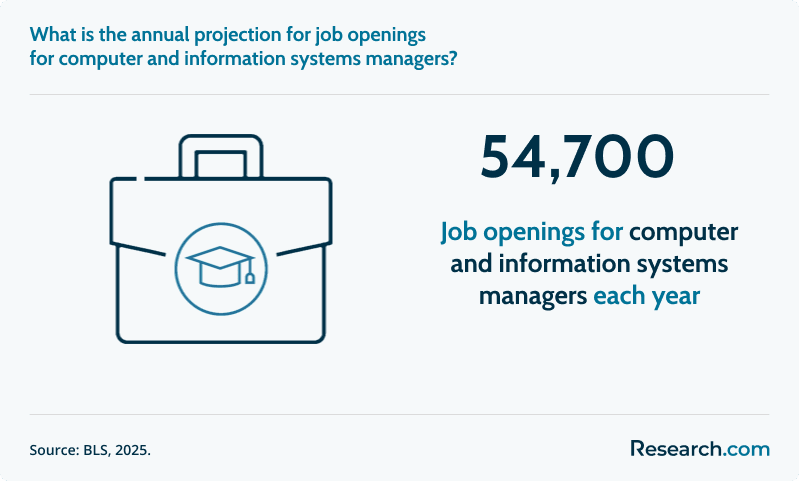
The employment outlook for computer and information systems managers is strong. Jobs in this category are projected to grow 17% from 2023 to 2033, which is much faster than the average for all occupations. About 54,700 openings for computer and information systems managers are anticipated each year.
Many openings are expected to result from workers moving into other careers or leaving the labor force, including retirement. In 2023, computer and information systems managers held approximately 613,500 jobs.
This outlook helps explain why an MIS graduate degree can be attractive for professionals who want to manage technology at the organizational level. It also raises a common question: what is the difference between computer science and information technology, and where does MIS fit?
Computer science generally emphasizes computation, software, algorithms, and the foundations of computing. Information technology focuses on applying and maintaining technology systems in organizations. MIS overlaps with both but adds a stronger business and management lens, focusing on how technology supports strategy, operations, security, and decision-making.
In 2023, the largest employers of computer and information systems managers were as follows:
What Online MIS Graduates Say About the Experience
-
: "
Completing the MIS master’s online allowed me to keep working full-time while building skills I could use immediately. The applied projects helped me grow into a leadership role on a team developing new technology solutions. - Seanna
"
-
: "
I was unsure about online learning at first, but the program turned out to be interactive and practical. The data analytics coursework connected directly to my job and helped support my promotion. - Bingo
"
-
: "
The program helped me understand how technology shapes business decisions. Coursework in cybersecurity led me toward consulting, and the online format made it possible to study from home at a manageable pace. - Ling
"
Key Insights
- An online Master’s in Management Information Systems is strongest for students who want to connect technology, data, security, systems, and business strategy.
- The job outlook is favorable: computer and information systems manager employment is projected to grow 17% from 2023 to 2033, with about 54,700 openings expected each year.
- Salary potential can be strong, but it varies. IT managers typically earn between $50,000 and $149,500 annually, cybersecurity specialists earn around $93,170, and business intelligence analysts earn about $99,864.
- Professionals with an online MIS master’s degree can expect an average salary of around $105,783 per year, while top earners make up to $138,500 annually.
- Most programs require 30 to 36 credits and can often be completed in one to two years; accelerated options may take as little as 16 to 21 months.
- Accreditation, curriculum relevance, career support, total cost, and specialization fit matter more than rankings alone.
- Online programs can offer flexibility, but students should be prepared for independent study, virtual collaboration, and proactive networking.
- The best ROI usually comes from choosing a reasonably priced accredited program that directly supports your target role and allows you to keep working while enrolled.
References:
- Business Intelligence Analyst salary. (2025). ZipRecruiter. Retrieved June 22, 2025, from https://www.ziprecruiter.com/Salaries/Business-Intelligence-Analyst-Salary
- Computer and Information Systems Managers. (2025, April 18). Bureau of Labor Statistics. https://www.bls.gov/ooh/management/computer-and-information-systems-managers.htm#tab-3
- Cyber Security Specialist salary. (2025). ZipRecruiter. Retrieved June 22, 2025, from https://www.ziprecruiter.com/Salaries/Cyber-Security-Specialist-Salary
- How to become an Information Systems manager: what it is and career path - ZiPpia. (2025, January 8). https://www.zippia.com/information-systems-manager-jobs
- It Manager Salary. (2025). ZipRecruiter. Retrieved June 22, 2025, from https://www.ziprecruiter.com/Salaries/It-Manager-Salary
Other Things You Should Know About Online Master's Degrees in Management Information Systems
A 2027 Online Master’s Degree in Management Information Systems offers a blend of technical and managerial skills, equipping graduates for diverse roles in IT management. The program's accelerated format enables faster completion, making it a strategic choice for those aiming to quickly advance their careers.
The 2027 Fastest Online Master's Degree in Management Information Systems offers accelerated learning, integrating current technology trends and management strategies. Students benefit from condensed coursework, diverse modules on information systems, and real-time industry applications, allowing for degree completion in record time without sacrificing educational quality.


