
2027 Fastest Online CompTIA A+ Training Bootcamps

Co-Founder and Chief Data Scientist
If you want an entry-level IT job without spending years in school, CompTIA A+ is one of the most practical credentials to consider. Nearly half of April 2025 U.S. tech-job ads no longer listed a four-year degree as a requirement, and many employers are giving more weight to job-ready credentials such as CompTIA A+. CompTIA also reports that certifications are viewed as “critical” in hiring decisions, which is why short online A+ bootcamps can appeal to career changers, recent graduates, and working adults who need a faster route into IT support.
This guide explains what online CompTIA A+ bootcamps actually cover, how fast they can be completed, what they cost, how to compare legitimate programs, and what kinds of jobs they may help you pursue. It also ranks fast online options and gives you a decision framework so you can choose a bootcamp based on schedule, value, exam preparation, and career fit—not marketing claims.
Quick answer: Are online CompTIA A+ bootcamps worth it?
An online CompTIA A+ bootcamp can be worth it if you want a focused, short-term path into IT support and you are ready to study intensively for both A+ exams. The strongest programs combine live instruction or structured self-paced lessons with virtual labs, practice exams, exam-objective coverage, and support from instructors who understand real help-desk and troubleshooting work.
A bootcamp is not the same as a degree. It is best for learners who need job-specific skills quickly, while a computer science or cybersecurity degree may be better for people who want broader theory, research opportunities, long-term academic credentials, or roles that specifically request a degree.
What are the benefits of an online CompTIA A+ training bootcamp?
- It can prepare you for entry-level IT support work quickly. The U.S. Bureau of Labor Statistics reports a median annual wage of $60,340 for computer user-support specialists as of May 2024.
- The labor market still supports help-desk and support roles. Employment for computer support specialists is projected to grow 6% from 2023-2033, according to BLS forecasts.
- It gives you a stackable starting point. A+ can support movement into help-desk, field technician, endpoint support, junior network support, and later cybersecurity or cloud roles when combined with additional credentials.
- It may help candidates without a four-year degree compete. Skills-based hiring is becoming more visible in tech postings, especially for roles that value certifications and hands-on troubleshooting ability.
What can I expect from an online CompTIA A+ training bootcamp?
An online CompTIA A+ bootcamp is usually a concentrated certification-prep program built around the two A+ exams. Most programs cover PC components, operating systems, mobile devices, networking basics, cloud and virtualization concepts, security fundamentals, operational procedures, and troubleshooting methods. A strong bootcamp should include labs—not just lectures—because A+ is meant to validate practical support skills.
Formats vary. Some bootcamps use a live online schedule with instructor-led sessions over a short period, while others allow self-paced study over several weeks or months. Many include recordings, practice tests, virtual simulations, and exam vouchers, but you should confirm exactly what is included before paying tuition.
| What to compare | Why it matters | What to ask before enrolling |
| Coverage of Core 1 and Core 2 | You must pass both exams to earn A+ certification. | Does the curriculum map directly to the current exam objectives? |
| Hands-on labs | Support jobs require troubleshooting, not memorization alone. | Are labs virtual, instructor-led, self-guided, or optional? |
| Practice exams | Practice tests help identify weak areas before the real exam. | How many practice exams are included, and are explanations provided? |
| Exam vouchers | Vouchers can significantly affect total cost. | Are both exam vouchers included in tuition? |
| Instructor access | Fast programs leave little time to get unstuck. | Can you ask questions live, by email, or through office hours? |
Where can I work after completing an online CompTIA A+ bootcamp?
A+ training is most relevant to organizations that need technicians who can support users, devices, operating systems, basic networks, and common security practices. Graduates often look first at entry-level support roles, then build toward networking, systems administration, cloud support, or cybersecurity after gaining experience and additional credentials.
- Corporate IT departments hire support technicians for internal help desks, workstation setup, account support, and endpoint troubleshooting.
- Managed-service providers use entry-level technicians for client support, device deployments, upgrades, and break-fix work.
- Healthcare systems, schools, and government agencies need support staff who can maintain secure devices and follow documentation, privacy, and compliance procedures.
- Remote support centers may be a good fit for new technicians because 28% of tech postings seek 0-3 years’ experience and often emphasize certifications over degrees.
- Field service companies need technicians for on-site printer, point-of-sale, workstation, and network troubleshooting.
How much can I make with CompTIA A+ training?
CompTIA A+ is most closely aligned with computer support roles. The U.S. Bureau of Labor Statistics lists $60,340 as the median annual pay for computer user-support specialists and $73,340 for computer network-support specialists as of May 2024. Pay varies by location, employer, shift, experience, and whether you add credentials in networking, security, cloud, or systems administration. Across computer and IT occupations overall, the median annual wage is $105,990. Salary.com lists senior help-desk roles averaging $124,000, showing how compensation can rise when support experience is paired with advanced responsibility and credentials.
Do not treat a bootcamp as a salary guarantee. A+ can help you qualify for interviews, but your earnings will depend on your hands-on ability, communication skills, local labor market, prior experience, and willingness to keep learning. Additional credentials such as Network+ and Security+ are often used to move beyond entry-level support, and continuous learning may lead to 10-25 % increases per credential while opening pathways into systems administration, cybersecurity, and cloud support.
- Fastest online CompTIA A+ training bootcamps for 2027
- How long does an online CompTIA A+ bootcamp take?
- Online CompTIA A+ bootcamp vs. on-campus program
- Average cost of an online CompTIA A+ bootcamp
- Financial aid and funding options
- Prerequisites for online CompTIA A+ bootcamps
- Common CompTIA A+ bootcamp topics
- How to study for CompTIA A+
- How to verify bootcamp legitimacy
- Should you pursue more education after A+?
- Challenges to expect in an online bootcamp
- How to choose the best fast A+ bootcamp
- Career paths after an A+ bootcamp
- Job market outlook for A+ graduates
- Return on investment of an online A+ bootcamp
Fastest Online CompTIA A+ Training Bootcamps for 2027
The fastest online CompTIA A+ bootcamps are designed for learners who already know they want certification prep, not a broad academic program. These programs concentrate on hardware, operating systems, networking fundamentals, security, mobile devices, and troubleshooting so students can prepare for the two required A+ exams in a compressed schedule.
If you are asking, what can I do after earning a computer science degree, an A+ bootcamp may be a way to add a practical support credential. If you do not already have a degree, a bootcamp can still be useful, but it should be evaluated as certification preparation rather than a replacement for a full academic credential.
The programs below are U.S.-based online options ranked by shortest listed time to completion, not by lowest tuition. Before enrolling, confirm current pricing, voucher inclusion, refund terms, exam version, and start dates directly with the provider.
How do we rank programs?
Research.com rankings use a structured ranking methodology that reviews available program information, institutional data, cost indicators, and outcomes-related sources where applicable.
For college-affiliated programs, relevant data sources may include the IPEDS database from the National Center for Education Statistics, Peterson's database, including distance learning data, and the College Scorecard database. Because many A+ bootcamps are non-credit professional training programs, students should also verify details directly with the continuing education or career training provider.
1. Cal Poly Pomona – CompTIA A+ Boot Camp
California State Polytechnic University, Pomona, commonly known as Cal Poly Pomona, is a public polytechnic university in Pomona, California. Founded in 1938 and part of the California State University system, it is known for applied learning and programs in engineering, science, and technology.
- Program cost: ~$2,595 (total program cost)
- Program duration: 5 days (live online)
- Total credits: Non-credit bootcamp (certificate prep)
- Accreditation: WSCUC (Western Senior Colleges and Universities Commission)
2. Texas State University – CompTIA A+ Training Boot Camp
Texas State University is a public research university in San Marcos, Texas. Established in 1899 as a teachers’ college, it has developed into one of the largest universities in Texas and offers programs across education, business, applied sciences, and other fields.
- Program cost: $2,695 (total program cost)
- Program duration: 5 days (live online cohort)
- Total credits: Non-credit bootcamp (certificate prep)
- Accreditation: SACS (Southern Association of Colleges and Schools)
3. Chicago State University – CompTIA A+ Training Boot Camp
Chicago State University is a public university on Chicago’s South Side. Founded in 1867 as a teacher training institution, it now offers programs in areas such as education, health sciences, and business while serving a diverse urban student population.
- Program cost: ~$2,595 (estimated total cost)
- Program duration: 5 days (live online, instructor-led)
- Total credits: Non-credit bootcamp (certificate prep)
- Accreditation: HLC (Higher Learning Commission)
4. Florida International University – CompTIA A+ Boot Camp (Online)
Florida International University is a public research university in Miami, Florida. Founded in 1972, FIU has become one of Florida’s largest universities and is known for programs connected to business, engineering, hospitality, and urban research.
- Program cost: ~$2,495 (total program cost)
- Program duration: 5 days (live online instruction)
- Total credits: Non-credit bootcamp (certificate prep)
- Accreditation: SACSCOC (Southern Association of Colleges and Schools Commission on Colleges)
5. University of Tennessee at Chattanooga – CompTIA A+ Online Boot Camp
The University of Tennessee at Chattanooga is a public university in Chattanooga, Tennessee. Founded in 1886 and later joining the University of Tennessee system in 1969, UTC combines liberal arts education with professional programs in areas including business, engineering, and healthcare.
- Program cost: ~$2,595 (total program cost)
- Program duration: 5 days (live online bootcamp)
- Total credits: Non-credit bootcamp (certificate prep)
- Accreditation: SACSCOC (Southern Association of Colleges and Schools Commission on Colleges)
6. Rowan University – CompTIA A+ Training Boot Camp
Rowan University is a public research university in Glassboro, New Jersey. It began in 1923 as Glassboro Normal School and has expanded into a comprehensive institution with strengths in engineering, business, medical education, and regional workforce development.
- Program cost: $2,495 (total program cost)
- Program duration: 5 days (intensive bootcamp)
- Total credits: Non-credit bootcamp (certificate prep)
- Accreditation: MSCHE (Middle States Commission on Higher Education)
7. George Mason University – CompTIA A+ Training Boot Camp
George Mason University is a public research university in Fairfax, Virginia. It began as an extension of the University of Virginia in 1949, became independent in 1972, and now serves more than 39,000 students near Washington, D.C.
- Program cost: $2,595 (total program cost)
- Program duration: 5 days (live online, expert-led)
- Total credits: Non-credit bootcamp (certificate prep)
- Accreditation: SACSCOC (Southern Association of Colleges and Schools Commission on Colleges)
8. University of Houston – Online CompTIA A+ Training Boot Camp
The University of Houston is a public research university founded in 1927. As the flagship campus of the University of Houston System and the third-largest university in Texas, UH offers programs in business, engineering, law, science, and other fields.
- Program cost: $2,595 (total program cost)
- Program duration: 5 days (live online bootcamp)
- Total credits: Non-credit bootcamp (certificate prep)
- Accreditation: SACSCOC (Southern Association of Colleges and Schools Commission on Colleges)
How long does it take to complete an online CompTIA A+ training bootcamp?
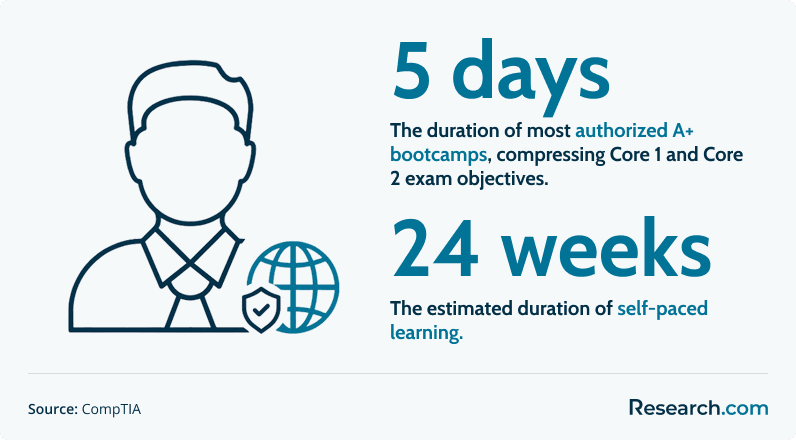
Many fast A+ bootcamps use a 5-day live online format that covers the Core 1 and Core 2 exam objectives through lectures, labs, review sessions, and practice questions. This can work well if you can clear your schedule and absorb a large amount of technical material quickly.
Other online options are more flexible. Self-paced courses may run up to 24 weeks, which can be more realistic for learners balancing work, family, or limited prior IT experience. The right timeline depends less on the advertised duration and more on how much time you can spend practicing, reviewing exam objectives, and troubleshooting in labs.
If you want a broader credential rather than a short certification program, a fast-track online computer science degree usually takes 12–18 months of accelerated coursework. That is a much larger commitment than the CompTIA A+ bootcamp timeline shown below.
How does an online CompTIA A+ training bootcamp compare to an on-campus program?
Online CompTIA A+ bootcamps and on-campus programs can both teach technical skills, but they serve different goals. A bootcamp is usually narrow, fast, and exam-focused. An on-campus degree or certificate program typically gives more time for theory, general education, peer networking, and broader academic development.
Online bootcamps increasingly use virtual IT lab environments to simulate common support tasks. That can be enough for A+ preparation, but students who learn best through face-to-face demonstrations, campus equipment, and in-person accountability may prefer a campus-based option.
| Option | Best for | Trade-offs |
| Online A+ bootcamp | Learners who want fast certification prep and flexible access from home | Requires self-discipline and may offer less in-person networking |
| On-campus IT course | Students who want classroom structure, campus labs, and face-to-face support | May require commuting and fixed class times |
| Online computer science degree | Learners seeking a broader academic credential, including theory and electives | Takes longer and usually costs more than a bootcamp |
If you want the broader academic route, compare A+ training with an affordable online computer science degree that includes topics such as algorithms, data structures, math, and software development.
What is the average cost of an online CompTIA A+ training bootcamp?
Based on the programs listed in this guide, online CompTIA A+ bootcamp tuition commonly falls between $2,495 and $2,695. These prices usually reflect short, instructor-led training rather than a credit-bearing degree program.
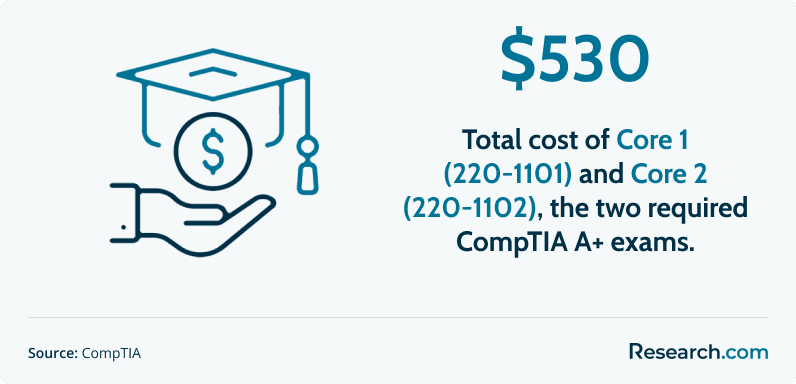
Tuition is only one part of the cost. Candidates also need vouchers for the two required exams: Core 1 (220-1101) and Core 2 (220-1102). Each CompTIA A+ exam voucher costs $265, or $530 for both exams. CompTIA bundles may include training materials or retake options and can provide savings of up to 46% off the combined retail price.
Compared with degree programs, bootcamps are usually less expensive and faster. For example, if you are comparing this path with cybersecurity education and asking how much a cybersecurity degree costs, cybersecurity degrees could reach $44,700 to $46,000. A+ bootcamps may be a lower-cost entry point, but they also provide a narrower credential.
What are the financial aid options for students enrolling in an online CompTIA A+ training bootcamp?
Most short CompTIA A+ bootcamps are non-credit professional training programs, so they often do not qualify for federal student aid such as Pell Grants or FAFSA-backed loans. That does not mean you must pay entirely out of pocket, but it does mean you should confirm funding eligibility before enrolling.
- Workforce funding: The Workforce Innovation and Opportunity Act (WIOA) may help unemployed or underemployed learners pay for eligible training if the provider is approved in their state.
- Employer tuition assistance: If you already work in an organization with IT needs, ask whether upskilling, tuition reimbursement, or professional development funds can cover A+ training.
- Veteran benefits: Some students may be able to use VA education benefits, the GI Bill, or the VET TEC program for approved technology training.
- Provider payment plans: Some bootcamps offer installment options, but read fees, refund rules, and cancellation policies carefully.
- CompTIA discounts and bundles: Student memberships, voucher bundles, and study packages may reduce exam and material costs.
If your long-term target is cybersecurity, compare A+ with later-stage credentials such as fast online CISSP training bootcamps. CISSP is not an entry-level substitute for A+, but it can be part of a longer security career plan.
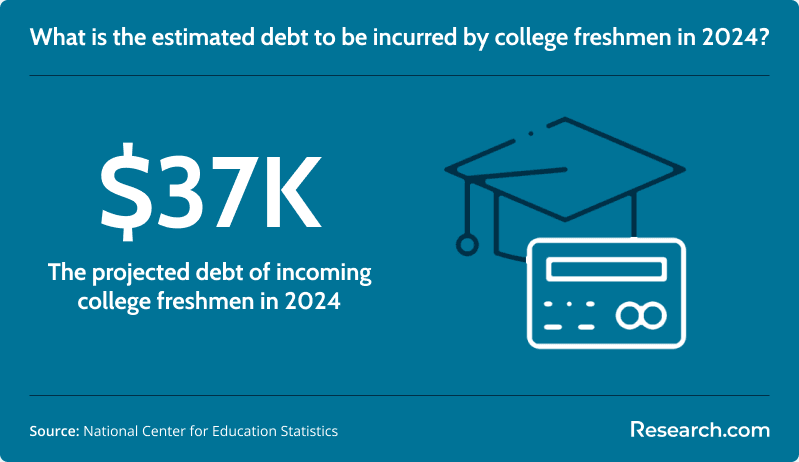
Learners comparing professional training with graduate education should also understand that degree programs, including options such as the fastest online master's degree in public relations, may have different financial aid eligibility than non-credit IT bootcamps. The image below highlights projected $37,000 student debt for incoming freshmen in 2024, which is one reason some learners investigate shorter, lower-cost credential pathways.
What are the prerequisites for enrolling in an online CompTIA A+ training bootcamp?
CompTIA A+ is beginner-friendly, but a fast bootcamp is not effortless. You do not need a four-year degree or advanced IT experience, but you should enter with enough basic technical comfort to keep up with a compressed schedule.
- Basic computer skills: You should be able to navigate files, use common settings, install software, and work comfortably in Windows or macOS.
- Interest in troubleshooting: A+ is built around diagnosing problems, so curiosity about how devices and networks work is important.
- Some practical exposure: Many providers recommend 6 to 12 months of informal or formal computer experience, which aligns with CompTIA’s preparation guidance.
- Comfort reading technical English: Exam questions, documentation, and lab instructions require careful reading.
- Reliable online setup: A live online bootcamp usually requires dependable internet, a webcam, a headset, and a computer capable of running the course tools.
After A+, learners who want to move into infrastructure or cloud support may compare next-step options such as the fastest online cloud engineering bootcamps.
What courses or topics are typically in an online CompTIA A+ training bootcamp?
A well-designed A+ bootcamp should follow the Core 1 (220-1101) and Core 2 (220-1102) exam objectives. The goal is to help students understand the technologies, procedures, and troubleshooting methods expected of entry-level support technicians.
| Exam area | Common topics | Why it matters in IT support |
| Core 1: Mobile devices | Laptops, mobile hardware, accessories, and device configuration | Technicians often support phones, tablets, laptops, and peripherals. |
| Core 1: Networking | Network concepts, protocols, hardware, connectivity, and troubleshooting | Help-desk staff must diagnose common connectivity problems. |
| Core 1: Hardware | Components, installation, connectors, devices, and peripherals | Support roles require confidence with physical and endpoint hardware. |
| Core 1: Virtualization and cloud computing | Cloud concepts and virtualization basics | Even entry-level technicians increasingly support virtual and cloud-connected environments. |
| Core 2: Operating systems | Windows, macOS, Linux, iOS, Android, installation, and configuration | User support often begins with operating system issues. |
| Core 2: Security | Threats, vulnerabilities, access control, and basic protections | Support technicians play a frontline role in reducing security risk. |
| Core 2: Software troubleshooting | Application errors, malware symptoms, mobile software issues, and remediation | Most help-desk tickets involve software, access, or configuration problems. |
| Core 2: Operational procedures | Documentation, change management, safety, backups, and recovery | Good process protects users, data, and business continuity. |
If you want to extend your skills into cloud infrastructure after A+, review options such as the shortest online CompTIA Cloud+ training programs.
How do I study for CompTIA A+?
The best study plan combines exam-objective review, hands-on practice, spaced repetition, and practice tests. Because A+ covers a wide range of support topics, memorizing definitions is not enough. You need to practice diagnosing problems and explaining why a solution works.
- Download and review the exam objectives. Use the official objectives as your checklist so you do not waste time on unrelated material.
- Choose one structured learning path. A bootcamp, official course, or guided self-paced program can keep you organized across Core 1 and Core 2.
- Build hands-on practice into every week. Use virtual labs, an old computer, operating system settings, command-line tools, and common troubleshooting scenarios.
- Take practice exams early and often. Review explanations, track weak domains, and revisit those topics before scheduling the real exams.
- Study in short, repeated sessions. A+ rewards retention across many domains, so cramming can leave gaps.
- Schedule the exam only when practice scores and lab confidence are consistent. Fast training is useful, but rushing the test can increase costs if you need a retake.
The same accelerated-learning mindset used by students comparing programs such as the shortest online fashion merchandising programs can apply here: focus on the credential requirements, use targeted resources, and practice the skills you will actually be tested on.
How can I verify the accreditation and legitimacy of my online CompTIA A+ bootcamp?
Because many CompTIA A+ bootcamps are non-credit programs, “accreditation” can be confusing. The university offering the continuing education program may be institutionally accredited, but the bootcamp itself may not be a credit-bearing academic program. Your job is to verify both the institution and the training provider behind the program.
- Confirm the institution’s accreditation. If the bootcamp is offered through a college or university, check the institution’s recognized accreditor.
- Ask whether the program is authorized or aligned with CompTIA materials. The curriculum should clearly prepare for the current A+ exam objectives.
- Verify what is included. Ask whether tuition includes both vouchers, labs, recordings, books, practice tests, and retake support.
- Look for transparent policies. Review refund rules, attendance requirements, transferability, and cancellation terms.
- Be skeptical of guaranteed-job claims. A bootcamp can support job readiness, but no credible program can promise employment for every graduate.
For comparison, degree fields such as game development use different quality signals, including academic curriculum depth and portfolio outcomes. If you are comparing academic programs rather than short certification training, review examples such as the best online game development degree programs.
Should I pursue further academic education after completing an online CompTIA A+ training bootcamp?
Further education depends on your career goal. If you want a first help-desk or support role, A+ plus practical troubleshooting ability may be enough to start applying. If you want software engineering, advanced cybersecurity, systems architecture, IT management, or research-heavy roles, a degree or more advanced certification path may eventually matter.
| Your goal | Possible next step after A+ | Why it may fit |
| Move into networking | Add Network+ and hands-on network labs | Builds from endpoint support into infrastructure troubleshooting |
| Enter cybersecurity | Add Security+ or later security-focused training | Helps connect support skills to risk, threats, and defense |
| Work in cloud support | Study cloud fundamentals and cloud support tools | Many support environments use cloud-based systems |
| Qualify for broader technical roles | Consider a computer science or IT degree | Provides deeper theory and a recognized academic credential |
| Move into management | Combine IT experience with business or leadership education | Supports progression beyond hands-on support work |
Some learners compare IT paths with unrelated graduate programs to understand cost, flexibility, and credential value. For example, a resource on affordable online master's degrees in biotechnology can illustrate how graduate education differs from short certification training.
What challenges should I anticipate during an online CompTIA A+ bootcamp?
The biggest challenge is pace. A 5-day program can introduce a large volume of hardware, operating system, networking, security, and troubleshooting content in a very short window. Students with little prior experience may need additional study time before taking the exams.
- Information overload: Fast programs can move too quickly if you have not worked with computer hardware or operating systems before.
- Limited hands-on confidence: Watching demonstrations is not the same as troubleshooting independently.
- Online distractions: Studying from home requires boundaries, a quiet setup, and a realistic schedule.
- Technical issues: Poor internet, audio problems, or incompatible equipment can interrupt live training.
- Exam anxiety: Practice tests and timed review sessions are essential because both exams require careful reading and decision-making.
Students who plan to combine technical training with leadership education may later compare programs such as an accelerated online master's degree in engineering management, but that is a longer-term step after building technical credibility.
How do I choose the best among the fastest online CompTIA A+ training bootcamps?
The fastest bootcamp is not automatically the best one. Choose the program that gives you the strongest chance of learning the material, passing both exams, and translating the credential into job applications.
| Selection factor | Good sign | Warning sign |
| Curriculum | Clear mapping to Core 1 and Core 2 objectives | Vague “IT fundamentals” description with no exam alignment |
| Labs | Hands-on troubleshooting simulations or guided practice | Lecture-only format with no practical exercises |
| Instructor quality | Certified instructors with support or infrastructure experience | No instructor bios or unclear teaching credentials |
| Schedule | Realistic live or self-paced format for your life | A pace that leaves no time for review or practice |
| Included costs | Transparent tuition, voucher, lab, and material details | Hidden fees or unclear voucher policies |
| Student support | Office hours, recordings, tutoring, or exam-prep support | No way to get help after class ends |
| Career services | Resume, LinkedIn, interview, or job-search guidance | Employment guarantees without evidence or conditions |
If you are comparing bootcamp models beyond A+, Research.com’s guide to the best coding bootcamps can help you evaluate curriculum quality, job support, and program value across different technical training formats.
What career paths are available for graduates of online CompTIA A+ training bootcamps?
A+ is most useful at the beginning of an IT career. It can help you qualify for support-oriented jobs, then serve as a foundation for more specialized roles once you gain experience and continue training.
- IT Support Specialist: Helps users resolve hardware, software, account, and connectivity problems.
- Help Desk Technician: Responds to tickets, documents issues, configures workstations, and escalates complex problems.
- Field Service Technician: Travels to client sites to install, repair, or maintain devices, peripherals, and network equipment.
- Network Support Technician: Assists with basic network setup, monitoring, and connectivity troubleshooting.
- Systems Administrator: Typically requires experience beyond A+ and involves managing users, servers, and infrastructure.
- Cybersecurity Analyst: Usually requires additional security training and focuses on monitoring, detecting, and responding to threats.
- Cloud Support Technician: Supports users and systems in cloud or virtualized environments, often after additional cloud training.
Some learners apply IT skills in media, events, or entertainment technology environments. If that combination interests you, compare A+ with broader business programs such as a fast-track online bachelor's degree in entertainment business.
For advanced technical or leadership roles, some A+ holders eventually pursue higher education, including options such as a master's in computer science for non-CS majors. That path is not necessary for every support career, but it can help learners who want to move beyond entry-level IT.
The chart below compares the salaries of these career paths.
What is the job market like for graduates of online CompTIA A+ training bootcamps?
The job market for A+ candidates is strongest when employers need practical support skills and are open to certifications as evidence of readiness. CompTIA’s State of the Tech Workforce 2024 reported that tech employment grew by more than 3% and represented over 9% of the total U.S. workforce, with more than 9 million jobs across IT roles. Entry-level help-desk and user-support jobs remain relevant as organizations maintain devices, support remote work, and upgrade systems.
BLS data shows that computer support specialists earned a median annual salary of $60,340, with employment projected to grow 6% from 2023 to 2033. These figures support a realistic but not guaranteed opportunity: A+ can help with entry-level job readiness, but candidates still need strong communication, customer service, troubleshooting practice, and persistence in the job search.
Many A+ graduates use stackable certifications to move toward better-paying specializations. If your goal is cybersecurity analysis after building a foundation, an accelerated online CompTIA CySA+ training program may be a later step. Career changers interested in healthcare IT leadership may eventually compare technical credentials with an accelerated online MBA in healthcare management to combine IT knowledge with business and healthcare operations.
The chart below highlights major IT spending in software and data center systems, which helps explain why organizations continue to need infrastructure and support talent.
What is the ROI of an online CompTIA A+ training bootcamp?
The ROI of an online CompTIA A+ bootcamp depends on whether the program helps you pass the exams, enter or advance in IT work, and avoid unnecessary education costs. A bootcamp with tuition between $2,495 and $2,695 plus exam costs can be a smaller and faster investment than a full degree, but the credential is also narrower.
A+ ROI is strongest when you use the bootcamp as part of a career plan: complete labs, pass both exams, build a basic home-lab portfolio, revise your resume around support skills, apply to realistic entry-level roles, and continue toward Network+, Security+, cloud, or systems credentials. ROI is weaker if you enroll without time to study, skip hands-on practice, or expect the credential alone to overcome a thin resume.
Students comparing shorter credentials with graduate study can use Research.com resources such as the guide to the most affordable online artificial intelligence degree programs to understand how cost, time, credential level, and career goals change the ROI calculation.
Common mistakes to avoid when choosing an online CompTIA A+ bootcamp
- Choosing only by speed: A 5-day bootcamp is useful only if you can keep up and continue studying after class.
- Ignoring total cost: Always include exam vouchers, study materials, labs, retakes, and payment-plan fees.
- Assuming accreditation means the bootcamp is for college credit: A university may be accredited while the A+ course remains non-credit professional training.
- Skipping hands-on practice: A+ tests practical support judgment, so labs and troubleshooting are essential.
- Believing job guarantees without reading conditions: Review placement claims carefully and ask for evidence.
- Taking the exam too soon: Fast instruction does not always equal exam readiness.
- Failing to plan the next credential: A+ is often the starting point, not the final destination.
Questions to ask before enrolling
- Does the bootcamp prepare for the current Core 1 and Core 2 exams?
- Are both exam vouchers included in tuition?
- What happens if I do not pass on the first attempt?
- How many hands-on labs are included, and how long will I have access?
- Are sessions live, recorded, self-paced, or a mix?
- Who teaches the course, and what IT experience do they have?
- Is the program non-credit or credit-bearing?
- What refund or cancellation policy applies?
- Does the provider offer resume, interview, or job-search support?
- Can I speak with an advisor before enrolling and review the full syllabus?
What graduates often value in online CompTIA A+ bootcamps
- The online structure made it possible to keep working while studying. The lab simulations felt practical, and having recordings helped me revisit difficult topics before the exam. Leon
- The course gave me a clear plan for Core 1 and Core 2. Instructor support made the technical material less intimidating, and passing A+ helped me feel ready to apply for support roles. Randall
- I was nervous about moving into IT, but the practice questions and troubleshooting scenarios helped me understand what the job actually involves. I later started working as a help desk technician. Maria
Key Insights
- CompTIA A+ is a practical entry-level IT credential, not a degree. It is best for learners who want to move quickly toward support roles and build from there.
- The fastest bootcamps can take 5 days, but exam readiness may take longer. Self-paced options up to 24 weeks may be better for beginners or working adults.
- Total cost matters more than tuition alone. Add exam vouchers, materials, labs, retake options, and financing fees before comparing programs.
- Hands-on labs are essential. Choose a bootcamp that teaches troubleshooting through practice, not just slides and lectures.
- A+ can support entry-level job searches, but it does not guarantee employment. Pair the credential with customer service skills, a targeted resume, and continued learning.
- The best next step depends on your goal. Network+, Security+, cloud training, a degree, or management education may make sense after A+, but not all learners need the same path.
References:
- Bureau of Labor Statistics. Computer and Information Technology Occupations.
- Cal Poly Pomona. CompTIA A+ Boot Camp.
- Chicago State University. CompTIA A+ Training Boot Camp.
- CompTIA. 9 Highest Paying IT Certifications in the United States.
- CompTIA. Best Virtual IT Training Labs: How to Choose.
- CompTIA. Core 1 (220-1101) and Core 2 (220-1102) Certification.
- CompTIA. How Do I Get My CompTIA A+ Certification?
- CompTIA. How Long Does the CompTIA A+ Certification Last?
- CompTIA. How Much Does the CompTIA A+ Certification Cost?
- CompTIA. Introducing the CompTIA Infrastructure Career Pathway.
- CompTIA. Online IT Training.
- CompTIA. State of the Tech Workforce 2024.
- CompTIA. What Is on the CompTIA A+ Exam?
- CompTIA. What’s on the CompTIA A+ Core 1 (220-1101) Exam?
- CompTIA. Academic Instructor Funding.
- Investopedia. Data Center, Software Spending Jumps as Companies Invest in AI.
- Florida International University. CompTIA A+ Training Boot Camp.
- Global Knowledge. CompTIA Certifications Are Building Blocks for IT Careers.
- PR Newswire. Uneven Tech Jobs Report Clouded by a Confluence of Factors, CompTIA Finds.
- Reddit. Online vs In-Person Courses.
- Rowan University. CompTIA A+ Training Boot Camp.
- Secure Tech Institute. CompTIA A+ 4-Day Boot Camp.
- Texas State University. CompTIA A+ Training Boot Camp.
- University of Houston. Online CompTIA A+ Training Boot Camp.
- University of Tennessee at Chattanooga. CompTIA A+ Online Boot Camp.
Other Things You Should Know About Online CompTIA A+ Training Bootcamps
Most fast online CompTIA A+ bootcamps include video lessons, downloadable labs, practice exams, and instructor support. Some also provide access to virtual machines and exam-mapped objectives for Core 1 (220-1101) and Core 2 (220-1102), which are the two exams required by CompTIA.
The expected completion time for 2027 online CompTIA A+ bootcamps varies, but many programs are designed to be completed in as little as 6 to 12 weeks. These intensive schedules help students quickly prepare for certification exams.


