
2027 Best Online Master's Degree in Management Information Systems

Co-Founder and Chief Data Scientist
Did you know that computer and information systems managers command a median annual salary of $159,010 in 2023? With technology deeply embedded in every sector, a 100% online MS in Management Information Systems equips you to lead IT strategy and data initiatives from anywhere in the U.S.
This article explores the fastest, most reputable online MIS programs, their costs, and what graduates can expect in terms of earnings, job growth, and career trajectories. By the end, you’ll know which programs align with your goals and how an MS in MIS can accelerate your career.
What are the benefits of completing an online master's degree in management information systems program?
- Graduates can land roles like Computer and Information Systems Manager, earning a median $159,010 per year in 2023.
- Employment for these managers is projected to grow 17% from 2023 to 2033, much faster than average.
- MIS graduates move into roles such as Business Systems Analyst, Information Security Analyst, and Data Engineer.
What can I expect from an online master's degree in management information systems program?
An online MS in MIS blends advanced technology coursework with business strategy, preparing you to lead IT initiatives in any sector. Expect classes in systems analysis, database management, cybersecurity, and project management, taught by the same faculty as on‑campus programs. Interactive webinars, virtual labs, and group projects mirror real‑world collaboration.
Most programs culminate in a capstone or practicum, letting you solve genuine organizational challenges. Along the way, you’ll gain access to career services, networking events, and alumni mentorship—just as if you were on campus.
Where can I work with an online master's degree in management information systems program?
Graduates with an MS in MIS often step into leadership roles across industries that rely heavily on data, software, and IT infrastructure.
Top‑employing industries for MIS managers include:
- Computer Systems Design and Related Services: 127,350 employed
- Management of Companies and Enterprises: 60,460 employed
- Software Publishers: 31,020 employed
- Management, Scientific, and Technical Consulting Services: 25,440 employed
- Computing Infrastructure Providers, Data Processing, Web Hosting: 23,450 employed
MIS graduates also find opportunities in healthcare systems, financial services, manufacturing, and government agencies seeking to modernize their IT platforms.
Top employing states for MIS managers are:
- California: 98,430 employed
- Texas: 62,620 employed
- New York: 39,190 employed
- New Jersey: 27,890 employed
- Florida: 27,110 employed
Whether you prefer the tech hubs of California, financial centers in New York, or government roles around Washington, D.C., your MS in MIS opens doors nationwide.
How much can I make with an online master's degree in management information systems program?
According to the U.S. Bureau of Labor Statistics, the mean annual wage for Computer and Information Systems Managers was $180,720 in May 2023.
Below are salary estimates from major job sites:
- Zippia: Average MIS Manager salary of $70,651 per year
- Salary.com: Average MIS Manager salary of $134,002 per year
- ZipRecruiter: National average for Information Systems Managers is $102,067 per year
- Indeed: Average Information Systems Manager salary of $100,658 per year
- Payscale: Average Information Systems Manager salary of $96,492
- Glassdoor: Average MIS Manager salary of $133,000 per year
While figures vary by source and methodology, all agree MIS leadership roles command six‑figure salaries. Pay ranges reflect factors like location, industry, and years of experience—so your online MS in MIS can be a lucrative investment.
- Best Online Master's Degree in Management Information Systems for 2027 List of Programs
- How long does it take to complete an online master's degree in management information systems program? Program Duration
- How does an online Master's Degree in Management Information Systems compare to an on-campus program? Online vs Campus
- What is the average cost of an online Master's Degree in Management Information Systems? Program Cost
- What are the prerequisites for enrolling in an online Master's Degree in Management Information Systems? Admission Requirements
- What courses are typically in an online Master's Degree in Management Information Systems? What courses are typically in an online Master's Degree in Management Information Systems?
- What types of specializations are available in an online Master's Degree in Management Information Systems? What types of specializations are available in an online Master's Degree in Management Information Systems?
- How do you choose the best online Master's Degree in Management Information Systems? How do you choose the best online Master's Degree in Management Information Systems?
- What career paths are available for graduates of an online Master's Degree in Management Information Systems? What career paths are available for graduates of an online Master's Degree in Management Information Systems?
- What is the job market for graduates of online Master's Degree in Management Information Systems? Job Outlook
- How do online MIS programs incorporate emerging technologies and digital transformation trends? How do online MIS programs incorporate emerging technologies and digital transformation trends?
- Is Accreditation a Reliable Indicator of Quality in Online MIS Programs? Is Accreditation a Reliable Indicator of Quality in Online MIS Programs?
Best Online Master's Degree in Management Information Systems for 2027
An online master’s degree in Management Information Systems is designed for professionals who want to lead technology projects, manage information systems, improve business processes, or move into IT leadership without leaving the workforce. The decision is not simply whether MIS is “technical enough” or “business-focused enough.” The real question is whether a specific program gives you the right mix of analytics, cybersecurity, systems design, project leadership, accreditation, flexibility, and cost control for your career goals.
This guide compares strong online MIS and information systems master’s programs, explains how long they take, what they cost, what admissions committees usually expect, and how graduates can use the degree in the labor market. It also covers online versus campus trade-offs, specialization choices, common selection mistakes, and practical questions to ask before enrolling.
If you are still deciding whether the field itself fits your interests, start with Research.com’s guide to whether Management Information Systems is a good major and career path.
Quick Answer: Is an Online Master’s in Management Information Systems Worth Considering?
An online master’s in Management Information Systems can be a practical option for working professionals who want to combine business strategy with technical decision-making. The best programs usually come from accredited universities, offer the same or similar curriculum as campus-based degrees, and include coursework in systems analysis, data management, cybersecurity, project management, and digital transformation.
The degree is strongest for students who already have some business, IT, analytics, or operations experience and want to qualify for roles such as systems analyst, IT project manager, information security analyst, database professional, IT director, or eventually CIO. It may be less useful for students who want a deeply technical software engineering degree, a research-focused computer science pathway, or an MBA with only light exposure to technology.
How We Ranked Online Master’s in Management Information Systems Programs
Research.com rankings are built using a structured methodology that combines data review with expert analysis. For online MIS programs, the most important considerations include institutional reputation, accreditation, curriculum relevance, online delivery quality, student support, cost transparency, and whether the online program reflects the rigor of an established on-campus academic offering.
To support this review, Research.com considers data from sources such as the IPEDS database from the National Center for Education Statistics, Peterson’s database and its distance learning data, and the College Scorecard database, which provides information on student outcomes and costs.
No ranking should be used as the only decision tool. Use this list as a shortlist, then verify each program’s current tuition, admissions requirements, course delivery format, transfer policies, and career support before applying.
Best Online Master’s in Management Information Systems Programs
| Rank | University and Program | Credits | Typical Duration | Listed Cost | Accreditation |
| 1 | University of Arizona – Master of Science in Management Information Systems | 30 credits | ~16 months (accelerated format) | $1,250/credit | AACSB; WSCUC (regional) |
| 2 | Florida State University – Master of Science in Management Information Systems | 33 credits | ~24 months (flexible part-time) | ~$810/credit (out-of-state) | AACSB; SACSCOC |
| 3 | University of Illinois Springfield – Master of Science in Management Information Systems | 30 credits | 12–24 months (can be completed in as few as 12 months) | ~$506/credit (estimated from $15,180 total tuition) | AACSB; HLC (regional) |
| 4 | Oklahoma State University – Master of Science in Management Information Systems | 33 credits | ~18–24 months (part-time) | ~$530/credit (flat online rate) | AACSB; HLC (regional) |
| 5 | University of Alabama at Birmingham – Master of Science in Management Information Systems | 30 credits | ~12–18 months (3–5 semesters) | $1,088/credit | AACSB; SACSCOC |
| 6 | University of Cincinnati – Master of Science in Information Systems | 36 credits (up to 44 with foundation courses) | ~24 months (with options to accelerate) | ~$1,061/credit (non-resident) | AACSB; HLC (regional) |
| 7 | University of Utah – Master of Science in Information Systems (Online) | 30 credits | ~12–24 months (flexible pacing) | $1,250/credit (effective Fall 2025) | AACSB; NWCCU (regional) |
| 8 | University of Washington – Master of Science in Information Management (MSIM) | 36–65 credits (varies by track, quarter system) | 12 months (Accelerated track) up to ~24 months (Early-Career) | $1,132/credit (2025 incoming rate) | NWCCU (regional) |
| 9 | Northwestern University – Master of Science in Information Systems | 11 courses (≈33 semester hours) | 2–5 years (flexible pacing; ~2 years typical part-time) | ~$1,679/credit (approx. $5,037 per course) | HLC (regional) |
| 10 | Carnegie Mellon University – Master of Science in Information Technology (MSIT), IT Management Track | 48 credits (144 units) | 2–3 years (part-time; up to 5 years max) | ~$1,425/credit hour | MSCHE (Middle States) |
1. University of Arizona – Master of Science in Management Information Systems
The University of Arizona offers an online MS in Management Information Systems through the Eller College of Management. The program is suited for students who want an accelerated business technology degree from a public R1 university with a long-established MIS department.
- Program cost: $1,250/credit
- Program duration: ~16 months (accelerated format)
- Total credits: 30 credits
- Program/School Accreditation: AACSB; WSCUC (regional)
2. Florida State University – Master of Science in Management Information Systems
Florida State University delivers an online MIS master’s through its College of Business. The program is a good match for students who want a flexible part-time structure from a public research university with a strong business school environment.
- Program cost: ~$810/credit (out-of-state)
- Program duration: ~24 months (flexible part-time)
- Total credits: 33 credits
- Program/School Accreditation: AACSB; SACSCOC
3. University of Illinois Springfield – Master of Science in Management Information Systems
The University of Illinois Springfield offers an online MIS program through its AACSB-accredited College of Business and Management. Its structure may appeal to students looking for a shorter completion window and a curriculum that connects technology, people, and business processes.
- Program cost: ~$506/credit (estimated from $15,180 total tuition)
- Program duration: 12–24 months (can be completed in as few as 12 months)
- Total credits: 30 credits
- Program/School Accreditation: AACSB; HLC (regional)
4. Oklahoma State University – Master of Science in Management Information Systems
Oklahoma State University offers an online MS in MIS through the Spears School of Business. The program is designed for students who want practical technology and data skills while continuing to work, with a curriculum aligned to the on-campus version.
- Program cost: ~$530/credit (flat online rate)
- Program duration: ~18–24 months (part-time)
- Total credits: 33 credits
- Program/School Accreditation: AACSB; HLC (regional)
5. University of Alabama at Birmingham – Master of Science in Management Information Systems
The University of Alabama at Birmingham offers a fully online MIS master’s through the Collat School of Business. It is especially relevant for students interested in Cyber Security Management or Business Analytics and for learners who want a program that can be completed in as little as one year.
- Program cost: $1,088/credit
- Program duration: ~12–18 months (3–5 semesters)
- Total credits: 30 credits
- Program/School Accreditation: AACSB; SACSCOC
6. University of Cincinnati – Master of Science in Information Systems
The University of Cincinnati offers an online MS in Information Systems through the Carl H. Lindner College of Business. The program is built for students who want to connect business requirements with information systems strategy and who may need either full-time or part-time pacing.
- Program cost: ~$1,061/credit (non-resident)
- Program duration: ~24 months (with options to accelerate)
- Total credits: 36 credits (up to 44 with foundation courses)
- Program/School Accreditation: AACSB; HLC (regional)
7. University of Utah – Master of Science in Information Systems (Online)
The University of Utah offers its online MSIS through the David Eccles School of Business. Students can study full-time or part-time, and the program is designed to mirror the on-campus curriculum while giving online students access to flexible course materials.
- Program cost: $1,250/credit (effective Fall 2025)
- Program duration: ~12–24 months (flexible pacing)
- Total credits: 30 credits
- Program/School Accreditation: AACSB; NWCCU (regional)
8. University of Washington – Master of Science in Information Management (MSIM)
The University of Washington offers online MSIM tracks through the UW Information School for both early-career and mid-career professionals. The program is a strong fit for students interested in information management, strategic leadership, and technical decision-making in data-intensive organizations.
- Program cost: $1,132/credit (2025 incoming rate)
- Program duration: 12 months (Accelerated track) up to ~24 months (Early-Career)
- Total credits: 36–65 credits (varies by track, quarter system)
- Program/School Accreditation: NWCCU (regional)
9. Northwestern University (School of Professional Studies) – Master of Science in Information Systems
Northwestern University offers a part-time online MS in Information Systems through its School of Professional Studies. The program is best suited for working adults who want a flexible schedule, specialization options, and access to a private research university’s professional network.
- Program cost: ~$1,679/credit (approx. $5,037 per course)
- Program duration: 2–5 years (flexible pacing; ~2 years typical part-time)
- Total credits: 11 courses (≈33 semester hours)
- Program/School Accreditation: HLC (regional)
10. Carnegie Mellon University – Master of Science in Information Technology (MSIT), IT Management Track
Carnegie Mellon University offers the MSIT with an Online IT Management track through Heinz College of Information Systems and Public Policy. The part-time format is aimed at experienced professionals who want advanced preparation in IT strategy, analytics, cybersecurity, and technology leadership, with the curriculum described as a #1-ranked IT management curriculum.
- Program cost: ~$1,425/credit hour
- Program duration: 2–3 years (part-time; up to 5 years max)
- Total credits: 48 credits (144 units)
- Program/School Accreditation: MSCHE (Middle States)
How Long Does It Take to Complete an Online Master’s Degree in Management Information Systems?
Most online MIS master’s programs require 30–36 credit hours. Full-time students commonly finish in 1 to 2 years, while accelerated options may shorten the timeline to 12–17 months. Examples include the University of Arizona’s Eller College pace of 17 months and Lamar University’s MS MIS, which can be completed in three semesters, or ≈1.5 years.
Part-time students usually need 18–24 months, although some programs let students extend their studies over 3–5 years. Northwestern SPS, for example, recommends 2–5 years at one–two courses per quarter. Texas A&M’s Flex Online MS-MIS is organized as 12 eight-week courses and is designed to finish in 24 months.
| Study Format | Typical Timeline | Best For | Trade-Off |
| Accelerated full-time | 12–17 months | Students who can handle a heavy academic workload | Less flexibility for work, family, or internships |
| Standard full-time | 1 to 2 years | Students who want a steady pace without stretching the degree too long | May still require reducing work hours |
| Part-time | 18–24 months | Working professionals balancing employment and school | Slower completion and longer time before career benefits may appear |
| Extended flexible pacing | 3–5 years | Students with demanding professional or family obligations | Total costs and motivation can become harder to manage over time |
Your actual timeline depends on course load, transfer credit, foundation courses, term length, and whether the program uses semester, quarter, or eight-week course formats.
How Does an Online Master’s Degree in Management Information Systems Compare to an On-Campus Program?
A well-designed online MIS master’s program can deliver comparable academic content to a campus program when it comes from an accredited university and uses the same faculty, curriculum standards, or learning outcomes. The main difference is not the subject matter; it is the learning environment. Online students rely more heavily on virtual collaboration tools, recorded or live lectures, discussion boards, digital labs, and remote advising.
Online delivery can reduce relocation, commuting, and housing expenses, but it does not always mean the tuition rate is lower. Some online programs charge flat online tuition, while others charge non-resident rates or additional technology fees. Students should compare total program cost, not just per-credit tuition.
Students who want more technical depth can look for MIS programs with analytics-focused electives or compare related options such as an online degree data analytics pathway. Those who want broader executive training may compare MIS with technology-focused business programs.
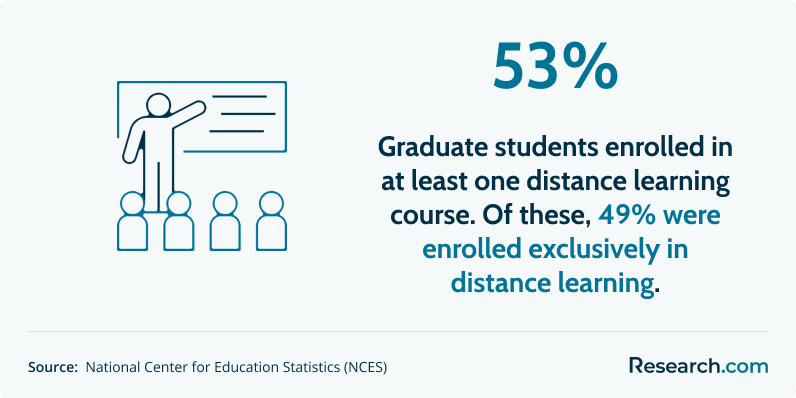
As the NCES snapshot shows, 53% of graduate students take at least one distance course and 49% learn entirely online. Those figures reflect how common online graduate learning has become, but quality still depends on accreditation, faculty engagement, course design, and the amount of support provided to remote learners.
| Factor | Online MIS Master’s | On-Campus MIS Master’s |
| Flexibility | Usually better for working professionals and students outside the university’s region | Better for students who want scheduled in-person structure |
| Networking | Depends on live sessions, group projects, alumni access, and career services | Often easier through campus events, faculty access, and local employers |
| Cost | May reduce housing and commuting costs, but tuition varies widely | May include campus fees, relocation, and commuting costs |
| Learning style | Best for self-directed students comfortable with remote collaboration | Best for students who prefer face-to-face interaction |
| Employer perception | Strongest when the school is accredited and reputable | Strongest when the program has recognized faculty, outcomes, and employer ties |
What Is the Average Cost of an Online Master’s Degree in Management Information Systems?
According to College Tuition Compare, the average annual graduate tuition for MIS programs in 2024–2025 is $19,990 across all institutions. In-state graduate students pay an average of $11,829 per year. Because many fully online MIS master’s degrees take 1 to 2 years, estimated total tuition can range from $11,829 for a one-year in-state path to $39,980 for a two-year out-of-state path.
Most programs require 30–36 credits. Using those averages, the per-credit equivalent can range from $329 for an in-state student spreading tuition over 36 credits to $666 for an out-of-state student spreading tuition over 30 credits. Actual program rates may be higher or lower, as shown in the ranked program list above.
Accelerated programs completed in 12 months may concentrate the cost into one academic year, around $19,990. Traditional two-year formats may bring the total closer to $39,980. Graduate tuition is roughly 70% higher than the undergraduate in-state average of $10,156, which reflects the advanced coursework and professional focus of the degree. Certificate or vocational MIS pathways remain less expensive, averaging $6,300 annually.
| Cost Item | Why It Matters | What to Ask |
| Tuition rate | Per-credit cost is the largest expense for most students | Is tuition charged per credit, per course, per term, or as a flat online rate? |
| Residency status | In-state and out-of-state pricing can create major differences | Do online students pay resident, non-resident, or separate online tuition? |
| Foundation courses | Students without technical prerequisites may need extra credits | Will I need additional courses beyond the standard degree plan? |
| Technology and student fees | Online programs may still charge mandatory fees | What fees are not included in the advertised tuition? |
| Time to completion | Longer enrollment can affect total cost and opportunity cost | What is the average completion time for working students? |
The chart below shows that 2024–2025 MIS tuition varies widely, from vocational programs at $6,300 annually to graduate out-of-state rates near $19,990. In-state graduate costs average $11,829, making residency and program length important parts of any affordability calculation.
What Financial Aid Options Are Available for Online Master’s in Management Information Systems Students?
Online graduate students may qualify for several types of financial support, but eligibility depends on enrollment status, citizenship or residency, school policies, employer benefits, and whether the program participates in federal aid programs.
Federal Aid
- Grants: Average $10,750 per graduate FTE student in 2023‑24
- Federal Loans: Average $17,240 per graduate FTE student in 2023‑24
- Federal Work‑Study (FWS): Average $60 per graduate FTE student in 2023‑24
- Education Tax Benefits: Average $370 per graduate FTE student in 2023‑24
Institutional, State, and Employer Funding
- University Scholarships & Fellowships: Some schools award funding based on merit, leadership, professional background, or academic promise.
- State Grants: Availability differs by state, and some funds may connect to fellowships, tuition waivers, or workforce development programs.
- Graduate Assistantships: Some programs offer tuition remission and a stipend in exchange for research, teaching, or administrative responsibilities, though fully online students should confirm whether remote assistantships are available.
- Employer Tuition Assistance: Technology, finance, healthcare, consulting, and government employers may reimburse part or all of graduate tuition.
- Veterans’ Benefits (GI Bill): Average $16,300 per recipient in 2023‑24
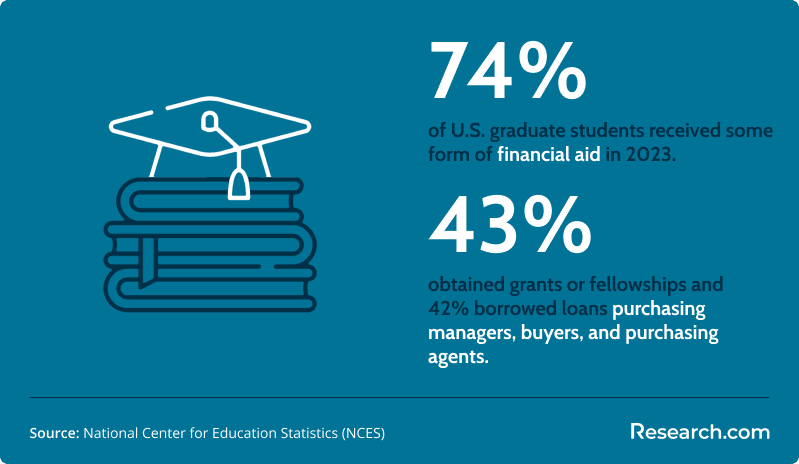
The NCES data below shows that nearly three-quarters of graduate students receive some form of financial support, with 43% receiving grants or fellowships and 42% using loans in 2023. MIS students should still compare net cost carefully because aid packages vary by school and student profile.
What Are the Prerequisites for an Online Master’s Degree in Management Information Systems?
Admissions requirements vary, but most online MIS master’s programs look for evidence that applicants can handle graduate-level technical, quantitative, and management coursework. A bachelor’s degree in MIS, computer science, business, engineering, or analytics can help, but many programs accept applicants from other fields if they can show readiness.
- Bachelor’s degree: Usually required from a regionally accredited institution, often in any field.
- Official transcripts: Programs commonly review undergraduate performance and may expect a minimum cumulative GPA, often 3.0/4.0.
- Prerequisite coursework: Some schools expect prior study in calculus, statistics, and basic programming.
- GRE or GMAT: Scores may be required, optional, or waived for applicants with strong GPAs or relevant professional experience.
- Professional résumé or CV: Many programs value 1–2 years of IT-related or business experience.
- Statement of purpose: Applicants usually explain their career goals, interest in MIS, and fit with the curriculum.
- Letters of recommendation: Schools commonly request two academic or professional references.
- English proficiency: International applicants may need TOEFL or IELTS scores depending on university policy.
Applicants without a technical background should ask whether the school offers bridge courses, foundation modules, or conditional admission. Those extra requirements can affect both cost and time to graduation.
What Courses Are Typically Included in an Online Master’s in Management Information Systems?
Online MIS master’s programs combine technical systems knowledge with business decision-making. The goal is not just to train students to use software, but to prepare them to select, design, govern, secure, and improve information systems that support organizational goals.
- Systems Analysis & Design: Covers how to gather requirements, model processes, and design systems that solve business problems.
- Database Management: Introduces relational databases, SQL querying, data warehousing, and database administration concepts.
- Project Management: Teaches planning, budgeting, scheduling, stakeholder communication, and Agile or Waterfall methods for IT projects.
- Cybersecurity & Information Assurance: Focuses on risk assessment, security controls, incident planning, and compliance frameworks.
- Data Analytics & Business Intelligence: Develops skills in data interpretation, dashboards, reporting, and decision support, similar to some content in an MBA information technology pathway.
- Enterprise Architecture: Examines how organizations align technology infrastructure with business strategy and governance.
- Management of Technology: Explores innovation, digital transformation, technology adoption, and organizational change.
- Emerging Technologies Seminar: May address cloud computing, IoT, AI, automation, and other tools reshaping business operations.
Electives often allow students to focus on areas such as health informatics, e-business, cybersecurity, analytics, or big data. Before enrolling, compare course titles, descriptions, and capstone requirements instead of relying only on the program name.
The following chart highlights key competencies used by MIS managers in 2025, with customer service at 17.4%, project management at 8.5%, and technical skills such as SQL Server at 3.3%. This mix helps explain why strong MIS programs emphasize both communication and hands-on systems knowledge.
What Specializations Are Available in an Online Master’s Degree in Management Information Systems?
Specializations help students align the MIS degree with a target role or industry. They are especially useful when they match your current experience or the type of job you want after graduation.
| Specialization | What It Emphasizes | Best Fit For |
| Cybersecurity Management | Risk assessment, security frameworks, governance, and incident response | Students targeting security leadership, compliance, or risk roles |
| Business Intelligence & Data Analytics | Data mining, visualization, predictive modeling, and strategic reporting | Students who want analytics-heavy roles without leaving the business side |
| Project Management | Planning, execution, monitoring, Agile, Waterfall, budgeting, and team coordination | Professionals moving into IT project manager or program manager roles |
| Enterprise Architecture | IT infrastructure, governance, systems integration, and alignment with business goals | Students interested in technology strategy and large-scale systems planning |
| Health Informatics | Clinical data, interoperability, healthcare analytics, and information systems in healthcare | Students comparing MIS with a healthcare informatics masters path |
| Cloud Computing & Virtualization | Cloud architecture, scalable platforms, virtualization, and cloud security | Students pursuing infrastructure, cloud operations, or digital platform roles |
| E-Business & Digital Transformation | Digital strategy, online platforms, automation, and technology-enabled business models | Students interested in consulting, product operations, or transformation teams |
| Information Systems Consulting | Technology roadmaps, process improvement, system implementation, and client advisory work | Students who want to advise organizations on technology decisions |
The wage breakdown below shows where MIS expertise can command high pay: web search portals report a mean $270,580, while equipment manufacturing and delivery services exceed $225,000. Students should not choose a specialization based on pay alone, but industry alignment can affect long-term ROI.
How Do You Choose the Best Online Master’s Degree in Management Information Systems?
The best online MIS program is the one that fits your career target, technical background, budget, schedule, and learning style. A prestigious school is not automatically the best choice if the curriculum is too theoretical, too expensive, or poorly aligned with your goals.
- Confirm accreditation first. Look for institutional accreditation and, when available, business school accreditation such as AACSB.
- Match the curriculum to your career goal. A future cybersecurity manager, analytics lead, and IT project manager should not choose the same electives by default.
- Check whether the online degree mirrors the campus program. Ask whether online students take the same courses, learn from the same faculty, and complete comparable projects.
- Review admissions fit. If you lack programming, statistics, or business coursework, ask whether foundation classes are required.
- Calculate total cost, not sticker tuition. Include fees, textbooks, travel for residencies, extra prerequisite credits, and lost work time.
- Evaluate online student support. Strong programs provide advising, technical support, library access, career services, and networking opportunities for remote learners.
- Ask about career outcomes carefully. Look for role placement, employer connections, alumni support, and capstone or project experience, but avoid assuming any salary outcome is guaranteed.
- Test the program’s flexibility. Confirm whether courses are synchronous, asynchronous, accelerated, part-time, or locked into a cohort schedule.
| Question to Ask | Why It Matters |
| Is the university regionally accredited? | Accreditation affects credibility, transferability, financial aid eligibility, and employer confidence. |
| Are online students taught by the same faculty as campus students? | Faculty continuity can indicate comparable academic expectations. |
| What technical background do successful students usually have? | This helps you judge whether you need bridge courses before starting. |
| Does the program include a capstone, practicum, or applied project? | Applied work can help you show practical skills to employers. |
| What career services are available to online students? | Remote students should not be excluded from coaching, job boards, alumni networks, or employer events. |
| Can I pause, slow down, or accelerate the program? | Flexibility matters if your work schedule changes. |
Who Should Choose an Online MIS Master’s, and Who Should Consider Another Path?
| Student Profile | Is an Online MIS Master’s a Good Fit? | Why |
| Working IT professional seeking management roles | Yes | The degree connects technical work with leadership, project management, and business strategy. |
| Business professional moving into technology operations | Often yes | MIS can provide systems, analytics, and digital transformation knowledge without requiring a full computer science pivot. |
| Student seeking deep software engineering preparation | Possibly not | A computer science or software engineering program may offer more advanced programming and systems depth. |
| Professional targeting executive general management | Maybe | An MIS degree may be useful, but an MBA or a technology-focused MBA may align better with broad leadership goals. |
| Healthcare data or informatics specialist | Depends | A health informatics specialization may work, but a dedicated health informatics master’s may be more targeted. |
| Student without technical or quantitative preparation | Only with support | Foundation courses, tutoring, or bridge work may be necessary before graduate MIS coursework. |
What Career Paths Are Available With an Online Master’s Degree in Management Information Systems?
MIS graduates can move through several technology and business roles depending on prior experience, specialization, and industry. A common information systems career paths sequence may look like this:
- Business Systems Analyst: Translates business needs into technology requirements and recommends process or system improvements.
- Systems Analyst: Designs, evaluates, and helps implement information systems that support organizational operations.
- Information Security Analyst: Protects systems and data by applying security controls, monitoring threats, and supporting compliance work.
- IT Project Manager: Leads technology projects, coordinates teams, manages schedules, and oversees budgets and deliverables.
- IT Director: Supervises technology operations and aligns IT initiatives with business priorities.
- Chief Information Officer (CIO): Sets enterprise technology strategy and leads digital transformation, governance, and information management at the executive level.
Other paths include data governance, enterprise architecture, technology consulting, business intelligence, cloud operations, and product operations. The degree is most powerful when paired with relevant work experience and a portfolio of projects that demonstrate measurable business impact.
What Is the Job Market Like for Online Master’s in MIS Graduates?
The job market for MIS graduates is supported by continued demand for technology leadership, cybersecurity, data governance, systems modernization, and digital operations. According to the Bureau of Labor Statistics, employment of computer and information systems managers is projected to grow 17% from 2023 to 2033, with about 54,700 annual openings.
Database administrators and architects are projected to see 9% growth over the same period, with 9,500 openings per year. Across computer and IT occupations, the BLS reports 356,700 annual openings through 2033 due to growth and replacement needs.
Industries hiring MIS-related talent include professional, scientific, and technical services; finance and insurance; healthcare systems; government agencies; and technology firms. Students interested in a career in database management can find opportunities in database administration, architecture, governance, and analytics, with May 2024 median salaries of $104,620 for administrators and $135,980 for architects.
How Do Online MIS Programs Address AI, Cybersecurity, and Digital Transformation?
Strong online MIS programs are increasingly expected to cover the technologies reshaping business operations, including artificial intelligence, machine learning, cloud platforms, automation, blockchain applications, cybersecurity, data governance, and analytics. The most useful programs do not treat these topics as buzzwords. They connect them to business cases, risk management, implementation challenges, ethics, compliance, and organizational change.
Students should look for programs that include applied projects, case studies, virtual labs, industry-informed assignments, or capstone work. These experiences help students practice translating technology trends into business decisions. If you are comparing MIS with broader business graduate options, Research.com’s guide to the cheapest online MBA programs can help you think about affordability and degree positioning.
Is Accreditation a Reliable Indicator of Quality in Online MIS Programs?
Accreditation is one of the first quality checks students should make, but it is not the only one. Institutional accreditation indicates that a university has met recognized academic and administrative standards. Program or school-level accreditation, such as business school accreditation, can add another layer of review for curriculum quality and academic governance.
Accreditation can affect financial aid eligibility, transfer credit acceptance, employer perception, and admission to further study. However, students should also review faculty qualifications, course content, technology platforms, student support, graduation requirements, and career services. A program can be accredited and still be a poor fit for your goals. Students comparing business-oriented technology degrees may also want to review Research.com’s guide to the best MBA online options.
What Is the Return on Investment for an Online Master’s Degree in Management Information Systems?
ROI depends on more than tuition. It includes your current role, prior experience, target job, employer demand in your region, how quickly you complete the degree, whether your employer helps pay for it, and whether the curriculum builds skills that employers recognize. A lower-cost program may produce better ROI if it fits your goals and lets you graduate without excessive debt. A higher-cost program may be reasonable if it provides stronger alumni access, brand recognition, specialized coursework, or career mobility.
To estimate ROI, compare total tuition and fees against realistic career outcomes rather than best-case salary claims. Look at job postings for your target roles and identify whether employers ask for MIS, information systems, analytics, cybersecurity, project management, or cloud experience. Then check whether the program provides those skills. Students comparing MIS with lower-cost business graduate programs can use the cheapest online MBA programs guide as one reference point for affordability.
Common Mistakes to Avoid When Choosing an Online MIS Master’s Program
| Mistake | Why It Can Hurt You | Better Approach |
| Choosing based only on ranking | A highly ranked program may not match your schedule, budget, or career target. | Use rankings as a shortlist, then compare curriculum, cost, and support. |
| Ignoring accreditation | Unaccredited programs can create problems with aid, transfer credit, and employer recognition. | Verify institutional accreditation and relevant school or program accreditation. |
| Comparing only per-credit tuition | Fees, extra foundation courses, and longer timelines can change the real cost. | Calculate total program cost from admission to graduation. |
| Assuming online means easier | Graduate MIS courses can be demanding, especially for students working full time. | Ask current students or advisors about weekly workload and course pacing. |
| Overlooking technical prerequisites | Weak preparation in statistics, programming, or databases can slow progress. | Complete bridge courses or self-study before starting advanced coursework. |
| Choosing a specialization too early | A narrow track may not support your long-term goals. | Review job descriptions and talk with advisors before committing to electives. |
| Assuming salary outcomes are guaranteed | Degree value depends on experience, location, industry, and market conditions. | Use salary data cautiously and evaluate realistic roles for your background. |
References
- Bureau of Labor Statistics. Occupational Employment and Wages for Computer and Information Systems Managers.
- Bureau of Labor Statistics. Computer and Information Systems Managers.
- Carnegie Mellon University. Master of Science in Information Technology, IT Management track.
- Drexel University Online. Online Degree vs. Traditional Degree.
- Florida State University. Master of Science in Management Information Systems.
- Glassdoor. MIS Manager Salary.
- Indeed. Management Information Systems Manager Salaries.
- Lamar University. Master of Science in Management Information Systems.
- Northwestern University School of Professional Studies. Master of Science in Information Systems.
- Oklahoma State University. Master of Science in Management Information Systems.
- Payscale. Information Systems Manager Salary.
- Research.com. Management Information Systems Major Salary.
- Research.com. MIS Manager Salary.
- Salary.com. MIS Manager Salary.
- Texas A&M University. Flex Online MS in Management Information Systems.
- University of Arizona. Online Master of Science in Management Information Systems.
- University of California, Cincinnati (Online UC). Master of Science in Information Systems.
- University of Utah. Master of Science in Information Systems.
- University of Alabama at Birmingham. Master of Science in Management Information Systems.
- University of Illinois Springfield. Master of Science in Management Information Systems.
- ZipRecruiter. MIS Manager Salary.
Key Insights
- An online master’s in MIS is best for professionals who want to manage technology, analytics, cybersecurity, systems, or digital transformation from a business-focused perspective.
- Most programs require 30–36 credit hours and can often be completed in 1 to 2 years, though part-time and extended formats may take longer.
- Average annual graduate tuition for MIS programs in 2024–2025 is $19,990, but actual program costs vary widely by school, residency status, fees, and completion speed.
- Accreditation should be a nonnegotiable first filter. After that, compare curriculum depth, faculty, online support, flexibility, specialization options, and total cost.
- Common career paths include business systems analyst, systems analyst, information security analyst, IT project manager, IT director, and CIO.
- The BLS projects 17% growth for computer and information systems managers from 2023 to 2033, but individual outcomes depend on experience, skills, location, and industry.
- Do not choose a program based only on ranking or tuition. The best ROI comes from a program that fits your career target, builds marketable skills, and is affordable for your financial situation.
Other Things You Should Know About an Online Master's Degree in Management Information Systems
While not universally mandatory, 1–3 years of professional experience in technology, business analysis, or operations strengthens your application and may waive standardized tests like the GRE. Experience demonstrates practical context for advanced coursework, enhances classroom discussions, and can qualify you for assistantships or tuition discounts.
Many 2027 online MS in MIS programs allow GMAT or GRE waivers for applicants with strong GPAs, relevant work experience, or a completed graduate degree. Schools set the rules themselves, and waiver requests usually must be submitted before the admission deadline.
The average duration to complete a 2027 online Master's in Management Information Systems is typically 1.5 to 2 years. Most programs require completion of 30 to 36 credit hours, allowing students to balance studies with personal and professional commitments effectively.


