
2027 Fastest Online Master’s in Software Engineering

Co-Founder and Chief Data Scientist
In today's rapidly evolving tech landscape, the demand for skilled software engineers is at an all-time high, making advanced education more valuable than ever. This article will delve into the world of the fastest online Master's in Software Engineering programs, offering a comprehensive guide for aspiring and current professionals looking to accelerate their careers.
We will explore the myriad benefits of pursuing such a degree, from enhanced technical expertise and specialization in cutting-edge areas like AI and machine learning, to opening doors for leadership roles and higher earning potential.
It is crucial to read this article to understand how these accelerated online programs can provide a strategic advantage, allowing individuals to upskill and remain competitive in a dynamic industry without putting their careers on hold.
What are the benefits of getting an online master's degree in software engineering?
- A Master's in Software Engineering can open doors to a wide range of specialized and leadership roles. It also prepares individuals for roles in highly sought-after areas such as cybersecurity, AI/ML, and embedded systems.
- The median annual salary for a Master Software Engineer in the United States is approximately $147,524 as of July 2025. This can range from $120,000 to $173,000, with top earners making around $205,000 annually.
- Pursuing an online Master's in Software Engineering provides unparalleled flexibility, allowing working professionals to balance their studies with existing careers and personal commitments.
What can I expect from an online master's degree in software engineering?
An online Master's in Software Engineering offers a rigorous yet flexible educational experience designed to equip professionals with advanced skills in the field. You can expect a curriculum that goes beyond basic coding, focusing on the entire software development lifecycle, from requirements engineering and architectural design to testing, deployment, and maintenance.
Key coursework often includes subjects like software project management, quality assurance, advanced software architectures, object-oriented design, and increasingly, specialized areas like secure software development, mobile application engineering, cloud computing, and even artificial intelligence/machine learning integration.
Where can I work with an online master's degree in software engineering?
An online Master's in Software Engineering provides a versatile credential that opens doors to a vast array of career opportunities across numerous industries, with the added benefit of flexible work arrangements.
Graduates can find themselves in leading roles within technology companies, from established giants like Google and Microsoft to innovative startups, working on everything from operating systems and cloud platforms to AI/ML applications and consumer-facing software.
How much can I make with an online master's degree in software engineering?
Earning an online Master's in Software Engineering can significantly boost your earning potential in the tech industry. As of July 2025, the average annual salary for a Master Software Engineer in the United States is approximately $147,524.
This figure can vary, with the majority of salaries ranging from $120,000 (25th percentile) to $173,000 (75th percentile). Top earners, often those with extensive experience or specialized skills, can command salaries as high as $205,000 annually.
- List of the Fastest Online Master's in Software Engineering Programs for 2027 Best Programs
- How long does it take to complete an online master's in software engineering program? Completion Time
- How does an online master's in software engineering program compare to an on-campus program? How does an online master's in software engineering program compare to an on-campus program?
- What is the average cost of an online master's in software engineering program? Average Cost
- What are the financial aid options for students enrolling in an online master's in software engineering program? Financial Aid
- What are the prerequisites for enrolling in an online master's in software engineering program? Requirements
- What courses are typically in an online master's in software engineering program? What courses are typically in an online master's in software engineering program?
- What types of specializations are available in an online master's in software engineering program? What types of specializations are available in an online master's in software engineering program?
- How to choose the best online master's in software engineering program? How to choose the best online master's in software engineering program?
- What career paths are available for graduates of an online software engineering program? Potential Careers
- What is the job market for graduates with an online software engineering program? Job Market
- How do accelerated online software engineering programs differ from an accelerated online computer science degree? How do accelerated online software engineering programs differ from an accelerated online computer science degree?
- What challenges may students encounter in an online master's program in software engineering? What challenges may students encounter in an online master's program in software engineering?
- How do online master's programs in software engineering uphold academic excellence and industry relevance? How do online master's programs in software engineering uphold academic excellence and industry relevance?
Choosing a fast online master’s in software engineering is a practical decision: you want an advanced credential that strengthens your technical leadership skills without pausing your career for several years. The challenge is that “fast” can mean different things depending on the school. Some programs are cohort-based and take about 2 years. Others use flexible or competency-based formats that may let experienced students move more quickly. Cost, prerequisites, accreditation, curriculum depth, and employer recognition also matter.
This guide is designed for working software developers, IT professionals, career changers with technical preparation, and bachelor’s degree holders comparing online graduate options. You will learn which programs are commonly structured for faster completion, how online software engineering degrees compare with campus programs, what they cost, what admissions requirements to expect, and how to judge whether a program is worth the investment for your goals.
List of the Fastest Online Master's in Software Engineering Programs for 2027
Quick answer: Many online master’s programs in software engineering can be completed in about 2 years, with some programs offering accelerated, asynchronous, part-time, or competency-based formats. The best choice depends on your background, schedule, budget, and career target. If speed is your top priority, look closely at total credits, course sequencing, whether prerequisites are required, and whether the school lets you take multiple courses per term.
How Research.com evaluates schools
Accreditation, academic quality, affordability, student outcomes, and program structure should all factor into your decision. Research.com uses recent, validated education data to support program rankings and comparisons. You can review the full ranking approach on our methodology page.
For this type of ranking, Research.com considers data from trusted higher education sources, including:
- Integrated Postsecondary Education Data System, also known as the IPEDS database
- Peterson’s database, including distance learning data
- College Scorecard database
- National Center for Education Statistics and related NCES resources
| Rank | School and Program | Typical Length | Credits or Courses | Listed Cost | Accreditation |
| 1 | California State University, Fullerton — Online Master of Science in Software Engineering | 2 years | 30 credits | $481 per credit | WASC Senior College and University Commission (WSCUC) |
| 2 | Bellarmine University — Online Master of Science in Software Engineering | 2 years | 39 credits | $820 per credit | Southern Association of Colleges and Schools Commission on Colleges (SACSCOC) |
| 3 | Penn State World Campus — Master of Software Engineering | 2 years | 36 credits | $1,027 per credit | Middle States Commission on Higher Education |
| 4 | Purdue University — Master of Science in Software Engineering | 2 years | 30 credits | $950 per credit | The Higher Learning Commission |
| 5 | Auburn University — Master of Science in Computer Science and Software Engineering | 2 years | 30 credits | $630 per credit | Southern Association of Colleges and Schools Commission on Colleges (SACSCOC) |
| 6 | Carnegie Mellon University — Master of Software Engineering | 2 years | 30 credits | $756 per credit | Middle States Commission on Higher Education |
| 7 | West Virginia University — Master of Science in Software Engineering | 2 years | 30 credits | $785 per credit | The Higher Learning Commission |
| 8 | Western Governors University — Master of Science in Software Engineering | 2 years | 10 courses | $4,085 per term | Northwest Commission on Colleges and Universities |
| 9 | Arizona State University — Master of Science in Engineering Science, Software Engineering concentration | 2 years | 30 | $1,215 per credit | The Higher Learning Commission |
| 10 | Nova Southeastern University — Master of Science in Computer Science, Software Engineering concentration | 2 years | 30 | $989 per credit | Southern Association of Colleges and Schools Commission on Colleges (SACSCOC) |
1. California State University, Fullerton Online Master of Science in Software Engineering
California State University, Fullerton offers an Online Master of Science in Software Engineering for professionals who want deeper preparation in building, managing, and improving software systems. The program may also be an option for applicants without a traditional computer science background because the program coordinator can review qualifications and recommend academic or career preparation. Graduates may use the degree to pursue work as software engineers, software architects, project managers, or process managers.
- Program Length: 2 years
- Tracks/concentrations: Software Engineering
- Cost per credit: $481
- Required credits to graduate: 30 credits
- Accreditation: WASC Senior College and University Commission (WSCUC)
2. Bellarmine University Online Master of Science in Software Engineering
Bellarmine University’s Master of Arts in Software Engineering is delivered fully online and asynchronously, making it a flexible choice for students who need to study around work and personal obligations. The program is especially relevant for career changers and students who do not already have a computer science degree but want structured preparation in programming, software development, and current technology practices.
- Program Length: 2 years
- Tracks/concentrations: Software Engineering
- Cost per credit: $820
- Required credits to graduate: 39 credits
- Accreditation: Southern Association of Colleges and Schools Commission on Colleges (SACSCOC)
3. Penn State World Campus Master of Software Engineering
Penn State World Campus offers a Master of Software Engineering that covers software analysis, architecture, design, development, testing, and project management. Its cohort structure can be valuable for students who want a stronger sense of peer connection and team-based progression while still completing the degree online.
- Program Length: 2 years
- Tracks/concentrations: Software Engineering
- Cost per credit: $1,027
- Required credits to graduate: 36 credits
- Accreditation: Middle States Commission on Higher Education
4. Purdue University Master of Science in Software Engineering
Purdue University’s Master of Science in Software Engineering is built for professionals who want to strengthen their ability to solve complex software engineering problems. The curriculum connects software engineering foundations with computing systems, cybersecurity, and data science, which can be useful for students targeting technical leadership or cross-functional engineering roles.
- Program Length: 2 years
- Tracks/concentrations: Software Engineering
- Cost per credit: $950
- Required credits to graduate: 30 credits
- Accreditation: The Higher Learning Commission
5. Auburn University Master of Science in Computer Science and Software Engineering
Auburn University’s Master of Science in Computer Science and Software Engineering gives students room to customize their coursework through electives in areas such as artificial intelligence, cybersecurity, machine learning, computer networks, databases, data science, and human-computer interaction. The program combines software development, systems design, data management, and advanced computing topics.
- Program Length: 2 years
- Tracks/concentrations: Software Engineering
- Cost per credit: $630
- Required credits to graduate: 30 credits
- Accreditation: Southern Association of Colleges and Schools Commission on Colleges (SACSCOC)
6. Carnegie Mellon University Master of Software Engineering
Carnegie Mellon University offers a part-time online Master of Software Engineering designed for experienced software professionals with at least two years of industry experience. The program is a better fit for students who already work in software and want to advance into higher-level technical, management, architecture, or leadership responsibilities.
- Program Length: 2 years
- Tracks/concentrations: Software Engineering
- Cost per credit: $756
- Required credits to graduate: 30 credits
- Accreditation: Middle States Commission on Higher Education
7. West Virginia University Master of Science in Software Engineering
West Virginia University’s Master of Science in Software Engineering focuses on the design, development, maintenance, and management of software applications and systems. Core coursework typically addresses project management, analysis and design, verification and validation, software evolution, and object-oriented design.
- Program Length: 2 years
- Tracks/concentrations: Software Engineering
- Cost per credit: $785
- Required credits to graduate: 30 credits
- Accreditation: The Higher Learning Commission
8. Western Governors University Master of Science in Software Engineering
Western Governors University offers a fully online, competency-based Master of Science in Software Engineering. Because students progress by demonstrating mastery, this format can be especially attractive to learners who already have relevant technical experience and want the possibility of moving faster than a traditional term-by-term structure may allow.
- Program Length: 2 years
- Tracks/concentrations: Software Engineering
- Cost per credit: $4,085 per term
- Required credits to graduate: 10 courses
- Accreditation: Northwest Commission on Colleges and Universities
9. Arizona State University Master of Science in Engineering Science
Arizona State University offers a Master of Science in Engineering Science with a Software Engineering concentration. The 30-credit program is intended for students who want to develop graduate-level expertise in software design, development methods, testing, project management, artificial intelligence, big data, and cloud computing.
- Program Length: 2 years
- Tracks/concentrations: Software Engineering
- Cost per credit: $1,215
- Required credits to graduate: 30
- Accreditation: The Higher Learning Commission
10. Nova Southeastern University Master of Science in Computer Science
Nova Southeastern University offers a fully online Master of Science in Computer Science with a Software Engineering concentration. Students study core computer science concepts, software development tools, computing platforms, scholarly research, and applied problem-solving for real-world computing environments.
- Program Length: 2 years
- Tracks/concentrations: Software Engineering
- Cost per credit: $989
- Required credits to graduate: 30
- Accreditation: Southern Association of Colleges and Schools Commission on Colleges (SACSCOC)
How long does it take to complete an online software engineering program?
Most online master’s programs in software engineering take about 1.5 to 3 years, depending on the number of credits, course load, term structure, and whether the student enters with all prerequisites completed. Many programs require about 30 to 36 credit hours, which commonly equals 10 to 12 graduate courses.
Texas A&M University’s online Master of Computer Science program requires 30 credits and can be completed in 1.5 to 2.5 years, depending on the number of courses taken each semester. San Diego State University offers a fully online Master of Science in Computer Engineering that can be completed in as little as 24 months.
Working professionals often choose slower pacing to avoid overload. Taking fewer courses per term can extend the timeline to three years or more, while accelerated formats may allow completion in as little as 15 months when the program structure and student schedule support it.
If your main goal is rapid job preparation rather than a graduate degree, compare the timeline against the fastest online software engineering bootcamps, which may run from 3 months to a year. If you are still comparing unrelated online degree timelines across fields, it may also help to understand how accelerated programs are structured in areas such as an accelerated behavioral health science degree online.
How does an online software engineering program compare to an on-campus program?
An online master’s in software engineering can offer the same academic seriousness as a campus program when it is properly accredited and taught by qualified faculty. The main difference is not necessarily the degree title; it is the learning format. Online programs are usually designed for students who need flexibility, while campus programs provide more face-to-face access to faculty, labs, events, and peer interaction.
Before choosing online or on campus, ask whether you learn best through independent study, scheduled live sessions, or in-person collaboration. Also check whether the online degree transcript differs from the campus version, whether projects are team-based, and whether career services are available to remote students.
| Factor | Online Master’s in Software Engineering | On-Campus Master’s in Software Engineering |
| Schedule flexibility | Often better for full-time employees, parents, and students outside commuting range | More structured, with set class times and campus expectations |
| Networking | Requires more initiative through discussion boards, virtual teams, alumni groups, and online events | Offers easier access to in-person study groups, faculty meetings, and campus recruiting |
| Learning style | Best for self-directed students who can manage deadlines independently | Best for students who prefer physical classrooms and immediate interaction |
| Access to resources | May include virtual tutoring, remote career services, cloud-based labs, and digital libraries | May include campus labs, live events, in-person advising, and local employer activities |
| Best fit | Working professionals who need location and schedule flexibility | Students who want a campus environment and can attend regularly in person |
The same online-versus-campus questions apply when evaluating other graduate options, including an accelerated online sustainability master's degree, but software engineering students should pay extra attention to project work, coding assessments, cloud tools, and collaboration requirements.
What is the average cost of an online software engineering program?
The total cost of an online master’s in software engineering varies widely by institution, credit requirements, tuition model, fees, and time to completion. A common total range is about $20,000 to $40,000 for the full program, although some schools cost less and elite or highly specialized programs can cost more.
Some affordable programs charge around $20,592 in total tuition for a 30-credit program. Other universities, including Loyola University Chicago and Texas Tech University, have total tuition costs in the $30,000 to $35,000 range for similar credit requirements.
Annual tuition for online software engineering master’s programs often falls between $6,000 and $14,000 per year, with many programs taking 1.5 to 3 years. Kennesaw State University and California State University, Fullerton have been noted as more affordable options, with annual tuition under $7,000. At the higher end, institutions such as Carnegie Mellon University may exceed $60,000 for the full program.
When comparing costs, do not look only at the advertised per-credit rate. Multiply tuition by required credits, add mandatory fees, estimate books or software costs, and consider whether a longer part-time plan increases total expenses. Students comparing technical and quantitative graduate programs may use a similar cost checklist when evaluating an accelerated master's degree in Mathematics online.
| Cost Item | Why It Matters | Question to Ask |
| Tuition per credit or per term | This is usually the largest expense, but pricing models differ by school | Is tuition charged per credit, per course, or per term? |
| Required credits or courses | A lower per-credit rate may not be cheaper if the program requires more credits | How many credits or courses are required to graduate? |
| Technology and online fees | Online programs may charge platform, exam, or student service fees | Are mandatory fees included in the tuition estimate? |
| Prerequisite coursework | Students without a software or computer science background may need extra courses | Will I need bridge courses before full admission or graduation? |
| Time to completion | A longer timeline can affect opportunity cost and employer reimbursement planning | Can I realistically finish within the advertised timeframe? |
What are the financial aid options for students enrolling in an online software engineering program?
Online graduate students may qualify for many of the same financial aid options as campus-based students, provided the institution and program meet eligibility requirements. The first step for most students is completing the Free Application for Federal Student Aid (FAFSA), which universities commonly use to determine federal aid and sometimes institutional aid.
- Direct Unsubsidized Loans: Graduate students may use these loans regardless of financial need. Interest begins accruing when funds are disbursed, although repayment may often be deferred while enrolled at least half-time. The annual limit for graduate students is currently $20,500.
- Direct PLUS Loans (Grad PLUS): These loans are available to graduate and professional students and can cover up to the full cost of attendance after other aid is applied. They are not need-based, but they require a credit check. Interest accrues from disbursement, though repayment may be deferred.
- University scholarships and grants: Some schools offer graduate awards based on merit, need, leadership, diversity goals, department priorities, or employer partnerships. Ask both the financial aid office and the software engineering department.
- Employer tuition assistance: Many working professionals use employer reimbursement or tuition assistance benefits. Some employers cover tuition, fees, or books up to an annual limit, such as up to $5,250 tax-free under IRS regulations.
- Private student loans: Private loans can fill funding gaps, but they are credit-based and may have less flexible repayment terms than federal loans. Compare them carefully before borrowing.
Ways to reduce the cost of an online software engineering master’s
- Choose a regionally accredited program with transparent tuition and fees.
- Ask whether your employer will prepay tuition instead of reimbursing you after grades post.
- Compare total program cost, not just per-credit price.
- Check whether prerequisite courses add extra cost.
- Look for tuition discounts for military students, alumni, public employees, or corporate partners if applicable.
- Consider whether a faster pace reduces total cost or simply increases workload.
What are the prerequisites for enrolling in an online software engineering program?
Admissions requirements vary, but most online master’s programs in software engineering expect applicants to have a bachelor’s degree, evidence of academic readiness, programming knowledge, and supporting application materials. Some programs are designed for students with computer science or software engineering backgrounds, while others offer bridge coursework for students changing careers.
| Requirement | What Programs Commonly Expect | Why It Matters |
| Bachelor’s degree | A four-year degree from an accredited institution, often in computer science, software engineering, computer engineering, or a related field | Graduate software engineering courses usually assume prior technical preparation |
| Academic record | Many programs look for a minimum GPA, often around 3.0 on a 4.0 scale | A strong GPA may also help with GRE waivers or admission to selective programs |
| Foundational coursework | Programming, data structures and algorithms, discrete mathematics or statistics, computer organization, and software engineering principles | Missing prerequisites can delay graduation or require extra courses |
| Programming experience | Experience with languages such as Java, C++, or Python; some programs may expect professional development experience | Graduate projects can be difficult without practical coding ability |
| Application materials | Transcripts, resume or CV, letters of recommendation, and sometimes a statement of purpose or GRE scores | These materials help the school judge readiness and fit |
| Technical and residency requirements | Some schools may require U.S. residency during enrollment or specific hardware, software, or internet access | Online students must be able to participate fully in coursework and assessments |
Applicants who need more undergraduate preparation may compare graduate admissions expectations with fast-track online computer science bachelor's degree options before applying directly to a master’s program.
What courses are typically in an online software engineering program?
An online master’s in software engineering usually focuses on the full software development lifecycle: requirements, design, architecture, implementation, testing, deployment, maintenance, project management, and quality assurance. The exact course titles vary by university, but the core themes are fairly consistent.
- Software project management: Covers planning, estimation, risk management, agile methods such as Scrum or Kanban, resource allocation, and team coordination.
- Software design and architecture: Examines scalable and maintainable system design, object-oriented principles, design patterns, architectural styles, and modeling.
- Requirements engineering: Teaches students how to gather, analyze, document, validate, and manage stakeholder and system requirements.
- Software verification, validation, and testing: Focuses on quality assurance methods, unit testing, integration testing, system testing, acceptance testing, defect tracking, and quality metrics.
- Advanced software engineering methods: Explores process improvement, software metrics, engineering practices for complex systems, and modern development models.
- Object-oriented development: Reinforces advanced programming and design practices used to build modular, reusable, and maintainable applications.
Some students compare software engineering with other applied graduate programs, such as an accelerated master's degree in TESOL online, but the workload is very different: software engineering programs usually require substantial technical projects, coding, system design, and collaborative development work. Graduates who combine advanced software expertise with strong professional experience may qualify for some of the highest paying tech jobs, though salaries are never guaranteed.
What types of specializations are available in an online software engineering program?
Specializations let students align a software engineering master’s with specific career goals. Not every school offers every option, so review the catalog carefully before applying.
- Artificial intelligence and machine learning: Focuses on intelligent systems, data-driven algorithms, natural language processing, computer vision, deep learning, and related applications. Potential roles include AI engineer, machine learning engineer, or data scientist.
- Cloud computing and systems architecture: Prepares students to design, deploy, and manage scalable infrastructure and cloud services, including distributed systems, containerization, performance, reliability, and cost management.
- Data science and big data analytics: Combines data mining, statistical analysis, machine learning, visualization, and large-scale data processing. Students interested mainly in analytics may also compare software engineering with a fast-track master's in data analytics online.
- DevOps engineering: Connects development and operations through CI/CD, infrastructure as code, automation, deployment pipelines, monitoring, and release management.
- Cybersecurity and secure software development: Emphasizes secure coding, vulnerability detection, threat modeling, privacy, data integrity, system availability, and defensive engineering practices.
How to choose the best online software engineering program?
The best online master’s in software engineering is not automatically the fastest, cheapest, or most famous program. It is the one that fits your technical background, career goal, learning style, schedule, and budget while maintaining recognized academic quality.
Step-by-step checklist for choosing a program
- Confirm accreditation. Verify institutional accreditation first. If programmatic accreditation or industry alignment matters for your goals, ask the department directly.
- Match the curriculum to your target role. Choose architecture-heavy programs for software architect goals, DevOps coursework for platform roles, AI or data electives for machine learning-adjacent work, and management content for lead engineer or project roles.
- Check prerequisites before applying. A “2-year” program may take longer if you need bridge courses in programming, algorithms, or discrete math.
- Compare total cost. Calculate tuition, fees, books, software, prerequisite courses, and the cost of taking longer than planned.
- Evaluate delivery format. Asynchronous classes offer flexibility, synchronous classes offer structure, cohort models support networking, and competency-based formats may reward prior experience.
- Review faculty and student support. Look for accessible instructors, online advising, technical support, writing help, career services, and alumni engagement.
- Ask about projects and portfolios. Strong programs help students produce work that demonstrates architecture, testing, deployment, and team collaboration skills.
- Consider employer recognition. If you plan to use tuition assistance, ask your employer whether the school and program meet reimbursement requirements.
| Choose This Type of Program If... | Consider Another Option If... |
| You already work in software and want leadership, architecture, or advanced engineering preparation | You need beginner-level coding instruction and have no programming foundation |
| You can manage graduate coursework while working independently online | You need daily in-person structure to stay on track |
| Your employer values graduate credentials or offers tuition assistance | A portfolio, bootcamp, or certification would meet your immediate goal at lower cost |
| You want deeper preparation in software systems, quality, design, and project execution | You are more interested in broad computing theory than applied software development |
What career paths are available for graduates of an online software engineering program?
Graduates of an online Master's in Software Engineering may pursue advanced technical, managerial, and specialized roles across industries that depend on software systems. The degree can support career movement, but outcomes depend on experience, portfolio quality, location, employer demand, and interview performance.
- Senior or lead software engineer: Builds and maintains complex applications while guiding technical choices and mentoring other developers.
- Software architect: Defines system structure, technical standards, scalability strategies, security considerations, and long-term design direction.
- DevOps engineer: Improves software delivery through automation, CI/CD, infrastructure as code, monitoring, and collaboration between development and operations teams.
- Cloud solutions architect: Designs and manages cloud-based systems using platforms such as AWS, Azure, or Google Cloud.
- AI or machine learning engineer: Builds models, intelligent systems, algorithms, and production workflows for AI-enabled applications.
- Data scientist or data engineer: Creates systems for collecting, processing, analyzing, and using data to support decisions and products.
- Cybersecurity engineer or secure software developer: Designs secure systems, identifies vulnerabilities, and applies defensive engineering practices.
Software engineering also overlaps with domain-specific careers. For example, professionals with healthcare experience may combine software skills with health informatics careers to work on clinical data systems, healthcare platforms, or digital health tools.
What is the job market for graduates with an online software engineering program?
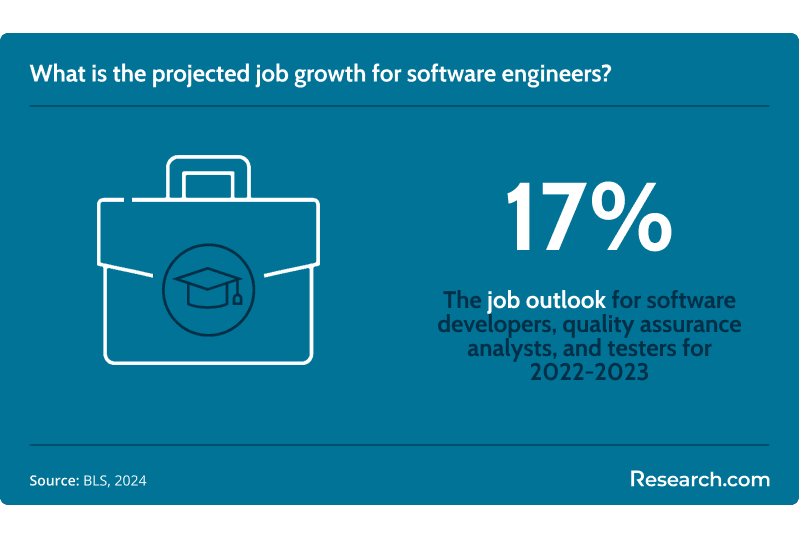
The long-term labor market for software professionals remains strong, but it is also more selective than it was during the rapid hiring period of 2021–2022. According to recent projections cited in this guide, software development roles are expected to grow by about 17% until 2033, adding roughly 327,900 new jobs in the field.
Demand is supported by digital transformation, cloud infrastructure, cybersecurity needs, data platforms, and the growing use of artificial intelligence. At the same time, employers increasingly look for candidates who can demonstrate practical experience, production-ready skills, strong collaboration, and the ability to work with modern development tools.
An online master’s in software engineering may help experienced professionals qualify for senior, lead, architecture, AI-related, cybersecurity, or project-focused roles. However, the degree works best when paired with a strong portfolio, relevant work experience, and current technical skills. Students interested in AI-related work may also compare software engineering career paths with guidance on how to become an AI trainer.
Current trends affecting software engineering students
- AI is changing development workflows. Engineers increasingly need to understand how AI tools affect coding, testing, documentation, productivity, and quality control.
- Cloud and DevOps skills are widely useful. Many software roles now involve deployment pipelines, containerization, monitoring, and infrastructure decisions.
- Security is becoming part of everyday engineering. Secure design and vulnerability awareness are no longer limited to dedicated cybersecurity teams.
- Employers are more selective. A graduate degree can help, but hiring decisions often depend on demonstrated ability, previous projects, system design skills, and interview performance.
- Online education is more accepted when quality is clear. Accreditation, reputable faculty, rigorous projects, and transparent outcomes matter more than the delivery format alone.
How do accelerated online software engineering programs differ from an accelerated online computer science degree?
Accelerated online software engineering programs usually emphasize applied software development, system design, project execution, software quality, architecture, and engineering practices. An accelerated online computer science degree is often broader and may focus more on algorithms, computation, theory, operating systems, data structures, and the foundations of computing.
Choose software engineering if your goal is to design, build, test, maintain, and lead software projects. Choose computer science if you want a broader theoretical base that can support software development, research, systems work, or future specialization in several computing areas.
What challenges may students encounter in an online master's program in software engineering?
Online software engineering students often struggle less with the technology itself and more with time, workload, and consistency. Graduate software projects can be demanding, especially when students are also working full time. Online learners must manage deadlines, communicate clearly in virtual teams, and stay engaged without the routine of a physical classroom.
| Common Challenge | Why It Happens | Better Strategy |
| Underestimating workload | Students assume online means easier or less time-intensive | Review weekly time expectations and start with a manageable course load |
| Weak networking | Online students may not naturally meet classmates and faculty outside assignments | Attend virtual events, join project groups, use office hours, and connect with alumni |
| Missing prerequisites | Applicants enter without enough programming, algorithms, or math preparation | Ask for a prerequisite audit before enrolling |
| Choosing based only on speed | The fastest option may not offer the right specialization, support, or recognition | Balance completion time with curriculum, accreditation, cost, and career fit |
| Ignoring total cost | Fees, extra courses, and longer enrollment can increase the final price | Compare full program cost and review cheapest online software engineering degree programs when affordability is a priority |
How can interdisciplinary studies enhance career prospects in software engineering?
Software engineering becomes more valuable when paired with knowledge of a specific industry or problem area. Healthcare, finance, education, logistics, manufacturing, and analytics all need professionals who can translate domain needs into reliable software systems. Interdisciplinary electives, capstone projects, or prior professional experience can help students stand out because they show more than coding ability; they show context.
For example, a software engineer with healthcare knowledge may be better prepared to work on patient data systems, clinical workflow tools, or health technology platforms. Students interested in this direction may compare software engineering with the fastest health informatics masters programs online. Those more interested in operations, leadership, or healthcare organizations may also review healthcare administration degree online accredited options.
How do online master's programs in software engineering uphold academic excellence and industry relevance?
Strong online software engineering programs maintain quality through recognized accreditation, qualified faculty, curriculum review, industry-informed projects, clear assessment standards, and regular updates to technical content. The best programs do not simply move lectures online; they build structured learning experiences around software design, testing, collaboration, deployment, and applied problem-solving.
When evaluating rigor, ask whether the program includes substantial projects, code reviews, team collaboration, architecture assignments, testing requirements, and real-world case work. Also ask how often the curriculum is updated to reflect changes in AI tools, cloud platforms, cybersecurity practices, and software delivery methods.
Common mistakes to avoid when choosing an online software engineering master’s
- Choosing a program without verifying accreditation. Accreditation affects credibility, transferability, financial aid eligibility, and employer confidence.
- Focusing only on tuition per credit. Total cost depends on credits, fees, prerequisites, books, software, and time to completion.
- Assuming online means self-paced. Some online programs have strict weekly deadlines, live sessions, group work, or cohort schedules.
- Ignoring prerequisites. Missing foundational coursework can delay graduation or make graduate classes much harder.
- Relying only on rankings. Rankings can narrow your search, but curriculum fit, support services, and career alignment matter more.
- Assuming the degree alone guarantees a promotion or salary increase. Employers usually evaluate experience, technical performance, project results, and leadership ability.
- Not asking about career services for online students. Remote learners should have access to advising, job search support, networking opportunities, and alumni resources.
Questions to ask before enrolling
- Is the institution regionally accredited?
- Does the online degree appear the same as the campus degree on the transcript?
- How many credits or courses are required to graduate?
- Can I complete the program in 2 years while working full time?
- Are courses asynchronous, synchronous, cohort-based, or competency-based?
- What programming languages, tools, and platforms are used?
- Are there bridge courses for students without a computer science background?
- Does the curriculum include software architecture, testing, security, DevOps, or AI coursework?
- What is the full cost, including fees and prerequisite courses?
- Do online students receive the same career support as campus students?
Related education paths to compare
A master’s in software engineering is not the only route into technical or technology-adjacent work. If you want faster job preparation, a bootcamp may be more direct. If you want a broader computing foundation, computer science may be a better fit. If your goal is to apply technology in a specific domain, interdisciplinary graduate programs may be worth comparing.
- For short-term coding preparation, compare degree programs with the fastest online software engineering bootcamps.
- For broader computing theory, review an accelerated online computer science degree.
- For analytics-heavy roles, consider a fast-track master's in data analytics online.
- For healthcare technology roles, compare software engineering with health informatics careers and the fastest health informatics masters programs online.
- For other accelerated online graduate models, review examples such as an accelerated online sustainability master's degree, an accelerated master's degree in Mathematics online, or an accelerated master's degree in TESOL online.
Key Insights
- Most fast online master’s in software engineering programs take about 2 years, but actual completion time depends on credits, prerequisites, course load, and program format.
- California State University, Fullerton, Bellarmine University, Penn State World Campus, Purdue University, Auburn University, Carnegie Mellon University, West Virginia University, Western Governors University, Arizona State University, and Nova Southeastern University all offer online options with software engineering-focused study.
- Online programs can be academically comparable to campus programs, but students must be proactive about networking, time management, and career support.
- Total program cost can range from about $20,000 to $40,000, with some programs below or above that range. Always calculate the full cost, not just tuition per credit.
- Financial aid may include FAFSA-based federal loans, Direct Unsubsidized Loans, Grad PLUS Loans, institutional aid, employer tuition assistance, and private loans.
- The best program is the one that fits your career target: architecture, DevOps, AI, cybersecurity, software leadership, cloud systems, or applied software development.
- Do not choose solely based on speed. Accreditation, curriculum quality, faculty support, project work, employer recognition, and total cost are just as important.
References:
- Bureau of Labor Statistics. Software Developers, Quality Assurance Analysts, and Testers. Occupational Outlook Handbook. https://www.bls.gov/ooh/computer-and-information-technology/software-developers.htm#tab-1
- C++ Institute. C++ Institute Certification Exams. https://cppinstitute.org/cc-certification-exams
- HackerRank. 2020 HackerRank Developer Skills Report. https://info.hackerrank.com/rs/487-WAY-049/images/HackerRank-2020-Developer-Skills-Report.pdf
- IEEE Computer Society. Professional Software Developer Certification. https://www.computer.org/product/education/professional-software-developer-certification
- ZipRecruiter. Graphic Engineer Salary. https://www.ziprecruiter.com/Salaries/Graphic-Engineer-Salary
Other Things You Should Know About the Fastest Online Master's in Software Engineering Programs
Yes, fast-track online Master's in Software Engineering (MSE) programs are generally designed to be as academically rigorous as their standard, on-campus counterparts. The key difference lies not in the quality or depth of the material, but in the pace and delivery method.
These programs condense a typical two-year curriculum into a shorter timeframe, often 12 to 18 months, by utilizing accelerated course schedules, year-round study, or heavier course loads per term. This means students are expected to manage an intensive workload and meet frequent deadlines, demanding strong self-discipline and time management skills.
The fastest online Master’s in Software Engineering for 2027 offers several benefits, including accelerated career advancement due to shorter completion times, flexible scheduling that accommodates personal and professional commitments, and often a cost-effective tuition structure compared to traditional programs. This blend of speed, flexibility, and affordability appeals to many professionals seeking to enhance their qualifications rapidly.
The fastest online Master's in Software Engineering programs in 2027 can typically be completed in 12 to 15 months. These accelerated programs offer intensive coursework and streamlined curriculums, allowing students to achieve their degrees in a shorter timeframe compared to traditional programs.


