
2027 Fastest Online CCNA Training Bootcamps

Co-Founder and Chief Data Scientist
The fastest online CCNA training bootcamps are built for learners who want Cisco networking exam preparation without spending months in a traditional course. The decision is not just “Which bootcamp is quickest?” A better question is: which program fits your current networking knowledge, schedule, budget, need for live instruction, and goal of passing the CCNA 200-301 exam?
This guide is for high school graduates considering an IT career, working professionals trying to move into networking, and degree holders who want a recognized technical credential. You will learn what online CCNA bootcamps cover, how long they take, what they cost, which programs are among the fastest for 2027, and how to compare options without relying only on speed or price.
Quick Answer: Are Online CCNA Bootcamps Worth Considering?
Online CCNA training bootcamps can be a practical route if you already have basic computer knowledge and want structured preparation for the Cisco Certified Network Associate exam. The best options combine live or guided instruction, virtual labs, practice exams, clear alignment with the CCNA 200-301 objectives, and transparent pricing. A bootcamp does not guarantee certification or employment, but it can shorten your preparation timeline and give you hands-on practice with routing, switching, IP services, security fundamentals, and automation concepts.
What are the main benefits of earning an online CCNA certification?
- It can support entry-level access to IT roles such as network administrator, systems support specialist, network support technician, or junior cybersecurity analyst.
- The U.S. Bureau of Labor Statistics reported a median annual salary of $96,800 for network and computer systems administrators, with top earners making over $150,000 annually.
- Online CCNA bootcamps can be faster and more flexible than semester-based training, which helps learners prepare for certification while working, studying, or changing careers.
What should you expect from an online CCNA certification program?
An online CCNA certification program is a focused training experience designed around the Cisco 200-301 CCNA exam. Instead of covering general IT broadly, these bootcamps concentrate on the networking knowledge Cisco expects candidates to understand: network fundamentals, IP connectivity, routing and switching, network access, security basics, IP services, automation, and introductory programmability.
Most programs use one of three formats: live online classes, self-paced video modules, or a blended model that combines recordings with instructor-led labs. Stronger programs include lab environments through tools such as Cisco Packet Tracer or GNS3, because the CCNA is not only a memorization exam. You need to understand how networks behave, how devices are configured, and how to troubleshoot connectivity problems.
Admissions are usually open to learners without a college degree, but that does not mean the material is beginner-proof. Students are more likely to keep up if they are comfortable using computers, reading technical documentation, and studying independently. Tuition varies widely, typically ranging from $500 to $4,000 depending on program length, instructor access, lab resources, included materials, and whether exam vouchers are bundled.
Where can a CCNA certification help you work?
A CCNA certification is most useful in organizations that rely on secure, reliable computer networks. Graduates may look for opportunities with corporations, managed service providers, healthcare systems, financial institutions, school systems, government agencies, telecom providers, and technology companies.
Remote and hybrid networking roles are more common than they were before distributed work became standard, but many early-career networking jobs still require some onsite work. Hardware installation, physical cabling, device replacement, and local troubleshooting often cannot be handled fully remotely.
Common job titles connected to CCNA training include Network Administrator, Network Support Technician, IT Specialist, Junior Network Engineer, Network Operations Center Technician, and Junior Systems Engineer. Some learners use CCNA training as a foundation before moving toward cybersecurity, cloud infrastructure, ethical hacking, penetration testing, or security analysis.
According to recent data cited in the source material, job postings for CCNA-related roles grew by 22%, indicating continued employer interest in candidates with networking skills.
How much can you make with an online CCNA certification?
Compensation depends on job title, location, industry, prior experience, clearance requirements, and whether the role includes security, cloud, or engineering responsibilities. The CCNA can help demonstrate networking knowledge, but salary outcomes are never guaranteed by a bootcamp alone.
According to the U.S. Bureau of Labor Statistics, the median annual salary for network and computer systems administrators was $96,800 in May 2024. Entry-level positions may start around $60,000, while top professionals in sectors such as finance and technology can earn over $150,000.
Salary also varies by industry:
- Information services: $101,140
- Computer systems design: $99,780
- Finance and insurance: $99,420
- Education: $83,620
The strongest return on a CCNA bootcamp usually comes when learners combine certification preparation with hands-on labs, troubleshooting practice, a portfolio of documented projects, and a clear plan for applying to entry-level networking roles.
- Fastest Online CCNA Training Bootcamps for 2027
- How long does an online CCNA training bootcamp take?
- Online CCNA bootcamp vs. on-campus training
- Average cost of an online CCNA training bootcamp
- Financial aid and payment options for online CCNA bootcamps
- Prerequisites for online CCNA training
- Typical courses and CCNA exam topics
- CCNA-related specializations and follow-up paths
- Can supplementary technical programs enhance an IT career?
- Common challenges of online CCNA bootcamps
- How to evaluate accreditation and industry relevance
- How to choose the best online CCNA training bootcamp
- Career paths after an online CCNA training bootcamp
- Job market for online CCNA bootcamp graduates
Fastest Online CCNA Training Bootcamps for 2027
How should you use this list?
The fastest program is not automatically the best program. A five-day bootcamp can work well for someone who already understands networking basics, while a 12- or 15-week option may be better for a learner who needs more repetition, lab time, and review. Use the list below to compare pace, cost transparency, accreditation or authorization status, and learning format.
How do we rank the programs?
Research.com rankings are designed to help learners compare education options with more confidence. For this guide, the evaluation draws from trusted education data sources, including the IPEDS database, Peterson's database, the College Scorecard database, and the National Center for Education Statistics.
These sources help assess institutional quality, affordability, and student outcome context where available. You can review Research.com's ranking approach on the methodology page.
| Program | Best fit | Length | Listed cost | Accreditation or authorization note |
| San Diego State University Global Campus | Learners who want an intensive university-backed live sprint | 7 days | $4,359 | WASC Senior College and University Commission |
| Cal Poly Pomona | Self-paced learners seeking dual CCNA and CyberOps preparation | Starts anytime; self-paced | N/A | WASC Senior College and University Commission, Cisco-authorized |
| Morgan State University | IT professionals who want live cohort learning with lab access | 7 days | N/A | Middle States Commission on Higher Education, Cisco-authorized |
| Boson | Candidates who want a short instructor-led Cisco-focused bootcamp | 5 days | $4195 | Cisco-authorized partner |
| ICOHS College | Learners who prefer a longer hybrid structure | 15 weeks | N/A | ACCSC institutional accreditation |
| GlobED | Budget-conscious learners who want weekend pacing | ~96 hours over 12 weeks | $1099 | Not specified |
| Training Camp | Students seeking a five-day live-online format with retake support | 5 days | N/A | Cisco-authorized partner |
| Fortray | Learners who want a short multiweek schedule and placement support | 5–6 weeks | ~$995 | Not specified |
| I-Medita | Students seeking a lower-cost hybrid intensive option | 15 days | ₹ 12,900 or ~$90 | Not specified |
| Udemy | Independent learners who want low-cost review materials | Starts anytime; self-paced | N/A | Not applicable |
1. San Diego State University Global Campus — Cisco CCNA Associate and Cybersecurity Associate Training Boot Camp
San Diego State University Global Campus offers a 7-day live online program for learners who want accelerated preparation in Cisco networking and cybersecurity topics. The bootcamp is designed for students who already understand basic TCP/IP concepts and want guided practice installing, configuring, and operating network devices. It also includes virtual labs and bundled learning materials for CCNA and CyberOps Associate preparation.
- Program length: 7 days
- Cost per credit: N/A, with a flat fee of $4,359
- Total credits: N/A
- Accreditation: WASC Senior College and University Commission
2. California State Polytechnic University, Pomona — Cisco CCNA Dual Certification Training Boot Camp
Cal Poly Pomona provides a self-paced, fully online bootcamp aligned with Cisco CCNA and CyberOps Associate preparation. The program uses expert-led virtual labs in a simulated cyber range and includes exam vouchers after completion, making it a fit for learners who need flexibility but still want structured technical practice.
- Program length: Starts anytime; self-paced
- Cost per credit: N/A
- Total credits: N/A
- Accreditation: WASC Senior College and University Commission, Cisco-authorized
3. Morgan State University — Cisco CCNA Dual Certification Training Bootcamp
Morgan State University offers a 7-day live online bootcamp in partnership with Infosec. The cohort model is suited to IT professionals who want scheduled instruction, hands-on networking and security labs, exam vouchers, and 90-day access to learning resources after the live training period.
- Program length: 7 days
- Cost per credit: N/A
- Total credits: N/A
- Accreditation: Middle States Commission on Higher Education, Cisco-authorized
4. Boson — CCNA: Implementing and Administering Cisco Solutions Bootcamp
Boson runs a 5-day live online CCNA bootcamp using official Cisco materials and instructor-led training. It is a strong match for candidates who want a compressed review schedule, direct instruction, and multiple date options for fast certification preparation.
- Program length: 5 days
- Cost per credit: N/A, with a flat fee of $4195
- Total credits: N/A
- Accreditation: Cisco-authorized partner
5. ICOHS College — Online/Hybrid CCNA Certification Bootcamp
ICOHS College offers a 15-week hybrid CCNA bootcamp that combines weekly live online sessions with hands-on labs. The longer timeline may be useful for beginners and working professionals who need more time to absorb routing, switching, subnetting, and troubleshooting concepts.
- Program length: 15 weeks
- Cost per credit: N/A
- Total credits: N/A
- Accreditation: ACCSC institutional accreditation
6. GlobED — The Ultimate CCNA 200-301 v1.1 Bootcamp
GlobED provides a 12-week online bootcamp with live weekend sessions and lifetime access to course content. Its lighter weekly schedule is designed for learners who want structured CCNA preparation without committing to a full-time intensive format.
- Program length: ~96 hours over 12 weeks
- Cost per credit: N/A, with a flat fee of $1099
- Total credits: N/A
- Accreditation: Not specified
7. Training Camp — Online CCNA Bootcamp
Training Camp delivers a 5-day live-online CCNA bootcamp with Cisco lab exercises and a pass guarantee that includes a free retake. This option is best suited to learners who want an intensive schedule and additional exam-risk protection.
- Program length: 5 days
- Cost per credit: N/A
- Total credits: N/A
- Accreditation: Cisco-authorized partner
8. Fortray — Online CCNA Bootcamp
Fortray offers a 5- to 6-week online CCNA bootcamp with weekly modules and recorded sessions. The program also includes job placement assistance after successful completion, which may appeal to learners who want career support in addition to exam preparation.
- Program length: 5–6 weeks
- Cost per credit: N/A, with a flat fee of ~$995
- Total credits: N/A
- Accreditation: Not specified
9. I-Medita — CCNA 200-301 Bootcamp
I-Medita provides a 15-day hybrid CCNA bootcamp that blends virtual lectures with lab practice. The structure is described as 60% theory and 40% practical work, with mock labs and flexible scheduling options.
- Program length: 15 days
- Cost per credit: N/A, with a flat fee of ₹ 12,900 or ~$90
- Total credits: N/A
- Accreditation: Not specified
10. Udemy — Various CCNA Bootcamps
Udemy offers self-paced CCNA training options, including a 78-hour prerecorded course that combines networking theory and practical labs. This route is best used by disciplined independent learners, exam repeaters, or students who want supplemental review before investing in a higher-cost bootcamp.
- Program length: Starts anytime; self-paced
- Cost per credit: N/A
- Total credits: N/A
- Accreditation: Not applicable for an online course platform
How long does an online CCNA training bootcamp take?
Many online CCNA training bootcamps can be completed in 5 days, but that pace is best for learners with prior exposure to networking. Other programs extend across 7 days, 15 days, 5–6 weeks, 12 weeks, or 15 weeks to provide more time for practice and review.
Accelerated certification formats are also common in other technical fields. For example, professionals interested in cybersecurity governance can compare CCNA-style intensive training with the fastest online ISC2 CGRC training bootcamps.
| Bootcamp pace | Who it fits best | Main risk |
| 5 to 7 days | Experienced IT workers, network technicians, or candidates using the course as final exam preparation | Too compressed for learners who are new to subnetting, routing, and troubleshooting |
| 15 days to 7 weeks | Career changers and early-career IT learners who need structure but still want a fast timeline | Requires consistent weekly study outside class |
| 12 to 15 weeks | Beginners, working adults, and students who need repeated lab practice | Slower completion and a longer period before exam readiness |
| Self-paced | Independent learners with strong study habits and flexible schedules | No built-in accountability unless the learner creates a study plan |
What happens in a 5-day CCNA bootcamp?
- Live online instruction: Students attend real-time classes and can ask questions during explanations and demonstrations.
- Hands-on labs: Programs often use Cisco equipment simulations or virtual networking environments to reinforce configuration and troubleshooting skills.
- Full exam-domain review: Training usually covers LANs, WANs, routing, IP services, network access, security fundamentals, and automation topics.
- Exam voucher support: Some providers include a CCNA exam voucher, which can reduce separate testing costs.
- Condensed scheduling: The short timeline is convenient, but students should expect long class days and evening study.
If you are new to networking, do not choose a five-day program just because it is fast. Choose it only if you can commit to pre-study, lab practice, and review immediately after the course.
How does an online CCNA training bootcamp compare to an on-campus program?
Online and on-campus CCNA programs can prepare students for the same Cisco 200-301 exam, but they differ in schedule flexibility, lab delivery, networking opportunities, and the amount of face-to-face support available.
Online bootcamps often use live virtual classrooms, recorded lessons, chat support, remote lab environments, and discussion forums. On-campus programs may provide easier access to physical lab equipment, in-person troubleshooting help, and classroom accountability. The right choice depends on how you learn and how much structure you need.
Students who want to extend networking skills into cloud environments can also compare CCNA preparation with the fastest online CompTIA Cloud+ training bootcamps.
| Factor | Online CCNA bootcamp | On-campus CCNA program |
| Access | Available from home with internet access and the required software | Requires travel to a physical location |
| Schedule | May be live, self-paced, or hybrid | Usually tied to fixed classroom times |
| Labs | Often completed through simulators, virtual labs, or remote lab access | May include physical routers, switches, and onsite lab equipment |
| Interaction | Depends on instructor availability, chat tools, and cohort design | Typically easier for spontaneous questions and peer interaction |
| Best for | Working professionals, remote learners, and students who need flexibility | Learners who want in-person accountability and hands-on hardware exposure |
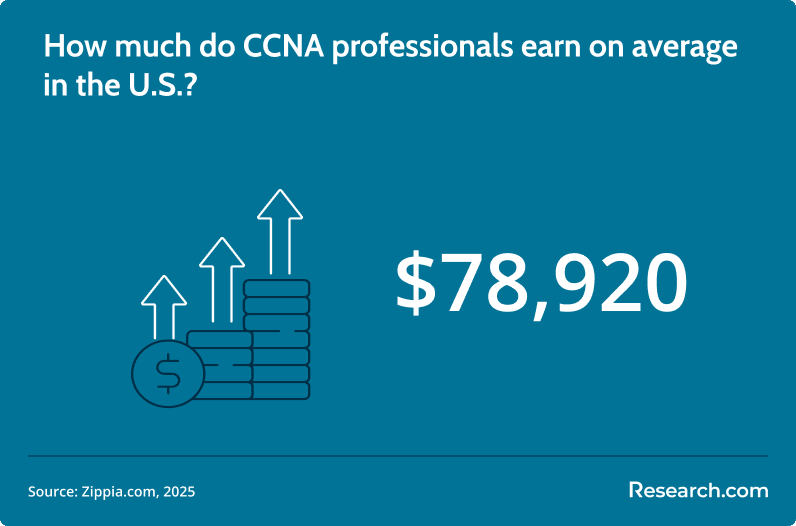
Both formats can lead to the same certification exam. For career planning, compare job goals as well as course format. For example, if you are researching the broader path and compensation for networking roles, see Research.com's guide to network administrator salary, which lists the U.S. average at around $79,429.
What is the average cost of an online CCNA training bootcamp?
The average cost of online CCNA training bootcamps ranges from $199 to over $4,000, with major differences based on delivery format, instructor involvement, lab access, institutional provider, and whether exam vouchers are included.
Low-cost self-paced courses may cost under $250 and can be useful for review, but they usually provide less individualized support. Intensive instructor-led bootcamps, especially those connected to universities or dual-certification pathways, often cost more than $3,000. For example, the San Diego State University Global Campus bootcamp is priced at $4,359 and includes preparation for both the CCNA and CyberOps Associate exams.
| Cost factor | Why it matters | Question to ask before enrolling |
| Exam voucher | A voucher can lower your separate testing expense | Is the CCNA exam voucher included, optional, or not provided? |
| Lab access | Hands-on practice is essential for troubleshooting skills | How long can I access labs after the course ends? |
| Instructor support | Live help can be valuable when subnetting or routing concepts become difficult | Can I ask questions outside scheduled class time? |
| Retake policy | Some programs reduce financial risk if you do not pass on the first attempt | Does the provider offer an exam retake, pass guarantee, or additional review? |
| Career services | Resume help and placement support may matter for first-time IT job seekers | Are job placement claims documented and specific? |
What financial aid options are available for online CCNA bootcamps?
Most online CCNA bootcamps are non-degree training programs, so they often do not qualify for traditional federal student aid. However, learners may still be able to reduce out-of-pocket costs through employer support, included exam vouchers, installment plans, scholarships, military benefits, or provider discounts.
Common ways to lower CCNA bootcamp costs
- Employer sponsorship: Ask whether your employer will prepay tuition or reimburse you after passing the CCNA exam.
- Exam vouchers: Some bootcamps include free CCNA exam vouchers, saving you $300.
- Installment plans: Providers may offer monthly payments, sometimes with zero or low interest.
- Scholarships and discounts: University-affiliated programs and workforce training providers may offer limited tuition reductions.
- Military and veteran benefits: Eligible learners may be able to use GI Bill or similar benefits for qualifying programs.
To understand how pricing and aid may compare across technical credential programs, you can also review Research.com's guide to the most affordable online Microsoft Azure dual certification bootcamps.
What are the prerequisites for enrolling in an online CCNA training bootcamp?
Most online CCNA bootcamps do not require a degree, but successful students usually bring some familiarity with computers, operating systems, command-line tools, and basic networking terminology. The CCNA exam can be challenging for complete beginners because it expects practical understanding of IP addressing, subnetting, routing behavior, VLANs, access control lists, and troubleshooting logic.
If you want a security-focused stepping stone before or alongside CCNA preparation, Research.com's guide to fast-track online CyberOps training programs may help you compare related options.
Recommended knowledge before starting
- TCP/IP fundamentals and IP addressing
- Subnetting and basic routing concepts
- Networking hardware such as routers and switches
- Basic firewall, security, and access-control concepts
Some programs recommend 6–12 months of experience with Cisco products or general networking tools. Beginners can still succeed, but they should plan for pre-course study, daily practice labs, and extra review after the bootcamp. Learners planning a longer cybersecurity career may later consider advanced security training, such as fast-track CISSP training online, after they have built the required experience and foundational knowledge.
What courses are typically included in an online CCNA training bootcamp?
Online CCNA bootcamps usually follow the official CCNA 200-301 exam domains. The goal is to connect theory with practical configuration and troubleshooting, so strong courses include labs instead of relying only on lectures or slides.
Learners who expect to move into security leadership later may eventually compare CCNA preparation with fast-track online CISM certification training, although CISM serves a different and more management-oriented purpose.
Core CCNA 200-301 topic areas
- Network Fundamentals (20%): IP addressing, OSI and TCP models, routing and switching basics, and common protocols.
- Network Access (20%): LAN switching, VLANs, wireless access, and device configuration concepts.
- IP Connectivity (25%): Static routing, OSPF, IPv4 and IPv6 configuration, and troubleshooting.
- IP Services (10%): DHCP, DNS, NAT, NTP, and other services that keep networks functioning.
- Security Fundamentals (15%): ACLs, access controls, wireless security, and basic threat prevention.
- Automation and Programmability (10%): Software-defined networking concepts, APIs, JSON, REST, and automation basics.
For additional exam context, TechTarget offers a guide to prepare for the CCNA 200-301 exam.
What types of specializations are available after CCNA training?
The modern CCNA 200-301 is a consolidated associate-level certification, so most bootcamps prepare for one primary exam rather than separate CCNA tracks. However, many programs introduce topics that can lead into specialized networking, security, cloud, collaboration, wireless, or data center roles.
Common follow-up areas after CCNA
- Cybersecurity: Builds on networking knowledge to focus on threat detection, access controls, intrusion analysis, and network defense.
- Cloud networking: Extends routing, connectivity, and security concepts into virtualized and cloud-based infrastructure.
- Collaboration: Applies networking to voice, video, and unified communications systems.
- Wireless networking: Focuses on WLAN planning, deployment, performance, and security.
- Data center networking: Covers storage networking, virtualization, redundancy, and data center architecture.
Networking is not the only technical path available. Learners who want a broader technology skill set may compare CCNA training with software-oriented options, including cheapest online web development degree programs.
Can supplementary technical programs enhance an IT career?
Yes, supplementary technical programs can strengthen an IT career when they are chosen strategically. CCNA training is strongest for networking fundamentals, but many employers also value skills in cloud platforms, cybersecurity, scripting, systems administration, and troubleshooting. The right add-on credential depends on the role you want next.
For example, a future cloud network engineer may pair CCNA with cloud training, while a future security analyst may add CyberOps, Security+, or other security-focused study. Some learners move into different technical or creative fields; those exploring interactive software and media can review Research.com's guide to the best online degree in game development. This is not a direct substitute for CCNA, but it may be relevant for students comparing broader technology education paths.
What are the common challenges of online CCNA training bootcamps?
Online CCNA bootcamps can be effective, but they are demanding. The most common challenge is pace: routing, subnetting, VLANs, OSPF, NAT, and ACLs can feel overwhelming when packed into a short schedule. Learners may also struggle if the virtual labs are weak, technical support is slow, or the program provides little feedback on practice exams.
| Common mistake | Why it hurts outcomes | Better approach |
| Choosing only the shortest bootcamp | Fast programs may move too quickly for beginners | Match the timeline to your current networking knowledge |
| Ignoring lab quality | CCNA success requires applied troubleshooting, not just videos | Ask for details about lab tools, access length, and exercises |
| Assuming a bootcamp guarantees certification | Passing still depends on study time, practice, and exam readiness | Use practice exams and schedule review time after the course |
| Focusing only on tuition | Cheap courses may exclude vouchers, labs, instructor access, or support | Compare total value, not just sticker price |
| Skipping provider verification | Unclear authorization or weak support can reduce credential value | Check institutional accreditation, Cisco authorization, reviews, and outcomes |
Some professionals use CCNA as one piece of a wider technical plan. For example, learners moving toward data-heavy scientific computing roles may compare networking with options such as an affordable online bioinformatics masters, although that path serves a different career goal.
How should you evaluate accreditation and industry relevance in a CCNA bootcamp?
Accreditation and industry relevance are not the same. A university may hold institutional accreditation, while a training company may be Cisco-authorized without being a college. Both details matter, but they answer different questions: institutional accreditation speaks to the school, while Cisco authorization or exam alignment speaks to training relevance.
What to verify before enrolling
- Institutional accreditation: If the provider is a college or university, confirm its recognized institutional accreditation.
- Cisco authorization: If the program claims Cisco alignment or partnership, verify what that means and whether official Cisco materials are used.
- Exam alignment: The curriculum should clearly map to the CCNA 200-301 objectives.
- Outcome transparency: Ask for documented pass rates, completion data, career support details, and whether outcomes are independently verified.
- Lab environment: Confirm whether labs are simulated, remote, physical, graded, or available after the course ends.
Students comparing quality signals across academic fields can also review how Research.com discusses online program evaluation in guides such as geology degree online options. The field is different, but the same habit applies: verify accreditation, curriculum relevance, and student support before paying.
How to choose the best online CCNA training bootcamp
The best online CCNA bootcamp is the one that fits your starting point and gives you enough structure to become exam-ready. Do not choose based only on brand name, price, or claims about speed. Compare the actual learning experience.
Decision checklist for CCNA bootcamp shoppers
- Delivery format: Decide whether you learn better through live instruction, self-paced video, or a hybrid structure.
- Course duration: Choose a five-day intensive only if you already have enough networking background to keep up.
- Included materials: Look for lab access, recordings, practice exams, study guides, and exam vouchers.
- Support services: Ask about tutoring, office hours, retake policies, career coaching, and technical help.
- Certification target: Confirm that the program explicitly prepares students for the CCNA 200-301 exam.
- Provider credibility: Review accreditation, Cisco authorization, instructor qualifications, and independent student feedback.
- Total cost: Include tuition, exam fees, textbooks, lab extensions, retake costs, and time away from work.
Your long-term plan also matters. If your goal is consulting, compare CCNA training with the broader skills described in Research.com's guide on how to become an IT consultant. If your goal is cloud infrastructure, pairing CCNA with a fast-track cloud engineering course online may make more sense than stopping at networking fundamentals.
Questions to ask an admissions advisor or training provider
- How many hours of live instruction, recorded content, and lab practice are included?
- Does the program include a CCNA exam voucher, and what happens if I do not pass?
- What prior experience do successful students usually have?
- Can I access labs after the bootcamp ends?
- Are instructors Cisco-certified or actively working in networking roles?
- Does the provider publish verified pass rates or employment outcomes?
- What refund policy applies if the course format does not match what was advertised?
What career paths are available after an online CCNA training bootcamp?
Graduates of online CCNA bootcamps commonly pursue entry-level and early mid-level roles in networking, technical support, systems operations, and security-adjacent IT work. The certification is most powerful when combined with practical troubleshooting ability and a resume that shows lab experience or real projects.
Common roles connected to CCNA preparation
- Network Technician
- IT Support Specialist
- Network Administrator
- Network Engineer
- Cybersecurity Associate, especially after dual-certification training
The CCNA is recognized across healthcare, finance, education, government, managed services, and technology employers. It can also serve as a foundation for advanced credentials along the Cisco certification paths in areas such as enterprise networking, cybersecurity, cloud, and infrastructure.
Some learners strengthen their entry-level IT profile by adding foundational troubleshooting credentials. For example, accelerated online CompTIA A+ certification training can complement CCNA preparation for students who need broader hardware, software, and support knowledge.
What is the job market for graduates of an online CCNA training bootcamp?
The job market for CCNA-certified professionals remained strong in 2025, particularly in roles connected to secure, scalable, and cloud-connected networks. According to Lightcast data cited in the source material, job postings requesting CCNA certification rose 22% year-over-year, while cybersecurity-related networking jobs saw a 43% spike.
Employers in finance, government, healthcare, education, managed services, and technology continue to rely on network professionals to support uptime, security, cloud connectivity, and distributed work environments. CCNA training can also support contract or freelance work, especially when paired with additional credentials such as fast-track online CCSP certification training.
Still, applicants should be realistic. A CCNA bootcamp can help you prepare for certification, but employers may also ask for hands-on experience, help desk background, documentation skills, cloud familiarity, or security knowledge. The most competitive candidates can explain what they configured, how they troubleshot a problem, and why a network design decision matters.
What learners say about online CCNA bootcamps
-
: "
Earning my CCNA through an online bootcamp gave me the flexibility to learn after work and still get certified within weeks. The hands-on labs and real-world scenarios made a huge difference in how quickly I was able to land my first networking role. — Jason
"
-
: "
Completing my online CCNA training bootcamp was one of the best career decisions I’ve made. The structured pace and access to expert instructors helped me finally understand complex concepts that once felt overwhelming. — Marissa
"
-
: "
I finished my CCNA bootcamp online in just five days and walked away with two certifications. Now I’m confident managing network systems and feel prepared for advanced IT certifications. — Dinesh
"
Key Insights
- Fast online CCNA bootcamps can take as little as 5 to 7 days, but beginners may be better served by 5–6 week, 12-week, or 15-week formats with more lab repetition.
- Online CCNA bootcamp costs vary widely. The source material shows pricing from $199 to over $4,000, while key program examples include $4,359, $4195, $1099, ~$995, and ₹ 12,900 or ~$90.
- The CCNA 200-301 exam covers six domains: Network Fundamentals (20%), Network Access (20%), IP Connectivity (25%), IP Services (10%), Security Fundamentals (15%), and Automation and Programmability (10%).
- Salary potential can be strong, but it depends on role and experience. The BLS reported a median annual salary of $96,800 for network and computer systems administrators in May 2024, while another cited U.S. network administrator salary figure is around $79,429.
- A bootcamp is most valuable when it includes hands-on labs, clear CCNA 200-301 alignment, instructor or mentor access, practice exams, and transparent exam voucher policies.
- Do not assume “fastest” means “best.” Choose a program based on your current networking knowledge, study discipline, budget, and target job path.
- CCNA certification can support roles in network support, network administration, systems operations, and cybersecurity-adjacent work, especially when combined with practical troubleshooting experience.
References
- Bureau of Labor Statistics. Network and computer systems administrators. U.S. Department of Labor.
- Cisco. CCNA certification and training.
- Coursera. What is the CCNA?
- Cybersecurity Guide. CCNA certification.
- Indeed Career Guide. How to get CCNA certification in 7 steps.
- Infosec Institute. CCNA 4Cert training course.
- Infosec Institute. The job outlook for CCNA professionals.
- Learn.org. What is the outlook for CCNA jobs?
- Zippia. Cisco certified network associate jobs.
Other Things You Should Know About Online CCNA Training Bootcamps
To enroll in a 2027 fastest online CCNA training bootcamp, you typically need a basic understanding of networking concepts and a computer with internet access. Some bootcamps may require familiarity with Cisco technologies or prior IT experience for a smoother learning experience.
A fast online CCNA bootcamp prepares students for the Cisco CCNA 200-301 exam. This is the single certification exam required for CCNA, and it covers network fundamentals, IP connectivity, security fundamentals, automation, and programmability.
In 2027, the fastest online CCNA training bootcamps feature intensive, focused modules, flexible scheduling, experienced instructors, live virtual labs, and real-world practice exams. These elements enable learners to grasp core networking concepts swiftly and efficiently progress toward certification.


