
2027 What Is the Easiest Computer Science Degree?

Co-Founder and Chief Data Scientist
Choosing the “easiest” computer science degree is not really about finding a program with no math, no coding, or no challenging projects. A legitimate computer science program should still teach programming, algorithms, systems, data structures, and problem-solving. The better question is: which programs are more accessible, flexible, transfer-friendly, career-focused, and manageable for your schedule?
This guide is for working adults, first-time college students, transfer students, career changers, and anyone comparing online and campus-based computer science or closely related technology programs. You will learn what makes a computer science degree feel easier or harder, how long it usually takes, what it costs, which specializations may fit your goals, what jobs graduates can pursue, and how to compare programs without relying only on rankings or marketing language.
Quick Answer: What Is the Easiest Computer Science Degree Path?
The easiest computer science degree path is usually an accredited online bachelor’s or associate program with flexible scheduling, generous transfer credit policies, practical coursework, strong tutoring support, and clear career services. Programs that use shorter terms, competency-based pacing, or applied projects may feel more manageable for working students. However, any credible computer science degree still requires consistent practice in programming, mathematics, logic, and technical problem-solving.
For students who want a faster or less intensive entry point, an associate degree, information technology program, boot camp, or certificate may be more practical than a traditional four-year computer science degree. Students aiming for software engineering, data science, artificial intelligence, cybersecurity, or graduate study should usually choose a full bachelor’s degree with strong technical depth.
What Makes a Computer Science Program “Easy” or More Manageable?
“Easy” should not mean low quality. A program that is too light on programming, algorithms, or systems may leave graduates underprepared for technical interviews and entry-level work. A better way to evaluate ease is to look at how well the program removes unnecessary barriers while still teaching the core skills employers expect.
| Factor | Why It Matters | What to Look For |
| Flexible format | Working students often need evening, asynchronous, or self-paced options. | Online courses, short terms, part-time enrollment, or competency-based pacing. |
| Transfer credit policy | Accepted credits can shorten the degree and reduce cost. | Clear transfer evaluations, credit for prior learning, and articulation agreements. |
| Math intensity | Some students struggle more with calculus, discrete math, or theory than with coding. | Placement support, tutoring, prerequisite refreshers, and realistic course sequencing. |
| Project-based learning | Applied work can be easier to understand than purely theoretical instruction. | Portfolio projects, labs, capstones, and real-world software assignments. |
| Student support | Technical subjects are easier when help is available quickly. | Coding labs, tutoring, instructor access, advising, and career coaching. |
| Accreditation | Accreditation affects credit transfer, financial aid eligibility, and employer trust. | Institutional accreditation from a recognized accreditor. |
Benefits of Earning an Online Computer Science Degree
- An online computer science degree can prepare graduates for roles in technology companies, private-sector organizations, government agencies, healthcare, finance, education, and other industries that depend on software and data systems.
- Online programs may reduce expenses tied to commuting, campus housing, relocation, and some on-campus fees. They can also help students keep working while studying full-time or part-time.
- Computer science graduates can pursue roles with median or average annual pay ranging from at least $60,000 to more than $100,000 for higher-level or specialized positions, depending on role, experience, employer, and location.
What can I expect from a computer science degree?
A computer science degree teaches students how computers solve problems, how software is designed, and how data and systems work together. Even programs that are considered more accessible usually include programming, algorithms, data structures, computer systems, databases, software engineering, and mathematics. Many programs also offer electives in cybersecurity, artificial intelligence, cloud computing, data science, mobile development, or game development.
Students should expect a mix of coding assignments, exams, group projects, debugging, technical writing, and applied labs. The most successful students usually practice coding outside class, build a portfolio, ask for help early, and learn how to explain technical decisions clearly.
Who is a computer science degree best for?
- Students who want a broad technical foundation for software, data, cybersecurity, systems, or graduate study.
- Career changers who are willing to build programming skills gradually and consistently.
- Working adults who need an online or part-time program but still want a recognized degree.
- Students who enjoy solving structured problems and learning how technology works under the surface.
Who may want a different path?
- Students who want only short-term job training may prefer a certificate, boot camp, or associate degree.
- Students who dislike math and abstract logic may be more comfortable in information technology, web design, digital media, or business analytics.
- Students who need licensure in a regulated field should confirm whether a computer science program supports that goal, because most CS degrees do not lead to professional licensure.
Where can I work with an online computer science degree?
Graduates with an online computer science degree can work in technology, finance, healthcare, manufacturing, consulting, education, defense, retail, and government. Common roles include software developer, data scientist, cybersecurity analyst, cloud computing engineer, database administrator, systems analyst, web developer, network engineer, machine learning engineer, and IT project manager. The degree is versatile because nearly every industry uses software, data, networks, and digital platforms.
How much can I make with an online computer science degree?
Salary depends on the job title, location, employer, industry, experience level, and technical specialization. The figures below reflect the salary examples cited in this guide and should be treated as reference points, not guaranteed outcomes.
| Role | Salary Figure Cited | Typical Work Focus |
| Software Engineer | $109,020 annually | Designing, building, testing, and maintaining software applications. |
| Data Scientist | Median of $131,490 | Using statistics, programming, and machine learning to analyze data. |
| Information Security Analyst | Around $112,000 | Protecting systems, networks, and sensitive data from threats. |
| Cloud Architect | $218,609 | Designing and managing cloud infrastructure and services. |
| Mobile Application Developer | $116,852 | Building apps for mobile platforms and connected services. |
| Network Architect | $164,694 | Planning and managing enterprise network systems. |
| Database Developer | $100,919 | Designing, improving, and maintaining database systems. |
| Web Developer | $80,730 | Creating websites, web applications, and user-facing digital tools. |
- 2027 list of manageable computer science degree programs
- How long does a computer science degree take?
- Online vs. on-campus computer science degrees
- Average cost of a computer science degree
- Financial aid options for computer science students
- Common prerequisites for computer science programs
- Typical computer science courses
- Computer science specializations
- How to choose the right computer science program
- Career paths for computer science graduates
- Job market and salary outlook
- Cost drivers for online computer science degrees
- Cybersecurity specialization and career impact
- How to judge online program credibility
- Game development as a specialization
- Interdisciplinary computer science careers
- Whether a computer science degree is worth it
- Artificial intelligence degrees and computer science careers
- Emerging trends computer science graduates should follow
- Faster alternatives to a traditional CS degree
- Combining computer science and engineering
- Computer science careers in health informatics
- Common mistakes to avoid when choosing a program
- Key insights
2027 List of Easiest Computer Science Degree Programs
This list focuses on programs that may be more manageable for students because of flexible delivery, applied coursework, shorter formats, career-oriented curricula, or alternative technical pathways. It should not be read as a guarantee that a program is academically easy. Students should confirm admissions standards, transfer policies, course sequencing, tuition, fees, and support services directly with each institution before enrolling.
To support program research, this guide draws from respected education data sources, including the IPEDS database, Peterson's database including the Distance Learning Licensed Data Set, the College Scorecard database, and the National Center for Education Statistics.
| School or Provider | Credential Type | Why It May Feel More Manageable | Important Caution |
| Southern New Hampshire University | Bachelor of Science in Computer Science | Online and on-campus options, practical coursework, and concentration choices. | Students still complete a 120-credit bachelor’s curriculum. |
| National University | Bachelor of Science in Computer Science | Online delivery and flexible eight-week terms. | Quarter-unit requirements and pacing should be reviewed carefully. |
| Grand Canyon University | Bachelor of Science in Computer Science | Applied emphases in areas such as big data, game development, and entrepreneurship. | The 128-credit requirement may affect time and cost. |
| Purdue Global University | Bachelor of Science in Information Technology | Online delivery and ExcelTrack® competency-based option. | This is an IT program, not a traditional computer science degree. |
| Full Sail University | Bachelor of Science in Computer Science | Accelerated schedule and project-based learning. | The fast pace and total program cost require careful planning. |
| Bryant & Stratton College | Associate-level technology programs | Shorter route with practical training for entry-level technology roles. | Associate programs may limit access to some bachelor’s-level roles unless credits transfer. |
| Universal Technical Institute | Technical training programs | Hands-on technical training in areas such as Robotics & Automation. | These programs are not traditional computer science degrees. |
1. Southern New Hampshire University (SNHU)
Southern New Hampshire University offers a Bachelor of Science in Computer Science in online and campus formats. The program is designed to develop skills in programming, software engineering, systems design, databases, mobile and web development, and cybersecurity. Students complete applied assignments and may use concentrations to align coursework with career interests such as machine learning or computer engineering.
- Program Length: Typically 4 years for full-time students
- Tracks/Concentrations: Machine Learning, Computer Engineering
- Tuition Cost: $330 per credit hour for online undergraduate courses; no additional out-of-state fees
- Required Credits to Graduate: 120 credits
- Accreditation: New England Commission of Higher Education (NECHE)
2. National University
National University provides a Bachelor of Science in Computer Science that combines theoretical computing concepts with practical technical work. Students study data structures, algorithms, object-oriented programming, computer networks, systems design, management, and security. The online format and eight-week terms may appeal to adults who want a more predictable academic calendar. National University also offers an MS in Computer Science with study in areas such as software engineering, database design, and cloud computing.
- Program Length: 4 years (Bachelor’s)
- Tracks/Concentrations: Software Engineering, Data Science
- Tuition Cost: Approximately $370 per unit (undergrad); total varies by course load
- Required Credits to Graduate: 180 quarter units
- Accreditation: WASC (Western Association of Schools and Colleges)
3. Grand Canyon University
Grand Canyon University (GCU) offers a Bachelor of Science in Computer Science with practical emphases that can help students connect computing theory to career goals. Areas of study include system architecture, cybersecurity, data analytics, big data analytics, game and simulation development, and business entrepreneurship. This structure may suit students who want a career-focused program with applied assignments rather than a purely theoretical path.
- Program Length: 4 years (128 credits)
- Tracks/Concentrations: Big Data Analytics, Game and Simulation Development, Business Entrepreneurship
- Tuition Cost: $455 per credit
- Required Credits to Graduate: 128
- Accreditation: Higher Learning Commission (HLC)
4. Purdue Global University
Purdue Global offers a Bachelor of Science in Information Technology rather than a traditional computer science degree. The program covers applied IT areas such as cybersecurity, cloud computing, programming, and data management. Students who want a flexible route into technology operations, systems, or IT support may find this path more approachable than a theory-heavy computer science curriculum. Purdue Global’s ExcelTrack® option uses one-credit competency-based modules that allow eligible students to move at their own pace.
- Program Length: 4 years/minimum of 180 quarter credit hours
- Tracks/Concentrations: Cloud computing, cybersecurity, game development, data management, and more
- Tuition Cost: $2,500 per term for ExcelTrack® (additional fees apply)
- Required Credits to Graduate: 180 quarter credits
- Accreditation: Higher Learning Commission (HLC)
5. Full Sail University
Full Sail University offers a Bachelor of Science in Computer Science for students interested in programming, software engineering, and applied computing. The program uses project-based assignments and includes work in problem-solving, data structures, software development, C#, C++, machine intelligence, wearable computing, computer networks, and data visualization. Career development and portfolio work are built into the student experience.
- Program Length: 108 weeks (approx. 27 months)
- Tracks/Concentrations: Machine Intelligence, Data Visualization, Computer Networks, and Wearable Computing
- Tuition Cost: Approximately $82,500 (total program)
- Required Credits to Graduate: 120 credits
- Accreditation: Accrediting Commission of Career Schools and Colleges (ACCSC)
6. Bryant & Stratton College
Bryant & Stratton College offers associate-level technology programs that focus on job-ready skills. The Computer and Information Sciences pathway introduces students to networking, information technology, computer systems, troubleshooting, basic cybersecurity, programming fundamentals, and systems analysis. This may be a practical option for students who want a shorter credential before seeking entry-level technology work or transferring into a bachelor’s program.
- Program Length: 2 years (Associate’s Degree)
- Tracks/Concentrations: System, Networking, & LAN/WAN Management
- Tuition Cost: Approximately $17,352 per year, with no differentiation between in-state and out-of-state rates
- Required Credits to Graduate: 60 credits
- Accreditation: Middle States Commission on Higher Education (MSCHE)
7. Universal Technical Institute
Universal Technical Institute (UTI) offers technical training rather than a conventional computer science degree. Its programs include Automotive, Diesel, Welding, and Robotics & Automation. The Robotics & Automation program lasts 51 weeks and emphasizes practical training in areas such as 3D design, applied physics, precision measuring, and computer-aided design. This pathway may suit students who prefer hands-on technical work in manufacturing, automation, and related environments.
- Program Length: 51 weeks for Robotics & Automation; other programs vary
- Tracks/Concentrations: Automotive, Diesel, Welding, Robotics & Automation
- Tuition Cost: Varies by program; financial aid available for eligible students
- Required Credits to Graduate: Typically not credit-based, as programs lead to diplomas and certifications rather than degrees
- Accreditation: Accredited by the Accrediting Commission of Career Schools and Colleges (ACCSC)
How long does it take to complete a computer science degree program?
The timeline depends on the credential, transfer credits, course load, academic calendar, and whether the student enrolls full-time or part-time.
| Credential | Typical Full-Time Length | Best For | Trade-Off |
| Associate Degree | 2 years | Students seeking entry-level skills, lower cost, or transfer preparation. | Some employers prefer or require a bachelor’s degree for software roles. |
| Bachelor’s Degree | 4 years | Students who want broad preparation for software, data, cybersecurity, or graduate study. | Requires more time, math, general education, and total credits. |
| Master’s Degree | 1-2 years | Professionals seeking advanced specialization or research-oriented roles. | Often requires prior technical preparation and may involve advanced theory. |
| Online or Part-Time Study | Varies | Working adults and students with family or scheduling constraints. | Flexibility can extend time to completion if students take fewer courses. |
Students who want to finish sooner can compare accelerated computer science degree programs. If your strengths lean toward quantitative modeling rather than software systems, it may also be worth comparing the easiest mathematics degree options, especially when programs emphasize applied math over advanced computing theory.
How does an online computer science degree compare to an on-campus program?
Online and campus computer science degrees can lead to similar academic credentials when offered by properly accredited institutions. The better choice depends on how you learn, how much structure you need, and whether you require campus labs, networking, or face-to-face support. Students comparing easier computer science degree programs should weigh flexibility and accreditation in the same careful way that students comparing the easiest teaching degree would examine field requirements and program legitimacy.
| Feature | Online Computer Science Degree | On-Campus Computer Science Degree |
| Schedule | Often more flexible; may include asynchronous courses. | Usually follows set class times and campus calendars. |
| Learning style | Best for self-directed students who can manage deadlines independently. | Best for students who prefer in-person accountability and classroom interaction. |
| Technical resources | Uses learning platforms, remote labs, discussion boards, and virtual tools. | May offer physical labs, campus libraries, and in-person tutoring. |
| Networking | Requires more intentional effort through virtual events, projects, and online communities. | Can make peer, faculty, club, and recruiting connections easier. |
| Cost considerations | May reduce commuting, housing, and relocation costs. | May provide more direct access to campus resources but can add living expenses. |
| Best fit | Working adults, military students, parents, and students far from campus. | Traditional-age students, lab-focused learners, and students seeking campus life. |
Graduate students comparing cost and flexibility can also review cheap and best universities for MS in computer science options.
What is the average cost of a computer science degree program?
Computer science degree costs vary widely by school type, residency status, degree level, program format, transfer credits, and fees. Tuition alone does not show the full cost. Students should also consider books, software, technology fees, proctoring fees, lab fees, housing, transportation, and the opportunity cost of reducing work hours.
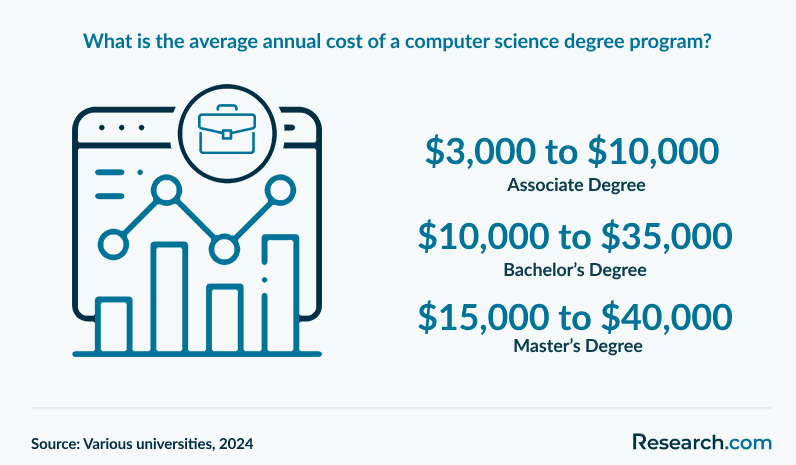
| Degree Level or School Type | Annual Tuition Range Cited | Total Cost Range Cited |
| Associate degree at community colleges, in-state | $3,000–$4,000 | $6,000–$16,000 |
| Associate degree at community colleges, out-of-state | $6,000–$8,000 | $6,000–$16,000 |
| Associate degree at private institutions | $15,000–$30,000 | $30,000–$60,000 |
| Bachelor’s degree at public in-state universities | $10,000–$15,000 | $40,000–$60,000 |
| Bachelor’s degree at public out-of-state universities | $25,000–$40,000 | $100,000–$160,000 |
| Bachelor’s degree at private universities | $35,000–$60,000 | $140,000–$240,000 |
| Master’s degree | $15,000–$40,000/year | Varies by specialization, credits, fees, and enrollment pace. |
How to reduce the cost of a computer science degree
- Start at a community college and transfer into a bachelor’s program if credits are accepted.
- Choose an in-state public option when it offers the right curriculum and support.
- Compare total program cost, not only tuition per credit.
- Ask whether prior learning, military training, certifications, or work experience can count for credit.
- Apply for federal aid, institutional scholarships, state grants, employer tuition assistance, and STEM scholarships.
- Consider online programs only after confirming accreditation, transfer rules, and student support.
What are the financial aid options for students enrolling in a computer science degree program?
Financial aid can make a computer science degree more affordable, but students should understand what must be repaid and what does not. Complete the FAFSA when required, compare award letters carefully, and avoid borrowing more than needed.
Federal financial aid options
- Federal Direct Loans: Up to $20,500 per year for eligible U.S. citizens and residents enrolled at least half-time. Students must complete the FAFSA.
- Federal Graduate PLUS Loans: These can cover additional education costs beyond Direct Loans. Students must complete the FAFSA and apply for Direct Loans first.
Scholarships
- Scholarships for Computer Science Majors: Examples include the Adobe Research Women-in-Technology Scholarship, which awards $10,000 to female students who demonstrate leadership.
- STEM Scholarships: Programs such as the SMART Scholarship may provide full tuition and stipends for STEM students, with guaranteed employment after graduation.
- Private Scholarships: Groups such as the Society of Women Engineers (SWE) offer awards ranging from $1,000 to $17,000 for female engineering students.
Employment-based aid
- Employer-Sponsored Fellowships: Some employers fund tuition in exchange for internships or work commitments, such as Graduate Fellowships for STEM Diversity.
- Work-Study Programs: Eligible students can work part time on campus or in related roles to help cover educational expenses.
State financial aid
- State Grants and Scholarships: State programs may support residents pursuing computer science or STEM degrees and usually do not require repayment.
What are the prerequisites for enrolling in a computer science degree program?
Prerequisites vary by institution and degree level, but most computer science or technical programs expect students to demonstrate academic readiness in math, problem-solving, and basic technology use. More selective bachelor’s and graduate programs may require stronger preparation.
| Program Level | Common Requirement | How to Prepare |
| Associate degree | High school diploma or equivalent | Strengthen algebra, basic computing, and academic writing skills. |
| Bachelor’s degree | High school diploma, math preparation, and general admissions materials | Take algebra, calculus, physics, or introductory programming when available. |
| Transfer bachelor’s pathway | Prior college credits and minimum grade requirements | Confirm which programming, math, and general education credits will transfer. |
| Master’s degree | Bachelor’s degree and technical preparation; GRE may be required or waived | Review prerequisite courses in programming, algorithms, data structures, and math. |
- High school diploma: Usually required for associate and bachelor’s degree admission.
- Mathematics and science: Algebra, calculus, and physics can help students handle technical coursework.
- Programming knowledge: Prior coding experience is useful, even when not required.
- GRE for graduate programs: Some master’s programs require it, while others waive it.
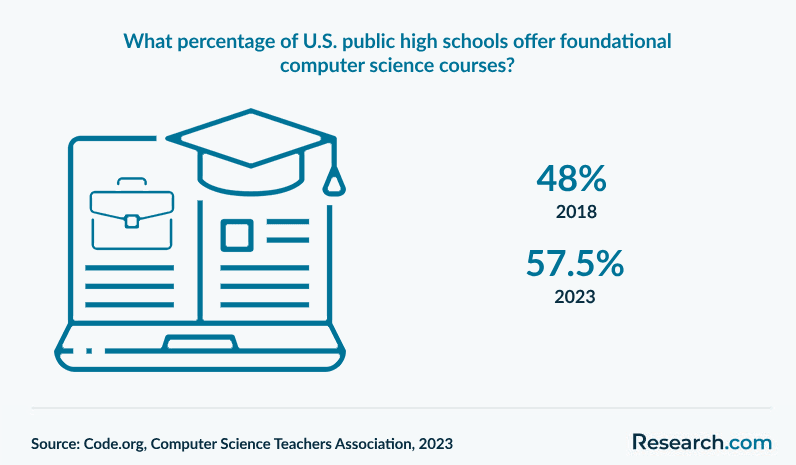
The percentage of U.S. public high schools offering foundational computer science courses increased from 48% in 2018 to 57.5% in 2023. This growth suggests that more students are entering college with some exposure to computer science, although access remains uneven.
What courses are typically in a computer science degree program?
Computer science curricula usually combine theory, math, programming, systems, and applied development. The exact mix depends on whether the program is a computer science, information technology, software engineering, or applied computing degree.
Core computer science courses
- Introduction to programming: Introduces coding, logic, syntax, problem decomposition, and computational thinking, often using Python, Java, or a similar language.
- Data structures and algorithms: Covers how to organize and process data efficiently through arrays, lists, trees, graphs, sorting, searching, and algorithm analysis.
- Computer systems and architecture: Explains how hardware and software interact, including processors, memory, storage, and data movement.
- Operating systems: Studies processes, threads, file systems, memory management, scheduling, and resource control.
- Discrete mathematics: Provides the logic, set theory, combinatorics, and graph theory used in algorithms and computing theory.
- Theory of computation: Examines formal languages, automata, Turing machines, and the limits of computation.
- Software engineering: Teaches software design, testing, documentation, version control, project management, and team-based development.
- Database management: Covers relational databases, SQL, data modeling, queries, indexing, and database design.
- Computer networks: Introduces communication protocols, TCP/IP, routing, data transmission, and networked systems.
Elective and major-specific courses
- Artificial intelligence: Studies machine learning, neural networks, natural language processing, and intelligent systems.
- Cybersecurity: Focuses on encryption, network security, ethical hacking, security policies, and threat response.
- Data science: Combines statistics, programming, visualization, data mining, and predictive modeling.
- Cloud computing: Covers cloud architecture, deployment, virtualization, scalability, and platforms such as AWS or Azure.
- Mobile application development: Teaches design and development for iOS, Android, and mobile user experiences.
- Game development: Introduces game engines, graphics, animation, physics, interactivity, and gameplay systems.
- Web development: Covers frontend and backend development using technologies such as HTML, CSS, JavaScript, and server-side frameworks.
- Human-computer interaction: Examines usability, user experience, accessibility, and interface design.
- Embedded systems: Teaches software development for hardware devices, microcontrollers, IoT systems, and real-time environments.
- Big data and analytics: Covers Hadoop, Spark, warehousing, scalable data processing, and large-scale analytics.
Reports show that foundational computer science access in U.S. high schools has increased over time. Only 47% of high schools offered these courses in 2018. That figure rose to 49% in 2019, 50% in 2020, 53% in both 2021 and 2022, and 57.5% in 2023. The trend is positive, but more than 40% of high schools still lacked foundational computer science offerings, which means many students may begin college without equal preparation.
What types of specializations are available in computer science degree programs?
Specializations help students connect a broad computer science foundation to a specific career direction. The best choice depends on the kind of work you want to do, the courses you enjoy, and the skills employers request in your target roles.
| Specialization | Best For Students Interested In | Common Skills |
| Artificial intelligence | Machine learning, automation, robotics, and intelligent software. | Neural networks, natural language processing, model training, and data analysis. |
| Cybersecurity | Protecting systems, networks, applications, and sensitive data. | Encryption, ethical hacking, threat detection, risk management, and secure coding. |
| Data science | Turning large datasets into business, scientific, or operational insights. | Statistics, predictive modeling, visualization, big data tools, and data mining. |
| Software engineering | Building reliable software products and working in development teams. | Testing, version control, architecture, lifecycle methods, and project management. |
| Cloud computing | Designing systems that run on distributed cloud infrastructure. | Virtualization, deployment, distributed computing, AWS, Azure, and scalability. |
| Mobile application development | Creating apps for smartphones, tablets, and connected services. | iOS, Android, mobile UI/UX, APIs, and app monetization concepts. |
| Game development | Interactive media, simulation, graphics, and entertainment software. | Game engines, graphics programming, animation, physics engines, and design. |
| Web development | Websites, web apps, APIs, and digital platforms. | HTML, CSS, JavaScript, frontend frameworks, backend frameworks, and databases. |
| Human-computer interaction | Designing usable, accessible, and intuitive technology. | UX design, usability testing, accessibility, interface design, and research methods. |
| Embedded systems | Software for hardware, IoT devices, vehicles, sensors, and appliances. | Microcontrollers, real-time systems, low-level programming, and hardware integration. |
| Big data and analytics | Large-scale data pipelines and enterprise analytics. | Data warehousing, Hadoop, Spark, scalable processing, and analytics platforms. |
| Robotics | Automation, manufacturing, healthcare robotics, and smart machines. | Control systems, robotic programming, sensors, automation, and applied engineering. |
Students interested in health technology, robotics, analytics, or digital operations may also pair computing skills with another discipline. For example, the cheapest online healthcare management degree programs may help students explore complementary healthcare administration knowledge when planning interdisciplinary study.
How does one choose the best computer science degree program?
The best computer science program is the one that fits your academic background, budget, schedule, support needs, and target career. A highly ranked program is not automatically the right choice if it is too expensive, too inflexible, or weak in the specialization you need.
- Accreditation: Confirm that the institution is accredited, since accreditation can affect credit transfer, financial aid eligibility, and employer confidence. Students comparing lower-cost options can review cheap accredited online bachelor degree programs that include computer science and related fields.
- Program format: Decide whether online, campus, or hybrid learning matches your schedule, learning style, and need for in-person interaction.
- Total cost: Compare tuition, fees, books, software, living costs, transportation, and likely borrowing.
- Program length: Check how many credits are required, how transfer credits apply, and whether part-time study changes the timeline.
- Specializations: Look for concentrations that match your goal, such as AI, cybersecurity, data science, cloud computing, or software engineering.
- Curriculum quality: Make sure the program includes core technical topics, practical projects, and up-to-date tools.
- Career support: Ask about internships, portfolio development, resume support, employer partnerships, and job placement services.
- Academic support: Prioritize programs with tutoring, coding help, advising, faculty access, and technical support.
Questions to ask before enrolling
| Question | Why It Matters |
| Is the institution accredited? | Accreditation affects quality assurance, credit transfer, financial aid, and employer trust. |
| How many of my prior credits will transfer? | Transfer credit can reduce both cost and time to completion. |
| What programming languages and tools are used? | Current tools help you build a stronger portfolio and prepare for interviews. |
| Are courses asynchronous, synchronous, or both? | Schedule format can determine whether the program works with your job or family obligations. |
| What support is available when I get stuck in coding or math? | Timely tutoring and instructor feedback can prevent course failure or withdrawal. |
| What are typical outcomes for graduates? | Career services, placement data, and alumni roles help you evaluate practical value. |
| Are there extra technology, proctoring, or platform fees? | Hidden fees can make a low advertised tuition rate less affordable. |
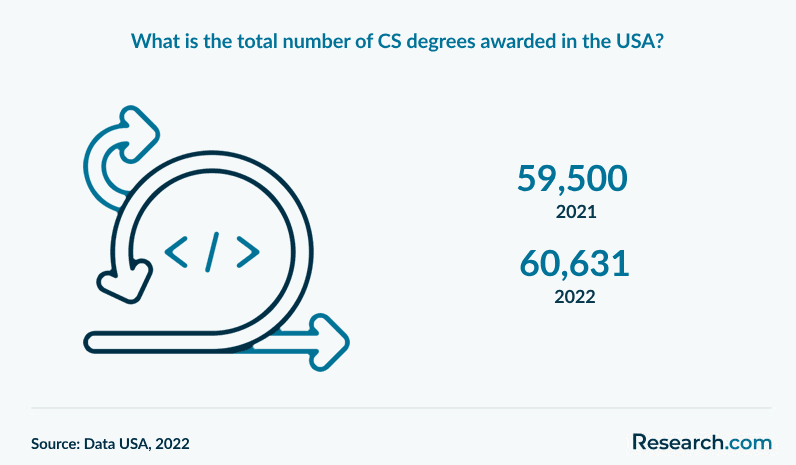
According to Data USA, approximately 59,500 computer science degrees were awarded in 2021, and this increased to approximately 60,631 in 2022. The rise reflects sustained student interest, but it also means graduates should build strong portfolios, internships, and practical skills to stand out.
What career paths are available for graduates of computer science degree programs?
Computer science graduates can pursue technical, analytical, security, management, and research roles. Entry-level access depends on the role, portfolio, internships, certifications, interview performance, and local labor market conditions.
| Career Path | What the Role Does | Preparation That Helps |
| Software Developer | Builds applications, writes code, tests features, fixes bugs, and improves software. | Programming projects, data structures, algorithms, version control, and internships. |
| Data Scientist | Analyzes large datasets to support decisions using statistics and machine learning. | Python, SQL, statistics, data visualization, modeling, and applied projects. |
| Cybersecurity Analyst | Monitors systems, responds to threats, and strengthens security controls. | Networking, secure coding, threat analysis, labs, and security certifications. |
| Web Developer | Creates and maintains websites and web applications. | Frontend, backend, databases, APIs, accessibility, and portfolio sites. |
| Systems Analyst | Evaluates business technology needs and translates them into system requirements. | Business analysis, databases, systems design, communication, and documentation. |
| Database Administrator | Maintains databases for performance, security, availability, and reliability. | SQL, database design, backups, indexing, security, and cloud database tools. |
| Network Engineer | Designs, configures, and maintains communication networks. | Networking, cloud infrastructure, security, troubleshooting, and certifications. |
| Machine Learning Engineer | Builds algorithms and systems that learn from data. | AI, machine learning, statistics, data engineering, and advanced programming. |
| IT Project Manager | Coordinates technology projects, timelines, budgets, teams, and stakeholders. | Technical literacy, project management, communication, and leadership experience. |
| Computer and Information Systems Manager | Plans and oversees technology strategy and IT operations. | Experience, leadership, budgeting, systems knowledge, and sometimes graduate study. |
| Computer and Information Research Scientist | Investigates new computing methods and advances technology research. | Advanced study, research skills, algorithms, theory, and specialized technical depth. |
Total funding for computer science education in U.S. state budgets increased from $20 million in 2019 to $120 million in 2023. Funding doubled to $40 million in 2020, then rose to $70 million in 2021 and $90 million in 2022.
This funding pattern reflects broader recognition that computer science belongs in K-12 education through course access, teacher preparation, and digital skills development. Students who already hold a bachelor’s degree and want advanced technical preparation may also compare the easiest masters degrees while being careful to confirm whether a specific master’s program provides enough computer science depth for their goals.
What is the job market for graduates with a computer science degree?
According to the U.S. Bureau of Labor Statistics (BLS), employment in computer and information technology occupations is projected to grow by 15% from 2021 to 2031. Demand is connected to software development, cybersecurity, data analytics, cloud systems, automation, and digital transformation across industries.
The job market can be strong, but competition varies by role. Entry-level software positions may require portfolios, internships, coding interview practice, and proof that candidates can build working systems. Specialized roles in data science, AI, cloud architecture, or cybersecurity may require additional coursework, certifications, graduate study, or professional experience.
| Role | Salary Figure Cited | What Can Affect Pay |
| Software Engineer | Average annual salary of around $109,020 | Programming skill, location, employer size, product area, and experience. |
| Data Scientist | Median salary of about $131,490 | Machine learning skill, statistics, industry, graduate preparation, and data tools. |
| Information Security Analyst | Average salary of approximately $112,000 | Security certifications, incident response experience, cloud security, and industry. |
| Cloud Architect | Average annual salary of $218,609 | Cloud platform expertise, enterprise architecture, leadership, and certifications. |
| Mobile Application Developer | Average salary of $116,852 | Platform expertise, app portfolio, backend integration, and product experience. |
| Network Architect | Around $164,694 on average | Enterprise networking, cloud networking, security, and infrastructure experience. |
| Database Developer | Around $100,919 per year | SQL skill, database design, performance tuning, cloud databases, and industry. |
| Web Developer | About $80,730 | Frontend/backend depth, portfolio, frameworks, accessibility, and location. |
These salary examples vary by experience, location, industry, and employer. Students should use them as planning references rather than promises.
What Factors Drive the Cost of an Online Computer Science Degree?
The cost of an online computer science degree is shaped by tuition model, number of credits, transfer policy, fees, textbooks, software, academic calendar, and whether the school charges different rates for in-state and out-of-state students. Some programs bill per credit, while others use subscription or term-based tuition. Students comparing computer science degree cost should calculate the total price to graduation, not only the advertised rate.
| Cost Driver | What to Check |
| Per-credit tuition | Multiply tuition by required credits after transfer credits are applied. |
| Term-based tuition | Estimate how many terms you realistically need, especially if self-paced. |
| Fees | Look for technology, platform, proctoring, graduation, lab, or course fees. |
| Transfer credits | Confirm accepted credits in writing before committing. |
| Course retakes | Failed or withdrawn technical courses can raise total cost. |
| Work schedule | Reducing work hours to study can create indirect financial pressure. |
How can a cybersecurity specialization impact my career trajectory?
A cybersecurity specialization can help computer science students move toward roles that focus on risk, defense, secure systems, incident response, and compliance. The specialization is especially useful for students who enjoy networks, operating systems, threat analysis, and investigative problem-solving. It can also make a general computer science degree more targeted for employers that need security-aware developers and analysts.
Students who want deeper preparation can compare affordable graduate options such as the cheapest online master's in cyber security. Before enrolling, verify whether the curriculum includes hands-on labs, secure coding, network security, cloud security, and incident response rather than only policy-level coursework.
How do you evaluate the credibility and quality of online computer science programs?
Start with accreditation. Then examine curriculum depth, faculty qualifications, technical support, student outcomes, transfer policies, and career services. A credible online program should teach the same core competencies students need in campus programs: programming, algorithms, data structures, systems, databases, software engineering, and applied projects.
Comparing computer science with related technology programs can also clarify fit. For students who want a more applied IT direction, online colleges for information technology may offer alternatives that focus more on systems, support, networks, and cloud operations.
Could specializing in game development boost my computer science career?
Game development can be a strong specialization for students who want to combine programming with interactive design, graphics, simulation, physics, and real-time systems. It may support work not only in entertainment but also in training simulation, virtual reality, education technology, and visualization. The best programs help students build a portfolio with playable projects and experience using industry-relevant tools.
Students interested in this route can compare game development degree programs. Because the field can be competitive, students should also build general software engineering skills so they are not limited to one industry.
How can a computer science degree open interdisciplinary career avenues?
Computer science often overlaps with engineering, healthcare, finance, logistics, education, media, and public policy. Programming, databases, cybersecurity, automation, and analytics can be applied wherever organizations need better systems and data-driven decisions. Students who want hardware or infrastructure-oriented roles may combine computing with engineering concepts such as circuits, robotics, embedded systems, and IoT.
For students interested in that combination, an online electrical engineer degree may provide complementary preparation in systems that connect software and hardware.
Is a Computer Science Degree Worth the Investment?
A computer science degree can be worth the investment when the program is accredited, affordable for your financial situation, aligned with your target role, and strong enough to help you build marketable technical skills. The degree may support access to software, data, security, systems, and management roles, but outcomes are not automatic. Employers often look for projects, internships, problem-solving ability, communication skills, and technical interview readiness.
To evaluate return on investment, compare total program cost with likely entry-level opportunities, time to completion, debt, salary expectations, and advancement potential. Students focused on earnings can review roles associated with a high computer science salary, while remembering that pay varies by specialization, location, experience, and employer.
Can an online degree in artificial intelligence enhance my computer science career?
Artificial intelligence training can strengthen a computer science background for students who want to work with machine learning, automation, analytics, natural language processing, robotics, or intelligent applications. A focused online degree in artificial intelligence may help students develop more advanced skills in algorithms, data analytics, machine learning models, and automation tools.
AI coursework is most valuable when students already have or are building a foundation in programming, statistics, data structures, algorithms, and software engineering. Students should avoid programs that emphasize AI buzzwords without enough hands-on modeling, coding, and data work.
What emerging trends should computer science graduates prepare for?
Computer science graduates should expect continued change in tools, platforms, and employer expectations. Areas such as artificial intelligence, cybersecurity, cloud computing, edge computing, blockchain, data infrastructure, automation, and privacy-aware systems are reshaping technical work. Graduates who keep learning through projects, certifications, open-source contributions, professional communities, and technical documentation will be better positioned than those who stop learning after graduation.
Students deciding whether the major still fits their goals can compare career value, competition, and alternatives by reviewing whether is computer science still a good major.
What alternative pathways can offer a rapid entry into computer science?
A four-year computer science degree is not the only route into technology. Students who need a faster or lower-cost entry point may consider certificates, vendor certifications, boot camps, associate degrees, apprenticeships, or self-directed portfolio building. These options can be useful for web development, IT support, QA testing, help desk work, junior development, or technical operations, depending on employer expectations.
| Pathway | Typical Advantage | Best Use Case | Limitation |
| Associate degree | Shorter and often less expensive than a bachelor’s degree. | Entry-level roles or transfer preparation. | May not satisfy bachelor’s degree preferences for some roles. |
| Boot camp | Focused technical training over a shorter period. | Portfolio development in web, software, data, or cybersecurity basics. | Quality and outcomes vary widely. |
| Certificate | Targets one skill area quickly. | Upskilling in cloud, cybersecurity, programming, or data tools. | Usually narrower than a degree. |
| Self-study portfolio | Low-cost and flexible. | Motivated learners who can build and document projects. | Requires discipline and may lack formal credential recognition. |
Students interested in a flexible two-year route can explore two-year degree programs online as a possible starting point.
Can integrating computer science with engineering studies offer a competitive edge?
Combining computer science with engineering can be valuable for students interested in robotics, embedded systems, automation, smart infrastructure, IoT, manufacturing technology, and hardware-software integration. This combination helps students understand not only code but also the physical systems that code controls.
Students considering this direction should compare accreditation, lab requirements, engineering coursework, faculty expertise, and career support. Reviewing the most affordable online schools for engineering can help identify cost-conscious options that complement computer science study.
Can a computer science degree drive success in health informatics?
A computer science degree can support careers in health informatics by preparing students to work with healthcare data, patient information systems, cybersecurity, software integration, analytics, and privacy-sensitive technology. Healthcare organizations need professionals who understand both technical systems and the operational realities of care delivery.
Students who want a more targeted healthcare technology path can review online programs in health informatics. This can be especially useful for students who want to combine programming, analytics, compliance awareness, and healthcare systems knowledge.
Common Mistakes to Avoid When Choosing an Easy Computer Science Degree
| Mistake | Why It Can Hurt You | Better Approach |
| Assuming “easy” means better | A weak program may leave you unprepared for technical roles. | Look for manageable structure plus rigorous core coursework. |
| Ignoring accreditation | Credits may not transfer, and financial aid or employer recognition may be affected. | Verify institutional accreditation before applying. |
| Comparing tuition only | Fees, transfer credits, course retakes, and time to graduation change total cost. | Calculate total cost through completion. |
| Choosing a specialization too early | You may commit before understanding what kind of technical work you enjoy. | Take core courses first, then specialize based on strengths and goals. |
| Overlooking math requirements | Discrete math, calculus, and theory can become barriers if you are unprepared. | Use placement tools, tutoring, and refresher courses. |
| Assuming online means self-paced | Many online programs still have weekly deadlines and scheduled terms. | Ask whether courses are asynchronous, synchronous, or competency-based. |
| Relying only on rankings | A ranked school may not be affordable, flexible, or strong in your area of interest. | Compare fit, cost, curriculum, support, and outcomes. |
| Expecting salary guarantees | Pay depends on skills, experience, location, employer, and specialization. | Build a portfolio, pursue internships, practice interviews, and network. |
References
- Brookings Institution. (2022). Exploring the state of computer science education amid rapid policy expansion. Brookings Institution.
- Code.org. (2023). State of Computer Science Education. Code.org.
- Code.org, Computer Science Teachers Association, & Expanding Computing Education Pathways Alliance. (2023). 2023 State of Computer Science Education Report. Code.org.
- Data USA. (2022). Computer Science. Data USA.
- Indeed.com. (2024). 20 Computer Scientist Degree Jobs That Pay Well. Indeed.com.
- Nexford University. (2024). 15 Highest Paying Computer Science Jobs & Salaries 2024. Nexford University.
- Salary.com. (2024). Computer Science Salaries by education, experience, location and more. Salary.com.
- U.S. Bureau of Labor Statistics. (2023). Occupational Outlook Handbook: Computer and Information Technology Occupations. U.S. Bureau of Labor Statistics.
Key Insights
- The easiest computer science degree is usually not the least rigorous one. It is the program that offers the right balance of accreditation, flexibility, support, transfer credit, applied projects, and realistic pacing.
- Students should define “easy” carefully. A program may be easier to manage because it is online, accelerated, competency-based, or transfer-friendly, but credible computer science study still requires coding, math, systems thinking, and sustained practice.
- Computer science degree cost varies by institution, location, and level: Associate's ($3,000-$10,000/year), Bachelor's ($10,000-$35,000/year, public vs. private), and Master's ($15,000-$40,000/year, with potential increases for specialization). Online options may reduce some costs, but fees and transfer policies matter.
- Associate degrees, boot camps, and certificates can provide faster entry into some technology roles, but a bachelor’s degree usually offers broader preparation for software engineering, data science, cybersecurity, AI, systems, and graduate study.
- The availability of foundational computer science courses in U.S. high schools increased from 47% in 2018 to 57.5% in 2023, but more than 40% of high schools still lacked such offerings, meaning many college students may need extra preparation.
- Total funding for computer science education in U.S. state budgets rose from $20 million in 2019 to $120 million in 2023, with increases to $40 million in 2020, $70 million in 2021, and $90 million in 2022.
- The job market offers many possible paths, including software engineering, data science, cybersecurity, cloud architecture, mobile development, network architecture, database development, and web development. Salary outcomes vary and are not guaranteed.
- Salary examples cited in this guide include $109,020 for software engineers, $131,490 for data scientists, $112,000 for information security analysts, $218,609 for cloud architects, $116,852 for mobile application developers, $164,694 for network architects, $100,919 for database developers, and $80,730 for web developers.
- According to the U.S. Bureau of Labor Statistics (BLS), employment in computer and information technology occupations is projected to grow by 15% from 2021 to 2031.
- The smartest next step is to compare programs by accreditation, total cost, course requirements, math expectations, support services, transfer credits, specialization options, and career outcomes before applying.
Other Things You Should Know About Online Computer Science Degrees
Degrees like Information Systems or IT Management often require fewer math courses compared to traditional Computer Science degrees. In 2027, these programs typically include only basic math topics like statistics and algebra, making them attractive to those looking to minimize math-heavy coursework.
The key prerequisites for the easiest computer science degree programs in 2027 typically include a high school diploma or GED, basic proficiency in mathematics and computer literacy, and possibly introductory courses in programming. Some programs may also require standardized test scores.


