
2027 Best Bachelor's Degree Programs in Database Management

Co-Founder and Chief Data Scientist
Choosing a bachelor's degree in database management is not just a question of which school teaches SQL. The better question is whether a program will prepare you to design reliable data systems, protect sensitive information, work with cloud platforms, and translate business needs into usable databases. For students comparing computer science, information systems, data analytics, and database technology degrees, the options can look similar on the surface but lead to different career paths.
This guide explains what a database management bachelor's degree covers, how long it takes, what it can cost, which programs stand out for 2027, and how to compare degree options based on accreditation, curriculum, hands-on learning, career support, and long-term return on investment. It is designed for students who want a data-focused technology career but need a practical way to decide whether database management is the right academic path.
Quick Answer: Is a Bachelor's Degree in Database Management Worth Considering?
A bachelor's degree in database management can be a strong choice for students who want careers involving database administration, data architecture, data analytics, cloud database systems, cybersecurity, or enterprise information systems. Most programs require about 120 semester credits and usually take four years to complete. Salaries vary by role, employer, location, and experience, but database-focused careers can offer strong earning potential: database administrators earned a median salary of $101,510, and database architects made $134,700 as of May 2023. The field is projected to grow 9% from 2023 to 2033.
The degree is most useful when the program includes SQL, database design, data modeling, security, cloud technologies, programming, analytics, and real-world projects. Students who want a faster, narrower path into one specific technical role may also compare the degree with bootcamps, certificates, or associate-level options.
Why Students Choose a Bachelor's Degree in Database Management
- It connects technical and business skills. Database professionals do not only store information; they help organizations make data accessible, accurate, secure, and useful for decision-making.
- It can lead to multiple career directions. Graduates may pursue work as database administrators, database developers, data analysts, information security analysts, market research analysts, software developers, or systems professionals.
- It builds skills used across industries. Finance, healthcare, education, retail, government, technology, and corporate operations all depend on structured and secure data systems.
- It supports long-term advancement. Students can later specialize in cloud databases, data architecture, business intelligence, cybersecurity, AI, or management roles.
- It aligns with data-driven hiring needs. Professionals in computer and information technology fields earned a median annual salary of $104,420 as of May 2023, and database-related jobs remain important as organizations expand digital operations.
What can I expect from a bachelor's degree in database management?
A bachelor's degree in database management teaches students how to organize, maintain, secure, and optimize data systems. The curriculum usually combines computer science fundamentals with database-specific training in SQL, relational database design, data modeling, database administration, data security, analytics, and enterprise systems. Many programs also include programming, networking, cloud computing, statistics, and business information systems.
Most bachelor's programs include 120 semester credits and are designed for four years of full-time study. Some schools offer database management as a standalone major, while others place it inside a broader computer science, information technology, information systems, data science, or data analytics program. Students should review the actual course list carefully because two degrees with similar titles may emphasize very different outcomes.
| Program feature | What it usually means for students | Why it matters |
| Database systems coursework | Training in relational databases, SQL, data models, and database design | Builds the foundation for database administrator, developer, and analyst roles |
| Programming and computer science | Courses in Python, Java, systems architecture, networking, or software development | Helps graduates work with applications, scripts, APIs, and technical teams |
| Security and privacy | Coverage of access control, data protection, cybersecurity, and compliance concepts | Prepares students to manage sensitive organizational data responsibly |
| Capstone, internship, or lab work | Applied projects using real or simulated datasets and database platforms | Gives students portfolio evidence and practical experience before graduation |
| Specialization options | Tracks such as analytics, cloud computing, business intelligence, or data engineering | Allows students to align the degree with a specific career direction |
Where can I work with a bachelor's degree in database management?
Graduates can work anywhere organizations collect, store, process, protect, or analyze information. Common employment settings include technology companies, banks, insurance firms, hospitals, universities, government agencies, consulting firms, retailers, manufacturers, and corporate IT departments. Database administrators held 80,500 jobs in 2023, with major employers including computer systems design at 13%, finance and insurance at 13%, and education at 10%. Database architects held 61,400 jobs, with employment concentrated in computer systems design at 22% and finance at 17%.
The work can vary widely by industry. A healthcare employer may need database professionals to protect patient records and support reporting systems. A financial services company may focus on transaction data, risk systems, fraud monitoring, and compliance. A retailer may use database professionals to support customer analytics, inventory, personalization, and e-commerce platforms.
How much can I make with a bachelor's degree in database management?
Salary outcomes depend on the role, employer, region, experience level, technical platform, certifications, and whether the position focuses on administration, architecture, analytics, security, or engineering. As of May 2023, database administrators earned a median salary of $95,070 in one cited occupational figure, while database architects earned $134,700. Other salary figures cited for database administrators include $101,510. Entry-level database managers typically start between $63,000 and $70,000, while senior-level professionals can earn $125,000 to $155,000 per year.
Industry also influences pay. Database administrators in computer systems design earn a median of $125,650, while those in education make around $82,910. Database architects in computing infrastructure roles earn the highest cited median salary at $151,890. Skills in Oracle, SQL Server, cloud platforms, automation, security, and performance tuning can affect compensation, but no degree guarantees a specific salary.
| Career or salary category | Salary figure cited | Decision note |
| Database administrator | $101,510 | Useful benchmark for students considering administration-focused roles |
| Database administrator | $95,070 | Shows that database salary estimates can vary by source and occupational grouping |
| Database architect | $134,700 | Often aligns with more advanced design, architecture, and enterprise data responsibilities |
| Entry-level database manager | $63,000 to $70,000 | More realistic planning range for new graduates entering the market |
| Senior-level professional | $125,000 to $155,000 | Typically requires experience, specialized skills, and stronger technical judgment |
- Best Bachelor's Degree Programs in Database Management for 2027
- How long does a bachelor's degree in database management take?
- How much does a bachelor's degree in database management cost?
- What financial aid can database management students use?
- What are the typical admission requirements?
- What courses are included in a database management bachelor's degree?
- What database management specializations are available?
- What trends are changing database management careers?
- Is graduate school helpful for database management careers?
- Should database students add cybersecurity training?
- How is AI changing database management?
- What soft skills do database professionals need?
- How does database management support game development?
- How to choose the right bachelor's degree in database management
- What challenges do database professionals face?
- Can online AI education strengthen database skills?
- What jobs can graduates pursue?
- What is the job market for database management graduates?
- Can specialized disciplines improve a database management career?
Best Bachelor's Degree Programs in Database Management for 2027
How do we rank the programs?
Because tuition, time, and career outcomes matter, this ranking uses transparent education data rather than promotional claims. Research.com evaluates programs using sources such as the IPEDS database, Peterson's database, the College Scorecard database, and The National Center for Education Statistics. These sources help compare affordability, institutional quality, student outcomes, and program characteristics. Readers who want more detail can review Research.com's methodology page.
Use this list as a starting point, not as the only factor in your decision. A highly ranked school may still be the wrong fit if it does not offer the database, cloud, security, or analytics coursework you need for your target role.
| School | Program focus | Credits or cost detail cited | Accreditation cited |
| Dordt University | Data science with database management skills | 120 credits; $17,000 per semester | Higher Learning Commission (HLC) |
| Aquinas College | Data analytics with database and business applications | 47 credits listed; $552 per credit | Higher Learning Commission (HLC) |
| University of Michigan-Ann Arbor | Data science with database systems, data mining, and information retrieval | 120 credits; $16,000-$18,000 per year in-state; $53,000-$56,000 per year out-of-state | Higher Learning Commission (HLC) |
| Northeastern University | Data science with data collection, storage, and retrieval | 130 credits; $28,250 per term | New England Commission on Higher Education (NECHE) |
| Florida Polytechnic University | Data science with database management, AI applications, and concentrations | 120 credits; $105 per credit in-state; $615 per credit out-of-state | Southern Association of Colleges and Schools Commission on Colleges (SACSCOC) |
| Rochester Institute of Technology | Information technology with database technology specialization | 120 credits; $49,420 in-state; $52,420 out-of-state | Middle States Commission on Higher Education (MSCHE) |
| Baker College | Database technology for students with prior coursework or an associate degree | 120 credits; $450 per credit hour; $13,500 per year for 30 credit hours | Higher Learning Commission (HLC) |
| University of Miami | Business administration with Computer Information Systems focus | 120 credits; $2,530 per credit online BBA; $2,421 per credit full-time BBA; $59,926 international students | Association to Advance Collegiate Schools of Business (AACSB) |
1. Dordt University
Dordt University is a private Christian college in Sioux Center, Iowa, offering a bachelor's degree in data science with coursework that supports database-focused careers. The program combines computer science, statistics, and mathematics, helping students build a foundation for data analytics, database administration, and related technical roles. Students can study database design, SQL, and network systems administration while gaining applied experience through internships and faculty-led research.
- Required Credits to Graduate: 120
- Cost: $17,000 per semester
- Accreditation: Higher Learning Commission (HLC)
2. Aquinas College
Aquinas College in Grand Rapids, Michigan, offers a BS in Data Analytics that brings together programming, business, marketing, and data interpretation. Students study database theory, data structures, and analytics tools, while a lab requirement helps them practice retrieval, reporting, and database management tasks. Internships and capstone work give students opportunities to apply classroom learning to practical data problems.
- Required Credits to Graduate: 47
- Cost: $552 per credit
- Accreditation: Higher Learning Commission (HLC)
3. University of Michigan-Ann Arbor
The University of Michigan offers a BSE/BS in Data Science through collaboration between the College of Engineering and the College of Literature, Science, and the Arts. Students complete core work in data mining, database management systems, and information retrieval, with elective options in AI and machine learning. The program is suited for students who want a rigorous data science pathway with database management as part of a broader technical education.
- Required Credits to Graduate: 120
- Cost: $16,000-$18,000 per year (in-state); $53,000-$56,000 per year (out-of-state)
- Accreditation: Higher Learning Commission (HLC)
4. Northeastern University
Northeastern University offers a BS in Data Science with attention to data collection, storage, retrieval, and practical learning. Students study database management, data structures, and machine learning while using labs, internships, and experiential education to connect theory with workplace expectations. Electives may help students tailor the degree toward industries such as healthcare data management.
- Required Credits to Graduate: 130
- Cost: $28,250 per term
- Accreditation: New England Commission on Higher Education (NECHE)
5. Florida Polytechnic University
Florida Poly offers a BS in Data Science that includes statistics, machine learning, and database management. Students can choose concentrations such as big data analytics, health systems engineering, and intelligent mobility. The program also incorporates internships, faculty research, and specialized coursework related to AI applications.
- Required Credits to Graduate: 120
- Cost: $105 per credit (in-state); $615 per credit (out-of-state)
- Accreditation: Southern Association of Colleges and Schools Commission on Colleges (SACSCOC)
6. Rochester Institute of Technology
Rochester Institute of Technology offers a Bachelor of Science in Information Technology with an option to specialize in database technology. Students work with SQL, data modeling, database connectivity, and practical database applications. The curriculum emphasizes hands-on projects and industry connections, which can be especially valuable for students who want applied IT roles.
- Required Credits to Graduate: 120
- Cost: $49,420 (in-state); $52,420 (out-of-state)
- Accreditation: Middle States Commission on Higher Education (MSCHE)
7. Baker College
Baker College offers a BS in Database Technology intended for students who already have an associate degree or previous computer science coursework. The program emphasizes database fundamentals, database management, administration, and programming. It may be a strong fit for learners seeking a focused database technology pathway rather than a broad data science degree.
- Required Credits to Graduate: 120
- Cost: $450 per credit hour; $13,500 per year (30 credit hours)
- Accreditation: Higher Learning Commission (HLC)
8. University of Miami
The University of Miami offers Bachelor of Business Administration and Bachelor of Science in Business Administration options with a focus on Computer Information Systems (CIS). Students study database systems management, information system design, and analytics through a business-oriented lens. The program is accredited by the Association to Advance Collegiate Schools of Business (AACSB), making it especially relevant for students who want to combine database skills with business operations, management, or consulting.
- Required Credits to Graduate: 120
- Cost: $2,530 per credit (Online BBA); $2,421 per credit (Full-time BBA); $59,926 (International students)
- Accreditation: Association to Advance Collegiate Schools of Business (AACSB)
How long does it take to complete a bachelor's degree in database management?
Most bachelor's degrees in database management take four years for full-time students. The common requirement is around 120 semester credits, although some programs list different credit totals for a major, concentration, or degree structure. Students who attend part time, change majors, repeat courses, or add internships may take longer.
| Enrollment path | Typical timeline | Best for |
| Full-time bachelor's program | About four years | Students who can take a standard course load each term |
| Part-time study | Longer than four years | Working adults, caregivers, and students balancing major obligations |
| Transfer pathway | May shorten the timeline | Students with prior college coursework or an associate degree |
| Accelerated format | Some universities offer three-year options | Highly organized students who can handle a faster pace |
| Internship-heavy program | May extend or reshape the timeline | Students who value work experience and employer connections |
Students aiming for technical leadership, product management, IT management, or analytics leadership may later consider an online MBA in information systems to combine database knowledge with organizational strategy and management skills.
What is the average cost of a bachelor's degree in database management?
The price of a bachelor's degree in database management can vary sharply by school type, residency status, delivery format, and financial aid. Annual tuition examples in this guide range from $16,000 to $56,000 per year, with some broader cost estimates placing annual costs between $20,000 and $30,000 and total four-year costs between $64,000 and $224,000. Students should treat published tuition as only one part of the cost calculation.
Cost factors to compare before enrolling
- Public or private institution: Public universities often have lower tuition for in-state students, while private colleges may charge higher sticker prices but sometimes offer institutional aid.
- Residency status: Out-of-state tuition at public universities can be much higher than in-state rates.
- Online or campus format: Online programs may reduce commuting or housing costs, but technology fees and per-credit tuition still matter.
- Transfer credit policy: A generous transfer policy can reduce total credits needed and lower the final cost.
- Required software, hardware, and lab fees: Database and data science programs may require specific tools, cloud access, or computing resources.
- Time to graduation: Taking extra semesters can increase tuition, fees, and living expenses.
Example tuition figures cited
- In-State Public University: $16,000 - $18,000 per year
- Out-of-State Public University: $53,000 - $56,000 per year
If affordability is your first priority, compare database-related programs with a cheap online information technology degree. An IT degree with strong database coursework may offer similar career preparation at a lower cost, depending on the school and curriculum.
What are the financial aid options for students enrolling in a bachelor's degree in database management?
Database management students may use the same major types of financial aid available to other undergraduate students: grants, scholarships, federal student aid, work-study, loans, institutional aid, and employer tuition assistance. The best approach is to compare net price, not just tuition, because scholarships and grants can change the real amount a student pays.
Grants and scholarships
Grants and scholarships are usually the most favorable forms of aid because they do not need to be repaid when students meet the award conditions. Federal Pell Grants and state grants are commonly based on financial need. Colleges, private foundations, employers, and professional groups may also offer merit-based or field-specific scholarships for students in information technology, computer science, cybersecurity, data analytics, or database management.
Federal student aid
Students should file the Free Application for Federal Student Aid (FAFSA) to determine eligibility for federal aid. Depending on eligibility, aid may include:
- Grants: Need-based support that generally does not require repayment.
- Work-study programs: Part-time employment opportunities that help students pay education-related expenses.
- Direct loans: Subsidized or unsubsidized loans with federal repayment structures.
Institutional aid and employer assistance
Colleges may offer their own grants, scholarships, or campus employment opportunities. Working adults should also ask employers about tuition reimbursement, professional development funds, or education assistance programs, especially if the degree supports current IT, analytics, cybersecurity, or operations responsibilities.
| Financial aid option | Does it need repayment? | What to check |
| Federal and state grants | Usually no | Eligibility rules, enrollment requirements, and annual limits |
| Scholarships | Usually no | Minimum GPA, major requirements, renewal rules, and deadlines |
| Work-study | No, but requires work hours | Availability of relevant campus or remote positions |
| Federal loans | Yes | Total borrowing, interest, repayment plans, and graduation timeline |
| Employer tuition assistance | Usually no if conditions are met | Grade requirements, repayment clauses, and approved program lists |
What are the prerequisites for enrolling in a bachelor's degree in database management?
Most bachelor's programs require a high school diploma or equivalent. Selective schools may also review GPA, standardized test policies, math preparation, science coursework, essays, recommendations, and prior technical experience. Although many programs teach beginners, students usually perform better if they enter with comfort in mathematics, problem-solving, and basic computing.
Common admission or preparation requirements
- High school diploma or equivalent: This is the basic requirement for most undergraduate programs.
- Computer science or IT exposure: Prior coursework is often helpful, even when it is not mandatory.
- Basic programming familiarity: Experience with Python, Java, or SQL can make introductory courses easier to manage.
- Microsoft Office proficiency: Many programs expect students to use Word, Excel, and PowerPoint for assignments and presentations.
- Math preparation: Algebra and statistics are especially useful for database design, analytics, and data modeling.
- Placement testing: Some institutions use math or computing assessments to place students into the right starting courses.
Students who already have strong preparation and want a compressed timeline may compare traditional programs with an accelerated computer science degree. This can be useful if the program still includes the database, systems, and applied project work needed for the student's career goal.
What courses are typically in a bachelor's degree in database management?
A database management bachelor's degree usually blends database theory, technical implementation, security, analytics, and software fundamentals. The strongest programs teach students not only how to query a database but also how to design reliable systems, protect data, document processes, and support business decisions.
Courses commonly found in database management programs
- Database Management Systems: Introduces relational database models, SQL, NoSQL concepts, database architecture, and the role of DBMS platforms.
- Data Visualization and Reporting: Teaches students to turn data into dashboards, reports, and business intelligence outputs.
- AI, Machine Learning, and Data Science: Covers predictive analytics, machine learning tools, and AI applications that interact with data systems.
- Data Administration and Security: Focuses on managing data assets, protecting access, improving efficiency, and maintaining secure database operations.
- Cybersecurity and Data Privacy: Examines safeguards for sensitive data, secure handling practices, and risk reduction strategies.
- Computer Science Fundamentals: Provides programming, systems, networking, and architecture knowledge through tools such as Python and Java.
Students who enjoy programming as much as data management should also understand how database skills connect to software work. Many applications rely on well-designed data storage and retrieval, and related software roles can be associated with a competitive computer programmer salary.
What types of specializations are available in a bachelor's degree in database management?
Specializations help students shape a database management degree around a specific job market. A student interested in cloud infrastructure should choose different electives from a student who wants business intelligence or data analytics. Before selecting a concentration, review job postings for your target roles and look for repeated skills, tools, and responsibilities.
| Specialization | Main focus | Good fit for students who want to... |
| Database Administration (DBA) | Maintenance, access control, backup, recovery, security, and performance | Keep database systems reliable, secure, and available |
| Data Analytics | SQL, statistics, dashboards, reporting, and insight generation | Use data to support business decisions |
| Data Engineering | Data pipelines, movement, processing, and integration | Build systems that prepare data for analytics or applications |
| Data Modeling | Logical and physical structures for organizing information | Design efficient, accurate, and scalable database structures |
| ETL Development | Extract, transform, and load processes across data sources | Move and clean data for warehouses, reports, and applications |
| Data Architecture | Enterprise-level storage, access, governance, and design strategy | Plan large-scale data systems and standards |
| Business Intelligence (BI) Development | Dashboards, metrics, reporting tools, and decision support | Translate raw data into useful business views |
| Cloud Database Administration | Databases hosted on AWS, Azure, Google Cloud, or similar platforms | Manage scalable cloud-based data environments |
Students leaning toward analytics may also compare database programs with a data analytics degree online, especially if they want more emphasis on visualization, machine learning, and big data processing.
Students who mainly want to build web applications should compare the four-year degree with practical training options such as the best full stack web developer bootcamp. Bootcamps are narrower and faster, while bachelor's programs usually provide broader technical and academic preparation.
What Are the Emerging Trends in Database Management Careers?
Database management is changing as organizations move more workloads to the cloud, adopt larger analytics systems, and explore AI-assisted operations. Employers increasingly value professionals who understand traditional relational databases, NoSQL systems, cloud services, automation, security, and data governance. These trends can create opportunities, but they also raise expectations: graduates may need to keep learning after the degree through projects, certifications, workshops, and platform-specific training.
Students who want to position themselves for advanced technical roles can review related pathways among the highest paying jobs in computer science field, then compare the skills listed in those roles with the courses and electives offered by prospective programs.
Should I Pursue a Graduate Degree to Enhance My Database Management Career?
A graduate degree is not always required for database management work, but it can help professionals who want deeper specialization, research-oriented roles, senior architecture responsibilities, leadership positions, or advanced work in data science, cloud computing, cybersecurity, or AI. The right time for graduate school depends on your career goal and your current experience. Some students benefit from working first, identifying a specialty, and then choosing a master's program that fills a specific skill gap.
Students comparing postgraduate options can explore online master of computer science programs to see how advanced curricula address algorithms, systems, databases, AI, and software engineering.
Graduate school is not the only way to specialize. Learners who prefer front-end interface work may be better served by a focused program such as the best front end web developer bootcamp, which is designed around user-facing web development skills and portfolio building rather than database administration.
Should I Consider an Online Cybersecurity Degree to Complement My Database Management Studies?
Cybersecurity pairs naturally with database management because databases often contain sensitive financial, personal, health, academic, or operational information. Students who understand access control, encryption concepts, monitoring, privacy, and security policy can be more valuable in roles where database reliability and data protection are both essential. This combination is especially useful for careers in healthcare, finance, government, cloud systems, and compliance-heavy environments.
Students seeking cost-conscious cybersecurity training can compare options such as the cheapest online cyber security degree. Before enrolling, verify that the program's courses complement your database goals rather than repeating content you already know.
How Do Emerging AI Technologies Impact Database Management?
AI is influencing database management through automation, predictive analytics, anomaly detection, monitoring, and faster data processing workflows. AI tools may help identify unusual database activity, recommend performance improvements, support data cleaning, or assist with query generation. However, these tools do not remove the need for database professionals who understand data quality, architecture, security, governance, and business context.
Students who want to deepen their AI expertise after building database fundamentals may consider an online masters in AI. This path is most relevant for professionals who want to work at the intersection of databases, machine learning systems, automation, and advanced analytics.
What soft skills are crucial for success in database management?
Technical skill gets database professionals into the field, but soft skills often determine how far they advance. Database work requires communication with software teams, executives, analysts, security staff, vendors, and non-technical users. Professionals must explain trade-offs clearly, document systems accurately, prioritize requests, and solve problems without disrupting business operations.
- Communication: Explaining database issues, risks, and design choices in language non-technical stakeholders can understand.
- Collaboration: Working with developers, analysts, security teams, and business units to support shared goals.
- Critical thinking: Diagnosing performance problems, data inconsistencies, access issues, or system failures.
- Adaptability: Learning new platforms, security expectations, cloud services, and automation tools as they evolve.
- Attention to detail: Avoiding errors in schema design, permissions, backups, migrations, and data handling.
Professionals who want to strengthen both technical and analytical capabilities after the bachelor's degree may compare online masters in data science options.
How Does Database Management Benefit Game Development Projects?
Game development depends on reliable data systems for player accounts, saved progress, in-game purchases, leaderboards, matchmaking, telemetry, live updates, and user behavior analysis. Strong database management can improve scalability, reduce delays in data retrieval, support analytics, and help developers understand how players interact with a game. Poor data design, by contrast, can create lag, lost progress, reporting errors, or frustrating user experiences.
Students interested in the intersection of creative technology and backend systems can explore the best online game design schools and compare whether those programs include database, analytics, or server-side coursework.
How to Choose the Best Bachelor's Degree in Database Management
The best database management degree is the one that fits your target role, budget, schedule, and learning style. Do not choose only by school name or ranking. Review the curriculum, accreditation, projects, faculty background, internship access, platform exposure, career support, and total cost after aid.
Key factors to evaluate
- Accreditation: Confirm institutional accreditation and, when relevant, programmatic accreditation. Some computing programs may reference ABET accreditation, which can signal that a program has met recognized quality standards.
- Curriculum depth: Look for database design, SQL, data modeling, database administration, warehousing, security, cloud databases, and platforms such as MySQL, Oracle, and PostgreSQL.
- Hands-on learning: Prioritize internships, labs, capstones, database projects, and applied assignments using realistic datasets.
- Faculty expertise: Review whether instructors have database, systems, analytics, cybersecurity, or industry experience.
- Career support: Ask about job placement services, employer partnerships, alumni networks, internship pipelines, and resume or portfolio support.
- Specialization options: Choose electives that match your goals in cloud databases, data analytics, BI, cybersecurity, or data engineering.
- Industry relevance: Confirm that the program addresses current tools and practices, including cloud computing, machine learning concepts, and database security.
Common degree paths to compare
| Degree option | Primary strength | Best fit |
| Bachelor of Science in Computer Science with a Database Management Concentration | Strong computing theory, programming, algorithms, and database electives | Students who want flexible technical options, including software and systems roles |
| Bachelor of Science in Information Systems with a Database Administration Focus | Business systems, IT operations, and database management in organizations | Students interested in enterprise IT, operations, and business-facing technology roles |
| Bachelor of Science in Data Analytics with a Database Management Emphasis | Analytics, reporting, statistics, and data interpretation | Students who want analyst, BI, or data-driven decision-support roles |
Questions to ask before applying
- Is the institution properly accredited?
- Does the curriculum include SQL, database design, data modeling, administration, cloud databases, and security?
- Which database platforms will I actually use in courses?
- Are internships, capstones, or portfolio projects required?
- How many credits can I transfer, and how will they apply to the major?
- What is the total cost after grants, scholarships, fees, books, software, and living expenses?
- What career services are available for online and campus students?
- Do graduates pursue database administration, analytics, software, security, or data engineering roles?
Students comparing tuition across computing programs can review computer science degree cost information to understand how database-related options may fit into a broader affordability plan.
If your main goal is fast entry into analytics rather than a full bachelor's degree, compare degree programs with intensive alternatives and ask which is a good bootcamp for data science. Bootcamps can be useful for targeted skills, while bachelor's degrees usually offer broader theory, general education, and long-term academic flexibility.
Common mistakes to avoid
- Choosing by title alone: A program labeled data science, IT, information systems, or database technology may or may not include enough database coursework.
- Ignoring accreditation: Accreditation can affect transfer credit, graduate school eligibility, employer perception, and financial aid access.
- Looking only at tuition: Fees, software, housing, transportation, course materials, and extra semesters can change the real cost.
- Assuming online always means cheaper: Some online programs charge high per-credit rates or additional technology fees.
- Skipping transfer credit review: Students with prior coursework should ask for a formal transfer evaluation before committing.
- Overlooking hands-on work: Database employers often want evidence that you can build, query, secure, and troubleshoot real systems.
- Assuming salary outcomes are guaranteed: Pay depends on experience, location, role, employer, and specialized skills.
What challenges do database management professionals face in today’s digital landscape?
Database professionals work in environments where downtime, poor data quality, weak security, and slow performance can affect entire organizations. Common challenges include protecting data from cyber threats, managing privacy expectations, integrating legacy systems with cloud platforms, supporting larger data volumes, and explaining technical risks to non-technical leaders. Professionals must balance reliability, cost, speed, compliance, and usability.
Because security is now closely tied to database work, some students build defensive skills through cybersecurity training. An option such as an associate in cyber security jobs pathway can help learners understand whether shorter cybersecurity education aligns with their database management goals.
Can Supplementary Online AI Education Enhance Database Management Skills?
Online AI coursework can strengthen a database professional's ability to work with predictive analytics, machine learning workflows, intelligent automation, and data-driven decision systems. This is most useful when the learner already understands database structure, data quality, and security. AI education should not replace database fundamentals; it should build on them.
Students seeking affordable AI-related study can compare cheapest online artificial intelligence degree programs and evaluate whether the coursework includes data infrastructure, machine learning foundations, and practical projects.
What career paths are available for graduates of a bachelor's degree in database management?
A bachelor's degree in database management can lead to technical, analytical, security-focused, and business-facing roles. Some graduates begin in support, junior database, reporting, or analyst positions and move into administration, architecture, engineering, or management as they gain experience.
| Career path | What the role does | Average salary cited |
| Database Manager | Oversees database infrastructure, security, updates, compliance needs, and user training | $63,493 per year |
| Data Analyst | Collects, cleans, analyzes, and reports data to support business decisions | $74,377 per year |
| Data Scientist | Uses statistics, programming, machine learning, and models to find insights in large datasets | $119,380 per year |
| Information Security Analyst | Protects systems and data by monitoring threats, applying security controls, and reducing risk | $90,425 per year |
| Database Administrator (DBA) | Maintains databases, protects integrity, manages backups, supports recovery, and tunes performance | $94,537 per year |
| Data Modeler | Designs data structures and frameworks for efficient storage, retrieval, and processing | $106,740 per year |
| Software Engineer | Builds and maintains applications, including systems that connect to databases | $108,896 per year |
Additional roles graduates may consider
- SQL Developer: Builds queries, stored procedures, and database logic while optimizing performance.
- Computer Systems Analyst: Reviews and improves technology systems, including database-dependent workflows.
- Information Systems Manager: Leads IT and database operations within an organization.
- Database Developer: Designs, creates, and modifies database solutions for business or application needs.
Career growth often depends on building a portfolio of practical work, learning widely used database platforms, earning relevant certifications, understanding security expectations, and developing the communication skills needed to work across departments.
What is the job market for graduates with a bachelor's degree in database management?
The job market for database management graduates is shaped by the continued importance of data in business operations, analytics, cybersecurity, cloud computing, and software development. Companies need professionals who can design, maintain, protect, and optimize databases while supporting accurate reporting and decision-making. Demand is also influenced by the growth of relational databases, non-relational databases, in-memory databases, and hybrid data environments.
Market growth indicators cited
- The global in-memory database market was valued at $5.19 billion in 2020 and is projected to reach $12.12 billion by 2026 (Mordor Intelligence).
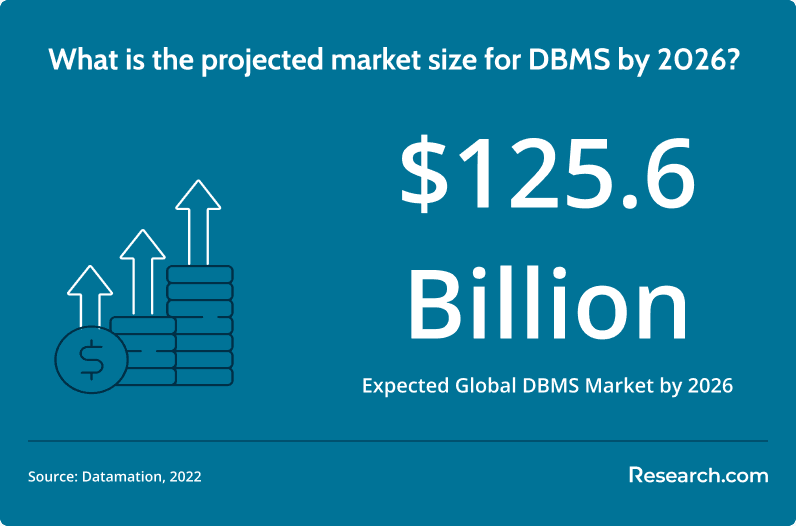
- The global database management system (DBMS) market was worth $63.1 billion in 2020 and is expected to reach $125.6 billion by 2026 (Expert Market Research).
- Organizations continue to use a mix of relational (SQL), non-relational (NoSQL), and in-memory databases, which can increase demand for specialized database skills.
Employers and industries
Graduates may find opportunities in technical and non-technical sectors. Companies cited as hiring for database-related roles include Amazon, JPMorgan Chase, Oracle, Walmart, and General Motors. Students should review job postings in their preferred region and industry to see which platforms, certifications, cloud tools, and programming languages employers request most often.
| If you want to work in... | Database skills to prioritize | Why it matters |
| Finance and insurance | Security, reliability, transaction systems, reporting, compliance awareness | Data accuracy and protection are central to financial operations |
| Healthcare | Privacy, secure access, reporting, data integrity, interoperability concepts | Patient and operational data must be handled carefully |
| Technology and software | SQL, NoSQL, cloud databases, APIs, performance tuning, automation | Applications depend on scalable and responsive data systems |
| Education | Student information systems, reporting, access control, analytics | Institutions rely on accurate records and decision-support data |
| Retail and e-commerce | Customer data, inventory systems, analytics, personalization, high-volume transactions | Database performance affects operations and customer experience |
Can Integrating Specialized Disciplines Enhance a Database Management Career?
Database management becomes more powerful when paired with another domain. A professional who understands both databases and healthcare, finance, cybersecurity, AI, gaming, education, or bioinformatics can solve more specialized problems than someone with database knowledge alone. This does not mean every student needs a second degree. It means students should think strategically about the industry where they want to apply their data skills.
For example, learners interested in biological and medical data may explore complementary options such as online bioinformatics masters programs. Others may combine database training with cybersecurity, business intelligence, software development, or AI depending on their target career.
Practical Next Steps Before You Apply
- Choose your likely career direction. Decide whether you are most interested in administration, analytics, data engineering, cybersecurity, software, cloud systems, or architecture.
- Compare curricula line by line. Confirm that each program includes database design, SQL, security, data modeling, and practical database projects.
- Verify accreditation. Check institutional accreditation and any program-level accreditation claims directly with the accreditor or school.
- Calculate net cost. Include tuition, fees, books, software, hardware, housing, transportation, and potential transfer credits.
- Ask about hands-on experience. Look for internships, labs, capstones, employer-sponsored projects, or portfolio assignments.
- Review job postings. Search roles you want and compare required skills against each program's courses.
- Plan for continued learning. Database platforms, cloud tools, security expectations, and AI capabilities change quickly, so the bachelor's degree should be the foundation rather than the endpoint.
Key Insights
- A bachelor's degree in database management is strongest when it combines SQL, database design, data modeling, security, cloud concepts, programming, analytics, and applied projects.
- Most programs require about 120 credits and take four years, but transfer credits, part-time enrollment, accelerated formats, and internships can change the timeline.
- Costs vary widely, with cited annual tuition figures ranging from $16,000 to $56,000 per year and total four-year estimates ranging from $64,000 to $224,000.
- Database careers can offer strong pay, but salary depends on role, industry, location, experience, and tools. Figures cited include $101,510 for database administrators and $134,700 for database architects as of May 2023.
- The field is projected to grow 9% from 2023 to 2033, supported by demand for secure, scalable, and analytics-ready data systems.
- Students should not choose a program by ranking alone. Accreditation, curriculum depth, hands-on work, platform exposure, transfer policy, and net cost are more important for long-term fit.
- AI, cloud computing, cybersecurity, and data governance are reshaping database work. Graduates who keep learning beyond the degree will be better positioned for advancement.
References:
- Indeed. Careers in database technology. Indeed Career Guide.
- BigFuture. 5 majors to consider in information technology. College Board.
- U.S. Bureau of Labor Statistics. Database administrators and architects. U.S. Department of Labor.
- Shaw, K. Database admins see brighter job prospects amid IT challenges. TechNewsWorld.
- Zippia. Database manager jobs and career overview. Zippia.
- Coursera. Data management specialist salary: What to expect. Coursera.
- Datamation. Database job market trends and insights. Datamation.
- Fullstack Academy. What is database management? Career and salary outcomes. Fullstack Academy.
- Business Wire. Global $125+ billion database management system markets to 2026. Business Wire.
Other Things You Should Know About Bachelor's Degree Programs in Database Management
Top 2027 bachelor's programs focus on SQL proficiency, data modeling, and cloud technologies. Schools like Carnegie Mellon and MIT emphasize hands-on labs and real-world projects, ensuring graduates meet current employer expectations in database management.
In 2027, database management bachelor's programs align with evolving tech trends by incorporating courses on cloud computing, NoSQL databases, and data analytics. Schools like Purdue University, Carnegie Mellon, and University of California, Berkeley are known for updating curricula to ensure students gain the latest skills in database technologies.


