2027 How To Become an App Developer: Salary & Career Paths

Co-Founder and Chief Data Scientist
Becoming an app developer in 2027 is no longer just about learning to code an app and publishing it to an app store. Employers now expect developers to understand user experience, cloud services, APIs, cybersecurity, AI-assisted coding, testing, deployment, and long-term product maintenance. The good news: there are several ways into the field, including computer science degrees, software engineering programs, bootcamps, self-study, internships, freelance projects, and portfolio-based hiring.
This guide is for students comparing tech degrees, career changers trying to break into software development, and self-taught programmers who want a clearer path to paid app development work. You will learn what app developers do, which skills matter most, how education options compare, what tools developers use, where jobs are found, how salary varies by role and industry, and how AI and no-code platforms are changing the profession.
Quick answer: Is app development a good career path?
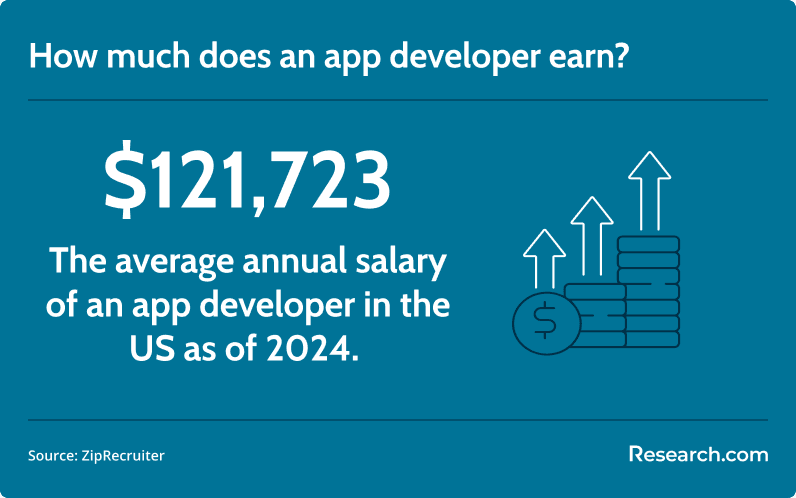
Yes, app development can be a strong career path for people who enjoy problem-solving, building digital products, and learning new technologies. The field offers high earning potential, broad industry demand, and multiple entry routes. The demand for app developers is expected to grow by 17% from 2023 to 2033, which is much faster than the average for all jobs (BLS, 2024). Salary.com reports that annual salaries typically range between $109,364 and $134,674, with an average salary of $121,723 annually.
However, it is not a low-effort career. To compete, you need a portfolio, practical coding experience, strong debugging habits, and the ability to keep learning as frameworks, platforms, and employer expectations change.
What are the main benefits of becoming an app developer?
- Strong labor market outlook: The field is projected to grow by 17% from 2023 to 2033, according to BLS, 2024.
- Competitive compensation: App developer pay commonly falls between $109,364 and $134,674 annually, based on Salary.com.
- Flexible career options: Developers can work in mobile, web, AI, gaming, healthcare, finance, e-commerce, enterprise software, or cloud-based applications.
- Multiple ways to enter the field: A degree can help, but employers also value portfolios, internships, open-source contributions, freelance work, and demonstrated technical skill.
- Room to specialize: App developers can move into AI integration, security, DevOps, product management, engineering leadership, or entrepreneurship.
- What does an app developer do?
- How to become an app developer for 2027?
- What are the best degree programs for aspiring app developers?
- What skills do you need to become an app developer?
- What tools and software do app developers use?
- Which industries can I work in as an app developer?
- What is the average salary of an app developer?
- Will an accelerated computer science program enhance my app development skills?
- How does continuous professional development drive career success?
- Could advanced education enhance your app development career?
- How do app developers address security and privacy challenges?
- What are the career pathways for an app developer?
- How can online education in AI advance your app development career?
- How can app developers tap into the healthcare technology market?
- How do artificial intelligence and no-code platforms impact app developers?
- Which certifications and professional memberships boost an app developer’s career?
- What are the biggest trends you need to know as an app developer?
What does an app developer do?
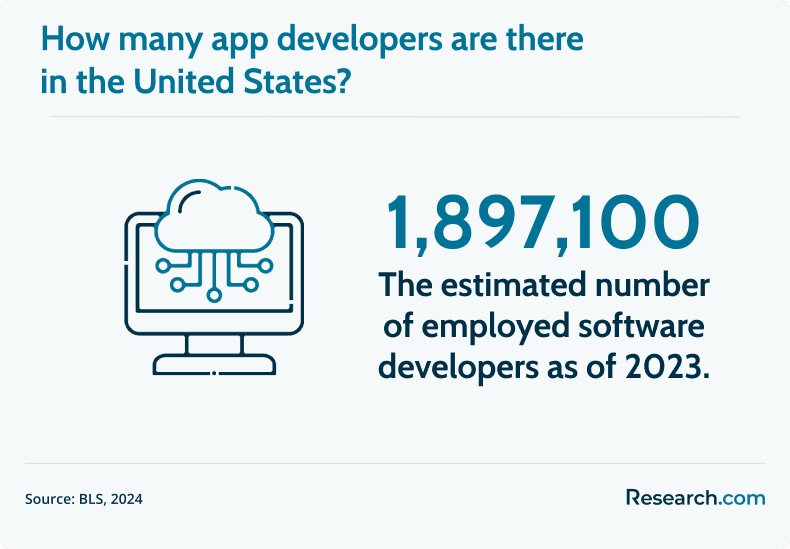
An app developer designs, builds, tests, improves, and maintains software applications. These applications may run on smartphones, tablets, web browsers, desktop computers, wearables, connected devices, or internal business systems. As of 2024, there are 1,897,100 app developers in the US, reflecting how deeply software now supports business operations, consumer services, and digital communication.
The job is broader than writing code. App developers translate user needs and business goals into functioning products. They often work with designers, product managers, quality assurance teams, cybersecurity staff, data teams, and business stakeholders. A developer may spend part of the day coding a new feature, part of it fixing a bug, and part of it reviewing pull requests or planning a release.
Typical app developer responsibilities
- Writing application code: Developers use languages such as Swift, Kotlin, Java, JavaScript, Python, TypeScript, or other tools depending on the platform.
- Testing and debugging: They find performance issues, logic errors, broken user flows, and compatibility problems across devices and operating systems.
- Working with UI/UX teams: Developers convert designs into usable interfaces and help ensure the app feels intuitive, accessible, and responsive.
- Connecting APIs and outside services: Many apps rely on payment systems, analytics, identity tools, cloud storage, mapping services, or third-party data sources.
- Improving performance: Developers optimize speed, loading behavior, memory use, responsiveness, and battery impact.
- Protecting user data: Secure coding, authentication, encryption, permissions, and privacy-aware design are now part of the job.
- Maintaining products after launch: Apps require updates, bug fixes, operating system compatibility changes, feature improvements, and security patches.
| Type of app developer | Primary focus | Common tools or languages | Best fit for |
| iOS Developer | Apps for Apple devices | Swift, Xcode, Apple frameworks | Developers who want to build for the Apple ecosystem |
| Android Developer | Apps for Android phones, tablets, and devices | Kotlin, Java, Android Studio | Developers interested in broad mobile device reach |
| Web App Developer | Browser-based applications | JavaScript, TypeScript, front-end and back-end frameworks | People who want to build products accessible across devices |
| Cross-Platform Developer | Apps that run on multiple platforms from one codebase | Flutter, React Native | Teams that need efficient development across iOS and Android |
| Back-End App Developer | Servers, databases, APIs, security, and business logic | Node.js, Django, Firebase, databases, cloud tools | Developers who enjoy systems, data flow, and architecture |
How to become an app developer for 2027?
To become an app developer in 2027, start by choosing a platform, learning the core programming languages for that platform, building real projects, and creating a portfolio that proves you can solve practical problems. A degree can strengthen your foundation, but it is not the only route. Employers typically look for evidence that you can write clean code, collaborate with others, troubleshoot issues, and ship working software.
A practical roadmap to becoming an app developer
- Choose your target path. Decide whether you want to focus on iOS, Android, web apps, cross-platform development, gaming, enterprise systems, or AI-enabled applications.
- Learn the core language and framework. Swift and Kotlin are common for native mobile development. JavaScript, TypeScript, Flutter, and React Native are common for web or cross-platform work.
- Study software fundamentals. Learn data structures, algorithms, databases, APIs, authentication, version control, testing, and basic system design.
- Build small projects first. Create apps such as a task tracker, budget tool, habit app, booking interface, weather dashboard, or API-powered web app.
- Move into portfolio-quality work. Build projects that show user authentication, database integration, API use, responsive design, error handling, and deployment.
- Use Git and document your work. A GitHub repository with clear commits, README files, screenshots, and setup instructions helps employers assess your work.
- Get feedback and collaborate. Join hackathons, contribute to open-source projects, work with classmates, or freelance for small clients.
- Apply for internships, apprenticeships, freelance projects, or junior roles. Your first role may not be your dream job, but it can give you production experience.
- Keep learning after you get hired. App development changes quickly, especially as AI-assisted coding, low-code platforms, cloud services, and security expectations evolve.
| Path | Advantages | Limitations | Best for |
| Computer science or software-related degree | Structured fundamentals, academic support, internships, and employer recognition | Can take longer and cost more than self-directed options | Students who want a broad technical foundation and access to campus recruiting |
| Coding bootcamp | Focused training, portfolio projects, and faster career preparation | Quality varies, and graduates still need practice beyond the curriculum | Career changers who can commit to intensive skill building |
| Self-study | Flexible, low-cost, and customizable | Requires discipline, project planning, and outside feedback | Independent learners who can build and document real applications |
| Internship or apprenticeship | Real-world experience, mentorship, and exposure to team workflows | May require prior coursework or a portfolio to qualify | Students and beginners who want supervised professional experience |
If you are comparing degree-based routes, computer science can be a strong option because it builds transferable skills across app development, software engineering, data systems, and cloud computing. Research.com also tracks one of the highest paying degrees areas, which can help you compare broader education and salary considerations before committing to a major.
What are the best degree programs for aspiring app developers?
The best degree for an aspiring app developer depends on the kind of software you want to build. A computer science degree is the most flexible option, while software engineering is more directly aligned with designing, testing, and maintaining applications. Information technology, web development, cybersecurity, game development, and AI-related programs can also make sense when they match your intended specialization.
| Degree area | What you study | How it supports app development | Choose this if... |
| Computer Science | Programming, algorithms, data structures, computer systems, and software design | Builds the strongest general foundation for many developer roles | You want maximum flexibility across software careers |
| Software Engineering | Software design, requirements, testing, maintenance, architecture, and development processes | Prepares you for building reliable applications in team environments | You want a degree focused on practical software delivery |
| Information Technology | Systems, networks, databases, cloud services, cybersecurity, and technical operations | Useful for business apps, internal tools, cloud-connected systems, and support-heavy environments | You want a broader technology operations background |
| Computer Programming | Coding, debugging, scripting, and applied software development | Emphasizes hands-on programming skills | You want a more applied coding-focused path |
| Game Development | Interactive design, graphics, game engines, programming, and user engagement | Supports mobile games, desktop games, AR/VR, and interactive apps | You want to create games or immersive products; you can also review game design schools online |
| Cybersecurity | Threats, secure systems, encryption, authentication, network security, and risk management | Helps developers build safer apps and understand privacy requirements | You want to specialize in secure software, fintech, healthcare, or enterprise systems |
| Artificial Intelligence & Machine Learning | Algorithms, data modeling, automation, predictive systems, and machine learning tools | Supports AI-powered app features, personalization, automation, and analytics | You want to build smarter applications or AI-enhanced products |
| Web Development | Front-end, back-end, databases, APIs, responsive design, and web frameworks | Directly prepares you for browser-based apps and full-stack development | You want to build web apps, SaaS products, or cross-platform experiences |
How to choose the right program
- Check accreditation first. Accreditation can affect transfer credits, graduate school options, financial aid eligibility, and employer confidence.
- Review the curriculum, not just the degree title. Look for courses in programming, databases, web or mobile development, software engineering, cybersecurity, cloud computing, and capstone projects.
- Look for project-based learning. A strong program should help you graduate with portfolio work, not just completed exams.
- Ask about internships and employer connections. Career services, co-ops, and local tech partnerships can matter as much as coursework.
- Compare total cost. Tuition is only part of the expense; also consider fees, software, books, devices, commuting, and lost income if you study full time.
For students who need federal aid eligibility, the Free Application for Federal Student Aid can be an important part of the planning process. You can begin your comparison with Research.com’s guide to online colleges that accept FAFSA.
What skills do you need to become an app developer?
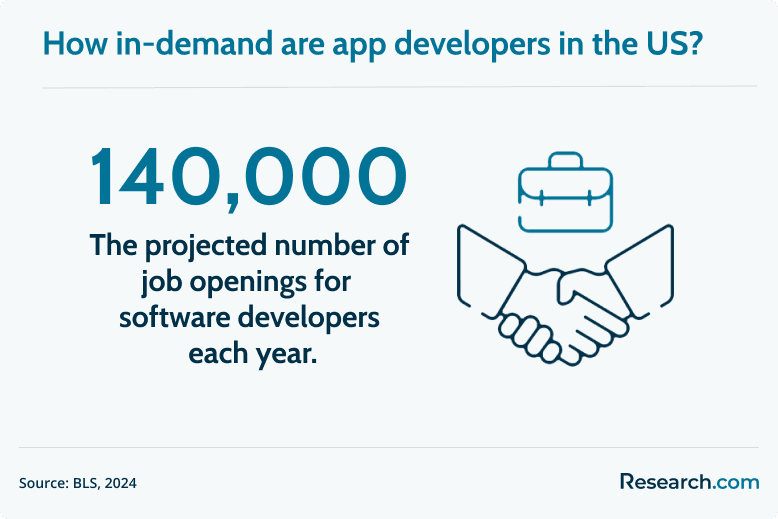
App developers need both technical and workplace skills. BLS, 2024 reports 140,000 job openings available across the US, but competition for desirable entry-level roles can still be intense. The developers who stand out usually combine coding ability with testing discipline, communication, problem-solving, and a portfolio that shows real application behavior.
Core technical skills
- Programming languages: Swift, Kotlin, Java, JavaScript, Python, TypeScript, Flutter, and React Native can all be useful depending on your platform.
- Front-end development: Developers should understand layout, responsive design, accessibility, user flows, and the basics of UI/UX.
- Back-end development: Server-side tools such as Node.js, Django, Firebase, databases, and authentication systems are important for data-driven apps.
- Version control: Git, GitHub, and GitLab help teams track code changes, review work, and recover from mistakes.
- Testing and debugging: Tools such as JUnit, XCTest, and Selenium help developers verify that applications work as expected.
- API integration: Many apps depend on third-party services for payments, maps, identity management, analytics, notifications, or cloud storage.
- Cybersecurity fundamentals: Developers need to understand secure coding, encryption, authentication, authorization, input validation, and privacy-aware data handling.
Workplace skills that matter
- Communication: Developers often need to explain technical trade-offs to nontechnical managers, clients, designers, or sales teams.
- Project planning: Estimating work, setting priorities, and tracking tasks are essential in professional app development. If you want formal training in these areas, compare project management degree programs.
- Problem-solving: Debugging is not just fixing errors; it requires tracing symptoms, testing assumptions, and preventing repeat problems.
- Adaptability: Frameworks, app store policies, security expectations, and AI tools change constantly.
- Product thinking: Good developers understand why a feature matters, who will use it, and how it supports the business or user goal.
What tools and software do app developers use?
App developers use different tools for coding, testing, collaboration, design, deployment, and automation. The best toolset depends on the platform you are building for, your budget, your team’s workflow, and whether you need native mobile development, web development, low-code automation, or cloud-based deployment. For example, Sublime Text offers a lightweight editing experience for $99, while Docker supports consistent development environments and scalable deployments for as low as $9.
Developers who work on commercial products often collaborate with business, product, and revenue teams. Understanding what does a sales manager do can help developers see how customer needs, market positioning, and product features connect.
Must-have software for app developers:
| Software | Average Cost | Primary Use |
| Sublime Text | $99 | Lightweight coding, quick editing, large-file performance, and a clean writing environment. |
| UltraEdit | $79.95-$99.95 | Large text file handling, advanced search, text manipulation, and multi-language development. |
| JetBrains IDEs | $169 | Language-specific development, advanced debugging, refactoring, and integrated version control. |
| Codeium | $15-$60 | AI-assisted coding, real-time suggestions, and support across multiple programming languages. |
| Axure | $29-$49 | Interactive prototyping, design documentation, stakeholder feedback, and product planning. |
| Docker | $9-$24 | Containerized environments, microservices, DevOps workflows, and more consistent deployments. |
| Linx | $599-$4,999 | Low-code back-end development, workflow automation, data handling, and systems integration. |
Source: Spacelift, 2025.
Which industries can I work in as an app developer?
App developers work wherever organizations need digital tools, customer-facing platforms, internal systems, automation, or data-driven services. You can build consumer apps for a startup, secure systems for a bank, clinical software for a healthcare organization, logistics platforms for supply chain teams, or learning apps for schools.
- Technology: Software companies, startups, cloud providers, and enterprise platforms hire developers for consumer products, SaaS tools, and internal systems.
- Finance and Banking: Developers build mobile banking apps, fintech platforms, fraud-prevention tools, investment interfaces, and secure payment workflows.
- Healthcare: App developers may work on telemedicine tools, patient portals, electronic health record integrations, wearable data, and clinical workflow systems.
- E-Commerce and Retail: Developers support mobile shopping, product recommendations, checkout systems, inventory tools, and customer loyalty apps.
- Gaming: Work may involve mobile games, PC games, console experiences, AR/VR, physics engines, graphics, and real-time interaction.
- Education and E-Learning: Developers create digital classrooms, tutoring platforms, language-learning apps, testing tools, and training systems. Domain research can also help; for example, the PE teacher job description may be useful if you are designing school fitness or sports education apps.
- Transportation and Logistics: Developers build ride-sharing tools, routing apps, fleet dashboards, delivery tracking, and inventory movement systems. If this area interests you, Research.com’s logistics career path guide can help you understand the industry context.
- Real Estate: Apps in this sector include property search tools, virtual tours, document workflows, lead management systems, and agent-client portals.
- Media and Entertainment: Developers work on streaming platforms, creator tools, interactive media, music apps, recommendation systems, and social features.
What is the average salary of an app developer?
App development is one of the better-paying technology career paths, though salary depends on experience, location, industry, specialization, education, and the complexity of the products you build. Salary.com reports an average salary of $121,723 annually for app developers, with common annual salaries ranging between $109,364 and $134,674.
Industry also matters. Annual earnings average $143,210 in software publishing and $127,880 in computer systems design. These figures show why many developers target software companies, cloud platforms, enterprise vendors, and organizations that rely heavily on custom digital products.
| Salary figure | Reported amount | What it means for career planning |
| Typical annual salary range | $109,364 and $134,674 | Use this as a broad benchmark, not a guaranteed offer. |
| Average app developer salary | $121,723 annually | A useful midpoint when comparing app development with other tech careers. |
| Software publishing annual earnings | $143,210 | Specialized software employers may offer stronger compensation. |
| Computer systems design annual earnings | $127,880 | Consulting, systems integration, and business technology services can also be strong markets. |
As illustrated in the chart below, the highest-paying industries for app developers can vary by employer type and role responsibilities.
Will an accelerated computer science program enhance my app development skills?
An accelerated computer science program can be useful if you want structured technical training in less time than a traditional schedule may require. The best programs focus on programming, algorithms, databases, software engineering, operating systems, cloud concepts, and applied projects. For working adults or career changers, an accelerated format may help build a stronger foundation while reducing time away from the labor market.
That said, speed should not be your only selection factor. Before enrolling in a computer science accelerated program, ask whether the program is accredited, how much coding support is available, whether courses include portfolio-ready projects, and whether the schedule is realistic with your work and family obligations.
How does continuous professional development drive career success?
App development rewards people who keep learning. New frameworks, app store requirements, AI coding tools, cloud services, privacy expectations, and security risks can change how developers work. Continuous professional development may include certifications, documentation reading, technical communities, hackathons, conferences, open-source work, and short courses in specialized areas.
Cross-industry knowledge can also help developers identify stronger niches. For example, reviewing trends in healthcare technology and health informatics salary can help a developer decide whether to specialize in clinical software, health data systems, or patient-facing digital health products.
Could advanced education enhance your app development career?
Advanced education can help when it clearly supports your target role. A master’s degree, specialized graduate certificate, or interdisciplinary program may be valuable for developers moving into AI, data science, cybersecurity, health technology, research software, or technical leadership. It is less useful if the program does not improve your skills, portfolio, network, or access to better roles.
Developers interested in scientific, healthcare, or data-intensive applications may benefit from programs that combine computing with analytics. For example, an online bioinformatics degree may help software professionals understand biological data, research workflows, and specialized data systems used in health and life sciences.
How do app developers address security and privacy challenges?
Security and privacy should be built into an app from the start, not added after launch. Developers need to understand what data is collected, why it is collected, how it is stored, who can access it, and what happens if a system is compromised. Common practices include secure authentication, role-based access, encryption, input validation, safe API design, privacy notices, vulnerability testing, and regular patching.
Developers who work with sensitive data need deeper training. Healthcare, finance, education, and research products often involve stricter expectations for data protection. For professionals building analytical or health-related applications, a bioinformatics master's online may provide exposure to data analysis, privacy-sensitive workflows, and technical systems used in regulated environments.
What are the career pathways for an app developer?
App development can lead to several career tracks. Some developers remain hands-on coders and become experts in mobile, web, back-end, or AI systems. Others move into architecture, DevOps, product management, leadership, consulting, or entrepreneurship. The best path depends on whether you prefer coding, designing systems, working with users, managing teams, or building your own products.
| Career path | Main responsibilities | Skills to build next |
| Junior App Developer | Write code, fix bugs, learn team workflows, and support senior developers | Version control, testing, debugging, clean code, and basic architecture |
| Mobile App Developer | Build iOS, Android, or cross-platform applications | Swift, Kotlin, Flutter, React Native, app store deployment, and mobile UX |
| Full-Stack Developer | Work across user interfaces, APIs, databases, and server-side logic | Front-end frameworks, back-end frameworks, cloud services, and databases |
| Software Engineer | Design, test, scale, and maintain larger software systems | Algorithms, architecture, system design, testing, and performance optimization |
| UI/UX Designer-Developer | Bridge visual design and functional implementation | Accessibility, user research, front-end development, and interaction design |
| DevOps Engineer | Automate builds, deployments, monitoring, and infrastructure workflows | CI/CD, Docker, cloud platforms, scripting, and observability |
| Product Manager | Define product features, prioritize roadmaps, and connect technical work to business goals | User research, analytics, stakeholder communication, and product strategy |
| Tech Lead or Engineering Manager | Guide technical direction, mentor developers, and oversee project delivery | Leadership, architecture review, planning, coaching, and cross-team communication |
| Tech Entrepreneur | Create, launch, and grow independent apps or software businesses | Business planning, product validation, marketing, finance, and customer discovery; cost-conscious founders may compare the cheapest online business degree options |
| Machine Learning or AI Developer | Add AI features, predictive tools, automation, or intelligent recommendations to applications | Machine learning frameworks, data modeling, APIs, evaluation, and responsible AI practices |
| Healthcare App Developer | Build digital health tools, patient-facing apps, clinical workflows, and health data systems | Privacy, security, healthcare workflows, interoperability, and domain knowledge; comparing how much do nurses make may also help when evaluating healthcare career alternatives |
How can online education in AI advance your app development career?
Online AI education can help app developers add intelligent features to software products, such as chatbots, personalization, image recognition, recommendations, predictive alerts, and workflow automation. This training is most valuable when it includes applied projects, model evaluation, data handling, ethics, and deployment—not only theory.
If your goal is to move beyond standard app features into AI-enhanced products, compare AI online degree programs by curriculum, faculty expertise, project requirements, flexibility, and whether the program teaches practical implementation in real applications.
How can app developers tap into the healthcare technology market?
Healthcare technology can be a strong niche for developers who are willing to learn the domain. Building useful healthcare apps requires more than coding skill. Developers must understand clinical workflows, patient privacy, secure data exchange, accessibility, reliability, and the difference between a wellness app and software used in medical decision-making.
Formal study in health informatics can help developers understand how healthcare data is collected, stored, analyzed, and used. If this path interests you, explore a health informatics bachelor degree online to see how programs combine healthcare systems, information technology, and data management.
How do artificial intelligence and no-code platforms impact app developers?
Artificial intelligence, low-code, and no-code platforms are changing app development, but they are not eliminating the need for skilled developers. The global low-code platform market is projected to reach around $65 billion by 2027, driven by demand for faster application development and automation. As these platforms mature, developers may spend less time on repetitive setup work and more time on architecture, integrations, security, customization, and complex problem-solving.
- Development cycles are getting faster: AI coding assistants and low-code tools can speed up prototyping, boilerplate code, and simple workflow creation.
- Entry-level competition is changing: Nontechnical users can build basic apps, which means developers need to show deeper skills in quality, reliability, scalability, and customization. This broader shift toward alternative entry routes can also be seen in other industries, including healthcare jobs that don't require a college degree are opening up.
- AI-augmented coding is becoming normal: Developers increasingly use AI to draft code, explain errors, generate tests, and review patterns, but they still need judgment to validate outputs.
- Back-end and integration skills remain valuable: Even when front-end screens are generated quickly, businesses still need secure databases, APIs, permissions, workflows, and system integrations.
- New specializations are emerging: Developers may move into AI integration, automation engineering, low-code consulting, prompt-enabled product development, or platform architecture.
Which certifications and professional memberships boost an app developer’s career?
Certifications and professional memberships can support an app developer’s career when they validate skills employers actually need. The most useful credentials usually relate to cloud platforms, cybersecurity, mobile development, project management, DevOps, database systems, or AI. A certification is not a substitute for a portfolio, but it can help prove knowledge in a specific tool or platform.
Before paying for a certification, ask whether it is recognized by employers in your target role, whether it includes hands-on assessment, how often it must be renewed, and whether your time would be better spent building a deployable project. Developers who want a broader engineering base can also compare affordable online schools for engineering as part of a long-term education plan.
What are the biggest trends you need to know as an app developer?
App developers should pay close attention to the technologies and expectations shaping user behavior, employer needs, and software design. The most important trends are not just new tools; they affect how apps are built, secured, deployed, and monetized.
- AI-powered features: AI has moved from novelty to product expectation in many software categories. Since the rise of ChatGPT, Gemini, Perplexity, and Microsoft Copilot in the past 3 years, users have become more familiar with AI-assisted interactions. More than 4 billion devices globally have AI-powered features built-in (Statista, 2025).
- 5G-optimized applications: In 2024, Apple introduced the 5G feature in visionOS 2.2, allowing Apple Vision Pro applications to use optimized 5G connectivity through Personal Hotspot on compatible iPhones and iPads (9to5Mac, 2024).
- Cross-platform development: Frameworks such as Flutter and React Native remain attractive because teams can develop for multiple operating systems while reducing duplicate work.
- Privacy-first development: The Information Commissioner’s Office (ICO) reminded app developers to prioritize transparency, valid consent, and strong security after reviewing period and fertility apps (Information Commissioner’s Office, 2024).
- Augmented reality and virtual reality: AR and VR are expanding into retail, education, healthcare, and training. PICO’s integration of OpenXR 1.1 supports more interoperable cross-platform immersive development (PICO, 2024).
- Wearable and IoT integration: Developers are building apps that sync with smartwatches, fitness trackers, and connected devices. TechTarget (2024) notes that wearable technology is especially important in healthcare, where connected devices can support ongoing monitoring of health metrics.
Common mistakes to avoid when becoming an app developer
| Mistake | Why it can hurt you | Better approach |
| Learning too many languages at once | You may end up with shallow knowledge and no finished projects | Pick one path first, then build complete apps before expanding |
| Relying only on tutorials | Tutorials can create the illusion of skill without independent problem-solving | Build original projects and debug issues without step-by-step instructions |
| Ignoring accreditation when choosing a degree | It can affect financial aid, transfer credits, and future academic options | Verify institutional accreditation before applying |
| Choosing a program based only on tuition | A cheaper program may lack support, projects, or employer connections | Compare total cost, curriculum, outcomes, flexibility, and career services |
| Assuming an online program fits every goal | Some programs may not offer the same networking, lab support, or local employer access | Ask how online students complete projects, internships, and career preparation |
| Neglecting security and privacy | Weak security can damage users, employers, and your professional credibility | Learn secure coding, testing, authentication, and data protection early |
| Building a portfolio with only basic apps | Employers need proof that you can handle real-world complexity | Show APIs, databases, authentication, testing, deployment, and documentation |
Questions to ask before choosing an app development path
- Do I want to build mobile apps, web apps, games, enterprise systems, AI-enabled products, or back-end services?
- Do I learn better through a structured degree, a bootcamp, self-study, or supervised work experience?
- Does the program or training path help me create portfolio-ready projects?
- Is the school accredited, and does it qualify for the financial aid I need?
- Will I have access to internships, career coaching, employer networks, or mentorship?
- What tools, languages, and frameworks are commonly required in job postings for my target roles?
- How will I prove my skills to employers if I do not have a formal degree?
- What security, privacy, and testing skills do I need for the industries I want to enter?
- How will AI-assisted coding and no-code platforms affect the type of developer work I want to do?
Key Insights
- App development remains a strong career option for people who can combine coding skill, product thinking, testing discipline, and continuous learning.
- As of 2024, there are about 1,897,100 app developers in the US, and BLS, 2024 reports 140,000 job openings available across the US.
- The field is projected to grow by 17% from 2023 to 2033, which is much faster than the average for all jobs.
- Salary.com reports an average app developer salary of $121,723 annually, with typical annual salaries ranging between $109,364 and $134,674.
- A computer science or software engineering degree can help, but a strong portfolio, real projects, GitHub activity, internships, and freelance work can also support entry into the field.
- The best degree depends on your specialization: computer science for flexibility, software engineering for application design, cybersecurity for secure apps, AI for intelligent features, and web development for browser-based products.
- AI and no-code tools are changing the job, not removing it. Developers who understand architecture, APIs, security, customization, and complex problem-solving will remain valuable.
- The global low-code platform market is projected to reach around $65 billion by 2027, so developers should learn how to work with automation tools rather than ignore them.
- Before choosing a school, bootcamp, or self-study plan, evaluate accreditation, cost, curriculum, project depth, career support, and how well the path matches your target developer role.
References:
- Axure. (n.d.). Axure pricing. Axure.com. Retrieved March 30, 2025.
- Bureau of Labor Statistics. (2024). Software developers. U.S. Department of Labor. Bls.gov. Retrieved March 30, 2025.
- Codeium. (n.d.). Pricing. Codeium.com. Retrieved March 30, 2025.
- Docker. (n.d.). Pricing. Docker.com. Retrieved March 30, 2025.
- Information Commissioner’s Office (ICO). (2024). ICO urges all app developers to prioritise privacy. Ico.org.uk. Retrieved March 30, 2025.
- JetBrains. (n.d.). JetBrains store. JetBrains.com. Retrieved March 30, 2025.
- Linx. (n.d.). Linx pricing. Linx.software. Retrieved March 30, 2025.
- PICO XR. (2024). OpenXR standard 1.1. Developer.picoxr.com. Retrieved March 30, 2025.
- Salary.com. (n.d.). Application developer salary. Salary.com. Retrieved March 30, 2025.
- Spacelift. (2025). Top 27 software development tools & platforms [2025 list]. Spacelift.io. Retrieved March 30, 2025.
- Statista. (2024). Number of voice assistants in use worldwide 2019-2024. Statista.com. Retrieved March 30, 2025.
- Statista. (n.d.). Low-code and no-code platforms. Statista.com. Retrieved March 30, 2025.
- Sublime HQ. (n.d.). Sublime Text store. Sublimehq.com. Retrieved March 30, 2025.
- TechTarget. (n.d.). Wearable technology. TechTarget.com. Retrieved March 30, 2025.
- UltraEdit. (n.d.). UltraEdit catalog. UltraEdit.com. Retrieved March 30, 2025.
Other Things You Should Know About an App Developer’s Career Path
In 2027, app developers must stay updated with trends like augmented reality (AR), machine learning integration, and enhanced cybersecurity. Familiarity with cross-platform tools such as Flutter and React Native is crucial. Understanding user experience (UX) design principles and cloud services can significantly impact career progression in app development.
In 2027, aspiring app developers typically start with a relevant degree or bootcamp, then gain experience through internships or junior roles. Many progress to mid-level developer roles, with opportunities to specialize in areas like AI or AR, or to move into leadership positions such as project manager or CTO.
In 2027, app developers in the U.S. can expect a salary range between $65,000 and $140,000 annually, depending on experience, location, and expertise in either iOS or Android platforms.