2027 Average Associate Degree Nursing (ADN) Salary by State

Co-Founder and Chief Data Scientist
An Associate Degree in Nursing (ADN) can be one of the fastest routes into registered nursing, but salary expectations are not always easy to interpret. Employers usually report pay for registered nurses as a group, not separately for ADN- and BSN-prepared nurses, so ADN salary estimates need to be read alongside RN wage data, local demand, experience, specialty, and cost of living.
This guide explains what ADN nurses can realistically expect to earn for 2026 career planning using the available salary and workforce data cited below. You will see how pay differs by state, how ADN earnings compare with LPN, BSN, and MSN pathways, which credentials can raise your value, and how to decide whether to stay in an ADN-level role, specialize, travel, or continue into a BSN, MSN, or DNP program.
What are the main benefits of earning an associate degree in nursing?
- Faster entry into RN practice: Many ADN programs can be completed in as little as two years, allowing students to reach RN licensure and begin earning sooner than they would through a traditional four-year nursing pathway.
- Strong return for the time invested: ADN nurses commonly see estimated salaries in the $65,000 to $77,000 per year range, and specialized experience or certifications in areas such as critical care, wound care, emergency care, or geriatrics may improve earning potential.
- Flexible education options: Online and hybrid ADN pathways can help working adults, parents, and students outside major metro areas access nursing education without relocating, although clinical requirements still need to be completed in approved healthcare settings.
- Average ADN nurse salary in the United States
- ADN salary compared with LPN, BSN, and MSN degrees
- Main factors that affect ADN nurse pay
- Highest-paying states for ADN nurses
- Regional differences in ADN salaries
- High-cost versus lower-cost states for ADN nurses
- Education and certifications that can increase ADN nurse salary
- Higher-earning career paths for ADN nurses
- Fastest advancement options after an ADN
- States with strong demand for ADN nurses
- Geriatric care specialization for ADN nurses
- Job outlook for ADN nurses
- Specialized certification programs for ADN nurses
- Dual degree options for ADN nurses
- Mentorship and networking for ADN nurse advancement
- Managing stress as an ADN nurse
- Healthcare technology skills for ADN nurses
- Nontraditional roles for ADN nurses
- How to choose an RN to BSN program
- Advanced education options for ADN nurses
- Most lucrative ADN nursing paths
Quick answer: How much do ADN nurses make?
There is no single official national salary figure only for ADN nurses because public wage data usually tracks registered nurses by license rather than by degree type. However, estimates from ZipRecruiter and Nurse.org place the average ADN nurse salary in the United States in 2024 at approximately $77,000 per year. The broader RN salary table from the Bureau of Labor Statistics shows large state-by-state differences, with annual RN wages ranging from 137,690 in California to 39,130 in Puerto Rico in the May 2023 data shown below.
The best way to evaluate ADN pay is to look at three things together: RN wages in your state, the setting where you plan to work, and whether your employer rewards specialty certification, shift differentials, travel assignments, or a BSN bridge degree.
ADN nurse salary scenarios to keep in mind
An ADN can make financial sense for students who want to enter nursing quickly, especially in states with high RN wages. A California ADN graduate, for example, may see strong income opportunities but also needs to account for housing, transportation, taxes, and competitive hospital hiring requirements.
For an LPN moving into an ADN program, the RN license can meaningfully expand scope of practice and earnings. The salary difference is not automatic, though; local employer demand, NCLEX-RN success, specialty experience, and shift availability all matter.
In lower-cost or rural states, ADN nurses may earn less than nurses in coastal metros but still have good purchasing power, shorter commutes, and access to community-based roles in long-term care, home health, outpatient clinics, and regional hospitals.
What is the average salary for ADN nurses in the United States?
The estimated average salary for ADN nurses in the United States in 2024 is approximately $77,000 per year based on ZipRecruiter and Nurse.org data. This estimate should be treated as a planning benchmark rather than a guaranteed wage because ADN-specific salary reporting is limited. Most official labor data groups ADN and BSN nurses together under registered nurses.
For students comparing nursing pathways, the ADN route can represent a major income jump from nursing assistant roles. The average ADN salary is double that of certified nurse assistants: CNA pay in 2024 is $38,200 annually. For CNAs who want more responsibility and higher earning potential, an ADN can be a logical next step if the program is accredited, affordable, and compatible with work obligations.
Hourly comparisons can also help. ADN nurses are often estimated at around $39/hour, while botox nurses are reported at $43/hour. If you are comparing clinical RN work with aesthetics, this guide on how much botox nurses make per hour can help you understand the trade-offs between patient-care settings, training requirements, and income potential.
Location is the biggest reason salary estimates vary. States with high housing costs, strong hospital systems, unionized workforces, or nurse shortages often show higher RN wages. The Bureau of Labor Statistics table below reports annual RN salary by state in 2023. Because the data is for registered nurses overall, it includes both ADN- and BSN-prepared RNs.
| State | Annual Salary |
| California | 137,690 |
| Hawaii | 119,710 |
| Oregon | 113,440 |
| Washington | 111,030 |
| Alaska | 109,210 |
| Massachusetts | 108,850 |
| District of Columbia | 106,850 |
| New York | 106,620 |
| New Jersey | 101,960 |
| Connecticut | 101,840 |
| Nevada | 97,700 |
| Rhode Island | 95,070 |
| Minnesota | 94,830 |
| Delaware | 94,670 |
| New Mexico | 92,140 |
| Maryland | 92,090 |
| Colorado | 91,730 |
| Arizona | 91,430 |
| Texas | 90,210 |
| Georgia | 90,000 |
| New Hampshire | 89,410 |
| Vermont | 88,380 |
| Virginia | 88,350 |
| Illinois | 87,650 |
| Pennsylvania | 87,530 |
| Wisconsin | 87,220 |
| Michigan | 86,210 |
| Florida | 84,760 |
| Ohio | 84,430 |
| Maine | 84,340 |
| Wyoming | 83,990 |
| Utah | 83,100 |
| Idaho | 83,090 |
| Montana | 82,950 |
| Indiana | 82,700 |
| North Carolina | 82,530 |
| Oklahoma | 82,110 |
| Kentucky | 81,770 |
| South Carolina | 81,390 |
| Louisiana | 80,760 |
| Nebraska | 79,780 |
| North Dakota | 79,190 |
| Tennessee | 78,240 |
| Missouri | 77,590 |
| Kansas | 76,240 |
| West Virginia | 75,990 |
| Mississippi | 75,510 |
| Iowa | 74,610 |
| Arkansas | 72,900 |
| Alabama | 71,370 |
| Virgin Islands | 70,410 |
| South Dakota | 69,030 |
| Puerto Rico | 39,130 |
| Guam | - |
How does the ADN salary compare to other nursing degrees?
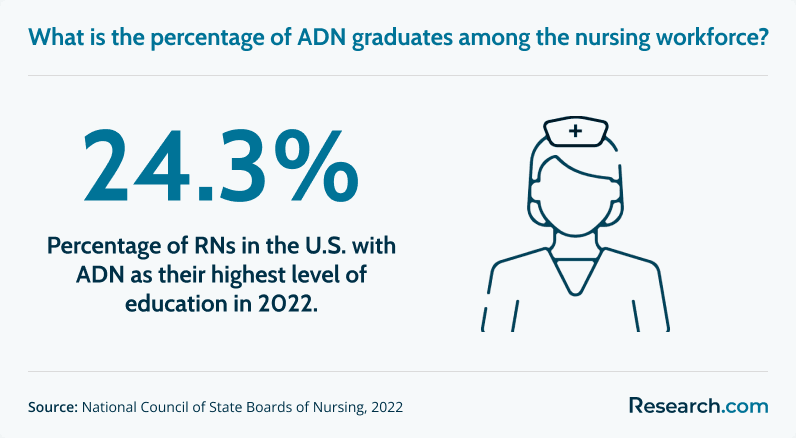
Among RNs in the U.S. in 2022, 24.3% identified ADN as their highest level of education. ADN-prepared nurses hold the same RN license after passing the NCLEX-RN, but employers may still differentiate roles by degree level, especially in hospitals seeking BSN-prepared staff for leadership, specialty, or magnet-related goals.
ADN vs. BSN: BSN nurses generally earn about $12,000 more annually than ADN nurses. The BSN may improve access to charge nurse roles, public health positions, case management, specialty units, and leadership-track jobs, although local employer policy determines how much the degree affects pay.
ADN vs. MSN: MSN nurses earn approximately $32,000 more than ADN nurses. The MSN is typically tied to advanced practice, education, informatics, administration, or clinical specialist roles, and some of those roles require additional certification or licensure beyond the degree.
ADN vs. LPN: ADN nurses typically earn about $23,000 more than LPNs/LVNs because RNs have a broader scope of practice, more independent clinical responsibilities, and more extensive training. If you are deciding between practical nursing and registered nursing, compare the differences between an LPN certificate and an associate degree in nursing before enrolling.
| Nursing pathway | Estimated Annual Salary Range | Best fit |
| ADN | $65,000 - $77,000 | Students who want a faster, lower-time route to RN licensure |
| LPN | $45,000 - $60,000 | Students seeking a shorter practical nursing pathway with a narrower scope |
| BSN | $75,000 - $92,000 | RNs aiming for broader hospital options, leadership tracks, or graduate study |
| MSN | $90,000 - $200,000+ | Nurses pursuing advanced practice, education, administration, or specialist roles |
What factors influence the average ADN salary across the U.S.?
ADN nurse pay is shaped by geography, experience, workplace setting, specialty credentials, shift type, and employer policies. Two nurses with the same degree can earn very different salaries depending on where they work and which responsibilities they hold.
Geographic location
High-wage states often have higher living costs, stronger demand, or competitive healthcare labor markets. Rural and non-metro regions may also offer incentives where staffing shortages are severe, but the base salary may still be lower than in major coastal markets.
Years of experience
New ADN graduates usually start in entry-level RN roles, while experienced nurses can move into charge duties, specialty units, preceptor roles, case management, or travel assignments. Some experienced ADN nurses later pursue graduate education through options such as the most affordable online MSN programs when they want advanced practice or leadership pathways.
Healthcare setting
Hospitals, intensive care units, emergency departments, surgical services, and specialty clinics may pay differently from long-term care, physician offices, public health, and home health. Higher pay often comes with higher acuity, shift work, call requirements, or weekend scheduling.
Specialty certification
Certifications show verified knowledge in a practice area and can help ADN nurses compete for specialized positions. In 2022, 16.5% of RNs specialized in acute and critical care, 10% in medical and surgical, and 8.1% in emergency and trauma. A certification alone does not guarantee a raise, but it can strengthen a promotion case or qualify a nurse for higher-responsibility units.
What are the highest-paying states for ADN nurses?
Because ADN-specific salary data is limited, the most useful reference point is RN wage data by state. The following states frequently appear among the highest-paying RN locations and may also offer strong earning opportunities for ADN-prepared RNs, depending on employer hiring requirements.
| State | Hourly Mean Wage |
| California | $ 66.20 |
| Hawaii | $ 57.55 |
| Oregon | $ 54.54 |
| Washington | $ 53.38 |
| Alaska | $ 52.51 |
High wages do not always mean a better financial outcome. California, Hawaii, Oregon, Washington, and Alaska can offer strong hourly pay, but nurses should compare housing, commuting, taxes, union coverage, relocation costs, license transfer rules, and whether local hospitals prefer or require BSN-prepared applicants.
Nursing shortages can also influence pay. Community colleges and healthcare organizations continue to discuss the role of ADN programs in addressing the nursing workforce shortage. Nationally, non-metro areas in the U.S. are projected to have a much higher shortage of RNs (14%) than metro areas (8%) by 2036.
How do ADN salaries vary across different regions in the U.S.?
ADN salaries tend to follow regional RN labor markets. The West Coast and parts of the Northeast usually show higher wages because of cost of living, union activity, large hospital systems, and demand for care. The Midwest and South often report lower salaries, but those wages may go further when housing and daily expenses are lower.
For example, ADN nurses in California can expect to earn around $100,000 per year, while those in New York might earn approximately $85,000 annually. These higher salaries help offset expensive housing, transportation, and other costs in high-cost regions. Major medical centers and dense healthcare networks can also increase competition for experienced nurses.
In lower-cost regions such as the Midwest and South, nurses in states like Texas, Ohio, and Oklahoma typically earn between $65,000 and $75,000 per year. While the headline salary may be lower, the overall financial picture may still be favorable if rent, home prices, childcare, commuting, and taxes are more manageable.
How do ADN salaries in high-cost living states compare to lower-cost living states?
ADN nurses in states such as California and New York may see salaries around $100,000 and $85,000 per year, respectively. Those figures can look attractive, but they must be weighed against housing affordability, insurance costs, commuting time, and competition for preferred hospital roles.
A nurse earning less in a state like Missouri may still have more financial flexibility if rent, transportation, and everyday expenses are lower. For this reason, take-home pay and quality of life are often more useful than salary alone.
| Decision factor | High-cost state | Lower-cost state |
| Salary potential | Often higher, especially in major hospital markets | Often lower, but may still support a comfortable lifestyle |
| Housing pressure | Can reduce the advantage of higher wages | May improve purchasing power and savings capacity |
| Job competition | Large markets may offer more roles but stronger BSN preference | Employers may be more flexible where RN shortages are acute |
| Best fit | Nurses prioritizing high wages, specialty hospitals, and urban career mobility | Nurses prioritizing affordability, community practice, and lower living costs |
Before relocating for a higher salary, compare net income, benefits, shift differentials, loan repayment options, overtime rules, union protections, and whether the employer will support an RN to BSN bridge program.
What further education or certifications can boost an ADN nurse's salary?
Based on a 2022 survey, 72.5% of RNs provide direct patient care. ADN nurses who want higher earnings can build from that clinical base by adding specialty credentials, moving into higher-acuity units, completing a BSN, or eventually entering graduate nursing education.
Specialty certifications
Specialty credentials can demonstrate readiness for more complex patient populations or higher-demand units. Common examples include:
- Critical Care Nurse (CCRN): Supports work with critically ill patients in intensive care and high-acuity settings.
- Emergency Room Nurse (CEN): Signals competence in rapid assessment, triage, trauma response, and emergency care workflows.
- Wound Care Certification (CWCN): Builds expertise in chronic wounds, pressure injuries, burns, and complex dressing protocols.
- Gerontological Nursing (GNC): Focuses on older adults, chronic disease management, mobility, medication safety, and long-term care coordination.
- Pediatric Nurse Certification (CPN): Demonstrates specialized knowledge in caring for infants, children, and adolescents.
Advanced certificates and focused training
Shorter certificate programs can help ADN nurses move toward specialized or non-bedside roles without immediately committing to a full degree.
- Nurse Educator Certificate: Can support clinical teaching, precepting, staff development, or academic support roles.
- Informatics Nurse Specialist: Combines clinical knowledge with documentation systems, data, workflow improvement, and health technology.
- Perioperative Nurse Certification: Develops skills in pre-operative, intraoperative, and post-operative nursing care.
Bachelor of Science in Nursing (BSN)
A BSN can improve access to leadership roles, specialized hospital positions, public health, case management, and graduate study. Among the nursing workforce, 51.1% were BSN graduates in 2022. Working RNs who need flexibility can compare options to earn a nursing degree online while maintaining employment.
Master of Science in Nursing (MSN)
An MSN can prepare nurses for advanced practice, clinical leadership, education, informatics, or administration. It requires a larger investment of time and may involve additional certification or licensure, but it can lead to roles with substantially higher pay. If graduate school is part of your plan, compare affordable MSN programs online before committing.
If you are currently an LPN and want the shortest realistic bridge to RN licensure, you may also compare a 6 month LPN to RN program online, while carefully confirming accreditation, clinical placement rules, and state board approval.
What career paths can ADN nurses pursue for higher earnings?
An ADN does not limit a nurse to one type of job. Higher earnings usually come from one of five strategies: specializing, moving to a higher-paying location, accepting travel assignments, using a multi-state license where appropriate, or completing additional degrees. Some nurses eventually pursue doctoral preparation through online DNP programs, but that is only one route.
- Specialize in a high-acuity area: Critical care, emergency nursing, perioperative nursing, wound care, and oncology can strengthen earning potential when employers pay for expertise.
- Move strategically: ADN nurses in states such as California or Washington may earn more, but relocation should be evaluated against cost of living and BSN hiring preferences.
- Consider travel nursing: Travel nurses fill temporary staffing gaps and may receive premium pay or housing support, although assignments can be unpredictable and licensing requirements vary.
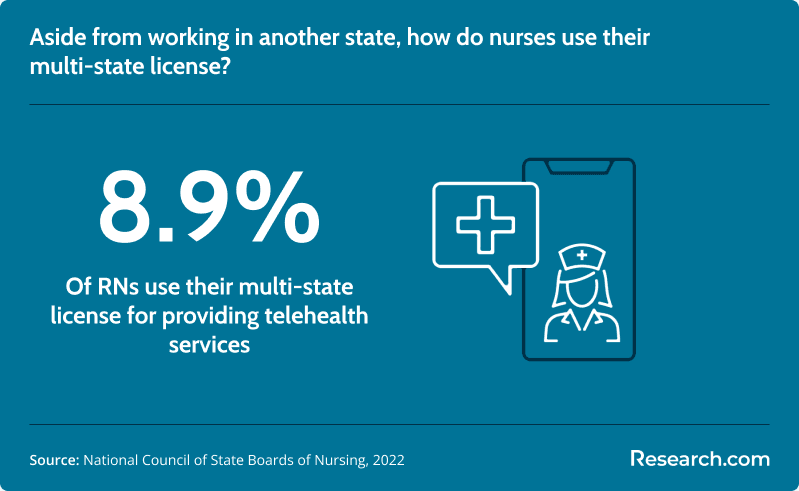
- Use a multi-state license when eligible: In the U.S., 8.9% of RNs use their multi-state license for telehealth, 2.6% for teaching in distance education, and 2.7% for disaster support.
- Earn a BSN or move toward management: A BSN can support advancement into leadership, care coordination, or graduate education. Nurses interested in administrative pathways may later compare options such as the cheapest online healthcare administration degree.
RNs who want advanced practice authority can also review the steps for going from RN to nurse practitioner, including education, certification, and state licensure requirements.
What are the fastest ways to become a nurse after completing an ADN?
After completing an ADN and passing the NCLEX-RN, the fastest career moves depend on whether your goal is higher pay, broader job eligibility, specialization, or advanced practice.
| Fast-track option | Typical timeline stated | When it makes sense |
| Accelerated BSN or RN to BSN pathway | 12 to 18 months | You want broader hospital eligibility, leadership options, or graduate school preparation |
| Nurse Practitioner program | 2 to 3 years | You want advanced practice responsibilities and are ready for graduate-level study |
| Online specialty certification | Less than a year | You want to qualify for a specialty unit or strengthen promotion potential quickly |
| Employer training program | Varies by facility | Your hospital offers internal tracks in leadership, specialty care, or management |
If speed is your main priority, compare the quickest ways to become a nurse with your state board rules and the clinical training required for safe practice.
Which states have the highest demand for ADN nurses?
Demand data is usually reported for registered nurses overall rather than ADN nurses specifically. Still, states with large populations, expanding healthcare systems, aging residents, and high projected RN job growth may offer strong opportunities for ADN-prepared RNs.
Workforce organizations continue to highlight a national nursing crisis. If labor force patterns remain the same as today, the demand for RNs in 2036 will exceed supply by 9%, resulting in a shortage of 337,970 full-time equivalent (FTE) RNs.
- California: A large healthcare market with major hospital systems and continued RN hiring needs.
- Texas: A fast-growing population and broad regional healthcare network support demand for nurses.
- Florida: An aging population and large healthcare sector create consistent RN staffing needs.
- Arizona: Strong projected employment growth makes it a state to watch for nursing opportunities.
- Colorado: Healthcare growth and population trends support ongoing demand for registered nurses.
How can specializing in geriatric care boost ADN nurses' career prospects?
Geriatric care can be a practical specialization for ADN nurses because older adults often need coordinated care across hospitals, long-term care, home health, rehabilitation, and community settings. Nurses with geriatric expertise may work with chronic conditions, fall prevention, medication safety, dementia care, mobility challenges, and family education.
This path can be especially useful for nurses who want stable demand, leadership opportunities in long-term care, or a bridge toward care management. If you are comparing aging-related careers, review the gerontologist salary guide to understand related roles and compensation considerations.
What is the job outlook for ADN nurses in the United States?
The job outlook for ADN nurses is tied to the broader registered nurse labor market. The BLS projects a 6% growth in registered nurse employment from 2022 to 2032, faster than the average for all occupations. This translates to roughly 193,100 new openings for RNs each year.
ADN nurses may find especially strong opportunities in long-term care, outpatient care, home health, rural facilities, rehabilitation, and community-based settings. Hospitals may still hire ADN nurses, but some large systems prefer BSN-prepared RNs or require ADN hires to complete a BSN within a set timeframe.
If you want to stay competitive in markets where BSN preference is common, compare affordable RN to BSN online programs and ask employers whether they offer tuition reimbursement, schedule flexibility, or internal promotion pathways.
How can ADN nurses access specialized certification programs for career advancement?
ADN nurses can access certification programs through professional nursing organizations, employer-sponsored training, continuing education providers, and academic certificate programs. Before enrolling, confirm eligibility requirements, required clinical hours, exam format, renewal rules, and whether your employer recognizes the credential for pay or promotion.
Certifications in critical care, emergency nursing, wound care, pediatrics, geriatrics, oncology, perioperative nursing, and informatics can help nurses show focused expertise. For nurses already moving toward advanced practice after graduate study, shorter post-master pathways such as a 1-year post-master's FNP online option may be relevant, but these are not entry-level ADN certifications and usually require prior graduate nursing preparation.
Can ADN nurses boost career advancement with dual degree programs?
Dual degree programs can make sense for nurses who want to move beyond bedside care into administration, operations, consulting, service-line leadership, or healthcare strategy. These programs combine clinical knowledge with business, finance, analytics, and management training.
They are not necessary for every ADN nurse. A dual degree is usually more appropriate after completing a BSN or MSN and gaining enough experience to know which leadership track you want. Nurses interested in combining clinical and business skills can compare MSN MBA programs online as a long-term option.
How can ADN nurses leverage mentorship and professional networking for career advancement?
Mentorship can help ADN nurses make better decisions about specialty units, certifications, graduate school, travel nursing, leadership roles, and burnout prevention. A good mentor can also explain workplace politics, interview expectations, and the skills needed for promotion.
- Ask for unit-based mentorship: New RNs should seek experienced nurses who can coach them through clinical judgment, documentation, prioritization, and communication.
- Join professional associations: Specialty associations can provide continuing education, certification information, conferences, and job leads.
- Use networking intentionally: Build relationships with charge nurses, clinical educators, nurse managers, preceptors, and faculty.
- Keep learning options open: If you are still choosing where to begin, comparing easy to get into nursing programs can help you identify realistic admissions routes while maintaining quality standards.
How can ADN nurses manage job stress effectively?
Nursing stress is not only a personal wellness issue; it affects patient safety, retention, communication, and long-term career satisfaction. ADN nurses should treat stress management as a professional skill, not an afterthought.
- Protect basic recovery: Sleep, hydration, nutrition, movement, and time away from work are essential for clinical judgment and resilience.
- Build a reliable support system: Debrief with trusted colleagues, mentors, family, or support groups instead of carrying difficult shifts alone.
- Use prioritization tools: Break large workloads into urgent, time-sensitive, and routine tasks to reduce overwhelm during busy shifts.
- Practice reset techniques: Breathing exercises, short mindfulness routines, stretching, or brief walks can help during emotionally intense workdays.
- Change roles when needed: If burnout becomes persistent, consider a different unit, schedule, employer, specialty, or nontraditional nursing role.
How can ADN nurses harness emerging healthcare technologies for career advancement?
Healthcare technology is changing nursing work through electronic health records, telehealth, remote monitoring, decision-support tools, patient portals, and AI-enabled documentation or diagnostics. ADN nurses who become comfortable with digital workflows can stand out in quality improvement, care coordination, informatics, and patient education.
Practical steps include becoming a unit super-user for EHR systems, volunteering for workflow improvement projects, learning telehealth etiquette, understanding data privacy rules, and documenting technology-related achievements on your resume. Nurses who later want to lead technology adoption may compare advanced options such as a 1 year DNP program online, depending on eligibility and career goals.
What unique roles can ADN nurses explore beyond traditional clinical settings?
ADN nurses are commonly associated with hospitals, skilled nursing facilities, and clinics, but RN experience can also transfer into education, research, corporate health, writing, technology, and public service. Some nontraditional roles may require a BSN, certification, or specialized experience, so check job postings before assuming ADN eligibility.
Students who are not yet nurses but want to enter the field through a bachelor’s pathway can compare online BSN programs for non nurses, while current ADN nurses can focus on roles that build from their RN license and bedside experience.
- Nurse health coach: Educates patients or employees on prevention, chronic disease management, lifestyle goals, and adherence strategies.
- Medical writer or editor: Uses clinical knowledge to create patient education, training materials, policy content, or healthcare publications.
- Clinical research coordinator: Supports study visits, participant monitoring, documentation, protocol compliance, and communication with research teams.
- Healthcare IT specialist: Helps optimize EHR workflows, documentation quality, user training, and patient data processes.
- Occupational health nurse: Works with employers on safety programs, screenings, injury prevention, and return-to-work planning.
- Travel or humanitarian nurse: Provides temporary or crisis-based care in underserved areas, disaster zones, or short-staffed facilities.
What factors should ADN nurses consider when selecting an RN to BSN program?
An RN to BSN program can be valuable, but only if it fits your license, budget, schedule, and career goals. Do not choose based on convenience alone. Accreditation, state authorization, clinical expectations, transfer credit policies, employer recognition, and total cost all matter.
| Question to ask | Why it matters |
| Is the program properly accredited? | Accreditation can affect transferability, employer acceptance, graduate school eligibility, and financial aid. |
| Will my ADN credits transfer? | Generous transfer policies can reduce time and cost. |
| Are clinical or practicum hours required? | Working nurses need to know whether placements are local, online-supported, or employer-based. |
| Can I study part time? | Flexibility matters for nurses balancing shifts, family, and tuition. |
| Does my employer support this program? | Tuition reimbursement or promotion recognition can improve ROI. |
If you want a flexible bridge pathway, compare the easiest RN to BSN online program options carefully, but do not confuse “easy to access” with low quality. The right program should be manageable, accredited, and respected by employers.
What opportunities do ADN nurses have for advanced education and career development?
ADN nurses can build their careers through BSN completion, specialty certification, MSN programs, nurse practitioner preparation, education, informatics, administration, and doctoral study. The best path depends on whether you want to remain in direct care, lead teams, teach, manage systems, or diagnose and treat patients as an advanced practice nurse.
For nurses who want to move from ADN-level preparation toward advanced practice, ADN to NP programs can provide a bridge, but admissions requirements, clinical hour expectations, licensure outcomes, and state rules should be reviewed carefully before enrollment.
What are the most lucrative career paths for ADN nurses?
The highest-paying ADN paths usually require specialty experience, certification, willingness to work high-acuity shifts, relocation, travel contracts, or additional education. The roles below can offer competitive compensation while still building on ADN-level RN preparation.
- Critical Care Nurse: ADN nurses in ICU and other high-acuity units manage unstable patients, advanced monitoring, and rapid clinical decisions. This specialty offers salaries ranging from $55,000 to $75,000 annually.
- Emergency Room Nurse: ER nurses care for patients with urgent and unpredictable conditions. With additional certification, ADN nurses in this role can earn between $52,000 and $72,000 per year.
- Travel Nursing: Travel nurses accept temporary assignments in facilities with staffing needs and may receive premium pay or housing support. ADN travel nurses can earn $75,000 or more annually, depending on the assignment.
- Wound Care Specialist: Certified wound care nurses manage complex wounds, chronic ulcers, burns, and treatment plans. Salaries typically range from $53,000 to $68,000 annually.
- Occupational Health Nurse: These nurses support employee health, workplace safety, screenings, and injury prevention. Salaries for ADN nurses in this role can exceed $70,000, depending on the organization.
For long-term planning, compare these ADN-accessible paths with the highest paid nursing jobs, many of which require graduate education, advanced certification, or broader leadership responsibility.
Common mistakes ADN nurses should avoid when evaluating salary
- Looking only at the advertised salary: Benefits, differentials, overtime rules, retirement contributions, tuition support, and cost of living can change the real value of an offer.
- Assuming ADN and BSN hiring rules are identical: Some employers hire ADN nurses readily, while others prefer BSN-prepared applicants or require BSN completion after hire.
- Choosing a program without checking accreditation: Program quality and approval can affect licensure, transfer credits, financial aid, and employer acceptance.
- Ignoring clinical placement logistics: Online coursework does not remove the need for approved hands-on clinical experience.
- Expecting certification to guarantee a raise: Credentials can improve competitiveness, but pay increases depend on employer policy and role availability.
- Relocating for pay without calculating expenses: A higher wage in a high-cost state may not improve savings or quality of life.
Key Insights
- The estimated average ADN nurse salary in the United States in 2024 is approximately $77,000 per year, but ADN-specific data is limited because many sources report salaries for all registered nurses together.
- State matters. RN salary data shows major differences, with California at 137,690 and Puerto Rico at 39,130 in the May 2023 BLS table.
- An ADN is often a strong entry route because it can be completed in as little as two years and can lead to RN licensure faster than a traditional BSN pathway.
- BSN and MSN degrees can raise earning potential, but they require more time, tuition, and planning. BSN nurses generally earn about $12,000 more annually than ADN nurses, while MSN nurses earn approximately $32,000 more.
- The best salary strategy for ADN nurses is usually targeted: gain experience, specialize, consider high-demand settings, evaluate travel or multi-state opportunities, and choose bridge programs only when they clearly support career goals.
- Do not judge a nursing opportunity by salary alone. Compare cost of living, accreditation, employer BSN preferences, schedule demands, benefits, stress level, and advancement support before making a decision.
References:
- Health Resources & Services Administration. (2024). National Sample Survey of Registered Nurses: 2024 Fact Sheet. U.S. Department of Health and Human Services.
- Smiley, R. A., Ruttinger, C., Oliveira, C. M., Hudson, L. R., Allgeyer, R., Reneau, K. A., & Silvestre, J. H. (2024). Nursing regulation and practice: 2024 national survey of registered nurses. Journal of Nursing Regulation, 14(1), 5-21.
- U.S. Bureau of Labor Statistics. (2024). Occupational employment and wages, May 2023: 29-1141 Registered Nurses.
- U.S. Bureau of Labor Statistics. (2024). Registered Nurses. Occupational Outlook Handbook.
Other Things You Should Know About the Average Associate Degree Nursing Salary by State
ADN graduates must pass the NCLEX-RN and hold an active RN license in the state where they work before employers set RN pay rates. State boards of nursing issue the license, and many hospitals require current BLS certification before starting a nursing position.
ADN salary differences across states in 2027 are influenced by factors such as cost of living, demand for healthcare services, state healthcare budgets, and regional economic conditions. These elements can lead to varied salary scales even within neighboring states.