2027 Online Electrical Engineering Degrees That Prepare Students for Electronics and Hardware Careers

Co-Founder and Chief Data Scientist
Choosing an online electrical engineering degree is a high-stakes decision because electronics, chips, robotics, EVs, and connected devices all depend on hardware talent. The U.S. Bureau of Labor Statistics reports that electrical and electronics engineers are projected to see 9% employment growth from 2023 to 2033, faster than the average for all occupations.
This guide is for students, career changers, technicians, and working adults comparing online options. You will learn how programs work, what they cost, which credentials matter, and how to choose a degree that supports electronics and hardware career goals.
Key Things You Should Know
- For U.S. students, ABET accreditation is the strongest quality signal for an online bachelor's in electrical engineering, especially if future PE licensure, government work, or traditional engineering roles may matter.
- College Board's 2024 tuition data lists average published tuition and fees at $11,610 for in-state public four-year colleges, $30,780 for out-of-state public colleges, and $43,350 for private nonprofit colleges, so total cost should be compared beyond tuition alone.
- BLS May 2024 wage data shows median annual pay of $111,910 for electrical engineers, $127,590 for electronics engineers except computer, and $155,020 for computer hardware engineers, but outcomes vary by degree level, location, experience, and industry.
What is an online electrical engineering degree and how does it prepare for electronics careers?
An online electrical engineering degree is a college program that teaches the theory, math, design methods, and lab skills used to develop electrical systems, electronic circuits, controls, communications equipment, embedded devices, and power technologies. In an online format, lectures, assignments, simulations, exams, advising, and many projects are delivered remotely, while labs may use at-home kits, simulation software, remote-access equipment, or short campus residencies.
For electronics and hardware careers, the most relevant programs are usually electrical engineering, electrical and computer engineering, electronics engineering, or computer engineering. Students who are still comparing schools may want to review online electrical engineering courses USA to see how online study options differ by curriculum, delivery format, and academic focus.
The degree level matters because each option prepares students for different responsibilities. The table below summarizes common online pathways and the hardware-related outcomes they usually support.
| Online degree type | Typical student profile | Electronics and hardware focus | Best-fit outcome |
| Associate degree in electronics or engineering technology | Students seeking a faster, lower-cost start. | Circuit basics, troubleshooting, instrumentation, soldering, industrial electronics. | Technician roles or transfer into a bachelor's program. |
| Bachelor's in electrical engineering | Students seeking engineering design roles. | Signals, circuits, electromagnetics, controls, microelectronics, power, embedded systems. | Entry-level electrical, electronics, test, controls, or hardware engineering roles. |
| Bachelor's in computer engineering | Students interested in hardware-software integration. | Digital logic, computer architecture, embedded programming, processors, FPGA concepts. | Embedded systems, firmware-adjacent hardware, digital design, and computer hardware roles. |
| Master's in electrical or computer engineering | Engineers or STEM graduates seeking specialization. | VLSI, semiconductor devices, RF, robotics, signal processing, advanced embedded systems. | Advanced design, R&D, technical leadership, or specialized hardware roles. |
Online EE is best for students who can stay organized, handle advanced math, and complete technical work independently. It is usually not the right fit for someone who wants a light technology credential, dislikes calculus and physics, or needs daily in-person lab supervision to stay on track.
Are online electrical engineering programs as reputable and rigorous as campus-based options?
Online electrical engineering programs can be reputable and rigorous when they are offered by properly accredited institutions, use the same academic standards as campus programs, and include meaningful labs and design projects. The delivery format alone does not determine quality. The curriculum, faculty qualifications, lab model, assessment standards, and employer recognition matter more.
The most important distinction is between "online" and "easier." A serious online EE degree still requires calculus, differential equations, physics, circuit analysis, electronics, signals, programming, and senior design. In many programs, online students complete the same exams, projects, and capstone expectations as on-campus students.
The table below shows how online and campus-based programs often compare in areas that affect reputation and rigor.
| Decision factor | Strong online EE program | Traditional campus EE program | What to verify |
| Accreditation | Institutionally accredited; ideally ABET-accredited for bachelor's engineering. | Institutionally accredited; many established programs are ABET-accredited. | Check the school website and ABET database directly. |
| Labs | At-home kits, remote labs, simulations, campus intensives, or approved local labs. | On-campus lab rooms and equipment. | Ask what hardware students physically use and how lab performance is graded. |
| Faculty access | Virtual office hours, recorded lectures, discussion boards, email, live sessions. | Office hours, in-person lectures, lab sessions. | Ask about response times and access to teaching assistants. |
| Employer perception | Strong when school reputation, accreditation, and projects are credible. | Often familiar to local employers. | Ask career services for employer partners and graduate outcomes. |
| Flexibility | Better for working adults and students outside commuting range. | Better for students wanting daily campus structure. | Compare synchronous requirements, residency dates, and exam proctoring. |
A common mistake is assuming an online degree will be less demanding. Another mistake is choosing a program based only on convenience. For hardware careers, rigor is not a drawback; it is the reason the credential has value. Look for evidence of graded labs, team design projects, faculty-led technical feedback, and courses that match the roles you want.

How do I choose an accredited online electrical engineering program in the United States?
Accreditation should be the first filter, not the final detail. In the United States, students should distinguish institutional accreditation, which applies to the college or university, from programmatic accreditation, which may apply to an engineering program. For electrical engineering bachelor's degrees, ABET Engineering Accreditation Commission accreditation is often the clearest sign that the curriculum meets widely recognized engineering education standards.
Use the following steps to evaluate programs before applying. These checks help you avoid programs that look convenient online but may not support engineering employment, graduate study, or licensure goals.
- Confirm institutional accreditation through an agency recognized by the U.S. Department of Education or the Council for Higher Education Accreditation.
- Check whether the specific online electrical engineering bachelor's program is ABET-accredited, not just whether the university has other ABET-accredited programs.
- Compare the curriculum against your target field, such as electronics, embedded systems, semiconductors, RF, controls, robotics, or power electronics.
- Ask how labs are completed, what equipment or software is required, and whether any campus visits are mandatory.
- Review transfer credit policies, especially for calculus, physics, chemistry, programming, and lower-division engineering courses.
- Request total cost details, including tuition, fees, lab kits, software, proctoring, travel, and graduation fees.
- Ask career services for examples of employer relationships, internship support, capstone projects, and graduate school placements.
Watch for red flags before you enroll. A program deserves closer scrutiny if it avoids clear accreditation language, has vague lab requirements, promises unusually fast completion for a full engineering bachelor's, offers little faculty interaction, or cannot explain how students complete senior design. Rankings can be helpful, but they should not replace accreditation checks and curriculum review.
What courses and concentrations focus on electronics, embedded systems, and hardware design?
Students aiming for electronics and hardware careers should look beyond the degree title and examine the upper-division courses. A general electrical engineering degree can be strong, but the best fit depends on whether the program gives enough depth in the hardware area you want to enter.
The table below connects common course areas to the career skills they build. Use it to judge whether a program aligns with electronics design, embedded systems, semiconductor work, or hardware testing.
| Course or concentration area | What students learn | Hardware career relevance |
| Analog and digital circuits | Amplifiers, logic gates, filters, timing, circuit behavior, measurement. | Core preparation for electronics design, test engineering, and PCB-focused roles. |
| Microelectronics and semiconductor devices | Diodes, transistors, MOSFETs, IC behavior, device physics. | Useful for semiconductor, chip-adjacent, and component-level engineering work. |
| Embedded systems | Microcontrollers, real-time constraints, interfaces, sensors, hardware-software interaction. | Strong fit for IoT, robotics, automotive electronics, medical devices, and consumer hardware. |
| Digital systems and computer architecture | Processors, memory, buses, digital design, hardware description concepts. | Relevant to FPGA, digital hardware, computer engineering, and firmware-adjacent roles. |
| Signals and systems | Frequency response, filtering, transforms, sampling, signal behavior. | Important for communications, audio, sensing, radar, and control applications. |
| Control systems | Feedback, stability, dynamic systems, controllers, modeling. | Supports robotics, automation, aerospace, industrial equipment, and electromechanical systems. |
| Electromagnetics and RF | Fields, waves, transmission lines, antennas, high-frequency behavior. | Relevant to wireless hardware, defense electronics, telecom, and RF testing. |
| Power electronics | Converters, inverters, motor drives, switching devices, energy conversion. | Useful for EVs, renewable energy hardware, industrial drives, and battery systems. |
Current employer expectations increasingly favor engineers who can bridge theory and implementation. AI-assisted design tools, simulation platforms, digital twins, and automated testing are becoming part of engineering workflows, but they do not replace the need to understand circuits, timing, noise, thermal limits, and physical constraints. Students should prioritize programs that require design decisions, debugging, documentation, and technical presentations.
When comparing concentrations, think in terms of job tasks. A student who wants to design sensor boards may need analog electronics, PCB design exposure, embedded systems, and measurement labs. A student aiming for semiconductors may need device physics, VLSI, microelectronics, and cleanroom or fabrication exposure if available. A student interested in robotics should look for controls, embedded systems, power electronics, and mechatronics projects.
What prior education, GPA, and technical background are required for admission online?
Admission requirements vary by school and degree level, but online electrical engineering programs are usually more math-intensive than many other online majors. Applicants should expect schools to look closely at calculus readiness, physics preparation, prior college coursework, and overall academic performance.
The table below outlines common admission profiles. Requirements differ by institution, so use it as a planning guide rather than a universal rule.
| Program level | Common prior education | Typical technical preparation | What can strengthen an application |
| Associate degree | High school diploma or GED | Algebra, trigonometry, basic science, computer literacy. | Prior electronics, robotics, drafting, IT, or military technical experience. |
| Bachelor's freshman admission | High school diploma or GED | Precalculus or calculus readiness, physics readiness, strong quantitative skills. | AP or dual-enrollment math and science, programming, engineering clubs, hardware projects. |
| Bachelor's transfer admission | College credits or associate degree | Calculus sequence, calculus-based physics, chemistry, programming, introductory engineering. | High grades in math and science prerequisites and clean transfer course mapping. |
| Master's admission | Bachelor's degree, usually in EE, computer engineering, or a related STEM field | Signals, circuits, systems, programming, probability, or electronics depending on specialization. | Technical work experience, strong recommendations, project portfolio, and prerequisite completion. |
Students coming from other fields should be realistic about prerequisites. For example, someone comparing engineering with a masters in library science online program will find that EE usually has stricter math and lab sequencing, which can affect both admission timing and completion speed.
Before applying, take these practical steps to reduce the risk of delays after enrollment. They are especially important for transfer students and working adults returning to school after several years away from formal math.
- Request an unofficial prerequisite review before paying application or enrollment fees.
- Ask whether math placement affects your first-semester schedule and expected graduation date.
- Confirm which credits must be completed at the home institution to satisfy residency requirements.
- Review whether online students can take missing prerequisites at a community college and transfer them back.
- Refresh calculus, physics, and programming before the first term if you have been out of school for a while.

How long do online electrical engineering degrees take and what do they cost?
Online electrical engineering degrees usually take about the same academic time as campus programs because engineering courses build in a strict sequence. A full bachelor's degree commonly requires four years of full-time study, while transfer students may finish faster if they bring in approved math, science, and general education credits. Part-time students often need longer because prerequisites, labs, and senior design may not be offered every term.
Cost varies widely by institution type, residency status, transfer credit, pace, and fees. College Board's 2024 Trends in College Pricing and Student Aid lists average published tuition and fees for 2024-25 at the following levels:
- $11,610 for in-state students at public four-year institutions.
- $30,780 for out-of-state students at public four-year institutions.
- $43,350 for students at private nonprofit four-year institutions.
These are published prices, not necessarily what every student pays after grants, scholarships, employer tuition assistance, military benefits, or institutional aid. Online students should compare total program cost instead of assuming online automatically means cheaper. Lab kits, software, proctored exams, travel for residencies, and repeated courses can change the real price.
The table below summarizes typical timeline and cost drivers by degree level so you can estimate the investment more realistically.
| Degree level | Common completion time | Main cost drivers | Cost-control strategy |
| Associate degree | About 2 years full time | Community college tuition, lab supplies, electronics kits. | Use transfer pathways into an ABET-accredited bachelor's program if engineering licensure may matter. |
| Bachelor's degree | About 4 years full time; longer part time | Tuition, engineering fees, lab kits, software, proctoring, residency travel. | Maximize approved transfer credits and compare net price after aid. |
| Master's degree | About 1.5 to 3 years depending on pace | Graduate tuition, specialization software, project or thesis fees. | Use employer tuition assistance and choose a concentration tied to advancement goals. |
| Graduate certificate | Often under 1 year to 18 months | Per-credit graduate tuition and specialized course fees. | Apply credits toward a future master's only if the school confirms transferability. |
It also helps to compare EE with other online degrees that have different lab needs. A nutrition school online program, for instance, may involve science coursework and applied learning, but electrical engineering typically requires more hardware kits, engineering software, and sequenced math-heavy labs. That difference can affect both schedule flexibility and total cost.
What entry-level and advanced electronics and hardware jobs can these degrees lead to?
Online electrical engineering degrees can lead to a range of hardware-oriented roles, but the best path depends on the degree level, project portfolio, internships, and technical focus. A bachelor's degree is the standard entry point for many engineering design roles, while associate degrees more often support technician work and master's degrees can support specialization or advancement.
The table below connects common job paths to responsibilities and preparation. Use it to decide whether your target role requires a full engineering degree, a technology degree, or graduate specialization.
| Role | Typical responsibilities | Common preparation | Good fit for |
| Electronics engineer | Design, test, and improve electronic circuits, components, and systems. | Bachelor's in electrical engineering or electronics engineering. | Students interested in circuit design, instrumentation, and product hardware. |
| Electrical engineer | Develop electrical systems for equipment, facilities, vehicles, devices, or industrial applications. | Bachelor's in electrical engineering. | Students wanting broad engineering options across industries. |
| Hardware engineer | Work on boards, processors, interfaces, validation, and physical computing systems. | Electrical or computer engineering degree with digital systems and embedded coursework. | Students interested in computer hardware and hardware-software integration. |
| Embedded systems engineer | Develop and test systems built around microcontrollers, sensors, firmware, and interfaces. | Electrical or computer engineering with programming and embedded projects. | Students who enjoy both circuits and code. |
| Test or validation engineer | Create test plans, run measurements, analyze failures, and verify performance. | Engineering degree or engineering technology background, depending on employer. | Students who like debugging, instruments, data, and reliability work. |
| Controls engineer | Design and tune feedback systems for machines, robotics, manufacturing, or automation. | Electrical engineering with controls, programming, and systems coursework. | Students interested in automation and electromechanical systems. |
| Electrical engineering technician | Build, test, repair, and document electronic or electrical equipment under engineering supervision. | Associate degree or electronics technology training. | Students seeking a faster hands-on route into technical work. |
Hardware careers are also shaped by industry. Employers may include semiconductor companies, aerospace and defense firms, medical device manufacturers, automotive and EV companies, robotics firms, telecom providers, utilities, consumer electronics companies, and industrial automation employers. Students drawn more to environmental technology, energy policy, or sustainability roles may also compare engineering with high-paying jobs with environmental science degree pathways, since the education requirements and day-to-day work can be very different.
For entry-level roles, projects can matter nearly as much as course titles. A strong portfolio might include PCB layouts, microcontroller projects, signal measurement reports, FPGA or digital logic work, robotics controls, power electronics prototypes, or documented test procedures. For advanced roles, employers often look for depth in a specialty, experience with industry tools, and evidence that the engineer can solve ambiguous design problems.
What salary ranges and earning potential exist for electrical engineers in hardware roles?
Salary potential in electronics and hardware depends on the role, degree level, industry, location, clearance requirements, and experience. Students should use wage data as a planning tool, not a promise. A degree can improve access to engineering roles, but pay still varies by employer and market conditions.
The U.S. Bureau of Labor Statistics May 2024 wage data provides useful national benchmarks for hardware-adjacent roles. The table below lists median annual wages, which represent the midpoint of reported wages rather than an entry-level guarantee.
| Occupation | Median annual wage | How to interpret it |
| Electrical engineers | $111,910 | Reflects broad roles across power, controls, systems, electronics, manufacturing, and related industries. |
| Electronics engineers, except computer | $127,590 | Often more closely aligned with electronic systems, communications, components, instrumentation, and specialized hardware. |
| Computer hardware engineers | $155,020 | Can reflect specialized work in computing systems, processors, boards, and hardware architecture. |
The same BLS outlook projects 9% employment growth for electrical and electronics engineers from 2023 to 2033. For students, that suggests a healthier demand picture than many occupations, but it does not remove competition. Internships, applied projects, tool fluency, and specialization still influence hiring.
Higher earning potential is often associated with advanced technical responsibility. Examples include chip design, RF systems, hardware architecture, power electronics for EVs and energy systems, defense electronics, robotics controls, or senior validation roles. However, these areas may require graduate coursework, security clearance, geographic mobility, or several years of experience. Students should compare salary expectations with the total cost and time required to reach the role they want.
What certifications, licensure, or PE credentials matter for electrical engineering careers?
Not every electrical engineer needs a Professional Engineer license, but students should understand when it matters. PE licensure is most important for engineers who offer services to the public, sign and seal engineering documents, work in regulated infrastructure, or move into consulting roles. It may be less central for many electronics, semiconductor, embedded systems, and product-design roles, where employers often prioritize degree quality, projects, experience, and tool skills.
The main credential path for PE licensure generally includes an accredited engineering degree, passing the Fundamentals of Engineering exam, gaining supervised engineering experience, and passing the PE exam. Exact requirements vary by state licensing board, so students should check the rules where they plan to work.
The table below summarizes credentials that may matter in electrical engineering and hardware careers.
| Credential or certification | Who it helps | Why it matters |
| ABET-accredited bachelor's degree | Students seeking traditional engineering roles, PE eligibility, or graduate study. | It signals that the program meets recognized engineering education standards. |
| FE exam and Engineer-in-Training status | Students or graduates considering PE licensure. | It is commonly the first step toward becoming a licensed professional engineer. |
| PE license | Engineers in consulting, public-facing engineering, utilities, facilities, or regulated systems. | It can be required to approve certain engineering work and may support advancement. |
| IPC electronics credentials | Technicians, PCB designers, manufacturing engineers, and quality roles. | They can demonstrate knowledge of electronics assembly, inspection, or PCB standards. |
| Vendor or tool certifications | Engineers using specific platforms, automation tools, CAD systems, or cloud-connected hardware tools. | They may help show practical tool readiness but rarely replace an engineering degree. |
A common mistake is assuming a certificate is equivalent to an engineering degree. Certificates can be valuable for focused skills, such as PCB design, embedded programming, or industrial automation, but they usually do not substitute for an accredited bachelor's degree when an employer requires an engineer. Another mistake is ignoring PE requirements until after graduation. If licensure could matter, ask admissions whether the online program supports FE eligibility and whether graduates have successfully pursued PE pathways in your state.
How is hands-on lab work, projects, and internships handled in online EE programs?
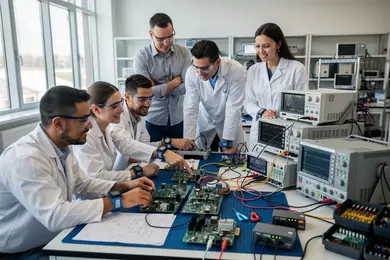
Hands-on work is one of the biggest questions for online electrical engineering students. A credible program should clearly explain how students measure circuits, use instruments, complete experiments, document results, and design systems. Simulations are useful, but they should not be the only form of applied learning in a hardware-focused program.
Online programs commonly use several lab models. The right model depends on your location, schedule, budget, and learning style.
- At-home lab kits that include components, breadboards, microcontrollers, sensors, meters, and other equipment for guided experiments.
- Remote labs where students control real instruments or hardware through an online interface.
- Simulation tools for circuit behavior, signal analysis, controls, electromagnetics, or digital systems before physical testing.
- Short campus residencies that allow students to complete intensive labs using university equipment.
- Approved local lab or proctoring arrangements when a program permits students to complete certain requirements near home.
- Team-based capstone projects where students design, build, test, and present an engineering solution.
Before enrolling, ask detailed lab questions. You want to know whether you will physically build circuits, what instruments are required, how lab safety is handled, whether equipment costs are included in tuition, and how team projects work across time zones. If a program cannot explain its lab model clearly, that is a serious red flag for electronics and hardware preparation.
Internships can also be completed while enrolled online, but they usually require student initiative. Working adults may use current employment for applied projects if the school approves it, while full-time students may need to search locally or relocate temporarily for summer internships. Career services should help with resumes, technical interview preparation, employer contacts, and project presentation, but students should not wait until senior year to build experience.
The smartest approach is to treat every lab and project as portfolio evidence. Save schematics, test results, code repositories, design notes, photos, failure analysis, and final reports where allowed by course policy. Hardware employers often want proof that candidates can debug real systems, not just pass exams.
Other Things You Should Know About Electrical Engineering
Yes, most students need at least some programming. Common uses include embedded systems, data analysis, simulation, controls, automation, and hardware testing. C, C++, Python, MATLAB, and hardware description languages may appear depending on the program.
Most programs require safety modules before any at-home lab work, including basic electrical hazards, ESD handling, and proper use of multimeters or soldering tools. Some schools also require a signed safety agreement and completion of an orientation quiz before shipping lab kits.
Some students do, but it requires careful pacing. Part-time enrollment is often more realistic for working adults because labs, problem sets, and exams can be time-consuming. Students with family or job responsibilities should ask about course load, live meeting times, and maximum time to degree.
References
- Internships for Electrical Engineering Students : Complete Guide https://www.skyfilabs.com/blog/good-internship-ideas-for-electrical-engineering-students
- The Significance of Electrical Engineering Certification for Professional Advancement - CertLibrary Blog https://www.certlibrary.com/blog/the-significance-of-electrical-engineering-certification-for-professional-advancement/
- 10 Remote STEM Internships for High School Students https://riseglobaleducation.com/blogs/remote-stem-internships-for-high-school-students
- Embedded Systems Course for EEE Students to Build a Strong Career https://vlsiguru.com/blog/embedded-systems-course-for-eee-students
- Salary for Electrical Engineer: Is it a high paying career? https://www.stonebridge.uk.com/blog/engineering/salary-for-electrical-engineer-or/