2027 Online Electrical Engineering Degrees for Students Who Want Promotion Potential in Engineering Teams

Co-Founder and Chief Data Scientist
Engineers trying to move from execution work into design leadership need more than experience; they often need a stronger credential. The U.S. Bureau of Labor Statistics projects employment for electrical and electronics engineers to grow 9% from 2023 to 2033, signaling continued demand in power, automation, electronics, aerospace, and semiconductor work.
This guide is for technicians, working engineers, military learners, and career changers comparing online electrical engineering degrees. You will learn how programs work, what to verify, what they cost, and how to choose a degree that supports promotion potential.
Key Things You Should Know
- An online electrical engineering bachelor's degree should usually have ABET Engineering Accreditation Commission accreditation if you want the strongest path toward engineering licensure, employer recognition, and later professional engineering eligibility.
- BLS data show electrical engineers had a median annual wage of $111,910 in May 2024, while electronics engineers except computer had a median annual wage of $127,080, but pay varies by industry, region, clearance status, and responsibility level.
- Online programs can be a strong fit for promotion-minded students when they include rigorous labs, design projects, faculty access, transfer-credit review, and a curriculum aligned with roles such as systems engineer, power engineer, controls engineer, embedded systems engineer, or technical lead.
What is an online electrical engineering degree and how does it work?
An online electrical engineering degree is a college program that teaches the theory, mathematics, design methods, and lab skills used to build and maintain electrical, electronic, communication, control, and power systems.
At the bachelor's level, it prepares students for entry-level engineering roles or advancement from technician work. At the master's level, it helps practicing engineers deepen expertise in areas such as power systems, signal processing, microelectronics, controls, robotics, communications, or embedded systems.
Online does not usually mean "self-taught." Most reputable programs combine recorded lectures, live sessions, problem sets, simulations, remote labs, proctored exams, group design projects, and instructor feedback. Some programs are fully online, while others require short campus visits for labs, orientations, or capstone demonstrations.
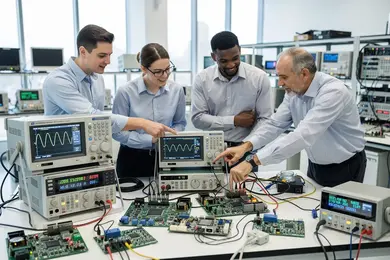
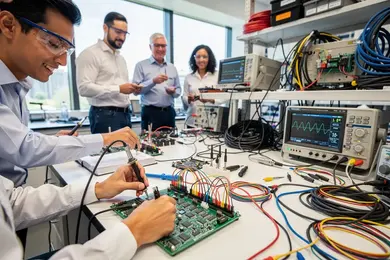
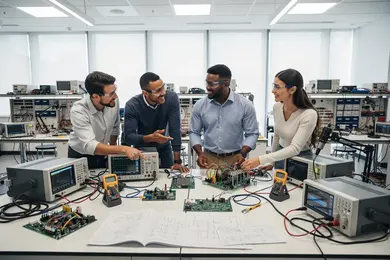
The format matters because electrical engineering is more math- and lab-intensive than many online majors. A strong program should show how students complete experiments, use instruments, demonstrate circuit behavior, document results, and collaborate on design work.
Students comparing engineering fields may also want to review an online mechanical engineering degree if their interests lean more toward machines, materials, thermodynamics, robotics hardware, or manufacturing systems.
The table below summarizes the main online electrical engineering degree options and the student profile each one typically serves.
| Degree type | Typical student | Primary purpose | Promotion value |
| Bachelor of Science in Electrical Engineering | New students, technicians, military learners, transfer students | Build the foundation for engineering design roles | Can help move from technician or associate roles into engineer-track positions |
| Bachelor's completion program | Students with prior credits or an associate degree | Finish upper-division engineering coursework | Can shorten the path to an engineering credential if credits transfer cleanly |
| Master of Science in Electrical Engineering | Engineers with a technical bachelor's degree | Specialize in advanced technical areas | Can support movement into senior engineer, specialist, systems, or project leadership roles |
| Electrical engineering technology degree | Hands-on learners focused on applied systems and implementation | Prepare for applied engineering, testing, field, or manufacturing roles | Useful for applied advancement, but it may not carry the same licensure or design-engineering value as an engineering degree |
Are online electrical engineering degrees respected by employers and engineering teams?
Online electrical engineering degrees can be respected by employers when the school is properly accredited, the curriculum is rigorous, and graduates can demonstrate engineering competence. Hiring managers usually care less about whether lectures were online and more about whether the applicant can solve technical problems, document work, use appropriate tools, communicate with teams, and handle real design constraints.
The strongest signal is not simply "online" or "campus." It is whether the program has recognized institutional accreditation and, for many bachelor's programs, ABET accreditation. In engineering teams, ABET accreditation can matter because it indicates that the program has been reviewed against discipline-specific outcomes such as experimentation, design, ethics, teamwork, and problem solving.
Students should also understand that employer respect depends on the role. A remote master's degree from a reputable engineering school may be well accepted for an experienced engineer seeking a senior technical track. For a first engineering job, however, employers may scrutinize labs, internships, capstone work, and project evidence more closely because early-career candidates have fewer workplace accomplishments.
Before enrolling, students should look for practical proof that the program translates into engineering credibility. The following signals are especially important when a degree will be used for promotion or career transition:
- ABET accreditation for bachelor's engineering programs when licensure, design authority, or broad employer recognition is important
- Clear lab delivery methods, such as remote lab platforms, mailed lab kits, simulation tools, or required in-person sessions
- Capstone or design projects that produce portfolio-ready documentation, test results, schematics, code, and engineering reports
- Faculty with engineering research, industry, or professional practice experience in relevant technical areas
- Career services that understand engineering recruiting, not only general resume writing
- Transparent outcomes, including graduate roles, employer examples, licensure preparation, and graduate-school placement where available
A common mistake is assuming that "online" automatically weakens a degree. A better question is whether the program can prove the same academic expectations as the campus version and whether the graduate can show evidence of applied engineering work.

How do online electrical engineering programs compare to campus-based programs?
Online and campus-based electrical engineering programs often cover similar technical material, but the student experience can be very different. The best choice depends on your schedule, learning style, access to labs, need for networking, and career stage.
The comparison below shows the main trade-offs students should weigh before choosing a format.
| Factor | Online electrical engineering program | Campus-based electrical engineering program | Best fit |
| Schedule | Often designed for working adults, with asynchronous or evening coursework | Usually follows daytime course blocks and on-campus lab schedules | Online for employed students; campus for traditional full-time students |
| Labs | May use simulations, remote equipment, home kits, or short residencies | Direct access to campus labs, instruments, and teaching assistants | Campus for students who want frequent hands-on lab access; online for students comfortable with structured remote lab work |
| Networking | Requires intentional effort through virtual teams, faculty hours, and professional societies | More spontaneous interaction with classmates, faculty, labs, and recruiters | Campus for immersive networking; online for students who already have industry connections |
| Cost control | Can reduce relocation and commuting costs, though tuition varies widely | May provide more campus resources but can add housing and transportation costs | Online for students staying employed or living far from an engineering school |
| Learning style | Requires self-management, strong math discipline, and comfort with digital tools | Provides more structured in-person support and scheduled accountability | Campus for students who need in-person structure; online for independent learners |
Online study can be especially practical for technicians, military personnel, parents, and engineers who cannot leave work for a residential program. It can also preserve income while a student studies, which is a major return-on-investment factor that tuition alone does not capture.
Campus study may be better for students who want daily lab access, undergraduate research, co-op recruiting, student engineering teams, and in-person faculty mentoring. It may also be easier for students who are still building college-level study habits or who need frequent help with calculus, physics, and circuits.
The wrong choice is the one that ignores how engineering learning actually happens. If you choose online, make sure the program has strong tutoring, live access to instructors, clear lab procedures, and realistic weekly time expectations. If you choose campus, make sure the added cost and schedule disruption are justified by resources you will actually use.
What accreditation should an online electrical engineering program have in the United States?
In the United States, accreditation is one of the most important checks for any online electrical engineering program. At minimum, the institution should be accredited by an agency recognized by the U.S. Department of Education or the Council for Higher Education Accreditation. This affects credit transfer, federal financial aid eligibility, graduate-school recognition, and basic institutional legitimacy.
For bachelor's degrees in electrical engineering, ABET Engineering Accreditation Commission accreditation is often the key program-level credential. ABET does not make a program automatically better for every student, but it is widely used as a quality signal in engineering education.
It can also be important for students who may later pursue the Fundamentals of Engineering exam, professional engineering licensure, public-sector engineering roles, or employers that prefer ABET-trained graduates.
Master's degrees are different. Many reputable online master's programs in electrical engineering are offered by accredited institutions even if the specific master's program is not ABET-accredited. This is common because ABET accreditation is more central at the undergraduate engineering level.
For a master's student, the program's faculty expertise, specialization options, research activity, employer recognition, and admission requirements may be more important than programmatic accreditation.
Students should verify accreditation directly rather than relying only on marketing language. Use this sequence before applying:
- Confirm the school's institutional accreditation through a recognized accreditor.
- Check whether the specific bachelor's electrical engineering program appears in ABET's accredited program search if ABET status matters for your goals.
- Confirm whether the online version has the same accreditation status as the campus version, because program names and delivery formats can differ.
- Ask the admissions office how the degree title appears on the transcript and diploma.
- If licensure is part of your plan, contact your state engineering board before enrolling to confirm how it treats the degree.
A major red flag is vague wording such as "ABET-aligned," "modeled after ABET," or "candidate for accreditation" without current accreditation. Those phrases may describe curriculum intent, but they are not the same as being accredited.
What admission requirements do online electrical engineering bachelor's and master's programs have?
Admission requirements vary by school, degree level, selectivity, and whether the program is designed for first-year students, transfers, or working engineers. Electrical engineering is math-heavy, so schools commonly look closely at readiness in calculus, physics, and prior technical coursework.
The table below outlines common admission expectations for online bachelor's and master's programs. Individual schools may add placement tests, bridge courses, interviews, or prerequisite reviews.
| Requirement area | Online bachelor's in electrical engineering | Online master's in electrical engineering |
| Prior education | High school diploma, GED, or transfer credits; some completion programs require an associate degree or completed prerequisites | Bachelor's degree, often in electrical engineering, computer engineering, physics, mathematics, or another engineering field |
| Math preparation | College algebra, trigonometry, precalculus, or calculus readiness may be required | Calculus sequence, differential equations, linear algebra, and engineering mathematics are often expected |
| Science preparation | Physics with lab is commonly required early in the program | Prior engineering science coursework may be reviewed for technical fit |
| GPA | Minimums vary; transfer programs may require a college GPA threshold | Many programs set a minimum undergraduate GPA, often with extra attention to technical courses |
| Tests | Placement exams may be used; standardized admissions tests are less common than they once were | GRE requirements are increasingly optional at many engineering schools, but policies vary |
| Application materials | Transcripts, application form, possible personal statement, and transfer-credit documents | Transcripts, resume, statement of purpose, recommendations, and sometimes a technical background review |
Students who are not fully ready should not assume rejection is the only outcome. Some schools offer bridge coursework, prerequisite sequences, or conditional admission. However, taking missing math and physics courses before entering upper-division engineering classes can prevent frustration and delays.
For working adults, transfer credit can make or break the timeline. Before committing, ask for a written transfer evaluation that shows exactly which credits apply to the degree, not just how many credits the school accepts. Credits that transfer as electives may not shorten an engineering degree if they do not satisfy required math, science, or engineering courses.
International applicants and U.S. students with foreign transcripts may need credential evaluations and English-language proficiency scores. Military students should ask whether technical training, electronics experience, or Joint Services Transcript credits can apply, but they should also verify whether those credits meet engineering requirements rather than general electives only.

What core courses and technical skills are taught in online electrical engineering programs?
Electrical engineering programs are built around mathematics, physics, circuits, computing, design, and systems thinking. The goal is not only to teach formulas but to help students model a problem, design a solution, test it, interpret data, and communicate the result to other engineers.
The core curriculum usually moves from foundational theory into increasingly specialized applications. Students should expect the following areas to appear in a rigorous program:
- Calculus, differential equations, linear algebra, probability, and engineering statistics
- Physics, electromagnetics, and semiconductor fundamentals
- Circuit analysis, electronics, digital logic, microprocessors, and instrumentation
- Signals and systems, communications, control systems, and power systems
- Programming for engineers, embedded systems, simulation, and numerical methods
- Engineering design, lab methods, technical writing, ethics, safety, and project documentation
Technical electives help students align the degree with a promotion path. A power-systems student may choose courses in grid operations, renewable integration, protection, and high-voltage equipment. An embedded systems student may focus on digital design, firmware, sensors, and real-time systems. A controls student may study robotics, automation, system modeling, and feedback design.
Current engineering teams also expect more software and data fluency than in the past. Electrical engineers increasingly work with Python, MATLAB, C/C++, SPICE tools, programmable logic, digital twins, test automation, and AI-assisted design workflows.
Students who want to move into analytics-heavy engineering roles may compare the electrical engineering path with an online master in data science, especially if their goal is predictive maintenance, sensor analytics, machine learning, or industrial data systems rather than hardware design.
To turn coursework into promotion value, students should document their work as they go. Useful portfolio artifacts include schematics, simulation results, firmware repositories, lab reports, test plans, failure analyses, capstone presentations, and design trade-off memos. These materials help managers see not only what you studied, but how you think as an engineer.
How long do online electrical engineering degrees take and what do they cost?
The time and cost of an online electrical engineering degree depend on degree level, transfer credits, enrollment pace, residency status, school type, fees, and whether the program requires campus visits. Because engineering courses often have prerequisites, acceleration is possible but not always flexible; calculus, physics, circuits, and labs usually must be taken in a sequence.
For a traditional bachelor's degree, students should plan for about four years of full-time study. Transfer students with an associate degree or substantial prior credits may finish in two to three years if prerequisites match the program. Online master's programs often take one and a half to three years, depending on whether the student enrolls full time, part time, or in an accelerated format.
Cost comparisons should include more than tuition. The College Board's 2024 pricing data reported average published tuition and fees of $11,610 for in-state students at public four-year institutions and $43,350 at private nonprofit four-year institutions for the 2024-2025 academic year. Those figures are not specific to online engineering programs, but they show why students should compare total net cost, not just sticker price.
The table below shows common cost and time factors that affect online electrical engineering students.
| Factor | How it affects students | What to ask before enrolling |
| Transfer credit | Can shorten the degree if credits satisfy required engineering courses | Which credits apply to major requirements, not only electives? |
| Residency tuition | Public universities may charge different rates for in-state, out-of-state, or online students | Is the online tuition rate the same for all students? |
| Lab costs | Engineering students may need kits, software, instruments, or campus lab visits | Are lab kits, proctoring, travel, and software included in tuition? |
| Enrollment pace | Part-time study protects work schedules but extends completion time | What is the maximum time allowed to finish the program? |
| Employer support | Tuition assistance can reduce out-of-pocket cost | Does the program schedule fit employer reimbursement rules? |
| Financial aid | Eligible students may use federal aid only at qualifying institutions and programs | Is the program eligible for federal financial aid? |
Students should be cautious with programs advertising extreme speed. Electrical engineering requires cumulative learning, and compressing too many technical courses can lead to weak fundamentals. Accelerated study works best for students who already have strong math preparation, fewer outside obligations, and prior exposure to electronics or programming.
A practical budgeting process should include these steps:
- Request a full program cost estimate that includes tuition, fees, books, software, lab equipment, proctoring, and travel.
- Ask for a written transfer-credit evaluation before paying a deposit.
- Compare net cost after scholarships, grants, employer tuition assistance, military benefits, or federal aid.
- Estimate the income you can preserve by studying online instead of leaving work for a campus program.
- Check whether course sequencing could delay graduation if a required class is offered only once per year.
What electrical engineering roles and promotion paths can these degrees support?
Online electrical engineering degrees can support several advancement paths, but the right path depends on your current role and target responsibilities. A technician may use a bachelor's degree to qualify for engineer-track work. A working engineer may use a master's degree to move into senior design, systems engineering, technical specialization, project leadership, or management.
Electrical engineering is broad, so students should connect electives and projects to the type of team they want to join or lead. The table below links common roles with typical responsibilities and promotion relevance.
| Role | Typical responsibilities | How the degree can support promotion potential |
| Electrical design engineer | Design circuits, review schematics, select components, document design decisions | Builds credibility for design ownership and technical review responsibilities |
| Power systems engineer | Work on generation, transmission, distribution, protection, reliability, or renewable integration | Supports advancement in utilities, energy firms, industrial facilities, and infrastructure teams |
| Controls engineer | Model systems, tune controllers, support automation, robotics, and manufacturing processes | Can lead to automation specialist, senior controls engineer, or plant engineering roles |
| Embedded systems engineer | Develop firmware, integrate sensors, test hardware-software systems | Supports advancement in automotive, aerospace, medical devices, industrial equipment, and IoT products |
| Test or validation engineer | Create test plans, analyze failures, verify product performance and compliance | Can move into reliability, quality engineering leadership, or systems validation |
| Systems engineer | Coordinate requirements, interfaces, risk, verification, and cross-disciplinary design | Often a strong path toward technical lead or program engineering roles |
| Engineering manager or project lead | Coordinate people, budgets, schedules, technical decisions, and stakeholder communication | A technical degree provides credibility, though management skills and experience are also essential |
Promotion usually requires more than the diploma. Engineering teams promote people who can reduce risk, mentor others, communicate trade-offs, and make sound decisions under constraints. Students should use the degree to build evidence of those behaviors through capstones, workplace projects, documentation, and measurable improvements.
Technology trends also influence career strategy. AI-assisted design, automation, electrification, semiconductor demand, grid modernization, cybersecurity for industrial systems, and connected devices are changing what electrical engineers do. Students whose interests lean more toward software architecture, algorithms, or systems programming may also compare electrical engineering with computer science degrees online before choosing a path.
A smart promotion plan often follows a sequence rather than a single leap:
- Identify the role you want next, such as design engineer, senior technician, controls engineer, or systems engineer.
- Map the role to missing requirements, including degree level, math, software tools, lab experience, or domain knowledge.
- Choose electives and projects that match the target role, not just courses that look interesting.
- Ask your manager which responsibilities would prove readiness for promotion while you study.
- Build a portfolio of engineering work that shows design decisions, testing, troubleshooting, and outcomes.
What salary ranges and job outlook can graduates in electrical engineering expect?
Electrical engineering compensation depends on specialization, industry, region, experience, security clearance, licensure, and whether the role involves design authority, systems responsibility, or leadership. National medians are useful benchmarks, but they should not be treated as guaranteed outcomes for any degree program.
According to BLS May 2024 wage data, the median annual wage for electrical engineers was $111,910, and the median annual wage for electronics engineers except computer was $127,080. For students, the key interpretation is that electrical engineering remains a high-skill technical field, but the strongest salary outcomes generally depend on matching the degree with in-demand experience, tools, and industries.
The employment outlook is also favorable by national standards. BLS projects electrical and electronics engineer employment to grow 9% from 2023 to 2033, with openings driven by growth and replacement needs. This does not mean every graduate will find the same opportunities, but it does suggest that electrical engineering skills remain relevant across infrastructure, product development, defense, communications, manufacturing, and energy systems.
The table below summarizes how salary and outlook context can differ by career direction without implying a guaranteed pay result.
| Career direction | Salary context | Outlook considerations | Credentials that may matter |
| Power and energy systems | Often tied to utilities, infrastructure, renewables, and industrial facilities | Grid modernization and electrification can support demand for power expertise | ABET bachelor's degree and eventual PE licensure may be valuable for some roles |
| Electronics and hardware design | Compensation can be strong in semiconductors, defense, aerospace, and advanced manufacturing | Experience with design tools, testing, and product cycles matters heavily | Portfolio projects, lab competence, and advanced coursework can strengthen applications |
| Controls and automation | Pay varies by manufacturing, robotics, process control, and systems integration work | Automation and smart manufacturing keep controls skills relevant | PLC, robotics, modeling, and industrial networking experience may help |
| Embedded systems | Roles may blend electrical engineering, firmware, and product testing | Connected devices, automotive systems, aerospace, and medical devices create demand for hybrid skills | C/C++, real-time systems, microcontrollers, and hardware debugging are important |
| Engineering leadership | Higher compensation often reflects responsibility for people, budgets, risk, or complex systems | Promotion depends on performance, communication, and organizational need as much as education | A master's degree, PE license, project experience, or management training may help depending on employer |
Students should evaluate salary data carefully. A national median does not account for local cost of living, industry cycles, federal contracting, union environments, overtime policies, or startup equity. The most practical approach is to compare target job postings in your region and note repeated requirements, such as ABET degree, simulation tools, programming languages, security clearance, PE license, or years of design experience.
How can students choose a reputable online electrical engineering program for career growth?
Choosing a reputable online electrical engineering program requires more than comparing tuition and rankings. The best program is the one that fits your career target, learning needs, accreditation requirements, budget, and weekly schedule while giving you credible engineering evidence to show employers.
Use the following checklist to narrow your options before applying:
- Start with your target role and choose programs with electives, labs, and faculty expertise that match it.
- Verify institutional accreditation and ABET status when relevant to licensure or employer expectations.
- Ask exactly how online labs work and whether any campus visits are required.
- Request a written transfer-credit evaluation and a full degree plan before enrolling.
- Compare total net cost, including fees, equipment, software, travel, and lost time.
- Review course sequencing to see whether part-time study will delay key prerequisites.
- Ask about tutoring, faculty office hours, advising, career support, and access to engineering software.
- Look for capstones, design projects, or industry partnerships that produce portfolio-ready work.
- Check whether the transcript identifies the degree differently from the campus program.
- Speak with current students or alumni if the school can connect you with them.
Common mistakes include choosing the cheapest program without checking lab quality, assuming all credits will transfer, ignoring ABET when licensure may matter, taking too many technical courses while working full time, and selecting electives that do not match the desired role.
Another mistake is relying only on a school's overall reputation; electrical engineering outcomes depend heavily on the specific department, curriculum, faculty, and project opportunities.
Students should also be honest about fit. If you dislike advanced math, physics, troubleshooting, or long technical problem sets, electrical engineering may not be the best investment. If your interests are centered on information organization, archives, knowledge systems, or research services rather than engineering design, a library degree may align better with your strengths. Choosing a different path is not a failure. It is a better ROI decision when the work matches your abilities and goals.
A strong final decision should answer three questions: Will this program be recognized for the roles I want? Can I realistically finish it while maintaining my responsibilities? Will the coursework produce skills and evidence that make me more promotable? If the answer to any of those questions is unclear, keep asking schools for specifics before you commit.
Other Things You Should Know About Electrical Engineering Degrees
Math proficiency is crucial for an online electrical engineering degree, as foundational courses like calculus and linear algebra are integral to the curriculum. Many programs offer resources and support to enhance students' math skills, ensuring success in technical problem-solving and electrical systems analysis.
Electrical engineering usually emphasizes theory, design, modeling, and analysis. Electrical engineering technology is typically more applied and focused on implementation, testing, maintenance, and field systems. Both can be valuable, but they may lead to different job titles, licensure options, and promotion paths.
It can help with confidence, troubleshooting, instrumentation, and applied context. Some schools may also award credit for evaluated military training, but students should confirm whether that credit applies to major requirements or only general electives.
Yes, but only if the program’s lab, design, and engineering science credits are part of an ABET-accredited electrical engineering degree. ABET accreditation is the key standard employers and state licensing boards check, especially for pathways toward the FE exam and future PE licensure.
References
- Find Programs - ABET https://www.abet.org/accreditation/find-programs/
- Career Paths & Advancement for Electrical Engineers | Vista Projects https://www.vistaprojects.com/career-paths-advancement-for-electrical-engineers/
- Electrical Engineering Salaries: Knowing Fact from Myth https://floridapoly.edu/news/electrical-engineering-salaries-knowing-fact-from-myth/
- Online Electrical Engineering Degrees - BSEE, MSEE https://www.onlineengineeringprograms.com/electrical