2027 Best Online Bachelor's in Electrical Engineering for Career Changers

Co-Founder and Chief Data Scientist
Switching into electrical engineering is a high-stakes choice because the degree is math-heavy, lab-based, and closely tied to licensure and employer expectations. The U. S. Bureau of Labor Statistics projects electrical and electronics engineering employment to grow 9% from 2023 to 2033, which makes program quality and career fit especially important. This guide is for adults changing careers who need to compare online bachelor's options, understand accreditation, estimate cost and time, and decide whether an online electrical engineering path is the right investment.
Key Things You Should Know
- For engineering roles, prioritize programs with institutional accreditation and, when available, ABET accreditation because ABET is the most widely recognized program-level standard for U.S. engineering degrees.
- The BLS reported a May 2024 median annual wage of $111,910 for electrical engineers, but entry-level pay varies by industry, region, internship experience, and technical specialization.
- College Board's 2024 pricing data shows published tuition and fees of $11,610 for in-state public four-year colleges and $43,350 for private nonprofit four-year colleges, so transfer credits and employer tuition benefits can strongly affect ROI.
What is an online bachelor's in electrical engineering and who is it best suited for?
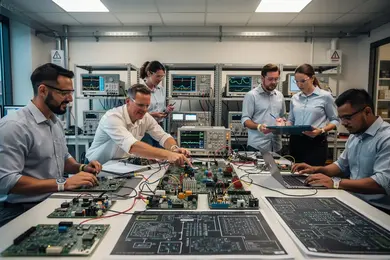
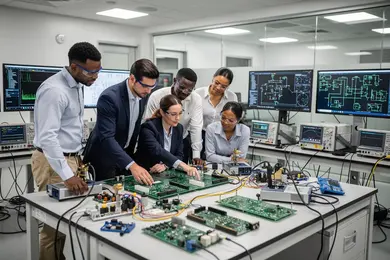
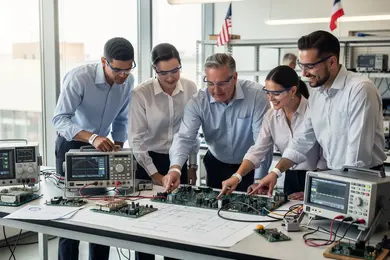
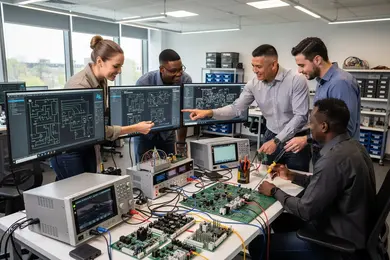
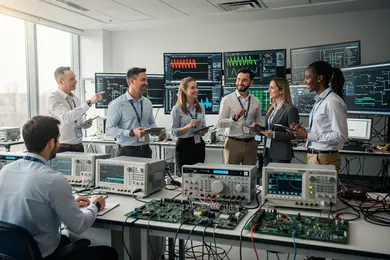
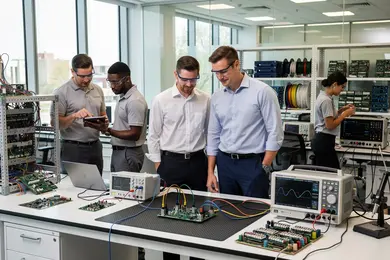
An online bachelor's in electrical engineering is a four-year undergraduate degree that teaches students how to design, analyze, test, and improve electrical and electronic systems. In an online format, lecture-based coursework is delivered remotely, while labs may use simulation software, mailed lab kits, remote instrumentation, short campus residencies, local proctored lab arrangements, or hybrid sessions.
For career changers, the degree is usually best suited for people who want to move into technical roles involving circuits, power systems, embedded systems, control systems, signal processing, communications, automation, renewable energy, semiconductors, or electronics product development. It can be a strong fit if you are comfortable rebuilding your math foundation and can commit to structured weekly problem-solving.
The degree may not be the best option if your goal is software-only work, IT administration, project coordination, or a faster credential for a non-engineering role. In those cases, a computer science degree, engineering technology program, coding-focused pathway, or shorter technical certificate may be more efficient. If your interest is in earth systems, environmental fieldwork, or resource exploration rather than electrical systems, comparing a geologist degree online may help you decide whether a different science path better matches your goals.
The table below summarizes who is most likely to benefit from an online EE bachelor's and who should consider alternatives before enrolling.
| Career changer profile | Fit for online electrical engineering | Why it matters |
| Working adult with strong algebra, trigonometry, or calculus readiness | Strong fit | The curriculum moves quickly into calculus-based physics, circuit analysis, and engineering math. |
| Technician, electrician, military electronics specialist, or manufacturing worker | Often a strong fit | Prior hands-on exposure can make lab concepts and system troubleshooting more intuitive. |
| Career changer seeking licensed Professional Engineer status later | Possible fit, but accreditation matters | State licensing boards often look closely at ABET accreditation and engineering work experience. |
| Student who wants the fastest possible career switch | Mixed fit | A bachelor's in EE is rigorous and usually takes several years, even with transfer credit. |
| Student who dislikes advanced math or physics | Weak fit | Electrical engineering depends heavily on mathematical modeling and quantitative problem-solving. |
Are online electrical engineering bachelor's degrees reputable and properly accredited in the U.S.?
Online electrical engineering bachelor's degrees can be reputable in the U.S., but reputation depends on accreditation, curriculum design, faculty oversight, lab quality, and employer recognition-not simply whether the program is online. A legitimate online degree should come from an institution accredited by a U.S. Department of Education-recognized accreditor. For engineering, the most important additional credential is usually ABET accreditation at the program level.
ABET accreditation is especially important if you may pursue engineering licensure, work in regulated industries, apply to competitive graduate programs, or seek roles where employers screen for accredited engineering degrees. Some online electrical engineering programs are ABET-accredited; others are not. A non-ABET program is not automatically worthless, but it may limit options for licensure or certain engineering titles.
Career changers should verify accreditation directly rather than relying on marketing language. Use the following steps before applying because accreditation status can vary by campus, delivery format, degree name, and graduation date.
- Confirm that the institution is accredited by a recognized institutional accreditor.
- Search ABET's public database for the exact program name, degree level, campus, and delivery mode.
- Ask admissions whether online students graduate under the same accredited program as campus students.
- Check whether the program supports Fundamentals of Engineering exam preparation if licensure may matter to you.
- Request written clarification if the school uses terms such as "ABET-aligned," "designed to meet ABET standards," or "seeking accreditation."
Red flags include unclear accreditation claims, pressure to enroll before you can review program outcomes, a curriculum with few engineering labs, or a degree title that sounds like electrical engineering but is actually electrical engineering technology. Engineering technology can be useful, especially for applied or technician-oriented careers, but it is not always treated the same as an engineering degree by employers or licensing boards.

How does an online electrical engineering bachelor's compare to a campus program for career changers?
For career changers, the online-versus-campus decision is less about prestige and more about access, lab structure, networking, schedule control, and total cost. Online programs can make an EE degree possible for adults who cannot relocate or leave a job, while campus programs may offer more immediate access to labs, research groups, student design teams, and local employer pipelines.
The comparison below highlights the practical trade-offs that matter most when you are changing careers rather than entering college directly from high school.
| Decision factor | Online bachelor's in electrical engineering | Campus bachelor's in electrical engineering |
| Schedule flexibility | Often better for working adults, especially with asynchronous lectures | Less flexible because labs and lectures usually follow fixed weekly schedules |
| Labs | May use simulations, remote labs, kits, or short residencies | Usually easier access to physical lab equipment and faculty-supervised sessions |
| Networking | Requires intentional effort through virtual office hours, projects, internships, and professional groups | More organic access to classmates, faculty, research labs, and campus recruiting |
| Cost control | Can reduce relocation and commuting costs, but fees and lab requirements vary | May cost more if relocation, housing, parking, or lost work hours are required |
| Career services | Quality varies; strong programs offer virtual career coaching and employer connections | Often more visible through career fairs, capstone sponsors, and local employers |
| Best fit | Self-directed adults who need flexibility and can create their own networking plan | Students who want immersive labs, campus teams, and in-person faculty access |
Online learning is no longer a niche option. National Center for Education Statistics reporting released in 2024 shows that distance education remains a major part of U.S. higher education, which means employers are increasingly familiar with online coursework. Even so, engineering is more hands-on than many majors, so you should evaluate the lab model carefully before choosing a fully online program.
A common mistake is assuming an online program will be easier because you can study from home. Electrical engineering is still a calculus-based engineering degree. The flexibility helps with scheduling, but it does not remove the workload, exams, labs, projects, or need for consistent practice.
What prior education or experience do career changers need to enter an online EE program?
Career changers do not always need prior engineering experience, but they do need academic readiness. Online EE programs typically expect a high school diploma or equivalent, college-ready writing and quantitative skills, and prerequisite preparation in algebra, trigonometry, precalculus, chemistry, and physics. Transfer students may also need prior college transcripts, minimum GPA standards, and completed general education courses.
If you are comparing several online engineering programs, pay close attention to how each school evaluates transfer credits, because this can change both your completion time and total cost. Some programs are built for first-time bachelor's students, while others work better for adults who already hold an associate degree or substantial general education credit.
The preparation checklist below can help you identify gaps before you apply. Completing these steps early can prevent you from being admitted into a program but delayed by prerequisites.
- Review the program's math sequence and determine whether you are ready for calculus I or need precalculus first.
- Ask whether prior calculus, physics, computer programming, or electronics coursework will transfer into the major.
- Confirm whether the school accepts credits from community colleges, military training, CLEP exams, AP exams, or prior universities.
- Check whether foundational courses are offered online every term or only during certain semesters.
- Estimate weekly study time realistically; engineering courses often require problem sets, lab work, projects, and exam preparation outside scheduled class time.
Relevant work experience can help, especially in electronics repair, utilities, manufacturing, aviation, telecommunications, robotics, or the military. However, experience usually does not replace core engineering theory. A technician may understand equipment behavior from practice, but the EE degree adds mathematical modeling, design analysis, and system-level reasoning.
What core courses and specializations are offered in online electrical engineering bachelor's curricula?
Online electrical engineering bachelor's curricula usually combine general education, calculus-based science, engineering fundamentals, laboratory work, design projects, and electives. The early courses build the math and physics base; the middle of the program focuses on circuits, signals, electronics, and systems; the final stage often includes specialization electives and a capstone design project.
The table below shows common curriculum areas and why they matter for career changers who are trying to connect coursework with jobs.
| Curriculum area | Common courses | Career relevance |
| Math and science foundation | Calculus, differential equations, linear algebra, physics, chemistry | Supports modeling, simulation, circuit analysis, signal processing, and power calculations |
| Electrical engineering core | Circuit analysis, electronics, electromagnetics, digital logic, signals and systems | Builds the technical base for most entry-level EE and electronics roles |
| Computing and tools | Programming, MATLAB or Python, embedded systems, simulation software | Helps students work with modern design, testing, automation, and data analysis workflows |
| Labs and design | Electronics labs, instrumentation, controls labs, senior capstone | Demonstrates practical ability to test, troubleshoot, document, and build systems |
| Professional preparation | Technical writing, engineering ethics, project management, engineering economics | Develops communication and decision-making skills employers expect from engineers |
Specializations vary by school, but career changers should choose electives based on target industries rather than the trendiest label. The most common concentration areas include power and energy systems, control systems, embedded systems, communications, microelectronics, robotics, signal processing, and renewable energy.
Current technology trends make computing skills especially important. AI-assisted design tools, digital twins, automated testing, smart grid technologies, and software-defined hardware are changing how engineers work. That does not mean AI replaces the need for engineering fundamentals; it means graduates increasingly need to understand both electrical systems and the software tools used to model, test, and optimize them.
How long does it take to complete an online electrical engineering bachelor's, and can you study part-time?
A traditional bachelor's in electrical engineering is commonly designed as a four-year full-time program, but career changers often take longer if they study part-time, need prerequisites, or transfer in credits that do not satisfy major requirements. Online programs may advertise flexibility, yet many engineering courses must be taken in sequence, which can limit how quickly you can accelerate.
The table below outlines common completion scenarios. Use it as a planning tool rather than a promise, because timelines depend on transfer credit, course availability, prerequisite placement, and how many credits you can handle while working.
| Starting point | Typical time pattern | Key planning issue |
| No prior college credit | About four years full-time; longer part-time | You must complete general education, math, science, engineering core, labs, and capstone work. |
| Associate degree with transferable general education | Often two to three years if prerequisites align | Engineering-specific math, physics, and circuits may still need to be completed in sequence. |
| Prior bachelor's in a non-engineering field | Varies widely | General education may transfer, but most engineering major courses are still required. |
| Technician background without college-level math | Often extended | Practical experience helps, but calculus and physics readiness may add preparation time. |
Part-time study can be a smart choice if you are working, supporting a family, or paying as you go. The trade-off is that long timelines can increase the risk of stopping out. Before enrolling part-time, ask whether required courses are available every semester, whether labs require synchronous attendance, and whether there is a maximum time limit for completing the degree.
One practical strategy is to complete math, physics, and general education courses at an accredited community college before transferring, if the university confirms in writing that the credits will apply. This can reduce cost and help you test whether engineering coursework fits your life before you commit to upper-division tuition.
What does an online electrical engineering bachelor's cost, and what financial aid is available?
The cost of an online electrical engineering bachelor's depends on residency status, public versus private tuition, transfer credits, lab fees, technology fees, textbooks, software, proctoring fees, and required campus visits. Online study may save money on relocation and commuting, but it is not automatically cheaper than campus study.
Recent national pricing data can help you benchmark offers from schools. College Board's 2024 Trends in College Pricing reported the following published tuition and fee averages for four-year institutions, which gives career changers a useful reference point before comparing program-specific charges.
- Public four-year in-state tuition and fees: $11,610
- Public four-year out-of-state tuition and fees: $30,780
- Private nonprofit four-year tuition and fees: $43,350
Those figures are sticker prices, not necessarily what you will pay. Online students may qualify for federal grants, federal loans, scholarships, employer tuition assistance, military education benefits, state aid, or institutional aid. For the 2024-25 award year, the maximum Federal Pell Grant is $7,395, which can meaningfully reduce costs for eligible undergraduates but will not cover the full price of most engineering degrees.
Federal student loans can help cover remaining costs, but borrowing should be tied to a realistic repayment plan. The federal undergraduate Direct Loan interest rate for 2024-25 is 6.53%, so even moderate borrowing can become expensive if you extend repayment or pause progress. Compare total program cost, not just per-credit tuition.
Before you enroll, request a written cost breakdown that includes these items. This is especially important for online engineering students because lab and technology requirements can be less obvious than standard tuition.
- Tuition per credit and total credits required after transfer evaluation
- Mandatory online, engineering, lab, proctoring, graduation, and technology fees
- Software, hardware, calculator, lab kit, and equipment requirements
- Travel costs for any campus residency, lab intensive, orientation, or final presentation
- Estimated net price after grants, scholarships, employer aid, and transfer credits
- Loan amount needed under full-time and part-time enrollment scenarios
A good affordability decision balances price with accreditation, course access, labs, and career support. Choosing the lowest-cost program can backfire if it delays graduation, lacks the accreditation you need, or does not offer enough technical depth for your target role.
What entry-level jobs can career changers get with an online electrical engineering bachelor's?
Career changers with an online bachelor's in electrical engineering can pursue entry-level roles in industries such as utilities, aerospace, defense, semiconductor manufacturing, renewable energy, automotive systems, telecommunications, medical devices, robotics, industrial automation, and consumer electronics. The strongest candidates often combine the degree with internships, capstone projects, a portfolio of technical work, or prior industry experience.
The table below connects common entry-level roles with the type of work you may perform. Job titles vary by employer, and some roles may require U.S. citizenship, security clearance eligibility, field travel, or specific software skills.
| Entry-level role | Typical responsibilities | Helpful preparation |
| Electrical engineer I | Assist with circuit design, testing, documentation, troubleshooting, and product improvement | Circuits, electronics labs, simulation tools, technical writing |
| Power systems engineer | Support design or analysis of generation, transmission, distribution, or renewable energy systems | Power electives, energy systems projects, utility internships |
| Controls engineer | Work on automation, feedback systems, sensors, actuators, and industrial control processes | Control systems, programming, PLC exposure, robotics projects |
| Embedded systems engineer | Develop or test hardware-software systems used in devices, vehicles, equipment, or sensors | C programming, microcontrollers, digital logic, embedded projects |
| Test engineer | Create test procedures, analyze performance data, validate products, and document failures | Instrumentation, lab methods, statistics, scripting |
| Applications engineer | Help customers or internal teams apply technical products to real-world design problems | Communication skills, product knowledge, circuits, systems thinking |
Career changers should not wait until the final semester to build employability. Engineering hiring is project-driven, so employers look for evidence that you can solve real problems, not just complete exams. Useful preparation includes internship applications, IEEE student membership, capstone documentation, GitHub or portfolio examples for embedded work, and targeted elective choices.
If these engineering roles do not match your interests after you review the coursework, it may be worth comparing other applied science options. For example, an online animal science degree may be more relevant for students drawn to agriculture, food systems, veterinary support pathways, or biological production environments rather than electrical systems.
What salary ranges and job outlook can graduates expect in electrical engineering roles?
Electrical engineering can offer strong salary potential, but salary outcomes are not guaranteed and depend on location, industry, experience, clearance requirements, graduate education, and technical specialization. The BLS Occupational Employment and Wage Statistics program reported a May 2024 median annual wage of $111,910 for electrical engineers in the U.S. This median is a useful benchmark, but new graduates and career changers entering their first engineering role may start below it.
The BLS also projects 9% employment growth for electrical and electronics engineers from 2023 to 2033. That outlook is faster than the average for all occupations and reflects demand in areas such as semiconductor development, renewable energy, automation, telecommunications, transportation electrification, and advanced manufacturing. Still, local hiring can be cyclical, especially in industries tied to capital spending, defense contracts, or hardware product cycles.
The table below shows how salary context can differ by role direction. Use it to think about fit and skill development rather than as a prediction of your personal outcome.
| Career direction | Salary context | What can improve competitiveness |
| Electrical design and product development | Often tied to hardware, electronics, devices, or industrial systems employers | Strong circuits, simulation, lab testing, and design documentation skills |
| Power and energy | Often linked to utilities, grid modernization, renewables, and infrastructure | Power systems electives, internships, FE exam preparation, utility experience |
| Embedded systems | Can overlap with computer engineering and software-heavy hardware roles | C/C++, microcontrollers, real-time systems, digital logic, project portfolio |
| Controls and automation | Common in manufacturing, robotics, process industries, and logistics | Control theory, sensors, PLCs, robotics, industrial communication protocols |
| Testing and validation | Often a practical entry point for new graduates building product knowledge | Instrumentation, data analysis, scripting, lab procedures, quality documentation |
Career changers can improve ROI by targeting roles that value their prior experience. A former manufacturing supervisor may stand out in automation; a military electronics technician may be competitive in defense or aerospace; an electrician may bring useful field awareness to power systems. The smartest salary strategy is to combine the degree with a specialization, internships or projects, and a clear story about how your previous career adds value.
How can career changers choose the best online electrical engineering bachelor's for their goals?
The best online bachelor's in electrical engineering for a career changer is the program that matches your career goal, accreditation needs, schedule, budget, lab expectations, and transfer profile. Rankings can help you discover schools, but they should not replace a detailed fit check. A highly ranked program is not the best choice if it lacks the specialization, course availability, affordability, or licensure pathway you need.
Use the following step-by-step process to compare programs before applying. This sequence helps you avoid choosing based only on tuition, brand name, or convenience.
- Define your target outcome, such as power engineering, embedded systems, electronics design, controls, telecommunications, or graduate study.
- Verify institutional accreditation and check whether the exact electrical engineering program is ABET-accredited.
- Request a preliminary transfer credit review before estimating cost or graduation time.
- Compare the lab model, including remote labs, required equipment, campus visits, and synchronous sessions.
- Review the course rotation to confirm that required classes are offered often enough for part-time or accelerated study.
- Ask about internships, co-ops, capstone sponsors, career services, FE exam support, and employer partnerships.
- Calculate net cost after aid and include fees, equipment, travel, and loan interest.
- Speak with current online students or alumni if the school can connect you with them.
The questions below are especially useful when speaking with admissions advisors, department coordinators, or faculty. Ask for written answers when the information affects accreditation, cost, transfer credit, or graduation timing.
- Is the online program the same degree as the campus electrical engineering program?
- Is the program ABET-accredited, and does that status apply to online students?
- How are labs completed, assessed, and documented?
- What percentage of my prior credits will apply to the degree plan?
- Can working adults complete the program part-time without delaying required course sequences?
- What software, hardware, lab kits, or campus visits are required?
- What career support is available specifically to online engineering students?
- Do graduates commonly pursue the FE exam, graduate school, or specific industries?
Common mistakes include assuming every engineering degree supports licensure, ignoring lab requirements until after enrollment, comparing sticker prices without transfer credit, and choosing a program before confirming the target specialization. Another mistake is treating online convenience as the main selection factor; in engineering, curriculum depth and hands-on assessment matter just as much.
Finally, give yourself permission to choose a different path if the EE curriculum does not match your strengths or interests. Career changers who prefer information organization, archives, digital collections, or research services may find that a library degree is a better fit than an engineering program. The best decision is not the most technical option; it is the credential that supports the work you actually want to do.
Other Things You Should Know About Electrical Engineering
In 2027, online electrical engineering programs often use virtual labs and simulations to provide practical experience. However, some programs may require students to purchase kits or attend in-person labs to fulfill hands-on requirements. Research your chosen program's lab criteria to ensure you can meet these requirements.
Yes, if the program provides the required math, science, engineering depth, and accreditation expected by the graduate school. Competitive master's programs may also expect strong grades, faculty recommendations, and preparation in the chosen specialization.
It depends on your strengths. Electrical engineering usually requires more physics, circuits, electromagnetics, and hardware labs, while computer science focuses more on algorithms, software, systems, and theory. Both can be rigorous.
Most online electrical engineering programs accept up to 60 semester credits from accredited community colleges or four-year schools. Core upper-division engineering courses usually must be completed in residence or through the program itself, and transfer credit is reviewed course by course by the registrar or engineering department.
References
- EEVblog Captcha https://www.eevblog.com/forum/chat/education-level-required-for-employment-as-ee/
- WELCOME TO BRADLEY UNIVERSITY ONLINE https://info.online.bradley.edu/
- What Can You Do With an Electrical Engineering Degree? https://www.onlineu.com/resources/college-planning/what-can-you-do-with-electrical-engineering-degree
- Electrical Engineering Salaries: Knowing Fact from Myth https://floridapoly.edu/news/electrical-engineering-salaries-knowing-fact-from-myth/