
2027 How To Become A Data Analyst

Co-Founder and Chief Data Scientist
Becoming a data analyst is a practical career goal for people who like solving problems with evidence, not guesses. Organizations now collect large amounts of customer, financial, operational, product, and healthcare data, but that data only creates value when someone can clean it, analyze it, explain it, and connect it to a business decision. Research cited in the original source notes that decisions supported by data analytics contribute to a 63% growth in productivity, which can support stronger profits.
This guide explains how to become a data analyst for 2027, what the job involves, which degrees and certifications are useful, what skills employers look for, how much data analysts earn, and how artificial intelligence is changing the field. It is written for students, career changers, early-career professionals, and working analysts deciding whether to specialize, earn another credential, or move into a higher-level analytics role.
Quick answer: how do you become a data analyst?
To become a data analyst, build a foundation in statistics, spreadsheets, SQL, data visualization, and at least one programming language such as Python or R. Most candidates enter the field with a bachelor’s degree, but a strong portfolio, relevant projects, internships, and recognized certifications can also help demonstrate job-ready skills.
Key facts about becoming a data analyst for 2027
- A data analyst studies raw information, identifies meaningful patterns, and turns those findings into recommendations that organizations can use.
- In the United States, the education profile of data analysts is 65% earned a bachelor's degree, 15% have a master's degree, 12% finished an associate degree, and 3% earned a high school diploma.
- Employment for data analysts is projected to increase by 23% from 2023 to 2033.
- The number of data analysts in the US is expected to rise from 123,300 in 2023 to 151,600 in 2033.
- About 11,300 openings for data analyst roles are expected each year in the country from 2023 to 2033.
- Data analysts in the United States have a median annual salary of $83,640 and an average annual salary of $95,600.
- What does a data analyst do?
- How do you become a data analyst for 2027?
- What education do data analysts usually need?
- Which certifications are useful for data analysts?
- What programming languages and tools should data analysts learn?
- What jobs can data analysts pursue?
- How can data analysts move into higher-level roles?
- Which skills matter most for data analysts?
- What happens in a data analyst interview?
- What is the job outlook for data analysts?
- Can cybersecurity knowledge help a data analyst?
- How can data analysts keep their skills current?
- Which specializations can strengthen a data analytics career?
- Should data analysts consider specialized graduate degrees?
- How are AI and automation changing data analysis?
- How can data analysts future-proof their careers?
- Can a health informatics certification help a data analyst?
- How much do data analysts earn?
- How can a data analyst build a strong portfolio?
- Which educational program is best for advancing in data analytics?
- What challenges do data analysts face?
What does a data analyst do?
A data analyst collects, cleans, organizes, studies, and explains data so that teams can make better decisions. The role sits between technical work and business communication: analysts need enough technical skill to work with databases and analytical tools, but they also need to explain what the numbers mean to people who may not have a technical background.
Typical work includes pulling data from spreadsheets, databases, dashboards, customer systems, or operational platforms; checking the information for errors; finding trends or anomalies; and building reports that show what is happening and why it matters. A data analyst may help a marketing team understand campaign performance, help a finance team forecast costs, help an operations team identify bottlenecks, or help a healthcare organization track quality and service metrics.
Data analysts also support the systems that make reporting possible. They may document data definitions, maintain dashboards, flag data quality problems, test reports, and work with database or engineering teams when data pipelines break. In more advanced roles, analysts may use predictive modeling, statistical testing, or segmentation to estimate future outcomes and compare possible decisions.
Because tools and employer expectations change quickly, many professionals use short programs, bootcamps, and online data analytics certificate options to update their skills without pausing their careers.
Common data analyst responsibilities
| Responsibility | What it looks like in practice |
| Data collection | Gathering information from databases, spreadsheets, surveys, software platforms, or external datasets. |
| Data preparation | Cleaning missing values, fixing duplicate records, standardizing formats, and preparing datasets for analysis. |
| Data analysis | Using statistics, formulas, SQL queries, or programming tools to find trends, relationships, and performance patterns. |
| Data visualization | Creating charts, dashboards, and visual summaries that make findings easier to understand. |
| Reporting | Producing recurring reports, executive summaries, and performance updates for stakeholders. |
| Insight generation | Translating findings into practical recommendations, not just presenting numbers. |
| Problem solving | Investigating why metrics changed, why a process is inefficient, or why a business outcome missed expectations. |
| Data system monitoring | Checking dashboards, databases, and reporting workflows for errors or inconsistencies. |
| Skill updating | Learning new tools, analytics methods, and industry standards as the field changes. |
Based on the CVs of data analysts in the United States, the most frequently listed skills are data analysis (10.2%), Python (6.9%), Power Bi (6.1%), data management (5.5%), visualization (5.3%), data quality (4.2%), and data collection (3.6%).
How do you become a data analyst for 2027?
The best path depends on your background. A college student may start with a degree in statistics, data science, computer science, economics, or business analytics. A career changer may begin with SQL, Excel, a portfolio, and a certificate. A working professional may use analytics projects in their current job to build experience before applying for dedicated analyst roles.
Step 1: Learn what the job actually requires
Start by reviewing job descriptions for entry-level data analyst roles in the industries that interest you. Look for repeated requirements: SQL, Excel, Tableau, Power BI, Python, statistics, stakeholder communication, dashboard development, data cleaning, or business analysis. This helps you avoid studying tools that are not relevant to your target roles.
Step 2: Choose an education path that fits your goal
Many data analysts have a bachelor’s degree in data science, computer science, mathematics, statistics, economics, business analytics, or a related field. If you already have a degree in another area, you may not need a second bachelor’s degree; targeted coursework, a certificate, or a project-based bootcamp may be more efficient. Analysts who later want leadership roles may consider business-focused graduate study, including accelerated MBA programs.
Step 3: Build the core technical toolkit
Prioritize SQL, spreadsheet analysis, statistics, data cleaning, and visualization before chasing advanced tools. Python or R can strengthen your profile, especially if you want to automate workflows or handle larger datasets. Cloud tools and big data platforms can help later, but entry-level applicants should first prove that they can answer business questions accurately and clearly.
Professionals who want a deeper technical base or who plan to lead technology-heavy analytics projects may compare graduate options such as an online master’s degree in information technology.
Step 4: Practice with real datasets
Use open datasets from public sources, Kaggle, Google Datasets, or the UCI Machine Learning Repository. Choose projects that resemble real business questions, such as customer churn, sales trends, budget forecasting, public health indicators, product usage, or operational efficiency. The goal is to show that you can move from messy data to a defensible conclusion.
Step 5: Create a portfolio employers can review
A portfolio should show your process, not just final charts. Include the question you investigated, where the data came from, how you cleaned it, what methods you used, what you found, and what you would recommend. Good data storytelling matters in analytics just as clear narrative structure matters in fields such as writing; students comparing communication-heavy programs can also review online creative writing degrees for a different education path.
Step 6: Add certifications when they fill a specific gap
Certifications can help when you need structure, proof of tool knowledge, or a credential for an entry-level resume. They are most useful when paired with projects. A certificate alone is rarely as persuasive as a certificate plus a portfolio that uses SQL, visualization, and a clear business recommendation.
Step 7: Apply for entry-level and adjacent roles
Search for titles such as data analyst, junior data analyst, reporting analyst, business analyst, operations analyst, marketing analyst, or analytics associate. Tailor each resume to the posting by naming the tools, datasets, and project outcomes most relevant to that role. Expect technical screens, take-home assignments, or case questions.
Step 8: Build professional relationships
Networking can help you learn which skills employers value and how analyst teams operate. Join analytics communities, attend webinars, ask for informational interviews, and connect with people who work in your target industry. Referrals and mentoring can make a difference, especially for career changers without a traditional analytics degree.
| Stage | Main goal | Evidence employers can see |
| Beginner | Learn spreadsheets, SQL, statistics, and basic visualization. | Practice notebooks, spreadsheet analyses, and simple dashboards. |
| Portfolio builder | Complete end-to-end projects using realistic datasets. | GitHub projects, Tableau Public dashboards, written summaries, or a personal site. |
| Job applicant | Match skills to entry-level job descriptions. | Targeted resume, certificate if relevant, portfolio links, and interview-ready project explanations. |
| Early-career analyst | Deliver reliable reports and business recommendations. | Work samples, stakeholder feedback, improved dashboards, and documented results. |
What education do data analysts usually need?
A bachelor’s degree is the most common education level for data analysts, and many entry-level postings prefer or require one. Relevant majors include data science, computer science, mathematics, statistics, economics, business analytics, management information systems, and some engineering fields. Students who need a lower-cost route can compare affordable online bachelor’s degree programs.
The right major depends on the kind of analyst work you want. A technically intensive role may favor computer science or data science. A finance, marketing, or operations role may value business analytics, economics, or management information systems. A research-heavy role may benefit from statistics or mathematics.
| Degree path | Best fit | Strength for analytics work | Possible limitation |
| Data Science | Students who want a direct analytics-focused major. | Combines statistics, programming, machine learning concepts, databases, and visualization tools such as Python, R, SQL, and Tableau. | Programs vary widely, so students should check how much hands-on project work is included. |
| Computer Science | Learners who want strong programming, database, and systems knowledge. | Builds technical depth for automation, data pipelines, and complex data environments. Cost-conscious students can review the most affordable online computer science degree options. | May require extra coursework in business analytics, statistics, or visualization. |
| Mathematics or Statistics | Students who enjoy quantitative reasoning and modeling. | Develops probability, statistical inference, regression, and analytical problem-solving. | May need additional programming and business communication practice. |
| Economics | Students interested in markets, finance, policy, or consumer behavior. | Includes econometrics, quantitative analysis, and interpretation of economic or business data. Data analyst and data scientist roles are also listed among the career options for economics master’s graduates. | May not cover modern analytics tools deeply unless electives are chosen carefully. |
| Business Analytics or MIS | Students who want to connect data work directly to business decisions. | Balances databases, reporting, decision-making, and organizational strategy. | May be less mathematically rigorous than statistics-focused programs. |
| Engineering, such as Industrial or Systems Engineering | Students interested in process improvement, optimization, or operations. | Provides training in systems thinking, optimization, operations research, and statistical modeling. | May require additional training in dashboarding and business reporting tools. |
According to Zippia, the education level of data analysts in the United States is 65% earned a bachelor's degree, 15% have a master's degree, 12% finished an associate degree, and 3% earned a high school diploma.
Which certifications are useful for data analysts?
Certifications can be useful when they match your experience level and target job. Beginners should look for programs that teach fundamentals and include projects. Working analysts should choose credentials tied to tools they use at work or specializations they want to enter, such as business intelligence, cloud analytics, big data, or predictive modeling.
| Certification | Who it is best for | What it covers |
| Google Data Analytics Professional Certificate | Beginners who want a structured introduction to analytics. | Data visualization, SQL, R programming, data ethics, and foundational analytics concepts across eight courses that take approximately six months to complete. |
| IBM Data Analyst Professional Certificate | Newcomers preparing for entry-level data analyst positions. | Python, SQL, Excel, and IBM Cognos Analytics through eight courses with no prior experience required. |
| Microsoft Certified: Power BI Data Analyst Associate | Analysts who work with Microsoft Power BI or business intelligence reporting. | Power BI data modeling, visualization, and reporting; candidates must pass the PL-300 exam. |
| CompTIA Data+ | Early-career professionals who want to validate broad analytics skills. | Data analysis, mining, visualization, governance, and data-informed decision-making, with around six months of preparation typically required. |
| Certified Analytics Professional (CAP) | Experienced analytics professionals seeking an independent credential. | Analytics process knowledge, methodology selection, and model building; eligibility requires three to seven years of professional experience depending on education. |
| SAS Certified Data Scientist | Analysts who use SAS or want deeper training in predictive analytics. | Multiple tracks covering data science, statistical analysis, and predictive modeling with SAS tools. |
| AWS Certified Data Analytics – Specialty | Experienced analysts working in AWS cloud environments. | AWS analytics tools and cloud-based data workflows; candidates are recommended to have at least five years of experience in data analytics and two years specifically with AWS. |
| Cloudera Certified Associate (CCA) Data Analyst | Professionals working with Hadoop and big data ecosystems. | SQL-based data analysis within Apache Hadoop and related big data technologies. |
How to choose a data analytics certification
- Choose a beginner certificate if you need structure and do not yet have a portfolio.
- Choose a tool-specific credential if job postings in your target market repeatedly mention Power BI, SAS, AWS, or another platform.
- Choose an advanced credential only if you meet the experience requirements and can use the credential to support promotion, specialization, or consulting work.
- Avoid collecting certifications without projects; employers need evidence that you can apply the skills.
What programming languages and tools should data analysts learn?
Data analysts do not need to master every programming language. They should first learn the tools that let them extract, clean, analyze, and explain data reliably. Unlike students in software-heavy fields such as online game programming college programs, data analysts usually focus less on building applications and more on querying databases, modeling data, and communicating findings.
| Language or tool | Why it matters for data analysts | When to prioritize it |
| Python | Python is widely used for data cleaning, automation, analysis, visualization, and machine learning. Libraries such as Pandas, NumPy, Matplotlib, Seaborn, and Scikit-learn make it useful for many analytics tasks. | Prioritize Python if you want flexible programming skills, plan to work with larger datasets, or want to move toward predictive analytics. |
| R | R is designed for statistical computing and visualization. Packages such as ggplot2 and dplyr help analysts explore and present complex datasets. | Prioritize R if you are interested in statistics-heavy work, academic research, healthcare analytics, or finance analytics. |
| SQL | SQL is essential for retrieving, filtering, joining, and summarizing data stored in relational databases. | Prioritize SQL early; it is one of the most common requirements for data analyst roles. |
| SAS | SAS supports statistical analysis, business intelligence, and predictive modeling, especially in regulated settings. | Prioritize SAS if you target healthcare, finance, government, or employers that use SAS systems. |
| Excel | Excel remains common for quick analysis, PivotTables, Power Query, reporting, and basic automation through VBA. | Prioritize Excel at the beginning because many teams still use spreadsheets for reporting and analysis. |
| JavaScript | JavaScript can support interactive, web-based visualizations through libraries such as D3.js. | Prioritize JavaScript only if your target roles emphasize custom dashboards, web visualization, or data storytelling on digital platforms. |
What jobs can data analysts pursue?
Data analysis skills transfer across many business functions. Some professionals keep the data analyst title, while others move into business, marketing, finance, operations, healthcare, product, risk, or visualization roles.
| Role | Primary focus | Good fit for |
| Data Analyst | Interprets datasets, builds reports, and identifies trends that support business goals. | People who want a broad analytics role across functions or industries. |
| Business Analyst | Uses data to improve business processes, requirements, workflows, and decision-making. | Analysts who enjoy stakeholder communication and process improvement. |
| Marketing Analyst | Studies campaigns, audiences, customer behavior, market trends, and return on investment. | People interested in customer data, advertising, growth, and digital marketing. |
| Financial Analyst | Analyzes budgets, forecasts, investment performance, and financial results. | Analysts with interest in finance, accounting, investments, or corporate planning. |
| Operations Analyst | Reviews operational metrics to find inefficiencies and recommend process improvements. | People who like systems, logistics, productivity, and workflow optimization. |
| Healthcare Data Analyst | Works with patient, clinical, administrative, or system data to improve care and operations. | Analysts interested in healthcare; this role is also relevant to some careers for health informatics master’s graduates. |
| Product Analyst | Analyzes product usage, user behavior, feature performance, and customer experience. | People interested in technology products, experimentation, and user metrics. |
| Data Visualization Specialist | Creates dashboards, visual reports, and interactive tools that make data easier to use. | Analysts with strong design, reporting, and communication skills. |
| Risk Analyst | Evaluates risk in finance, compliance, operations, or cybersecurity-related settings. | People who like structured analysis, controls, and risk mitigation. |
| Freelance Data Analyst | Provides project-based analytics services to multiple clients. | Experienced analysts who want flexibility and can manage client relationships. |
How can data analysts move into higher-level roles?
Data analysts advance by moving beyond routine reporting into higher-impact work: designing better metrics, leading analytics projects, advising stakeholders, building scalable dashboards, mentoring junior analysts, or specializing in an industry. Career growth often requires stronger business judgment, clearer communication, and the ability to connect analysis to strategy.
Some professionals pursue graduate education when they want to move into analytics leadership, consulting, product strategy, or management. For example, an affordable online MBA in data analytics may make sense for analysts who want business leadership training along with analytics coursework.
Which skills matter most for data analysts?
Strong data analysts combine technical ability with judgment. They must know how to work with data, but they also need to ask the right questions, recognize weak assumptions, explain uncertainty, and recommend practical next steps.
Technical skills
- Statistical analysis: Analysts need to understand probability, distributions, hypothesis testing, regression, and other methods used to interpret data responsibly.
- Programming and querying: SQL, Python, and R help analysts retrieve, clean, transform, and study data efficiently.
- Data cleaning and preparation: Much of the job involves fixing missing values, inconsistent fields, duplicate records, outliers, and formatting problems before analysis begins.
- Data visualization: Tableau, Power BI, Excel, and similar tools help turn complex findings into clear charts, dashboards, and reports.
- Database knowledge: Analysts should understand how data is stored, joined, updated, and governed in structured and unstructured environments.
- Machine learning basics: Introductory knowledge can help analysts understand predictive modeling, though many data analyst roles do not require advanced machine learning.
Professional skills
- Critical thinking: Good analysts test assumptions and look for alternative explanations before presenting conclusions.
- Communication: Analysts must explain technical findings to managers, clients, and colleagues who may not work with data every day.
- Problem-solving: The work often begins with unclear business questions, messy data, or incomplete information.
- Attention to detail: Small errors in formulas, joins, filters, or definitions can lead to misleading conclusions.
- Collaboration: Analysts frequently work with marketing, finance, operations, product, engineering, healthcare, or executive teams.
- Ethical judgment: Responsible data use requires attention to privacy, security, bias, and appropriate interpretation.
What happens in a data analyst interview?
A data analyst interview usually tests both technical skill and business thinking. You may be asked to write SQL queries, interpret a dataset, explain a dashboard, analyze a business case, or walk through a portfolio project. Employers want to know whether you can produce correct analysis, communicate clearly, and make recommendations that fit the situation.
Behavioral questions often focus on how you handled unclear requirements, worked with stakeholders, corrected an error, prioritized deadlines, or explained a technical issue to a non-technical audience. Candidates with a stronger computing foundation may feel more prepared for technical assessments; one possible route is a 2 year bachelor degree in computer science program, depending on prior credits and program structure.
Common interview tasks
- Write SQL queries using joins, filters, aggregations, and subqueries.
- Explain how you would clean a messy dataset.
- Interpret a chart and identify what decision it supports.
- Discuss a portfolio project, including limitations and assumptions.
- Answer a business case, such as why sales dropped or why customer churn increased.
- Describe how you would communicate uncertain findings to a stakeholder.
What is the job outlook for data analysts?
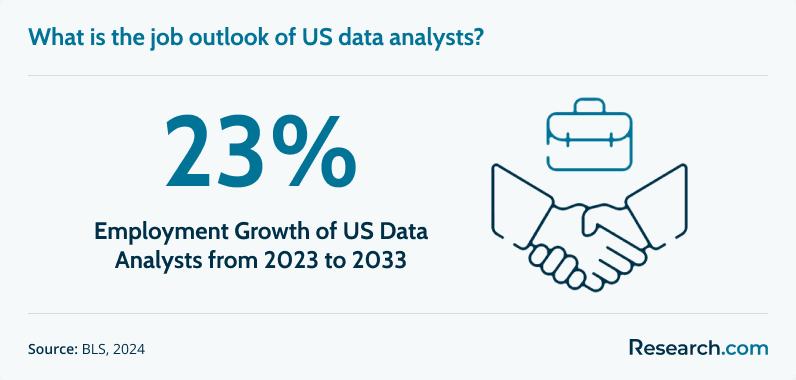
According to the United States Bureau of Labor Statistics (BLS), employment of data analysts is projected to grow by 23% from 2023 to 2033. That is higher than the 4% collective average for all occupations in the country. The number of data analysts is expected to increase from 123,300 to 151,600 during that period.
Graduates can expect around 11,300 job openings for data analyst positions in the country each year from 2023 to 2033. That figure does not include every adjacent role that uses analytics skills, such as business analyst, marketing analyst, operations analyst, or product analyst.
Can cybersecurity knowledge help a data analyst?
Yes, cybersecurity knowledge can make a data analyst more useful, especially in organizations that handle sensitive information. Analysts often work with customer, employee, financial, health, or operational data, so they should understand basic privacy, access control, data quality, and risk concepts. This does not mean every analyst needs to become a cybersecurity specialist, but knowing how data can be exposed, misused, or compromised can improve analytical judgment and collaboration with IT and risk teams.
Professionals who want to combine analytics with security may compare cost-conscious options such as the cheapest cyber security degree online pathways.
How can data analysts keep their skills current?
Data analytics changes quickly because tools, data platforms, and employer expectations evolve. Analysts can stay current by learning one new tool at a time, updating portfolio projects, reading documentation, joining professional communities, attending webinars, and practicing with datasets outside their comfort zone.
Skill growth should be intentional. A beginner may focus on SQL and dashboards. A mid-career analyst may learn Python automation, cloud data tools, governance, or experimentation. A senior analyst may build expertise in strategy, stakeholder management, machine learning concepts, data ethics, or team leadership. Some professionals use advanced study, such as an affordable online master's in information technology, to broaden their technical foundation.
Which specializations can strengthen a data analytics career?
Specialization can help analysts stand out when they pair analytics skills with domain knowledge. Instead of being a generalist who can build reports in any setting, a specialist understands the data, regulations, terminology, and decision-making patterns of a specific field.
| Specialization | Why it can help | Best for |
| Healthcare analytics | Healthcare organizations rely on data for patient outcomes, operations, quality measures, and administrative decisions. | Analysts interested in clinical, hospital, insurance, or public health data. |
| Finance analytics | Financial data supports forecasting, risk analysis, budgeting, investment evaluation, and compliance. | Analysts who like structured data, quantitative models, and financial decision-making. |
| Marketing analytics | Marketing teams use analytics to understand customers, measure campaigns, and improve return on investment. | Analysts interested in consumer behavior, digital channels, and growth metrics. |
| Product analytics | Product teams use usage data, experiments, and customer behavior to improve digital products. | Analysts interested in technology, user experience, and experimentation. |
| Bioinformatics | Bioinformatics connects data analysis with biological and genomic information, often requiring domain-specific methods. | Analysts considering advanced study such as online bioinformatics master's programs. |
Should data analysts consider specialized graduate degrees?
A specialized graduate degree can be worthwhile if it supports a clear career move. It may help when you want to enter a technical niche, qualify for senior roles, move into research-heavy work, or combine analytics with another field such as healthcare, biotechnology, business, or information technology. It may not be necessary if your goal is an entry-level analyst job and you still lack a portfolio or practical tool experience.
For analysts drawn to biological data, genomics, or life sciences, options such as online master’s in bioinformatics programs may provide domain-specific preparation.
How are AI and automation changing data analysis?
AI and automation are changing the daily workflow of data analysts. Repetitive tasks such as cleaning data, generating code snippets, summarizing datasets, and building first-draft visualizations can often be accelerated with newer tools. However, automation does not remove the need for human judgment. Analysts still need to define the problem, verify data quality, check assumptions, interpret results, and explain what should happen next.
The analysts most likely to benefit from AI are those who understand both the tools and the business context. They can use automation to work faster while still validating outputs and protecting against misleading conclusions. Professionals interested in technical systems, optimization, and applied problem-solving may also compare related pathways such as cheap accredited engineering online colleges.
How can data analysts future-proof their careers?
Data analysts can protect their long-term value by becoming better problem solvers, not just better tool users. Tools will change, but employers will continue to need professionals who can ask precise questions, judge data quality, communicate uncertainty, and make recommendations that improve decisions.
- Strengthen SQL, statistics, and data visualization before chasing advanced tools.
- Learn how AI tools work, but verify their outputs instead of trusting them blindly.
- Build industry knowledge in a field such as finance, healthcare, product, marketing, operations, or bioinformatics.
- Practice explaining analysis to non-technical audiences.
- Understand data governance, privacy, ethics, and security basics.
- Consider advanced study when it clearly supports a career goal, such as an online artificial intelligence program.
Can a health informatics certification help a data analyst?
A health informatics credential can help analysts who want to work with healthcare data. Healthcare analytics often involves electronic health records, patient privacy, clinical workflows, reimbursement data, quality metrics, and regulatory requirements. A general data analyst may know how to build a dashboard, but a healthcare-focused analyst also needs to understand what the data represents and how it affects patient care or administration.
For analysts targeting this sector, a health informatics certification online may strengthen healthcare-specific knowledge and help connect analytics skills to clinical and operational decisions.
How much do data analysts earn?
According to 2024 data from the BLS, data analysts in the United States have a median annual salary of $83,640 and an average annual salary of $95,600. The national median annual salary is $48,060. Salaries can vary by industry, location, experience, technical skill, and the complexity of the work.
The highest average annual salaries listed in the original data are in business schools and computer and management training centers ($157,960), computer equipment manufacturing ($138,980), government offices ($132,170), petroleum and coal products manufacturing ($131,720), and motion picture and video industries ($129,460).
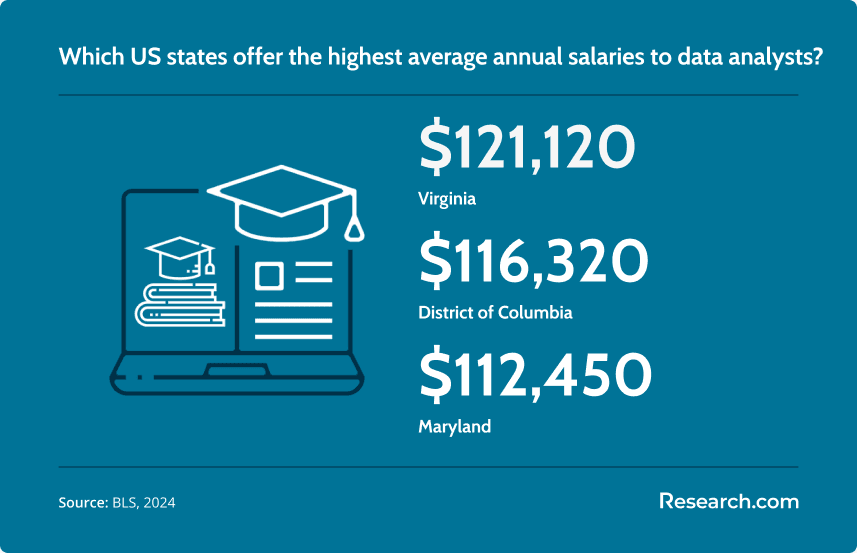
Location also affects pay. Virginia ($121,120) and the District of Columbia ($116,320) are listed as offering notably high average annual salaries for data analysts. When comparing salaries across fields, use role-specific labor data rather than assuming that one occupation follows the same pattern as another; for example, a guide to forensic psychology salary reflects a different career track.
How can a data analyst build a strong portfolio?
A data analyst portfolio should prove that you can solve realistic problems from beginning to end. Employers should be able to see the question you asked, the data you used, the steps you took, the tools you applied, the insights you found, and the recommendation you made.
- Show different types of projects: Include examples involving data cleaning, SQL queries, dashboards, exploratory analysis, and business recommendations.
- Use credible datasets: Public datasets from sources such as Kaggle, government portals, or open research repositories can make projects more realistic.
- Explain the workflow: For each project, describe the problem, data source, cleaning process, methods, findings, and limitations.
- Demonstrate technical range: Show evidence of spreadsheet work, SQL, Python or R, statistics, and visualization tools where appropriate.
- Publish work where employers can access it: Use platforms such as GitHub, Tableau Public, or a personal website.
- Match projects to target roles: If you want a marketing analyst job, include campaign or customer data. If you want healthcare analytics, use health-related datasets when appropriate.
- Write for non-technical readers: A strong portfolio explains why the analysis matters, not just how the code works.
- Add self-directed work or competitions: Personal projects and Kaggle challenges can show initiative and curiosity.
- Refresh the portfolio regularly: Update old projects as your skills improve and remove work that no longer represents your ability.
- Ask for feedback: Mentors, peers, instructors, and working analysts can help identify unclear explanations or weak project choices.
What to include in each portfolio project
| Portfolio element | What employers should learn |
| Business question | What problem you tried to answer and why it mattered. |
| Dataset description | Where the data came from and what fields it included. |
| Cleaning steps | How you handled missing data, duplicates, outliers, and inconsistent formats. |
| Analysis method | Which formulas, queries, statistical methods, or programming techniques you used. |
| Visualization | How you communicated the findings visually. |
| Recommendation | What action a stakeholder could take based on your findings. |
| Limitations | What the data could not prove and what you would investigate next. |
Which educational program is best for advancing in data analytics?
The best program depends on your current skill level and career target. Beginners may need a bachelor’s degree, certificate, or structured introductory program. Working analysts may need a graduate certificate, master’s degree, MBA, or specialized training in cloud platforms, artificial intelligence, business intelligence, or an industry domain.
When comparing schools or programs, look beyond the program name. Review the curriculum, tools taught, project requirements, faculty background, career support, transfer credit policy, cost, schedule flexibility, and whether the program includes hands-on work with real datasets. Students who want a flexible analytics-focused option can compare an online data analytics degree.
Questions to ask before choosing a data analytics program
- Does the curriculum teach SQL, statistics, data visualization, and at least one programming language?
- Are students required to complete portfolio-ready projects?
- Which tools are used: Excel, Tableau, Power BI, Python, R, SAS, cloud platforms, or others?
- Is the program appropriate for beginners, or does it assume prior technical experience?
- How much does the program cost after fees, books, software, and other expenses?
- Can you transfer credits or use prior learning to reduce time and cost?
- Does the school clearly state accreditation information?
- What career support is available for internships, resume review, interview practice, and employer connections?
- Are salary or job placement claims clearly sourced and realistic?
What challenges do data analysts face?
Data analysts often work with incomplete, inconsistent, or poorly documented data. They may also face pressure to deliver quick answers when the data does not fully support a simple conclusion. Other challenges include integrating data from multiple systems, protecting sensitive information, meeting compliance expectations, and explaining uncertainty to stakeholders who want a clear yes-or-no answer.
Technology changes add another challenge. Analysts must keep learning new tools while maintaining strong fundamentals in statistics, SQL, visualization, and business communication. For a broader view of technology careers and compensation context, see this computer science jobs list and salary resource.
Common mistakes to avoid
| Mistake | Why it hurts | Better approach |
| Choosing a program without checking accreditation | Credits, financial aid eligibility, and employer recognition may be affected. | Verify institutional accreditation before enrolling. |
| Focusing only on tuition | Fees, software, books, time to completion, and lost work hours can change the real cost. | Compare total cost and ask about transfer credits or employer tuition support. |
| Learning tools without building projects | Tool knowledge is hard to evaluate without evidence of applied work. | Create portfolio projects that show your workflow and recommendations. |
| Assuming certificates guarantee a job | Credentials help, but employers also look for skills, experience, and communication ability. | Pair certifications with projects, internships, volunteer work, or job-relevant examples. |
| Ignoring communication skills | Analysis has limited value if stakeholders cannot understand or use it. | Practice writing summaries, explaining charts, and presenting recommendations. |
| Trusting AI outputs without verification | Automated tools can produce incorrect code, weak assumptions, or misleading summaries. | Validate formulas, queries, sources, and conclusions before sharing results. |
| Relying only on rankings | A highly ranked program may still be the wrong fit for your budget, schedule, or goals. | Use rankings as one input, then compare curriculum, cost, flexibility, and outcomes. |
Here's what data analysts say about their jobs
- : ""What attracted me to data analysis was how much the field keeps changing. There is always another tool to learn, another method to test, or another way to think about a problem. The training was demanding because it strengthened both my analytical and technical skills, but it also kept the work interesting. I like that the field rewards curiosity and staying current." - Ken"
- : ""I have always enjoyed solving problems, and data analysis gave me a practical way to do that. Taking raw information, applying the right methods, and seeing useful insights emerge is extremely satisfying. The work can be challenging, but it is rewarding when your findings influence real decisions." - June"
- : ""Working as a data analyst changed how I see business problems. I enjoy turning raw data into recommendations that help organizations make better choices. Every project feels like a new puzzle, and I find it rewarding to uncover patterns that might otherwise be missed." - Sue"
References:
- BLS (2024, April 3). 15-2031 Operations Research Analysts. BLS
- BLS (2024, August 29). Operations Research Analysts. BLS
- Fairlie, M. (2024, October 29). How Data Analytics Impacts Small Businesses in 2025. Business.com
- Zippia (2024, April 5). Data Analyst Education Requirements. Zippia
- Zippia (2024, June 25). Data Analyst skills for your resume and career. Zippia
Key Insights
- Data analysts turn raw information into decisions by cleaning data, finding patterns, building reports, and explaining what the results mean.
- A bachelor’s degree is the most common education path, but certificates, projects, internships, and portfolios can also help candidates demonstrate readiness.
- SQL, Excel, statistics, and data visualization are core skills; Python or R can strengthen your profile and support more advanced analysis.
- The field has a strong projected outlook, with 23% employment growth from 2023 to 2033 and about 11,300 expected openings each year during that period.
- Salary varies by industry and location, but BLS data lists a median annual salary of $83,640 and an average annual salary of $95,600 for data analysts in the United States.
- AI can speed up repetitive analytics tasks, but it increases the importance of human judgment, data validation, ethics, and clear communication.
- The best next step is practical: choose a target role, learn the tools listed in those job postings, build two or three portfolio projects, and practice explaining your analysis like a business recommendation.
Other Things You Should Know About Becoming a Data Analyst
While not mandatory, internship experience in 2027 is highly recommended for aspiring data analysts. It offers practical exposure to real-world data challenges and valuable industry insights, enhancing your resume and improving job prospects upon graduation.
Yes. SQL is expected for querying databases, and Python is widely used for cleaning, analysis, and automation. Many employers also expect Excel, Tableau, or Power BI skills. Entry-level candidates usually prove these abilities through projects, internships, or a portfolio.
In 2027, essential tools for data analysts include Python, R, SQL, and Tableau for data manipulation and visualization. Familiarity with AI and machine learning tools is also crucial, alongside cloud platforms like AWS and Google Cloud, reflecting the growing trend toward big data analytics and remote data processing.


