2027 Best Careers to Pursue With an Economics Master’s Degree

Co-Founder and Chief Data Scientist
A master’s degree in economics can be a strong career accelerator if you want to turn data, markets, policy, and human behavior into decisions that organizations can act on. The degree is especially relevant for professionals targeting economist roles, financial analysis, policy research, data science, market research, consulting, or academic work.
This guide explains what you can do with a master’s in economics, which careers offer the strongest salary and growth potential, what skills employers expect, how to compare economics graduate programs, and when another path—such as finance, an MBA, a DBA, data science training, or entrepreneurship—may be a better fit.
Quick Answer: What Can You Do With a Master’s Degree in Economics for 2027?
With a master’s in economics, you can pursue careers such as economist, data scientist, financial and investment analyst, market research analyst, postsecondary economics teacher, policy analyst, consultant, or economics journalist. The best path depends on whether you want to focus on research, business strategy, public policy, finance, analytics, teaching, or communication.
- Best fit for quantitative careers: Data scientist, economist, econometrician, financial analyst, and market research analyst roles value statistical modeling, forecasting, and data interpretation.
- Best fit for policy work: Government agencies, think tanks, nonprofits, and international organizations hire economics graduates to evaluate programs, model policy impacts, and analyze labor, trade, health, development, and environmental issues.
- Best fit for business careers: Consulting, corporate strategy, pricing, risk analysis, market intelligence, and finance roles use economics training to support decisions under uncertainty.
- Best fit for academic careers: Teaching and research roles may require additional graduate study, especially for tenure-track university positions.
- Main caution: A master’s in economics is most valuable when paired with strong technical skills in statistics, econometrics, programming, data visualization, and clear communication.
- Best careers for economics master’s degree graduates in 2027
- What is a master’s in economics?
- What are the usual admission requirements?
- Which economics specializations can you choose?
- Is a master’s in economics worth it?
- What skills matter most for economics careers?
- What is the job outlook for economics master’s degree careers?
- What are alternatives to traditional economics careers?
- Can an MBA complement an economics master’s degree?
- Should you pursue an online MBA with an economics master’s?
- How do you choose the right economics master’s program?
- Should you consider a DBA after an economics master’s?
- What trends are changing economics careers?
- Could an accelerated MBA improve your economics career options?
- Master’s in economics vs. master’s in finance
- How can you move into roles beyond economics?
- How can networking and professional development help?
- What is the ROI of an economics master’s degree?
- How can you verify program quality?
- Can entrepreneurship expand your economics career?Common mistakes to avoid
Best Careers to Pursue with a Master’s Degree in Economics for 2027
The strongest economics master’s degree careers usually combine economic reasoning with data analysis, forecasting, research, and communication. Below are career options where graduate-level economics training can be especially useful.
Economist
What economists do: Economists study economic and statistical information, build forecasts, evaluate trends, and advise businesses, governments, research organizations, and public institutions. Their work may involve policy analysis, market research, fiscal and monetary policy, labor market studies, or research on how goods and services are produced, distributed, and consumed.
Who this role fits best: This career is a strong match if you enjoy research design, statistical modeling, policy questions, and writing reports that influence decisions. Because economist roles can pay well, economics is often considered a strong option among high paying master's degrees for students who want a quantitative graduate credential.
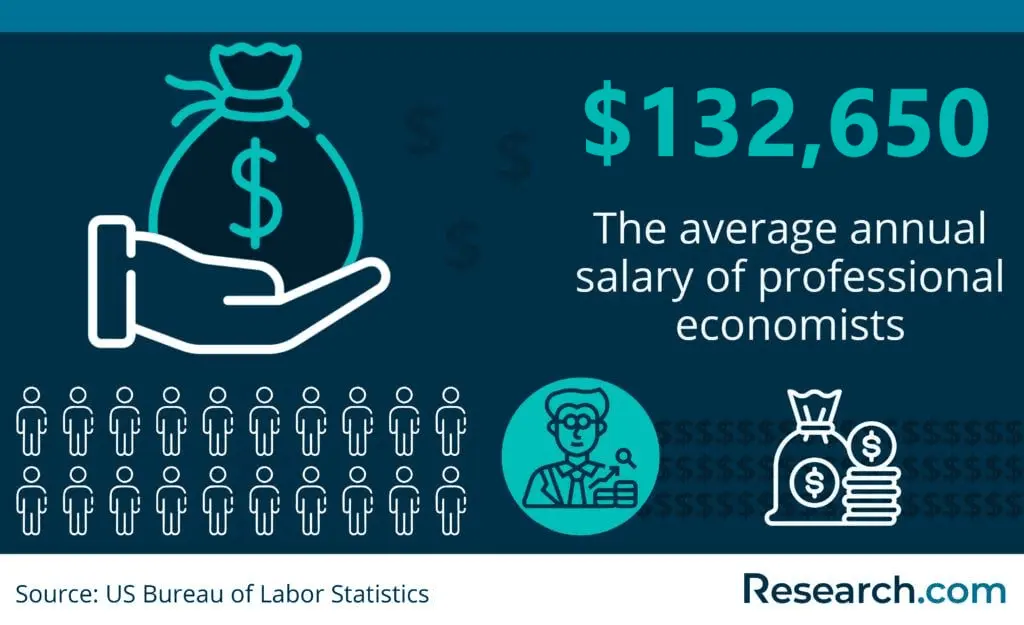
Average Annual Salary: $132,650
Median Annual Wage: $115,730
Job Outlook (2023-2033): 5%
Data Analyst or Data Scientist
What data scientists do: Data scientists use programming, statistical techniques, visualization tools, data mining, data modeling, natural language processing, and machine learning to turn structured and unstructured data into usable insights. Economics graduates often bring an advantage in causal reasoning, forecasting, model interpretation, and translating numbers into business or policy recommendations.
Who this role fits best: This path is ideal if you want to work with large datasets, use tools such as Python or R, and solve business or public-sector problems with evidence rather than intuition alone.
Average Annual Salary: $119,040
Median Annual Wage: $108,020
Job Outlook (2023-2033): 36%
Financial and Investment Analyst
What financial and investment analysts do: Financial and investment analysts examine financial data, evaluate investment programs, assess companies, study market conditions, and help institutions make decisions about assets, risk, performance, and valuation. They may work in banks, investment firms, hedge funds, corporate finance teams, or advisory roles.
Who this role fits best: This career can make sense if you are interested in markets, valuation, forecasting, and investment strategy. Students who already have an accelerated finance degree may use a graduate economics program to deepen their quantitative and macroeconomic perspective.
Average Annual Salary: $112,950
Median Annual Wage: $99,010
Job Outlook (2023-2033): 9%
Market Research Analyst
What market research analysts do: Market research analysts study market conditions at local, regional, national, online, or global levels. They evaluate customer behavior, competitor activity, pricing, sales trends, advertising performance, marketing channels, web metrics, and product demand to help organizations decide what to sell, where to compete, and how to position products or services.
Who this role fits best: This is a practical route for economics graduates who enjoy consumer behavior, survey data, market sizing, pricing strategy, and communicating findings to marketing, product, or leadership teams.
Average Annual Salary: $83,190
Median Annual Wage: $74,680
Job Outlook (2023-2033): 8%
Economics Professor
What economics professors do: Postsecondary economics teachers teach economics courses at colleges and universities. Many also conduct research, publish academic work, advise students, design curricula, and contribute to departmental or institutional service.
Who this role fits best: This career is best for students who enjoy teaching, theory, research, and academic writing. Some positions may require additional doctoral study depending on the institution and role type.
Average Annual Salary: $133,650
Median Annual Wage: $115,300
Job Outlook (2023-2033): 8%
Economics Journalist
What economics journalists do: Economics journalists report, write, and explain stories about financial markets, labor conditions, inflation, public budgets, business cycles, tax policy, trade, and local or national economic trends. Their work may involve interviews, document review, data analysis, investigation, and commentary for print, digital, radio, television, or other media outlets.
Who this role fits best: This path suits economics graduates who can translate technical topics into clear public explanations. It may be less stable than some analytics or finance roles, but it can be meaningful for people interested in public understanding of economic issues.
Average Annual Salary: $101,430
Median Annual Wage: $57,500
Job Outlook (2023-2033): -3%
| Career | Best For | Main Strength Needed | Potential Limitation |
| Economist | Research, forecasting, policy, and economic modeling | Econometrics, writing, and economic theory | Some roles prefer or require doctoral training |
| Data Scientist | High-growth analytics careers | Programming, statistics, machine learning, and visualization | Economics coursework alone may not provide enough coding depth |
| Financial and Investment Analyst | Markets, valuation, banking, investment, and corporate finance | Financial modeling and quantitative analysis | Finance-specific credentials or experience may be expected |
| Market Research Analyst | Consumer behavior, pricing, marketing analytics, and product strategy | Survey analysis, data interpretation, and communication | Roles may lean more toward marketing than pure economics |
| Economics Professor | Teaching and academic research | Research methods, teaching, and publication skills | Higher-level academic jobs may require a PhD |
| Economics Journalist | Public communication and business reporting | Writing, interviewing, and data storytelling | Employment is projected to decline for the broader journalist category |
What is a master’s in economics?
A master’s in economics is a graduate degree focused on economic theory, quantitative methods, statistical analysis, econometrics, research, and practical applications of economic decision-making. Most programs are designed to be completed in one to two years, though timelines vary by school, enrollment status, prerequisites, and whether the program is research-based or professionally oriented.
Students usually study advanced microeconomics, macroeconomics, econometrics, and applied research methods. Depending on the program, they may also take courses in finance, international trade, labor economics, health economics, environmental economics, behavioral economics, public policy, or data analytics.
The degree is not usually the simplest business-related graduate option. Economics is rarely described as one of the easiest business major pathways because it requires quantitative reasoning, formal modeling, and comfort with data. However, it can be a practical choice for students who want to understand markets, policy effects, business cycles, incentives, resource allocation, and evidence-based decision-making.
What are the typical requirements for a master’s in economics?
Admission requirements differ by institution, but most economics master’s programs evaluate whether applicants have the academic preparation to handle advanced theory and quantitative coursework.
- Bachelor’s degree: Applicants typically need a bachelor’s degree from an accredited institution. Economics, mathematics, finance, statistics, business, or related fields are common backgrounds. Even a cheapest online business administration degree can provide useful preparation if the student completes the required quantitative prerequisites.
- Prerequisite coursework: Programs often expect prior study in microeconomics, macroeconomics, statistics, and sometimes calculus or econometrics.
- Minimum GPA: A 3.0 GPA or higher is commonly expected, while more selective programs may set higher academic standards.
- GRE or GMAT scores: Some schools request Graduate Record Examination or Graduate Management Admission Test results, though test-optional and waiver policies may apply.
- Recommendation letters: Applicants are commonly asked to submit two to three letters from faculty members, supervisors, or professionals who can assess their readiness for graduate work.
- Statement of purpose: A personal essay usually explains the applicant’s academic interests, career plans, research goals, and reasons for choosing economics.
- English proficiency: International applicants whose first language is not English may need TOEFL, IELTS, or similar proof of language proficiency.
- Professional experience: Work experience is not always required, but applied economics and professional-track programs may value experience in finance, policy, analytics, consulting, research, or business.
If you are still building a foundation before graduate study, reviewing what is the best online associate degree in business administration can help you understand lower-division business pathways that may later support economics or business graduate education.
What are the different specializations available in a master's in economics program?
Specializations help you connect economic training to a specific labor market. The best concentration depends on the problems you want to solve and the employers you want to target.
| Specialization | What It Emphasizes | Common Career Directions |
| Financial Economics | Financial markets, investments, risk, valuation, and macro-financial conditions | Banking, asset management, risk analysis, corporate finance, and investment research |
| International Economics | Trade, exchange rates, global markets, development, and international policy | Government agencies, multinational firms, trade organizations, and international institutions |
| Behavioral Economics | How psychology, incentives, and decision-making affect markets and policy outcomes | Market research, consumer behavior, product design, public policy, and consulting |
| Environmental Economics | Resource use, environmental regulation, climate-related policy, sustainability, and cost-benefit analysis | Environmental consulting, sustainability strategy, policy analysis, and energy-related roles |
| Public Policy Economics | Policy evaluation, government programs, regulation, taxation, public spending, and social outcomes | Government, think tanks, nonprofit research, and public-sector consulting |
| Health Economics | Healthcare systems, insurance, resource allocation, public health, and health policy | Health policy, healthcare consulting, public agencies, research organizations, and insurers |
| Data Analytics and Econometrics | Statistical modeling, causal inference, forecasting, programming, and data interpretation | Data science, economic research, consulting, market analytics, and business intelligence |
| Development Economics | Poverty reduction, economic growth, institutional development, and emerging economies | International development, NGOs, global organizations, and policy research |
Economics may not be one of the easiest masters degrees, so choosing a specialization that genuinely matches your interests can make the workload more sustainable and your career planning more focused.
What are the benefits of obtaining an economics master’s degree?
An economics master’s degree can be valuable when it gives you capabilities that employers will pay for: modeling, forecasting, policy evaluation, data interpretation, and clear decision support. The benefits are strongest when the program has rigorous quantitative training, relevant electives, experienced faculty, and career support.
- Access to advanced roles: Graduate-level economics can qualify you for roles in finance, analytics, consulting, public policy, market research, and applied research that may be harder to enter with only a bachelor’s degree.
- Stronger earning potential: Many economics-related careers offer competitive pay, particularly economist, financial analyst, data science, and postsecondary teaching roles. Salary outcomes still depend on role, location, employer, experience, technical skill, and industry.
- Specialized expertise: You can align coursework with fields such as behavioral economics, health economics, environmental policy, international trade, or econometrics.
- Transferable analytical skills: Economics training strengthens data analysis, causal reasoning, forecasting, model building, and evidence-based problem-solving.
- Public and private sector flexibility: Graduates may work for corporations, consulting firms, government agencies, universities, research organizations, nonprofits, or international organizations.
- Preparation for doctoral study: A master’s degree can help students prepare for a PhD in economics or a related field, particularly if the curriculum includes advanced theory and research methods.
Students comparing graduate options can also review traditional and online business school pathways if they want broader management training alongside economics. For professionals interested in policy, earning an economics credential may also support career pivots connected to public affairs; for example, some students compare economics roles with options discussed in guides on political science salary outcomes.
What skills are relevant when pursuing economics master's degree careers?
Employers rarely hire economics graduates for theory alone. They look for people who can work with messy data, explain uncertainty, build credible models, and communicate conclusions to leaders who may not have technical backgrounds.
- Quantitative analysis: You need confidence with statistics, econometrics, probability, forecasting, and model interpretation.
- Critical thinking: Economics careers require you to question assumptions, identify trade-offs, test claims, and distinguish correlation from causation.
- Technical software skills: Tools such as R, Python, Stata, Excel, SQL, Tableau, and visualization software can improve employability, especially in analytics-heavy roles.
- Research design: Strong graduates know how to frame research questions, choose methods, evaluate evidence, and present limitations honestly.
- Written communication: Reports, memos, forecasts, policy briefs, and executive summaries must translate technical findings into clear recommendations.
- Presentation skills: Economists and analysts often brief executives, policymakers, clients, faculty, or cross-functional teams.
- Business and policy judgment: The best analysis connects numbers to real decisions, budgets, regulations, markets, operations, or social outcomes.
- Attention to detail: Small errors in data cleaning, assumptions, code, formulas, or interpretation can lead to flawed recommendations.
Economics can also be useful for students considering law because it builds logic, evidence evaluation, and policy analysis. If that is part of your long-term plan, compare economics preparation with guidance on what is the best lawyer degree program for future lawyers.
What is the job outlook for economics master's degree careers?
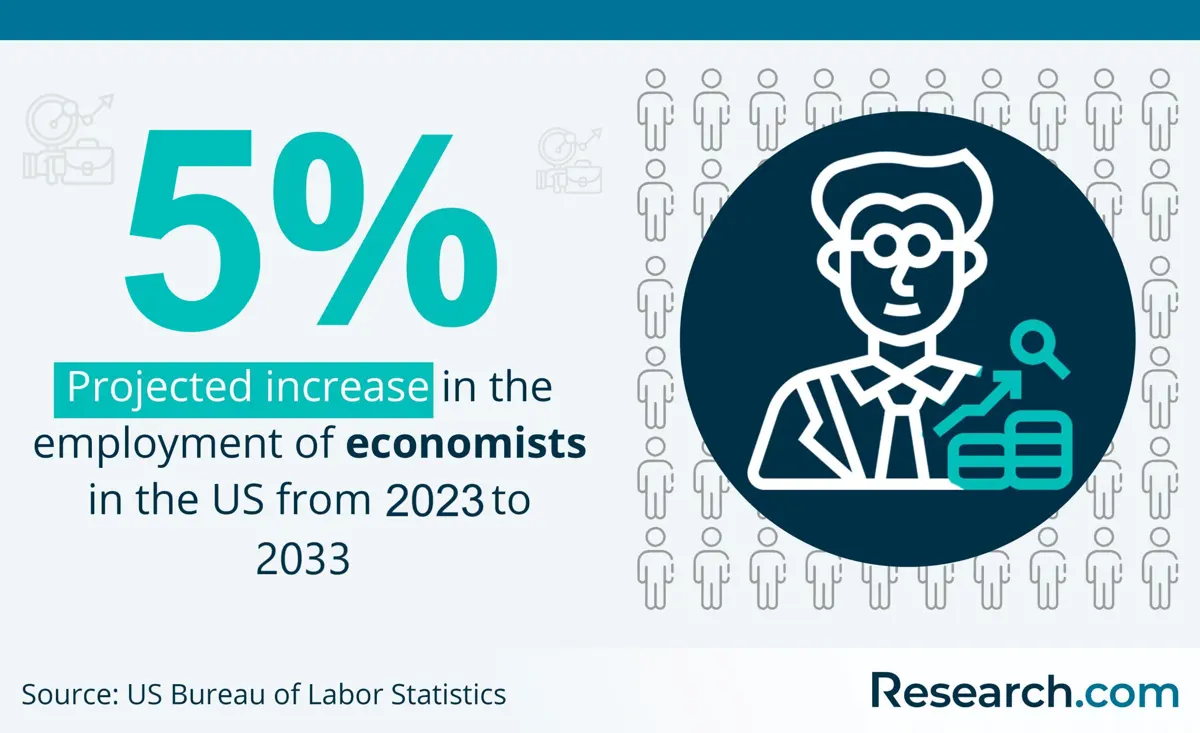
The outlook varies widely by occupation. According to the United States Bureau of Labor Statistics, economist employment is projected to grow 5% from 2023 to 2033, compared with 4% for all occupations. That projection equals about 1,000 economist openings each year, on average, over the period, with many openings expected because workers change occupations or leave the labor force.
Data science shows much faster projected growth at 36% from 2023 to 2033, which is one reason many economics graduates strengthen their programming and machine learning skills. Financial analyst and market research analyst roles also show positive projected growth. Journalism is different: employment for news analysts, reporters, and journalists is projected to decline 3% from 2023 to 2033, though about 4,500 annual openings are still projected for the broader occupation.
| Careers for Economics Master's Degree-Holders | Average Hourly Wage | Projected Employment Growth Rate (2023-2033) | Projected Annual Job Openings (2023-2033) |
| Economist | $63.78 | 5% | 1,000 |
| Data Scientist | $57.23 | 36% | 20,800 |
| Financial Analyst | $54.30 | 9% | 30,700 |
| Market Research Analyst | $40.00 | 8% | 88,500 |
| Postsecondary Economics Teacher | $64.25 | 8% (general) | 118,900 (general) |
| News Analyst/Journalist (general) | $48.76 | -3% | 4,500 |
The key takeaway is that “economics career” does not mean one labor market. Your outlook depends on the occupation you target, your technical portfolio, your industry, and whether you can convert economic analysis into decisions employers value.
What are the alternatives to traditional economics master's degree careers?
You do not have to become an economist to benefit from a master’s in economics. Many graduates move into interdisciplinary roles where economic reasoning is useful but the job title may not include “economist.”
- Data science and analytics: Economics graduates with programming and machine learning skills can compete for roles that involve prediction, segmentation, causal analysis, pricing, and experimentation.
- Technology roles: Tech companies may use economics expertise for pricing models, marketplace design, platform strategy, user behavior research, advertising measurement, and product analytics.
- Behavioral economics consulting: This path applies insights about incentives, biases, and consumer decisions to marketing, public policy, product design, and organizational strategy.
- Sustainability and environmental consulting: Economics training can support analysis of environmental regulation, resource management, carbon pricing, energy markets, and cost-benefit decisions.
- Entrepreneurship: Market analysis, pricing, demand forecasting, and competitive strategy are directly useful when launching or advising a business.
- Corporate training and education: Some graduates teach economic literacy, train teams on market analysis, or help organizations interpret economic conditions.
Can an MBA Complement My Economics Master's Degree?
An MBA can complement a master’s in economics when your goal is to move from analysis into leadership, operations, general management, entrepreneurship, or executive decision-making. Economics programs tend to emphasize theory, modeling, data, and policy analysis; MBA programs usually add management, leadership, marketing, accounting, operations, and organizational strategy.
This combination may be useful if you want to lead analytics teams, move into corporate strategy, manage business units, consult with senior executives, or build a broader commercial skill set. If cost and flexibility matter, compare affordable online MBA programs before committing to another graduate credential.
Should I Consider an Online MBA Alongside My Economics Master’s Degree?
An online MBA can make sense if you are working full time and want management training without leaving your job. It may be especially relevant for economics graduates who already have strong quantitative skills but need more exposure to leadership, operations, finance, marketing, negotiation, or entrepreneurship.
Before enrolling, ask whether the MBA fills a real gap in your career plan. If your target role is economist or research analyst, more econometrics, coding, or doctoral preparation may be more useful. If your target role is director, consultant, product strategist, or executive, reviewing the best online MBA options can help you compare flexible business programs.
How do you choose the right economics master’s degree program?
The right economics master’s program is the one that matches your target career, technical needs, budget, and preferred learning format. Do not choose based on name recognition alone. A strong fit should have the coursework, faculty, outcomes, and support services that align with your next step.
| Selection Factor | What to Check | Why It Matters |
| Accreditation and institutional credibility | Confirm recognized institutional accreditation and review program reputation | Accreditation affects credibility, transferability, employer trust, and financial aid eligibility |
| Curriculum depth | Look for advanced microeconomics, macroeconomics, econometrics, statistics, and applied electives | Weak quantitative training can limit career options in research, analytics, and policy |
| Technical tools | Check whether courses use R, Python, Stata, SQL, Excel, Tableau, or similar tools | Employers often expect practical data skills, not just theory |
| Career alignment | Compare concentrations, capstones, internships, research projects, and employer connections | A policy-focused program may not serve a finance-focused student, and vice versa |
| Faculty expertise | Review faculty research areas, industry experience, publications, and advising availability | Faculty can shape research opportunities, mentorship, and specialization quality |
| Format and schedule | Compare online, campus, hybrid, full-time, and part-time options | The best program is one you can complete without undermining work, finances, or family obligations |
| Total cost | Look beyond tuition to fees, books, software, travel, lost income, and financing terms | ROI depends on total investment, not tuition alone |
| Outcomes | Ask about placement, alumni roles, internship access, and employer partnerships | Program outcomes help you judge whether graduates reach jobs similar to your goals |
If you are considering a broader business credential in addition to economics, comparing options such as the fastest online MBA can help you understand how management programs differ in speed, flexibility, and career focus.
Should I Consider Pursuing a DBA to Expand My Economics Expertise?
A Doctor of Business Administration may be worth considering if you want to apply advanced research to executive business problems rather than pursue a traditional academic economics PhD. A DBA typically emphasizes applied research, organizational decision-making, leadership, and practice-oriented problem solving.
This route may fit senior professionals who want to move into executive consulting, corporate leadership, applied research leadership, or teaching in professionally oriented business settings. It may be less appropriate if your goal is to become a research economist in a highly theoretical academic department. If flexibility and cost are priorities, compare online DBA programs carefully before enrolling.
What emerging trends are shaping economics master’s degree careers?
Several labor market shifts are changing how economics graduates compete for jobs. The common theme is that employers want analysts who can combine economic reasoning with technical execution and practical communication.
- AI and machine learning are changing analytics work: Economics graduates who understand causal inference, model assumptions, and data limitations can add value when organizations use predictive tools and automated analysis.
- Data science overlap is growing: Roles in product analytics, pricing, experimentation, and forecasting increasingly reward coding, statistics, visualization, and business interpretation.
- Sustainability and environmental policy are creating interdisciplinary demand: Economics training can support decisions about regulation, climate policy, resource allocation, energy markets, and cost-benefit analysis.
- Healthcare and public policy need stronger evaluation skills: Health economics, labor economics, and public finance remain useful for evaluating programs, budgets, and outcomes.
- Employers expect clearer communication: Technical analysis has limited value if you cannot explain assumptions, uncertainty, and recommendations to decision-makers.
Students who want broader business exposure may also compare economics training with options such as the fastest online business degree, especially if they need a faster route into business fundamentals before or alongside graduate study.
Could an Accelerated MBA Further Boost Your Economics Career?
An accelerated MBA may help if you already have strong economics and analytics skills but want faster exposure to leadership, finance, operations, marketing, and strategy. This option is most useful when your goal is management advancement rather than deeper economic research.
Before choosing this path, compare the time savings against workload intensity, networking opportunities, internship access, and total cost. If speed is a major priority, reviewing an accelerated MBA can help you evaluate whether the format fits your schedule and goals.
What is the difference between a master’s in economics and a master’s in finance?
A master’s in economics and a master’s in finance both use quantitative analysis, but they prepare students for different kinds of questions. Economics studies markets, incentives, systems, policies, behavior, and resource allocation. Finance focuses more directly on capital, investments, risk, valuation, portfolios, and corporate financial decisions.
| Comparison Point | Master’s in Economics | Master’s in Finance |
| Main focus | Economic systems, policy, markets, incentives, econometrics, and forecasting | Investments, valuation, risk, corporate finance, financial markets, and portfolio management |
| Typical coursework | Microeconomics, macroeconomics, econometrics, statistics, public policy, international economics, labor economics | Corporate finance, investment analysis, derivatives, financial modeling, risk management, portfolio theory |
| Best for | Economist, policy analyst, research analyst, data analyst, consultant, academic or public-sector roles | Financial analyst, investment analyst, asset management, banking, corporate finance, risk analysis |
| Decision lens | How incentives, markets, policies, and systems behave | How financial resources, assets, risks, and returns are managed |
| When to choose it | Choose economics if you want broad analytical and policy flexibility | Choose finance if your main goal is financial markets or corporate financial management |
Students who are focused specifically on banking, investment analysis, and corporate finance may prefer finance-focused training, including options such as the best affordable college for finance. Students who want broader policy, research, and market analysis may find economics more flexible.
How can you transition to roles beyond economics master's degree careers?
To move beyond traditional economist roles, treat your economics degree as a platform rather than a job title. Your goal is to translate economic training into the language of the field you want to enter.
- Choose a target industry: Decide whether you want to move into technology, healthcare, sustainability, finance, consulting, education, media, or public policy.
- Identify the missing skills: Compare job descriptions and note recurring tools, credentials, methods, and domain knowledge.
- Build technical proficiency: Strengthen Python, R, SQL, Tableau, Excel, Stata, machine learning, or data visualization depending on the role.
- Complete applied projects: Create portfolio work in pricing, forecasting, policy evaluation, market analysis, experimentation, or dashboard development.
- Reframe your resume: Highlight outcomes, methods, tools, and business or policy impact rather than listing coursework only.
- Use targeted networking: Speak with professionals in your chosen field to learn what employers actually value and where economics graduates fit.
- Consider short credentials: If needed, add focused training in project management, UX research, sustainability, product analytics, or healthcare policy.
- Gain practical experience: Freelance work, internships, volunteer research, consulting projects, and capstones can help you prove your ability in a new field.
How Can Networking and Professional Development Elevate Your Economics Career?
Networking matters in economics careers because many opportunities are shaped by specialization, sector, and applied experience. A student interested in environmental economics needs a different network than one targeting banking, policy evaluation, journalism, or data science.
- Join field-specific groups: Look for associations, conferences, webinars, and local events related to economics, public policy, analytics, finance, or your chosen specialization.
- Build mentor relationships: Faculty, alumni, supervisors, and industry professionals can help you understand hiring expectations and avoid unfocused job searches.
- Publish or present work: Research posters, policy briefs, dashboards, articles, and conference presentations can make your skills visible.
- Keep learning: Short courses, certificates, workshops, and executive education can fill gaps in coding, management, communication, or industry knowledge.
- Develop leadership experience: If you want to supervise teams or move into management, consider business training, including options such as online business degree programs accelerated.
Here’s What Graduates Have to Say About Their Economics Master’s Degree Careers
- My economics master’s degree changed how I approach policy problems. I learned how to evaluate evidence, question assumptions, and support recommendations with data. That training helped me move into policy advising, where the analysis I produce can influence important decisions. Alex
- The graduate coursework in econometrics and data analysis prepared me for the technical demands of financial analysis. I entered the role with more confidence because I had already worked through complex models, datasets, and forecasting problems. Jordan
- Specializing in behavioral economics let me connect my interest in psychology with market behavior. I now work on projects that use economic insight to improve consumer experiences, which is a career direction I had not expected before graduate school. Taylor
What Is the Return on Investment for an Economics Master’s Degree?
The ROI of a master’s in economics depends on total cost, opportunity cost, the career you pursue, how much your earnings increase, and whether the degree helps you reach roles that were previously inaccessible. A program with high tuition but weak career support may be a poor investment. A lower-cost program with strong quantitative training, employer connections, and relevant specialization may offer better value.
| ROI Factor | Question to Ask | Why It Matters |
| Total cost | What will I pay for tuition, fees, books, software, travel, and living expenses? | Actual cost is broader than listed tuition |
| Lost income | Will I study full time, reduce work hours, or keep working? | Time away from work affects the real investment |
| Career outcome | Which job title am I targeting after graduation? | ROI differs for economist, analyst, professor, journalist, and data science roles |
| Technical skill gain | Will I graduate with marketable tools and portfolio work? | Employers often reward practical capabilities more than degree titles alone |
| Financial aid | Are scholarships, assistantships, employer tuition benefits, or grants available? | Reducing debt can improve ROI significantly |
| Career support | Does the program provide internships, employer connections, alumni access, and placement support? | Career services can affect how quickly the degree converts into opportunity |
Students planning a cost-conscious pathway may also compare earlier business education options, such as an affordable online business associate's degree, as part of a longer-term financial plan before graduate study.
How Can You Verify the Quality and Credibility of an Economics Master’s Program?
Before applying, verify that the program is legitimate, academically rigorous, and aligned with your goals. Do not rely only on rankings, advertising, or a school’s general reputation.
- Confirm accreditation: Check whether the institution holds recognized accreditation. Accreditation can affect financial aid, transferability, employer recognition, and graduate school options.
- Review the curriculum: Make sure the program includes advanced economic theory, econometrics, statistics, and applied research methods.
- Assess quantitative rigor: If the program does not build strong statistical or programming skills, it may limit your competitiveness in analytics-heavy careers.
- Evaluate faculty fit: Look for faculty expertise in the fields you care about, such as finance, labor, health, development, public policy, or environmental economics.
- Ask for outcome data: Request information about alumni roles, internship access, employer partnerships, and graduate placement.
- Compare student support: Advising, career services, research opportunities, and networking support can influence your results.
- Check online program quality: For online programs, ask about faculty access, live sessions, technical support, peer interaction, and assessment standards.
If your long-term goal includes executive leadership, you may also compare economics graduate study with business-focused credentials such as the best value online MBA executive program.
Can Entrepreneurship Amplify Your Economics Master’s Degree Career?
Entrepreneurship can be a strong application of economics training because founders and consultants constantly make decisions about demand, pricing, incentives, competition, resource allocation, and market entry. Economics graduates can use those skills to test business ideas, evaluate customer behavior, model costs, and identify underserved markets.
This path is best for people who are comfortable with uncertainty and want to apply analysis directly to business creation or advisory work. It may also fit graduates who want to consult for startups, build analytics products, advise on pricing, or launch research-driven services. For a broader look at entrepreneurship-focused career paths, review What can you do with a business entrepreneurship degree?.
Common Mistakes to Avoid When Planning an Economics Master’s Degree Career
- Choosing a program without checking accreditation: Always verify institutional credibility before applying or enrolling.
- Assuming the degree alone guarantees a high salary: Pay depends on occupation, industry, location, employer, experience, and technical skills.
- Ignoring software and programming skills: Many competitive roles expect practical ability with data tools, not only economic theory.
- Picking a specialization too casually: Your concentration should connect to real job titles and industries you would actually pursue.
- Focusing only on tuition: Fees, living costs, software, transportation, debt, and lost income all affect ROI.
- Relying only on rankings: A highly ranked school may not be the best fit if it lacks your desired specialization, schedule format, or career support.
- Assuming online and campus programs are identical: Compare faculty access, networking, internship options, technology, and student support.
- Waiting until graduation to build a network: Start informational interviews, alumni outreach, and portfolio projects while enrolled.
Key Insights
- A master’s in economics is most valuable when it leads to a specific career target. Economist, data scientist, financial analyst, market research analyst, professor, and journalist roles require different skills and offer different outlooks.
- Technical skill is the career multiplier. Econometrics, statistics, Python, R, SQL, visualization, and clear communication can make the degree more marketable.
- Salary potential is strong but not automatic. Economists report a median annual wage of $115,730, but outcomes vary by role, sector, location, experience, and specialization.
- Data science is a major adjacent path. Data scientist employment is projected to grow 36% from 2023 to 2033, making analytics preparation especially important for economics graduates.
- Program choice affects ROI. Compare accreditation, curriculum rigor, faculty expertise, total cost, career support, and alumni outcomes before enrolling.
- Economics and finance are related but not interchangeable. Choose economics for broader market, policy, and systems analysis; choose finance for investment, valuation, and corporate financial decision-making.
- Additional credentials should solve a clear problem. An MBA, DBA, finance credential, or analytics certificate can help only if it fills a specific gap in your career plan.
References:
- United States Bureau of Labor Statistics. (2024, April 3). Occupational Employment and Wage Statistics: 13-1161 Market Research Analysts and Marketing Specialists. BLS.
- United States Bureau of Labor Statistics. (2024, April 3). Occupational Employment and Wage Statistics: 13-2051 Financial and Investment Analysts. BLS.
- United States Bureau of Labor Statistics. (2024, April 3). Occupational Employment and Wage Statistics: 15-2051 Data Scientists. BLS.
- United States Bureau of Labor Statistics. (2024, April 3). Occupational Employment and Wage Statistics: 19-3011 Economists. BLS.
- United States Bureau of Labor Statistics. (2024, April 3). Occupational Employment and Wage Statistics: 25-1063 Economics Teachers, Postsecondary. BLS.
- United States Bureau of Labor Statistics. (2024, April 3). Occupational Employment and Wage Statistics: 27-3023 News Analysts, Reporters, and Journalists. BLS.
- United States Bureau of Labor Statistics. (2024, August 29). Occupational Outlook Handbook: Data Scientists. BLS.
- United States Bureau of Labor Statistics. (2024, August 29). Occupational Outlook Handbook: Economists. BLS.
- United States Bureau of Labor Statistics. (2024, August 29). Occupational Outlook Handbook: Financial Analysts. BLS.
- United States Bureau of Labor Statistics. (2024, August 29). Occupational Outlook Handbook: Market Research Analysts. BLS.
- United States Bureau of Labor Statistics. (2024, August 29). Occupational Outlook Handbook: News Analysts, Reporters, and Journalists. BLS.
- United States Bureau of Labor Statistics. (2024, August 29). Occupational Outlook Handbook: Postsecondary Teachers. BLS.
Other Things You Should Know About Economics Master's Degree Careers
Yes. Many U.S. federal economist and analyst roles require U.S. citizenship, and some positions also require a background investigation or security clearance. Agencies such as the Bureau of Labor Statistics and Federal Reserve hire candidates with quantitative coursework, but clearance rules are set by the hiring agency.
Certifications like the Chartered Financial Analyst (CFA) or Certified Economic Developer (CEcD) can benefit economics master's graduates. These credentials offer specialized skills and enhance career prospects in financial analysis, development, and consulting sectors, aligning with the industry's evolving needs in 2027.
Top careers for economics master’s graduates in 2027 often require strong quantitative skills, proficiency in data analysis software, and knowledge of economic modeling. Familiarity with financial regulations and global economic trends is also essential to secure leading roles in finance, consulting, and government sectors.