2027 How to Become a Crime Laboratory Analyst

Co-Founder and Chief Data Scientist
Becoming a crime laboratory analyst is a science-focused career decision, not just a criminal justice career choice. The role requires laboratory accuracy, evidence-handling discipline, strong documentation habits, and the ability to explain technical findings in investigations or court. If you are considering this path, the most important questions are practical: What degree should you choose? Do online programs work for this career? Which certifications matter? How long will it take? And what salary or job outlook can you reasonably expect?
This guide explains how to become a crime laboratory analyst for 2027, including education requirements, common forensic specialties, certification options, online degree limitations, salary factors, and career advancement paths. It is designed for students comparing forensic science programs, biology or chemistry majors considering forensic careers, and working professionals who want to move into a crime lab role.
Quick Answer: How Do You Become a Crime Laboratory Analyst?
Most crime laboratory analysts need at least a bachelor’s degree in forensic science, chemistry, biology, biochemistry, or a closely related natural science. Candidates usually strengthen their applications through internships, hands-on laboratory experience, specialized forensic coursework, and, in some roles, professional certification. Federal agencies, senior positions, and highly specialized units may prefer applicants with a master’s degree.
- A bachelor’s degree is typically the entry-level requirement, especially in forensic science, chemistry, biology, or a related field.
- Certifications are not always mandatory, but credentials from organizations such as the American Board of Criminalistics (ABC) or the American Board of Forensic Toxicology (ABFT) can improve competitiveness.
- Common forensic specialties include DNA analysis, toxicology, firearms and toolmarks, latent prints, forensic chemistry, trace evidence, and digital forensics.
- Career growth often comes from experience, advanced training, certifications, courtroom credibility, and leadership ability.
- The field is growing at 13% per year, faster than the average occupation. Entry-level analysts typically earn $50,000–$60,000 per year, while experienced professionals, especially in federal agencies or private labs, can earn $90,000 or more.
- What is a crime laboratory analyst?
- What does a crime laboratory analyst do?
- What are the steps to becoming a crime laboratory analyst for 2027?
- What are the different types of crime laboratory analysts?
- What degree do you need to become a crime laboratory analyst?
- Can you become a crime laboratory analyst with an online degree?
- How long does it take to become a certified crime laboratory analyst?
- What are the costs associated with specialized forensic education?
- What challenges do crime laboratory analysts face in their day-to-day work?
- Can an online criminal justice program enhance my forensic career?
- How are emerging technologies impacting crime laboratory analysis?
- How can legal studies enhance a crime laboratory analyst’s career?
- How can interdisciplinary experience elevate a crime laboratory analyst’s career?
- What are the opportunities for interdisciplinary career advancement?
- What certifications are required for crime laboratory analysts?
- What is the average salary for a crime laboratory analyst?
- What is the job outlook for forensic laboratory analysts?
What is a crime laboratory analyst?
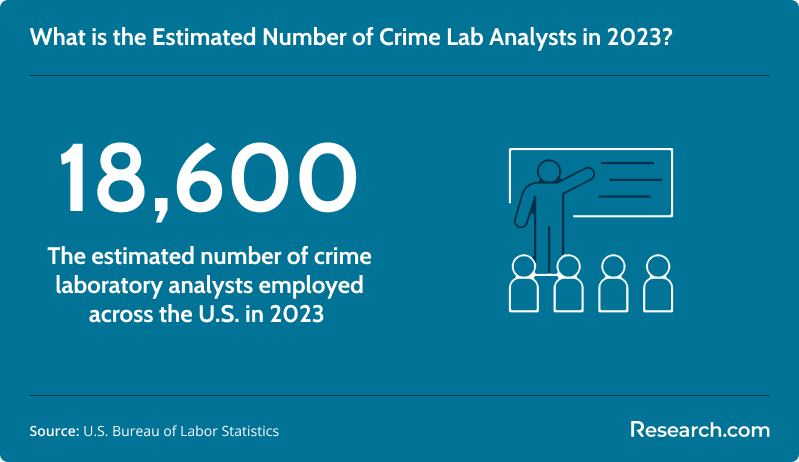
A crime laboratory analyst is a forensic science professional who examines physical, biological, chemical, or digital evidence connected to criminal investigations. These analysts are often grouped under the broader occupational category of forensic science technicians. Their findings can help investigators identify suspects, connect evidence to a person or location, reconstruct events, confirm or challenge investigative theories, and support evidence presented in court. As of 2023 there were 18,600 analysts employed in crime labs across the United States.
The job is built on scientific testing rather than speculation. Analysts may work with DNA, fingerprints, controlled substances, firearm evidence, trace materials, toxicology samples, questioned documents, or electronic records. They must also protect the integrity of evidence through careful chain-of-custody procedures and clear reporting. In many cases, they serve as the scientific foundation for criminal investigations, translating laboratory results into findings that investigators, attorneys, judges, and juries can understand.
| Career factor | What it means for aspiring analysts |
| Primary focus | Scientific testing and interpretation of evidence |
| Typical minimum education | Bachelor’s degree in forensic science, chemistry, biology, or a related field |
| Work setting | Local, state, federal, or private forensic laboratories |
| Most important strengths | Accuracy, documentation, laboratory technique, ethics, and communication |
| Career risk to understand | Errors can affect investigations, court outcomes, and public trust |
What does a crime laboratory analyst do?
A crime laboratory analyst applies validated scientific methods to evidence submitted by investigators. The analyst’s role is not to decide guilt or innocence. Instead, the job is to test evidence objectively, interpret results within scientific limits, document the process, and communicate findings clearly.
Common responsibilities include:
- Analyzing evidence: Analysts examine materials such as DNA samples, fingerprints, drugs, fibers, glass, soil, firearms evidence, toxicology specimens, and other physical or chemical evidence.
- Following laboratory protocols: Crime labs operate under strict procedures for testing, contamination control, quality assurance, instrument calibration, and peer review.
- Maintaining chain of custody: Analysts track evidence from receipt through testing, storage, reporting, and transfer so its handling can be defended in court.
- Interpreting scientific results: They evaluate test data and determine what conclusions can be supported without overstating the evidence.
- Writing reports: Forensic reports must be accurate, clear, and complete enough for investigators and attorneys to understand the findings.
- Providing expert testimony: Some analysts explain their methods, results, limitations, and conclusions in depositions or courtroom proceedings.
- Maintaining equipment and quality controls: Analysts help ensure laboratory instruments are functioning correctly and that test results meet required standards.
If you are interested in a narrower forensic specialty, you may also want to review how to become a blood spatter analyst, since that path uses biology, physics, and scene reconstruction to interpret bloodstain pattern evidence.
What are the steps to becoming a crime laboratory analyst for 2027?
The usual path combines formal science education, hands-on laboratory experience, background screening, and specialty training. The U.S. local government employed 10,770 crime lab analysts in 2023, which makes it the industry with the highest concentration of forensic science technicians.
1. Choose a science-heavy bachelor’s degree
Start with a degree that gives you strong laboratory preparation. For many students, that means forensic science, biology, chemistry, biochemistry, or another natural science. If you want a direct forensic curriculum, compare programs from the top forensic science colleges and pay close attention to laboratory coursework, internship access, faculty expertise, and graduate outcomes.
2. Build a transcript that matches crime lab hiring needs
Employers often look for coursework in chemistry, biology, genetics, molecular biology, statistics, physics, analytical chemistry, organic chemistry, and forensic methods. A criminal justice major alone may not provide enough laboratory science for many analyst positions unless it includes substantial forensic science coursework.
3. Get hands-on laboratory experience before graduation
Internships, undergraduate research, laboratory assistant roles, and forensic lab placements can make a major difference. Crime labs need applicants who understand sample handling, contamination prevention, documentation, instrumentation, and quality-control expectations.
4. Decide on a forensic specialty
Specializing can help you target the right jobs. DNA analysis, toxicology, drug chemistry, firearms and toolmarks, latent prints, trace evidence, and digital forensics each require different technical preparation. Choose electives and internships that support your intended specialty.
5. Prepare for background checks and hiring requirements
Crime lab applicants may face background investigations, drug screening, reference checks, and in some cases polygraph examinations. Because analysts handle sensitive evidence, employers evaluate judgment, integrity, and reliability in addition to academic qualifications.
6. Pursue certification when it fits your role
Certification is often most useful after you gain experience in a forensic specialty. Organizations such as the American Board of Criminalistics offer credentials that can demonstrate professional competence. Shorter online certificate programs may also support continuing education, but they should not be treated as a substitute for required laboratory training.
7. Keep learning as forensic technology changes
Forensic science changes as instruments, databases, software, validation standards, and legal expectations evolve. Analysts who continue training in new methods, quality systems, statistics, and courtroom communication are better positioned for advancement.
| Step | Best action | Why it matters |
| Degree planning | Choose forensic science, chemistry, biology, or a related science major | Most analyst jobs require strong laboratory science preparation |
| Course selection | Prioritize chemistry, biology, statistics, genetics, and forensic methods | Specialized units often screen for specific science coursework |
| Experience | Complete internships, research, or lab assistant work | Hands-on practice helps prove you can work safely and accurately |
| Specialization | Focus on DNA, toxicology, trace evidence, firearms, prints, or digital evidence | Different forensic units require different technical skills |
| Credentialing | Add certification after gaining relevant experience | Credentials can support credibility and promotion |
Specialized abilities in DNA analysis, toxicology, or digital forensics can improve salary potential and advancement prospects, particularly in state and federal government roles. Analysts with advanced credentials and defined technical expertise may be more competitive for higher-level jobs in local governments, which employs the most number of crime lab analysts, as shown in the chart that follows.
What are the different types of crime laboratory analysts?
Crime laboratory analysis is not one single job. Analysts often work in specialized units based on the type of evidence they examine. Students considering a forensic science degree should compare these specialties early because each one can require different coursework, internships, and certifications.
| Specialty | Evidence analyzed | Best academic preparation |
| DNA analyst | Blood, saliva, hair, tissue, and other biological samples | Biology, molecular biology, genetics, forensic science |
| Forensic toxicologist | Drugs, alcohol, poisons, and chemicals in biological specimens | Chemistry, toxicology, forensic science, biochemistry |
| Firearms and ballistics analyst | Firearms, bullets, cartridge cases, and toolmarks | Forensic science, physics, criminalistics |
| Trace evidence analyst | Fibers, paint, glass, soil, hair, and microscopic materials | Chemistry, microscopy, forensic science |
| Latent fingerprint analyst | Fingerprints and palm prints recovered from scenes or objects | Forensic science, criminal justice with forensic training |
| Forensic chemist | Controlled substances, explosives, unknown powders, and chemical compounds | Chemistry, analytical chemistry, forensic chemistry |
| Digital forensics analyst | Computers, phones, storage devices, logs, and electronic records | Computer science, cybersecurity, digital forensics, criminal justice |
What degree do you need to become a crime laboratory analyst?
A bachelor’s degree is the standard starting point for most crime laboratory analyst roles. The best major depends on the forensic unit you want to enter. In general, degrees with strong natural science and laboratory components are more useful than broad criminal justice programs for lab-based positions.
Bachelor’s degree: the common entry requirement
Most aspiring analysts pursue one of these majors:
- Forensic science: A direct option for students who want coursework tied to evidence analysis, criminalistics, and forensic laboratory practice.
- Biology or biochemistry: A strong fit for DNA, serology, molecular biology, and some toxicology roles. Crime lab analyst can also be one of the careers in biology that pay well.
- Chemistry: Often preferred for drug analysis, forensic chemistry, toxicology, explosives analysis, and analytical laboratory work.
- Criminal justice with forensic science coursework: Useful for understanding investigations and legal processes, but it should include enough laboratory science to meet employer requirements.
Key coursework may include genetics, microbiology, analytical chemistry, organic chemistry, molecular biology, statistics, instrumental analysis, forensic biology, forensic chemistry, and evidence procedures.
Master’s degree: helpful for specialization or advancement
A master’s degree in forensic science, biology, chemistry, toxicology, or a related field may improve competitiveness for specialized or senior roles. It can be especially useful for:
- Higher-level federal crime lab positions, including roles such as Senior Lab Analyst with an annual salary of $102,527.
- Advanced work in DNA analysis, toxicology, digital forensics, forensic chemistry, or research.
- Teaching, laboratory leadership, technical review, or policy-focused forensic work.
Not every analyst needs a graduate degree, but candidates aiming for leadership, federal roles, or highly technical units should compare whether the added time and cost fit their goals.
Doctorate: mainly for research, teaching, and expert consulting
A Ph.D. is not usually required for entry-level crime laboratory analyst jobs. It is more relevant for professionals who want to lead forensic research, teach at the university level, publish in specialized areas, or serve as high-level consultants and expert witnesses.
Certifications and specialized training: useful after the degree
Professional certification is separate from a degree. It is most valuable when tied to your actual forensic specialty and supported by work experience. Some credentials are among the certifications that pay well, but candidates should verify eligibility requirements before paying for exam preparation or training.
| Education option | Best for | Limitations |
| Bachelor’s in forensic science | Students who want a direct route into forensic lab work | Quality varies; lab access and accreditation matter |
| Bachelor’s in chemistry | Drug chemistry, toxicology, explosives, and analytical testing | May require forensic electives or internship experience |
| Bachelor’s in biology or biochemistry | DNA, serology, molecular biology, and some toxicology roles | May need additional forensic procedure training |
| Criminal justice with forensic concentration | Students interested in investigations plus forensic concepts | May not satisfy lab science requirements for some crime labs |
| Master’s degree | Specialization, advancement, federal roles, and research-focused work | Adds time and cost; not always required for entry-level jobs |
Can you become a crime laboratory analyst with an online degree?
An online degree can help you move toward a crime laboratory analyst career, but it must be chosen carefully. The main issue is laboratory training. Crime lab work requires hands-on practice with instruments, specimens, quality controls, documentation, and evidence-handling procedures. A fully online program that teaches only theory may not be enough for competitive lab-based positions.
When an online degree can make sense
- It can help working adults complete general education, criminal justice, forensic theory, or advanced coursework with more scheduling flexibility.
- It may be useful for professionals who already have laboratory experience and need a degree or additional credential to advance.
- It can support careers connected to forensic administration, crime analysis, legal processes, or some of the highest paying criminology jobs.
- Hybrid programs with in-person labs, campus residencies, or approved local laboratory placements may provide stronger preparation than theory-only programs.
When an online degree may not be enough
- Employers may prefer candidates with documented in-person lab experience, especially for government or accredited crime laboratories.
- At-home lab kits usually cannot fully replace supervised work with forensic-grade instruments and evidence protocols.
- Some forensic specialties require specific science coursework, technical competencies, or supervised training that online programs may not offer.
- A criminal justice online degree without advanced science labs may not qualify you for many analyst positions.
How to evaluate an online forensic or criminal justice program
- Ask whether the program includes supervised laboratory courses, practicums, internships, or campus-based lab requirements.
- Confirm that the curriculum includes the science courses required for the forensic specialty you want.
- Check institutional accreditation and any relevant forensic program recognition.
- Ask where graduates work and whether they have entered crime lab, law enforcement, toxicology, DNA, or digital forensics roles.
- Find out whether credits transfer if you later pursue a science-heavy bachelor’s or master’s program.
How long does it take to become a certified crime laboratory analyst?
Becoming a certified crime laboratory analyst typically takes four to six years at minimum, depending on the degree path, specialty, and certification requirements. Most candidates begin with a bachelor’s degree in forensic science, chemistry, biology, or a related field, which usually takes about four years.
Some candidates then add internships, entry-level forensic technician work, or graduate education. Specialized or federal positions may prefer or require a master’s degree, adding another two years. Certification timelines vary because many credentials require professional experience before candidates can sit for an exam.
After meeting education and experience requirements, analysts may pursue certifications such as the American Board of Criminalistics (ABC) Certification or the American Board of Forensic Toxicology (ABFT) Certification. Preparing for and completing a certification process may take several months to a year.
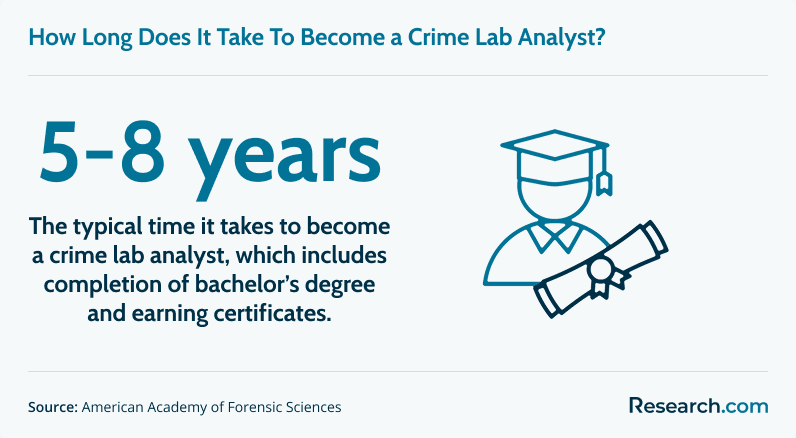
Overall, the path to becoming a certified crime laboratory analyst can take anywhere from five to eight years, depending on education, experience, employer requirements, and the credential being pursued.
| Stage | Typical time involved | What to focus on |
| Bachelor’s degree | About four years | Science coursework, laboratory skills, forensic electives |
| Internship or entry-level experience | Varies by employer and opportunity | Evidence handling, documentation, instrumentation, quality control |
| Master’s degree, if needed | Another two years | Specialization, research, leadership preparation |
| Certification preparation | Several months to a year | Eligibility review, exam preparation, specialty knowledge |
| Total path to certification | Five to eight years | Education, experience, and credentialing aligned to a specialty |
What are the costs associated with specialized forensic education?
The cost of becoming a crime laboratory analyst depends on the degree level, school type, delivery format, lab requirements, relocation needs, and whether you pursue certification or graduate study. Tuition is only one part of the total cost. Students should also budget for laboratory fees, textbooks, technology, background checks, commuting or housing for internships, exam fees, professional memberships, and continuing education.
Online and hybrid programs may reduce commuting or housing expenses, but they are not automatically cheaper when lab residencies, travel, and additional science courses are required. Before enrolling, compare the full cost of attendance and review resources on how much does a criminal justice degree cost to understand how tuition, aid, and program format can affect affordability.
| Cost category | Questions to ask before enrolling |
| Tuition and fees | Is pricing per credit, per term, or full program? Are lab fees separate? |
| Laboratory access | Are in-person labs included, or will you need to travel for residencies? |
| Internship costs | Will you need to relocate, commute, or reduce work hours to complete field experience? |
| Certification expenses | Are exam fees, study materials, and professional memberships included in your budget? |
| Transfer credits | Will prior credits reduce your cost, or will science prerequisites need to be repeated? |
| Financial aid | Is the institution eligible for federal aid, scholarships, grants, or employer tuition assistance? |
What challenges do crime laboratory analysts face in their day-to-day work?
Crime laboratory work can be rewarding, but it is also demanding. Analysts must balance accuracy with case volume, follow strict quality procedures, and produce work that can withstand legal review. A single documentation issue, contamination concern, or unsupported conclusion can affect an investigation and may be challenged in court.
Common challenges include heavy caseloads, backlogs, strict accreditation expectations, recurring proficiency testing, evolving technology, detailed documentation demands, and pressure from legal scrutiny. Analysts also need to communicate effectively with investigators, attorneys, supervisors, and sometimes juries. Professionals comparing related paths may find it useful to explore broader criminology careers before deciding whether a laboratory-centered role is the right fit.
| Challenge | Why it matters | How to prepare |
| Case backlogs | High volume can create pressure to work quickly | Develop time management and careful prioritization habits |
| Legal scrutiny | Reports and testimony may be challenged | Practice clear writing and learn courtroom expectations |
| Quality assurance | Crime labs must maintain reliable methods and documentation | Understand validation, peer review, and standard operating procedures |
| Technology changes | New instruments and software can change workflows | Commit to continuing education and technical training |
| Emotional distance | Some evidence is connected to serious harm or death | Use professional boundaries and workplace support resources |
Can an online criminal justice program enhance my forensic career?
An online criminal justice program can strengthen your understanding of investigations, courts, corrections, policing, criminal procedure, and evidence rules. That knowledge can help forensic professionals communicate more effectively with investigators and legal teams. However, it should be viewed as a complement to laboratory science, not a replacement for chemistry, biology, toxicology, or forensic lab coursework.
For working professionals who already have lab experience or a science background, earning a criminal justice degree online may support advancement into supervisory, investigative coordination, compliance, or administrative roles. For students seeking entry-level analyst jobs, the program should be paired with sufficient science labs and forensic technical training.
How are emerging technologies impacting crime laboratory analysis?
Crime laboratories increasingly rely on automated instruments, advanced software, digital evidence tools, cloud-based data systems, and artificial intelligence-supported workflows. These technologies can improve efficiency and help laboratories process complex evidence, but they also create new training needs. Analysts must understand data integrity, cybersecurity risks, validation requirements, and the limits of software-assisted interpretation.
Technology does not remove the need for scientific judgment. Instead, it raises expectations for analysts to understand both the tools and their limitations. Students and working professionals who want more flexible training options may compare a forensic science degree online, especially if the program includes credible laboratory or applied components.
How can legal studies enhance a crime laboratory analyst’s career?
Legal knowledge helps analysts understand how evidence moves from the laboratory into court. Training in legal studies can improve report writing, testimony preparation, chain-of-custody awareness, ethics, and communication with attorneys. It can also help analysts avoid overstating conclusions or using language that may be scientifically imprecise in a legal setting.
For analysts who want a stronger foundation in legal terminology and procedure without leaving the workforce, an associate degree in legal studies online may offer useful context. It is most valuable when paired with strong forensic science training rather than used as a substitute for laboratory education.
How can interdisciplinary experience elevate a crime laboratory analyst’s career?
Crime lab analysts who understand adjacent fields can often communicate more effectively and move into broader roles. Experience with investigations, digital evidence, legal procedures, intelligence analysis, quality systems, or data science can support advancement into technical leadership, consulting, training, or interagency work.
For example, professionals interested in national security or federal investigative work may benefit from understanding how agencies use scientific, investigative, and intelligence-based information together. Learning about how to become a field agent in the CIA can provide perspective on cross-agency skills, though laboratory analyst roles and field agent roles have different requirements.
What are the opportunities for interdisciplinary career advancement?
Experienced analysts may move beyond routine benchwork into supervision, quality assurance, technical review, laboratory management, forensic consulting, training, research, policy, intelligence support, or specialized digital investigations. The best path depends on the analyst’s technical specialty, communication skills, education, and professional credibility.
Adding interdisciplinary education can be useful when it supports a defined career goal. For example, an analyst interested in national security, intelligence-led investigations, or federal analytical roles may consider an intelligence masters online program. The key is to choose credentials that expand your career options without weakening your core forensic expertise.
What certifications are required for crime laboratory analysts?
Certification requirements vary by employer, forensic specialty, and career stage. Some crime labs require certification for certain positions, while others strongly prefer it after analysts gain professional experience. The right credential depends on the evidence type you handle. Many forensic roles also share skills with clinical technologist job requirements, including laboratory safety, instrument handling, quality control, and precise data interpretation.
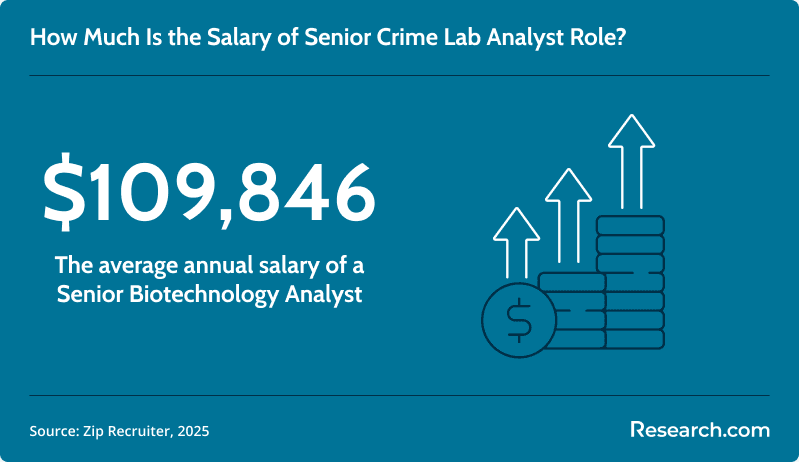
Certifications and specializations also enhance salary. The Senior Biotechnology Analyst, for instance, receives $109,846 annually. The following are common certification pathways by specialty:
| Certification or credential area | Best for | Typical eligibility focus |
| American Board of Criminalistics (ABC) | General criminalistics, trace evidence, drug chemistry, and DNA-related work | Bachelor’s degree in a relevant field and forensic laboratory experience |
| American Board of Forensic Toxicology (ABFT) | Forensic toxicologists analyzing drugs, alcohol, poisons, and chemicals | Degree in chemistry, toxicology, forensic science, or related area plus professional experience |
| International Association for Identification (IAI) | Latent print examiners, crime scene investigators, and forensic photographers | Specialized training and experience in prints, scenes, or photography |
| Association of Firearm and Tool Mark Examiners (AFTE) | Firearms, ballistics, bullets, cartridge cases, and toolmark examiners | Relevant degree and at least two years of firearms and toolmark analysis experience |
| Forensic document examiner certification | Handwriting, signatures, altered documents, and authenticity analysis | Bachelor’s degree and at least two years of document examination training |
| Digital forensics certifications | Computer, mobile device, operating system, log, and data recovery investigations | Technical training in digital evidence tools, systems, and forensic procedures |
American Board of Criminalistics (ABC) Certification
The ABC credential is commonly associated with criminalistics, trace evidence, drug chemistry, and DNA-related forensic work. Candidates generally need a bachelor’s degree in forensic science, chemistry, biology, or a related field and at least two years of professional forensic laboratory experience. ABC offers credentials such as the Diplomate of ABC (D-ABC) and Fellow of ABC (F-ABC), depending on the candidate’s level of expertise and qualifications.
American Board of Forensic Toxicology (ABFT) Certification
ABFT certification is designed for forensic toxicologists who analyze biological samples for drugs, alcohol, poisons, and other substances. Candidates typically need relevant education in chemistry, toxicology, forensic science, or a related discipline, along with at least two years of professional experience in forensic toxicology. This credential is especially relevant for professionals working in crime labs, medical examiner offices, and law enforcement-related toxicology units.
International Association for Identification (IAI) Certification
IAI credentials support professionals in latent print examination, crime scene work, and forensic photography. Certification options include the Certified Latent Print Examiner (CLPE), Certified Crime Scene Investigator (CCSI), and Certified Forensic Photographer (CFP). Candidates usually need specialized training and 1–2 years of relevant experience, depending on the credential.
Association of Firearm and Tool Mark Examiners (AFTE) Certification
AFTE certification is relevant for analysts who examine firearms, ammunition components, bullets, cartridge cases, and toolmarks. Candidates generally need a bachelor’s degree in forensic science or criminalistics and at least two years of experience analyzing firearms, bullets, and tool marks. This credential can support credibility in law enforcement laboratories and forensic firearms units.
Forensic Document Examiner Certification
Document examination credentials are intended for professionals who evaluate handwriting, signatures, altered documents, and authenticity questions. Candidates usually need a bachelor’s degree and at least two years of specialized training in forensic document examination. This path is most relevant for analysts working with legal records, fraud investigations, questioned documents, and government or crime lab document units.
Digital Forensics Certifications
Digital evidence work often requires specialized technical credentials. Two common options are the Certified Forensic Computer Examiner (CFCE), offered by the International Association of Computer Investigative Specialists (IACIS), and the GIAC Certified Forensic Examiner (GCFE), which focuses on operating systems, logs, and digital data. These certifications can support work in law enforcement, cybersecurity, private investigation, and digital forensic laboratories.
What is the average salary for a crime laboratory analyst?
The average salary for a crime laboratory analyst ranges from $55,000 to $85,000 per year, depending on experience, location, employer type, specialty, and credentials. According to the U.S. Bureau of Labor Statistics (BLS), forensic science technicians, which include crime lab analysts, earn a median salary of around $63,740 annually.
Entry-level analysts typically start at $50,000 to $60,000. Experienced analysts in specialized fields such as DNA analysis or toxicology can earn upwards of $90,000. If you are also comparing field-based forensic careers, review how do I start a career in crime scene investigation, since crime scene investigation roles can have different pay structures and job duties.
Federal agencies such as the FBI and DEA often offer higher pay than state and local crime labs. Analysts in high-cost-of-living areas such as California, New York, and Washington, D.C. may also earn more, while private forensic laboratories and consulting roles may exceed $100,000 for senior positions. Salaries are not guaranteed; they depend on hiring budgets, location, specialization, years of experience, education, and certification.
| Salary factor | How it can affect pay |
| Experience level | Entry-level analysts usually earn less than senior analysts, technical reviewers, or supervisors |
| Specialization | DNA, toxicology, digital forensics, and advanced chemistry roles may command higher compensation |
| Employer type | Federal agencies and private consulting roles may pay differently than local or state labs |
| Location | High-cost areas may offer higher wages, though living expenses can offset the difference |
| Credentials | Relevant certification and graduate education can support advancement but do not guarantee a salary increase |
The salary of a crime laboratory analyst varies based on experience, specialization, and employer, with opportunities for advancement in state and federal agencies. The chart below highlights annual salary ranges for entry-level, mid-career, and senior analysts.
What is the job outlook for forensic laboratory analysts?
The job outlook for forensic science technicians, including forensic laboratory analysts, is generally positive. Demand is supported by the growing use of scientific evidence, DNA analysis, toxicology, digital forensics, and advanced laboratory methods in criminal investigations. However, job openings can still be competitive because many positions depend on government budgets, agency staffing levels, and local crime lab funding.
To improve your prospects, it helps to understand related investigative and analytical roles. For example, reviewing crime analyst job requirements can clarify how laboratory evidence and crime data are used together in investigations. Crime analysts and forensic laboratory analysts do different work, but both support evidence-based decision-making in public safety.
The strongest candidates typically combine a relevant science degree, hands-on laboratory experience, clean background screening, strong writing skills, courtroom readiness, and specialty training. Emerging fields such as DNA analysis, toxicology, and digital forensics may provide additional pathways, but advanced qualifications and practical experience remain important.
Common mistakes to avoid when preparing for this career
- Choosing a criminal justice degree without enough science coursework: Many lab jobs require chemistry, biology, or forensic laboratory preparation. Review job postings before choosing a major.
- Assuming online theory equals lab readiness: Online courses can be useful, but employers often want supervised hands-on laboratory experience.
- Ignoring accreditation and program quality: Verify institutional accreditation, lab access, internship placement, faculty qualifications, and graduate outcomes.
- Waiting too long to pursue internships: Crime lab experience is competitive. Start looking early through faculty, local agencies, research labs, and forensic organizations.
- Overlooking background requirements: Drug use, criminal history, dishonesty, or financial concerns may affect eligibility for sensitive evidence-handling roles.
- Choosing certifications too early: Some credentials require professional experience. Confirm eligibility before spending money on exam preparation.
- Focusing only on salary: Consider location, cost of living, caseload, lab culture, career growth, shift expectations, and emotional demands.
Questions to ask before choosing a forensic science program
- Does the program include substantial in-person laboratory coursework?
- Which forensic specialties does the curriculum support: DNA, toxicology, chemistry, trace evidence, firearms, prints, or digital forensics?
- Are internships, practicums, or research opportunities available with crime labs or related agencies?
- What science prerequisites are required for the forensic jobs you want?
- Do graduates work in crime laboratories, medical examiner offices, toxicology labs, law enforcement agencies, or private forensic companies?
- Is the program accredited by a recognized institutional accreditor?
- Will online or transfer credits be accepted by graduate programs or employers?
- What is the total cost after tuition, fees, lab expenses, travel, books, and certification costs?
Here's What professionals Have to Say About Becoming Crime Laboratory Analysts
-
: "
Working as a crime laboratory analyst has been incredibly fulfilling—I get to combine my love for science with real-world problem-solving that helps bring justice to victims. The job is challenging, but the excitement of analyzing evidence and uncovering the truth makes every day rewarding. Knowing that my work directly impacts criminal investigations gives me a strong sense of purpose. Jessica
"
-
: "
The path to becoming a crime lab analyst took years of study and training, but landing a job in a state crime lab made it all worth it. The hands-on experience with cutting-edge forensic technology and constant learning opportunities keep me engaged and motivated. Plus, the demand for skilled analysts means strong job security and career growth. Mark
"
-
: "
One of the best parts of my career is the teamwork—collaborating with law enforcement, attorneys, and forensic specialists to piece together crucial evidence. Every case is a new puzzle, and the sense of accomplishment when we help solve a crime is unbeatable. If you have a passion for science and justice, this career is incredibly rewarding. Rachel
"
Key Insights
- Crime laboratory analyst is a science-based forensic role. A strong background in chemistry, biology, forensic science, or another laboratory discipline is usually more important than a general interest in criminal justice.
- As of 2023, 18,600 crime laboratory analysts were employed across the United States, and local government agencies employed 10,770 crime lab analysts, making it the largest employer of forensic science technicians.
- The typical path includes a bachelor’s degree, hands-on lab experience, background screening, specialty training, and, for many analysts, certification after gaining experience.
- The path to becoming a certified crime laboratory analyst typically takes five to eight years, depending on education, experience, and certification requirements.
- Online degrees can help, but they are strongest when paired with supervised laboratory work, internships, campus labs, or prior hands-on science experience.
- Federal crime labs, such as the FBI and DEA, offer higher-level positions like Senior Lab Analyst, with salaries reaching $102,527 annually.
- Certifications and specializations significantly impact salary, with roles like Senior Biotechnology Analyst earning $109,846 per year.
- According to the U.S. Bureau of Labor Statistics (BLS), forensic science technicians, including crime lab analysts, earn a median salary of $63,740 annually.
- Entry-level salaries range from $50,000 to $60,000, while experienced analysts in specialized fields like DNA analysis or toxicology can earn over $90,000 per year.
- The best program choice is not always the cheapest or most convenient. Choose the path that gives you the science coursework, laboratory practice, internship access, and specialty preparation required for the crime lab jobs you want.
References:
- Bureau of Labor Statistics, U.S. Department of Labor. (2024). Forensic science technicians. Occupational Outlook Handbook.
- Bureau of Labor Statistics, U.S. Department of Labor. (2024). Occupational employment and wage statistics.
- National Archive of Criminal Justice Data. (2020). National forensic laboratory information system (NFLIS) data, 2014-2019. ICPSR.
- O*NET OnLine. (2024). 19-4092.00 forensic science technicians.
- SmithGroup. (2023). Forensic workforce: Crime lab ASCLD.
- SmithGroup. (2023). Forensic workforce: MDI.
- ZipRecruiter. (2025). Crime lab analyst salary.
Other Things You Should Know About Becoming a Crime Laboratory Analyst
Most employers expect a bachelor’s degree in forensic science, chemistry, biology, or a related natural science. Useful coursework includes analytical chemistry, biochemistry, genetics, statistics, and criminalistics, plus laboratory methods and microscopy. Many agencies also want documented lab experience from internships or undergraduate research.
Obtaining certifications such as the Certified Crime Scene Analyst (CCSA) from the International Association for Identification can enhance career prospects in 2027. While not always mandatory, these credentials demonstrate specialized knowledge and commitment to the field.
To become a crime laboratory analyst in 2027, a bachelor's degree in forensic science or a related field, such as chemistry or biology, is typically required. Many employers also prefer candidates with specialized training or certification in forensic analysis techniques.