2027 How To Become a Crime Analyst

Co-Founder and Chief Data Scientist
If you want a criminal justice career that uses evidence, technology, and data instead of patrol work, crime analysis is one of the clearest paths to consider. Crime analysts help police departments, public safety agencies, and security organizations make better decisions by finding patterns in crime reports, calls for service, arrests, locations, and investigative records. The work matters because agencies increasingly depend on data to deploy resources, understand repeat problems, and evaluate public safety strategies.
This guide explains how to become a crime analyst in 2027, including the education route, skills, timeline, certifications, software tools, salary expectations, workplaces, advancement options, and common mistakes to avoid. It is designed for students comparing criminal justice degrees, working professionals moving into analytical roles, and anyone deciding whether crime analysis is the right career path.
Quick Answer: How Do You Become a Crime Analyst?
Most crime analysts begin with a bachelor’s degree in criminal justice, criminology, data analytics, GIS, statistics, psychology, or a related field. They then build practical experience through internships, law enforcement support roles, research work, or entry-level analyst positions. Strong candidates usually know how to clean and interpret data, use GIS or crime mapping tools, write clear reports, and explain findings to investigators or command staff. Certifications are not always mandatory, but they can strengthen a resume and show specialized training.
Key Things You Should Know Before Choosing This Career
- A bachelor’s degree is the common entry point. In 2025, data showed that 68% of crime analysts hold a bachelor's degree, so choosing the right undergraduate program is an important first decision.
- The typical preparation timeline is 4 to 6 years. This usually includes college, internships or entry-level experience, and optional certification training.
- The job blends criminal justice and analytics. Crime analysts do not just study crime; they translate data into maps, reports, forecasts, and operational recommendations.
- Technical skills can separate candidates. GIS, spreadsheet modeling, databases, statistics, dashboard tools, and crime mapping platforms are especially useful.
- The work carries legal and ethical responsibility. Analysts often handle sensitive information, so accuracy, privacy, fairness, and careful interpretation are essential.
- What are the steps to becoming a crime analyst in 2027?
- How long does it take to become a crime analyst?
- What does a crime analyst do?
- What skills are required to be a crime analyst?
- What are the best majors for crime analysis?
- What is the average salary of a crime analyst in 2027?
- Where do crime analysts work?
- What are the career advancement opportunities in crime analysis?
- Can crime analysis lead to more lucrative criminal justice careers?
- How can an advanced degree boost career prospects in crime analysis?
- Can legal studies enhance crime analysis effectiveness?
- How can hands-on experience enhance your crime analyst career?
- What are the legal and ethical considerations in crime analysis?
- What online training programs can complement your crime analysis education?
- What certifications can help you become a crime analyst?
- What crime mapping software do analysts use?
- What are the biggest challenges in crime analysis?
What are the steps to becoming a crime analyst in 2027?
Becoming a crime analyst is usually a planned progression: earn a relevant degree, develop technical ability, get exposure to public safety data, and then apply for analyst or intelligence support roles. In 2025, data showed that 68% of crime analysts hold a bachelor's degree. Students who want a practical starting point often compare criminal justice, criminology, data analytics, and GIS programs; those looking for a less demanding academic route may also review options such as the easiest bachelor degree, while still making sure the program builds real analytical skills.
- Choose a degree aligned with crime analysis. Criminal justice and criminology are common choices because they cover policing, courts, crime patterns, and public safety systems. Data science, statistics, GIS, computer science, psychology, and cybersecurity can also prepare you well if you add criminal justice coursework or relevant experience.
- Learn how crime data is created and used. Analysts work with incident reports, calls for service, arrest records, victimization data, field interview records, and open-source information. Understanding the limits of each source is as important as knowing how to calculate trends.
- Build technical skills before graduation. Practice with spreadsheets, databases, GIS tools, statistical methods, dashboards, and report writing. Employers value candidates who can turn messy information into useful findings.
- Seek internships or public safety experience. Police departments, sheriff’s offices, prosecutors’ offices, emergency management agencies, research centers, and city government offices may offer relevant exposure. Even administrative or records-related work can help you understand how law enforcement data is collected.
- Create a portfolio of analysis work. Use class projects, capstones, internships, or publicly available datasets to show maps, charts, dashboards, written summaries, and analytical memos. A portfolio can make your resume more concrete.
- Consider certification once you have the foundation. Certifications can demonstrate professional commitment and knowledge of crime analysis methods, but they are most useful when paired with education and practical experience.
- Apply for entry-level roles strategically. Search for titles such as crime analyst, intelligence analyst, research analyst, public safety analyst, crime analysis assistant, records analyst, or investigative analyst.
- Keep learning after you are hired. Crime trends, technology, privacy rules, and analytical techniques change over time. Ongoing training helps analysts remain useful to investigators, patrol commanders, and public safety leaders.
| Step | Why it matters | What to do next |
| Earn a relevant degree | Most employers expect college-level preparation in criminal justice, data, research, or a related field. | Compare programs for statistics, research methods, GIS, criminology, and internship options. |
| Develop analytical tools | Crime analysts must identify patterns, explain trends, and present findings clearly. | Practice Excel, SQL basics, GIS, dashboards, and written analytical briefs. |
| Get field exposure | Real agency data is complex, incomplete, and shaped by reporting practices. | Look for internships, records roles, research assistant work, or volunteer opportunities with public safety agencies. |
| Earn optional credentials | Certifications may help show specialized knowledge and professional seriousness. | Choose credentials that match your target role, such as crime analysis, intelligence analysis, GIS, or data analytics. |
| Apply and continue training | Analysts improve by working with actual cases, data systems, and decision-makers. | Build a portfolio, join professional associations, attend workshops, and keep software skills current. |
The chart below lists the most common education levels of crime analysts in the US, as reported by Zippia in 2025.
How long does it take to become a crime analyst?
Most people need about 4 to 6 years to become competitive for crime analyst roles. The exact timeline depends on whether you study full time, complete internships while in school, transfer credits, pursue certification, or enter the field through a related law enforcement, research, records, military, or data role.
- 4 years for a bachelor’s degree. A traditional undergraduate program usually takes four years. Students who need more flexibility may compare self paced online colleges, especially if they are working while studying.
- 6 months to 1 year for practical experience. Internships, part-time public safety jobs, research assistantships, or records positions can help you apply classroom knowledge to real information systems.
- 3 to 6 months for certification preparation. Some credentials require study time, documentation, or exam preparation. Requirements vary by organization and certification type.
- Ongoing training throughout the career. Analysts must keep up with new crime trends, software tools, data privacy expectations, and agency priorities.
| Path | Best fit | Trade-off |
| Traditional bachelor’s degree | Students who want a broad criminal justice or criminology foundation. | Usually takes the full four years unless you bring transfer or accelerated credits. |
| Online or self-paced degree | Working adults, parents, military learners, or students who need scheduling flexibility. | You must be disciplined and confirm the program includes enough analytical coursework. |
| Related job first, analyst role later | People already working in records, dispatch, law enforcement, research, or government support. | Career transition can take longer if you need to add statistics, GIS, or data training. |
| Data-focused degree plus criminal justice experience | Students interested in higher technical specialization. | You may need internships or electives to understand policing, courts, and crime data context. |
What does a crime analyst do?
A crime analyst studies information from police reports, calls for service, arrests, investigations, locations, time patterns, and other public safety records to help agencies understand what is happening, where it is happening, and what actions may reduce harm. The role is not the same as a forensic laboratory position. Crime analysts focus on patterns and intelligence, while laboratory analysts focus on physical evidence; students comparing related careers can review crime lab analyst job requirements to understand the difference.
- Review crime and incident data. Analysts examine reports, calls, arrests, case details, and historical records to identify repeat problems and emerging patterns.
- Create maps and location-based analysis. GIS tools help analysts show hotspots, travel patterns, clusters, and geographic relationships.
- Prepare tactical and strategic reports. Tactical analysis may support active investigations, while strategic analysis may guide staffing, prevention programs, or long-term policy decisions.
- Support investigations. Analysts may connect cases, summarize suspect activity, identify repeat locations, or provide timelines to detectives.
- Brief decision-makers. Clear charts, maps, dashboards, and written summaries help command staff, officers, prosecutors, city leaders, and community partners understand the findings.
- Evaluate public safety strategies. Analysts may help agencies compare crime levels before and after interventions, while acknowledging limits in the data.
| Type of work | Typical question | Example output |
| Tactical analysis | What information can help with an active case or short-term crime pattern? | Case linkage summary, suspect timeline, hotspot map, bulletin, or investigative lead packet. |
| Strategic analysis | What long-term trends should leaders address? | Monthly crime trend report, seasonal comparison, patrol deployment analysis, or problem-area review. |
| Administrative analysis | How are agency resources being used? | Workload analysis, call volume report, response pattern summary, or staffing support document. |
| Intelligence analysis | What people, groups, locations, or behaviors may be connected? | Network chart, intelligence bulletin, link analysis, or organized crime pattern summary. |
What skills are required to be a crime analyst?
Crime analysts need more than interest in criminal justice. They must be able to work with imperfect data, explain uncertainty, use technical tools, and communicate findings to people who may need to act quickly. These skills also show what can you do with a law enforcement degree besides becoming a sworn officer.
- Data analysis. Analysts must organize, clean, compare, and interpret information from multiple sources without overstating what the data proves.
- Statistics and research methods. Basic statistical reasoning helps analysts distinguish real patterns from random variation or reporting changes.
- GIS and geospatial thinking. Location matters in crime analysis, so analysts should understand mapping, proximity, clustering, boundaries, and spatial trends.
- Critical thinking. Analysts must test assumptions, look for alternative explanations, and recognize when the data is incomplete.
- Report writing. A strong analysis is only useful if decision-makers can understand it. Clear summaries, precise language, and well-labeled visuals are essential.
- Technical fluency. Spreadsheet tools, databases, dashboards, GIS software, and visualization platforms are common parts of the job.
- Communication under pressure. Analysts may brief detectives, command staff, or public officials, sometimes with limited time and high stakes.
- Collaboration. Crime analysis often requires working with officers, records staff, prosecutors, city departments, researchers, and community partners.
- Ethical judgment. Analysts must handle sensitive information responsibly and avoid biased, unsupported, or privacy-invasive conclusions.
| Skill area | Why employers value it | How to build it |
| GIS and mapping | Helps agencies understand where crime concentrates and how locations relate to incidents. | Take GIS coursework, complete mapping projects, and practice with public datasets. |
| Data cleaning | Crime data often has missing fields, duplicates, inconsistent labels, or reporting errors. | Practice spreadsheet functions, database queries, and documentation of cleaning decisions. |
| Writing and briefing | Investigators and leaders need concise findings, not raw data dumps. | Create one-page analytical memos, dashboards, and short presentation summaries. |
| Legal awareness | Analysts must understand privacy, evidence sensitivity, and proper information sharing. | Study criminal procedure, public records rules, evidence basics, and agency policies. |
| Domain knowledge | Crime patterns make more sense when analysts understand policing, courts, and communities. | Take criminology courses, complete internships, and read agency reports or policy research. |
What are the best majors for crime analysis?
The strongest major depends on the type of analyst role you want. Zippia reports that 38% of crime analysts hold a degree in criminal justice, making it one of the most common choices. However, crime analysis is increasingly interdisciplinary, so students should compare majors by the skills they develop rather than choosing only by title.
- Criminal justice. This is a direct option for students who want to understand policing, courts, corrections, crime prevention, and public safety operations.
- Criminology. This major focuses on why crime occurs, how patterns develop, and how social conditions relate to offending and victimization.
- Data science or statistics. These programs can be powerful for students who want stronger quantitative preparation, predictive modeling skills, and comfort with large datasets.
- Geographic information systems. GIS is highly relevant because many crime analysis tasks involve locations, boundaries, hotspots, and spatial relationships.
- Psychology or forensic psychology. Students interested in behavior, risk factors, and offender patterns may consider a forensic psychology degree, especially if they also build data and research skills.
- Computer science or cybersecurity. These majors can support careers involving digital evidence, cybercrime trends, data systems, automation, and technical investigative support.
| Major | Best for students who want to... | Skill gap to watch |
| Criminal justice | Work directly in law enforcement or public safety agencies. | May need extra coursework in statistics, GIS, databases, or data visualization. |
| Criminology | Study crime patterns, causes, prevention, and social context. | May need applied software training and agency experience. |
| Data science or statistics | Compete for technically demanding analyst roles. | May need criminal justice context and knowledge of law enforcement data systems. |
| GIS | Specialize in mapping, spatial analysis, and hotspot identification. | May need broader training in criminal justice and investigative analysis. |
| Psychology or forensic psychology | Understand behavior, motivation, and risk factors. | May need stronger quantitative, GIS, and database skills. |
| Computer science or cybersecurity | Focus on cybercrime, automation, data systems, or technical investigations. | May need exposure to policing, legal processes, and crime analysis methods. |
The chart below lists the most common majors for crime analysts, as reported by Zippia in 2025.
What is the average salary of a crime analyst in 2027?
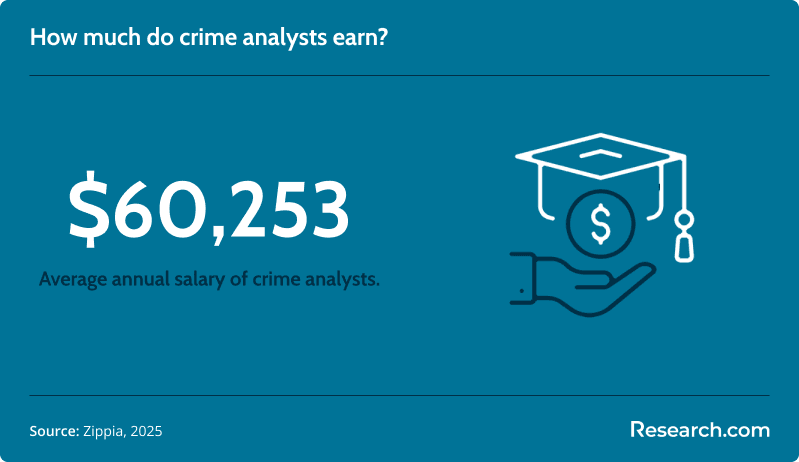
According to Zippia, the average salary of a crime analyst in 2025 is $60,253 per year. Pay can differ by employer, city, department size, union or government pay scale, experience, technical specialization, and whether the role includes intelligence, supervisory, or federal responsibilities. Salary ranges are not guarantees; they are planning benchmarks.
Crime Analyst Salary Breakdown
- Entry-level (0-2 years): $45,000 – $55,000 per year
- Mid-career (3-5 years): $55,000 – $70,000 per year
- Experienced (6+ years): $70,000 – $90,000+ per year
What Can Influence Crime Analyst Pay?
| Factor | How it can affect earnings | What candidates can do |
| Location | Larger metro areas and higher-cost regions may offer higher pay, though living costs also matter. | Compare salary with housing, transportation, benefits, and pension or retirement options. |
| Employer type | Federal agencies, large departments, and some private security employers may pay more than smaller local offices. | Review job descriptions carefully and compare benefits, advancement, workload, and mission fit. |
| Technical specialization | GIS, data visualization, SQL, cybersecurity, and intelligence tools may support stronger applications. | Build demonstrable projects and list specific tools, not just general “data skills.” |
| Experience level | Analysts with years of relevant work, supervisory duties, or specialized assignments may qualify for higher bands. | Document measurable contributions, reports produced, systems used, and investigations supported. |
| Education and credentials | Advanced coursework and certifications may help, especially when they match the role’s requirements. | Choose credentials with a clear connection to job postings you actually want. |
Where do crime analysts work?
Crime analysts are employed wherever organizations need to understand crime, risk, investigations, or public safety patterns. Many work inside police departments, but the broader field includes government, federal, research, and private-sector employers. Students comparing analytical work with field-based roles can also review how to become a crime scene investigator to see how investigative support careers differ.
- Police departments and sheriff’s offices. Local agencies often use analysts to track hotspots, support investigations, brief command staff, and evaluate patrol strategies.
- State agencies. State-level offices may analyze statewide crime trends, intelligence information, trafficking patterns, or multi-jurisdictional cases.
- Federal agencies. Federal employers may hire analysts for intelligence, homeland security, drug enforcement, cybercrime, fraud, or national investigations.
- City and county government offices. Some analysts work in public safety, policy, budgeting, emergency management, or community violence prevention units.
- Private security and corporate risk teams. Corporations, retailers, financial institutions, and security firms may use analysts to study theft, fraud, threats, organized retail crime, or cyber-related patterns.
- Academic and research organizations. Universities, think tanks, and policy groups may employ analysts to study crime trends, evaluate programs, and support public safety research.
Some professionals enter crime analysis after studying social behavior, community intervention, rehabilitation, or social services. For example, a DSW degree may be more relevant for advanced social work leadership than entry-level crime analysis, but the behavioral and systems perspective can still be useful in public safety policy or community violence prevention roles.
What are the career advancement opportunities in crime analysis?
Crime analysts can move into senior, supervisory, technical, policy, intelligence, or consulting roles as they gain experience. Advancement usually depends on the quality of your work, your ability to explain findings to decision-makers, your technical depth, and your understanding of agency operations. Analysts who want broader leadership preparation may compare options such as a criminal justice degree online, especially if they need a flexible route to complete or expand their education.
| Advancement path | What the role may involve | Helpful preparation |
| Senior crime analyst | More complex analysis, mentoring junior staff, and briefing leadership. | Strong portfolio, advanced GIS or data skills, and experience with major projects. |
| Crime analysis supervisor | Managing analysts, setting priorities, reviewing products, and coordinating with command staff. | Leadership training, project management, and clear documentation practices. |
| Intelligence analyst | Working with criminal networks, threat information, organized crime, or multi-agency intelligence. | Intelligence training, legal awareness, link analysis, and information-sharing protocols. |
| Public safety data manager | Overseeing dashboards, data systems, reporting workflows, and performance metrics. | Database skills, data governance knowledge, and experience building repeatable reporting processes. |
| Consultant or trainer | Helping agencies implement analysis units, software, methods, or training programs. | Deep field experience, professional network, certifications, and strong communication skills. |
Can crime analysis lead to more lucrative criminal justice careers?
Crime analysis can be a stepping stone to higher-paying criminal justice and public safety roles, but the outcome depends on specialization, employer type, location, education, and leadership experience. Analysts who develop advanced skills in intelligence, cybersecurity, GIS, data systems, or management may qualify for broader opportunities over time. To compare related paths, review Research.com’s guide to the highest paying jobs you can get with a criminal justice degree.
For students focused on long-term earning potential, the key is not simply choosing “crime analysis” as a title. It is building transferable skills: data interpretation, investigative support, risk analysis, dashboard design, policy evaluation, technical documentation, and briefing experience. Those abilities can carry into analyst, management, consulting, intelligence, cybersecurity-adjacent, and federal roles.
How can an advanced degree boost career prospects in crime analysis?
An advanced degree can help experienced analysts qualify for leadership, research, policy, legal, or specialized analytical roles. It is not always required for entry-level work, so students should weigh the cost and time commitment against specific job goals. A master’s program may be useful if it adds advanced statistics, GIS, data science, public administration, criminal justice policy, legal studies, or research methods.
Legal knowledge can also be valuable for analysts who work closely with prosecutors, evidence procedures, privacy rules, or administrative decision-making. For example, an online master in legal studies may complement crime analysis experience by strengthening understanding of legal systems, compliance, documentation, and policy interpretation.
Can legal studies enhance crime analysis effectiveness?
Legal studies can make a crime analyst more effective by improving their understanding of court processes, evidence rules, privacy expectations, public records issues, and agency liability. Analysts do not need to become attorneys to benefit from legal literacy. They do, however, need to know when data can be shared, how sensitive information should be handled, and why unsupported conclusions can create operational and ethical problems.
Students who want affordable legal training without enrolling in law school may explore options such as the cheapest ABA-approved paralegal programs. Paralegal-oriented coursework can be useful for documentation, legal terminology, evidence organization, and case file management, although it should be paired with data and crime analysis training for this career.
How can hands-on experience enhance your crime analyst career?
Hands-on experience is one of the best ways to learn how crime analysis works because real public safety data is rarely clean, complete, or easy to interpret. Internships, capstone projects, agency partnerships, research assistant roles, dispatch or records jobs, and volunteer projects can help you understand how reports are written, how incidents are coded, how maps can mislead, and how commanders use analysis under pressure.
Legal and procedural exposure can also sharpen an analyst’s judgment. Programs such as accelerated certificate programs for paralegals may help students understand legal documents, evidence procedures, and case organization, but they should be treated as complementary training rather than a replacement for statistics, GIS, and criminal justice analysis skills.
Practical Ways to Gain Experience Before Your First Analyst Job
- Apply for internships with police departments, sheriff’s offices, prosecutors, or city public safety units. Even if the internship is not labeled “crime analysis,” exposure to records and reporting systems can be valuable.
- Use public datasets for portfolio projects. Create maps, dashboards, trend summaries, and brief written recommendations while clearly noting data limitations.
- Ask professors about research assistant opportunities. Criminology, public policy, sociology, GIS, and statistics faculty may have projects related to crime, neighborhoods, or public safety.
- Look for part-time support roles. Dispatch, records, administrative support, campus safety, and research jobs can help you understand how agencies collect and use information.
- Join professional groups or attend webinars. This can help you learn terminology, software expectations, and hiring patterns.
What are the legal and ethical considerations in crime analysis?
Crime analysts work with information that can affect investigations, public trust, privacy, resource allocation, and individual rights. That makes ethical judgment a core job requirement, not an optional soft skill. Analysts must avoid drawing conclusions that exceed the evidence, protect sensitive records, and recognize how data quality or enforcement practices can influence observed crime patterns.
- Privacy and confidentiality. Criminal justice records, victim information, juvenile data, intelligence files, and investigative details may have strict access rules.
- Bias and fairness. Crime data reflects reported incidents and enforcement activity, not every event that occurs. Analysts must be careful when comparing neighborhoods, groups, or individuals.
- Data accuracy. Missing fields, miscoded incidents, duplicate reports, and delayed reporting can affect conclusions.
- Appropriate information sharing. Analysts should follow agency policy and legal requirements before distributing bulletins, maps, or intelligence products.
- Transparency about limits. Forecasts, hotspots, and trend lines should be presented with enough context to prevent overconfidence or misuse.
- Role boundaries. Analysts support decisions; they should not replace investigators, prosecutors, judges, or policy leaders.
Understanding agency-specific standards also matters. For example, students reviewing DEA job requirements can see how federal public safety careers often involve strict eligibility, integrity, and procedural expectations. Crime analysts should bring the same seriousness to data handling and professional conduct.
What online training programs can complement your crime analysis education?
Online training can help aspiring crime analysts fill gaps that a degree program may not cover in depth. The best option depends on your background. A criminal justice major may need more data and GIS training; a data science major may need criminology and legal context; a working law enforcement employee may need formal research methods or visualization skills.
| Training area | Useful for | What to look for |
| GIS and crime mapping | Students who want to produce hotspot maps, spatial analysis, and location-based reports. | Hands-on projects, map interpretation, geocoding, and public safety examples. |
| Data analytics | Candidates who need stronger spreadsheet, dashboard, database, or statistical skills. | Practice with real datasets, visualization assignments, and clear documentation methods. |
| Criminal justice research methods | Students who need to evaluate data quality, trends, and program outcomes. | Courses covering research design, measurement, ethics, and interpretation. |
| Legal documentation or paralegal studies | Analysts who want stronger understanding of case files, legal terminology, and evidence procedures. | Accreditation, practical assignments, and relevance to criminal law or public safety work. |
| Cybercrime or intelligence analysis | Candidates interested in digital threats, link analysis, or intelligence support roles. | Ethics, legal boundaries, open-source intelligence, and structured analytical techniques. |
Students who want legal-documentation training may compare accredited online paralegal certificate programs. These programs can strengthen understanding of legal files and evidence-related workflows, but crime analyst candidates should still prioritize data, mapping, and analytical writing.
What certifications can help you become a crime analyst?
Certifications are not always required to become a crime analyst, but they can help prove specialized knowledge, especially when a job posting mentions crime analysis, intelligence analysis, GIS, or data tools. The best credential is the one that matches your target employer’s needs and your current skill gaps.
- Certified Law Enforcement Analyst (CLEA). Offered by the International Association of Crime Analysts (IACA), this credential focuses on professional crime analysis knowledge, including mapping, statistics, and analytical methods.
- Crime and Intelligence Analysis Certification. Some colleges and training providers offer certificates in law enforcement analysis, intelligence methods, criminal behavior patterns, and applied public safety data.
- Certified Criminal Intelligence Analyst (CCIA). The International Association of Law Enforcement Intelligence Analysts (IALEIA) provides this certification for professionals focused on intelligence analysis and crime trend interpretation.
- Geographic Information Systems certification. GIS credentials can be useful because mapping and spatial analysis are central to many analyst roles.
- CompTIA Data+. This credential can support candidates who want to demonstrate data analysis, visualization, and data management skills relevant to crime analysis work.
| Certification type | Best for | Before you enroll, ask... |
| Crime analysis certification | Candidates targeting police department or public safety analyst roles. | Does the certification align with job postings in my region? |
| Intelligence analysis certification | Professionals interested in criminal intelligence, threat analysis, or multi-agency work. | Does the program cover legal limits and structured analytical techniques? |
| GIS certification | Applicants who want stronger mapping and spatial analysis credibility. | Will I build a portfolio of maps and spatial projects? |
| Data analytics certification | Students or career changers who need stronger technical proof. | Does it include practical work with dashboards, databases, and visualization? |
Certifications can also matter in adjacent criminal investigation support roles. For example, people exploring hands-on evidence work can review crime scene technician job requirements to see how training expectations differ from analytical positions.
What crime mapping software do analysts use?
Crime analysts use mapping, database, link analysis, and visualization tools to find patterns and communicate them clearly. Software requirements vary by employer, so job seekers should read local postings and learn the platforms most common in their region. A Geographic Information System (GIS) is especially important because crime patterns often depend on place, distance, boundaries, land use, and movement.
- ArcGIS. Analysts use this GIS platform to map hotspots, examine location patterns, and create visual products for public safety decision-making.
- CrimeMapping.com. This web-based platform helps agencies share selected crime information with the public and display incidents by location.
- IBM i2 Analyst’s Notebook. This tool is commonly associated with link analysis, relationship mapping, and investigative pattern identification.
- LexisNexis Risk Solutions (Accurint Crime Analysis). Agencies may use this platform to support investigative research, data connections, and crime analysis workflows.
- Microsoft Power BI. Although not built only for law enforcement, Power BI can help analysts create dashboards, charts, and interactive reports.
- Esri Crime Analysis Solution. This law enforcement-focused solution extends ArcGIS workflows for crime mapping and public safety analysis.
Current Trends Affecting Crime Analysis
- Greater reliance on dashboards and real-time reporting. Agencies increasingly want information that can be updated and interpreted quickly, not only static monthly reports.
- More attention to data quality and transparency. Analysts are expected to explain where data comes from, what it excludes, and how reporting practices affect trends.
- AI-assisted tools are expanding, but human review remains essential. Automation may help summarize, classify, or visualize information, but analysts still need to validate results, check bias, and interpret context.
- Privacy and civil liberties concerns are more visible. As agencies use more data sources, analysts must be careful about information sharing, surveillance implications, and unsupported profiling.
- Cross-disciplinary hiring is more common. Criminal justice knowledge still matters, but employers may also value applicants with GIS, statistics, computer science, cybersecurity, or public policy training.
The chart below illustrates the homicide rates in the US by year, as reported by the CCJ in 2025.
What are the biggest challenges in crime analysis?
Crime analysis can be meaningful work, but it is not a simple “data in, answer out” job. Analysts must deal with incomplete records, changing crime patterns, legal constraints, limited resources, and pressure from decision-makers who may want fast conclusions. In 2024, the homicide rate in major U.S. cities dropped to 12%, down from 14.3% in 2023. Such changes show why careful analysis matters: trends can shift, and agencies need accurate interpretation before changing strategy.
- Incomplete or inconsistent data. Reports may be missing fields, miscoded, delayed, duplicated, or affected by changes in enforcement and reporting behavior.
- Technology gaps between agencies. Some departments have advanced GIS and data systems, while others rely on older tools or fragmented records.
- Legal and ethical risk. Analysts must protect sensitive data, avoid improper sharing, and prevent conclusions that unfairly target people or communities.
- Education and training costs. A degree and specialized tools can be expensive, so students may need to compare financial aid options such as online colleges that accept FAFSA.
- Changing crime patterns. New technologies, economic shifts, social changes, and enforcement priorities can alter what analysts see in the data.
- Stress and exposure to disturbing information. Analysts may work with violent crime reports, victim details, and urgent investigative requests.
- Pressure to overpredict. Forecasts and hotspot maps can be useful, but they should not be treated as certainty or used without context.
Common Mistakes to Avoid When Preparing for a Crime Analyst Career
| Mistake | Why it can hurt you | Better approach |
| Choosing a degree based only on the title | A criminal justice program may not include enough statistics, GIS, or data work. | Review course lists for research methods, data analysis, mapping, and internships. |
| Ignoring accreditation and transfer policies | Credits, financial aid, graduate admission, and employer recognition may be affected. | Confirm institutional accreditation and ask how credits transfer before enrolling. |
| Assuming certification replaces experience | Credentials help, but employers still want evidence that you can analyze real information. | Pair certification with internships, projects, dashboards, maps, or reports. |
| Focusing only on software names | Tools change, but analytical reasoning and communication remain central. | Learn concepts such as data quality, spatial thinking, trend interpretation, and briefing. |
| Overstating what data proves | Poor interpretation can damage investigations, policy decisions, and public trust. | Explain limitations, avoid unsupported claims, and document assumptions. |
| Comparing salaries without comparing benefits | Government roles may include benefits that are not reflected in base pay. | Consider health coverage, retirement, pension, overtime rules, leave, and promotion ladders. |
Questions to Ask Before Choosing a Crime Analysis Program
- Does the curriculum include statistics, research methods, GIS, data visualization, and criminal justice systems?
- Are internships or agency partnerships available?
- Can students complete a portfolio, capstone, dashboard, mapping project, or applied analysis report?
- Is the institution accredited, and will credits transfer if you later pursue graduate study?
- Does the program teach ethical data use, privacy, evidence handling, and legal context?
- What software tools will you actually practice with?
- How does the program support online students, working adults, or transfer students?
- What career services are available for public safety, government, or analyst roles?
References
- Hernández, A. (2025). Most violent crime rates have fallen back to pre-pandemic levels, new report shows. Stateline.
- International Association of Crime Analysts (IACA). (n.d.). Implementing Crime Analysis. IACA.
- International Association of Crime Analysts (IACA). (n.d.). Overview of Crime Analysis. IACA.
- Leduc, A. (2023). Crime Analysts: Using Data to Make Communities Safer. In Depth. CNA.
- Lopez, E. & Bozerman, B. (2025). Crime Trends in U.S. Cities: Year-End 2024 Update. Council on Criminal Justice.
- Zippia. (2025a). Crime Analyst Education Requirements. Zippia.
- Zippia. (2025b). Crime Analyst Salary. Zippia.
Key Insights
- Crime analysis is a data-centered criminal justice career focused on identifying patterns, supporting investigations, improving resource decisions, and explaining trends clearly.
- A bachelor’s degree is the most common starting point: 68% of crime analysts hold a bachelor's degree, and 38% have a degree specifically in criminal justice.
- The typical preparation timeline is 4 to 6 years, including education, practical experience, and optional certifications.
- According to Zippia, the average salary of a crime analyst in 2025 is $60,253 per year, with reported ranges rising by experience level and employer type.
- The best major depends on your target role: criminal justice and criminology provide field context, while GIS, statistics, data science, computer science, and cybersecurity can strengthen technical competitiveness.
- Certifications can help, but they work best when paired with practical projects, internships, software skills, and clear writing samples.
- Before enrolling in any program, check accreditation, cost, transfer credit policies, internship access, software training, and whether the curriculum includes both criminal justice and analytics.
- The strongest crime analysts are careful interpreters. They understand that crime data can be incomplete, biased by reporting practices, and legally sensitive, so they document limitations and avoid unsupported claims.
Other Things You Should Know About Becoming a Crime Analyst
The Certified Crime Analyst (CCA) credential from the International Association of Crime Analysts is the main professional certification. Applicants need relevant experience and must pass the IACA exam. Many employers prefer it for analysts who work with crime mapping, trend analysis, and intelligence reporting.
Certification programs like the IALEIA Professional Certification may be required for crime analysts in 2027. These programs ensure analysts meet professional standards and enhance credibility. Requirements often include a bachelor's degree and relevant work experience in criminal analysis.