
2027 Best Jobs for Criminology Majors: Salary and Responsibilities Comparison

Co-Founder and Chief Data Scientist
Navigating a post-graduate career path can be challenging for criminology majors, who often wonder about the specific job responsibilities and salary potential within their field. This article aims to address those concerns by providing a clear, data-driven comparison of top criminology careers.
Criminology, a subfield of sociology, offers a positive job outlook; the U.S. Bureau of Labor Statistics projects about a 7% growth for sociologists, including criminologists, until 2033. Drawing on over a decade of career planning expertise, our team at Research.com has compiled a comprehensive guide to help you find the right fit. By the end of this article, you will be equipped to make informed decisions about your professional future.
Key Things You Should Know About Jobs for Criminology Majors
- Criminology graduates can find a variety of jobs across law enforcement, social services, and research, with average salaries ranging from $55,726 for a Private Investigator to $94,158 for a Clinical Social Worker. The highest-paying criminology-related job is a judge, with an average salary of approximately $128,710.
- The job outlook for criminology majors is positive, with a projected 7% growth from 2023 to 2033 for sociologists, which includes criminologists, a rate faster than the national average. To succeed, employers prioritize skills such as analytical thinking, research and data analysis, and strong communication.
- Government jobs for criminologists typically offer stable salaries and benefits with a focus on public safety and law enforcement, but with less flexibility and slower pay growth, while private sector roles have higher earning potential and more innovative approaches, but with less stability and legal authority.
- What jobs are suitable for criminology majors? Best Jobs
- What is the starting salary for a criminology graduate? Starting Salary
- What is the job outlook for graduates with a degree in criminology? Job Outlook
- What skills do employers look for in a criminology major? Required Skills
- What are the key differences between a government job and a private sector job for criminologists? Government vs Private
- How long does it take to complete a degree in criminology? Program Length
- What is the average cost of a degree in criminology? Average Cost
- What are the financial aid options for criminology majors? Financial Aid
- How to Choose the Best Criminology Major How to Choose the Best Criminology Major
- What are the various specializations within forensic science careers? What are the various specializations within forensic science careers?
- What Professional Certifications Can Enhance a Criminology Career? What Professional Certifications Can Enhance a Criminology Career?
- What are the ethical challenges faced by criminologists in their careers? What are the ethical challenges faced by criminologists in their careers?
Criminology Jobs in 2026: What Can You Do With the Major?
A criminology degree can lead to work in law enforcement, courts, corrections, victim services, forensic support, policy research, private investigation, and corporate security. The challenge is that “criminology jobs” do not all require the same preparation. Some roles need a bachelor’s degree, some require academy training or a license, and others may expect graduate study, laboratory science coursework, or clinical credentials.
This guide is for students, recent graduates, career changers, and working professionals who want to understand where a criminology major can realistically lead. You will learn which jobs fit the degree, how salaries compare, what employers look for, when graduate school or certification may be worth it, and how to choose a criminology program that supports your career goals.
Quick Answer: Best Jobs for Criminology Majors
Criminology majors are well suited for careers that require understanding crime patterns, criminal behavior, legal systems, public safety, corrections, and evidence-based policy. Common options include police detective, crime scene investigator, private investigator, forensic scientist, probation or parole officer, clinical social worker, jury consultant, and criminologist. Entry-level salaries often depend heavily on the role, employer, location, and whether the job is in government, nonprofit, or private industry.
| Career Path | Best Fit For | Typical Work Setting | Average Salary |
| Police Detective/Criminal Investigator | Graduates interested in investigations, interviews, case building, and public safety | Police departments, sheriff’s offices, state or federal agencies | $75,325 |
| Crime Scene Investigator | Detail-oriented students who want to collect and document physical evidence | Law enforcement agencies, forensic units, crime labs | $59,636 |
| Private Investigator | Graduates who prefer independent investigations for individuals, businesses, or legal teams | Private investigation firms, law firms, corporate clients | $55,726 |
| Forensic Scientist | Students with strong science preparation who want laboratory-based evidence analysis | Crime laboratories, medical examiner offices, government agencies | $79,408 |
| Probation/Parole Officer | Graduates interested in rehabilitation, supervision, case management, and reentry support | Courts, corrections departments, community supervision agencies | $56,720 |
| Clinical Social Worker | Students who want to support people affected by trauma, addiction, violence, or justice-system involvement | Hospitals, treatment centers, community agencies, correctional settings | $94,158 |
| Jury Consultant | Graduates interested in law, psychology, communication, and trial strategy | Legal consulting firms, law firms, litigation support companies | $86,430 |
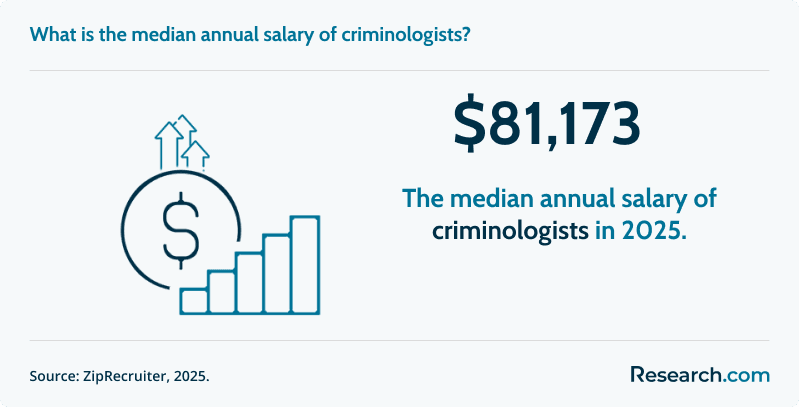
| Criminologist | Students who enjoy research, statistics, theory, and public policy | Universities, think tanks, government agencies, research organizations | $81,173 |
Police Detective/Criminal Investigator
Police detectives and criminal investigators examine reported crimes, identify suspects, gather evidence, interview witnesses, prepare case files, and work with prosecutors. A criminology background can help these professionals understand criminal behavior, victimization, community risk factors, and investigative patterns.
This route usually involves more than earning a degree. Many detectives begin in patrol or another law enforcement role before moving into investigations. If you are comparing public law enforcement with private investigative work, review the steps to becoming a private investigator to understand how the two paths differ in authority, licensing, and day-to-day responsibilities.
Average Salary: $75,325
Crime Scene Investigator
Crime scene investigators document scenes, collect physical evidence, preserve the chain of custody, photograph relevant details, and sometimes testify about how evidence was handled. This work is highly procedural. Small mistakes in collection or documentation can affect whether evidence is useful in court.
A criminology major can prepare students to understand the justice-system context of evidence, but CSI roles may also require training in forensic procedures, photography, biology, chemistry, or evidence management depending on the employer.
Average Salary: $59,636
Private Investigator
Private investigators conduct fact-finding assignments for clients such as attorneys, insurance companies, businesses, and individuals. Their work may involve background research, interviews, surveillance, locating people, fraud inquiries, or civil case support. Unlike police officers, private investigators generally work for private clients and do not have the same legal authority as sworn law enforcement.
This path may appeal to criminology graduates who want investigative work but prefer a private-sector environment. Licensing rules vary by state, so students should check local requirements before planning this career.
Average Salary: $55,726
Forensic Scientist
Forensic scientists analyze physical evidence using scientific methods. Depending on the specialty, they may examine DNA, toxicology samples, trace materials, firearms evidence, or other laboratory evidence. Their findings can support investigations and may be presented in court.
A criminology degree alone may not be enough for every forensic science role. For students asking “what education is needed to become a forensic scientist?”, a bachelor's degree in a natural science is typically the minimum requirement. This includes degrees in forensic science, chemistry, or biology.
Average Salary: $79,408
Probation/Parole Officer
Probation and parole officers supervise people serving sentences in the community or transitioning back after incarceration. Their work combines accountability with support. They monitor compliance, prepare reports, connect clients with services, and help reduce the risk of reoffending through employment, housing, counseling, and treatment referrals.
The parole officer education requirements typically include a bachelor's degree in a field such as criminal justice, social work, psychology, or sociology. Many jurisdictions may also require candidates to pass a civil service exam, undergo psychological and physical evaluations, and complete a state-sponsored training academy before they can officially begin their work.
Average Salary: $56,720
Clinical Social Worker
Clinical social workers support individuals and families affected by trauma, substance use, violence, mental health challenges, incarceration, or victimization. In justice-related settings, they may work with people returning from prison, crime victims, juveniles, or families involved with courts and community agencies.
This option is not usually a direct bachelor’s-only criminology job. Students who want clinical practice should expect additional social work education and licensure requirements. However, criminology can be a strong undergraduate foundation for understanding systems, risk, rehabilitation, and social conditions connected to crime.
Average Salary: $94,158
Jury Consultant
Jury consultants help legal teams understand how potential jurors may interpret evidence, arguments, witnesses, and case themes. The role draws from criminology, psychology, sociology, research methods, communication, and trial strategy.
This career is more specialized than many entry-level criminology jobs. It may require strong research experience, consulting skills, litigation support knowledge, or graduate-level preparation in a related social science field.
Average Salary: $86,430
Criminologist
Criminologists study crime, criminal behavior, justice systems, policing, prevention, incarceration, recidivism, and policy outcomes. They may analyze data, publish research, advise agencies, evaluate programs, or help design interventions.
Students who want to become criminologists should build strong research, writing, statistics, and policy analysis skills. Advanced education can be important for research-heavy roles, especially in universities, think tanks, and policy organizations.
Average Salary: $81,173
What Is the Starting Salary for a Criminology Graduate?
The starting salary for a criminology graduate in the United States typically ranges from about $45,000 to $60,000 per year. The exact criminology salary depends on the job title, employer, region, education level, prior experience, and whether the position is in the public, nonprofit, or private sector.
Entry-level criminologists and related jobs for criminology majors often begin around $45,000 annually, while early-career professionals may earn closer to $60,000. Graduates should treat these figures as broad planning estimates rather than guaranteed outcomes because hiring standards and compensation vary widely by agency, state, and specialization.
| Factor | How It Can Affect Starting Pay |
| Job title | Research, law enforcement, forensic, social service, and private-sector positions pay differently even when they accept the same major. |
| Location | Cost of living, state budgets, local demand, and agency funding can change salary offers. |
| Education level | Some roles are accessible with a bachelor’s degree, while others may favor graduate study or science-heavy coursework. |
| Experience | Internships, military service, public safety experience, research projects, and technical skills can strengthen entry-level applications. |
| Employer type | Government jobs may offer structured pay scales and benefits, while private employers may vary more by performance, contracts, and client demand. |
What Is the Job Outlook for Criminology Graduates?
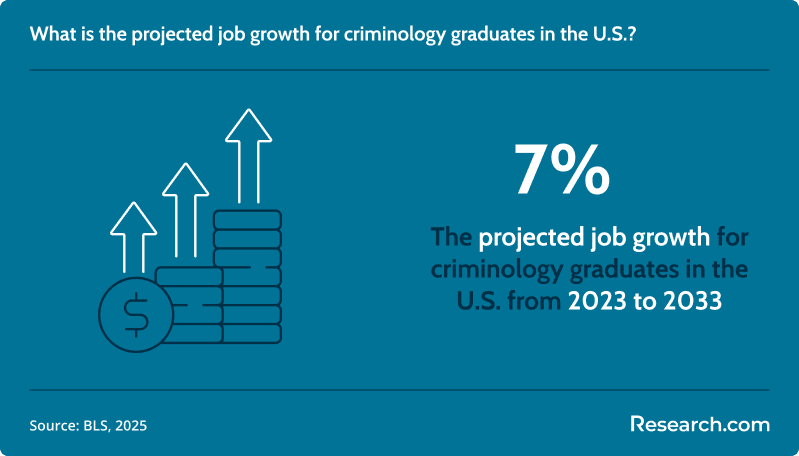
The job outlook for criminology graduates is generally favorable across several related fields, but it depends on the specific occupation. The U.S. Bureau of Labor Statistics anticipates a 7% growth for sociologists, which includes criminologists, until 2033—a rate quicker than for most occupations.
Criminology graduates may find opportunities in policing, corrections, forensic support, social services, crime analysis, victim advocacy, policy research, and compliance-related work. However, demand is not identical across all job titles. A student seeking a forensic laboratory job, for example, may face different requirements and competition than a student pursuing probation, law enforcement, or research.
Career Prospects and Educational Pathways
A bachelor’s degree can qualify graduates for many entry-level criminal justice, corrections, victim services, and investigative support roles. A master’s degree can be useful for students who want to move into policy analysis, research, leadership, teaching, or specialized consulting. Students interested in forensic science should pay close attention to science prerequisites because some employers prioritize laboratory training over a general criminology background.
To improve job prospects, students should combine coursework with internships, data analysis, writing samples, field experience, and professional references. Employers often want proof that applicants can handle sensitive information, communicate clearly, follow procedures, and make ethical decisions under pressure.
What Skills Do Employers Look for in a Criminology Major?
Employers do not hire criminology graduates only because they know criminal justice theory. They look for candidates who can analyze evidence, write accurately, work with diverse populations, use data responsibly, understand legal limits, and make sound decisions in stressful or sensitive situations. The strongest applicants can connect classroom learning to real problems in agencies, communities, courts, and research settings.
| Skill Area | Why It Matters | Where It Shows Up at Work |
| Analytical and critical thinking | Helps graduates evaluate evidence, identify patterns, question assumptions, and solve complex problems. | Crime analysis, investigations, policy research, case review, program evaluation |
| Research and data skills | Allows professionals to collect, interpret, and explain information instead of relying on guesswork. | Criminology research, agency reporting, public safety dashboards, policy briefs |
| Written and oral communication | Essential for reports, testimony, interviews, presentations, and interagency coordination. | Case files, court documents, client meetings, community briefings |
| Technology skills | Supports work with databases, digital records, statistical tools, mapping systems, and evidence-management platforms. | Crime mapping, digital forensics support, records analysis, investigative research |
| Interpersonal judgment | Helps professionals work with victims, clients, witnesses, officers, attorneys, and community partners. | Corrections, probation, victim services, law enforcement, social services |
| Ethical and legal awareness | Protects privacy, due process, confidentiality, and professional credibility. | Research, policing, evidence handling, case management, policy work |
Analytical and Critical Thinking
Criminology graduates must be able to break down complicated situations, compare explanations, recognize weak evidence, and develop reasoned conclusions. This is especially important in roles that involve crime trends, investigative leads, policy recommendations, or program evaluation.
Students who want stronger quantitative preparation may consider a fast-track graduate certificate in data analytics online. Data skills can help criminology graduates analyze crime patterns, evaluate interventions, and contribute to evidence-based decision-making.
Research and Data Skills
Research ability is valuable in both academic and applied criminology. Graduates may need to summarize literature, design surveys, interview participants, analyze administrative data, or evaluate whether a program is meeting its goals. Quantitative and qualitative methods both matter because crime and justice problems involve numbers, behavior, institutions, and lived experience.
Communication Skills
Clear communication is a core workplace skill for criminology majors. Reports must be accurate, concise, and understandable. Presentations may need to translate complex findings for supervisors, judges, attorneys, community members, or agency partners. Poor communication can lead to misunderstandings, weak cases, or flawed decisions.
Technical and Computer Skills
Criminology work increasingly involves digital tools, records systems, databases, spreadsheets, mapping software, and case-management platforms. Some roles also benefit from familiarity with statistical software, geographic information systems, or digital evidence concepts. Students should not assume that a criminology degree alone proves technical readiness; they should build a portfolio of projects when possible.
Interpersonal and Teamwork Skills
Many criminology-related jobs require daily collaboration with people under stress, including victims, witnesses, clients, officers, attorneys, social workers, and agency administrators. Employers value candidates who can listen carefully, stay professional, document accurately, and work within a chain of command or multidisciplinary team.
Observation and Attention to Detail
Small details can matter in investigations, field notes, case files, evidence logs, and research datasets. A missed inconsistency or incomplete record can affect decisions. Students preparing for investigative, forensic, or analytical roles should practice careful documentation and verification.
Legal and Ethical Understanding
Criminology professionals often handle sensitive information and work near the boundaries of privacy, liberty, public safety, and institutional power. Employers expect graduates to understand legal procedures, confidentiality, due process, consent, and the ethical risks of bias or misuse of data.
The chart below connects these workplace skills with salary patterns by industry, helping readers see where criminology training may be valued most.
Government vs. Private Sector Criminology Jobs: What Is Different?
The main differences between government and private-sector criminology jobs involve authority, mission, accountability, compensation structure, and daily work environment. Government roles usually focus on public safety, enforcement, corrections, courts, or policy. Private-sector roles often focus on protecting a company, client, asset, brand, or legal interest.
| Comparison Point | Government Jobs | Private Sector Jobs |
| Primary mission | Serve the public, enforce laws, support courts, manage corrections, or improve public policy. | Protect clients, organizations, assets, information, employees, or business interests. |
| Common roles | Police officer, detective, probation officer, parole officer, forensic expert, policy analyst, agency researcher. | Private investigator, security consultant, corporate crime analyst, fraud investigator, litigation support specialist. |
| Legal authority | May include law enforcement powers, access to government systems, and formal authority defined by statute or agency policy. | Usually more limited; authority depends on licensing, contracts, employer policies, and applicable law. |
| Accountability | Accountable to the public, courts, supervisors, statutes, regulations, and constitutional protections. | Accountable to employers, clients, contracts, industry standards, and civil or criminal law. |
| Work environment | Police departments, courts, prisons, probation offices, public agencies, research offices. | Corporations, law firms, consulting firms, insurance companies, security firms, private clients. |
| Pay and benefits | Often structured around salary schedules, public benefits, pension plans, and civil service systems. | May offer higher upside in some roles but can vary more by client base, performance, contracts, and business conditions. |
| Best for | Students who want public service, formal authority, structured procedures, and long-term agency careers. | Students who prefer client-focused work, business settings, investigative flexibility, or specialized consulting. |
Forensic-focused graduates should also consider geography. Location can affect compensation, hiring demand, and agency funding. Students comparing forensic roles may want to review what state pays the most for forensic technicians before deciding where to apply.
How Long Does It Take to Complete a Criminology Degree?
A typical bachelor's degree in criminology takes about three to four years to complete on a full-time basis. For example, the Bachelor of Criminology program at some universities requires completion of around 144 units (about 24 courses), which usually spans three years if studying full-time.
Other institutions may structure criminology as a four-year program, especially when the curriculum includes broader general education, research requirements, electives, internships, or practical training. Part-time students should expect a longer timeline, and students pursuing a double degree may need four to five years.
Postgraduate degrees, such as a master’s in criminology, typically take one to two years to complete. Some students also expand their options by applying to grad school for a different major, using criminology as preparation for law, psychology, public administration, social work, data analytics, or public policy.
| Path | Typical Timeframe | When It Makes Sense |
| Bachelor’s degree, full time | About three to four years | Best for students seeking entry-level criminal justice, corrections, law enforcement, advocacy, or research-support roles. |
| Bachelor’s degree, part time | Longer than full time | Best for working adults or students balancing school with family, military service, or employment. |
| Double degree | Four to five years | Useful for students combining criminology with psychology, law-related studies, public policy, or another field. |
| Master’s degree | One to two years | Useful for research, leadership, policy, academic, or specialized professional goals. |
What Is the Average Cost of a Criminology Degree?
The average cost of a bachelor's degree in criminology in the United States varies widely by institution, residency status, delivery format, and financial aid. For 2025, typical tuition costs for an online criminology bachelor's degree are approximately between $6,000 and $16,000 per year at many public universities.
On average, the total tuition and fees for a bachelor's in criminology were about $12,815 in 2020, according to National Center for Education Statistics data, with net prices after financial aid often closer to $6,144 annually.
The overall cost, including living expenses, books, and materials, can range from approximately $10,000 to $40,000 for tuition plus $17,000 to $20,000 for living expenses over the duration of the degree. Costs tend to be lower at in-state public universities and higher at private institutions.
Students who want to reduce the total cost may begin at cheap accredited online community colleges, complete transferable general education courses, and then finish the major at a four-year institution. Before choosing this route, confirm that credits will transfer into the criminology program and count toward degree requirements.
| Cost Factor | What to Check Before Enrolling |
| Tuition | Compare in-state, out-of-state, online, and private school rates. |
| Fees | Ask about technology fees, lab fees, online course fees, graduation fees, and background check costs. |
| Books and materials | Estimate recurring course costs, not just first-semester expenses. |
| Living expenses | Include housing, transportation, food, insurance, and lost work hours if studying full time. |
| Transfer credits | Confirm whether prior coursework, community college credits, military credits, or exams reduce the time to graduate. |
| Career services | Consider internship access, agency partnerships, resume support, alumni networks, and employer connections. |
The chart below shows common degree levels among criminologists, which can help students decide whether a bachelor’s degree is enough or whether graduate study may support their target role.
What Financial Aid Options Are Available for Criminology Majors?
Criminology students may use scholarships, grants, fellowships, federal work-study, student loans, employer tuition assistance, and school-based aid to reduce out-of-pocket costs. Aid may be based on financial need, academic performance, public service interest, community involvement, or a planned career in criminal justice.
Examples include scholarships like the Paul Janosky Criminal Justice Scholarship, Women in Federal Law Enforcement Scholarship, and others that award amounts from $500 to $25,000, depending on the program and level of study.
| Aid Type | How It Helps | What Students Should Watch For |
| Scholarships | May reduce tuition without repayment if eligibility requirements are met. | Deadlines, essays, recommendation letters, GPA rules, and major-specific criteria. |
| Grants and fellowships | Can support undergraduate or graduate study, often based on need, merit, research, or service goals. | Renewal requirements and whether funds apply to tuition only or broader expenses. |
| Federal work-study | Provides part-time employment that can help students pay educational costs. | Job availability, hourly limits, and whether the work supports career experience. |
| Student loans | Can cover remaining costs when scholarships and grants are not enough. | Interest, repayment terms, borrowing limits, and total debt at graduation. |
| Targeted awards | Some awards support children of law enforcement officers or students researching specific criminology topics. | Eligibility details may be narrow, so students should read requirements carefully. |
Students should complete the Free Application for Federal Student Aid (FAFSA) early, then search for criminology, criminal justice, public safety, law enforcement, forensic science, and public service scholarships. Strong applications usually require careful attention to deadlines, essays, transcripts, and recommendation letters.
Some students strengthen their academic profile by pairing criminology with a complementary field. For example, understanding the benefits of pursuing a dual degree in psychology can help students evaluate whether added study supports goals in victim services, forensic psychology, rehabilitation, or behavioral research.
Financial aid can make the degree more affordable, but students should still compare total cost against realistic career outcomes. Borrowing heavily for a program with limited career support can weaken the return on investment.
How to Choose the Best Criminology Major or Program
The best criminology program is the one that matches your career target, offers credible academic quality, provides practical experience, and fits your budget. A strong program should do more than list interesting courses. It should help you build job-ready skills, complete internships, understand ethical practice, and graduate with a clear employment or graduate-school plan.
Questions to Ask Before Choosing a Criminology Program
| Question | Why It Matters |
| Is the institution accredited? | Accreditation affects credit transfer, financial aid eligibility, graduate school options, and employer confidence. |
| Does the curriculum match my career goal? | Students interested in policing, forensic science, policy, corrections, or research need different course combinations. |
| Are internships required or strongly supported? | Field experience can help students build references, test career fit, and compete for entry-level jobs. |
| Who teaches the courses? | Faculty with experience in criminology, criminal justice, law, forensic science, statistics, or policy can shape learning quality. |
| What career support is available? | Resume help, agency partnerships, alumni networks, and job-placement support can affect the value of the degree. |
| Can I afford the full degree? | Students should compare tuition, fees, living costs, aid, transfer credits, and likely borrowing. |
| Will the program support graduate school or licensure goals? | Some career paths, such as clinical social work or forensic science, may require additional education beyond criminology. |
Key Factors to Consider
- Career direction: Decide whether you are most interested in law enforcement, corrections, forensic science, crime analysis, victim services, policy, research, or legal support.
- Curriculum: Review required and elective courses in criminal law, criminological theory, research methods, statistics, juvenile justice, cybercrime, policing, corrections, forensic psychology, or public policy.
- Practical experience: Prioritize programs with internships, capstones, research projects, agency partnerships, or supervised fieldwork.
- Faculty expertise: Look for instructors whose research or professional background aligns with your interests.
- Cost and aid: Compare net price, not just sticker tuition, and ask whether transfer credits can shorten the degree.
- Alumni and employer connections: Programs with active networks may help students discover jobs, internships, and graduate-school pathways.
What Are the Main Specializations Within Forensic Science Careers?
Forensic science is not one single job. It includes several specialties that use scientific or technical methods to support investigations and legal proceedings. Criminology majors interested in forensics should identify which specialty they want early because some areas require science-heavy coursework or additional professional training.
| Specialization | What Professionals Do | Best Fit For |
| Forensic Science (Laboratory Analysis) | Analyze physical evidence such as DNA, blood, fingerprints, and trace evidence. | Students with strong biology, chemistry, laboratory, and evidence-analysis interests. |
| Forensic Pathology | Examine deceased individuals to determine cause of death through autopsies and medical investigation. | Students interested in medical examiner, coroner, forensic pathologist, or autopsy technician pathways. |
| Forensic Anthropology | Study human skeletal remains to help identify victims and assess trauma or possible cause of death. | Students interested in anatomy, archaeology, human remains, and identification work. |
| Forensic Toxicology | Test bodily fluids for drugs, poisons, and other substances connected to death, impairment, or criminal cases. | Students with strong chemistry, pharmacology, and laboratory analysis interests. |
| Digital Forensics | Recover, preserve, and analyze information from digital devices connected to cybercrime or digital evidence. | Students interested in technology, cybersecurity, investigations, and electronic records. |
What Professional Certifications Can Strengthen a Criminology Career?
Professional certifications can help criminology graduates show specialized knowledge, especially in areas such as digital forensics, investigative methods, crime analysis, fraud examination, emergency management, or forensic psychology. Certifications are most useful when they match a specific career goal rather than being collected without a plan.
Students should first check the job postings for their target roles. Some employers value certifications; others care more about a degree, academy training, licensure, internships, or prior experience. For federal law enforcement pathways, reviewing DEA agent requirements can help students understand how formal qualifications, training, and eligibility standards may differ from general criminology jobs.
When Certification May Be Worth It
- When job postings repeatedly request or prefer a specific credential.
- When the credential teaches a technical skill not covered deeply in the degree program.
- When it supports a clear specialization, such as digital evidence, fraud, investigation, or analysis.
- When the issuing organization is respected by employers in the field.
- When the cost and renewal requirements are reasonable compared with the likely career benefit.
What Ethical Challenges Do Criminologists Face?
Criminology careers often involve sensitive data, vulnerable populations, law enforcement power, court processes, public safety decisions, and life-changing consequences for individuals and communities. Ethical judgment is therefore not optional. It is a core professional responsibility.
- Privacy and intrusion: Research and fieldwork may involve people who have experienced harm, committed crimes, or live under supervision. Professionals must respect privacy and avoid unnecessary intrusion.
- Confidentiality and legal duties: Criminologists may face tension between protecting confidential information and responding to legal obligations or safety concerns.
- Objectivity and advocacy: Researchers and practitioners may care deeply about reform or public safety, but they must still avoid distorting evidence to support a preferred conclusion.
- Use and misuse of findings: Data or research may be selectively interpreted in legal, political, or agency settings. Criminologists should communicate limitations clearly.
- Institutional pressure: Professionals working with agencies may need to balance cooperation with independence, especially when findings are inconvenient or politically sensitive.
- Bias and fairness: Criminology work can affect policing, sentencing, supervision, and services. Professionals should examine how bias may enter data, policies, algorithms, or decisions.
Common Mistakes Criminology Students Should Avoid
| Mistake | Why It Can Hurt You | Better Approach |
| Choosing a program without checking accreditation | It can create problems with financial aid, transfer credits, graduate admission, or employer recognition. | Confirm institutional accreditation before applying. |
| Assuming every criminology job is law enforcement | You may overlook research, policy, victim services, corrections, compliance, forensic, and private-sector options. | Map the major to several career paths before choosing electives or internships. |
| Ignoring science requirements for forensic jobs | Some forensic roles may require laboratory science coursework beyond a general criminology curriculum. | Review job postings early and choose science courses if forensics is your target. |
| Focusing only on tuition | Fees, living costs, commuting, books, lost wages, and delayed graduation can raise the real cost. | Compare total cost of attendance and net price after aid. |
| Graduating without field experience | Employers may prefer candidates who have completed internships, research projects, or agency work. | Seek internships, volunteer roles, capstones, or part-time work related to your goal. |
| Assuming salary outcomes are guaranteed | Pay depends on location, employer, role, education, and experience. | Use salary data as a planning tool and compare local job postings. |
| Relying only on rankings | A highly ranked program may not be the best fit for your budget, schedule, specialization, or location. | Evaluate curriculum, cost, internships, faculty, and career support together. |
What Graduates Say About Criminology Careers
- James: "A criminology degree gave me more options than I expected. I was drawn to investigations, and the best part of my work is knowing that careful casework can make a real difference for community safety."
- Lydia: "The field is broader than people think. I chose corrections because I wanted to be part of rehabilitation, reentry, and long-term change, not just punishment."
- Eve: "My criminology background helped me enter the legal system as a case analyst. The work is intellectually demanding, and I like knowing that accurate analysis can support fairer decisions."
Key Insights
- Criminology majors can pursue careers in law enforcement, corrections, forensic support, research, social services, courts, private investigation, and corporate security.
- The strongest career path depends on your target role. Forensic science may require natural science preparation, clinical work may require graduate education and licensure, and law enforcement may require academy training.
- The starting salary for a criminology graduate in the United States typically ranges from about $45,000 to $60,000 per year, but pay varies by job title, location, employer, and experience.
- The U.S. Bureau of Labor Statistics anticipates a 7% growth for sociologists, which includes criminologists, until 2033, but job outlook differs across specific criminology-related occupations.
- Employers value analytical thinking, research ability, communication, technology skills, ethical judgment, attention to detail, and the ability to work with diverse populations.
- Government jobs usually offer public-service missions, formal authority, and structured accountability, while private-sector jobs may offer more client-focused work and different compensation patterns.
- Students should compare criminology programs by accreditation, curriculum, internships, faculty expertise, cost, transfer policies, and career support—not by tuition or rankings alone.
- Before enrolling, ask whether the program supports your intended career path, especially if you are considering forensic science, clinical social work, federal law enforcement, graduate school, or research roles.
References:
- Clinical Social Worker salary. (2025). ZipRecruiter. Retrieved August 29, 2025, from https://www.ziprecruiter.com/Salaries/Clinical-Social-Worker-Salary
- Crime scene investigator Salary. (2025). ZipRecruiter. Retrieved August 29, 2025, from https://www.ziprecruiter.com/Salaries/Crime-Scene-Investigator-Salary
- Criminology salary. (2025). ZipRecruiter. Retrieved August 29, 2025, from https://www.ziprecruiter.com/Salaries/Criminology-Salary
- Detective and criminal investigator salary. (2025). ZipRecruiter. Retrieved August 29, 2025, from https://www.ziprecruiter.com/Salaries/Detective-And-Criminal-Investigator-Salary
- How to become a criminologist: What it is and career path - Zippia. (2025, January 8). https://www.zippia.com/criminologist-jobs
- Jury Consultant salary. (2025). Retrieved August 29, 2025, from https://www.ziprecruiter.com/Salaries/Jury-Consultant-Salary#Yearly
- National Forensic Scientist salary. (2025). ZipRecruiter. Retrieved August 29, 2025, from https://www.ziprecruiter.com/Salaries/National-Forensic-Scientist-Salary
- Occupational Employment and wage statistics. (2025). U.S. Bureau of Labor Statistics. Retrieved August 29, 2025, from https://www.bls.gov/oes/2023/may/oes251111.htm
- Private investigator salary. (2025). ZipRecruiter. Retrieved August 29, 2025, from https://www.ziprecruiter.com/Salaries/Private-Investigator-Salary#Yearly
- Probation and Parole officer salary. (2025). ZipRecruiter. Retrieved August 29, 2025, from https://www.ziprecruiter.com/Salaries/Probation-And-Parole-Officer-Salary
- Sociologists. (2025, August 28). U.S. Bureau of Labor Statistics. Retrieved August 29, 2025, from https://www.bls.gov/ooh/life-physical-and-social-science/sociologists.htm
- What can you do with a criminology degree in criminology? - Zippia. (2023, November 17). https://www.zippia.com/criminology-major
Other Things You Should Know About Jobs for Criminology Majors
Certifications such as Certified Criminal Justice Professional (CCJP) and Crime Scene Investigator (CSI) can enhance a criminology major's career prospects in 2027, offering specialized skills that appeal to employers. Pursuing these can improve job opportunities and potential salaries significantly.
Many criminology-related government jobs require a security clearance background investigation under National Security Adjudicative Guidelines. Applicants are often screened for criminal history, financial responsibility, drug use, and foreign contacts. Some positions also require fingerprinting and repeated reinvestigations every 5 to 10 years.





