2027 How to Become a K9 Officer?

Co-Founder and Chief Data Scientist
Becoming a K9 officer is not an entry-level police job. It is a competitive specialty within law enforcement that requires patrol experience, strong judgment, physical conditioning, and the ability to work daily with a highly trained dog in stressful, unpredictable situations. Agencies use K9 teams for patrol support, suspect tracking, narcotics detection, explosives detection, search-and-rescue, and public safety operations.
This guide explains how to become a K9 officer, what training and certifications are typically required, how education can help, where K9 officers work, what they earn, and how to decide whether this career path fits your goals. It is designed for aspiring police officers, current patrol officers planning their next move, military personnel, and career changers researching specialized law enforcement roles.
Quick answer: How do you become a K9 officer?
To become a K9 officer, you usually must first qualify as a police officer, complete a police academy, earn state law enforcement certification, work as a patrol officer for one to three years, apply for a K9 unit opening, and complete specialized handler training with an assigned police dog. Most agencies choose the dog and match it with the handler based on temperament, mission needs, and team compatibility.
Key things you should know before pursuing K9 work
- Most departments do not allow new police recruits to move directly into a K9 unit; patrol experience is normally required first.
- K9 handler training is intensive and may take several months, depending on the dog’s role and the agency’s standards.
- Handlers typically do not select their own dogs. The department, trainer, or vendor evaluates and assigns dogs based on suitability for police work.
- The job extends beyond calls for service. Handlers are responsible for daily care, training, documentation, legal compliance, and the dog’s welfare.
- Approximately 50,000 K9 officers are actively serving in the U.S., and K9 teams remain important in areas such as explosives detection, narcotics enforcement, tracking, and public safety response.
- What does a K9 officer do?
- Do you need a degree to become a K9 officer?
- What are the licensing requirements to become a K9 officer in 2027?
- What experience is required to become a K9 officer?
- Where can you work as a K9 officer?
- How do you apply to become a K9 officer in the police force?
- What skills do you need to be a successful K9 officer?
- How much do K9 officers make per year?
- What is the future job outlook for K9 officers?
- Should K9 officers consider additional legal education?
- How can K9 officers strengthen legal and analytical skills?
- What ethical responsibilities do K9 handlers have?
- What career advancement opportunities are available to K9 officers?
- How can K9 officers build legal knowledge through online learning?
- How do education and training costs affect a K9 officer career?
- How can K9 officers protect long-term physical and mental well-being?
- Can K9 officers move into federal agency roles?
What does a K9 officer do?
A K9 officer is a sworn law enforcement officer who works with a trained police dog. The officer directs the dog during searches, patrols, tracking assignments, detection operations, apprehensions, and community demonstrations. The dog is not a replacement for police judgment; the handler remains responsible for when the dog is deployed, how the dog is controlled, and how the incident is documented.
According to the National Police Dog Foundation, police dogs generally fall into two broad categories:
| Type of police K9 | Primary function | Common uses |
| Patrol dogs | Support general police operations and officer safety. | Suspect apprehension, building searches, area searches, handler protection, and controlled-area security. |
| Detection dogs | Use scent training to locate a specific category of material. | Narcotics detection or explosives detection. Detection dogs are normally trained for one specialty rather than both. |
Daily work varies by agency, shift, and assignment. A local police K9 team may spend much of its time assisting patrol officers, while a transportation or federal team may focus more heavily on explosives detection in high-traffic locations. Search-and-rescue teams may respond to missing-person cases, disaster scenes, or difficult terrain.
Common K9 officer duties
- Patrol support: Responding to calls, backing up patrol officers, and helping secure high-risk scenes.
- Suspect tracking and apprehension: Using the dog’s scenting ability and training to locate or detain fleeing suspects when legally justified.
- Search-and-rescue assistance: Helping locate missing people, fugitives, or disaster victims in environments where human searchers may be limited.
- Narcotics or explosives detection: Searching vehicles, buildings, luggage, public spaces, and facilities for trained target odors.
- Building and area searches: Clearing spaces more efficiently while reducing some risks to officers entering unknown areas.
- Training and care: Feeding, exercising, grooming, transporting, and maintaining the dog’s readiness outside normal calls for service.
- Documentation: Recording training logs, deployments, alerts, search outcomes, bite incidents, and use-of-force details.
- Community outreach: Participating in demonstrations and public education events while keeping the dog controlled and the public safe.
As of 2022, approximately 5,600 K9s served across various federal government agencies, according to the Government Accountability Office. The chart below shows how federal working dogs were distributed across departments and agencies.
Do you need a degree to become a K9 officer?
A college degree is not always required to become a K9 officer, but education can strengthen your application, help you compete for promotion, and improve your understanding of law, evidence, policy, and animal behavior. The minimum hiring requirement for many police departments is a high school diploma or GED, followed by police academy completion and state certification.
That said, candidates with college coursework, an associate degree, or a bachelor’s degree may be more competitive in agencies that value formal education. If you need a flexible starting point, online associate degree options can help you build academic credentials while preparing for law enforcement hiring requirements.
| Education path | How it helps a future K9 officer | Best fit |
| High school diploma or GED | Meets the basic education requirement for many police officer positions. | Candidates ready to enter academy-based training as soon as they qualify. |
| Associate degree in criminal justice or law enforcement | Introduces criminal law, policing, corrections, ethics, and investigation basics. | Applicants who want a faster, lower-cost college credential before or during police employment. |
| Bachelor’s degree in criminal justice | Provides deeper study of legal systems, policy, criminology, research, and leadership. | Officers aiming for advancement, federal roles, or supervisory work later in their careers. |
| Forensic science coursework | Builds knowledge of evidence collection, crime scene procedures, and investigative methods. | Officers interested in investigations, detection work, or specialty assignments. |
| Animal behavior or veterinary-related study | Improves understanding of canine health, behavior, conditioning, and welfare. | Future handlers who want stronger preparation for daily work with police dogs. |
Who should consider a degree?
- Applicants in competitive departments where many candidates already have college credits.
- Officers who want to promote into detective, supervisory, training, or federal roles.
- Military personnel planning to transition into civilian law enforcement.
- Working adults who need flexible education while maintaining full-time employment.
Who may not need a degree right away?
- Candidates applying to agencies that prioritize academy performance, physical fitness, and patrol readiness over college credentials.
- Officers who already meet all hiring requirements and can gain experience before returning to school.
- Applicants who would need to take on significant debt for a degree that is not required by their target agency.
What are the licensing requirements to become a K9 officer in 2027?
K9 officers must first meet the same legal and certification requirements as other sworn officers. After that, they complete specialized K9 handler training and may need to pass recurring evaluations with their assigned dog. Requirements differ by state, department, and agency, so candidates should always verify standards with the law enforcement agency where they plan to apply.
1. Complete an approved police academy
Before becoming eligible for K9 work, you must become a sworn officer. Police academy programs approved by state or local authorities typically last between 12 to 24 weeks and combine classroom learning with practical training. Common academy topics include:
- Criminal law and procedure: Constitutional standards, arrests, warrants, criminal statutes, and due process.
- Firearms training: Safe handling, marksmanship, maintenance, and scenario-based use.
- Defensive tactics and fitness: Control techniques, officer survival, arrest tactics, and physical conditioning.
- Emergency response and communication: Radio procedures, de-escalation, report writing, crisis response, and field decision-making.
2. Earn state law enforcement certification
Most officers must be certified through their state’s Peace Officer Standards and Training board or an equivalent authority. This certification confirms that the officer has met the jurisdiction’s minimum training and competency requirements for sworn law enforcement work.
- Federal roles may require training through agencies such as the Federal Law Enforcement Training Center.
- Continuing education or recertification may be required as laws, procedures, and agency policies change. Some professional development can be completed through flexible formats similar to self-paced online college courses.
3. Maintain firearms and defensive tactics qualifications
K9 officers often work in volatile situations, including searches for armed suspects, high-risk vehicle stops, and building clearances. Agencies generally require ongoing firearms and defensive tactics qualifications, such as:
- Annual firearms qualification: Marksmanship testing and practical scenarios.
- Tactical response training: Safe movement, cover, communication, and force options.
- Use-of-force knowledge: Understanding when force is lawful, necessary, proportional, and consistent with policy.
4. Complete K9 handler certification or agency-approved training
Once selected for a K9 unit, the officer must learn how to direct, control, reward, correct, and deploy the dog safely. Handler training typically covers:
- Canine behavior: Reading body language, drives, stress signals, and environmental responses.
- Obedience and control: Voice commands, leash handling, recall, reward systems, and operational discipline.
- Search and detection work: Tracking, article searches, narcotics detection, explosives detection, or missing-person search techniques.
- Deployment documentation: Recording training, alerts, search conditions, and results for legal and administrative review.
Many departments use certified K9 training facilities or standards associated with organizations such as the National Police Canine Association and the North American Police Work Dog Association.
5. Pass recurring team evaluations
K9 certification is not a one-time event. The handler and dog may need regular evaluations to verify that the team remains operationally ready. These reviews can assess obedience, detection accuracy, tracking, apprehension control, handler safety, and documentation quality. For sensitive assignments such as explosives detection, federal guidelines and agency standards may add additional requirements.
| Requirement | Why it matters | What to verify with the agency |
| Police academy completion | Establishes baseline law enforcement authority and training. | Approved academy, training length, and graduation standards. |
| State officer certification | Confirms eligibility to work as a sworn officer. | POST or equivalent requirements and renewal rules. |
| Patrol experience | Builds field judgment before K9 specialization. | Minimum years, performance expectations, and disciplinary standards. |
| K9 handler training | Prepares the officer to control and deploy the dog safely. | Training provider, specialization, testing, and recertification schedule. |
| Ongoing documentation | Supports legal defensibility and operational accountability. | Training log, deployment report, alert documentation, and use-of-force reporting rules. |
As of 2022, 26 federal programs used government-managed working dogs for critical missions. The chart below summarizes those programs.
What experience is required to become a K9 officer?
Most agencies expect K9 candidates to prove themselves first as reliable patrol officers. A strong patrol record matters because K9 work requires independent decision-making, restraint, communication, and the ability to assess legal risk quickly.
- One to three years of law enforcement experience: Many departments require this range before an officer may compete for a K9 unit opening.
- Strong patrol performance: Supervisors typically look for sound judgment, clean documentation, safe tactics, and professional conduct.
- Physical readiness: Handlers must run, search, climb, control a strong dog, and respond to fast-changing incidents.
- Discipline and dependability: A history of policy violations, poor reports, or weak courtroom credibility can damage a K9 application.
- Interest in training and animal care: K9 work includes routine dog care and repeated training, not only exciting deployments.
Some officers improve their chances by volunteering to assist K9 teams, attending approved workshops, studying case law, or gaining experience in patrol, investigations, traffic enforcement, or tactical support. If you are comparing public-service careers outside law enforcement, a guide explaining patient care coordinator responsibilities shows how healthcare roles use a very different credentialing and service model.
Where can you work as a K9 officer?
K9 officers work wherever trained dogs can improve safety, detection, tracking, or response capability. The right workplace depends on whether you want local policing, federal security, military service, search-and-rescue operations, or private-sector protective work.
| Work setting | Typical K9 missions | Who this path fits |
| Local and state police departments | Patrol support, tracking, apprehension, narcotics detection, building searches, crowd support, and public demonstrations. | Officers who want community-based law enforcement and a broad range of calls. |
| Federal agencies such as the FBI, TSA, and Border Patrol | Explosives detection, border security, facility protection, counterterrorism support, and contraband detection. | Experienced officers or applicants interested in federal standards, mobility, and specialized missions. |
| Private security firms | Event security, executive protection support, facility screening, explosives detection, and threat deterrence. | Handlers moving from public law enforcement or military K9 roles into contracted security work. |
| Search-and-rescue organizations | Missing-person searches, wilderness searches, disaster response, and human scent tracking. | People drawn to rescue missions, outdoor work, and specialized volunteer or public safety teams. |
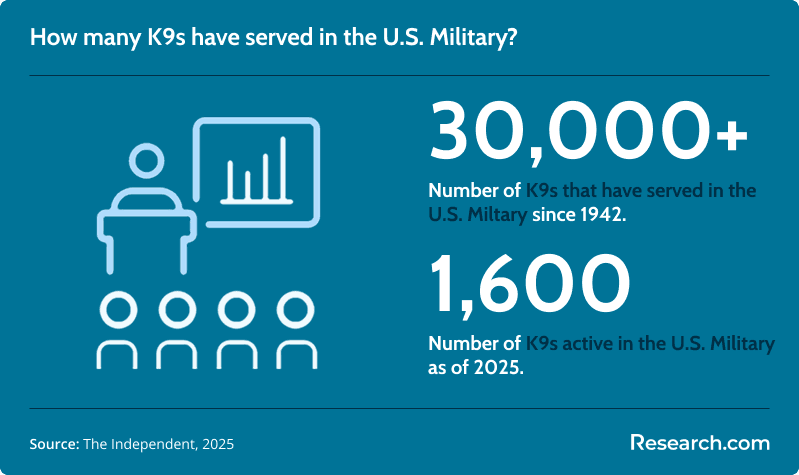
| Military police units | Base security, explosives detection, patrol support, and combat-related missions. The U.S. Military began using K9s in 1942. | Service members interested in military law enforcement and working-dog operations. |
Career exploration should also include work conditions, schedules, and physical demands. For example, healthcare roles such as post-anesthesia care have different risks, credentials, and compensation models; reviewing PACU nurse salary information can help readers compare law enforcement with non-law-enforcement public service careers.
How do you apply to become a K9 officer in the police force?
The path to a K9 unit is usually internal and competitive. Departments want handlers who have already shown they can make sound decisions under pressure, write strong reports, testify credibly, follow policy, and work well with other officers.
Step 1: Meet police officer hiring requirements
Start by qualifying for a sworn officer position. Typical screening includes:
- Background investigation: Review of criminal history, employment history, references, credit-related issues, and overall suitability.
- Police academy completion: Training in criminal law, firearms, defensive tactics, patrol procedures, emergency response, and report writing.
- Physical fitness testing: Assessment of strength, endurance, agility, and job-related fitness.
- Psychological evaluation: Screening for emotional stability, stress tolerance, judgment, and suitability for police work.
Step 2: Build a strong patrol record
Most departments require up to three years of patrol experience before an officer can apply to a K9 unit. During that period, focus on:
- Writing clear, accurate, and legally sound reports.
- Handling high-risk calls without unnecessary escalation.
- Developing courtroom credibility.
- Maintaining physical fitness and policy compliance.
- Learning from experienced K9 handlers when possible.
Step 3: Apply when a K9 unit opening is posted
When a position opens, the process may include a written exam, interview board, supervisor review, performance evaluation, and assessment of your work history. Some agencies also evaluate home suitability because the dog may live with the handler.
Step 4: Complete handler training with the assigned dog
After selection, you train with the dog chosen by the department or trainer. Training may include:
- Obedience and control: Commands, recall, reward timing, leash work, and off-leash discipline.
- Scent detection: Narcotics, explosives, human scent, or other trained odor work depending on the assignment.
- Apprehension work: Proper deployment, control, bite release, and handler safety.
- Tactical deployment: Searching buildings, vehicles, open areas, and high-risk scenes while coordinating with officers.
Step 5: Pass final team evaluations
The agency must be confident that the handler and dog can operate as a safe, controlled, legally defensible team. Final evaluations may examine the handler-dog bond, obedience under stress, search reliability, deployment judgment, and operational readiness.
| Application stage | What can strengthen your candidacy | Common mistake to avoid |
| Police hiring | Clean background, fitness preparation, strong academy performance. | Assuming love of dogs is enough for a policing role. |
| Patrol years | Sound judgment, strong reports, good supervisor reviews. | Ignoring documentation because K9 deployments are legally scrutinized. |
| K9 application | Clear motivation, realistic understanding of workload, willingness to train daily. | Applying without understanding the off-duty care responsibilities. |
| Handler training | Consistency, patience, coachability, and physical conditioning. | Trying to rush the bond or overcorrect the dog. |
| Operational evaluation | Safe deployment decisions and reliable command control. | Focusing only on dog performance instead of team performance. |
Other high-pressure careers also require structured preparation and strict qualifications. If you are comparing career paths, reviewing a nurse case manager career path or the qualifications for critical care nurses can help you see how requirements differ across public safety and healthcare fields.
What skills do you need to be a successful K9 officer?
Successful K9 officers combine police experience, animal handling ability, legal awareness, and emotional control. The best handlers are not simply physically strong; they are consistent, patient, observant, and disciplined enough to train every day.
| Skill | Why it matters in K9 work | How to build it |
| Physical fitness | Handlers may run, climb, search large areas, and control powerful dogs during fast-moving incidents. | Maintain department fitness standards and train for endurance, mobility, and grip strength. |
| Communication | K9 teams must coordinate with patrol officers, supervisors, dispatch, prosecutors, and the public. | Practice concise radio communication, report writing, and courtroom explanation. |
| Patience and consistency | Dogs learn through repetition, reinforcement, and clear expectations. | Train regularly, follow trainer guidance, and avoid emotional corrections. |
| Tactical awareness | Handlers decide when deployment is safe, lawful, and useful. | Study policy, scenario training, building search tactics, and use-of-force decision-making. |
| Observation | Handlers must read the dog’s body language and recognize changes in odor behavior, stress, or focus. | Review training videos, work with experienced handlers, and keep detailed training notes. |
| Analytical thinking | K9 deployments often affect investigations, evidence, and court proceedings. | Study criminal procedure, evidence rules, and investigative writing. |
Officers who want to strengthen academic preparation can review an online schools list to compare programs in criminal justice, law enforcement, public safety, and related subjects.
How much do K9 officers make per year?
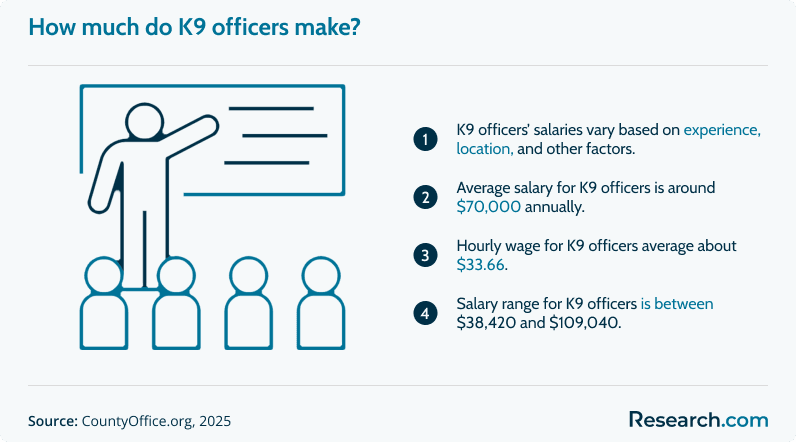
K9 officer pay depends on the employer, region, union agreement, overtime rules, years of service, specialty assignment, and whether the officer receives additional compensation for dog care or K9 duties. The U.S. Bureau of Labor Statistics reported that the median annual salary for police officers and detectives was $74,910 as of 2023.
K9 officers may earn more than general patrol officers in some agencies because of specialized duties, overtime, call-outs, training obligations, and risk exposure. However, higher pay is not guaranteed. Always review the specific department’s pay scale, collective bargaining agreement, overtime policy, and specialty pay rules.
For example, K9 officers in the PFPA Canine Division can earn between $67,808 and $116,639 per year, with an additional 6% pay supplement after successful completion of required training.
Military K9 handlers may be paid through a different structure that can include base pay, housing allowances, and special duty pay depending on rank and years of service. Service members planning to combine education with military commitments may want to compare military friendly online colleges.
| Pay factor | Why it changes earnings | Question to ask before applying |
| Location | Cost of living and local budgets affect police pay scales. | What is the salary range for sworn officers and K9 handlers in this jurisdiction? |
| Experience | Pay often rises with years of service, rank, and step increases. | How long does it take to move through the pay scale? |
| Specialty pay | Some agencies offer additional compensation for K9 duties. | Is there K9 incentive pay, care pay, or a training stipend? |
| Overtime and call-outs | K9 teams may respond outside normal shifts. | How are after-hours deployments and dog care time compensated? |
| Federal or military employment | Compensation may follow federal pay grades or military pay systems. | Which allowances, supplements, or special duty pays apply? |
Below is the average compensation of K9 officers according to CountyOffice.org:
What is the future job outlook for K9 officers?
K9 officer opportunities are tied to broader police hiring, agency budgets, public safety priorities, and specialized security needs. K9 teams remain useful because dogs can detect odors, track scent, search spaces, and support officers in ways technology alone does not fully replace. At the same time, agencies face increasing expectations for transparency, documentation, humane training, and legally defensible deployments.
Future demand is likely to be strongest for handlers who combine field experience with strong reporting, constitutional knowledge, de-escalation skills, and specialized detection training. Officers who build these competencies may also position themselves for advancement into supervisory, training, investigative, or other higher-paying criminal justice career paths.
Trends affecting K9 units
- More scrutiny of use-of-force decisions: K9 deployments must be documented clearly and justified under law and policy.
- Continued need for explosives detection: Transportation hubs, public events, and federal facilities continue to rely on trained detection teams.
- Technology integration: Cameras, GPS tools, drones, and data systems can support K9 work but do not remove the need for skilled handlers.
- Emphasis on dog welfare: Agencies are paying closer attention to heat injury, veterinary care, workload, retirement, and handler accountability.
- Competition for specialty assignments: K9 openings are limited, so strong patrol performance and training records matter.
Should K9 officers consider additional legal education?
Legal knowledge is especially important for K9 officers because searches, detentions, dog sniffs, bite deployments, and evidence handling can be challenged in court. A handler who understands constitutional limits, probable cause, reasonable suspicion, use-of-force standards, and documentation requirements can reduce legal risk and improve the quality of investigations.
Additional legal education is not mandatory for every handler, but it can be valuable for officers who write reports frequently, testify in court, help revise department policy, train other handlers, or plan to move into supervision. Flexible online legal studies programs may be useful for officers who want structured legal training without leaving full-time law enforcement work.
How can K9 officers strengthen legal and analytical skills?
K9 handlers need more than practical dog-handling ability. They must also explain why a deployment occurred, what the dog did, what the handler observed, and how the search or use of force complied with policy. Analytical skills help handlers connect field observations with legal standards and investigative documentation.
| Skill area | Why it matters | Training option |
| Legal research | Helps officers understand case law and policy changes affecting K9 searches and deployments. | Department training, legal updates, or formal coursework. |
| Evidence documentation | Supports reliable reports and courtroom testimony. | Report-writing workshops and evidence courses. |
| Policy analysis | Helps handlers follow evolving standards on searches, bites, alerts, and dog welfare. | Supervisor mentoring or legal studies coursework. |
| Administrative procedure | Improves compliance with training logs, certification records, and deployment reports. | Internal audits and structured legal training. |
Programs such as ABA approved online paralegal programs can help officers build skills in legal analysis, documentation, and procedural compliance, although they do not replace police certification or agency-specific K9 training.
What ethical responsibilities do K9 handlers have?
K9 handlers carry ethical responsibilities toward the public, their department, the courts, and their canine partners. Because a police dog can locate evidence, influence a search, or apply force, handlers must use K9 authority carefully and transparently. Even an accessible criminal justice program, such as one discussed in guides to the easiest bachelor degree options, should still include serious attention to ethics, law, and professional conduct.
1. Humane treatment of police dogs
The dog is a working partner, not a tool to be used without regard for health or safety. Ethical care includes:
- Safe housing and rest: Clean living conditions, recovery time, and protection from unsafe temperatures.
- Routine veterinary care: Preventive care, vaccinations, injury treatment, and monitoring for illness.
- Workload management: Avoiding unnecessary fatigue and recognizing when the dog is stressed, injured, or overheated.
2. Appropriate training methods
Effective police dog training depends on consistency and clear reinforcement. Ethical handlers avoid abusive methods that can cause fear, injury, or unreliable behavior.
- Reward-based reinforcement: Using praise, toys, or other rewards to encourage correct behavior.
- Avoiding unnecessary physical punishment: Preventing harsh corrections that damage trust or increase aggression.
- Ongoing maintenance training: Keeping skills sharp through regular, documented practice.
3. Controlled and lawful use of force
Handlers must deploy dogs only when the situation, law, and policy justify it. Ethical deployment requires:
- Proportional decision-making: Matching the deployment to the threat and circumstances.
- Command control: Maintaining the ability to direct and recall the dog.
- De-escalation when possible: Using communication and tactical patience before force when circumstances allow.
4. Compliance with search and seizure law
K9 searches must follow constitutional standards and agency policy. Handlers should avoid shortcuts that can weaken a case or violate rights.
- Proper authorization: Understanding warrant requirements and recognized exceptions.
- Objective handling: Avoiding cues or behavior that could influence a false alert.
- Accurate reporting: Recording alerts, search conditions, outcomes, and training history honestly.
5. Responsible public interaction
K9 teams often appear at schools, demonstrations, and community events. Handlers must educate the public while keeping the dog and spectators safe.
- Public education: Explaining the K9 unit’s role without exaggerating capabilities.
- Professional conduct: Modeling restraint, respect, and transparency.
- Safety control: Preventing unsupervised contact and managing crowds appropriately.
6. Ethical retirement planning
When a police dog retires, the handler and agency should plan for continued care, medical needs, and humane end-of-service decisions.
- Handler or family adoption: Many retired K9s live with their handlers after service.
- Veterinary support: Agencies may help with medical care depending on policy and funding.
- Compassionate decisions: End-of-life choices should prioritize the dog’s quality of life.
What career advancement opportunities are available to K9 officers?
K9 experience can support advancement inside and outside a police department. Handlers develop specialized knowledge in training, scent work, tactical deployment, courtroom testimony, and policy compliance. Those skills can lead to supervisory roles, training assignments, federal opportunities, or related security careers.
| Advancement path | What the role may involve | Best preparation |
| K9 trainer | Training new dogs, coaching handlers, maintaining certification standards, and troubleshooting performance issues. | Strong deployment history, instructor training, and excellent documentation. |
| K9 supervisor | Managing unit operations, policy compliance, training schedules, equipment, and performance reviews. | Leadership experience, policy knowledge, and supervisory eligibility. |
| Federal agency role | Working in detection, border security, facility protection, or specialized enforcement. | Clean record, strong experience, mobility, and federal hiring readiness. |
| Detective or investigator | Using field experience to support investigations, evidence development, and case preparation. | Investigative training, legal knowledge, and report-writing strength. |
| Private security or consulting | Supporting event security, facility screening, training, or protective operations. | Specialized K9 experience, certifications, and professional network. |
Further education can also support long-term advancement. Officers interested in behavioral analysis, investigations, or court-related work may consider accredited online forensic psychology master’s programs after completing a bachelor’s degree.
The chart below shows the distribution of police and detectives, including those assigned to K9 units:
How can K9 officers build legal knowledge through online learning?
Online learning can be useful for officers who need to study around rotating shifts, court appearances, training days, and call-outs. The best options are not generic courses; they should directly support law enforcement tasks such as report writing, evidence handling, constitutional law, administrative procedure, and legal research.
A paralegal certificate online program can help some officers strengthen legal vocabulary, documentation habits, and research skills. However, it should be viewed as supplemental education. It does not replace police academy training, POST certification, K9 handler certification, or department policy training.
Questions to ask before enrolling in an online legal program
- Is the program from an accredited institution?
- Does the curriculum cover legal research, writing, evidence, and procedure?
- Will the schedule work with shift work, overtime, and court appearances?
- Can credits transfer into a future degree if you continue your education?
- Will the credential help with promotion, investigations, supervision, or federal applications?
How do education and training costs affect a K9 officer career?
Cost matters because the K9 path may require academy preparation, college coursework, certifications, equipment, travel, and ongoing training. Some expenses are covered by the department after you are hired, while others may fall on the applicant or officer, especially when pursuing college credentials independently.
Before enrolling in a degree program, compare tuition, fees, transfer credit policies, financial aid, schedule flexibility, and likely career value. If criminal justice is your preferred field, reviewing affordable online criminal justice degree options can help you estimate education costs before committing.
| Cost category | Who may pay | What to check |
| Police academy | Agency, recruit, or sponsoring organization depending on the hiring model. | Whether you are paid while attending and whether tuition is reimbursed. |
| College coursework | Usually the student, though tuition assistance may be available. | Accreditation, transfer credits, employer tuition benefits, and total program cost. |
| K9 handler training | Often the department after selection. | Training length, travel costs, certification fees, and recertification rules. |
| Equipment and dog care | Usually agency-funded, but policies vary. | Vehicle setup, kennel requirements, veterinary care, food, and off-duty care compensation. |
| Continuing education | Agency, officer, grant, or professional association. | Whether training counts toward recertification or promotion requirements. |
How can K9 officers protect long-term physical and mental well-being?
K9 work can be physically demanding and emotionally intense. Handlers may face violent calls, long searches, traumatic scenes, irregular sleep, heat exposure, and the stress of being responsible for a living partner. Long-term success requires proactive fitness, recovery, mental health support, and realistic workload management.
- Maintain job-specific fitness: Train for endurance, mobility, strength, and injury prevention rather than only academy-style testing.
- Monitor stress and sleep: Rotating shifts, call-outs, and dog care can increase fatigue and burnout risk.
- Use peer and professional support: K9 teams benefit from supervisors, trainers, mental health resources, and peer networks that understand the work.
- Protect the dog’s health: Heat safety, hydration, veterinary care, and rest periods are part of operational readiness.
- Keep learning: Legal and analytical training can reduce uncertainty in high-pressure decisions. Some officers explore options such as a fast track paralegal course to strengthen legal understanding.
Can K9 officers move into federal agency roles?
Yes. Experienced K9 officers may be competitive for federal roles when their background aligns with the agency’s mission, hiring standards, and training requirements. Federal employers may value experience in detection, tactical decision-making, documentation, court testimony, and interagency operations. However, federal hiring is not automatic; candidates must meet age, fitness, background, citizenship, training, and position-specific requirements.
Officers considering federal enforcement work should compare their current qualifications with target agency standards. For example, reviewing DEA agent requirements can help K9 officers evaluate whether their experience, education, and investigative skills fit a federal path.
Common mistakes aspiring K9 officers should avoid
- Assuming K9 work is only about loving dogs: The role is still police work first, with legal, tactical, and public safety responsibilities.
- Ignoring patrol performance: A weak disciplinary record or poor report writing can prevent selection.
- Choosing education without checking accreditation: A degree is most useful when it comes from a credible institution and supports your career goals.
- Focusing only on salary: Consider shift work, call-outs, dog care, overtime rules, risk, and long-term advancement.
- Underestimating legal scrutiny: K9 searches and bite deployments can be challenged in court, so documentation and policy compliance are essential.
- Forgetting the dog’s welfare: Training, rest, medical care, and ethical handling are core parts of the job.
Key Insights
- K9 officer is a specialized law enforcement assignment, not a shortcut into policing. Most candidates first become patrol officers and build one to three years of field experience.
- Education is helpful but not always mandatory. Criminal justice, law enforcement, forensic science, legal studies, and animal behavior coursework can strengthen preparation and promotion potential.
- Licensing starts with standard police certification, followed by agency-approved K9 handler training and recurring evaluations with the assigned dog.
- K9 officers can earn more than general patrol officers in some agencies, but pay depends on location, employer, overtime, specialty pay, and experience. The BLS reported a $74,910 median annual salary for police officers and detectives as of 2023.
- Some specialized roles pay more. PFPA K9 officers can earn between $67,808 and $116,639 per year, plus a 6% pay supplement after required training is completed.
- Federal agencies used approximately 5,600 K9s in 2022, and 26 federal programs utilized government-managed working dogs.
- Strong candidates combine physical fitness, patrol credibility, legal knowledge, dog-handling discipline, ethical judgment, and excellent documentation.
- The best next step is to identify target agencies, confirm their K9 eligibility rules, build a strong patrol record, and choose education or training that directly supports those requirements.
References:
- PFFPA. (n.d.). PFPA K-9 officer. Pentagon Force Protection Agency. Retrieved March 17, 2025.
- U.S. BLS. (2024, August 29). Occupational outlook handbook: Police and detectives. U.S. Bureau of Labor Statistics. Retrieved March 18, 2025.
- U.S. GAO. (2022, October 19). Working dogs: Federal agencies need to better address health and welfare. U.S. Government Accountability Office. Retrieved March 17, 2025.
- USA Facts. (2023, November 2). Dogs with jobs: Data on canine employment in the US government. USAFacts.org. Retrieved March 18, 2025.
Other Things You Should Know About Becoming a K9 Officer
State police academies, sheriffs’ offices, and national groups such as the North American Police Work Dog Association certify many K9 teams in 2027. Certification usually requires a patrol-dog obedience test, detection or apprehension scenarios, annual recertification, and documented veterinary clearance before deployment.
To become a K9 officer in 2027, you must first be a certified police officer. You then need to complete specialized K9 training, including obedience and handling courses. Passing specific fitness tests is often required, along with a demonstration of teamwork and leadership skills.