2027 Best Careers to Pursue With a Political Science Master’s Degree

Co-Founder and Chief Data Scientist
A master’s in political science is most useful when you want to move beyond general civic knowledge into policy analysis, political research, public affairs, diplomacy, campaign strategy, government service, or teaching. The degree can help you build advanced research, writing, data interpretation, and institutional analysis skills—abilities that employers value in public agencies, nonprofits, think tanks, advocacy organizations, consulting firms, media organizations, and international groups.
This guide explains the political science master’s degree careers worth considering for 2027, the skills employers expect, how the degree connects to government and global work, what admissions and costs may look like, and how to decide whether the program is a smart investment for your goals. It is written for prospective graduate students, current political science majors, working professionals considering a career pivot, and graduates who want to turn political knowledge into practical career options.
Quick Answer: What can you do with a master’s in political science?
With a master’s in political science, graduates can pursue roles such as political scientist, policy analyst, campaign manager, public relations director, diplomat, political consultant, political reporter, adjunct professor, economist, and human resources specialist. The strongest outcomes usually go to graduates who combine the degree with internships, writing samples, data skills, policy specialization, professional networks, and experience in government, advocacy, research, or communications.
Key Things You Should Know About Political Science Master's Degree Careers for 2027
- In 2022, about 47,686 political science degrees were awarded, including graduate-level credentials.
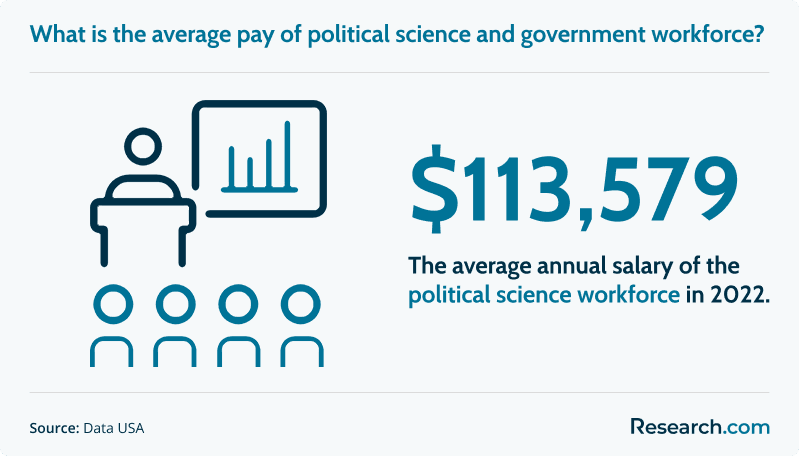
- Political science degree holders in the U.S. have an average annual salary of $113,579, based on the cited data used in this guide.
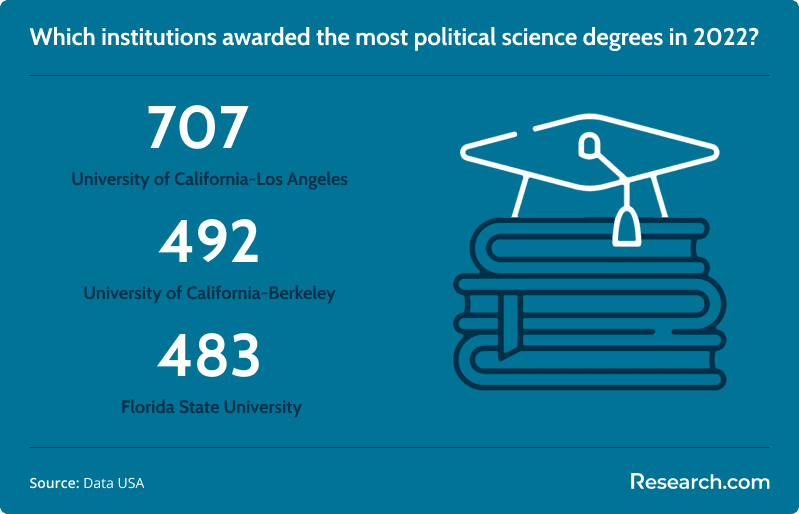
- Los Angeles County awarded 2,557 political science degrees in 2022, the highest number reported for any U.S. region that year.
- New York is identified as the top-paying location for political science graduates, making location an important factor in career planning.
- More than 4 million professionals work in political science and government-related sectors, showing that the field reaches far beyond elected office.
- The average age of workers in political science-related careers is 43, suggesting a mature labor market where experience, credentials, and networks matter.
- Best jobs for political science master’s graduates in 2027
- Skills developed in a political science master’s program
- Government career paths after a political science master’s
- Academic and teaching roles for political science master’s graduates
- International career options for political science graduates
- Admission requirements for political science master’s programs
- How to choose the right political science graduate program
- Trends changing political science careers
- Political science master’s degree cost
- Internships that can strengthen your political science career
- How political science shapes public policy
- Financial aid options for political science graduate students
- How graduates can speed up career growth
- Whether a doctorate makes sense after a political science master’s
- Networking and mentorship for career advancement
- Long-term value of a political science master’s degree
- Using supplemental credentials to improve employability
- Complementary accelerated programs for career mobility
- One-year master’s programs and career timing
- Accreditation, rankings, and program value
- Professional certifications for political science careers
- Data analytics and technology in political science work
Best jobs for political science master’s graduates in 2027
A political science master’s degree can qualify graduates for research-heavy, communication-focused, policy-oriented, and leadership roles. It is not a single-track degree. Some graduates use it for public service, others for campaigns or consulting, and others as a bridge to law, public policy, academia, journalism, or international work.
Compared with some other graduate paths, including fields discussed in a masters in social work salary guide, political science outcomes vary widely by sector, location, experience, and specialization. A graduate working in federal policy analysis may have a very different salary trajectory from one teaching part time or working for a small advocacy nonprofit.
Political science is also a common foundation for legal study. Students comparing pre-law options can review degree programs for future lawyers, but they should understand that a political science master’s is not required to attend law school. Its value is strongest when the student wants deeper policy, government, research, or political systems expertise.
| Career | Estimated salary | Why the master’s degree can help | Best fit for graduates who enjoy |
| Political Scientist | $132,350 per year | Political scientist roles often require advanced research preparation; the U.S. Bureau of Labor Statistics notes that a master’s degree is typically required for this occupation according to the U.S. Bureau of Labor Statistics. | Research design, political behavior, institutions, public opinion, and policy effects |
| Director of Public Relations | $127,134 per year | Graduate training in public opinion, persuasion, political messaging, and institutional communication can support senior communications work. | Strategic messaging, media relations, reputation management, and crisis response |
| Economist | $115,730 per year | Political science graduates with quantitative training can analyze the political and regulatory context behind economic decisions. | Markets, public finance, regulation, statistical analysis, and political economy |
| Policy Analyst | $105,000 per year | The degree directly supports policy research, legislative analysis, stakeholder review, and evidence-based recommendations. | Writing briefs, evaluating programs, interpreting laws, and solving public problems |
| Campaign Manager | $102,521 per year | Coursework in elections, voter behavior, communications, and political institutions can translate into campaign strategy. | Fast-paced work, voter outreach, fundraising strategy, and message discipline |
| Adjunct Professor | $89,649 per year | A master’s can meet minimum teaching requirements for some college-level courses, especially at community colleges or as part-time faculty. | Teaching, mentoring students, public speaking, and curriculum planning |
| Diplomat | $83,000 per year | International relations, negotiation, comparative politics, and regional studies can strengthen preparation for diplomatic work. | Global affairs, languages, negotiation, cultural analysis, and public service |
| Political Reporter | $82,648 per year | Graduate-level understanding of institutions, elections, and public policy can improve political reporting and analysis. | News writing, interviewing, explaining complex events, and public accountability |
| Political Consultant | $79,740 per year | Consultants benefit from training in polling, strategy, persuasion, voter segmentation, and policy positioning. | Campaigns, client advising, communications, data interpretation, and public affairs |
| Human Resource Specialist | $76,060 per year | Knowledge of governance, labor relations, negotiation, compliance, and organizational behavior can support HR work. | People operations, workplace policy, mediation, and compliance processes |
How to interpret these career options
Salary figures should be treated as planning benchmarks, not guarantees. Political science careers are highly sensitive to geography, employer type, security clearance requirements, professional network, writing ability, technical skills, and years of experience. A master’s degree can strengthen your candidacy, but internships, work samples, data literacy, and a clear specialization often determine whether the degree turns into a strong job offer.
Skills developed in a political science master’s program
A strong political science master’s program should teach more than political theory. It should train students to investigate public problems, evaluate evidence, write persuasively, interpret institutions, and communicate recommendations to audiences that may not agree with one another. Students comparing academic difficulty across fields may ask what the easiest college majors are, but political science at the graduate level is best evaluated by fit: it rewards students who like reading dense material, debating evidence, conducting research, and writing clearly under pressure.
| Skill | How it is used at work | Careers where it matters most |
| Critical analysis | Breaking down competing arguments, identifying assumptions, and weighing evidence before recommending action | Policy analyst, political scientist, consultant, reporter |
| Policy evaluation | Assessing whether a policy works, who it affects, and what alternatives may be more effective | Government analyst, nonprofit advocate, legislative staffer |
| Research methodology | Designing studies, gathering data, reviewing literature, and interpreting results | Research associate, political scientist, think tank analyst |
| Strategic communication | Explaining complex issues in memos, speeches, reports, press materials, and public presentations | Campaign manager, public relations director, diplomat |
| Comparative analysis | Studying how different governments, regions, or legal systems approach similar problems | Foreign service officer, global policy advisor, political risk analyst |
| Ethical judgment | Recognizing conflicts of interest, equity concerns, privacy issues, and public accountability obligations | Public administrator, compliance professional, policy advisor |
| Leadership and project coordination | Managing people, deadlines, stakeholders, budgets, and competing priorities | Campaign manager, nonprofit director, program coordinator |
| Advocacy and negotiation | Representing a position, building coalitions, negotiating compromises, and influencing decision-makers | Lobbying, diplomacy, labor relations, advocacy work |
| Global awareness | Understanding geopolitical risk, international institutions, migration, trade, conflict, and human rights concerns | Diplomat, humanitarian coordinator, international development specialist |
| Interdisciplinary collaboration | Working with economists, lawyers, data analysts, sociologists, journalists, and public administrators | Policy analyst, consultant, public affairs strategist |
Students comparing political science with other people-centered fields, such as those asking whether ECE is easy for average students, should focus less on perceived difficulty and more on the type of work they want. Political science is reading- and writing-intensive, often analytical, and increasingly data-informed.
The degree can also support pre-law preparation because it strengthens argumentation, legal context, institutional analysis, and policy reasoning. However, becoming a legal professional follows a separate path. Students weighing legal support careers can compare the roles of a paralegal versus a lawyer before deciding whether a master’s, law degree, or entry-level legal job is the better next step.
Government career paths after a political science master’s
A political science master’s degree can be a practical credential for government roles because it trains students to understand institutions, laws, administrative systems, public budgets, elections, public opinion, and policy trade-offs. Graduates from traditional programs or an online political science degree pathway may work in legislative offices, executive agencies, courts, public affairs departments, regulatory bodies, municipal governments, and public research units.
Data USA reported that 2.8% of graduates were employed in executive offices and legislative bodies in 2022. That share shows how competitive direct legislative and executive roles can be. These jobs often depend on internships, campaign experience, referrals, writing samples, and familiarity with the specific policy area an office handles.
The judicial sector also employed more than 8% of political science graduates in 2022. In that setting, political science training can support work connected to court administration, legal research support, justice policy, public safety analysis, and reform initiatives. Graduates should remember that some legal and court roles require additional credentials, exams, or professional training beyond a political science master’s.
Government roles where the degree can be useful
- Legislative analyst: Researches bills, prepares memos, tracks hearings, and explains policy consequences to elected officials or staff.
- Program analyst: Evaluates public programs, reviews performance data, and recommends operational improvements.
- Public affairs specialist: Communicates agency priorities, prepares public-facing materials, and manages stakeholder information.
- Regulatory analyst: Studies proposed rules, stakeholder comments, statutory requirements, and implementation challenges.
- Local government policy staffer: Works on housing, transportation, public safety, sustainability, education, zoning, or community development issues.
Academic and teaching roles for political science master’s graduates
A master’s degree in political science can open some academic jobs, but expectations vary by institution. A master’s may be enough for adjunct teaching, academic advising, curriculum work, or research support positions. Tenure-track professor roles at four-year institutions, however, commonly require a doctorate or substantial scholarly record.
| Academic role | Typical responsibilities | Important reality check |
| Adjunct professor or lecturer | Teaches courses in American politics, comparative politics, international relations, public policy, or political theory | Many positions are part time and may not provide stable long-term income |
| Academic advisor | Helps students select courses, understand requirements, and connect political science study to careers | Student services experience may be as important as subject-matter expertise |
| Research associate | Supports faculty, think tank, or institutional research through literature reviews, data collection, and report drafting | Quantitative and qualitative methods training can strongly improve competitiveness |
| Curriculum developer | Designs course materials, learning outcomes, assessments, and political science content | Instructional design skills may be needed in addition to political science expertise |
| Program coordinator | Manages civic engagement, public policy, international studies, or pre-law programs | Administrative ability, budgeting, and event planning may be part of the job |
International career options for political science graduates
Political science graduates who specialize in international relations, comparative politics, security, development, migration, trade, human rights, or regional studies may pursue work beyond domestic politics. Global careers often require strong writing, cross-cultural communication, language skills, field experience, and the ability to analyze political risk quickly.
- International development specialist: Designs, monitors, or evaluates programs addressing poverty, education, governance, health, or community resilience, often through NGOs or international organizations.
- Foreign service officer: Represents national interests through diplomacy, consular services, trade support, political reporting, and crisis response.
- Global policy advisor: Helps international organizations, corporations, or nonprofits understand policy developments related to trade, climate, human rights, or security.
- Humanitarian aid coordinator: Supports relief operations, coordinates with public agencies and NGOs, and helps manage services in crisis-affected regions.
- Political risk analyst: Studies elections, conflict, regulation, instability, sanctions, and governance changes that could affect organizations or investors.
The United States ranked among the highest in political participation globally in 2023, according to the Economist Intelligence Unit's political participation Index. For students interested in democracy, civic participation, and comparative institutions, that kind of global context can shape research interests and career direction.
Admission requirements for political science master’s programs
Admissions requirements vary by university, but most political science master’s programs look for evidence that applicants can handle advanced reading, research, theory, and writing. Applicants reviewing general political science degree requirements should also check each graduate program’s specific standards because some tracks emphasize research preparation while others focus on applied policy or professional practice.
| Requirement | What it usually shows | How to strengthen it |
| Bachelor’s degree | Completion of undergraduate study, often in political science, international relations, economics, sociology, public policy, or a related field | Take prerequisite courses in statistics, research methods, political theory, or comparative politics if your background is outside the field |
| GPA | Academic readiness; many programs look for a minimum GPA, often 3.0 on a 4.0 scale | Use a strong writing sample, recommendations, or recent coursework to offset weaker earlier grades |
| Letters of recommendation | Faculty or supervisor assessment of your writing, research ability, judgment, and reliability | Choose recommenders who can give specific examples, not just general praise |
| Statement of purpose | Your academic interests, professional goals, and fit with the program | Name the policy area, region, method, or career direction you want to pursue |
| GRE scores | Standardized evidence of verbal, quantitative, or analytical readiness when required | Confirm whether the program requires, waives, or ignores GRE results before spending time and money on the exam |
| Writing sample | Your ability to build an argument, use evidence, cite sources, and write in an academic style | Submit polished work that shows analysis, not just opinion |
| Professional experience | Exposure to government, campaigns, nonprofit work, research, journalism, law, or advocacy | Connect your experience directly to your graduate goals |
| English proficiency | For international students, TOEFL or IELTS scores may demonstrate readiness for English-language academic work | Check minimum score requirements early because processing times can affect deadlines |
| Application fee | Administrative requirement set by the institution | Ask about fee waivers if cost is a barrier |
| Interview | Some programs use interviews to evaluate fit, communication skills, and motivation | Prepare to explain why this program, why now, and what you plan to do with the degree |
How to choose the right political science graduate program
The best political science master’s program is not automatically the most famous one. It is the program that fits your career target, budget, schedule, academic interests, and preferred learning format. A student aiming for a think tank job should evaluate research methods training and faculty expertise, while someone seeking public affairs leadership may prioritize internships, communications coursework, and alumni connections.
Program selection checklist
- Reputation in your target field: Look beyond broad name recognition. A program may be especially strong in public policy, comparative politics, international relations, political theory, campaigns, or quantitative methods.
- Faculty alignment: Review faculty research areas and recent publications. Your strongest graduate experience will often come from mentors who work on topics close to your goals.
- Specializations: Check whether the curriculum offers concentrations such as public policy, international relations, American politics, political economy, security studies, or comparative politics.
- Research opportunities: Assistantships, research centers, survey labs, policy institutes, and funded projects can help you build a portfolio.
- Format: Decide whether online, campus-based, or hybrid study fits your schedule and learning style. Working professionals may need flexibility, while career changers may benefit from campus networking.
- Professional network: Ask about alumni outcomes, internship pipelines, employer partnerships, and events with practitioners.
- Funding: Compare scholarships, assistantships, fellowships, tuition discounts, and employer support before focusing only on sticker price.
- Location: Programs near capitals, courts, agencies, NGOs, media hubs, or international organizations may offer stronger internship access.
- Career services: Review whether the school helps with résumés, policy writing samples, interview preparation, internship placement, and government job applications.
- Curriculum depth: Make sure the program includes methods, writing, theory, and applied courses rather than a loose collection of electives.
Questions to ask before enrolling
- What jobs have recent graduates actually obtained?
- Does the program publish career outcome information for political science master’s students?
- How many students receive assistantships, scholarships, or other funding?
- Will I complete a thesis, capstone, internship, practicum, or exam?
- How much quantitative training is required?
- Can working students complete the program part time?
- Are internship placements available for online students as well as campus students?
- Does the program prepare students for government hiring processes, policy writing, or doctoral study?
Trends changing political science master’s degree careers
Political science careers are becoming more data-driven, interdisciplinary, and technology-aware. Employers still value strong writing and institutional knowledge, but they increasingly expect graduates to understand digital communication, public data, social media behavior, polling, geographic information, campaign analytics, and policy evaluation tools.
Artificial intelligence is also changing parts of political work. AI tools can help summarize documents, scan public comments, model voter segments, monitor media narratives, or support early-stage research. They do not replace political judgment. Graduates still need to verify evidence, understand bias, protect sensitive information, and explain why a recommendation makes sense in a specific legal, institutional, and public context.
Flexible education is another important trend. Some students are combining graduate degrees with certificates or courses from online universities to add practical skills in analytics, public administration, cybersecurity policy, nonprofit management, or communications. The key is to choose credentials that are recognized, relevant, and connected to a clear career goal.
Political science master’s degree cost
The average cost of a master’s degree is cited at around $79,530. For many students, that is a major financial decision. Political science programs can be worthwhile, but the return depends on how much you pay, whether you receive funding, whether you keep working while enrolled, and whether the program helps you reach a role that requires or rewards graduate training.
Students should compare the total cost of attendance, not just tuition. Fees, books, travel, technology, relocation, lost income, and interest on loans can change the real price. If your goal is applied policy work rather than political science research specifically, an affordable online master's in public policy may be a practical alternative to compare.
| Cost factor | Why it matters | What to ask the school |
| Tuition | The largest visible expense, but not the only one | Is tuition charged per credit, per term, or by residency status? |
| Fees | Technology, student services, graduation, or course fees can add up | What mandatory fees are not included in advertised tuition? |
| Program length | Longer programs may increase cost but allow more time for internships or research | Can I study part time without paying extra fees? |
| Assistantships | Teaching or research assistantships may reduce cost and build experience | How many master’s students receive assistantships each year? |
| Online versus campus expenses | Online study may reduce relocation and commuting costs, but fees can vary | Are online students eligible for the same funding and career services? |
| Opportunity cost | Leaving full-time work can be more expensive than tuition alone | Can the program be completed while employed? |
Internships that can strengthen your political science career
Internships are often the bridge between a political science degree and a credible job application. They give students applied experience, references, policy writing samples, and a clearer sense of which political environments fit them. A political science master’s is not usually grouped with easy master's degrees that pay well, but students can improve their employment prospects by gaining real-world experience before graduation.
- Congressional internships: Students assist with constituent services, legislative research, hearing preparation, correspondence, and policy tracking in a U.S. Senator’s or Representative’s office.
- Nonprofit advocacy internships: Interns may conduct issue research, support community outreach, prepare policy briefs, monitor legislation, or help with coalition campaigns.
- Political campaign internships: Campaign interns gain exposure to voter outreach, field operations, event planning, fundraising, media tracking, and rapid-response communications.
- International relations internships: Students may work with organizations such as the United Nations or the U.S. State Department on research, diplomacy support, meeting preparation, or international policy analysis.
- Think tank internships: Interns contribute to policy research, literature reviews, data gathering, report editing, event support, and briefings for public audiences or decision-makers.
Some students pair political science with community practice, social services, or public service training. Those considering that direction may compare flexible online BSW social work programs with political science graduate study to decide whether they want to work primarily in policy systems, direct community services, or both.
How political science shapes public policy
Political science influences public policy by helping decision-makers understand institutions, incentives, public opinion, political conflict, legal authority, and implementation constraints. A good policy idea can fail if agencies cannot administer it, voters do not trust it, courts challenge it, or stakeholders resist it. Political science helps explain those dynamics.
Research also shows how social and political conditions affect crisis response. During the COVID-19 pandemic, political science scholarship examined how institutions, communication, and social divisions shaped public health decisions. The article “The Social and Political Impact of the COVID-19 Pandemic: An Introduction,” a study by Beth Redbird, Laurel Harbridge-Yong, and Rachel Davis Mersey, explored how social and political forces affected early pandemic responses and were then changed by the pandemic itself.
Political science can also clarify how evidence enters policymaking. Research on federal agencies and regulatory impact analyses has examined how public attention, media scrutiny, and controversy can affect the use of scientific evidence. For graduate students, this is an important lesson: good evidence matters, but policy decisions are also shaped by timing, institutions, political incentives, and public legitimacy.
Financial aid options for political science graduate students
Political science master’s students may be able to reduce costs through scholarships, grants, fellowships, research assistantships, teaching assistantships, employer tuition support, federal aid, or part-time study. The best funding options are often program-specific, so students should contact departments directly instead of relying only on general financial aid pages.
Students seeking flexible and lower-cost options can also compare schools listed among the cheapest online colleges that accept FAFSA. When reviewing online programs, confirm that the institution is eligible for federal aid, that the program is recognized by relevant employers, and that online students have access to advising, career support, library resources, and internships.
How graduates can speed up career growth
Career growth after a political science master’s depends on turning academic skills into visible professional proof. Employers want to see that you can write a concise memo, analyze data, brief a senior decision-maker, manage stakeholders, interpret policy language, and work under deadlines.
- Choose a specialization: Focus on a field such as elections, security, public health policy, environmental policy, international development, law and courts, public finance, or urban policy.
- Build a portfolio: Save policy memos, research papers, data dashboards, op-eds, campaign plans, or briefing documents that demonstrate applied ability.
- Learn practical tools: Add skills in spreadsheets, statistical software, survey design, visualization, geographic analysis, or digital communications.
- Use internships strategically: Pick placements that match your target career, not just any available office.
- Find mentors: Ask faculty, alumni, supervisors, and professional contacts for feedback on career direction and work samples.
- Consider adjacent credentials carefully: Legal knowledge can help in compliance, regulatory affairs, and policy roles. Students exploring that direction can compare options such as the easiest law degree, while remembering that legal careers have separate licensing and education requirements.
Whether a doctorate makes sense after a political science master’s
A doctorate can be valuable if your goal is tenure-track teaching, advanced academic research, high-level methodology work, or specialized policy scholarship. It is usually not necessary for many applied roles in government, campaigns, public affairs, nonprofit advocacy, or consulting.
Before applying to doctoral programs, ask whether the extra years of study match your career goal. A PhD can deepen theoretical knowledge, research design, and credibility, but it also requires a long-term commitment to scholarly work. Students who need a lower-cost route can review options discussed in guides to the cheapest PhD programs.
| Choose a doctorate if... | Consider stopping at the master’s if... |
| You want to become a full-time academic researcher or professor | You want to work in applied policy, campaigns, public affairs, or government operations |
| You enjoy long-form research and theory development | You prefer practical problem-solving, management, or communications work |
| Your target jobs commonly require a PhD | Your target jobs value experience, writing samples, and networks more than another degree |
| You can secure funding that limits debt | You would need to borrow heavily without a clear salary payoff |
Networking and mentorship for career advancement
Political science careers are relationship-heavy. Many opportunities arise through internships, alumni connections, former supervisors, campaign networks, professional associations, civic organizations, and policy events. Networking does not mean collecting contacts. It means building a reputation for being prepared, reliable, thoughtful, and useful.
Students comparing broader career options may also review guides to the best degrees for the future, especially if they are deciding whether political science, public policy, data analytics, law, communications, or economics is the strongest fit.
Practical networking moves
- Ask alumni for 20-minute informational interviews about their work, not immediate job referrals.
- Attend public hearings, policy panels, campaign events, university lectures, and professional association meetings.
- Follow up after internships with a short note and periodic updates on your progress.
- Share a polished writing sample when asking for career advice.
- Seek mentors in more than one area: academic, professional, and peer networks all matter.
Long-term value of a political science master’s degree
A political science master’s can be a sound long-term investment when it is tied to a realistic career plan, funded responsibly, and paired with applied experience. The degree is less likely to pay off if a student enrolls without a target field, borrows heavily, avoids internships, or assumes the credential alone will create senior-level opportunities.
Students comparing return on investment across fields may look at best-paying degrees online as a benchmark. That comparison can be useful, but political science should not be evaluated only by salary. It may also appeal to students who want influence in public decisions, civic institutions, international affairs, advocacy, research, or democratic governance.
Using supplemental credentials to improve employability
Supplemental credentials can help political science graduates stand out when they fill a specific skill gap. The best add-ons are practical and targeted: data analytics, grant writing, project management, public administration, nonprofit management, geographic information systems, cybersecurity policy, conflict resolution, foreign language training, or strategic communications.
Students exploring short credentials can compare online certificate programs that pay well. The key question is not whether a certificate sounds impressive, but whether employers in your target field recognize it and whether it helps you produce better work.
Complementary accelerated programs for career mobility
Accelerated or short-format programs can be useful when they add practical skills that your political science curriculum does not cover. For example, a graduate interested in public budgeting may add accounting or data coursework; someone focused on advocacy may add nonprofit management; and a future policy analyst may add statistics or visualization training.
Some students explore options such as a fast track associates degree to gain job-ready skills in an adjacent area. This can make sense for career changers, but it should not distract from the main graduate credential unless it clearly supports a specific role.
One-year master’s programs and career timing
One-year master’s programs can be appealing because they reduce time away from work and may lower living expenses. They can also be intense. Students have less time to build relationships, complete internships, explore research interests, or recover from a weak start.
Programs such as cheap one year master's programs online may be worth comparing if you already have relevant experience, know your career goal, and need a faster credential. Before enrolling, confirm accreditation, faculty access, career services, curriculum depth, and whether the accelerated schedule still allows you to produce strong work samples.
Accreditation, rankings, and program value
Accreditation matters because it signals that an institution meets recognized academic standards. Rankings can be useful as one input, but they should not drive the whole decision. A lower-ranked program with excellent funding, a strong policy center, and internship access in your target city may serve you better than a more famous program that leaves you with high debt and little support.
Working adults comparing flexible programs can also review affordable online schools for working adults. When comparing schools, look at accreditation, total cost, faculty fit, alumni outcomes, research or internship access, student support, and how well the curriculum matches your career goal.
Professional certifications for political science careers
Targeted certifications can support political science careers when they demonstrate job-specific skills. A public affairs professional may benefit from communications training; a policy analyst may need statistics or visualization; a nonprofit advocate may need grant writing; and a campaign professional may benefit from digital advertising or voter data tools.
Students can review certification programs that pay well while keeping the selection practical. A certificate should help you qualify for a role, improve your work samples, or meet an employer expectation. If it does none of those, it may not be worth the time or money.
Data analytics and technology in political science work
Data skills can significantly strengthen a political science career. Policy analysts use data to evaluate programs. Campaign teams use voter files, polling, and digital engagement metrics. Political risk analysts monitor events, economic indicators, legal changes, and social instability. Public affairs teams track media narratives and public sentiment.
Useful technical skills may include spreadsheets, statistical analysis, survey methods, data visualization, mapping tools, database basics, text analysis, and responsible use of AI-supported research tools. Students who want an online pathway with federal aid eligibility can examine online schools that accept FAFSA while checking that the curriculum includes credible analytics or methods training.
Common mistakes to avoid
| Mistake | Why it can hurt you | Better approach |
| Choosing a program only because of ranking | Rankings may not reflect your specialization, funding needs, or target job market | Compare curriculum, faculty, internships, cost, and alumni outcomes |
| Ignoring accreditation | Unrecognized credentials can limit transfer, aid, and employer acceptance | Confirm institutional accreditation before applying |
| Looking only at tuition | Fees, relocation, lost income, and loan interest can change the real cost | Calculate total cost of attendance and net price after aid |
| Skipping internships | Graduates may leave with theory but little professional proof | Complete internships, assistantships, research projects, or policy practicums |
| Assuming the degree guarantees a high salary | Outcomes vary by role, location, employer, and experience | Use salary data as a benchmark and build marketable skills |
| Writing a vague statement of purpose | Admissions committees may not see your fit or direction | Identify your policy interest, research area, or career goal clearly |
| Avoiding quantitative methods | Many policy and campaign roles increasingly require data literacy | Take statistics, survey research, visualization, or analytics coursework |
Graduate perspectives on political science master’s careers
- My graduate program helped me move from classroom theory into policy work. The strongest benefit was learning how to analyze complicated issues and explain them clearly to decision-makers. Candice
- The degree gave me a clearer path into political strategy. Coursework mattered, but the mentors and professional connections I built were just as important. Ernest
- Graduate study prepared me for teaching and academic work by strengthening my research habits, writing discipline, and ability to guide students through difficult political questions. Peter
References
- Economist Intelligence Unit. Political participation index. Our World in Data. Retrieved January 3, 2025.
- Glassdoor. Director of Public Relations salary information. Glassdoor.com. Retrieved January 2, 2025.
- Glassdoor. Policy analyst salary information. Glassdoor.com. Retrieved January 2, 2025.
- Glassdoor. Campaign manager salary information. Glassdoor.com. Retrieved January 2, 2025.
- Glassdoor. Adjunct professor salary information. Glassdoor.com. Retrieved January 2, 2025.
- Glassdoor. U.S. Department of State diplomat salary range. Glassdoor.com. Retrieved January 2, 2025.
- Glassdoor. Political reporter salary information. Glassdoor.com. Retrieved January 2, 2025.
- Glassdoor. Political consultant salary information. Glassdoor.com. Retrieved January 2, 2025.
- Hanson, M. Average cost of a master's degree. Education Data Initiative. Retrieved January 2, 2025.
- U.S. Bureau of Labor Statistics. Occupational Outlook Handbook: Political Scientists. U.S. Bureau of Labor Statistics. Retrieved January 2, 2025.
- U.S. Bureau of Labor Statistics. Occupational Outlook Handbook: Economists. U.S. Bureau of Labor Statistics. Retrieved January 2, 2025.
- U.S. Bureau of Labor Statistics. Occupational employment and wages, May 2023: 13-1071 human resources specialists. U.S. Bureau of Labor Statistics. Retrieved January 2, 2025.
Key Insights
- A master’s in political science is most valuable when paired with a clear career target, such as policy analysis, political research, public affairs, diplomacy, campaigns, or teaching.
- The highest-paying roles listed in this guide include political scientist at $132,350 per year, director of public relations at $127,134 per year, economist at $115,730 per year, and policy analyst at $105,000 per year.
- Career outcomes depend heavily on experience. Internships, assistantships, writing samples, data skills, and networks can matter as much as the degree itself.
- Government roles are competitive. Data cited in this guide notes that 2.8% of graduates worked in executive offices and legislative bodies in 2022, while 1.9% is also reported for executive offices and legislative bodies in the cited findings, depending on the data grouping used.
- The average master’s degree cost cited is around $79,530, so students should compare net price, funding, opportunity cost, and expected career use before enrolling.
- Online, accelerated, and certificate options can help, but only when they are accredited, relevant, and connected to a specific employment goal.
- AI and data tools are changing political science work, but they do not replace human judgment, ethical reasoning, institutional knowledge, or persuasive writing.
- The strongest decision rule is simple: choose a political science master’s program only if it gives you the skills, mentors, evidence of work, and professional access needed for the career you actually want.
Other Things You Should Know About Political Science Master's Degree Careers
In 2027, key factors to consider include the demand for roles in public policy, international relations, and data analytics. Understanding how your skills align with emerging fields like climate policy or cybersecurity, and awareness of geographic hotspots for political science careers can also guide your decision.
In 2027, global political shifts, growing emphasis on policy analysis, and the digital transformation of civic engagement may highlight roles in international organizations, policy advisory positions, and data-driven public sector jobs as promising career paths for political science graduates.