2027 How Many Years of College Does It Take to Become a Lawyer?

Co-Founder and Chief Data Scientist
Becoming a lawyer is a long professional pathway, and the biggest question for many prospective students is not only whether they can handle law school, but whether the time, cost, licensing requirements, and career trade-offs make sense for their goals. In the U.S., the traditional route usually includes a bachelor’s degree, law school, bar exam preparation, and state licensure before a graduate can practice law independently.
The legal profession remains large and highly regulated. In 2024, the American Bar Association (ABA) reported 1,322,649 active lawyers in the U.S., showing how central attorneys are to courts, businesses, government agencies, advocacy organizations, and individual client representation. Lawyers interpret laws, advise clients, draft legal documents, negotiate disputes, and represent parties in legal matters. The work can be intellectually demanding and socially meaningful, but the path requires careful planning.
This guide explains how long it takes to become a lawyer, what can shorten or lengthen the timeline, how online and accelerated options compare, what to know about the LSAT and bar exam, and how to evaluate whether law school or another legal education pathway is the right investment.
Quick answer: How long does it take to become a lawyer?
For most students in the U.S., becoming a lawyer takes about seven years: four years for a bachelor’s degree and three years for a Juris Doctor (JD). After graduating from law school, candidates usually spend nine weeks to six months preparing for the bar exam, waiting for results, completing character and fitness requirements, and obtaining a license. Accelerated JD programs, 3+3 bachelor’s/JD pathways, part-time formats, apprenticeships in select states, and additional specializations can change the timeline.
| Stage | Typical time required | What happens during this stage |
| Undergraduate degree | Four years | Students complete a bachelor’s degree while building reading, writing, research, and analytical skills. |
| LSAT preparation | Two to three months | Applicants study logical reasoning, reading comprehension, and analytical thinking before applying to law school. |
| Law school | Three years | JD students complete required courses, electives, writing assignments, clinics, internships, and professional preparation. |
| Bar exam and licensure | Nine weeks to six months | Graduates study for the bar exam, take the exam, wait for results, and complete state licensing steps. |
Why people choose a legal career
- Multiple practice areas are available. Lawyers can work in litigation, corporate law, criminal defense, tax, family law, immigration, public interest, compliance, government, intellectual property, and many other fields.
- The earning potential can be strong. Lawyers typically earn high salaries, with the average annual wage for lawyers in the U.S. at $176,470 or more depending on specialization and experience.
- Legal skills transfer across industries. Research, negotiation, regulatory analysis, policy interpretation, writing, and advocacy are valuable in law firms, corporations, public agencies, nonprofits, and consulting environments.
- The job outlook remains steady. The job outlook for lawyers remains strong, which is about as fast as average for all professions. Demand is shaped by population growth, business regulation, litigation, compliance needs, and increasingly complex legal issues.
- How long does it take to become a lawyer for 2027?
- How long does LSAT preparation take?
- Are accelerated law programs available?
- Can online law programs shorten the timeline?
- How long does each type of law degree take?
- How long does legal specialization take?
- What financial factors should future lawyers consider?
- How long should you study for the bar exam?
- Is an online master's in legal studies worth it?
- How much time do law internships require?
- Can you become a lawyer without attending law school?
- Can an associate degree in legal studies help you get started?
- How can interdisciplinary education support legal work?
- Can an interdisciplinary online degree strengthen legal practice?
- How is artificial intelligence changing legal education and practice?
- Can you work in law before passing the bar?
- How should you choose a legal education pathway?
- What skills do lawyers need?
- What career options can advanced legal education support?
How long does it take to become a lawyer for 2027?
The standard U.S. route takes seven years before bar preparation and licensure are complete. That usually means four years of undergraduate study followed by three years in law school. The full timeline may be longer for part-time students, dual-degree students, graduates who need multiple bar exam attempts, or candidates who pursue additional specialization before entering practice.
- Undergraduate Education (Four years): Law schools do not require one specific college major. Students often choose political science, criminal justice, criminology, history, English, business, or other fields that build strong writing, reasoning, problem-solving, and communication skills.
- Law School (Three years): Most future attorneys earn a JD through an ABA-accredited law school. Full-time JD programs generally take three years and include foundational legal subjects, upper-level electives, legal writing, experiential courses, clinics, internships, and advocacy training.
- Bar Exam and Licensure (Nine weeks to six months): After completing the JD, graduates prepare for the bar exam in the jurisdiction where they want to practice. The timing includes intensive study, exam administration, result release, and final licensing requirements.
The timeline also depends on your personal situation. A full-time student with few outside obligations may progress more quickly than someone balancing work, caregiving, military service, or financial constraints. A realistic law school plan should account for study habits, tuition and living costs, internship availability, bar preparation, and the state-specific rules that govern admission to practice.
| Pathway | Best fit | Main trade-off |
| Traditional bachelor’s degree plus JD | Students who want the most widely recognized route into legal practice | Usually takes seven years before bar preparation and licensing steps are complete |
| 3+3 bachelor’s/JD program | Students who commit to law early and want to reduce the total academic timeline | Less flexibility to change direction during undergraduate study |
| Two-year accelerated JD | Highly focused students who can study year-round | More intense schedule with fewer long breaks |
| Part-time JD | Working adults or students with major personal responsibilities | Can extend law school to four or more years |
| Apprenticeship route in select states | Self-directed learners in jurisdictions that allow legal apprenticeship pathways | Limited availability and substantial responsibility for independent preparation |
How long does it take to prepare for the LSAT?
Most applicants spend about two to three months preparing for the Law School Admission Test (LSAT). The exam is designed to measure logical reasoning, reading comprehension, and analytical thinking, so preparation should focus on repeated practice, timed sections, error review, and test strategy rather than memorization alone.
A common study load is 10 to 20 hours per week. Students who are working, caring for family members, or completing another academic program, such as a political science degree online, may need a longer runway so they can prepare consistently without sacrificing grades, employment, or health.
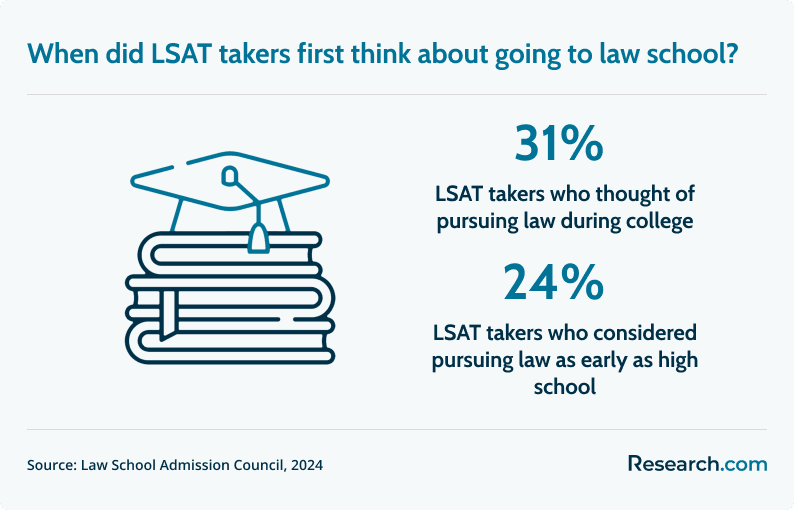
The 2024 Knowledge Report from the Law School Admission Council (LSAC) found that 31% of test takers first considered law school during college, 24% in high school, and 16% after earning their degree. In practice, this means law school planning does not start at the same point for everyone. Some applicants have years to prepare; others begin after gaining professional experience.
A strong LSAT plan should begin with a diagnostic test, then move into targeted practice. If your score is far from the range you need for your target schools, extending preparation may be smarter than rushing an application cycle. Applicants should also leave time for letters of recommendation, personal statements, application fees, transcript requests, and school research.
Are there accelerated programs for law students?
Yes. Accelerated legal education options exist for students who want to reduce the time required to earn a JD. These programs can be useful, but they are not easier. They usually compress the academic calendar, reduce long breaks, or combine undergraduate and law school credits.
One option is a two-year law degree program. Students often attend classes year-round, including summer terms, to complete the JD faster than the traditional schedule. Schools that offer two-year law programs include the Northwestern University Pritzker School of Law, Drexel University Thomas R. Kline School of Law, and Southwestern Law School.
Another option is a 3+3 program. In this structure, students complete the bachelor’s degree and JD in six years instead of the usual seven by beginning law school during what would normally be the fourth undergraduate year.
Accelerated routes make the most sense for students who are academically prepared, financially organized, and confident that they want to practice law. They may be less ideal for students who need time to explore majors, build a GPA, work during school, or improve their LSAT score. Students who want legal exposure before committing to law school may also consider an accelerated paralegal program as a shorter way to build foundational skills.
Can online law programs be completed faster than traditional ones?
Online JD programs are usually chosen for flexibility, not speed. Most online programs also last three years, while some take three years and three months, three and a half years, or four years. The format may help students stay enrolled while working or managing family responsibilities, but it does not automatically shorten the licensing path.
The ABA has approved a short list of online law schools. Most are hybrid JD programs that combine online coursework with required in-person residencies, while only a small number are fully online. Students comparing flexible legal education options should examine accreditation, bar eligibility, required campus visits, faculty access, clinical opportunities, and career services. Broader research into top online colleges can help students understand what to look for in online learning quality, but JD accreditation and bar eligibility require separate verification.
Some non-ABA-accredited online law schools offer programs lasting three to six years. These may be appropriate for very specific circumstances, but graduates can face limits on bar exam eligibility in some states and may encounter narrower employment options than graduates of ABA-accredited institutions.
Before enrolling in any online law program, contact the state bar or board of law examiners where you plan to practice. Do not assume that an online JD, hybrid JD, or non-ABA program will qualify you for licensure in every jurisdiction.
| Program format | Potential advantage | Risk to check before enrolling |
| Campus-based ABA-accredited JD | Most traditional route for students seeking broad bar eligibility and employer recognition | Less scheduling flexibility for students who need remote or part-time study |
| Hybrid ABA-approved JD | Combines online learning with required in-person components | Residency requirements, travel costs, and state bar rules vary |
| Fully online ABA-approved JD | Greater geographic flexibility than campus programs | Limited availability and the need to confirm licensure rules carefully |
| Non-ABA online law program | May offer a different schedule or cost structure | Bar eligibility and employment portability may be restricted |
How long is law school for different types of law degrees?
Not every legal degree is designed for the same outcome. A JD is the primary degree for those who want to become licensed attorneys in the U.S. Other legal degrees may support specialization, academic research, compliance roles, policy work, or legal-adjacent careers.
- Juris Doctor (JD) (Three years): The JD is the standard professional degree for students planning to become lawyers. Coursework typically includes constitutional law, contracts, criminal law, civil procedure, legal writing, and electives tied to career interests. Part-time JD programs can take four or more years.
- Dual JD Degrees (Three to six years): Some students combine a JD with another graduate credential, such as a Master of Business Administration (JD/MBA), Master of Public Health (JD/MPH), or Master of Science in Nursing (JD/MSN). A JD/MBA may be especially relevant for students interested in corporate law, finance, executive leadership, or related MBA career paths and salaries.
- Master of Laws (LLM) (One to two years): The LLM is an advanced degree for attorneys who want deeper training in areas such as international law, tax law, or human rights law. It can also help some foreign-trained attorneys work toward U.S. practice eligibility, depending on jurisdiction rules.
- Doctor of Juridical Science (SJD) (Three to five years): The SJD is the highest academic law degree and is generally intended for legal scholars, researchers, and future faculty members. It requires advanced research and a dissertation.
ABA data show that in 2024, the total number of first-year JD enrollees was 40,650, marking a 4.52% increase from the previous year. The total fall enrollment for all JD students during the same year was 115,410, slightly lower than 2023’s total JD enrollment (-1.23%).
The total number of non-JD enrollees, including students in LLM, masters, and certificate programs, was 23,583. These figures show that legal education includes both attorney-track and non-attorney-track options, and students should match the degree to the career they actually want.
This chart shows the enrollment figures of law school students in 2024.
How long does it take to specialize in a legal field?
Specialization usually begins during law school but develops over years of practice. Students often explore practice areas in the second and third years through electives, clinics, journals, externships, internships, and moot court or trial advocacy experiences. The real depth, however, often comes after graduation through client work, supervision, courtroom exposure, transactions, regulatory matters, or agency practice.
In a Bloomberg Law survey (2023), 30% of students aimed to specialize in corporate or transactional law and 29% in litigation or dispute resolution. Corporate or transactional practice may lead to work involving mergers and acquisitions, securities regulation, contracts, compliance, or business counseling. Litigation and dispute resolution can include trial practice, arbitration, appellate advocacy, negotiation, and settlement work.
Some lawyers specialize by earning an LLM in tax, international law, or another advanced area. Others pursue certifications through the ABA or state bar associations. These credentials typically require three to five years of experience and ongoing education, with several weeks to a couple of months spent preparing for the certification exam.
| Specialization route | When it usually starts | What it is best for |
| Law school electives and clinics | Second and third years of law school | Testing interests before choosing a first legal job |
| Internships, externships, or clerkships | During law school or after graduation | Building practical experience and professional references |
| LLM | After earning a JD or equivalent legal degree | Advanced knowledge in a focused legal field |
| Bar association certification | After years of legal practice | Formal recognition of experience in a practice area |
This chart shows the intended areas of specialty among law school students.
What are the financial considerations of pursuing a legal career?
Law school should be evaluated like a major professional investment. Students need to compare tuition, fees, living expenses, books, technology costs, bar preparation costs, application costs, and the income they may give up while studying full time. The right choice is not always the highest-ranked or most expensive school; it is the option that provides strong licensing eligibility, academic support, career placement, practical training, and manageable debt for the type of legal work the student wants to pursue.
Prospective students should also compare traditional JD programs, accelerated JD programs, part-time formats, online or hybrid options, and legal-adjacent pathways. Scholarships, grants, employer tuition support, public service options, and loan forgiveness programs may reduce the burden, but each has conditions that should be reviewed before enrollment. Students who want legal training without immediately committing to a JD can compare lower-cost entry options, including ABA approved paralegal programs.
| Cost factor | Why it matters | Question to ask |
| Tuition and mandatory fees | These are usually the largest direct education expenses | What will the total program cost be after scholarships and fees? |
| Living expenses | Housing, transportation, food, and health costs can change the real price of attendance | Can I afford the location without taking on excessive debt? |
| Bar preparation costs | Licensure expenses continue after graduation | Does the school provide bar support, and what outside prep will I need? |
| Employment outcomes | Career results affect repayment ability | Where do graduates work, and how many pass the bar? |
| Program format | Full-time, part-time, online, and accelerated formats affect both cost and income | Will this schedule let me work, intern, or manage personal responsibilities? |
How long does it take to study for the bar exam?
Most candidates begin serious bar exam review about nine weeks before the exam and spend two to three months studying full time. A typical study commitment is 40 to 50 hours per week, although some candidates begin earlier or extend preparation if they are working, retaking the exam, managing health issues, or studying in a jurisdiction with additional testing requirements.
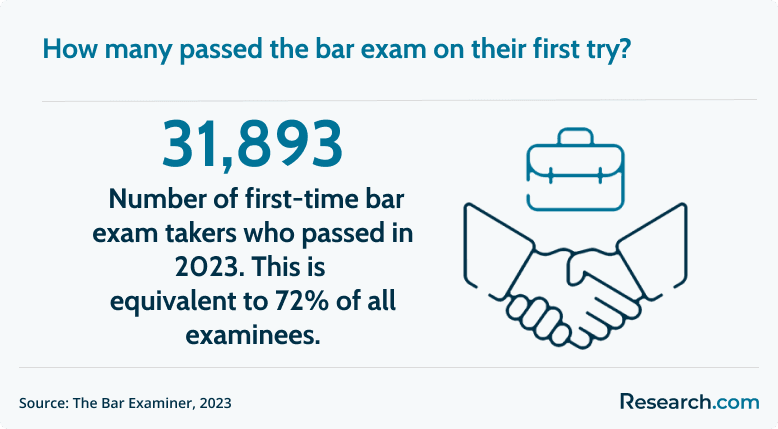
In 2023, The Bar Examiner reported that 66,174 total candidates across the nation took the bar exam, but only 38,485 (58%) passed. Among the 44,180 first-time bar exam takers, 31,893 passed (72%). These results show why bar preparation should be treated as a separate phase of the lawyer timeline rather than an afterthought.
Many graduates use commercial bar review courses, outlines, practice essays, multiple-choice question banks, performance test practice, study groups, or tutoring. Students with prior legal-adjacent coursework, including those who completed the easiest criminal justice degree, may already recognize some legal topics, but bar success still requires focused exam-specific preparation.
A practical bar study plan should include diagnostic practice, a weekly schedule, memorization time, simulated exams, feedback on writing, and rest days. Studying more hours is not always better if fatigue reduces accuracy. Consistency, practice under timed conditions, and honest review of weak areas matter most.
Is an online master's in legal studies a worthwhile investment?
An online master’s in legal studies can be valuable for professionals who need legal knowledge but do not plan to become licensed attorneys. It may fit people working in compliance, human resources, risk management, healthcare administration, policy, contracts, privacy, finance, government, or corporate operations. It is not a substitute for a JD if your goal is to practice law.
Before enrolling, compare accreditation, curriculum depth, faculty background, flexibility, employer recognition, tuition, and whether the program teaches practical skills such as regulatory interpretation, legal research, policy analysis, negotiation, and compliance documentation. Cost-conscious professionals can review cheapest master of legal studies online programs while still checking quality indicators and career alignment.
How much time do law internships typically take?
Internships, externships, clinics, and clerkships are important because they turn classroom learning into supervised practice. They also help students discover whether they prefer litigation, transactional work, government service, public interest, judicial work, or corporate legal departments.
- Internships or Externships (Eight to 12 weeks): Many law students work full time during the summer between academic years. Placements may be in law firms, judges’ chambers, government agencies, nonprofits, prosecutors’ offices, public defenders’ offices, or corporate legal departments.
- Part-Time Internships (10 to 15 hours per week): During the school year, students may work limited hours while continuing coursework. These placements can provide steady experience without requiring a full academic break.
- Clerkships (One to two years): Judicial clerkships are paid post-graduate roles that often involve research, writing, court observation, and close work with a judge. Many students begin applying during the second year of law school.
Students should not treat internships as résumé fillers. The best placements help build writing samples, references, practice-area knowledge, and professional judgment. When comparing opportunities, ask what work interns actually perform, who supervises them, whether feedback is provided, and how the role connects to long-term goals.
Can you become a lawyer without law school?
In most cases, law school is the standard route to becoming a lawyer. However, a small number of states allow alternative apprenticeship-based pathways. These routes can reduce formal classroom time, but they are demanding, highly jurisdiction-specific, and not broadly available.
California, Vermont, Virginia, and Washington provide apprenticeship programs that allow aspiring lawyers to train under a judge or practicing attorney instead of attending traditional law school. These programs typically last four years and require apprentices to work between 18 and 32 hours per week before qualifying to sit for the bar exam.
New York and Maine offer related options for students who complete one or two years of law school and then finish their preparation through supervised legal work before becoming eligible for the bar.
This path requires exceptional self-discipline because apprentices must learn legal doctrine, practice skills, professional responsibility, and bar exam subjects without the same structure as a JD program. It may also limit mobility if the candidate later wants to practice in another state. If your interest is law-related but you are not ready for law school, you may also compare public policy careers, compliance roles, legislative affairs, legal operations, or consulting positions.
Can an associate degree in legal studies serve as a foundation for your legal career?
An associate degree in legal studies can be a practical starting point for students who want to enter the legal field sooner or test their interest before pursuing higher credentials. Programs typically introduce legal terminology, legal research, document preparation, office procedures, and foundational concepts used in law firms and legal departments.
This credential may support roles such as legal assistant or paralegal, depending on employer expectations and local requirements. It can also help students decide whether to continue into a bachelor’s degree, paralegal studies, legal studies, or eventually law school. Students looking for an accessible entry point can compare options such as an associate of science in legal studies online.
How can interdisciplinary education enhance your legal practice?
Law does not operate in isolation. Attorneys often need to understand business operations, public policy, technology, healthcare, criminal justice systems, environmental regulation, finance, or national security. Interdisciplinary study can make a lawyer more useful to clients because it strengthens context, not just legal analysis.
For example, coursework in criminal justice or law enforcement may help future lawyers understand investigation procedures, agency structures, public safety policy, and regulatory environments. Students interested in those connections can explore a law enforcement degree online as one way to build knowledge that may later complement legal education.
Is an interdisciplinary online degree beneficial for your legal practice?
An interdisciplinary online degree can be useful when it supports a clear legal or policy goal. For example, legal professionals who work with national security, emergency management, regulatory compliance, privacy, risk assessment, or public administration may benefit from structured coursework outside traditional legal subjects.
The key is fit. Students should avoid stacking credentials without a career reason. Instead, choose programs that deepen expertise in a field where legal interpretation, regulation, and decision-making overlap. For professionals interested in security, policy, and risk environments, fast online homeland security degree programs may offer relevant interdisciplinary preparation.
How can artificial intelligence transform legal education and practice?
Artificial intelligence is changing how legal research, document review, due diligence, contract analysis, and case preparation are performed. AI tools can search large legal databases, identify patterns in documents, summarize materials, and support drafting workflows. These tools do not replace professional judgment, but they are increasingly part of legal work.
Future lawyers should understand both the advantages and risks of AI. Important issues include confidentiality, accuracy, bias, unauthorized practice concerns, citation verification, client consent, and ethical use. Law students who learn how to validate AI-assisted research and use technology responsibly may be better prepared for modern practice. Professionals who want a stronger technical foundation may consider an online masters in artificial intelligence as a way to connect legal, analytical, and technology-focused skills.
Can you start working as a lawyer before passing the bar?
No. You cannot practice law independently until you pass the bar exam and complete the licensing requirements in your jurisdiction. However, many graduates work in supervised legal or legal-adjacent roles while waiting for bar results.
Law firms, courts, agencies, and legal departments may hire third-year law students or recent graduates as law clerks, paralegals, legal assistants, research assistants, or post-graduate fellows. These roles can involve legal research, document drafting, case preparation, filing support, and client matter organization. They do not allow unlicensed graduates to represent clients independently or give legal advice as attorneys.
This transition period can be productive, but it can also be stressful. According to The Bar Examiner’s 2021 Survey of Law Student Well-Being, 64% of third-year law students preparing for the bar felt overwhelmed by the volume of material, and 44% reported experiencing anxiety. Bar preparation is important, but so are sleep, mental health support, exercise, realistic scheduling, and breaks.
Graduates should use the time before licensure to strengthen professional habits, learn office systems, observe experienced attorneys, and prepare for the bar without burning out. Passing the bar is a milestone, not the only measure of long-term success.
This chart illustrates what law students felt as they prepared for the bar exam.
What should you consider when choosing your legal education pathway?
The right legal education path depends on whether you want to become a licensed attorney, work in a legal-support role, move into compliance or policy, or add legal knowledge to an existing career. A JD is usually necessary for practicing law, while paralegal, legal studies, public policy, criminal justice, or compliance-focused programs may be better for students who want legal knowledge without attorney licensure.
- Check accreditation first. For JD programs, confirm ABA approval and state bar eligibility. For non-JD programs, review institutional accreditation and employer relevance.
- Compare total cost, not just tuition. Include fees, books, living expenses, travel, technology, bar prep, and lost income.
- Review bar passage and career outcomes. A program should show evidence that students complete the degree, pass licensing exams when applicable, and obtain relevant employment.
- Evaluate practical training. Clinics, externships, internships, writing courses, and simulation courses help students prepare for actual legal work.
- Match format to your life. Full-time, part-time, accelerated, online, and hybrid options create different pressures.
- Consider alternatives before committing to a JD. Students interested in legal support roles can explore online paralegal degrees before deciding whether law school is necessary.
Common mistakes to avoid when planning a legal career
| Mistake | Why it creates problems | Better approach |
| Choosing a law school without checking bar eligibility | A degree may not qualify you to sit for the bar in the state where you want to practice | Confirm requirements with the state bar or board of law examiners before applying |
| Looking only at rankings | Rankings may not reflect cost, location, bar support, or your preferred practice area | Compare outcomes, affordability, clinics, alumni networks, and employer connections |
| Ignoring debt until after enrollment | Loan payments can limit career flexibility after graduation | Estimate total cost and compare it with likely employment paths before committing |
| Assuming online programs are always faster | Many online JD programs take about the same time as campus programs | Choose online study for flexibility only after confirming accreditation and licensure rules |
| Underestimating the bar exam | Graduation alone does not authorize independent legal practice | Plan a dedicated bar preparation period and budget for exam-related costs |
| Choosing a specialization too early | Students may overlook better-fitting practice areas before gaining exposure | Use electives, clinics, internships, and informational interviews to test interests |
What skills are essential for a successful legal career?
Successful lawyers need more than knowledge of statutes and cases. They must read dense material accurately, identify relevant facts, write persuasively, communicate with clients, negotiate under pressure, manage deadlines, and make ethical decisions even when the answer is not simple.
- Analytical reasoning: Lawyers must connect facts, rules, precedent, and policy arguments.
- Legal writing: Clear writing is essential for briefs, contracts, motions, client updates, memos, and compliance documents.
- Oral communication: Attorneys explain risk, advocate for clients, negotiate settlements, and present arguments.
- Research discipline: Legal work depends on accurate sources, updated law, and careful citation.
- Professional judgment: Lawyers must balance client goals, legal limits, ethical duties, and practical consequences.
- Digital literacy: Modern practice increasingly uses databases, e-discovery tools, document automation, cybersecurity practices, and AI-supported workflows.
Students who want to build a related foundation before or instead of law school may compare options such as the cheapest online criminal justice degree, especially if their interests involve criminal law, public safety, courts, corrections, or policy.
What career opportunities can advanced legal education unlock?
Advanced legal education can support more than traditional attorney roles. A JD may lead to litigation, corporate practice, public defense, prosecution, government counsel, judicial clerkships, public interest advocacy, or in-house legal work. Non-JD graduate legal studies programs may support compliance, regulatory affairs, contract administration, risk management, policy analysis, legal operations, and consulting roles.
Professionals considering a master’s in legal studies should be clear about the credential’s purpose. It can strengthen legal literacy and improve performance in regulated industries, but it generally does not authorize graduates to practice law. For a deeper look at non-attorney legal career outcomes, review What can you do with a masters in legal studies?.
Key Insights
- The typical U.S. lawyer timeline is about seven years: four years for a bachelor’s degree and three years for a JD, followed by bar preparation and state licensure steps.
- LSAT preparation usually takes two to three months, with many applicants studying 10 to 20 hours per week.
- Accelerated JD and 3+3 programs can reduce time in school, but they require strong academic readiness and leave less room for exploration or schedule flexibility.
- Online law programs are often more flexible, but they are not automatically faster. Accreditation and bar eligibility should be verified before enrollment.
- In 2024, first-year JD enrollment totaled 40,650, a 4.52% increase from the previous year, while total fall enrollment for all JD students was 115,410, slightly lower than 2023’s total JD enrollment (-1.23%).
- The bar exam is a major hurdle. In 2023, 66,174 total candidates took the bar exam nationwide, and 38,485 (58%) passed. Among 44,180 first-time takers, 31,893 passed (72%).
- Law school is not the only way to work in the legal field. Paralegal, legal studies, compliance, public policy, and legal operations pathways may be better fits for students who want legal work without attorney licensure.
- Mental well-being matters. Among third-year law students preparing for the bar, 64% felt overwhelmed by the volume of material, and 44% reported anxiety.
- The best legal education pathway is the one that matches your licensing goal, budget, learning format, geographic plans, practice interests, and tolerance for debt and academic intensity.
References:
- American Bar Association. (2024a). 2023-2024 ABA National Lawyer Population Survey. https://www.americanbar.org/content/dam/aba/administrative/market_research/2024-aba-nlps.pdf
- American Bar Association. (2024b, December 16). 2024 Standard 509 Information Report Data Overview. https://www.americanbar.org/content/dam/aba/administrative/legal_education_and_admissions_to_the_bar/statistics/2024/2024-standard-509-information-report-data-overview.pdf
- Organ, J. M., Jaffe, D. B., & Bender, K. M. (2022). The 2021 Survey of Law Student Well-Being: More Progress Needed in Fostering Help-Seeking among Law Students. The Bar Examiner. https://thebarexaminer.ncbex.org/article/summer-2022/2021-survey-of-law-student-well-being
- The Bar Examiner. (2024a). Persons Taking and Passing the 2023 Bar Examination by Source of Legal Education. https://thebarexaminer.ncbex.org/wp-content/uploads/Persons-Taking-and-Passing-the-2023-Bar-Examination-by-Source-of-Legal-Education.pdf
- The Bar Examiner. (2024b). First-Time Exam Takers and Repeaters in 2023. https://thebarexaminer.ncbex.org/wp-content/uploads/First-Time-Exam-Takers-and-Repeaters-in-2023.pdf
Other Things You Should Know About Becoming a Lawyer
After completing an undergraduate degree, aspiring lawyers in 2027 typically need to attend law school for three years to earn a Juris Doctor (JD) degree. Following law school, passing the bar exam is essential to practice law.
Before attending law school in 2027, you typically need a bachelor's degree, often requiring around four years of college. No specific undergraduate major is mandated, but courses in political science, history, or English may be beneficial. Additionally, a satisfactory LSAT score is usually required.
Most law schools do not set a single cutoff, but competitive applicants often score above 160 on the LSAT. The test is administered by the Law School Admission Council, and many ABA-accredited schools review it alongside GPA, letters of recommendation, and personal statements.