
2027 Training Industry Statistics: Data, Trends & Predictions

Co-Founder and Chief Data Scientist
Employee training is no longer a side activity reserved for onboarding or compliance refreshers. For most organizations, it is now part of how they close skill gaps, retain staff, prepare people for AI-enabled work, and build the next generation of leaders. That shift matters because the cost of missing skills is rising while job requirements keep changing. In the US, organizations allocated an average of $1,254 per participant of employee learning in 2024 (ATD, 2025).
This guide breaks down the latest training industry statistics and explains what they mean for employers, HR teams, learning and development professionals, educators, and employees. You will learn what employee training includes, which delivery methods are most common, where training budgets are going, what challenges limit results, and how to judge whether a training program is actually worth the investment.
If you are deciding how to train employees, choose a learning platform, justify a budget, or compare internal training with formal education, this article gives you the data and decision points you need.
Quick Answer: What Do Current Training Industry Statistics Show?
The training industry is still growing, but the focus has shifted from volume to value. Organizations are spending heavily on learning, yet they are also asking tougher questions: Does this training improve performance? Can employees apply what they learned? Is the method efficient for our workforce?
In 2025, US training expenditures rose by 4.9% to $102.8 billion, up from $98 billion in 2024. Training Magazine’s 2025 report also found that 89% of organizations use learning management systems, and 37% now use artificial intelligence in training, up from 25% in 2024. Digital delivery remains important, but companies are still using instructor-led, virtual, and blended formats when those methods better fit the skill being taught.
Bottom line: the strongest training strategies in 2026 are not the ones with the most content. They are the ones that connect learning to business goals, measure application on the job, and support both technical and human skills.
Training Industry Statistics Table of Contents
- What employee training means
- Why organizations invest in workforce training
- Training delivery methods and learning models
- Employee training challenges and effectiveness
- How employee training strengthens company culture
- Training expenditure and outsourcing trends
- Emerging training trends and workforce forecasts
- Accessibility and affordability in employee training
- Benefits of online training for organizations and learners
- Further education and training opportunities
- How higher education can complement employee training
- How open enrollment programs support skill development
- How employee training supports career advancement
- How to measure the ROI of employee training
- How employee training can adapt to future business demands
- How advanced academic pathways enhance employee training
- Benefits of accelerated learning in employee training
- How legal and regulatory training reduces business risk
What Is Employee Training?
Employee training is a planned effort to improve performance by building knowledge, skills, behaviors, and work habits across individuals, teams, or entire organizations (Goldstein & Ford, 2002). It can cover onboarding, compliance, safety, leadership, communication, customer service, software, technical skills, and career development.
Training can happen in real time or on demand. Synchronous training takes place live, either face-to-face or online. Asynchronous training lets employees learn independently through modules, videos, readings, simulations, or assessments. Blended learning combines both. The best option depends on the complexity of the task, how fast the skill must be applied, and how much practice the learner needs.
Training is only effective when organizations evaluate whether it changed behavior or results. Managers can use learner feedback, supervisor observations, and performance data to see whether training helped. Well-written employee evaluation comments can support that process by connecting learning to job performance, strengths, and remaining gaps.
Training Magazine’s 2025 report shows that organizations still rely most on digital delivery, but not exclusively. Many companies use a mix of online learning, classroom instruction, virtual classrooms, and blended instruction depending on the audience and topic.
- 34% of small companies prefer online or computer-based training without an instructor.
- 32% of small companies use instructor-led classroom training.
- 27% of midsize companies use instructor-led training, 23% use blended learning, and 25% use virtual classrooms.
- 20% of large companies use instructor-led training and 21% use blended learning.
- Large companies (34%) are more likely than smaller ones to use computer-based or online learning.
- Large companies (10%) use mobile-based learning slightly more often than midsize companies (6%) and small companies (4%).
| Training model | How it works | Best used for | Main limitation |
| Instructor-led classroom | A trainer teaches employees together in person. | Hands-on practice, group discussion, leadership workshops, and complex topics. | Harder to scale across locations and schedules. |
| Virtual classroom | A live instructor delivers training remotely using web conferencing or webcasting. | Distributed teams, interactive sessions, and recurring development programs. | Engagement can drop if the session is too lecture-based. |
| Self-paced online learning | Employees complete digital lessons on their own schedule. | Compliance, software, onboarding, refreshers, and scalable training. | Completion does not always prove mastery. |
| Blended learning | Online content is combined with live instruction, coaching, or practice. | Programs that need both knowledge-building and application. | Requires strong design and coordination. |
| Mobile learning | Short lessons are delivered through mobile devices. | Microlearning, frontline workers, reminders, and just-in-time support. | Not suitable on its own for deep technical learning. |
AI is also shaping employee learning. In 2024, AI adoption expanded across business functions and began influencing recommendations, practice tools, and personalized learning paths. LinkedIn Learning’s 2024 Workplace Learning Report also shows that retention remains a major concern, and learning opportunities are a leading retention strategy. In healthcare and other specialized fields, employees may also use online medical coding training programs to build marketable skills while working.
- 4 in 5 people want to learn more about AI applications in their profession.
- Employees who set career goals are four times more engaged with learning than employees without goals.
- 90% of companies list employee retention as a concern, and their top retention strategy is offering learning opportunities.
Why Do Organizations Invest in Employee Training?
Organizations invest in training because skills are changing faster than most job descriptions. Employers use training to improve performance, reduce errors, retain staff, meet regulations, prepare future leaders, and keep up with technology shifts. For many companies, workforce capability is now a major competitive advantage.
Good training starts with a real business need. A needs analysis helps leaders identify the gap between current performance and desired performance before they spend on vendors, courses, software, or certifications. Without that step, training can become busywork that looks productive but produces little value.
Training can also improve everyday workplace behavior, not just technical skill. Small professional habits, including learning how to write professional letter salutations, can increase clarity, confidence, and credibility in daily communication.
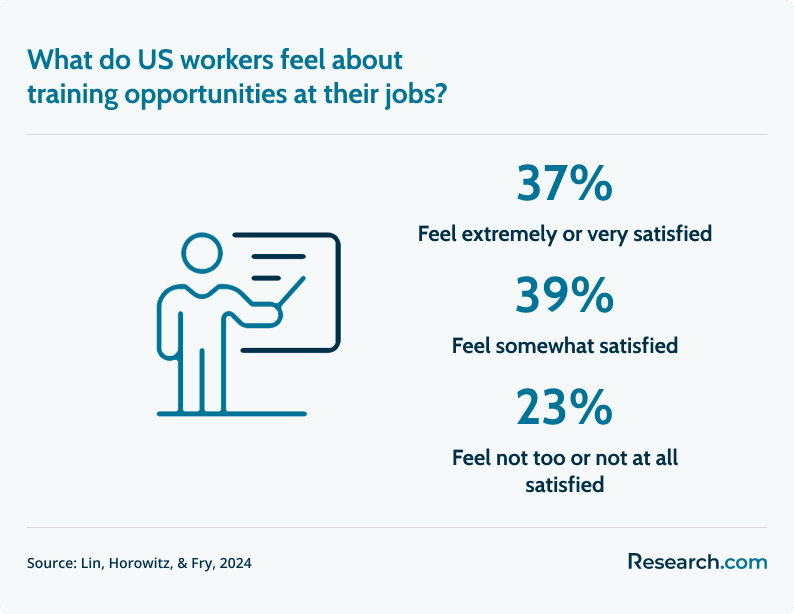
- 37% of US workers feel extremely satisfied or very satisfied with the training opportunities available at their jobs (Lin, Horowitz, & Fry, 2024).
- 39% feel somewhat satisfied, while 23% feel not too or not at all satisfied (Lin, Horowitz, & Fry, 2024).
What employers want from workers is also shifting. According to the Future of Jobs Report 2025, analytical thinking remains the top core skill, followed by resilience, flexibility, agility, leadership, and social influence. That means training has to go beyond technical instruction and also build judgment, communication, and adaptability.
For the 2025–2030 period, the World Economic Forum identifies AI and big data, networks and cybersecurity, and technological literacy as the fastest-rising skills. Future-ready programs should therefore blend digital capability with human strengths such as leadership, collaboration, motivation, and self-awareness.
Training Approach and Methodologies
The best training method depends on the role, the audience, the skill gap, and the business outcome. A software rollout, a compliance update, and a leadership program should not use the same design. When organizations choose a format before defining the result, they usually end up with low engagement or weak follow-through.
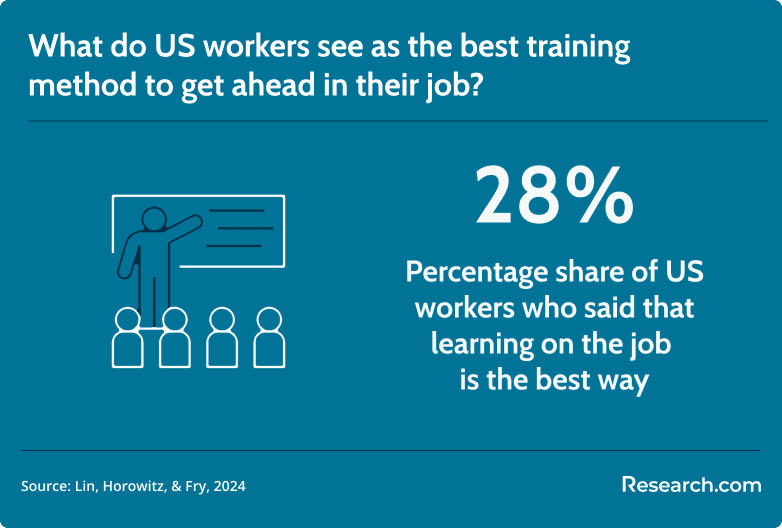
- 28% of US workers said on-the-job training is the best way to receive education and training for improving employability.
- 24% said certificate programs are the best option for professional training.
- 24% said formal education, including a 2-year, 4-year, or postgraduate degree, is the best route.
- 13% preferred classes or online tutorials.
- 10% were unsure which path works best.
Training delivery also varies by company size. Training Magazine’s 2025 report shows that small, midsize, and large employers all use a combination of self-paced digital learning, classroom instruction, virtual learning, and blended formats. Some employers also support formal education when a role requires broader academic preparation or a pathway into leadership. For example, professionals in social work may compare the cheapest MSW programs online when planning for long-term advancement.
- About 34% of training hours were delivered through online or computer-based technologies.
- 24% of training hours were delivered through virtual classrooms or webcasts.
- 28% of training hours were delivered through instructor-led classrooms.
- 92% of companies conducted some mandatory or compliance training online.
- 45% conducted mandatory or compliance training completely online.
- 76% of organizations offered IT or systems training online.
- Among the 11 learning technologies in Training Magazine’s 2025 report, learning management systems (LMSs) were the most widely used platform at 89%.
- 77% of organizations use virtual classrooms, webcasting, or video broadcasting for online training.
- 90% of large companies, 97% of midsize companies, and 84% of small companies use LMSs in training and development.
- 37% of companies now use artificial intelligence (AI), up from 25% in 2024.
- Learning content management systems (LCMSs) are used by 26% of organizations.
- Virtual reality (VR) and augmented reality (AR) remain rare, with less than 1% of companies using them.
| If the goal is... | Consider this training approach | Why it fits |
| Improve task performance quickly | On-the-job training, coaching, job aids, and short practice sessions | Employees learn in the same setting where they will use the skill. |
| Meet compliance requirements | Online modules with assessments and documentation | Completion records are easier to track consistently. |
| Build leadership capability | Blended learning, mentorship, simulations, and feedback | Leadership requires practice, reflection, and behavior change. |
| Support technical upskilling | Certificates, labs, guided projects, and assessments | Technical learning should demonstrate applied competence, not just attendance. |
| Prepare employees for promotion | Career pathways, stretch assignments, formal education, and coaching | Advancement usually requires both job knowledge and broader judgment. |
Employee Training Challenges and Effectiveness
One of the hardest parts of training is proving that it improved business results. CompTIA’s Workforce Learning Trends 2024 report identified connecting training to business outcomes as a major challenge. That matters because many organizations track completion, attendance, or satisfaction but never measure whether employees actually became more productive, more accurate, safer, or more likely to stay.
- 49% of survey respondents view skills-based hiring and related skills-first approaches as a “new and compelling approach.”
- 34% see these approaches as mostly a reframing of older ideas.
- 17% believe they are still undefined and evolving.
- 48% of HR leaders reported that skills-based hiring and talent development can take more time and cost more.
- 40% reported skills validation as a difficulty.
- 66% of HR professionals plan to implement workstyle or personality skills assessments, while 25% already use them.
- 61% plan to implement digital literacy assessments, such as PowerPoint and Excel tests, while 26% already use them.
- 79% of HR professionals said certifications are a major factor in hiring and candidate assessment. Professionals who need formal education may also compare online degree options. For example, students interested in psychology can research a psychology degree online Texas institutions offer, along with other state options.
Training Magazine’s 2024 and 2025 reports also show several operational barriers that slow results. Resource shortages and staffing remain the biggest issue, followed by learner engagement, budget pressure, and challenges with new technology.
- 41% of organizations said lack of resources and personnel was their top training challenge.
- 29% reported learner engagement as a challenge.
- 12% said budget cuts are a problem, and 11% reported difficulties implementing new technology.
LinkedIn’s 2024 Workplace Learning Report shows that L&D teams are paying more attention to business alignment and analytics.
- 54% more L&D professionals included analytical skills on their LinkedIn profiles in 2024 than in 2023.
- 36% use performance reviews to measure training impact.
- 34% use productivity indicators and 31% use retention indicators to track learning effectiveness.
| Common training mistake | Why it weakens results | Better alternative |
| Starting with a course instead of a performance problem | The training may not solve the real cause of poor performance. | Run a needs analysis before selecting a delivery method. |
| Measuring only attendance or completion | Completion does not prove the learner can use the skill. | Track job performance, manager observations, quality, productivity, and retention. |
| Using identical content for all employees | Beginners may get overwhelmed, while experienced staff disengage. | Segment learners by role, skill level, and career goal. |
| Choosing technology without adoption planning | Platforms can become expensive repositories instead of active learning tools. | Train managers, set expectations, and embed learning into workflows. |
| Ignoring employee career goals | Workers may see training as a requirement rather than a growth opportunity. | Link training to mobility, credentials, promotions, and development plans. |
How Employee Training Contributes to a Strong Company Culture
Training helps shape culture because it shows employees what the organization values. When development is connected to opportunity, feedback, ethics, performance, and safety, learning becomes part of everyday work instead of a one-time obligation.
- It makes learning continuous. Regular development helps employees expect change and adapt faster.
- It improves collaboration. Team training, communication practice, and cross-functional learning can reduce silos.
- It reinforces values. Leaders can use training to connect integrity, inclusion, accountability, service, and safety to behavior.
- It supports engagement. People are more likely to stay motivated when they believe the company is investing in them.
- It creates clearer advancement paths. Defined learning routes help employees understand what is needed for promotion.
Training Expenditure
Training budgets reveal how seriously employers are treating workforce development. In 2025, US spending on training and training staff payroll increased, although the mix of costs changed across company sizes and expense categories.
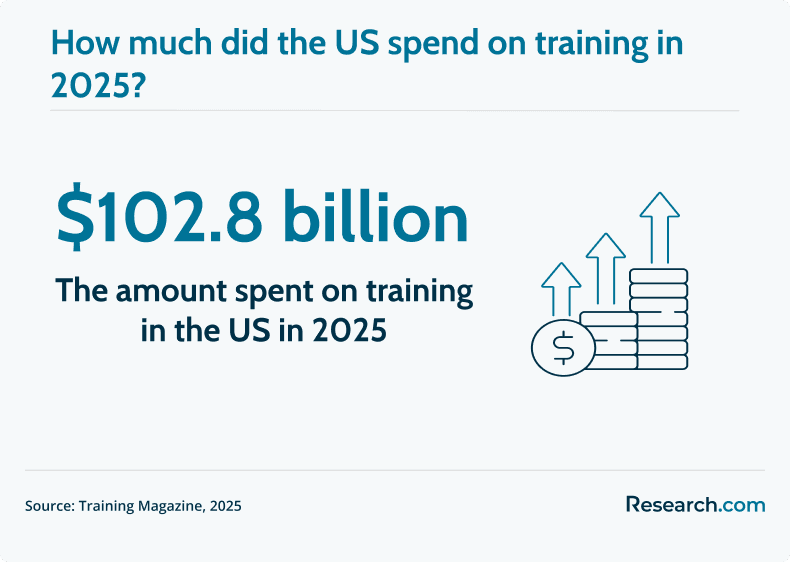
- US training expenditures increased by 4.9% to $102.8 billion in 2025, up from $98 billion in 2024.
- Payroll increased by 7% to $64.7 billion, from $60.6 billion in 2024.
- Outside products and services spending rose by 29% to $16 billion.
- Other training spending, including travel, facilities, and equipment, fell to $22.1 billion from $25 billion in 2024.
- Large companies reduced average training expenditures from $13.3 million in 2024 to $11.7 million in 2025.
- Midsize companies increased spending slightly from $1.5 million to $1.6 million.
- Small companies lowered training expenditures from $374,207 to $333,305.
- About 31% of organizations expanded staff in 2025, down from 38% in the previous year.
Organizations outsource training when they need specialized expertise, extra facilitation capacity, content development support, or technology services that are hard to build internally. Outsourcing may cover LMS hosting, instructor facilitation, leadership workshops, compliance content, or technical training. Some employer-supported learning also reaches beyond job tasks, including broader digital literacy or life-skills topics such as guidance on what age a child should get a phone.
- Average outsourced training spending fell to $217,178 in 2025 from $241,311 in 2024 (Training Magazine, 2025).
- Large US companies spent an average of $409,778 on outsourcing, midsize companies spent $309,431, and small companies spent $112,412.
- On average, 7% of the total training budget was spent on outsourcing in 2025.
- 26% of organizations mostly or completely outsourced LMS operations or hosting.
- 86% of organizations kept learner support and LMS administration in-house.
- 62% of training instruction or facilitation is outsourced.
- About 85% of organizations expect to keep outsourcing at the same level in 2026.
- 50% said they have no plans to outsource learning support or LMS administration within the year.
- 42% of midsize and small companies and 43% of large companies expect outsourcing costs to stay the same in 2026.
| Training budget area | Decision question leaders should ask |
| Internal payroll | Do we have enough L&D staff to design, deliver, analyze, and improve training? |
| Outside products and services | Are vendors filling a true expertise gap, or are we paying for work we could do internally? |
| Technology platforms | Will the LMS, LCMS, AI tool, or virtual classroom platform improve access, tracking, personalization, or outcomes? |
| Travel, facilities, and equipment | Is in-person delivery necessary, or could a blended model cut cost without hurting results? |
| Formal education support | Will tuition assistance or degree pathways help keep talent and prepare future hires? |
Emerging Trends and Forecasts
The training industry is being shaped by AI, skills-based hiring, hybrid work, online learning, digital credentials, and stronger pressure to show business impact. Employers are no longer satisfied with course completion alone. They want evidence that workers can apply what they learned and adapt as the business changes.
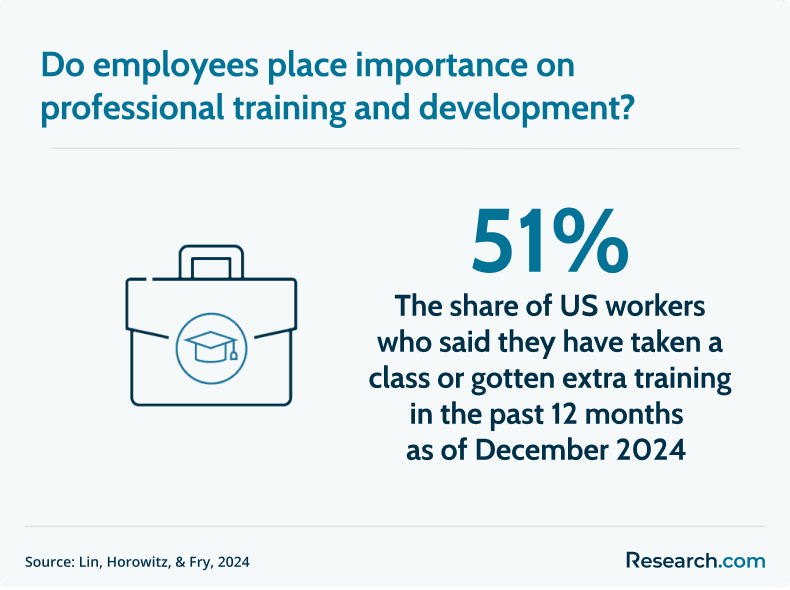
- 51% of US workers reported taking a class or receiving additional training within 12 months as of December 2024 (Lin, Horowitz, & Fry, 2024).
- 49% reported not receiving any training during that same period (Lin, Horowitz, & Fry, 2024).
- 53% of workers who said they need additional education also said they completed a class or received training in the previous 12 months, while 47% did not (Lin, Horowitz, & Fry, 2024).
- 73% of workers with a postgraduate degree said they received training in the past year (Lin, Horowitz, & Fry, 2024).
- 53% of workers with a bachelor’s degree reported receiving training in the past 12 months (Lin, Horowitz, & Fry, 2024).
- 50% of workers with some college education or less said they received training during the same period (Lin, Horowitz, & Fry, 2024).
- 62% of US workers said a major reason for taking training was to keep pace with field or industry requirements (Lin, Horowitz, & Fry, 2024).
Personalization is one of the biggest promises in modern learning technology, but it often falls short when programs are too generic. If employees are placed into broad pathways that ignore role, prior knowledge, or career goals, the experience still feels one-size-fits-all. Better assessments, adaptive learning, and manager feedback can make training more relevant.
Organizations looking to improve learning design may also benefit from expertise in human behavior, motivation, and assessment. People exploring HR, learning design, or organizational development may ask what you can do with a psychology degree, since psychology can support employee development and workplace behavior roles.
Accessibility and Affordability in Employee Training
Training is more accessible than it used to be because employees can learn through online courses, employer platforms, short credentials, virtual classrooms, and degree programs built for working adults. That flexibility is especially useful for companies with distributed teams, smaller budgets, or workers who cannot attend traditional in-person classes.
Still, affordable does not always mean effective. Employers should compare accreditation, curriculum relevance, transfer credit policies, learner support, completion expectations, and the connection to job roles. For employees interested in broader business knowledge, comparing the cheapest online business administration degree options can be one way to explore lower-cost academic paths.
Small and midsize employers should be especially careful to align education benefits with workforce planning. A low-cost program that does not support business needs may not improve performance. In some cases, a focused certificate, degree, or internal pathway will deliver more value because it prepares workers for roles the company actually needs.
Benefits of Online Training for the Training Industry
Online training is now a standard tool in workforce development because it helps organizations reach more people, control some costs, and deliver instruction consistently. It is especially useful for training distributed teams or documenting compliance completion.
- Lower delivery costs: Online programs can reduce travel, printed materials, facilities, and repeated live sessions.
- Scalability: Digital courses can reach large or geographically dispersed teams more easily than a single classroom.
- Flexible scheduling: Self-paced learning helps employees fit training around work obligations.
- Wider access: Remote employees and learners with mobility constraints can participate without commuting or relocating.
- Consistent instruction: Standardized modules help ensure that everyone receives the same core content.
- Trackable progress: Platforms can record completion, quiz scores, and other learning data.
Online training is not automatically superior to face-to-face instruction. It works best when the content is carefully designed, managers reinforce application, and assessments check actual competence. Learners comparing formal online options can review accredited self-paced online colleges that offer flexible programs.
What Are the Opportunities for Further Education and Training in the Field?
Further education can extend employee training beyond short-term courses. Depending on the role, employees may benefit from certificates, associate degrees, bachelor’s degrees, graduate programs, apprenticeships, bootcamps, licensing preparation, or industry credentials.
Healthcare is one example where formal pathways can be especially important. Employees interested in diagnostic imaging may research the best ultrasound tech schools as part of their advancement plan. The right choice depends on prerequisites, accreditation, clinical requirements, cost, location, and career goals.
| Learning option | Best for | What to check before enrolling |
| Internal company training | Role-specific processes, compliance, systems, and culture | Whether the program includes practice, manager support, and follow-up. |
| Certificate program | Targeted skill building and career changes | Employer recognition, assessment quality, and alignment with job requirements. |
| Associate or bachelor’s degree | Foundational academic preparation and career mobility | Accreditation, transfer credits, total cost, time to completion, and student support. |
| Graduate degree | Leadership, specialization, or advanced professional roles | ROI, tuition support, admissions requirements, and relevance to advancement goals. |
| Open enrollment course | Fast access to skill building without selective admissions | Course rigor, credential value, schedule, and whether credits transfer. |
How Can Higher Education Opportunities Complement Employee Training?
Higher education can complement workplace training when employees need deeper theory, stronger analytical skills, leadership preparation, or a formal credential. Internal training usually works best for company-specific systems and procedures, while colleges and universities can provide broader knowledge that supports strategic thinking across roles and industries.
Employers can connect tuition assistance, cohort partnerships, and career pathways to workforce planning. For example, companies preparing employees for finance, operations, marketing, or executive roles may evaluate the most affordable MBA options to balance cost with academic depth.
How Do Open Enrollment Programs Contribute to Employee Skill Development?
Open enrollment programs help employees start learning quickly because they do not require waiting for a traditional admissions cycle. They can be useful for technical refreshers, business fundamentals, professional certificates, and early-career exploration.
That said, employers should not treat every open enrollment course as equally valuable. Before reimbursing or recommending a program, check whether it includes meaningful assessment, recognized credentials, relevant content, and support for working adults. Employees who need flexible access may compare online colleges with open enrollment to see whether the format matches their goals.
How Can Employee Training Support Career Advancement?
Employee training supports career growth when it is tied to visible pathways. Workers need to know which skills, credentials, experiences, and performance outcomes lead to promotion or lateral movement. Training without a pathway may improve knowledge but still fail to keep ambitious employees engaged.
Career-focused development should combine technical skill building, leadership practice, mentoring, stretch assignments, feedback, and credential planning. Employees considering business leadership may also review highest paying MBA concentrations to understand how specialization may shape career direction, while remembering that salary outcomes are never guaranteed.
Measuring the ROI of Employee Training
Training ROI asks a simple question: did the value created by the training justify the investment? Not every program needs a dollar-based return. Safety, ethics, cybersecurity, and compliance training may be justified because they reduce risk. Other programs can be evaluated through productivity, quality, sales, customer satisfaction, retention, error reduction, or time-to-competence.
A sound ROI process starts before training begins. Organizations should define the problem, record baseline performance, choose the right intervention, measure learning, observe behavior change, and then compare the results with the original goal.
| ROI step | What to do | Example metric |
| Define the business goal | State the performance problem the training should solve. | Reduce errors, improve sales, increase retention, or shorten onboarding time. |
| Set a baseline | Measure performance before training begins. | Current productivity, customer satisfaction, compliance incidents, or turnover. |
| Measure learning | Use assessments, simulations, demonstrations, or supervisor reviews. | Test scores, skill demonstrations, completed practice tasks. |
| Measure behavior change | Check whether employees apply the training on the job. | Manager observations, work samples, quality checks, system data. |
| Connect to business outcomes | Compare post-training results with the baseline. | Productivity indicators, retention indicators, sales results, or error rates. |
For some workers, a shorter training pathway may be the better investment than a long degree. Employees exploring faster preparation may review short careers that pay well, but employers should still confirm fit, credibility, and job relevance before funding any program.
How Can Employee Training Evolve to Meet Future Business Demands?
Future training will need to be more adaptive, measurable, and aligned with business strategy. AI, learning analytics, virtual classrooms, simulations, and digital assessments can help scale development and personalize learning, but technology should support the learning goal rather than replace instructional design.
Organizations should also connect internal training with external education when future roles require broader business capability. Employees preparing for management responsibilities may explore online business management programs as one way to build strategic, operational, and leadership knowledge.
How Can Advanced Academic Pathways Enhance Employee Training?
Advanced academic pathways can help organizations develop employees who need research, analytics, management, or executive-level capability. These programs make the most sense when they support succession planning, innovation goals, consulting work, or leadership development.
Professionals seeking deeper business expertise may consider the most affordable DBA online programs as a way to combine applied business learning with advanced academic study. Employers should look closely at how the degree aligns with role expectations and long-term workforce needs.
What Are the Benefits of Integrating Accelerated Learning into Employee Training Programs?
Accelerated learning can help employees build skills faster when the curriculum is focused, well organized, and directly tied to work. It is especially useful when organizations face urgent skill shortages, new technology rollouts, compliance deadlines, or sudden market changes.
The main risk is that speed can reduce depth if the program is compressed without enough practice or feedback. Employers should choose accelerated models that still require real application. Employees who need a faster academic route may consider accelerated online business degrees, especially if they are balancing work, school, and advancement goals.
How Can Legal and Regulatory Insights Strengthen Employee Training?
Legal and regulatory training reduces risk and helps employees make better decisions. Workers who understand compliance, business law, ethics, privacy, employment rules, and industry regulations are less likely to make costly errors and more likely to escalate concerns properly.
Effective compliance training should use realistic scenarios, role-specific examples, clear reporting steps, and regular refreshers. Professionals who need deeper legal knowledge for business roles may explore master of business law online programs as a targeted academic option.
Questions to Ask Before Choosing an Employee Training Strategy
- What exact business problem or skill gap should this training solve?
- Is training the real solution, or is the issue caused by poor tools, unclear processes, staffing shortages, or weak incentives?
- Which employees need the training, and what do they already know?
- Should the program be instructor-led, online, blended, on-the-job, or linked to a formal credential?
- How will managers reinforce learning after the course ends?
- What evidence will show the training worked?
- Does the program support retention, promotion, or succession planning?
- Are vendors, platforms, or academic partners accredited, reputable, and relevant to the organization’s needs?
- What is the full cost, including work time, technology, facilitation, content updates, and support?
- How will the organization keep training current as AI, cybersecurity, compliance, and industry expectations change?
Common Mistakes to Avoid When Evaluating Training
- Choosing a course before defining the performance problem.
- Judging success only by enrollment or completion.
- Using the same program for beginners and experienced employees.
- Buying technology without a rollout plan or manager support.
- Ignoring employee career goals and internal mobility.
- Assuming online learning is always cheaper once support, maintenance, and follow-up are included.
- Assuming salary or job promotion is guaranteed after training.
Key Insights
- Employee training is now a business strategy, not just an HR function. In 2024, US organizations allocated an average of $1,254 per participant of employee learning (ATD, 2025).
- Training budgets are still large. US training expenditures increased by 4.9% to $102.8 billion in 2025, up from $98 billion in 2024.
- Digital tools are central to modern learning. Learning management systems were used by 89% of organizations, and 37% now use AI in training, up from 25% in 2024.
- Online learning matters, but it is not the only effective method. Instructor-led, virtual, blended, and mobile learning still play important roles depending on the skill and audience.
- The biggest training challenge is not content access. It is proving business impact, building learner engagement, and making sure employees can apply what they learned.
- Future-ready training must support both technical skills and human skills. AI and cybersecurity matter, but so do analytical thinking, leadership, resilience, and adaptability.
- The best programs start with a needs analysis, match the method to the objective, and measure outcomes beyond completion.
- Higher education, certificates, open enrollment programs, accelerated learning, and online degrees can complement workplace training when they are aligned with real career and business goals.
References
- Association for Talent Development. (2019, December 6). Learning by the numbers. ATD. https://www.td.org/magazines/td-magazine/learning-by-the-numbers#gsc.tab=0
- Association for Talent Development. (2025). 2025 State of the Industry Report. https://www.td.org/product/research-report--2025-state-of-the-industry-talent-development-benchmarks-and-trends/192507
- Berkley, R. A., & Kaplan, D. M. (2019). Strategic training and development. New York, NY: SAGE Publications, Inc. https://us.sagepub.com/en-us/nam/strategic-training-and-development/book250876
- CompTIA. (2024). Workforce and Learning Trends. https://comptiacdn.azureedge.net/webcontent/docs/default-source/research-reports/comptia-workforce-and-learning-trends-2024.pdf?sfvrsn=68a665ab_10
- Department of Labor. (2014). What works in job training: A synthesis of the evidence. https://www.dol.gov/sites/dolgov/files/OASP/legacy/files/jdt.pdf
- Freifeld, Lori. (2024, November 20). Training Industry Report. Training Magazine. https://trainingmag.com/2024-training-industry-report
- Goldstein IL, Ford JK. (2002). Training in organizations: Needs assessment, development, and evaluation. Belmont, CA: Wadsworth. 4th ed.
- Harward, D., & Taylor, K. (2014). What makes a great training organization?: A handbook of best practices. Pearson Education. https://ptgmedia.pearsoncmg.com/images/9780133491968/samplepages/013349196X.pdf
- Huhn, P. (2019, June 11). Forecast: Industry revenue of “business schools, computer and management training“ in the U.S. 2011-2023. Statista. https://www.statista.com/forecasts/311191/business-schools-computer-and-management-training-revenue-in-the-us
- Kempski, L. (2019, November 25). State of the training industry with Ken Taylor. d’Vinci Interactive | A Custom e-Learning Solutions Company. https://www.dvinci.com/thinking/state-of-training-industry-with-Ken-Taylor
- LinkedIn Learning. (2020). 2020 Workplace Learning Report (4). https://learning.linkedin.com/content/dam/me/learning/resources/pdfs/LinkedIn-Learning-2020-Workplace-Learning-Report.pdf
- LinkedIn Learning. (2024). Workplace Learning Report 2024. https://learning.linkedin.com/content/dam/me/business/en-us/amp/learning-solutions/images/wlr-2024/LinkedIn-Workplace-Learning-Report-2024.pdf
- Lin, L., Horowitz, J. M., & Fry, R. (2024, December 10). Most Americans Feel Good About Their Job Security but Not Their Pay. Pew Research Center. https://www.pewresearch.org/social-trends/2024/12/10/job-satisfaction
- Mazareanu, E. (2019, September 12). Greatest contributors to employee satisfaction U.S. 2019. Statista. https://www.statista.com/statistics/717104/greatest-contributors-to-employee-satisfaction
- Training Magazine. (2024, November 20). 2024 Training Industry Report. https://trainingmag.com/2024-training-industry-report
- Training Magazine. (2025, November 10). 2025 Training Industry Report. https://trainingmag.com/2025-training-industry-report
- Urdan, T. A., & Weggen, C. C. (2000). Corporate e-learning: Exploring a new frontier (415.551.8600). WR Hambrecht + Co. https://papers.cumincad.org/data/works/att/2c7d.content.pdf
- Van Nuys, A. (2019, December 28). New LinkedIn research: Upskill your employees with the skills companies need most in 2020. Online Learning & Training Platform for Organizations | LinkedIn Learning. https://learning.linkedin.com/blog/learning-thought-leadership/most-in-demand-skills-2020
- World Economic Forum. (2025). The future of jobs report 2025. https://reports.weforum.org/docs/WEF_Future_of_Jobs_Report_2025.pdf
- Yazdanifard, R., Maimuna, M., & Nda. (2013). The impact of employee training and development on employee productivity. Global Journal of Commerce and Management Perspective, 2. https://www.researchgate.net/publication/260219097_THE_IMPACT_OF_EMPLOYEE_TRAINING_AND_DEVELOPMENT_ON_EMPLOYEE_PRODUCTIVITY
Other Things You Should Know About The Training Industry
In 2027, organizations are expected to spend an average of 5% more on employee training compared to the previous year. The increased investment focuses mainly on digital training solutions and upskilling initiatives to adapt to rapidly changing industry demands.
In 2027, organizations use advanced analytics and AI to craft personalized training experiences. These technologies analyze employee skill gaps and learning preferences, tailoring content to enhance engagement and improve individual performance. This approach ensures training is relevant and maximizes learning outcomes.
In 2027, common methods of employee training delivery include e-learning platforms, virtual reality (VR) simulations, hybrid in-person and online sessions, and mobile learning applications. These approaches cater to diverse learning styles and provide flexibility for both employers and employees in training schedules.
Key challenges include lack of leadership support, insufficient budget, time constraints, and difficulty in getting managers to prioritize employee learning. Additionally, creating a culture of learning and driving engagement are significant hurdles.
Effectiveness is measured through evaluation comments, which collect quantitative and qualitative data on training impact. Metrics include employee engagement and participation, progress in performance, and feedback on training materials and delivery methods.
Emerging technologies like virtual reality (VR), augmented reality (AR), and artificial intelligence (AI) enhance the personalization and relevance of training programs. These technologies enable immersive learning experiences and more effective skill development.
Organizations increasingly use external training services to bridge skill gaps that internal training cannot address effectively. In 2025, large companies in the U.S. spent $409,778 on outsourced training services.


