2027 Leadership Development: Training Program, Key Elements and Trends

Co-Founder and Chief Data Scientist
Leadership Development Programs: What They Are, Who Needs Them, and How to Choose One
Many organizations still promote high performers into management and assume leadership will follow. In practice, that transition often exposes a skill gap: leading people requires coaching, conflict resolution, delegation, accountability, and strategic judgment—not just technical excellence. Leadership development programs are designed to close that gap before it hurts retention, culture, execution, and succession planning.
This guide explains what leadership development programs are, which formats exist, how much they typically cost, how long they take, and how to evaluate whether one is worth the time and money. It is written for current and future managers, HR and learning teams, executives, and professionals comparing training with degree-based options such as business, leadership, or management programs.
The need is timely. LinkedIn Learning reported that 82% of learning and development professionals now view leadership and management skills as important or very important in 2025. At the same time, organizations are being asked to develop stronger leaders while adapting to AI, changing employee expectations, cybersecurity pressure, and tighter budgets.
Quick Answer: What Is a Leadership Development Program?
A leadership development program is a structured experience that helps people improve how they lead others, make decisions, communicate, manage change, and support organizational goals. Depending on the format, it may include coaching, assessments, workshops, simulations, mentoring, online coursework, or degree-level study. The most effective programs are tied to real job responsibilities and include feedback before, during, and after training.
What readers should know right away
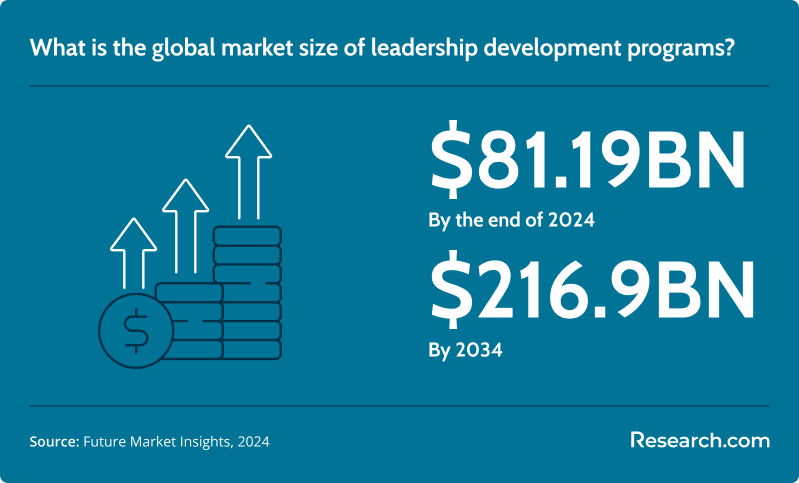
- The global leadership development program market is expected to be valued at $81.19 billion by the end of 2024 and reach $216.9 billion by 2034.
- Instructor-led training is the most commonly used leadership development method, with 56% of business leaders choosing it, followed closely by professional coaching at 54%.
- About 62% of business managers do not know what their jobs entail, let alone inspire their teams to perform well.
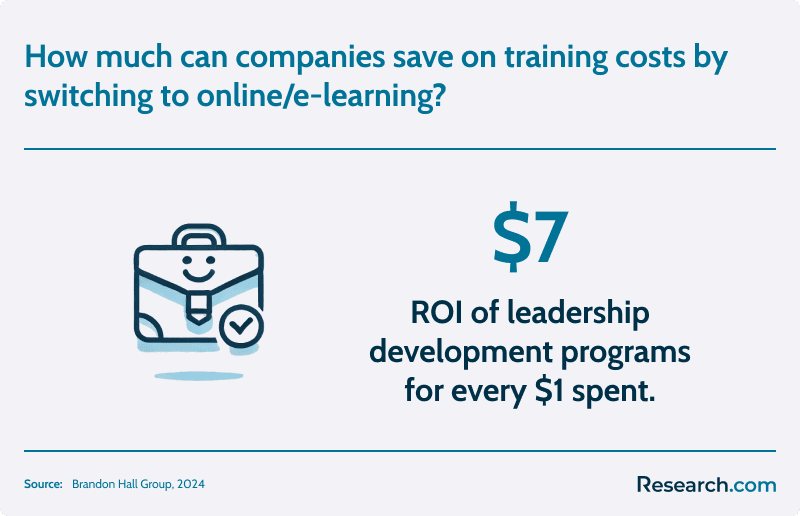
- Organizations see a $7 ROI per dollar spent on leadership development.
- The average leadership training budget for managers sank from $1,247 per manager in 2023 to $312.5 in 2024.
- The average amount spent on leadership development per employee is $183.
What this guide covers
- What leadership development is and how it works
- The main types of leadership training programs
- The core elements of strong leadership development
- Essential leadership skills to build
- The real benefits of leadership training
- How much leadership development programs cost
- How long different program formats take
- How leadership development shapes culture
- The biggest leadership challenges organizations face
- Emerging trends changing leadership training
- How to evaluate program quality
- How to measure success after training
- Why cultural intelligence matters
- How ethical leadership is built
- How leadership development can affect salary growth
- What accelerated academic programs add
- How legal literacy supports better leadership
- How technology is changing leadership development
- How leadership development supports career advancement
- Specialized leadership development by field
- When advanced leadership education makes sense
- Key insights
Why Leadership Development Matters Now
Leadership problems usually show up after a promotion. A strong individual contributor becomes a manager, then has to give feedback, delegate work, resolve tension, and lead through uncertainty with little formal preparation. That can create confusion for the new leader and frustration for the team.
Leadership development matters because it gives people a chance to practice those responsibilities before they become high-stakes problems. It also helps organizations build a stronger leadership pipeline, improve communication, and reduce the cost of poor management.
For employees, the payoff is practical: better confidence, stronger decision-making, and greater readiness for promotion. For employers, the payoff is organizational: better engagement, more consistent performance, and better succession planning.
What is leadership development?
Leadership development is the deliberate process of building the mindset, habits, and skills needed to guide people and organizations effectively. It can apply to first-time supervisors, mid-level managers, nonprofit leaders, school administrators, healthcare managers, and executives preparing for larger responsibility.
Unlike one-time training, leadership development works best as an ongoing process. A person may learn a concept in a workshop, apply it on the job, receive coaching, reflect on feedback, and then adjust their approach over time. The goal is behavior change, not just awareness.
This kind of development is used across many industries, including business, healthcare, government, education, manufacturing, technology, retail, and hospitality and tourism. The context changes, but the leadership challenge stays similar: align people, priorities, and resources around results.
The growth in this market reflects how central leadership has become. A 2024 Future Market Insights report projects the global leadership development program market will be valued at $81.19 billion by the end of 2024 and reach $216.9 billion by 2034, at a 10.3% annual growth rate.
What effective leadership development usually includes
- Clear structure: Participants should know what the program is trying to change and how progress will be tracked.
- Multiple learning methods: Strong programs often combine coaching, workshops, peer discussion, assessments, mentoring, and simulation.
- Competency-based learning: Topics usually include communication, delegation, decision-making, influence, accountability, and change leadership.
- Applied practice: People should use the skills in real work settings rather than only talk about theory.
- Feedback loops: High-quality programs include self-assessments, manager input, peer feedback, or other ways to measure growth.
What are the different types of leadership training programs?
Leadership training comes in several formats because participants have different goals, schedules, and levels of experience. Instructor-led training remains the most widely used approach, chosen by 56% of business leaders, followed by professional coaching at 54%. Leadership assessments are also common, with 56% of potential business leaders saying they plan to use them to evaluate performance.
Some programs are designed for employees moving into their first management role. Others are meant for executives who oversee strategy, governance, and organizational change. Academic pathways can also build leadership capacity, especially for professionals who want a formal credential along with management training. In business-focused study plans, leadership coursework often appears in business master's degree programs, part-time MBA programs, and leadership-oriented degrees.
| Program type | Best for | What it usually develops | When it makes sense |
| Skill-based leadership training | Employees or managers with a specific gap | Communication, feedback, conflict resolution, delegation, and decision-making | Use this when the problem is narrow and tied to day-to-day behavior. |
| New manager or managerial development programs | First-time supervisors and newly promoted managers | Performance management, coaching, accountability, and team expectations | Best when strong individual contributors are stepping into people management. |
| Executive leadership development | Senior managers, directors, executives, and succession candidates | Strategy, influence, change leadership, governance, and cross-functional alignment | Useful when decisions affect multiple teams or the whole organization. |
| Cross-functional leadership training | Leaders working across departments, regions, or business units | Collaboration, systems thinking, stakeholder management, and shared decision-making | Choose this when silos and misalignment are slowing execution. |
| Personal development workshops | Professionals who need more self-awareness before leading others | Emotional intelligence, resilience, confidence, and authentic leadership | Helpful when leadership issues are tied to trust, communication style, or self-management. |
| Virtual leadership development | Remote teams and distributed organizations | Digital communication, online collaboration, and remote team management | Practical when travel or geography makes in-person training harder. |
| Industry-specific leadership programs | Leaders in regulated or specialized sectors | Sector-specific compliance, decision-making, and operational issues | Best when generic leadership examples do not fit the work. |
| Diversity, equity, and inclusion leadership development | Managers responsible for inclusive teams | Inclusive communication, bias awareness, cultural competence, and psychological safety | Useful when the goal is fairer management and stronger team belonging. |
| Team-building leadership workshops | Teams needing better collaboration | Trust, communication norms, conflict management, and shared accountability | Better when the issue is team performance rather than individual knowledge. |
| Coaching and mentoring programs | Managers who need individualized support | Behavior change, confidence, judgment, and executive presence | Strong choice when development requires tailored feedback and privacy. |
Before selecting a format, define the real need. Is the organization trying to prepare future managers, improve current managers, develop executives, or support a culture change? The answer should shape the program.
What are the key elements of leadership development?
A useful leadership program should focus on a few high-impact capabilities instead of trying to cover every possible leadership topic. The most valuable elements tend to be communication, coaching, accountability, influence, and change management.
Communication
Leadership communication is not just public speaking. It includes setting expectations, explaining priorities, sharing feedback, and handling sensitive conversations with clarity and care. Leaders do this in meetings, one-on-ones, presentations, email, chat, and informal conversations.
Good communication also affects trust. In research involving public university administrators in Malaysia, soft skills were found to be closely related to perceived trustworthiness, and frequent interaction increased staff trust. That is a reminder that communication is not a soft extra; it is part of how teams decide whether to follow a leader.
The best programs help participants practice communication under pressure through role play, coaching, feedback, and workplace application.
Coaching
Coaching is the ability to help people improve, solve problems, and grow. It is different from formal evaluation. A coach asks better questions, gives timely feedback, and helps employees connect their work to goals and development.
Gallup has reported that only 30% of employees strongly agree that they have someone at work who encourages their development. That gap explains why good leadership programs emphasize ongoing feedback instead of annual reviews alone.
Coaching also improves team learning. When leaders coach well, they create more openness, better problem-solving, and stronger working relationships.
Accountability
Leadership accountability means owning results, clarifying responsibilities, and making sure people understand what they are responsible for. Once a person becomes a manager, success depends on team performance as much as personal output.
Leaders need to define roles, monitor commitments, and review progress without turning the workplace into a blame culture. A Landmark Workplace Accountability Study by Partners in Leadership, which included 40,000 participants, found that 93% cannot take responsibility for the outcomes of their tasks because goals and priorities are unclear. Participants also pointed to leadership behavior as a major factor in organizational responsibility.
Accountability works best when expectations are specific and support is available when obstacles appear.
Influence and negotiation
Modern leaders often have to influence people who do not report directly to them. That is especially true in matrix organizations, cross-functional teams, and senior leadership roles. They must build trust, persuade stakeholders, and negotiate competing priorities.
Influence is not manipulation. It is the ability to create commitment through credibility, clarity, and understanding. Negotiation supports that process by helping leaders resolve conflict and reach workable agreements.
Change management
Change is now a normal part of leadership. Markets shift, technology moves quickly, teams evolve, and customer expectations change. Leaders are expected to help people adapt while still delivering results.
Change management gives leaders a framework for handling resistance, explaining the reason for change, and helping teams adopt new behaviors. Prosci reports that 88% of companies with excellent and established change management programs have met or exceeded their goals.
That same source says organizations and teams trained to handle significant change are six times more likely to meet their goals than those with poor change management experience, while even average change management programs are three times more likely to succeed than those without.
What are the essential skills for effective leadership?
Effective leadership is built from a combination of interpersonal skill, self-awareness, business judgment, and execution. These are not personality traits alone. They show up in how people communicate, decide, delegate, and respond to pressure.
| Leadership skill | What it looks like in practice | How to build it |
| Clear communication | Explaining expectations, priorities, and feedback in ways others can act on | Practice difficult conversations, active listening, presentations, and writing. |
| Emotional intelligence | Recognizing your own reactions and responding thoughtfully to others | Use reflection, coaching, 360-degree feedback, and peer input. |
| Strategic vision | Connecting current work to long-term goals and direction | Study strategy, market context, and planning frameworks. |
| Decision-making | Choosing quickly and carefully while weighing risk and trade-offs | Use case studies, simulations, and after-action reviews. |
| Empathy | Understanding others’ perspectives without giving up accountability | Hold regular one-on-ones and ask better questions. |
| Adaptability | Adjusting plans when conditions change | Work on change projects and scenario planning. |
| Influence | Building commitment without depending only on authority | Develop stakeholder mapping, persuasion, and relationship skills. |
| Delegation | Matching work to strengths while keeping ownership clear | Define outcomes, decision rights, and follow-up points. |
| Coaching and feedback | Helping others improve through timely guidance | Practice feedback models and coaching conversations. |
| Conflict resolution | Addressing disagreements before they damage trust or performance | Learn mediation and interest-based problem-solving. |
One reason leadership development matters is that many managers are unclear about what their role actually requires. If a person does not understand the job, motivation alone will not fix the problem. Role clarity has to be part of the training.
What are the benefits of leadership training?
Leadership training works best when it is connected to the realities of the job. When it is well designed and supported, it can improve retention, strengthen decision-making, support change, and prepare people for promotion. But the benefits depend on relevance, follow-up, and measurement.
Benefits for organizations
- Better retention: Leadership behavior affects whether employees stay. One study found that 57% of employees left their previous jobs because of their managers. Employees who feel cared for and appreciated by their managers are 65% more likely to be loyal.
- Stronger change readiness: Up to 86% of companies with well-developed leadership training programs can adapt to rapid change more effectively.
- Improved financial results: Organizations see a $7 ROI per dollar spent on leadership development. About 98% of organizations with ongoing leadership training report better results. Harvard Business Review has also reported stronger market returns among organizations that invest in developing people.
- Better succession planning: Programs help identify and prepare employees who can move into larger roles.
- More consistent management: Training gives managers a shared language for coaching, accountability, feedback, and decision-making.
Benefits for employees
- Role clarity: Employees learn what leadership responsibilities actually involve.
- Skill growth: Future managers can build management and communication skills before promotion.
- Better problem-solving: Leaders learn to analyze issues and make decisions aligned with broader goals.
- Career mobility: Training can help with promotion readiness, internal mobility, and advanced study.
- More confidence: Participants gain tools for conflict, delegation, and difficult conversations.
Training has the most impact when participants are given real opportunities to use what they learn. A coaching module should be followed by coaching practice. A change management module should connect to an actual change initiative.
What is the average cost of a leadership development program?
Leadership development costs vary widely. Price depends on the program format, whether it is customized, how senior the participants are, how long it lasts, and whether it is part of a degree program. A short coaching engagement may cost a few hundred dollars, while degree-based leadership education can cost much more.
| Program format | Typical cost stated | Best use case |
| Coaching or one-on-one training | $250 to $350 per hour; for top executives, the rate can go up to about $500 per hour | Personalized support for managers, executives, or high-potential employees. |
| Organization-specific leadership training | $250 to $400 per hour for a class with 15 to 20 trainees, or $2,000 to $4,500 per day | Training tied to company culture, internal competencies, and business goals. |
| College leadership courses | Around $3,000 per course | Leadership coursework inside undergraduate business degrees, programs from the best MBA schools, and similar graduate degrees. |
| Online leadership training | Starts at around $450 per month or $5,400 per year | Flexible development for working professionals and distributed teams. |
How to decide whether the price is justified
- Match the cost to the importance of the role being developed.
- Include hidden costs such as travel, software, assessments, and time away from work.
- Ask how the program will measure behavior change or business impact.
- Look for follow-up support, because one-time training often fades without reinforcement.
How long does it take to finish a leadership development program?
Leadership development can last a few days, several months, a year, or longer. The right length depends on the goal. A short workshop may help with a single skill, but deeper behavior change usually needs repetition, coaching, and practice.
| Program length | Typical duration | Best fit | Limitations |
| Short intensive program | 2-4 days | Leadership boot camps, simulations, and urgent skill-building | Limited behavior change unless followed by practice and coaching. |
| Traditional leadership development program | 3-6 months to a year | New managers, high-potential employees, and broader development tracks | Needs manager support and steady participation. |
| Long-term executive program or fellowship | Over a year or multiple years | Senior leaders and succession candidates | Requires more time and money. |
| Degree-based leadership education | Often built into undergraduate business degrees, MBAs, and graduate programs | Professionals who want academic credentials and leadership development | Longer and more expensive than nondegree training; for example, an MBA can take around two to three years. |
How can leadership development improve organizational culture?
Culture is shaped by what leaders model, reward, tolerate, and communicate. Leadership development improves culture when it changes everyday managerial behavior in ways employees can see and feel.
- It reinforces learning: Leaders who learn publicly make it easier for employees to do the same.
- It supports inclusion: DEI-focused training helps leaders build teams where more voices are heard.
- It improves communication: Clearer leadership reduces confusion and avoidable conflict.
- It increases engagement: Recognition, coaching, and care can improve morale and commitment.
- It builds resilience: Leaders trained in adaptation can help teams stay focused during change.
Culture change takes more than training. If senior leaders behave in ways that contradict the lessons, the program will have little effect. Incentives, promotion decisions, and executive behavior all need to match the leadership model the organization wants.
What are the biggest challenges in organizational leadership?
Leadership is becoming more complex because leaders must manage people, technology, risk, and constant change at the same time. A 2024 report found that C-suite executives see changing worker expectations at 33%, cybersecurity threats at 32%, keeping up with AI and other modern solutions at 30%, and hiring and developing new talent at 30% as major leadership challenges.
Budget pressure makes the problem harder. The average leadership training budget for managers dropped from $1,247 per manager in 2023 to $312.5 in 2024, and the average amount spent on leadership development per employee is $183.
That means organizations must choose carefully. Generic training may not justify limited budgets. Programs that are tightly connected to real business needs are more likely to matter.
Common leadership challenges organizations must solve
- Managers are promoted without enough preparation in feedback, delegation, and conflict resolution.
- Remote and hybrid teams require stronger trust-building and communication.
- AI and automation are changing workflows quickly.
- Employees want more transparency, flexibility, development, and purpose.
- Succession pipelines are weak because high-potential employees are not developed early enough.
- Training budgets are shrinking even as leadership expectations increase.
What are the emerging trends shaping leadership development programs?
Leadership development is shifting toward more personalized, measurable, and technology-enabled learning. At the same time, organizations are asking harder questions about return on investment and practical business impact.
- More personalized pathways: Assessments and analytics are being used to tailor learning to role, strengths, and gaps.
- Greater focus on emotional intelligence: Programs increasingly emphasize self-awareness, empathy, listening, and trust.
- More tech-supported learning: Learning platforms, virtual classrooms, AI tools, and simulations are expanding access and flexibility.
- Stronger ROI pressure: Organizations want clearer evidence that training improves retention, readiness, performance, or execution.
- More attention to ethics and inclusion: Leaders are expected to make fair, transparent, and socially responsible decisions.
Technology can improve reach and personalization, but leadership remains relational. Coaching, manager support, and real workplace practice still matter most.
What criteria determine a high-quality leadership development program?
A strong program should be practical, measurable, and matched to the participant’s role. It should do more than inspire. It should define what people will do differently after the training ends.
| Selection criterion | What to look for | Why it matters |
| Clear learning outcomes | Specific competencies such as coaching, delegation, strategy, or change leadership | Vague goals are hard to measure. |
| Role relevance | Content matched to new managers, mid-level leaders, executives, or industry needs | Different leadership levels need different tools. |
| Qualified facilitators | Instructors with leadership experience, coaching skill, industry knowledge, or academic expertise | Facilitator quality affects trust and usefulness. |
| Real-world application | Case studies, simulations, workplace projects, or action learning | Practice is what changes behavior. |
| Assessment and feedback | Pre-assessments, 360-degree feedback, coaching notes, or progress reviews | Feedback shows blind spots and progress. |
| Flexible delivery | In-person, blended, virtual, cohort-based, or self-paced options | The format should fit work and life constraints. |
| Post-program support | Mentoring, manager check-ins, alumni groups, or follow-up modules | Reinforcement helps skills stick. |
Professionals looking for a credential-based path can also compare academic options such as accredited online certificate programs. The right choice depends on whether the goal is immediate performance improvement, a recognized credential, or a step toward a degree.
How can organizations measure the success of leadership development programs?
Organizations should decide how success will be measured before the program begins. A training initiative aimed at reducing turnover should not be evaluated in the same way as a program intended to prepare executives or improve change adoption.
| Measurement area | Possible indicators | How to use the data |
| Participant learning | Assessments, knowledge checks, reflection assignments, facilitator evaluations | Shows whether participants understood the material. |
| Behavior change | Manager observations, 360-degree feedback, coaching notes, peer feedback | Shows whether new behaviors are being used on the job. |
| Team outcomes | Engagement, retention, absenteeism, productivity, conflict trends | Shows whether leadership behavior is affecting teams. |
| Career progression | Promotion rates, readiness for succession roles, internal mobility | Shows whether the program is building the leadership pipeline. |
| Business impact | Operational efficiency, project success, change adoption, customer outcomes, ROI | Shows whether the program supports strategic goals. |
Quantitative data is strongest when paired with feedback from participants, managers, direct reports, and stakeholders. Some organizations also compare leadership training with academic routes, such as accredited online business degree programs, when deciding whether employees need targeted training, broader education, or both.
How can cultural intelligence drive leadership success?
Cultural intelligence helps leaders work effectively across differences in nationality, language, region, identity, and communication style. It matters most in global teams, multinational organizations, and cross-border partnerships.
Leaders with stronger cultural intelligence are less likely to make assumptions and more likely to adapt communication and decision-making to the situation. That can improve trust, reduce misunderstandings, and support more inclusive leadership.
Leadership programs can build cultural intelligence through case studies, simulations, peer learning, and reflection on bias and communication norms. Professionals who want a broader business foundation may also compare leadership development with options such as an affordable online MBA.
How do leadership development programs foster ethical leadership and social responsibility?
Ethical leadership development helps participants make decisions with integrity, transparency, fairness, and accountability. This matters because leaders often face choices where compliance, business pressure, employee well-being, and public trust overlap.
Strong programs use realistic scenarios instead of simplistic examples. Participants may examine conflicts of interest, privacy issues, workforce decisions, vendor relationships, environmental questions, or governance failures. The aim is to build judgment, not memorize rules.
For professionals seeking more advanced study, a low cost online doctorate in business administration can provide a deeper framework for research, strategy, and organizational decision-making.
What is the impact of leadership development on compensation and salary growth?
Leadership development can support salary growth indirectly by helping professionals become ready for higher-responsibility roles. It may improve promotion readiness, strengthen performance, expand networks, and help workers show higher-level capability. But it cannot guarantee a raise, bonus, or promotion.
Compensation still depends on industry, geography, employer, experience, performance, and market demand. Leadership development is most useful when combined with visible results, credible credentials, and relevant experience.
Professionals thinking about the earning potential of leadership-focused business pathways may also compare options such as high-paying MBA concentrations.
What role do accelerated academic programs play in enhancing leadership growth?
Accelerated academic programs can help motivated professionals gain business and leadership knowledge more quickly than traditional routes. They are best for learners who want a formal credential and can handle a faster pace of study.
These programs often combine leadership concepts with coursework in strategy, management, communication, organizational behavior, and decision-making. An accelerated online bachelor's degree in business may be a useful option for working adults who want to move toward management while completing an undergraduate degree.
Accelerated should not be confused with easy. Students still need to review workload, transfer-credit rules, accreditation, cost, and whether the schedule fits work and family obligations.
How can legal expertise shape ethical leadership decisions?
Legal literacy can strengthen leadership by helping managers understand compliance, employment risk, contracts, governance, and regulatory change. Leaders do not need to become lawyers, but they do need to know when a decision has legal or ethical consequences.
This is especially relevant in regulated industries and in roles tied to HR, healthcare, finance, operations, public administration, and technology. Legal awareness helps leaders ask better questions, document decisions carefully, and work more effectively with counsel.
Professionals seeking formal preparation at the intersection of business and law may explore a master business law online program.
How is technology used to enhance leadership development?
Technology makes leadership development more flexible and scalable. Online platforms let busy professionals complete modules, attend virtual sessions, and collaborate across locations. Mobile learning can also support small, repeated practice sessions instead of one-time events.
Virtual reality and simulation tools can help participants rehearse difficult conversations in a lower-risk setting. Adaptive learning systems can adjust content based on progress, and 360-degree feedback tools can gather input from multiple sources.
AI tools may support coaching prompts or practice exercises, but they should not replace human judgment. Leadership involves context, emotion, and trust, so the strongest programs still rely on coaching, manager support, and real workplace application.
Pathways to advanced leadership roles through higher education
Leadership development programs build practical skills, while higher education can add depth, credentials, and professional networks. The right choice depends on where someone is in their career. A certificate may be enough for a new manager. A master's degree, MBA, or doctorate may be a better fit for professionals pursuing senior leadership, teaching, consulting, or research-based roles.
Why professionals choose advanced education for leadership growth
- More depth: Graduate study often covers strategy, finance, organizational behavior, analytics, and leadership theory in greater detail.
- Stronger networks: Programs can connect students with faculty, alumni, peers, and employers.
- Credential value: A recognized degree can support roles where advanced study is expected.
- Greater flexibility: Education can help professionals move across industries or into broader roles.
For working adults, online MBA programs with no GMAT requirements may be worth comparing. As always, students should review accreditation, curriculum, admissions requirements, total cost, faculty, support services, and outcomes before enrolling.
How can leadership development programs contribute to career advancement?
Leadership development can help people move into roles that require people management, cross-functional influence, strategic thinking, and change leadership. It also helps employees show readiness before a promotion opens up.
Early-career professionals may use leadership training to move from individual contributor to supervisor. Mid-career managers may use it to improve team results and prepare for department-level responsibility. Senior leaders may use it to strengthen executive presence and enterprise thinking.
Leadership development can also work alongside advanced study. For example, a professional pursuing a PhD in Educational Leadership online may use leadership training to turn theory into practical decision-making and team leadership. The degree can build conceptual depth, while leadership development builds workplace execution.
Career growth still depends on results. Participants should apply new skills to visible work, track outcomes, seek feedback, and explain how their leadership has improved performance.
What opportunities exist for specialized leadership development in different fields?
Leadership development is not limited to corporate settings. Specialized programs exist for education, healthcare, technology, nonprofit work, public service, hospitality, and other fields. The best ones combine general leadership principles with the realities of the industry.
For example, library leadership requires understanding information services, budgeting, digital access, community needs, and staff management. Professionals interested in that path may compare flexible academic options such as the cheapest MLIS degree online while also building leadership through mentoring, supervision, and professional networks.
Specialization matters because leadership problems are shaped by context. A hospital administrator, school principal, library director, hotel general manager, and software engineering manager may all need communication and accountability, but they apply those skills differently.
When does advanced leadership education make sense?
Advanced leadership education makes sense for professionals who want deeper expertise, a formal credential, and preparation for more complex roles. It can strengthen strategic thinking, applied research, organizational analysis, and decision-making under ambiguity.
One major advantage is credibility. Senior roles often expect more than experience alone. They may also value evidence of advanced study and disciplined problem-solving.
Another benefit is perspective. Leaders who work across systems, cultures, or stakeholder groups often need a broader understanding of ethics, policy, economics, and human behavior. Degree programs usually explore those ideas more deeply than short courses.
For professionals who need flexibility, an online doctorate in leadership can offer a path to advanced study while continuing to work. Students should still compare accreditation, dissertation or capstone requirements, faculty expertise, residency expectations, cost, and fit with career goals.
Common mistakes to avoid when choosing a leadership development program
| Mistake | Why it causes problems | Better approach |
| Choosing a program because it looks prestigious | A well-known provider may still offer content that does not match your needs. | Start with the problem you need to solve, then compare programs against that goal. |
| Focusing only on price | The cheapest option may lack coaching, practice, or follow-up. | Compare total value, not just the sticker price. |
| Assuming one workshop changes behavior | Leadership habits usually require repetition and reinforcement. | Look for assignments, coaching, manager support, or post-program follow-up. |
| Ignoring participant readiness | The training may be too advanced, too basic, or irrelevant. | Match the program to the learner’s career stage and role. |
| Skipping measurement | Without metrics, there is no clear way to tell whether the program worked. | Define success before the program begins. |
| Treating online learning as automatically equal | Some online programs are interactive and rigorous; others are generic. | Review instructor access, feedback, assessments, and practical exercises. |
| Assuming salary gains are guaranteed | Pay depends on role, employer, industry, location, and performance. | Use leadership development as one part of a broader career plan. |
Questions to ask before enrolling in or buying a leadership development program
- What leadership problem is this program meant to solve?
- Who is the intended participant: new manager, experienced manager, executive, or high-potential employee?
- What specific skills will participants be able to use afterward?
- Does the program include feedback, coaching, simulations, or applied projects?
- Who are the facilitators, and what leadership experience do they bring?
- How much time is required outside the scheduled sessions?
- What is the total cost, including assessments, software, travel, coaching, and time away from work?
- How will success be measured before and after the program?
- Will managers help participants apply what they learn?
- If it is an academic program, is the school accredited and aligned with the learner’s goals?
Key Insights
- Leadership development works best when it addresses a real performance gap and connects directly to the participant’s role.
- The strongest programs combine learning with practice, feedback, coaching, and follow-up support.
- Instructor-led training and coaching remain common, but virtual tools, simulations, and AI-supported learning are expanding how leadership is taught.
- Costs range from a few hundred dollars for coaching to thousands for custom training or academic programs.
- Program length should match the goal: a short workshop can build awareness, but lasting behavior change usually takes months of reinforcement.
- Organizations should measure success through learning, behavior change, team outcomes, promotion readiness, and business impact.
- Leadership development may support salary growth, but it does not guarantee a raise or promotion.
- Common mistakes include choosing based on prestige, ignoring accreditation, underestimating the need for follow-up, and failing to define success up front.
- Advanced education can be valuable for professionals who need deeper strategic preparation, stronger credentials, or a path to senior leadership.
References
- Carufel, R. (2024, March 12). The New Era of Leadership: New research reveals the biggest challenges for C-suite executives—and skills needed to lead in 2024. Agility PR Solutions. Additional context: leadership cost discussion.
- Future Market Insights. (2024, February). Leadership Development Program Market Outlook from 2024 to 2034. Future Market Insights. Related industry coverage: HR Dive.
- Griffin, T. (2024, February 8). People Quit Bosses, Not Jobs: Why Employees Are Frustrated With Leadership in 2024. Thomas Griffin.
- High5Test. (2025, November 25). 25+ leadership training and development statistics (2024–2025). High5Test. https://high5test.com/leadership-training-statistics/
- LinkedIn Learning. (2024). 2024 workplace learning report. LinkedIn. https://learning.linkedin.com/content/dam/me/business/en-us/amp/learning-solutions/images/wlr-2024/LinkedIn-Workplace-Learning-Report-2024.pdf
- Sander, F. (2024, March 18). The State Of Leadership Development In 2024. VeeMind
Other Things You Should Know About Leadership Development
In 2027, leadership coaching focuses on enhancing specific skills and strategies for leaders, with measurable achievements, while mentoring involves a broader, long-term relationship aimed at personal and professional growth, where experienced leaders guide protégés through wisdom and advice.
In 2027, key trends in leadership development programs include the integration of AI-driven analytics for personalized learning, emphasis on emotional intelligence, and greater focus on agile leadership to navigate rapid changes in global business environments. Sustainability and ethical leadership play increasingly central roles as organizations aim for holistic growth.
In 2027, leadership development programs are leveraging virtual reality simulations and AI-driven personalized learning paths to enhance leadership skills. These methods offer immersive, real-world scenarios and tailored feedback, enabling leaders to develop their abilities more effectively and address specific growth areas.