
2027 Best Open Enrollment Colleges Online

Co-Founder and Chief Data Scientist
An online open-enrollment degree can be a practical route back to college if you want a bachelor’s degree but do not have a competitive GPA, recent test scores, time for a campus schedule, or a traditional academic background. Open-enrollment colleges generally admit most applicants who have a high school diploma or GED, making them more accessible than selective institutions. The important question is not only whether you can get in, but whether the program is accredited, affordable, respected by employers, and aligned with your career goal.
This guide explains how online open-enrollment degrees work, which fields are commonly available, how costs compare, what requirements to expect, how employers may view these credentials, and how to avoid low-value programs. It is designed for working adults, first-generation students, career changers, students returning after stopping out, and anyone comparing flexible online degree options for 2027.
Affordable Quick Online Degree Programs With High Acceptance Rates for 2027
Quick answer: Online open-enrollment degrees are best for students who need an accessible path into college and want flexibility, lower commuting costs, and a wider range of start dates. They can be worthwhile when the school is properly accredited, the total price is manageable, the degree matches a realistic career path, and the program provides enough advising, tutoring, career support, and transfer-credit options to help you finish.
Open-enrollment does not mean “no standards.” You should still compare curriculum quality, graduation support, employer relevance, accreditation, total cost, and whether the program meets licensing requirements in fields such as nursing, counseling, teaching, social work, and healthcare.
| Best fit | Why open enrollment may work | What to verify before applying |
| Working adults | Online courses can make it easier to study around employment and family responsibilities. | Check weekly workload, course deadlines, transfer-credit rules, and support hours. |
| Career changers | Programs can provide a structured credential in a new field without selective admissions barriers. | Confirm that entry-level jobs in the field actually accept the degree you plan to earn. |
| Students with uneven academic records | Open admissions may offer a second chance without relying heavily on past grades or test scores. | Ask about placement testing, remedial courses, academic coaching, and graduation requirements. |
| Cost-conscious students | Online study can reduce housing, commuting, and some campus-related expenses. | Compare the full cost, not only tuition, including technology fees, books, and repeated courses. |
1. Business Administration
Business administration is one of the most flexible open-enrollment options because it covers core functions used across many employers: accounting, finance, marketing, operations, management, and human resources. Students who want a broad degree rather than a narrow technical major may use it to prepare for entry-level business roles, supervisory tracks, entrepreneurship, or later graduate study.
2. Psychology
A psychology degree introduces students to how people think, develop, behave, communicate, and respond to stress, relationships, and social environments. Typical coursework may include research methods, developmental psychology, social psychology, mental health concepts, and behavioral science. The degree can support roles in human resources, social services, community programs, healthcare support, and case management-related environments, but students who want to become licensed psychologists or counselors should expect graduate education and state-specific licensing requirements.
3. Computer Science
Computer science focuses on programming, algorithms, data structures, systems thinking, and software problem-solving. In an open-enrollment format, this major can be a useful option for students who want a technical career path but need an accessible starting point. The strongest programs emphasize hands-on coding projects, portfolio development, databases, cybersecurity basics, and current development tools rather than theory alone.
4. Counseling
Counseling-related degrees can help students understand communication, human development, helping skills, ethics, and behavioral health concepts. At the undergraduate level, these programs usually prepare students for support roles rather than independent clinical practice. Anyone planning to become a licensed counselor should confirm the graduate degree, practicum, supervised experience, and state licensure rules required for that profession.
5. Healthcare Administration
Healthcare administration prepares students for nonclinical roles in medical offices, hospitals, clinics, public health organizations, long-term care settings, and insurance-related environments. Coursework often covers healthcare policy, operations, finance, compliance, human resources, and medical office systems. Students who already work in healthcare may use the degree to move toward administrative or supervisory responsibilities, while those planning graduate study can compare options such as the most affordable online MHA programs.
6. Nursing
A Bachelor of Science in Nursing (BSN) is different from many online open-enrollment degrees because nursing requires clinical training, state board eligibility, and licensure. Online coursework may cover anatomy, physiology, pharmacology, evidence-based practice, health assessment, and nursing leadership, but students should verify clinical placement expectations, state authorization, accreditation, and whether the program leads to the credential they need.
7. Social Work
Social work programs teach students about human behavior, social systems, policy, ethics, advocacy, and intervention strategies. A bachelor’s degree may support roles in social service agencies and community organizations, but clinical social work and many licensed roles usually require a master’s degree and state approval. Accreditation is especially important for students who want a recognized pathway into advanced social work education.
8. Marketing
Marketing degrees combine business strategy with consumer behavior, communication, brand development, analytics, digital channels, and campaign planning. Students who want creative roles should still build a portfolio of writing, content, design, research, or analytics work. Additional creative credentials, including affordable online MFA programs, may be useful for specific writing, media, or communications goals, but they are not required for many entry-level marketing jobs.
9. Finance
Finance programs teach students how organizations and individuals make money-related decisions. Coursework may include financial analysis, investments, accounting, risk management, markets, and corporate finance. Students interested in banking, financial planning support, insurance, investment operations, or corporate finance should look for programs with spreadsheet-heavy assignments, case studies, and preparation for relevant professional credentials.
10. Logistics
Logistics and supply chain programs focus on how products, materials, information, and services move from suppliers to customers. Students study transportation, inventory, warehousing, procurement, distribution, global trade, and operations planning. This degree can fit students who like process improvement, scheduling, data, vendor coordination, and problem-solving in fast-moving business environments.
- Key findings and the main takeaways
- How long open-enrollment online degrees may take
- Online vs. on-campus open-enrollment programs
- Expected cost of an online open-enrollment degree and financial aid considerations
- Typical admission requirements and course expectations
- Common specializations for open-enrollment students
- How to choose a strong online open-enrollment program
- Career options after an open-enrollment online degree
- Accreditation bodies and quality checks
- Trends shaping open-enrollment degrees
- Additional academic credentials
- How to seek financial aid
- Accelerated online degree options
- Employer views of online open-enrollment degrees
- Networking in online programs
- Pathways to advanced academic credentials
- Whether an online open-enrollment degree is worth it
- Combining degrees with industry certifications
- Salary and job-market information
- How to improve your chances of success
- Student resources and support services
- Online learning strategies that work
- How to judge program quality before enrolling
What Students Often Value About Online Open-Enrollment Degrees
Students are usually drawn to open-enrollment online programs for three reasons: access, flexibility, and a chance to restart. A working parent may need evening study time instead of fixed campus classes. A student who left college earlier may want a route that does not overemphasize past academic performance. Someone with years of work experience may need a formal credential to compete for management roles.
The format can be helpful, but it also requires discipline. Online learners must manage deadlines, communicate with instructors, use digital platforms confidently, and ask for support early. A flexible program is not automatically easier; it simply gives students more control over when and where they complete the work.
Key Findings
- The U.S. median annual tuition and fees for bachelor’s degrees are $10,940 at public in-state institutions, $28,240 at out-of-state public universities, and $39,400 at private universities.
- Average annual earnings vary by education level: high school diploma holders earn $37,024, associate degree holders earn $43,472, and bachelor’s degree holders earn $67,860.
- Some fields report median annual wages from $70,000 to more than $100,000, including Software Engineering at $101,200 and Radiation Therapy at $106,200.
- Among undergraduate students who took only distance education courses in 2021, 20% attended public institutions, 20% attended private nonprofit institutions, and 71% attended private for-profit institutions.
- Coursera registrations increased from 21 million to 92 million between 2019 and 2021.
- Worldwide online course enrollment doubled in 2020 and then rose 32% in 2021, reaching 189 million.
How Long Does an Online Open-Enrollment Degree Take?
The time to finish depends on transfer credits, course load, program structure, prior college experience, and whether the school offers accelerated terms. Students entering with no prior credits should expect a longer path than students who can transfer completed coursework. Before enrolling, ask the school for a written degree plan showing which credits apply, which requirements remain, and how many terms are realistically needed at your intended pace.
| Factor | How it can affect completion | Question to ask |
| Transfer credits | Previously earned credits may reduce the number of courses you still need. | Will I receive an official transfer evaluation before I commit? |
| Course format | Self-paced courses may offer flexibility, while structured courses provide clearer deadlines. | Are courses asynchronous, self-paced, term-based, or live online? |
| Work and family schedule | Part-time enrollment may be more sustainable but can extend the timeline. | How many hours per week should I plan for each course? |
| Program requirements | Clinical, internship, lab, or fieldwork requirements can affect scheduling. | Are there in-person, supervised, or location-based requirements? |
Is an Online Open-Enrollment Degree Better Than an On-Campus Program?
An online open-enrollment degree is not automatically better than a campus program. It is better when it fits your schedule, budget, learning style, location, and career requirements. Campus programs may offer stronger face-to-face networking, labs, and structured routines, while online programs often make college more realistic for adults who cannot relocate or attend class at set times.
| Comparison point | Online open-enrollment degree | On-campus program |
| Schedule | Often better for students balancing work, caregiving, or irregular hours. | Better for students who prefer fixed class times and in-person accountability. |
| Cost considerations | May reduce commuting, housing, meal, and some campus-related expenses. | May include additional transportation or residential costs, depending on location. |
| Student interaction | Usually happens through discussion boards, video meetings, group projects, and virtual events. | Provides more spontaneous in-person interaction with classmates and faculty. |
| Hands-on learning | Works well for many business, technology, and social science subjects, but not every field can be fully online. | Can be stronger for labs, studios, simulations, clinics, and equipment-heavy learning. |
| Access | Useful for students who live far from campus or need broader program availability. | Useful for students who want campus resources, physical libraries, and in-person support. |
Cost can be one of the biggest reasons students compare online options. Some students also look for schools with added technology support or benefits, such as online schools that give refund checks and laptops, but these benefits should never outweigh accreditation, total cost, and program quality.
How Much Can I Expect to Spend on an Online Open-Enrollment Program?
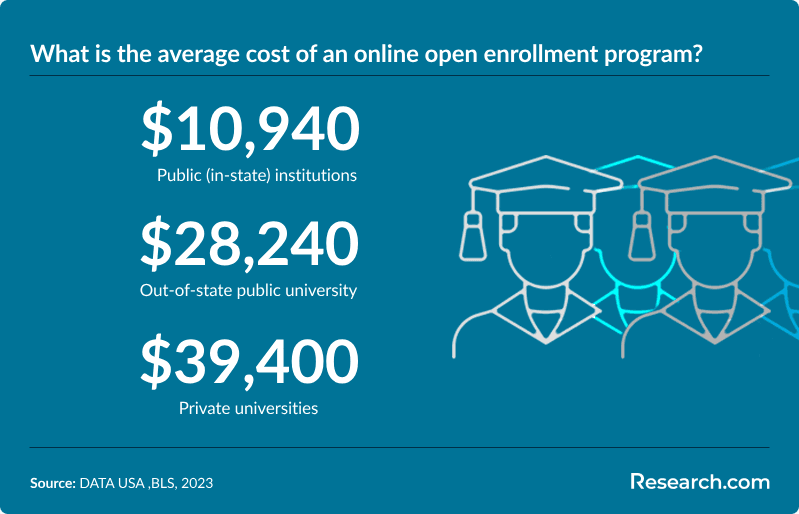
If you are asking how much an online bachelor’s degree costs, start with tuition and fees, then add books, technology charges, exam proctoring, course materials, transfer-credit evaluation fees, and any required travel or field placements. The median annual tuition and fees for U.S. bachelor’s degrees are listed below:
- Public in-state institutions: $10,940
- Out-of-state public universities: $28,240
- Private universities: $39,400
The figure below presents these tuition and fee levels. The median undergraduate tuition at baccalaureate colleges is $27,610, which is higher than the national median of $10,200, according to DataUSA.
| Cost item | Why it matters | How to reduce risk |
| Tuition and mandatory fees | This is the largest visible cost, but not always the full cost. | Ask for a total program estimate, not only the per-credit price. |
| Transfer-credit policy | Generous transfer rules can shorten the degree path. | Request a written transfer evaluation before enrolling. |
| Course materials | Books, software, subscriptions, or lab kits may add expenses. | Ask whether materials are included or billed separately. |
| Repeated courses | Failing or withdrawing can increase total cost. | Use tutoring and advising early rather than waiting until problems grow. |
| Financial aid eligibility | Accreditation and enrollment status can affect aid options. | Confirm aid eligibility with the financial aid office before committing. |
What Should Students Know About Financial Aid?
Financial aid can lower out-of-pocket costs, but students should read the details carefully. Federal aid, state aid, scholarships, employer tuition assistance, and payment plans may all have eligibility rules. Many students begin by reviewing online colleges that accept FAFSA, then asking each school how enrollment intensity, academic progress, and program type affect aid eligibility.
Before borrowing, compare the total cost of the degree with the entry-level roles you are likely to pursue. A lower-priced accredited program may create less financial pressure than a more expensive program with similar outcomes.
What Requirements Do I Need to Apply for an Online Open-Enrollment Program?
Open-enrollment programs typically reduce admissions barriers, but they still require documentation. Most schools need proof that you are prepared for college-level study, and some programs may require placement steps after admission.
- High school diploma or GED equivalent: This is the standard baseline requirement for many undergraduate open-enrollment programs.
- Application form or short statement: Some institutions may ask for a basic application or brief explanation of your goals, even when they do not use selective admissions.
- Placement testing: Schools may use placement assessments in areas such as math or English to decide whether you should begin in college-level or developmental coursework.
- International student documentation: Students educated outside the United States may need transcripts, credential evaluation, and proof of English proficiency, such as TOEFL or IELTS scores.
Students should also check whether their intended field has program-specific rules. For example, legal studies and paralegal students may want to review ABA approved paralegal programs, while students focused on cost may compare accredited online colleges with no application fee.
What Courses Should You Expect in an Open-Enrollment Online Degree?
Coursework depends on the major, but most bachelor’s programs combine general education, major requirements, electives, and sometimes a capstone, internship, practicum, or project. A strong online program should show exactly how each course contributes to the degree and what skills students are expected to demonstrate by graduation.
| Program area | Common course themes | Practical evidence to look for |
| Business | Accounting, management, marketing, finance, operations, business communication. | Case studies, presentations, spreadsheets, business plans, and applied projects. |
| Technology | Programming, databases, systems, networks, cybersecurity, software design. | Code samples, labs, portfolio projects, and industry tool exposure. |
| Healthcare administration | Healthcare systems, policy, finance, compliance, records, operations. | Scenario-based assignments and exposure to healthcare regulations and workflows. |
| Social sciences | Human behavior, research methods, ethics, policy, communication. | Research papers, case analysis, field-related projects, and writing-intensive work. |
What Specializations Are Available for Online Open-Enrollment Program Students?
Specializations help students connect a broad degree to a specific career direction. Some are built into the degree, while others are developed through electives, internships, certificates, graduate study, or work experience. The list below shows examples, but students should confirm which options are actually offered by each school.
- Accounting:
- Auditing
- Cost Accounting
- Financial Accounting
- Forensic Accounting
- Taxation
- Business Administration:
- Entrepreneurship
- Finance
- Healthcare Management
- Human Resources
- Marketing
- Operations Management
- Computer Science:
- Artificial Intelligence
- Cybersecurity
- Computer Networks
- Data Science
- Software Engineering
- Economics:
- Applied Economics
- Financial Economics
- International Economics
- Macroeconomics
- Microeconomics
- Healthcare Administration:
- Health Informatics
- Hospital Administration
- Long-Term Care Administration
- Public Health Administration
- Management:
- Human Resource Management
- Organizational Leadership
- Operations Management
- Project Management, including pathways that may later connect to affordable online master's degree in project management programs
- Management Information Systems:
- Business Analytics
- Cybersecurity
- Enterprise Systems
- IT Management
- Nursing: These areas commonly require education beyond a basic open-enrollment online program, licensure, and clinical preparation. Students considering related health pathways may also compare options such as exercise science degree cost before choosing a direction.
- Nursing Administration
- Nursing Education
- Nurse Practitioner
- Nursing Informatics
- Social Work:
- Clinical Social Work
- Community Social Work
- Social Policy
- Social Work Administration
- Special Education:
- Autism Spectrum Disorders
- Developmental Disabilities
- Early Childhood Special Education
- Gifted and Talented Education
Specialization does not always require an expensive degree. For technology-focused students, affordable online cybersecurity degree programs may provide a more targeted route than a general major.
How Do You Choose the Best Online Open-Enrollment Program?
The best program is not simply the easiest one to enter. It is the one you can afford, complete, and use. Compare schools using a structured process instead of relying on advertising, convenience, or a single ranking list.
- Clarify your goal. Decide whether you need a degree for promotion, career change, graduate admission, licensure preparation, or personal completion.
- Check accreditation first. Confirm that the institution and, when relevant, the program have recognized accreditation. Social work students, for example, should pay close attention to accredited online schools for social work.
- Compare learning format. Decide whether you prefer scheduled deadlines or more independent pacing. Students who need maximum flexibility may compare self paced online courses.
- Review the curriculum. Look for current tools, applied assignments, writing practice, quantitative work, field-specific skills, and clear outcomes.
- Ask about support. Advising, tutoring, technical help, career services, library access, and faculty responsiveness can make a major difference in online success.
- Study outcomes carefully. Graduation rates, retention, transfer success, licensure pass information where relevant, and employment support are more useful than vague promises.
- Calculate the full price. Include fees, materials, repeated courses, time away from work, and borrowing costs.
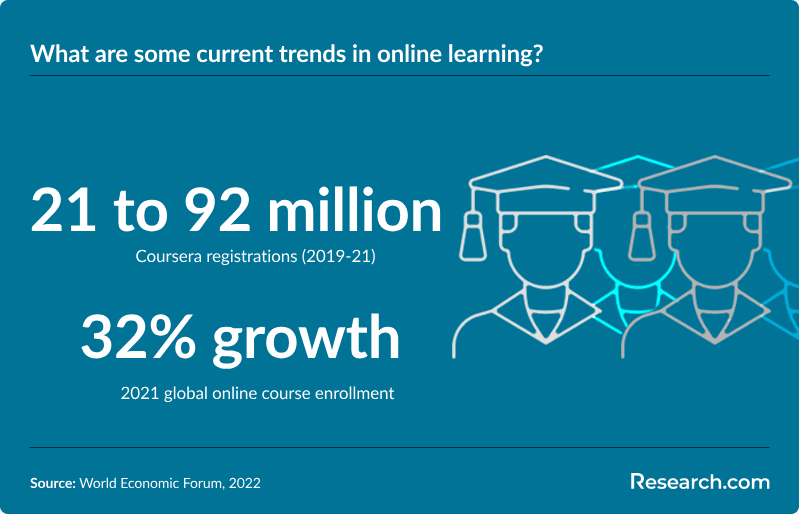
Online learning demand has grown sharply. Coursera registrations tripled from 2019 to 2021, rising from 21 million to 92 million, and global online course enrollment doubled in 2020 before growing 32% in 2021 to 189 million, according to the World Economic Forum. This growth gives students more choices, but it also makes quality checks more important.
What Types of Careers Can I Pursue With an Online Open-Enrollment Program?
Career options depend on the degree, prior experience, location, licensure rules, and the strength of your portfolio or practical training. Many graduates begin in entry-level or assistant-level roles, then build experience, certifications, or graduate credentials to advance.
- Nursing: Some online pathways may support Licensed Practical Nurse (LPN) preparation or degree completion, but clinical and licensure requirements must be verified. Further roles after additional education and specialization may include:
- Call Center Nurse
- Insurance Claims Nurse
- Nursing Informatics Specialist
- Nurse Case Manager
- Nurse Educator
- Telehealth/Telemedicine Nurse
- Computer Science:
- Data analysis
- IT support
- Network administration
- Software engineering
- Software testing
- Web development
- Management and MIS:
- Business systems analyst
- Database management
- IT support
- Network administration
- Operations manager
- Project manager
- Social Work: A BSW online degree can support some entry- and mid-level human services roles, but licensure rules vary.
- Case aide
- Social work assistant
- A master’s degree is typically required for licensure as a Licensed Social Worker (LCSW).
- Economics:
- Market research analyst
- Budget analyst
- Financial analyst
- Special Education: An online degree may support paraprofessional or assistant roles, but it does not replace teacher certification requirements.
- Accounting:
- Bookkeeping
- Accounting clerk roles
- Further education and experience may support advancement toward CPA or management accounting roles.
- Business Administration:
- Business analyst
- Customer service representative
- HR assistant
- HR manager
- Marketing assistant
- Marketing manager
- Healthcare Administration:
- Medical office assistant
- Medical records specialist
- Practice manager
What Are the Accreditation Bodies for Online Open-Enrollment Programs?
There is no separate accreditor just for “online open enrollment.” Instead, students should verify the institution’s accreditation and, in some fields, programmatic accreditation. Accreditation helps with credit transfer, financial aid eligibility, graduate school recognition, and employer confidence.
- Accrediting Council for Continuing Education and Training (ACCET): ACCET accredits some continuing education and training providers, which may be relevant for non-degree or workforce-focused programs.
- The Distance Education Accrediting Commission (DEAC): DEAC accredits distance education institutions and programs that meet online education standards.
- The Higher Learning Commission (HLC): HLC is a regional accreditor that reviews institutions, including online programs offered by accredited schools.
- The Middle States Commission on Higher Education (MSCHE): MSCHE accredits institutions in Delaware, Maryland, New Jersey, New York, Pennsylvania, Puerto Rico, the Virgin Islands, and the District of Columbia.
- The New England Commission of Higher Education (NECHE): NECHE accredits institutions in Connecticut, Maine, Massachusetts, New Hampshire, Rhode Island, and Vermont.
- The Northwest Commission on Colleges and Universities (NWCCU): NWCCU accredits institutions in Alaska, Idaho, Montana, Nevada, Oregon, Washington, and Wyoming.
- The Southern Association of Colleges and Schools Commission on Colleges (SACSCOC): SACSCOC accredits institutions and reviews online offerings from regionally accredited schools.
Always verify accreditation directly through the accreditor or recognized databases rather than relying only on a school’s marketing page. If a career requires licensure, confirm that the specific program—not just the institution—meets your state’s requirements.
What Trends Will Affect Open-Enrollment Degrees in the Future?
Several forces are shaping online open-enrollment programs. Students should understand these trends because they affect price, program design, employer expectations, and the skills graduates need.
- More pressure to control cost and improve completion: Rising college costs make affordable pathways important, especially for students comparing quick and easy online degrees.
- Stronger employer alignment: More programs may build curricula around workforce needs, applied projects, employer partnerships, and job-ready skills.
- Greater emphasis on stackable credentials: Degrees may increasingly be paired with certificates, badges, and short credentials that validate specific skills.
- Growth of microlearning: Microlearning uses short, focused learning units that can support skill development alongside degree study.
- Technology-enhanced delivery: Online platforms, simulations, adaptive tools, and interactive assessments can improve access, but students should still look for human support from faculty and advisors.
What Additional Academic Credentials Can Improve Career Prospects?
An open-enrollment degree can be a foundation, but many career paths require additional credentials. Graduate certificates, master’s programs, professional certifications, and supervised training can help students move beyond entry-level roles. For professionals already in leadership or management tracks, executive masters degrees may offer advanced business, strategy, or industry-focused preparation.
Choose extra credentials only when they connect to a clear goal. Before enrolling, ask whether the credential is recognized by employers, required for licensure, accepted by graduate schools, or useful for a specific promotion path.
How Can You Secure Financial Aid for an Online Open-Enrollment Degree?
Start by confirming that the school and program are eligible for the type of aid you want to use. Then complete required aid forms, meet priority deadlines, and speak with the financial aid office before you enroll. Ask how aid changes if you attend part time, take accelerated terms, withdraw from a course, or fail to meet satisfactory academic progress rules.
Students should compare grants, scholarships, employer tuition benefits, payment plans, and loans. Loans can help you start, but they also increase the long-term cost of the degree, so borrow only after comparing realistic salary outcomes and total program cost.
Can Online Open-Enrollment Programs Offer Accelerated Degree Options?
Yes, some open-enrollment online colleges offer accelerated formats, but “accelerated” should be evaluated carefully. Faster programs may use shorter terms, heavier weekly workloads, transfer credits, prior learning assessment, or year-round enrollment. They can be useful for motivated students with strong time management, but they can also be difficult for students managing full-time work or caregiving.
Students comparing speed should look at options such as one year degree programs as a reference point for how fast-track models work, while remembering that timelines vary by degree level, transfer credits, and program requirements.
Do Employers Value Online Open-Enrollment Degree Programs?
Employers usually care less about whether a school had open admissions and more about whether the degree is accredited, relevant, and backed by real skills. A candidate with an online open-enrollment degree can strengthen employer confidence through internships, projects, portfolios, certifications, work experience, strong references, and measurable accomplishments.
Program choice still matters. Degrees connected to applied skills and recognized career paths, including some 2-year online degrees that pay well, may be easier to explain to employers than broad credentials with no clear career connection.
Are Networking Opportunities Included in Online Open-Enrollment Programs?
Good online programs do more than post lectures. They create opportunities to interact with faculty, classmates, alumni, and employers through discussion forums, virtual events, group projects, professional webinars, career fairs, and alumni communities. These connections can lead to mentorship, referrals, project collaboration, and better job-search confidence.
Students planning advanced study may also use online networks to compare graduate options, including top paying master degrees, but the best networking strategy is to participate early rather than waiting until graduation.
Can an Online Open-Enrollment Degree Lead to Advanced Academic Credentials?
Yes, an accredited online open-enrollment degree can help students qualify for graduate study, but admission requirements vary. Master’s and doctoral programs may require a minimum GPA, prerequisites, professional experience, recommendations, writing samples, exams, interviews, or licensure-related preparation.
Students considering doctoral study should compare costs and academic expectations carefully. Options such as the cheapest online doctorate may be relevant for cost planning, but affordability should be weighed against accreditation, faculty fit, research expectations, and career purpose.
Is an Online Open-Enrollment Degree a Sound Investment?
An online open-enrollment degree can be a sound investment when it helps you reach a defined goal at a manageable price. It is less likely to pay off when students borrow heavily for a program with weak support, unclear outcomes, poor accreditation, or limited connection to the job they want.
For some students, a lower-cost stepping stone may be the smarter starting point. Comparing options such as the easiest associate's degree to get can help students decide whether to begin with a shorter credential before pursuing a bachelor’s degree.
| Worth considering if... | Be cautious if... |
| The school is accredited and transparent about costs. | The program avoids clear answers about accreditation or fees. |
| The degree matches a specific job, promotion, or graduate-school requirement. | You are enrolling only because admission is easy. |
| You can manage the workload without excessive borrowing. | The total price is high compared with realistic entry-level outcomes. |
| The program offers advising, tutoring, tech support, and career services. | Student support is limited or difficult to reach. |
How Can Open-Enrollment Degrees Be Combined With Industry Certifications?
Pairing a degree with industry-recognized certifications can help students show both academic preparation and job-specific skill. This is especially useful in technology, project management, accounting, healthcare administration, human resources, marketing analytics, and operations roles.
Students should choose certifications that match job postings in their target field. Researching certifications that pay the most can be helpful, but the highest-paying credential is not always the best fit for your background or local job market.
What Are the Salaries and Job Market Like for Online Open-Enrollment Degree Graduates?
Salary outcomes vary widely because open-enrollment graduates enter many fields and career stages. Some wages reflect entry-level roles, while others reflect specialized skills, advanced experience, or additional credentials. A degree can support career mobility, but it does not guarantee a specific salary.
The chart below compares median annual wages by education level and selected fields. High school diploma holders earn $37,024, associate degree holders earn $43,472, and Licensed Practical Nurses with a vocational degree earn $49,392. Bachelor’s degree holders earn $67,860.
Selected field wages include Applied Mathematics at $73,558, Statistics at $75,916, Computer and Information Science at $78,603, Operations Research at $80,166, Electrical/Electronics and Communications Engineering at $80,819, Computer Science at $85,766, Instrumentation and Control Engineering at $95,400, Instrumentation Technology at $97,900, Software Engineering at $101,200, and Radiation Therapy at $106,200.
How Can Students Maximize Success at Open-Enrollment Online Colleges?
Open access makes enrollment easier, but completion still requires planning. Online students are most successful when they treat school like a scheduled responsibility, not an activity to fit in only when time is available.
- Create a weekly study routine: Block specific times for readings, assignments, discussions, exams, and instructor communication.
- Use support services early: Tutoring, advising, writing help, and technical support are most useful before you fall behind.
- Communicate with instructors: Ask questions when instructions are unclear, and reach out before deadlines if problems arise.
- Build peer connections: Join discussion groups, virtual study sessions, and program communities to reduce isolation.
- Track degree progress: Review your academic plan each term so you do not take unnecessary courses.
- Control avoidable costs: Students comparing low-cost options may review open-enrollment online colleges no application fee, but should still prioritize accreditation and completion support.
What Resources and Support Services Are Available to Students in Open-Enrollment Programs?
Support services can determine whether a flexible program is manageable. Before enrolling, ask whether online students receive the same level of support as campus students and whether help is available outside standard business hours.
- Academic advising: Advisors help students choose courses, understand degree requirements, and plan a realistic path to graduation.
- Tutoring and writing support: Virtual tutoring, writing centers, and math help can improve performance in difficult courses.
- Technical support: Online learners need reliable help with learning platforms, login issues, software, and digital tools.
- Online library access: Strong programs provide e-books, databases, journals, citation help, and librarian support.
- Mental health and counseling services: Working students and adult learners may benefit from virtual counseling or wellness resources.
- Career services: Resume reviews, mock interviews, job-search coaching, and career planning help connect coursework to employment.
- Peer communities: Forums, virtual events, and program groups can help students form study networks and professional connections.
What Strategies Can Help You Succeed in an Online Open-Enrollment Degree Program?
Online learning rewards consistency. Students who wait until the end of the week often underestimate the amount of reading, writing, practice, and discussion required. Use the following habits to stay on track.
- Set a fixed academic calendar: Put every assignment, quiz, exam, and discussion deadline into a calendar at the start of each term.
- Break large assignments into smaller tasks: Divide papers, projects, and exams into research, drafting, review, and submission steps.
- Participate actively: Discussion boards, virtual office hours, and group projects can improve understanding and visibility.
- Organize digital materials: Keep syllabi, readings, notes, rubrics, and feedback in clearly labeled folders.
- Focus on career-relevant work: Save projects, papers, presentations, code, or case studies that can become part of a portfolio.
- Choose the right level of challenge: Students seeking a more straightforward completion path may compare easy bachelor degrees, while still checking quality and outcomes.
How Do You Assess the Quality of Online Open-Enrollment Programs?
Quality varies across open-enrollment programs, so students should evaluate schools carefully before applying. Do not assume that online access, low admissions barriers, or a familiar school name automatically mean the program is the right choice.
| Quality factor | What to look for | Red flag |
| Accreditation | Recognized institutional accreditation and programmatic accreditation where required. | Vague claims such as “fully recognized” without naming the accreditor. |
| Cost transparency | A clear breakdown of tuition, fees, materials, and total estimated cost. | Hard-to-find fees or pressure to enroll before seeing the full price. |
| Curriculum | Courses tied to current skills, practical assignments, and career or transfer goals. | Outdated course descriptions or little evidence of applied learning. |
| Faculty | Instructors with relevant academic credentials and professional experience. | No accessible faculty information or unclear instructor qualifications. |
| Student support | Advising, tutoring, career services, library access, and technical help for online learners. | Support limited to email only or unavailable during times online students study. |
| Outcomes | Graduation, retention, transfer, licensure, or career information where available. | Guaranteed job or salary claims without transparent evidence. |
Students comparing institutions can also review resources on top rated online universities, but rankings should be only one part of the decision. Your final choice should be based on accreditation, affordability, support, transferability, and fit with your career plan.
Common Mistakes to Avoid Before Enrolling
- Choosing only because admission is easy: Open enrollment helps you start, but program quality determines whether the degree is useful.
- Ignoring accreditation: Lack of proper accreditation can affect credit transfer, financial aid, graduate admission, and employer recognition.
- Looking only at tuition: Fees, materials, technology costs, and repeated courses can change the true price.
- Assuming online means self-paced: Many online courses have weekly deadlines, required discussions, exams, and group work.
- Forgetting licensure rules: Nursing, counseling, social work, teaching, and some healthcare roles may require specific accredited programs and supervised experience.
- Borrowing without a career plan: Estimate likely entry-level roles and repayment pressure before taking on debt.
- Waiting to ask for help: Online students should contact advisors, tutors, and instructors before academic problems become difficult to fix.
Questions to Ask Before You Apply
- Is the institution accredited by a recognized accreditor, and is my specific program separately accredited if my field requires it?
- Will the school provide a written transfer-credit evaluation before I enroll?
- What is the total estimated cost, including fees, books, software, and required materials?
- How are online courses delivered: live, asynchronous, self-paced, accelerated, or term-based?
- What support services are available to online students, and when can students access them?
- Does the program meet licensure or certification requirements in my state?
- What career services are available before and after graduation?
- What happens if I need to pause enrollment, withdraw, or reduce my course load?
- Can I see a sample degree plan for full-time and part-time study?
- What evidence does the school provide about student completion, transfer, licensure, or employment outcomes?
Key Insights
- Online open-enrollment degrees are designed to reduce admissions barriers, but students still need to evaluate accreditation, cost, curriculum, support, and outcomes.
- The best program is the one that fits your career goal and life schedule while keeping total debt manageable.
- Fields such as business, computer science, healthcare administration, social work, psychology, finance, marketing, logistics, counseling, and nursing can be available online, but licensure-based careers require extra caution.
- Online study can save time and reduce commuting or housing costs, but it requires strong self-management and regular communication with instructors and advisors.
- Salary outcomes vary by field, experience, location, and additional credentials; a degree can improve opportunity, but it does not guarantee a specific wage.
- Students should compare transfer policies, financial aid eligibility, student services, and employer relevance before enrolling—not after the first bill arrives.
- Industry certifications, graduate study, portfolios, internships, and work experience can make an open-enrollment degree more valuable in the job market.
References:
- DataUSA. (2022). Baccalaureate Colleges. DataUSA.
- Franklin University. (2024). How Much Does a Bachelor’s Degree Cost? Franklin University.
- Indeed. (2024). Average Registered Nurse - Home Health Salary in the United States. Indeed.
- Indeed. (2024). Average Registered Nurse - Medical/Surgical Salary in the United States. Indeed.
- National Center for Education Statistics. (2022). Fast Facts: Distance learning. U.S. Department of Education. National Center for Education Statistics.
- Payscale. (2024). Average Nurse Case Manager Salary in Philippines. Payscale.
- Payscale. (2024). Average Nurse Educator Salary. Payscale.
- Payscale. (2024). Average Nursing Informatics Specialist Salary. Payscale.
- Salary.com. (2024). Home Health Nurse Salary in the United States. Salary.com.
- Salary.com. (2024). Nurse Administrator Salary in the United States. Salary.com.
- Salary.com. (2024). Nurse Researcher Salary in the United States. Salary.com.
- Salary.com. (2024). Occupational Health Nurse Salary in the United States. Salary.com.
- Salary.com. (2024). Registered Nurse RN Telephone Triage Salary in the United States. Salary.com.
- Salary.com. (2024). Telephone Triage Nurse Salary in the United States. Salary.com.
- U.S. Bureau of Labor Statistics. (2019). Education pays. Career Outlook. U.S. Bureau of Labor Statistics.
- U.S. Bureau of Labor Statistics. (2021). Education pays. Career Outlook. U.S. Bureau of Labor Statistics.
- U.S. Bureau of Labor Statistics. (2023). Education pays. Career Outlook. U.S. Bureau of Labor Statistics.
- U.S. Bureau of Labor Statistics. (2024). Registered Nurses. U.S. Bureau of Labor Statistics.
- World Economic Forum. (2022, January). Online learning courses could help us reskill for the future. World Economic Forum.
Other Things You Should Know About Online Open Enrollment Programs
Most top open enrollment colleges online in 2027 have no minimum GPA requirement for admission. These institutions focus on accessibility and often admit students regardless of academic history, allowing a diverse range of individuals to pursue higher education.
No. Open-enrollment online colleges do not require SAT or ACT scores for admission in 2027. Most use a simple application, proof of high school completion or GED, and sometimes a placement assessment for math or writing before registration.
In 2027, some online open enrollment colleges offer tuition-free courses through Massive Open Online Courses (MOOCs), such as those provided by platforms like edX and Coursera, in partnership with accredited universities. These courses often cover a wide range of subjects and allow free access to learning materials.


