
2027 Best Online Exercise Science Degree Programs

Co-Founder and Chief Data Scientist
Choosing the right exercise science degree can significantly impact your career in fitness, healthcare, or sports performance—especially given the booming demand for related roles. According to the U.S. Bureau of Labor Statistics, opportunities for fitness trainers and instructors are expected to grow by 14%, reflecting strong demand driven by rising health awareness and an aging population
This guide highlights the best online exercise science degree programs available today, evaluating factors like cost, flexibility, accreditation, and career outcomes. You’ll gain insights on undergraduate and graduate pathways tailored to your goals and discover programs that align with your schedule and budget to help you make a confident, informed decision.
What are the benefits of getting an online exercise science program?
- Online programs allow you to balance coursework with work or personal commitments, making it easier to study at your own pace.
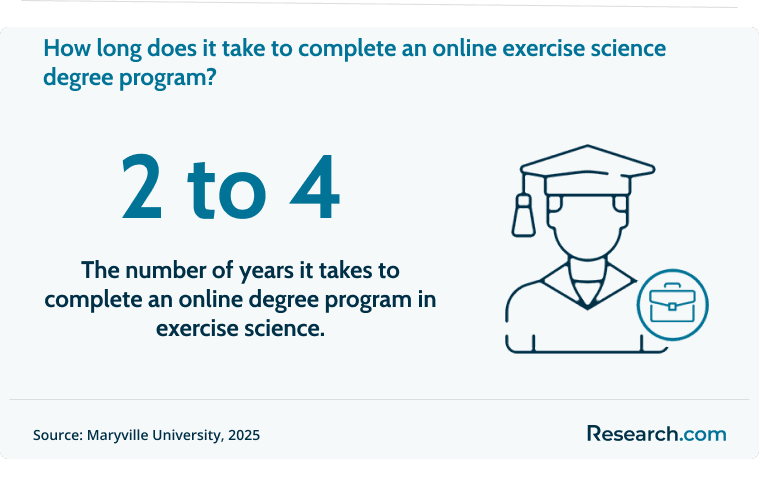
- Many programs can be completed in 2–4 years, especially with transfer credits or full-time enrollment.
- Courses are designed to prepare you for certifications and practical roles in fitness, health, and sports-related fields.
What can I expect from an online exercise science program?
An online exercise science degree program offers a comprehensive blend of theoretical knowledge and practical skills focused on human movement, fitness, and health. You can expect to study subjects like anatomy, kinesiology, biomechanics, exercise physiology, nutrition, and sport psychology, often through interactive lectures, virtual labs, and case-based assignments.
Many programs also include internships or capstone projects that give you real-world experience in clinical, athletic, or wellness settings. Courses are typically asynchronous, allowing you to complete work on your schedule, with support from faculty who have professional experience in the field.
Where can I work with an online exercise science program?
Graduates with an online exercise science degree can work in a variety of settings that promote physical health, performance, and rehabilitation. Common workplaces include hospitals, physical therapy clinics, fitness centers, corporate wellness programs, athletic departments, and community health organizations.
Some roles may also be found in research institutions, sports teams, or government agencies focused on public health. With the right certifications or advanced education, you can expand into specialized areas like cardiac rehabilitation, strength and conditioning, or clinical exercise physiology.
How much can I earn with an online exercise science program?
Earning potential with an online exercise science degree varies based on your role, experience, and certifications, but the field offers solid entry-level and long-term income opportunities. Graduates entering roles such as personal trainers or wellness coaches may start around $45,000 annually, while specialized positions like exercise physiologists or strength and conditioning coaches typically earn between $50,000 and $60,000.
With additional credentials or a master’s degree, roles in clinical settings, athletic administration, or corporate wellness can offer salaries exceeding $70,000. Geographic location, industry demand, and level of education all play key roles in determining overall earnings.
- How Can Nutritional Science Complement an Online Exercise Science Program? How Can Nutritional Science Complement an Online Exercise Science Program?
- Can an online exercise science program equip me for leadership roles in health and sports? Can an online exercise science program equip me for leadership roles in health and sports?
Best Online Exercise Science Degree Programs for 2026
Choosing an online exercise science degree is not just a question of convenience. The right program can prepare you for fitness, wellness, sports performance, rehabilitation support, graduate health programs, or certification-based roles, while the wrong program may leave you short on labs, prerequisites, clinical preparation, or employer-recognized credentials.
This guide is for students comparing online bachelor’s and master’s programs in exercise science, sports and health sciences, kinesiology-related study, or wellness-focused training. You will learn which programs are featured, how they compare by cost and structure, what coursework to expect, how online study differs from campus-based learning, and how to evaluate whether a degree fits your career goals. Students exploring broader online academic pathways may also compare this field with options such as the best online humanities degree, but exercise science is more science-heavy and career-specific.
Quick Answer: Is an Online Exercise Science Degree Worth Considering?
An online exercise science degree can be a practical choice if you want a flexible path into fitness, health promotion, strength and conditioning, wellness coaching, rehabilitation support, or graduate study in health-related fields. The best programs combine accredited coursework, movement science, anatomy and physiology, exercise programming, research skills, and applied experiences such as internships, practicums, labs, capstones, or certification preparation.
It is not the right fit for every student. If your goal is to become a licensed physical therapist, chiropractor, athletic trainer, nurse, or another regulated healthcare professional, an exercise science degree may be only one step in a longer education path. Always confirm graduate prerequisites, certification requirements, and state-specific rules before enrolling.
How We Rank and Review Online Exercise Science Programs
At Research.com, our goal is to help students compare programs using consistent, decision-relevant information rather than promotional claims. Our ranking work follows our methodology and draws from recognized education data sources, institutional information, and publicly available program details.
Sources used in our review process include:
- IPEDS database
- Peterson's database, including the Distance Learning Licensed Data Set
- College Scorecard database
- National Center for Education Statistics
When comparing schools, pay attention to more than the rank order. Accreditation, total cost, transfer credit policy, internship expectations, graduate school alignment, and certification preparation often matter more than a single placement on a list.
Featured Online Exercise Science Programs at a Glance
| School | Degree | Length or Credits | Concentrations or Tracks | Tuition or Cost Listed | Accreditation Listed |
| Maryville University | BS in Exercise Science | Four years full-time; 128 credit hours | Wellness Management; Strength and Conditioning | $575 per credit | Higher Learning Commission |
| American Public University System | BS in Sports and Health Sciences | Four years; 120 credit hours | Fitness and Wellness Professional Studies | $350/credit standard; $250/credit military rate; $315/credit with Veteran or Opportunity Grant | Higher Learning Commission |
| Concordia University, St. Paul | B.A. in Exercise Science | Four years; 120 credit hours | N/A | $420 per credit | Higher Learning Commission |
| St. Mary’s University | B.S. in Exercise & Sport Science | Four years; 120 credit hours | Generalist; Pre-Physical Therapy | $429 per credit | Southern Association of Colleges and Schools Commission on Colleges |
| Methodist University | BS in Exercise & Sport Science | Typically 2.5–4 years; 124 credit hours | N/A | $435 per credit standard; $250 per credit military | Southern Association of Colleges and Schools Commission on Colleges |
| Liberty University | BS in Exercise Science | Four years; 120 credit hours for Fitness Specialist; 127 hours for Therapeutic Science | Fitness Specialist; Therapeutic Science | $390 per credit for full-time online rate for 12+ credits per semester | Commission on Accreditation of Allied Health Education Programs |
| University of Cincinnati | M.S. in Exercise and Sport Science | 30 credits; approximately 3 semesters | N/A | $22,830 for program total | Higher Learning Commission |
| University of North Carolina at Charlotte | BS in Exercise Science | Four years; 120 credit hours | Health & Fitness; Strength & Conditioning; Pre-Professional self-designed | Visit the bursar’s official website for tuition calculation. | Southern Association of Colleges and Schools Commission on Colleges |
| Aurora University | M.S. in Exercise Science | 1–2 years; 30 credit hours | Clinical Exercise Physiology | $565 per credit | HLC |
| Franklin University | BS in Exercise Science | Four years; 120 credit hours | Athletic administration & sport leadership; Athletic coaching leadership; Health promotion & public health; Sport performance & fitness business ownership | $398 per credit | Higher Learning Commission (HLC) |
1. Maryville University — BS in Exercise Science
Maryville University offers a fully online Bachelor of Science in Exercise Science for students who want a structured undergraduate route into fitness, wellness, strength and conditioning, or graduate preparation. The 128-credit curriculum includes general education, exercise science core courses, electives, and two concentration options. Students also have remote access to a Human Performance Lab, which can be valuable for learners who want applied exposure without relocating.
- Program length: Four years full-time; 128 credit hours
- Tracks or concentrations: Wellness Management; Strength and Conditioning
- Cost per credit or tuition: $575 per credit
- Accreditation: Higher Learning Commission
2. American Public University System — BS in Sports and Health Sciences
American Public University offers an online BS in Sports and Health Sciences that may appeal to working adults, military-affiliated students, and learners seeking a broad foundation in human movement and wellness. The curriculum covers anatomy, physiology, kinesiology, nutrition, sports psychology, and exercise testing, with a concentration designed around fitness and wellness professional practice.
- Program length: Four years; 120 credit hours
- Tracks or concentrations: Fitness and Wellness Professional Studies; 18 semester-hour concentration covering wellness promotion, facility management, risk leadership, and sports facility economics
- Cost per credit or tuition: $350/credit standard; $250/credit military rate; $315/credit with Veteran or Opportunity Grant
- Accreditation: Higher Learning Commission
3. Concordia University, St. Paul — B.A. in Exercise Science
Concordia University, St. Paul delivers its online Bachelor of Arts in Exercise Science through CSP Global. The program combines a liberal arts foundation with exercise science coursework in anatomy, biomechanics, nutrition, kinesiology, physiology, exercise prescription, sport business, and psychology. A required internship adds an applied component for students who want workplace experience before graduation.
- Program length: Four years; 120 credit hours
- Tracks or concentrations: N/A
- Cost per credit or tuition: $420 per credit
- Accreditation: Higher Learning Commission
4. St. Mary’s University — B.S. in Exercise & Sport Science
St. Mary’s University’s online B.S. in Exercise & Sport Science is offered through the College of Arts, Humanities, and Social Sciences. The program emphasizes biomechanics, exercise physiology, sport psychology, nutrition, motor learning, and strength training. Students can choose a Bachelor of Arts or B.S. track, and the school also lists a 27-credit teacher certification in physical education.
- Program length: Four years; 120 credit hours
- Tracks or concentrations: Generalist; Pre-Physical Therapy
- Cost per credit or tuition: $429 per credit
- Accreditation: Southern Association of Colleges and Schools Commission on Colleges
5. Methodist University — BS in Exercise & Sport Science
Methodist University’s online Bachelor of Science in Exercise & Sport Science is designed for students interested in fitness, coaching, rehabilitation support, or sport performance. Coursework focuses on evidence-based practice in areas such as kinesiology, strength and conditioning, sport psychology, and facility management.
- Program length: Typically 2.5–4 years; 124 credit hours
- Tracks or concentrations: N/A
- Cost per credit or tuition: $435 per credit standard; $250 per credit military
- Accreditation: Southern Association of Colleges and Schools Commission on Colleges
6. Liberty University — BS in Exercise Science
Liberty University offers an online BS in Exercise Science for students preparing for health, fitness, rehabilitation-related support roles, or further study. The program includes coursework and applied experiences connected to Human Performance, Biomechanics, and Functional Assessment labs, along with practicum and internship requirements.
- Program length: Four years; 120 credit hours for Fitness Specialist; 127 hours for Therapeutic Science
- Tracks or concentrations: Fitness Specialist; Therapeutic Science
- Cost per credit or tuition: $390 per credit for full-time online rate for 12+ credits per semester
- Accreditation: Commission on Accreditation of Allied Health Education Programs
7. University of Cincinnati — M.S. in Exercise and Sport Science
University of Cincinnati offers an online MS in Exercise and Sport Science for professionals and recent graduates who want advanced training. The curriculum includes advanced exercise physiology, research methods, data analysis, and sport science theory. Students complete a capstone project or internship to connect graduate coursework with professional practice.
- Program length: 30 credits; approximately 3 semesters
- Tracks or concentrations: N/A
- Cost per credit or tuition: $22,830 for program total
- Accreditation: Higher Learning Commission
8. University of North Carolina at Charlotte — BS in Exercise Science
University of North Carolina at Charlotte’s BS in Exercise Science is built around research, hands-on learning, and preparation for graduate health science programs or applied roles in clinical exercise physiology, strength and conditioning, and allied health settings. Students study evidence-based training, biomechanics, exercise physiology, and screening methods.
- Program length: Four years; 120 credit hours
- Tracks or concentrations: Health & Fitness; Strength & Conditioning; Pre-Professional self-designed
- Cost per credit or tuition: Visit the bursar’s official website for tuition calculation.
- Accreditation: Southern Association of Colleges and Schools Commission on Colleges
9. Aurora University — M.S. in Exercise Science
Aurora University’s online MS in Exercise Science is intended for working professionals and recent graduates seeking deeper preparation in clinical or performance-oriented exercise science. Courses cover exercise physiology, research methods, sports nutrition, sports psychology, and program management. Students complete either a capstone project or internship experience.
- Program length: 1–2 years; 30 credit hours
- Tracks or concentrations: Clinical Exercise Physiology
- Cost per credit or tuition: $565 per credit
- Accreditation: HLC
10. Franklin University — BS in Exercise Science
Franklin University offers a fully online Bachelor of Science in Exercise Science designed for adult learners and working professionals. The curriculum aligns with American College of Sports Medicine (ACSM) standards and includes applied physiology, biomechanics, exercise testing, program design, and leadership in health and fitness environments.
- Program length: Four years; 120 credit hours
- Tracks or concentrations: Athletic administration & sport leadership; Athletic coaching leadership; Health promotion & public health; Sport performance & fitness business ownership
- Cost per credit or tuition: $398 per credit
- Accreditation: Higher Learning Commission (HLC)
How Long Does an Online Exercise Science Degree Take?
The completion timeline depends on degree level, transfer credits, enrollment pace, and whether the program requires a thesis, internship, practicum, capstone, or lab component.
| Program Level | Typical Credit Requirement | Common Completion Time | What Can Change the Timeline |
| Bachelor’s degree | Around 120 credit hours | Four years of full-time study | Transfer credits, accelerated terms, part-time enrollment, internship requirements, and science prerequisites |
| Accelerated or transfer-friendly bachelor’s pathway | Varies by accepted credits | As little as 2.5 to 3 years in some online bachelor’s programs | Prior college coursework, military credit, year-round enrollment, and institutional transfer policies |
| Master’s degree | 30 to 36 credit hours | One to two years of full-time study | Thesis, capstone project, internship track, course availability, and part-time scheduling |
A bachelor’s program usually includes general education plus core science courses such as anatomy, physiology, biomechanics, kinesiology, and exercise programming. A master’s program is shorter but more specialized and may expect prior coursework in exercise science, biology, kinesiology, or a related field.
Timeline planning matters in any health-related education path. For example, students comparing clinical routes such as how to become a wound care nurse will also find that prerequisites, specialization, and supervised practice can significantly affect how long training takes.
Online vs. On-Campus Exercise Science Programs: Which Format Fits You?
Online and campus-based exercise science programs can cover similar academic content, but the student experience is different. Online programs often work best for students who need schedule flexibility, while campus programs may be better for learners who want frequent in-person labs, athletic facilities, face-to-face networking, and direct access to equipment.
| Factor | Online Exercise Science Program | On-Campus Exercise Science Program | Best Fit |
| Schedule | Often asynchronous or designed for working adults | Usually follows set class times and campus calendars | Online fits students balancing work, family, or military responsibilities |
| Labs and applied learning | May use virtual labs, remote assignments, local internships, or limited in-person requirements | May provide direct access to campus labs, athletic facilities, and equipment | Campus may fit students who want frequent hands-on lab exposure |
| Networking | Virtual discussions, online career services, digital alumni networks, and remote faculty contact | Campus events, in-person faculty access, athletic department connections, and local internships | Choose based on whether you prefer digital or face-to-face relationship building |
| Self-management | Requires strong time management, comfort with technology, and independent study habits | Provides more built-in structure and immediate classroom interaction | Online is better for disciplined learners; campus is better for those who need routine |
| Career preparation | Can be strong if the program includes internship support, certification alignment, and advising | Can be strong if the school has local clinical, athletic, or wellness partnerships | Compare specific program outcomes rather than assuming one format is automatically better |
The value of an online degree depends on accreditation, curriculum quality, practical experience, and how well the format supports your goals. This is similar to asking is a teaching degree worth it: the answer depends less on the degree label alone and more on cost, requirements, career fit, and long-term plans.
What Does an Online Exercise Science Degree Cost?
Online exercise science tuition varies by school, degree level, credit load, military status, grants, transfer credits, and fees. Bachelor’s programs usually require more total credits, while master’s programs may have higher per-credit tuition but fewer credits overall.
Examples from the featured programs include:
- American Public University standard rate: $42,000 for the 120-credit online BS in Sports and Health Sciences at $350 per credit.
- American Public University preferred military rate: $30,000 at $250 per credit for active-duty service members and reservists.
- American Public University Veteran Grant / APUS Opportunity Grant rate: $37,800 at $315 per credit for eligible students.
- Aurora University master’s program: $16,950 for the 30-credit online MS in Exercise Science at $565 per credit.
Cost should be evaluated alongside completion speed, transfer credit acceptance, internship requirements, and career goals. The same cost-benefit logic applies when comparing other flexible online programs, including a fast-track online esports business degree, where speed only helps if the credential still supports the student’s intended outcome.
| Cost Factor | Why It Matters | Question to Ask Before Enrolling |
| Per-credit tuition | It is the easiest number to compare, but it does not show the full cost alone | How many credits will I actually need after transfer evaluation? |
| Fees | Technology, lab, graduation, course material, and proctoring fees can increase the total | Can the school provide a full cost estimate in writing? |
| Transfer credits | Accepted credits can shorten the degree and reduce tuition | Which prior courses apply to major requirements, not just electives? |
| Internship or practicum costs | Some experiences may require travel, background checks, equipment, or local site coordination | Will I need to secure my own placement? |
| Certification preparation | Some career paths require or strongly value external credentials | Does the curriculum align with certifications I plan to pursue? |
Financial Aid Options for Online Exercise Science Students
Students in accredited online exercise science programs may be eligible for many of the same aid options available to campus-based students. Eligibility depends on the school, program level, enrollment status, financial need, citizenship status, and other requirements.
- Federal financial aid: Students should begin with the FAFSA (Free Application for Federal Student Aid) to determine eligibility for federal aid such as Pell Grants, Stafford Loans, and PLUS Loans.
- Scholarships: Colleges, professional associations, employers, and community organizations may offer awards for students in health, wellness, fitness, or science-related majors.
- Grants: Federal, state, and institutional grants can reduce tuition costs and generally do not require repayment if students meet the conditions of the award.
- Military and veteran benefits: Active-duty service members, veterans, reservists, and eligible family members may qualify for tuition assistance, GI Bill® benefits, school-specific discounts, or military scholarship options.
- Work-study and employer support: Some online students may qualify for remote work-study roles, tuition reimbursement, or education benefits through an employer. Flexible funding questions also arise in programs such as the best online interdisciplinary studies degree options, where students may combine multiple academic interests while managing cost.
Admission Requirements and Prerequisites
Admission standards differ by school and degree level. Exercise science is a science-based field, so students should be ready for anatomy, physiology, biomechanics, statistics, and evidence-based practice.
| Requirement | Bachelor’s Programs | Master’s Programs |
| Prior education | High school diploma or GED | Bachelor’s degree in exercise science, kinesiology, biology, or a related discipline |
| Recommended or required coursework | Biology, chemistry, physical education, or other college-preparatory science courses may be recommended | Anatomy, physiology, statistics, or related prerequisite coursework may be required if not already completed |
| GPA | Some programs may require a minimum GPA, typically around 2.5 or higher | Graduate GPA expectations vary by institution |
| Transcripts | Official high school and college transcripts may be required | Official transcripts from all prior colleges are usually required |
| Essay or personal statement | May be required by some schools | Commonly requested to explain goals and fit |
| Letters of recommendation | Less common, but possible | Graduate programs may request one to three letters |
| Standardized tests | Bachelor’s programs typically do not require standardized test scores for admission | Some master’s programs may require GRE scores, although many have adopted test-optional policies |
If you plan to use exercise science as preparation for physical therapy, chiropractic school, occupational therapy, or another graduate pathway, compare prerequisites early. The difference between chiropractor and physical therapist careers can affect which undergraduate science courses, shadowing experiences, and graduate prerequisites matter most.
Common Courses in an Online Exercise Science Program
Exercise science programs usually combine biological science, movement analysis, fitness assessment, behavior change, health promotion, and research skills. Course names vary, but many programs include the following subjects:
- Anatomy and physiology: Students study body systems, structure, function, and how the body responds to movement, stress, and exercise.
- Exercise physiology: This course examines cardiovascular, muscular, respiratory, and metabolic responses to physical activity and training.
- Kinesiology: Students learn principles of human movement, motor control, biomechanics, and practical exercise application.
- Nutrition for exercise and sport: Coursework may cover macronutrients, hydration, recovery, metabolism, supplements, and dietary planning for active populations.
- Biomechanics: Students analyze force, motion, posture, body alignment, and injury prevention. These movement-analysis skills can complement other health-related education routes, including the best ASN online programs.
- Health promotion and wellness: Learners study behavior change, community health, lifestyle interventions, and program planning.
- Research methods or statistics: Students build skills in data interpretation, study design, evidence evaluation, and applied decision-making.
Specializations in Online Exercise Science Programs
Specializations help students align coursework with a more specific career direction. They can also help with internship selection, certification preparation, and graduate school planning.
| Specialization | Focus | Best For |
| Clinical exercise physiology | Exercise testing, chronic disease management, rehabilitation support, and clinical populations | Students interested in hospitals, cardiac rehabilitation, wellness clinics, or graduate health programs |
| Strength and conditioning | Athletic performance, resistance training, power development, speed, conditioning, and injury risk reduction | Students interested in coaching athletes or working in performance settings |
| Wellness and health promotion | Lifestyle behavior change, corporate wellness, community health, and prevention programs | Students interested in wellness coaching, public health-adjacent roles, or workplace health programs |
| Sports performance | Training design, biomechanics, testing, recovery, and performance monitoring | Students interested in teams, athletic facilities, private training centers, or sport organizations |
| Nutrition and exercise | Diet, recovery, metabolism, body composition, and performance support | Students who want a stronger wellness or performance nutrition foundation |
A focused curriculum can make career planning clearer, much like the benefits of becoming a medical assistant often include targeted preparation for defined entry-level healthcare duties. In exercise science, however, some roles still require separate certifications, graduate education, or supervised clinical experience.
How to Choose the Best Online Exercise Science Program
The best program is the one that matches your career objective, budget, learning style, and next educational step. Use the checklist below before applying.
- Confirm accreditation: Look for institutional accreditation from a recognized agency, such as the Higher Learning Commission (HLC), and check whether program-specific accreditation matters for your intended pathway.
- Compare curriculum against your goal: A student preparing for graduate physical therapy prerequisites may need different coursework than a student pursuing personal training, strength and conditioning, or corporate wellness.
- Evaluate applied learning: Ask whether the program includes internships, practicums, capstones, virtual labs, in-person requirements, or local placement support.
- Check certification alignment: If you plan to pursue a fitness, wellness, clinical exercise, or strength and conditioning credential, ask how the curriculum prepares students for that credential.
- Review faculty background: Instructors with professional experience in exercise science, sports medicine, rehabilitation, coaching, or health promotion may bring stronger applied context to online courses.
- Understand course delivery: Asynchronous courses offer flexibility, while live sessions may provide more interaction. Choose the format you can sustain through the entire program.
- Calculate total cost: Compare tuition, fees, transfer credits, books, equipment, technology costs, and travel for any required in-person experiences. Similar ROI questions appear in programs such as the best master's in mathematics online, where affordability and career fit should be weighed together.
Common Mistakes to Avoid
| Mistake | Why It Can Hurt You | Better Approach |
| Choosing a program before checking accreditation | It may affect financial aid, transfer credits, graduate admissions, or employer recognition | Verify institutional accreditation before applying |
| Looking only at per-credit tuition | A lower rate may not mean a lower total cost if many credits are required or fees are high | Request a full program cost estimate after transfer review |
| Assuming online means no hands-on expectations | Some programs require labs, internships, practicums, or local site placements | Ask exactly what applied experiences are required and who arranges them |
| Ignoring graduate school prerequisites | An exercise science degree may not automatically meet requirements for physical therapy, chiropractic, or other professional programs | Compare the curriculum with target graduate program prerequisites before enrolling |
| Assuming salary outcomes are guaranteed | Pay depends on role, location, experience, certifications, employer, and education level | Use salary data as a planning tool, not a promise |
| Relying only on rankings | A highly ranked program may still be a poor fit for your budget, schedule, or career path | Use rankings as a starting point, then compare requirements, cost, support, and outcomes |
Career Paths for Online Exercise Science Graduates
Exercise science graduates may work in fitness, health promotion, sport performance, rehabilitation support, clinical research, or wellness programming. Some roles are accessible with a bachelor’s degree and relevant certifications, while others may require graduate education, supervised experience, or additional credentials.
| Career Path | Average Salary Listed | What the Role Usually Involves |
| Exercise Physiologist | $58,160 | Designs exercise and rehabilitation programs that help patients improve cardiovascular function, manage chronic conditions, or recover safely under clinical guidance |
| Strength and Conditioning Coach | $65,951 | Creates training plans for athletes to build strength, speed, conditioning, and performance while reducing injury risk |
| Wellness Coach | $59,862 | Supports clients with behavior change, goal-setting, fitness planning, and healthier lifestyle habits |
| Personal Trainer | $61,014 | Builds individualized fitness programs, teaches exercise technique, monitors progress, and motivates clients |
| Rehabilitation Specialist | $53,201 | Assists with exercise-based recovery plans for people returning from injury, surgery, or physical limitations, often in collaboration with healthcare professionals |
| Clinical Research Coordinator | $72,905 | Helps manage research studies involving health, exercise, or clinical interventions, including data collection and regulatory processes |
These roles are not interchangeable. A student who wants to coach athletes should prioritize strength and conditioning coursework and field experience, while a student targeting healthcare settings should look for clinical exercise physiology, research, anatomy, physiology, and internship opportunities.
Job Market Outlook for Exercise Science Graduates
Demand for exercise science skills is connected to several broad needs: preventive healthcare, chronic disease management, fitness and wellness services, athletic performance, rehabilitation support, and workplace wellness. Employers may include hospitals, rehabilitation centers, universities, school athletic departments, private fitness companies, corporate wellness providers, research organizations, and community health programs.
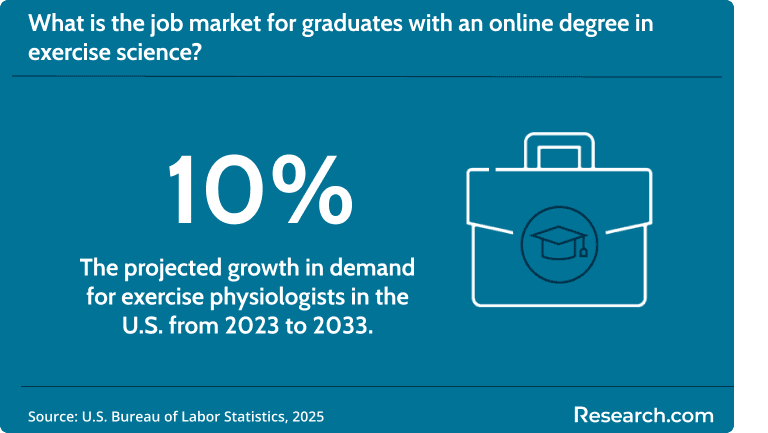
Employment of exercise physiologists is projected to grow 9 percent from 2024 to 2034, which is much faster than the average for all occupations. On average, about 1,600 job openings for exercise physiologists are expected each year throughout the decade. Earlier projections cited a 10% increase from 2023 to 2033, so students should always review the most current source when making career decisions.
Online degrees are typically evaluated by employers based on accreditation, school reputation, coursework, experience, certifications, and demonstrated skills. The word “online” is usually less important than whether the program prepared you for the specific responsibilities of the job you want.
Current Trends Affecting Exercise Science Students
- More interest in preventive health: Fitness, wellness, and exercise-based interventions are increasingly discussed as part of long-term health management, especially for chronic conditions and aging populations.
- Technology-driven performance tracking: Wearables, motion analysis tools, remote coaching platforms, and data dashboards are changing how fitness and performance programs are monitored.
- Hybrid education and remote labs: Online programs continue to expand virtual simulations, remote assessments, video-based skill demonstrations, and local field experiences.
- Employer focus on applied skills: Graduates who can interpret data, communicate clearly, design safe programs, and work with diverse clients are better positioned than those with coursework alone.
- Certification-aware hiring: In many fitness and performance roles, degrees and certifications work together. Students should plan for both when needed.
How Online Exercise Science Differs From Other Online Healthcare Degrees
Exercise science focuses on human movement, physical performance, exercise physiology, biomechanics, wellness programming, and fitness assessment. Other healthcare degrees may emphasize diagnosis, medication, direct patient care, clinical procedures, or professional licensure. For example, a PharmD online pathway is centered on pharmacy practice and pharmaceutical science, not exercise testing or performance training.
Before choosing exercise science, ask whether you want to work primarily with movement, fitness, wellness, and performance, or whether your goal requires a regulated clinical degree. If licensure is part of your long-term plan, confirm the full education sequence before committing.
How Nutritional Science Can Strengthen Exercise Science Training
Nutritional science complements exercise science because performance, recovery, body composition, energy balance, and long-term health are affected by both movement and diet. Students who understand nutrition principles can design more complete wellness and performance strategies, while still recognizing the limits of their scope of practice.
Learners who want deeper nutrition preparation may compare exercise science electives with a dedicated bachelor's degree nutrition science. This can be especially useful for students interested in health promotion, sport performance, corporate wellness, or graduate study in related fields.
Can an Online Exercise Science Degree Prepare You for Leadership Roles?
An online exercise science degree can support leadership preparation when it includes coursework or experience in program management, facility operations, team supervision, communication, ethics, and health promotion strategy. Leadership roles may include fitness director, wellness program manager, athletic performance coordinator, or health program supervisor, depending on experience and credentials.
Students aiming for administrative or executive roles may eventually need broader training in budgeting, policy, compliance, operations, and healthcare systems. In that case, adding or later pursuing a healthcare administration online degree can provide management preparation beyond the exercise science curriculum.
Questions to Ask Schools Before You Apply
- Is the institution accredited, and is there any program-specific accreditation relevant to my career goal?
- How many of my transfer credits will apply to the major, not just to electives?
- Are labs fully online, hybrid, local, or campus-based?
- Does the program require an internship, practicum, capstone, or clinical site?
- Who is responsible for finding internship or practicum placements?
- Which certifications does the curriculum help prepare students for?
- What career services are available to online students?
- What is the total estimated cost, including fees, books, technology, and applied learning expenses?
- Will this curriculum meet prerequisites for the graduate programs I may apply to later?
- Can I study part time, full time, or in an accelerated format?
Student Perspectives on Online Exercise Science Degrees
- Ren: "The online format made it possible for me to keep working full time while moving toward my degree. The virtual coursework and lab activities kept me involved, and I was able to get support when I needed it."
- Jade: "Being able to study on my own schedule helped me manage school and family responsibilities. The program gave me a stronger understanding of human performance and helped me prepare for a personal training certification."
- Kate: "I expected online study to feel isolated, but the faculty interaction and class structure helped me stay connected. By graduation, I felt more confident about applying what I had learned in a professional setting."
Key Insights
- An online exercise science degree is best for students interested in movement, fitness, wellness, performance, rehabilitation support, or graduate health preparation.
- Bachelor’s programs commonly take four years and around 120 credit hours, while master’s programs often require 30 to 36 credit hours and take one to two years.
- Some online bachelor’s programs may be shortened to as little as 2.5 to 3 years when students bring transferable credits.
- Featured tuition examples range from $16,950 for Aurora University’s master’s program to $42,000 for American Public University’s standard-rate bachelor’s program.
- Employment of exercise physiologists is projected to grow 9 percent from 2024 to 2034, with about 1,600 job openings expected each year throughout the decade; earlier projections cited 10% from 2023 to 2033.
- Accreditation, applied learning, certification alignment, transfer credit policies, and total program cost are more important than choosing by rank alone.
- Online programs can be credible and useful, but students must verify labs, internships, prerequisites, and career requirements before enrolling.
- If your goal is a licensed healthcare profession, treat exercise science as a possible foundation rather than a complete professional pathway.
References
- American Public University System. (2025). School of Health Sciences: Sports and Health Sciences. APU
- Aurora University. (2025). Exercise Science (MS). Aurora University
- Glassdoor. (2025). Strength and Conditioning Coach Salaries. Glassdoor
- Maryville University. (2025). Coursework in Exercise Science: The BS in Exercise Science Online Curriculum. Maryville University
- U.S. Bureau of Labor Statistics. (2025). Occupational Outlook Handbook: Exercise Physiologist. U.S. BLS BLS profile
Other things you should know about online exercise science programs
Yes. Many regionally accredited online exercise science programs accept up to 60 transfer credits from a community college, especially for general education courses. Schools usually require official transcripts, a minimum 2.0 to 2.5 GPA, and course-by-course evaluation before awarding transfer credit.
After completing an online exercise science degree in 2027, you can pursue careers as a fitness trainer, exercise physiologist, or health coach. Specific roles may include working in fitness centers, corporate wellness programs, or rehabilitation facilities.


