2027 Fastest Online Doctorate in Behavioral Health Leadership

Co-Founder and Chief Data Scientist
Earning a doctorate in behavioral health leadership can be a game-changer for professionals aiming to move into executive roles. However, many struggle to find a program that is both credible and fast.
Traditional doctoral paths can take years, making it hard for working professionals to advance their careers efficiently. The fastest online DBH programs solve this problem by offering accelerated, flexible pathways to high-impact leadership roles in healthcare.
In this article, you will discover how these programs work, what to look for when choosing one, and how they can boost your career. Whether you are seeking affordability, flexibility, or a strategic leadership edge, this guide will help you make an informed decision.
What are the benefits of getting a degree in the fastest online doctorate in behavioral health leadership?
- Advance into high-impact roles such as Behavioral Health Director, Program Administrator, Policy Advisor, or Healthcare Executive across hospitals, clinics, and public agencies.
- Earn a competitive salary, with professionals holding a doctorate in behavioral health leadership often making $100,000 to $120,000+ annually, depending on role and setting.
- Study with maximum flexibility—online programs let you complete coursework around your schedule, making it easier to earn your degree while working full-time.
What can I expect from the fastest online doctorate in behavioral health leadership?
The fastest online doctorate in behavioral health leadership programs are designed for experienced professionals who want to lead change in behavioral healthcare systems without putting their careers on hold. These programs combine advanced training in leadership, healthcare management, policy, and integrated care models, preparing graduates to take on executive roles in hospitals, public health organizations, nonprofits, and academic institutions.
Unlike clinical doctorates such as the PsyD, the DBH emphasizes administrative strategy, systems thinking, and applied solutions to real-world mental health challenges. With fully online and accelerated formats, these programs allow students to complete their degree in as little as two to three years, offering a flexible path to career advancement.
By focusing on the intersection of behavioral health and leadership, the DBH equips professionals to drive improvements in care delivery, access, and outcomes across diverse populations.
Where can I work with the fastest online doctorate in behavioral health leadership?
Graduates of the fastest online doctorate in behavioral health leadership programs often find leadership roles across a wide range of industries where behavioral health intersects with policy, care delivery, and administration. Many work in healthcare systems and hospitals, leading behavioral health departments or overseeing integrated care initiatives.
Others are employed by community mental health centers and nonprofit organizations, where they develop and manage programs focused on mental health access, prevention, and outreach. Public health agencies and government institutions also hire DBH graduates to shape mental health policy, manage state or federal behavioral health programs, and advise on population health strategies.
Additionally, DBH graduates are increasingly valued in managed care organizations, insurance companies, and behavioral health consulting firms, where they evaluate program effectiveness, improve service delivery models, and guide strategic planning.
Many also pursue careers in higher education as faculty members or program directors in psychology, counseling, or public health departments. With strong demand across sectors, DBH graduates play a vital role in shaping the future of behavioral healthcare.
How much can I make with fastest the online doctorate in behavioral health leadership?
Graduates of the fastest online doctorate in behavioral health leadership typically earn robust salaries that reflect their advanced expertise and leadership roles. In the United States, a Director of Behavioral Health with a doctorate often commands a median base salary around $114,000, and total compensation—including bonuses—may reach $140,000 to $150,000 or more. Salary.com reports an average base pay of $143,872 as of January 2025.
Entry-level graduates can expect starting salaries in the $100,000 to $130,000 range, depending on experience and region, while seasoned executives—especially in large systems or regional agencies—can earn $180,000 to over $200,000 annually. Directors with a doctorate level degree (PhD, MD, PsyD, or equivalent) often fall into the upper percentile of these salary ranges, reflecting their leadership qualifications and ability to manage large programs or departments.
- Fastest Online Doctorate in Behavioral Health Leadership Programs for 2027 List of Programs
- How long does it take to complete the fastest online doctorate in behavioral health leadership program? Completion Time
- How does the fastest online doctorate in behavioral health leadership program compare to an on-campus program? How does the fastest online doctorate in behavioral health leadership program compare to an on-campus program?
- What is the average cost of the fastest online doctorate in behavioral health leadership program? Program Cost
- What are the financial aid options for students enrolling in the fastest online doctorate in behavioral health leadership program? Financial Aid
- What are the prerequisites for enrolling in the fastest online doctorate in behavioral health leadership program? Program Requirements
- What courses are typically in the fastest online doctorate in behavioral health leadership program? What courses are typically in the fastest online doctorate in behavioral health leadership program?
- What types of specializations are available in the fastest online doctorate in behavioral health leadership programs? What types of specializations are available in the fastest online doctorate in behavioral health leadership programs?
- How do you choose the best among the fastest online doctorate in behavioral health leadership programs? How do you choose the best among the fastest online doctorate in behavioral health leadership programs?
- What career paths are available for graduates of the fastest online doctorate in behavioral health leadership programs? What career paths are available for graduates of the fastest online doctorate in behavioral health leadership programs?
- What is the job market like for graduates of the fastest online doctorate in behavioral health leadership program? Career Outlook
- What accreditation and quality assurances should I look for in an online DBH program? What accreditation and quality assurances should I look for in an online DBH program?
- What are the potential challenges in pursuing an online DBH program? What are the potential challenges in pursuing an online DBH program?
- Do employers view an online DBH degree as equally credible? Do employers view an online DBH degree as equally credible?
- How can online DBH programs boost career networking and mentorship opportunities? How can online DBH programs boost career networking and mentorship opportunities?
Fastest Online Doctorate in Behavioral Health Leadership Programs
Choosing an accelerated online doctorate in behavioral health leadership is not just a question of speed. It is a decision about career direction, clinical versus administrative scope, accreditation, workload, cost, and whether the program’s applied research or dissertation model fits the kind of leadership role you want next.
This guide is designed for working professionals in behavioral health, counseling, psychology, social work, public health, nursing, healthcare administration, and nonprofit leadership who want a doctoral credential without leaving the workforce. You will learn how fast online DBH, PhD, PsyD, DrPH, and related leadership doctorates can be completed, how they compare with campus-based programs, what they usually cost, what admissions committees look for, and how to evaluate whether a program is credible and worth the investment.
Quick answer: What is the fastest online doctorate in behavioral health leadership?
The fastest online doctorate in behavioral health leadership programs can often be completed in about 2 to 3 years by full-time students, especially when the program uses accelerated terms, year-round enrollment, transfer credit, or a capstone instead of a traditional dissertation. However, many working professionals take 3 to 5 years, and some programs allow longer timelines when students enroll part time or need additional time for dissertation, capstone, internship, or residency requirements.
The best choice is not always the shortest option. A strong program should be properly accredited, aligned with your leadership goals, transparent about total cost, realistic about workload, and clear about whether it prepares students for administrative leadership, integrated care, public health leadership, academic work, or clinical advancement.
How do we rank schools?
This ranking uses Research.com’s transparent methodology and draws from recognized education data sources, including the Integrated Postsecondary Education Data System (IPEDS), Peterson's databases and their Distance Learning Licensed Data Set, and the College Scorecard database from the National Center for Education Statistics.
Because doctoral programs in this field use different degree titles, formats, and completion models, students should treat rankings as a starting point rather than the only decision tool. Compare accreditation, curriculum fit, doctoral project requirements, faculty experience, transfer policies, and whether the degree supports your intended career path.
Fastest online doctorate in behavioral health leadership programs at a glance
| School | Program focus | Program length | Credits | Listed tuition rate | Accreditation |
| Pepperdine University | Behavioral Health Leadership | 3 years | 98 quarter credits | $630 per quarter hour | Western Association of Schools and Colleges (WASC) Senior College and University Commission (WSCUC) |
| Alliant International University | Behavioral Health Leadership | 5 to 7 years | 60 to 80 credit hours | $325 | WASC Senior College and University Commission (WSCUC) |
| Liberty University | Behavioral Health Leadership | 3 to 5 years | 60 credit hours | $610/credit | Southern Association of Colleges and Schools Commission on Colleges (SACSCOC) |
| Walden University | Behavioral Health Leadership | 3 to 8 years | 98 quarter credits | $630 per quarter hour for coursework | Higher Learning Commission (HLC) |
| University of Arizona Global Campus | Behavioral Health Leadership | 4 years | 62 credits | $812.00 per credit | WASC Senior College and University Commission (WSCUC) |
| Freed-Hardeman University | Doctor of Behavioral Health (DBH) | 2.5 to 3 years | 60 credit hours | $665 per credit | Southern Association of Colleges and Schools Commission on Colleges (SACSCOC) |
| Grand Canyon University | Doctor of Behavioral Health (DBH) | 3 years | 60 credits | $750 per credit | Higher Learning Commission (HLC) |
| Cummings Graduate Institute for Behavioral Health Studies | Integrated Behavioral Healthcare (IBH) | 3 to 5 years | 60 credit hours | $400 per credit hour | Distance Education Accrediting Commission (DEAC) |
| University of Bridgeport | Doctor of Behavioral Health (DBH) | 3 years | 61 credit hours | $720 per credit hour | New England Commission of Higher Education (NECHE) |
| University of South Florida | Doctor of Public Health (Advanced Practice Leadership) | 3 to 5 years | 90 credits | $309.32 to $444.26 per credit | Southern Association of Colleges and Schools Commission on Colleges (SACSCOC) |
1. Pepperdine University
Pepperdine University’s GSEP offers an online-hybrid doctoral option that combines leadership development, strategic thinking, and organizational change. The format includes 40% online coursework and 60% in-person residencies in Los Angeles, so it may work best for students who want online flexibility but can travel for structured face-to-face learning. The program is designed for professionals in nonprofit, government, academic, and organizational leadership environments and includes dissertation work as well as national/international leadership experiences.
- Program Length: 3 years
- Tracks/concentrations: Behavioral Health Leadership
- Cost per Credit: $630 per quarter hour
- Required Credits to Graduate: 98 quarter credits
- Accreditation: Western Association of Schools and Colleges (WASC) Senior College and University Commission (WSCUC)
2. Alliant International University
Alliant International University offers a doctoral pathway with a behavioral health leadership specialization in online or hybrid formats. The program emphasizes applied learning, internships, and practitioner-focused projects, making it a fit for licensed or master’s-prepared professionals who want leadership preparation connected to clinical, educational, or service delivery settings.
- Program Length: 5 to 7 years
- Tracks/concentrations: Behavioral Health Leadership
- Cost per Credit: $325
- Required Credits to Graduate: 60 to 80 credit hours
- Accreditation: WASC Senior College and University Commission (WSCUC)
3. Liberty University
Liberty University offers a fully online PhD with a Behavioral Health Leadership track. The program requires 60 credit hours and uses eight-week accelerated courses, which can help working professionals move through the curriculum efficiently. Students complete psychology research, administration-focused coursework, and a dissertation sequence. The program may appeal to students seeking a Christian university environment alongside behavioral health leadership training.
- Program Length: 3 to 5 years
- Tracks/concentrations: Behavioral Health Leadership
- Cost per Credit: $610/credit
- Required Credits to Graduate: 60 credit hours
- Accreditation: Southern Association of Colleges and Schools Commission on Colleges (SACSCOC)
4. Walden University
Walden University’s non-licensure PsyD is structured for students interested in behavioral health management rather than a licensure-focused clinical psychology pathway. The program requires about 58 credit hours and may be completed in as little as two years, though many students take 3 to 5 years. Coursework includes behavioral health management, healthcare finance, and public health leadership, with two required residencies.
- Program Length: 3 to 8 years
- Tracks/concentrations: Behavioral Health Leadership
- Cost per Credit: $630 per quarter hour for coursework
- Required Credits to Graduate: 98 quarter credits
- Accreditation: Higher Learning Commission (HLC)
5. University of Arizona Global Campus
University of Arizona Global Campus offers online doctoral study with a behavioral health leadership emphasis within psychology or leadership-focused doctoral offerings. The program is designed for adult learners who need flexible online pacing and want practical leadership preparation. Because degree titles and DBH branding can differ, applicants should confirm the exact credential, curriculum, and career alignment before enrolling.
- Program Length: 4 years
- Tracks/concentrations: Behavioral Health Leadership
- Cost per Credit: $812.00 per credit
- Required Credits to Graduate: 62 credits
- Accreditation: WASC Senior College and University Commission (WSCUC)
6. Freed-Hardeman University
Freed-Hardeman University offers a 60-credit fully online DBH built for working healthcare professionals. The program’s accelerated structure is typically completed in 2.5 to 3 years and includes synchronous web conferencing plus an optional short in-person orientation. Instead of a traditional dissertation, students complete a capstone research project, which may be attractive to professionals who want an applied doctoral experience.
- Program Length: 2.5 to 3 years
- Tracks/concentrations: Doctor of Behavioral Health (DBH)
- Cost per Credit: $665 per credit
- Required Credits to Graduate: 60 credit hours
- Accreditation: Southern Association of Colleges and Schools Commission on Colleges (SACSCOC)
7. Grand Canyon University
Grand Canyon University’s online DBH is a 60-credit program delivered in eight-week terms. The curriculum is focused on behavioral health administration and includes research methods, supervision, ethics, leadership, and a dissertation-based capstone. It is designed for professionals who want to advance into administrative or systems-level behavioral health roles.
- Program Length: 3 years
- Tracks/concentrations: Doctor of Behavioral Health (DBH)
- Cost per Credit: $750 per credit
- Required Credits to Graduate: 60 credits
- Accreditation: Higher Learning Commission (HLC)
8. Cummings Graduate Institute for Behavioral Health Studies (CGI)
Cummings Graduate Institute for Behavioral Health Studies offers a 60-credit fully online DBH designed for clinicians and leaders working in integrated care environments. The program can be completed in roughly 3 years, with up to 5 years available, and includes concentration options such as Integrated Behavioral Healthcare and Trauma-Informed Care.
- Program Length: 3 to 5 years
- Tracks/concentrations: Integrated Behavioral Healthcare (IBH)
- Cost per Credit: $400 per credit hour
- Required Credits to Graduate: 60 credit hours
- Accreditation: Distance Education Accrediting Commission (DEAC)
9. University of Bridgeport
The University of Bridgeport offers an online executive health doctoral pathway with relevance to behavioral health leadership and healthcare administration. The program is aimed at professionals who want to lead systems, departments, or service lines and typically includes online coursework plus a practice-based leadership capstone.
- Program Length: 3 years
- Tracks/concentrations: Doctor of Behavioral Health (DBH)
- Cost per Credit: $720 per credit hour
- Required Credits to Graduate: 61 credit hours
- Accreditation: New England Commission of Higher Education (NECHE)
10. University of South Florida (USF)
The University of South Florida offers an online Doctor of Public Health with an Advanced Practice Leadership track that includes content relevant to behavioral health leadership. The program is designed for professionals in public health, healthcare administration, and systems improvement who want doctoral-level training in policy, leadership, and organizational change.
- Program Length: 3 to 5 years
- Tracks/concentrations: Doctor of Public Health (Advanced Practice Leadership)
- Cost per Credit: $309.32 to $444.26 per credit
- Required Credits to Graduate: 90 credits
- Accreditation: Southern Association of Colleges and Schools Commission on Colleges (SACSCOC)
How long does it take to complete the fastest online doctorate in behavioral health leadership program?
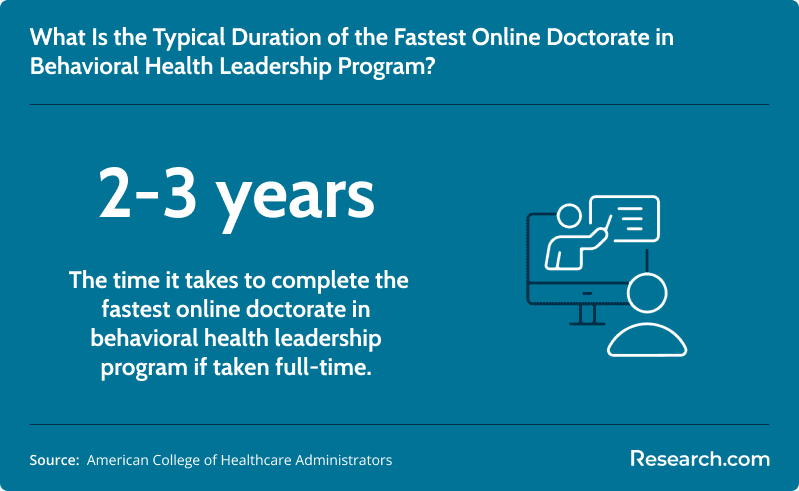
The fastest online doctorate in behavioral health leadership programs may take as little as 2 to 3 years for full-time students in accelerated formats. Programs that use eight-week terms, year-round enrollment, synchronous or asynchronous online delivery, and applied capstone projects can shorten the path compared with traditional semester-based doctoral study.
Completion time depends heavily on the degree structure. A 60-credit DBH with an applied capstone may move faster than a program with residencies, internships, or a dissertation sequence. Prior graduate coursework, transfer credit, and relevant professional experience may also reduce the time required when a school allows those credits to count toward the degree.
If you are comparing this doctorate with other mental health pathways, review related options such as MFT degree career opportunities. A DBH or behavioral health leadership doctorate usually prepares students for systems, administration, policy, or integrated care leadership, while an MFT pathway is typically more directly connected to marriage and family therapy practice.
Working professionals should be cautious about choosing only the shortest timeline. A 2.5-year or 3-year plan can be manageable for some students, but those balancing full-time work, family responsibilities, leadership roles, and doctoral research may need 4 or 5 years to finish without compromising performance.
| Time-to-completion factor | How it can affect your timeline | What to ask before enrolling |
| Credit requirements | Programs listed here range from 60 credit hours to 98 quarter credits and 90 credits. | How many credits must I complete after transfer evaluation? |
| Capstone or dissertation | A capstone may be more applied, while a dissertation can require a longer research sequence. | What are the milestones, approval steps, and average completion patterns? |
| Residencies or in-person sessions | Hybrid programs may require travel even when most coursework is online. | How often must I attend in person, and where are residencies held? |
| Course pacing | Eight-week or accelerated terms may help students move faster but increase weekly workload. | How many hours per week should I expect for each course? |
| Transfer credit | Approved graduate credits can reduce the number of courses required. | What is the maximum transfer credit allowed, and how is it evaluated? |
How does the fastest online doctorate in behavioral health leadership program compare to an on-campus program?
Online doctoral programs in behavioral health leadership are usually better suited for experienced professionals who need flexibility and want to keep working while studying. Many online formats allow students to complete coursework asynchronously, participate in virtual discussions, and complete applied projects connected to their workplace or community.
Accelerated online programs may also use shorter terms and year-round enrollment, which can help students finish faster than programs tied to a traditional academic calendar. Similar accelerated models exist in other healthcare fields; for example, nurses comparing specialized graduate pathways may look at the fastest online MSN women's health nurse practitioner programs to understand how online pacing affects advanced professional study.
Campus-based programs may provide more direct access to faculty, research labs, in-person networking, and structured mentorship. They can be a better fit for students who prefer scheduled classes, face-to-face collaboration, or research-intensive environments. The trade-off is that campus attendance may be difficult for professionals with demanding work schedules or those who do not live near a suitable program.
| Format | Best for | Advantages | Potential drawbacks |
| Fully online | Working professionals who need maximum flexibility | Flexible scheduling, no relocation, easier to continue full-time work | Requires strong self-management and may offer fewer in-person networking opportunities |
| Online-hybrid | Students who want online coursework plus periodic in-person learning | Combines flexibility with residencies, cohort building, or intensive sessions | Travel costs and residency scheduling can add complexity |
| On campus | Students who value face-to-face mentorship and structured academic routines | Direct access to campus resources, faculty, peers, and research spaces | Less flexible for full-time professionals and may require relocation or commuting |
Online study is not automatically easier. In accelerated doctoral programs, the weekly reading, writing, research, and project expectations can be intense. The right question is not “online or campus?” but “Which format gives me the support, pace, access, and professional fit I need to finish?”
What is the average cost of the fastest online doctorate in behavioral health leadership program?
The cost of an online doctorate in behavioral health leadership varies by school, credit structure, residency requirements, transfer credit, technology fees, and whether the program charges by semester, quarter hour, or credit hour. Among the programs listed here, stated tuition rates include $309.32 to $444.26 per credit, $325, $400 per credit hour, $610/credit, $630 per quarter hour, $630 per quarter hour for coursework, $665 per credit, $720 per credit hour, $750 per credit, and $812.00 per credit.
Students should not compare only the per-credit price. A program with a lower credit rate can still cost more if it requires more credits, residencies, extended enrollment, repeated dissertation terms, or additional fees. Ask each school for a full program cost estimate before applying.
| Cost factor | Why it matters | Question to ask the school |
| Per-credit tuition | This is the most visible cost, but it does not show the full price by itself. | Is this rate locked for the program, or can it increase? |
| Total credits required | Credit requirements differ across DBH, PhD, PsyD, DrPH, and executive doctoral programs. | How many credits will I personally need after transfer review? |
| Residency or travel costs | Hybrid and residency-based programs can add travel, lodging, and time away from work. | Are residencies required, optional, virtual, or in person? |
| Dissertation or capstone continuation fees | Students who need extra time may pay additional terms. | What happens financially if I do not finish the project on schedule? |
| Employer reimbursement | Healthcare employers may support leadership training when the degree aligns with organizational needs. | Does the school coordinate billing or documentation for employer tuition assistance? |
Cost should be evaluated alongside likely career use. Graduates who move into behavioral health administration, executive leadership, policy, or integrated care roles may benefit professionally, but salary outcomes are never guaranteed and depend on experience, location, employer type, licensure, and leadership responsibility.
For context, graduates in behavioral health leadership roles may pursue positions such as Director of Behavioral Health. In the United States, a Director of Behavioral Health with a doctorate often has a median base salary around $114,000, and total compensation—including bonuses—may reach $140,000 to $150,000 or more. Salary.com reports an average base pay of $143,872 as of January 2025. Entry-level graduates may see starting salaries in the $100,000 to $130,000 range, while seasoned executives in larger systems or regional agencies can earn $180,000 to over $200,000 annually.
The workforce context also matters. A shortage of adult psychiatrists is projected at 57% by 2037, and professionals considering leadership roles may strengthen their clinical foundation through related pathways such as accelerated MFT programs online when those credentials align with their goals.
The chart below shows projected shortages for selected behavioral health providers by 2037 and illustrates why workforce planning remains a major issue in mental health systems.
What are the financial aid options for students enrolling in the fastest online doctorate in behavioral health leadership program?
Doctoral students in online behavioral health leadership programs may use several funding sources, but eligibility depends on school accreditation, enrollment status, citizenship or residency status, employer policies, and program participation in federal aid.
- Federal financial aid: Eligible graduate students can submit the FAFSA and may qualify for Direct Unsubsidized Loans. Graduate students do not receive Pell Grants, but they may borrow up to $20,500 annually through federal loans. Graduate PLUS Loans may be available for additional costs.
- Scholarships and grants: Universities may offer scholarships for doctoral students, healthcare leaders, counseling professionals, or public service-oriented applicants. External associations and nonprofit foundations may also award aid that does not need to be repaid. Students still building toward doctoral study may compare lower-cost foundations such as the most affordable online counseling degrees.
- Employer tuition assistance: Behavioral health agencies, hospitals, insurers, public health departments, and nonprofit organizations may help pay for a doctorate when the program supports leadership succession, quality improvement, or service expansion.
- Military and veterans’ benefits: Eligible service members, veterans, and dependents may use GI Bill® benefits, Yellow Ribbon Program funds, or military tuition discounts at participating schools.
- Payment plans and private loans: Monthly payment plans can spread tuition across the term. Private student loans are another option, but students should compare interest rates, repayment terms, and borrower protections against federal loan options.
How to reduce the cost before you enroll
- Ask for a written total program cost estimate, not just a per-credit tuition figure.
- Request a transfer credit review before committing to a program.
- Confirm whether residencies, technology fees, dissertation continuation terms, or graduation fees are included.
- Check whether your employer has preferred education partners or reimbursement requirements.
- Compare the degree’s curriculum with the job titles you are targeting so you do not overpay for a program that does not match your career plan.
What are the prerequisites for enrolling in the fastest online doctorate in behavioral health leadership program?
Admissions requirements vary, but accelerated online doctoral programs in behavioral health leadership usually expect applicants to bring graduate-level academic preparation and professional experience. These programs are often built around applied leadership problems, so admissions committees typically look for evidence that applicants can connect doctoral study to real organizational challenges.
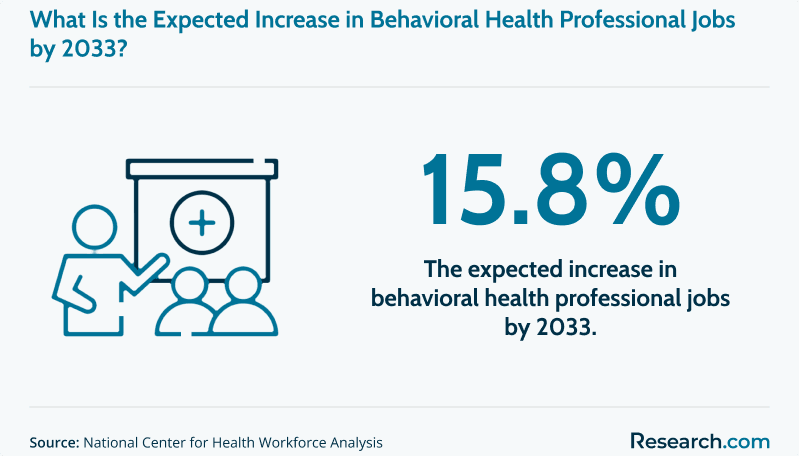
In 2023, there were 119,474 behavioral health professional jobs in the U.S. By 2033, that number is projected to grow by 18,860 positions—an increase of 15.8% over the decade. This labor market context helps explain why many programs target professionals who already understand behavioral health systems and want to lead them.
- Master’s degree: Most programs require a master’s degree in behavioral health, psychology, counseling, social work, public health, nursing, healthcare administration, or a related area. Some schools may consider other academic backgrounds when the applicant has relevant leadership experience.
- Professional experience: Many programs prefer or require at least 2 to 3 years of experience in behavioral health, healthcare, public health, or organizational leadership. If you are still deciding between clinical and leadership routes, this guide to the clinical psychologist vs clinical mental health counselor career path can help clarify role differences.
- Minimum GPA: A graduate GPA of 3.0 is commonly expected, although some schools may review applicants holistically if they have substantial professional achievements.
- Letters of recommendation: Applicants commonly submit two to three recommendations from supervisors, faculty members, or professional colleagues who can comment on readiness for doctoral work.
- Resume or CV and personal statement: A current resume or CV and a written statement usually explain leadership experience, professional goals, and reasons for pursuing doctoral study.
- Interview: Some programs use an interview to evaluate fit, communication skills, research interests, and readiness for the pace of an accelerated doctorate.
What courses are typically in the fastest online doctorate in behavioral health leadership program?
Coursework in an online doctorate in behavioral health leadership usually combines organizational leadership, integrated care, policy, data use, ethics, and applied research. The goal is to prepare graduates to improve behavioral health systems rather than only provide direct services.
A typical curriculum may begin with behavioral health leadership theory and practice, where students examine leadership models, change management, team development, and decision-making in complex service environments. Integrated healthcare systems courses focus on how behavioral health, primary care, public health, and community services can work together to improve access and outcomes.
Students may also study health policy and advocacy, including laws, regulations, reimbursement structures, and funding models that shape behavioral health delivery. Organizational behavior and culture courses address communication, conflict, workforce issues, and inclusive leadership. Nurses who want a shorter credential for academic or clinical teaching may compare this broader doctoral route with the fast track nurse educator graduate certificate online.
Behavioral health informatics is increasingly important because leaders are expected to understand data, dashboards, electronic health records, quality measures, and digital tools. Program evaluation and quality improvement courses teach students to measure outcomes, evaluate services, and use evidence to guide organizational decisions.
Students working in substance use treatment or considering roles as an addiction counselor may find the systems-level focus useful because it extends beyond individual counseling into program design, integrated care, workforce development, and community impact.
Most programs end with a doctoral capstone, dissertation, or applied research project. This final requirement typically asks students to identify a real behavioral health leadership problem, study it systematically, and propose or implement a practical solution.
| Course area | What students learn | Leadership use |
| Behavioral health leadership | Leadership theory, change management, supervision, and strategic decision-making | Managing teams, departments, programs, or service lines |
| Integrated care systems | Coordination between behavioral health, primary care, public health, and community providers | Building collaborative care models and reducing service fragmentation |
| Health policy and advocacy | Regulation, funding, reimbursement, and policy influence | Leading policy-informed programs and advocating for system improvements |
| Behavioral health informatics | Data tools, reporting, analytics, and technology-supported care | Using evidence and metrics to guide decisions |
| Program evaluation | Outcome measurement, quality improvement, and applied research methods | Assessing whether programs are effective and sustainable |
| Capstone or dissertation | Applied inquiry into a real leadership challenge | Demonstrating doctoral-level problem-solving in practice |
What types of specializations are available in the fastest online doctorate in behavioral health leadership programs?
Specializations vary by school. Some programs offer formal concentrations, while others allow students to tailor electives, research, practicum experiences, or capstone topics toward a leadership niche. Behavioral health leaders with specializations may have access to roles tied to program management, integrated care, policy, informatics, or executive administration. Among states in 2024, Kentucky offered the highest pay for behavioral health director jobs at $156,703.
Students interested in performance, wellness, and mental health in athletic settings may also compare leadership doctorates with accelerated sports psychology degrees online, especially if their long-term goals involve coaching, performance psychology, or mental resilience programs.
- Integrated Behavioral Health: Focuses on coordinating mental health, substance use, primary care, and community services across interdisciplinary teams.
- Health Policy and Advocacy: Prepares students to understand regulations, funding, legislation, and system-level reform.
- Organizational Leadership in Healthcare: Emphasizes strategic planning, executive decision-making, change management, and workforce leadership.
- Behavioral Health Program Development: Builds skills in designing, launching, managing, and evaluating mental health and behavioral health initiatives.
- Behavioral Health Informatics: Teaches students to use data, reporting tools, and digital systems to improve service delivery and outcomes.
These specializations may be useful for professionals such as a licensed clinical social worker who wants to move from direct service into program direction, policy work, executive leadership, or systems-level quality improvement.
Salaries for behavioral health directors differ by state, employer, role scope, and experience. The chart below highlights states with the highest average salaries for behavioral health directors.
How do you choose the best among the fastest online doctorate in behavioral health leadership programs?
Start with accreditation. A fast program is not a good investment if the institution lacks recognized accreditation, if credits are unlikely to transfer, or if employers question the credential. Regional or recognized institutional accreditation also affects access to federal financial aid and signals that the school meets established academic standards.
Next, match the degree type to your goal. A DBH may be more applied and leadership-oriented, a PhD may be more research-focused, a PsyD may emphasize applied psychology depending on the program, and a DrPH may fit public health leadership. Do not assume all “behavioral health leadership” programs prepare students for the same roles.
Review the curriculum and specialization options carefully. Look for courses in integrated care, administration, policy, informatics, quality improvement, finance, supervision, and applied research if you want systems leadership. If your goal is academia or research, examine faculty research interests, dissertation expectations, and publication opportunities.
Then evaluate time and workload. Accelerated doctoral study can be efficient, but the pace is demanding. Ask whether courses are asynchronous, synchronous, cohort-based, self-paced, or hybrid. Confirm how often courses start, how many courses students typically take at once, and what happens if you need to slow down.
Finally, compare total cost, student support, faculty background, alumni outcomes, career services, and the capstone or dissertation process. Speak with admissions staff, program directors, current students, or alumni before making a final decision.
Questions to ask before choosing a program
| Decision area | Questions to ask | Why it matters |
| Accreditation | Is the institution accredited, and by whom? | Accreditation affects credibility, aid eligibility, and transferability. |
| Degree fit | Is this a DBH, PhD, PsyD, DrPH, DHSc, or another doctoral title? | Degree type can shape employer perception and career alignment. |
| Licensure impact | Does this program lead to any clinical license, or is it non-licensure? | Many leadership doctorates do not qualify graduates for new clinical licensure. |
| Completion model | Is the final requirement a capstone, dissertation, internship, or applied project? | The final project can strongly affect timeline and workload. |
| Cost transparency | What is the full estimated cost, including fees and residencies? | Per-credit tuition does not show the full financial commitment. |
| Career support | What mentoring, networking, and alumni support are available online? | Doctoral value often depends on relationships as well as coursework. |
What career paths are available for graduates of the fastest online doctorate in behavioral health leadership programs?
Graduates of online behavioral health leadership doctorates often pursue senior roles in healthcare organizations, behavioral health agencies, public health systems, nonprofits, higher education, consulting, and policy environments. The degree is especially relevant for professionals who want to lead programs, improve systems, manage interdisciplinary teams, or influence how behavioral health services are delivered.
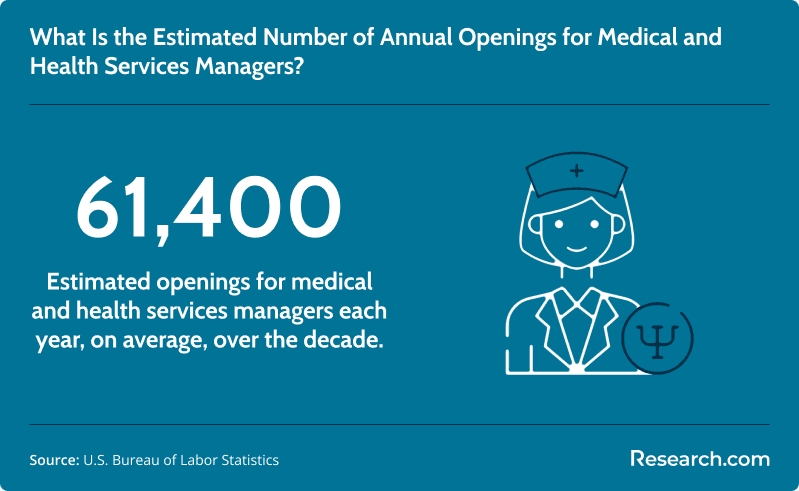
A common target role is Behavioral Health Director. These professionals may oversee mental health programs, manage budgets and staff, develop clinical strategies, supervise quality improvement efforts, and coordinate care delivery across departments or service lines. About 61,400 openings for medical and health services managers are projected each year, on average, over the decade.
Other graduates move into healthcare executive or administrative roles, especially within integrated care organizations, hospitals, community mental health agencies, addiction treatment systems, managed care organizations, and public-sector behavioral health programs. Professionals who need a shorter administrative credential may also compare doctoral study with shortest nurse administrator graduate programs online.
Some graduates work as policy advisors, consultants, faculty members, academic program directors, nonprofit executives, or founders of community-based behavioral health initiatives. Career outcomes depend on prior credentials, licensure, leadership history, employer needs, and geographic market conditions.
| Career path | Typical focus | Best fit for graduates who want to |
| Behavioral Health Director | Program leadership, staff supervision, quality improvement, service strategy | Lead mental health or substance use programs in healthcare or community settings |
| Healthcare Executive or Administrator | Operations, budgets, compliance, organizational strategy | Move into senior management within hospitals, agencies, or health systems |
| Integrated Care Leader | Coordination between behavioral health, primary care, and public health | Build collaborative care models and improve access |
| Policy Advisor or Consultant | Regulation, advocacy, program evaluation, systems reform | Influence mental health policy or advise organizations |
| Faculty Member or Academic Program Director | Teaching, curriculum development, academic leadership | Train future behavioral health professionals |
| Nonprofit or Community Organization Leader | Mission-driven service design, fundraising, partnerships, community impact | Expand access to behavioral health services through local or regional initiatives |
What is the job market like for graduates of the fastest online doctorate in behavioral health leadership program?
The job market for behavioral health leadership is shaped by rising demand for mental health services, workforce shortages, integrated care expansion, and the need for administrators who understand both clinical realities and organizational systems. The American Psychological Association has reported on a national shortage of mental health professionals, which increases pressure on organizations to recruit leaders who can improve access, staffing, quality, and care coordination.
Demand is not limited to direct-service clinicians. Healthcare organizations, public agencies, insurers, nonprofits, and academic institutions need leaders who can design programs, evaluate outcomes, manage teams, and align services with funding and policy requirements.
Broader behavioral health roles such as counselors and substance-use specialists are projected to grow 18–19% between 2022 and 2032, far above average. Employment for psychologists is projected to grow 7% through 2033, with clinical and counseling psychologists seeing as much as 13% job growth over that period.
Salary potential varies by role. Median pay for psychologists reached $94,300 in May 2024, with clinical and counseling psychologists averaging around $95,800. Top earners such as industrial–organizational psychologists typically make six figures, while those with PhD or PsyD credentials in behavioral health may see earnings between $100,000 to $110,000 or more, depending on role and setting.
Doctorate-prepared professionals may also benefit from low unemployment in some psychology-related fields. Clinical psychology doctorates are said to have around 0.7% unemployment, lower than most STEM fields. Still, students should avoid treating any single statistic as a guarantee. Location, licensure, experience, employer type, and leadership scope all influence hiring and compensation.
What accreditation and quality assurances should I look for in an online DBH program?
Accreditation is one of the most important quality checks for an online DBH or behavioral health leadership doctorate. Look for an institution with recognized accreditation, clear academic policies, qualified faculty, transparent student outcomes, and structured support for online doctoral learners.
Quality assurance should also include a coherent curriculum, regular outcome review, accessible faculty, research or capstone support, and clear expectations for dissertation or applied project completion. Fast completion should not mean reduced academic rigor.
Students comparing behavioral health leadership programs with other specialized graduate routes can use benchmarks from options such as the most affordable online BCBA programs to evaluate whether tuition, accreditation, faculty expertise, and career alignment support long-term value.
What are the potential challenges in pursuing an online DBH program?
Accelerated online doctoral study can be convenient, but it is demanding. Students must manage advanced readings, research assignments, leadership projects, discussions, and writing deadlines while often maintaining full-time professional and family responsibilities.
Common challenges include limited face-to-face networking, fewer informal mentorship moments, technology issues, compressed course schedules, and the need to stay self-directed through capstone or dissertation work. Students who need more structure may prefer a hybrid or campus-based format, while those who need a lower-cost or earlier-stage option may compare doctoral study with a psychology degree online cheap pathway.
| Common challenge | Why it happens | Better approach |
| Underestimating the pace | Accelerated courses compress doctoral-level work into shorter terms. | Ask for weekly workload estimates and sample syllabi before enrolling. |
| Choosing only by tuition | Low per-credit rates may not include fees, residencies, or continuation costs. | Compare full program cost and financial aid options. |
| Ignoring licensure limits | Many DBH and leadership doctorates are not designed for new clinical licensure. | Confirm licensure implications with the school and state licensing board if relevant. |
| Overlooking accreditation | Unrecognized programs can limit transfer, aid, or employer acceptance. | Verify institutional accreditation before applying. |
| Waiting too long on the capstone | Applied projects require planning, approvals, and access to data or sites. | Begin identifying a feasible workplace or community problem early. |
Do employers view an online DBH degree as equally credible?
Employer perception depends less on whether the program is online and more on whether it is accredited, rigorous, relevant, and connected to measurable leadership skills. Many employers are familiar with online graduate education, especially for working healthcare professionals, but they may still scrutinize the institution, degree title, curriculum, and applicant’s prior experience.
An online DBH or behavioral health leadership doctorate is more likely to be respected when the school is accredited, faculty have field expertise, the curriculum is evidence-based, and the student can show how the degree improved leadership, program outcomes, quality improvement, policy work, or organizational performance. Students comparing credibility across psychology-related online programs can review whether is an online psychology degree credible to understand how accreditation and reputation affect employer confidence.
How can online DBH programs boost career networking and mentorship opportunities?
Strong online DBH programs do not rely only on recorded lectures. They build professional connection through live seminars, cohort discussions, virtual conferences, faculty advising, capstone supervision, alumni events, employer panels, and mentorship opportunities with behavioral health leaders.
Students can strengthen networking outcomes by choosing a program with active faculty engagement, applied projects tied to real organizations, and structured career support. They can also expand their professional circle through complementary academic routes such as accelerated psychology programs, especially when interdisciplinary psychology, behavioral health, and leadership networks overlap.
Practical ways to build your network while studying online
- Introduce yourself to faculty early and ask which research, policy, or leadership topics match your goals.
- Use capstone or dissertation work to solve a real problem for an employer, agency, or community partner.
- Attend virtual conferences, webinars, and association meetings connected to integrated care or behavioral health leadership.
- Join student groups or alumni communities instead of treating online coursework as an isolated experience.
- Ask classmates about their service settings; online cohorts can include professionals from many healthcare systems and regions.
Here’s What Professionals Have to Say About the Fastest Online Doctorate in Behavioral Health Leadership Program
- Jasmine: "Completing my behavioral health leadership doctorate online helped me keep my full-time role while studying. The accelerated structure was challenging, but I could apply what I was learning to team supervision, planning, and service improvement almost immediately."
- Marcus: "I expected online doctoral study to feel distant, but the cohort discussions and faculty feedback were more interactive than I anticipated. I finished in under three years, and the program helped me prepare for a senior leadership opportunity."
- Elena: "The flexibility mattered most for me. I could complete coursework while traveling for work, and the assignments were connected to real behavioral health leadership problems rather than abstract theory alone."
Key Insights
- The fastest online doctorate in behavioral health leadership programs may be completed in about 2 to 3 years, but many working professionals should plan for 3 to 5 years depending on workload, transfer credit, and final project requirements.
- Accreditation should be your first filter. A faster program is not a good investment if the school’s accreditation, credit transferability, financial aid eligibility, or employer recognition is weak.
- Degree titles matter. DBH, PhD, PsyD, DrPH, DHSc, and executive doctoral programs can lead to different academic expectations and career signals, even when they all include behavioral health leadership content.
- Do not compare programs by tuition rate alone. Total credits, residencies, technology fees, dissertation continuation terms, and employer reimbursement policies can change the real cost.
- Many behavioral health leadership doctorates are non-licensure or leadership-focused. If you need a clinical license, confirm requirements with the school and the relevant licensing board before enrolling.
- The strongest programs connect coursework to integrated care, policy, informatics, quality improvement, supervision, organizational change, and an applied capstone or dissertation that solves a real behavioral health problem.
- Career outcomes are strongest when the doctorate builds on prior professional experience. The degree can support advancement into behavioral health director, administrator, consultant, policy, faculty, or nonprofit leadership roles, but it does not guarantee salary or promotion.
- Online programs can be credible when they are accredited, rigorous, well-supported, and career-relevant. Students should actively seek mentorship, networking, and applied project opportunities rather than relying on coursework alone.
References:
- American Psychological Association. (2024). Practitioner report 2024.
- Bureau of Labor Statistics. (2024). Medical and health services managers. U.S. Department of Labor.
- Bureau of Labor Statistics. (2024). Strong growth projected in mental health-related employment. TED: The Economics Daily.
- Franklin University. (n.d.). How much salary do behavioral health professionals make?
- HRSA Bureau of Health Workforce. (2024). State of the behavioral health workforce report 2024. U.S. Department of Health and Human Services.
- Mental Health America. (2024). 2024 state of mental health in America report.
- O*NET OnLine. (n.d.). 11-9111.00 - Medical and health services managers.
- Together SC. (n.d.). Behavioral health director.
- Zippia. (n.d.). Administrative director of behavioral health services overview. Additional APA practitioner report source
Other Things You Should Know About The Fastest Online Doctorate in Behavioral Health Leadership
Many accelerated programs use a practice-based dissertation or applied doctoral project instead of a traditional thesis. Expect a proposal, faculty chair approval, and final defense. Programs commonly require about 40 to 60 dissertation-equivalent credit hours and a scholarly project tied to behavioral health leadership practice.
Admission requirements typically include a master's degree in a related field, minimum GPA of 3.0, professional experience in behavioral health leadership, and completion of an application form by the deadline. GRE scores might be required by some programs.