2027 Fastest Online Sports Psychology Degree Programs

Co-Founder and Chief Data Scientist
The overall well-being of athletes is important to ensure successful performance. Not only does their well-being include physical health, but it also includes their mental, emotional, and social health. Maintaining this balance is key to consistent athletic achievement and long-term growth.
Thus, sports psychologists are essential to the development of athletes at any level. These professionals help athletes manage stress, improve focus, recover from injuries, and maintain motivation through performance slumps or transitions.
To help aspirants get started on their careers, I created this in-depth guide to online sports psychology degree programs. Explore degree programs, tuition rates, financial aid options, income potential, and career outlook.
What are the benefits of completing an online sports psychology degree program?
- Online sports psychology degree programs offer convenient, self-paced coursework, making it easier for students to balance studies with work, athletics, or family responsibilities.
- With growing awareness of mental health in athletics, sports psychology graduates are in demand in coaching, athletic training, and performance consulting.
- Online learning gives students the chance to enroll in leading programs nationwide, often with options to specialize in areas like motivation, injury recovery, or team dynamics.
What can I expect from a fast-track online sports psychology degree program?
Students enrolled in online sports psychology degree programs can expect a comprehensive curriculum that blends psychology, kinesiology, and coaching principles. These programs usually offer flexibility, enabling learners to study at their own pace while balancing other commitments.
Coursework often includes essential topics, such as motivation, performance enhancement, mental health, and athlete behavior. Interactive components, including virtual discussions, case studies, and practical assignments, help students apply theoretical knowledge.
Many programs also incorporate internships or capstone projects to provide hands-on experience. These prepare graduates for careers in coaching, mental performance consulting, or advanced clinical studies.
Where can I work with an online sports psychology degree program?
Graduates of online sports psychology degree programs can work in diverse settings that support athletic performance and mental well-being.
Many find roles with professional athletic teams and Olympic organizations, helping elite athletes manage pressure and enhance focus. Others work with school athletic teams at the elementary, high school, or collegiate levels to support young athletes’ mental development.
Opportunities also exist in concussion centers and sports rehabilitation centers, where specialists aid recovery and psychological resilience. Academic medical centers and research institutions offer additional roles focused on advancing the science of sports psychology through clinical studies and performance research.
How much can I make with an online sports psychology degree program?
Graduates of an online sports psychology degree program can expect competitive earnings, especially as demand grows for mental health expertise in athletic performance. In the U.S., the average annual salary for sport psychologists was $92,813 in July 2025, according to ZipRecruiter.
While salaries can vary based on location, experience, and level of education, sport psychologists tend to earn well compared to other professions. Overall, psychologists across the country earned a median annual wage of $94,310 as of May 2024 (U.S. Bureau of Labor Statistics, 2025).
This suggests that salaries for sport psychologists are in line with national averages, with room for growth depending on credentials and career trajectory.
- List of Online Sports Psychology Degree Programs for 2027 List of Programs
- How long does it take to complete a fast-track online sports psychology degree program? Completion Time
- How does an online sports psychology degree program compare to an on-campus program? How does an online sports psychology degree program compare to an on-campus program?
- What is the average cost of an online sports psychology degree program? Average Cost
- What are the financial aid options for students enrolling in an online sports psychology degree program? Financial Aid
- What are the prerequisites for enrolling in an online sports psychology degree program? Prerequisites
- What courses are typically in an online sports psychology degree program? What courses are typically in an online sports psychology degree program?
- What types of specializations are available in online sports psychology degree programs? Specializations
- How do you choose the best online sports psychology degree programs? How do you choose the best online sports psychology degree programs?
- What career paths are available to graduates of online sports psychology degree programs? Career Paths
- What is the job market like for graduates of online sports psychology degree programs? Job Outlook
- How Do Online Sports Psychology Programs Support Research and Evidence-Based Practice? How Do Online Sports Psychology Programs Support Research and Evidence-Based Practice?
- How Do Accreditation and Licensing Impact Online Sports Psychology Degree Programs? How Do Accreditation and Licensing Impact Online Sports Psychology Degree Programs?
- Can additional certifications enhance career prospects in sports psychology? Can additional certifications enhance career prospects in sports psychology?
- What Are the Benefits of an Accelerated Curriculum in Online Sports Psychology Programs? What Are the Benefits of an Accelerated Curriculum in Online Sports Psychology Programs?
Online Sports Psychology Degree Programs for 2027: Programs, Costs, Careers, and How to Choose
Choosing an online sports psychology degree is not just about finding a program with the right title. Students also need to know whether the degree supports their career goal, whether it can fit around work or coaching responsibilities, how much it may cost, and whether it helps them move toward certification, doctoral study, consulting, or licensure. This guide is for prospective graduate students, coaches, athletes, fitness professionals, counselors, and psychology majors who want to understand what online sports psychology programs actually offer and how to compare them wisely.
Sports psychology sits at the intersection of mental performance, psychology, exercise science, coaching, and athlete well-being. Online programs can be a practical option for working adults, but students should pay close attention to accreditation, field experience, curriculum design, and state licensing rules. In this guide, you will find featured online programs, typical timelines, cost considerations, admissions requirements, career options, labor market information, and practical questions to ask before enrolling.
Quick Answer: What Is an Online Sports Psychology Degree?
An online sports psychology degree is usually a graduate program that teaches students how psychological factors affect athletic performance, motivation, confidence, stress, recovery, coaching, and team dynamics. Most online options are master’s programs in psychology, sport and performance psychology, kinesiology, or sport and exercise psychology. They can prepare graduates for roles in coaching, performance consulting, exercise science, athlete support, research, or further doctoral study, but they do not automatically qualify graduates to become licensed psychologists. Licensure depends on state requirements, degree level, supervised experience, and examinations.
How This List Was Developed
The programs below were selected using Research.com’s established research methodology. The review considered recent information from the IPEDS database, Peterson's database, the College Scorecard database, and the National Center for Education Statistics. Students should still verify current tuition, curriculum, transfer policies, and admission requirements directly with each institution before applying.
Featured Online Sports Psychology Degree Programs
| School | Online Program | Program Length | Credits | Published Cost Information | Accreditation |
| Capella University | MS in Psychology with a sport psychology concentration | At least 15 months | 58 quarter credits | $525 per credit through GuidedPath | Higher Learning Commission (HLC) |
| National University | MA in Sport and Performance Psychology | Contact the university for information on program duration. | At least 67.5 quarter credits | $13,669 per year | Western Association of Schools and Colleges (WASC) |
| Springfield College | MEd in Sport and Exercise Psychology | 1 to 2 years | 36 credits | $745 per credit | New England Commission of Higher Education (NECHE) |
| Adams State University | MS in Kinesiology with an applied sport psychology concentration | 1 to 2 years | 36 credits | $461.80 per credit | HLC |
| Southern Illinois University-Edwardsville | MS in Kinesiology with a specialization in exercise and sport psychology | 12 to 22 months | 30 credits | Contact the university for tuition information. | HLC |
1. Capella University
Capella University offers an online Master of Science in Psychology with a concentration in sport psychology. The curriculum covers learning theories in psychology, sport psychology principles, the biological basis of behavior, quantitative design and analysis, and current issues in sport psychology. This option may appeal to students who want a psychology-centered program with sport-specific coursework and an online structure designed for adult learners.
- Program Length: At least 15 months
- Specialization: Sport Psychology
- Cost per Credit: $525 (GuidedPath)
- Required Credits to Graduate: 58 quarter credits
- Accreditation: Higher Learning Commission (HLC)
2. National University
National University’s online Master of Arts in Sport and Performance Psychology focuses on performance enhancement, mindful performance, leadership, team building, counseling skills, and core sport and performance psychology concepts. The program offers two specialization directions: Applied Mental Performance and Theoretical Mental Performance. Students who are comparing performance consulting pathways should review how each specialization aligns with their intended work setting.
- Program Length: Contact the university for information on program duration.
- Specializations: Applied Mental Performance; Theoretical Mental Performance
- Cost per Year: $13,669
- Required Credits to Graduate: At least 67.5 quarter credits
- Accreditation: Western Association of Schools and Colleges (WASC)
3. Springfield College
Springfield College offers an online Master of Education in Sport and Exercise Psychology. Students study applied sport and exercise psychology, stress management, counseling theories, professional ethics and standards, and sport in society. Because this is an MEd program, applicants should compare the curriculum with their goals in coaching, education, performance support, or future doctoral study.
- Program Length: 1 to 2 years
- Specializations: Sport and Exercise Psychology
- Cost per Credit: $745
- Required Credits to Graduate: 36 credits
- Accreditation: New England Commission of Higher Education (NECHE)
4. Adams State University
Adams State University provides an online Master of Science in Kinesiology with an applied sport psychology concentration. Coursework includes the psychology of coaching, sports physiology, positive psychology, mental health in sport, and mental strength and conditioning. This program may be a strong fit for students who want sport psychology training within a kinesiology framework rather than a purely psychology-based degree.
- Program Length: 1 to 2 years
- Specialization: Applied Sport Psychology
- Cost per Credit: $461.80
- Required Credits to Graduate: 36 credits
- Accreditation: HLC
5. Southern Illinois University-Edwardsville
Southern Illinois University-Edwardsville offers an online Master of Science in Kinesiology with a specialization in exercise and sport psychology. Required study includes exercise and sport psychology, sport sociology, and research methods in kinesiology. Elective options include counseling skills for sport psychology, the psychology of coaching, and an internship, making it important for students to ask how local field experiences are arranged.
- Program Length: 12 to 22 months
- Specialization: Exercise and Sport Psychology
- Cost per Credit: Contact the university for tuition information.
- Required Credits to Graduate: 30 credits
- Accreditation: HLC
How Long Does It Take to Complete a Fast-Track Online Sports Psychology Degree Program?
Most online sports psychology master’s programs take about 1.5 to 3 years to finish, depending on the number of credits, course pacing, enrollment status, practicum expectations, and whether the program requires a thesis, internship, or capstone. Programs commonly require 30 to 48 credit hours, although quarter-credit programs may list a higher number because their credit system is different.
Students who want to move quickly should look beyond the advertised completion time. A shorter program is not always the best option if it lacks applied experience, faculty mentorship, research training, or preparation for the credential the student wants. Conversely, a longer program may be worthwhile if it offers supervised practice, a thesis option, or stronger preparation for doctoral study.
| Timeline Factor | How It Can Affect Completion | What to Ask Before Enrolling |
| Full-time versus part-time study | Full-time enrollment can shorten the calendar timeline, while part-time study may be more realistic for working coaches, teachers, or fitness professionals. | Can I switch between full-time and part-time if my work schedule changes? |
| Course format | Asynchronous courses may offer more flexibility; synchronous courses may provide more live discussion and structure. | Are classes self-paced, scheduled, or a mix of both? |
| Field experience | Internships and practicums can add time but may strengthen career readiness and professional networking. | Will the school help me find a placement near my location? |
| Final project | A thesis or capstone can extend the timeline but may help students build research, consulting, or doctoral application credentials. | Is a thesis required, optional, or unavailable? |
Students still building an undergraduate foundation in sport, coaching, or athletic administration may also compare the fastest online bachelor's degree in sports management programs before pursuing graduate-level sports psychology study.
How Does an Online Sports Psychology Degree Program Compare to an On-Campus Program?
Online and on-campus sports psychology programs can lead to comparable academic credentials when they are offered by accredited institutions. The bigger question is whether the format matches how you learn, how much structure you need, and whether you can access hands-on experiences. Students who are unsure about credibility should review how employers and graduate schools evaluate online psychology education, including guidance on whether an online psychology degree is credible.
| Feature | Online Sports Psychology Program | On-Campus Sports Psychology Program | Best Fit |
| Class access | Coursework is delivered virtually, often with asynchronous components that allow students to study around work, athletics, or family responsibilities. | Classes usually meet in person on a set schedule, which can make participation more structured but less flexible. | Online is often better for working adults; campus study may suit students who want daily in-person interaction. |
| Faculty and peer interaction | Interaction happens through discussion boards, video meetings, group projects, email, and virtual office hours. | Students can meet faculty, classmates, athletic staff, and campus professionals face to face. | Choose based on whether you prefer digital communication or in-person relationship-building. |
| Applied training | Students may need to secure local internships, practicums, or observation opportunities with school approval. | Students may have easier access to athletic departments, campus clinics, labs, or nearby teams. | Students pursuing applied work should ask about placement support before choosing either format. |
| Networking | Networking may be national and online, especially if classmates work in different athletic or clinical settings. | Networking may be local or campus-centered, which can help students who plan to work in the same region. | Online can broaden geographic connections; campus programs may offer stronger local ties. |
What Is the Average Cost of an Online Sports Psychology Degree Program?
The price of an online sports psychology degree can vary substantially by institution, credit requirement, tuition model, residency policy, fees, and program length. Some schools charge per credit, some publish annual tuition, and some require students to contact the institution for the latest tuition details. Because online students may still pay technology fees, course materials, background check fees, or travel costs for short residencies or field placements, tuition alone does not show the full cost.
Students should calculate the total estimated cost using the number of credits required for graduation, not just the per-credit rate. They should also ask whether tuition is locked in, whether online learners pay different fees, and whether employer benefits or scholarships can be applied. Students considering advanced leadership or behavioral health roles after a master’s degree may also compare options such as the fastest doctorate in behavioral health leadership online, but only if that path fits their long-term professional goals.
| Cost Item | Why It Matters | Question to Ask the School |
| Tuition rate | The per-credit or annual rate is the largest visible cost, but it may not include fees. | What is the total tuition for the entire degree based on required credits? |
| Fees | Online, technology, graduation, library, or student service fees can increase the final bill. | Which fees are mandatory for online students? |
| Books and materials | Psychology and research courses may require textbooks, software, assessments, or statistics tools. | What should I budget for materials each term? |
| Field experience expenses | Internships or practicums can involve travel, background checks, liability insurance, or unpaid hours. | Are there additional costs for practicum or internship placement? |
| Time away from work | Accelerated programs can reduce calendar time but may limit how many hours a student can work. | How many hours per week should I expect to spend on coursework? |
The chart below visualizes per-credit cost information for featured online sports psychology programs using the current tuition data available from the listed institutions.
What Financial Aid Options Are Available for Online Sports Psychology Students?
Online graduate students may be eligible for several types of financial support, including scholarships, grants, federal aid, institutional aid, military benefits, and employer tuition assistance. Aid availability depends on the school, enrollment status, citizenship or residency eligibility, academic standing, and whether the program participates in federal student aid programs. Students should complete the school’s required financial aid steps early because graduate scholarships and assistantship-style opportunities can have separate deadlines.
| Financial Aid Option | What It Can Cover | Important Details |
| Psi Chi Graduate Scholarships | Tuition, institutional fees, required course materials, and related graduate study costs | The Psi Chi Graduate Scholarships award eight scholarships of $3,000 each to graduate students in psychology. |
| COGDOP Graduate Student Scholarships | Research costs connected to master’s theses or doctoral dissertations | The COGDOP program offers 21 graduate student scholarships of up to $5,000, including the Harry and Miriam Levinson Scholarship ($5,000), the William and Dorothy Bevan Scholarship ($3,000), and the Charles and Carol Spielberger Scholarship ($5,000). |
| Employer tuition assistance | Partial or full tuition reimbursement for education related to an employee’s role or advancement plan | Students should ask whether the employer requires a minimum grade, continued employment period, or program approval before reimbursement. |
| Institutional scholarships | School-based tuition discounts or awards | Availability varies by institution, and online graduate students should ask whether they qualify for the same awards as campus students. |
| Federal student aid | Graduate loans and other aid when the school and student meet eligibility rules | Students should confirm that the online program is eligible before assuming federal aid applies. |
What Are the Prerequisites for Enrolling in an Online Sports Psychology Degree Program?
Admissions requirements differ by school, but most online sports psychology graduate programs expect applicants to show academic readiness, writing ability, and a clear reason for pursuing the field. Requirements may resemble graduate psychology admissions in structure, although they are usually tailored to sport, performance, kinesiology, counseling, or exercise science. Students comparing clinical routes can also review PsyD in clinical psychology requirements to understand how doctoral clinical preparation differs from many sports psychology master’s programs.
- Bachelor’s degree: Most programs require a bachelor’s degree from an accredited institution. Helpful undergraduate backgrounds may include psychology, kinesiology, sports science, exercise science, counseling, education, or a related field.
- Minimum GPA: Many schools set a minimum undergraduate GPA to demonstrate readiness for graduate-level work. Applicants with a lower GPA may need to submit additional materials or explain academic improvement.
- Letters of recommendation: Programs often request two to three letters from faculty members, supervisors, coaches, or professionals who can speak to the applicant’s preparation and potential.
- Statement of purpose: Applicants may need to explain their interest in sports psychology, relevant experience, career goals, and fit with the program.
- Resume or CV: Coaching, athletic, research, counseling, teaching, fitness, or healthcare experience can help admissions committees understand the applicant’s background.
- Prerequisite coursework: Some programs may prefer or require prior coursework in psychology, statistics, research methods, anatomy, physiology, or exercise science.
What Courses Are Typically Included in an Online Sports Psychology Degree Program?
Online sports psychology programs usually combine theory, research, applied mental skills, ethics, counseling fundamentals, and sport or exercise science. The exact course mix depends on whether the degree is housed in psychology, kinesiology, education, or performance studies. Students should review course descriptions carefully because two programs with similar names can prepare graduates for different types of work.
| Common Course | What Students Learn | Why It Matters for Practice |
| Principles of Sport Psychology | Core concepts such as motivation, confidence, focus, arousal regulation, performance routines, and athlete behavior | This course builds the foundation for understanding how mental processes influence training and competition. |
| Mental Health in Sport | Topics such as anxiety, depression, burnout, injury adjustment, identity, and emotional well-being in competitive environments | Students learn to recognize when performance concerns may be connected to broader mental health needs. |
| Mental Strength and Conditioning | Goal-setting, visualization, self-talk, resilience, concentration, and pressure management | These skills can be used in coaching, consulting, rehabilitation, and athlete development settings. |
| The Psychology of Coaching | Leadership, communication, feedback, motivation, group dynamics, and coach-athlete relationships | This course is especially useful for coaches and athletic staff who want to improve team culture and athlete engagement. |
| Counseling Skills | Active listening, interviewing, ethical communication, empathy, referral awareness, and helping relationships | Students gain interpersonal tools, while also learning the boundaries between performance support and clinical care. |
| Research Methods and Quantitative Analysis | Research design, data interpretation, assessment, and evidence evaluation | Research literacy helps graduates use evidence-based practices instead of relying on unsupported performance claims. |
Students with a broader interest in healthcare systems, patient safety, or clinical leadership may find related graduate pathways such as a fast track MSN healthcare quality and patient safety useful for comparison, but that route serves a different professional audience than sports psychology.
What Types of Specializations Are Available in Online Sports Psychology Degree Programs?
Sports psychology is one area within the broader psychology field. Students comparing options across the discipline may want to review different areas of psychology before committing to a sports-focused program. Within sports psychology programs, specializations usually reflect whether the student wants to work in mental performance, clinical support, coaching, exercise behavior, research, or youth development.
| Specialization | Main Focus | Best For | Important Caution |
| Performance Enhancement | Mental skills training, confidence, goal-setting, focus, imagery, routines, and competitive consistency | Students interested in mental performance consulting, coaching support, or athlete development | This track does not automatically qualify graduates to treat clinical mental health disorders. |
| Clinical Sport Psychology | Integration of sport context with counseling, assessment, mental health, trauma, anxiety, depression, and ethical care | Students planning to pursue licensure or additional clinical training | Licensure typically requires meeting state-specific education, supervised experience, and examination requirements. |
| Youth and School Sports | Developmentally appropriate motivation, positive coaching, student-athlete well-being, family communication, and early intervention | Coaches, teachers, counselors, and youth sport professionals | Students should verify whether the program prepares them for school-based roles that require separate credentials. |
| Exercise and Health Psychology | Physical activity behavior, rehabilitation, adherence, wellness, and the psychological side of exercise participation | Fitness, rehabilitation, wellness, and exercise science professionals | Scope of practice may differ from clinical counseling or psychology roles. |
The chart below shows employment levels for occupations connected to the sport psychology field in the US in 2023, based on 2025 data from the US BLS.
How Do You Choose the Best Online Sports Psychology Degree Program?
The best online sports psychology program is the one that fits your career target, learning style, budget, credential needs, and geographic constraints. A highly ranked or fast program may still be a poor fit if it lacks the field experience, faculty expertise, or licensure alignment you need. Start with the outcome you want, then work backward to the degree structure that supports it.
Key Factors to Compare
| Selection Factor | Why It Matters | How to Evaluate It |
| Institutional accreditation | Accreditation helps confirm that the school meets recognized academic quality standards and may affect financial aid, transferability, and employer acceptance. | Check the school’s accreditor and verify it through official accreditor or government sources. |
| Program focus | A psychology-based degree, kinesiology-based degree, and education-based degree can lead to different preparation. | Compare required courses, electives, capstone options, and stated learning outcomes. |
| Faculty expertise | Faculty with sport psychology, counseling, kinesiology, coaching, or performance consulting experience can provide stronger mentorship. | Review faculty bios, publications, applied work, and availability for advising. |
| Field experience | Internships, practicums, and supervised projects can be essential for building applied skills. | Ask whether placements are required, optional, local, virtual, or student-arranged. |
| Licensure and certification alignment | Some careers require additional credentials beyond a master’s degree. | Ask the program to explain what the degree does and does not qualify graduates to pursue. |
| Total cost | Tuition, fees, books, travel, and lost work time all affect return on investment. | Request a full cost estimate through graduation, not just one term of tuition. |
Who Should Consider an Online Sports Psychology Degree?
- Coaches who want deeper training in motivation, team culture, confidence, and athlete development
- Psychology graduates interested in performance, athletics, exercise, or future doctoral study
- Fitness, rehabilitation, or wellness professionals who want to understand behavior change and mental resilience
- Athletes or former athletes who want to support others through evidence-based performance strategies
- Educators and school professionals working with student-athletes
Who May Need a Different Path?
- Students who want to become licensed psychologists should verify whether the program supports that pathway and may need doctoral-level preparation.
- Students primarily interested in marriage, family, or relational therapy may be better served by programs such as the best online MFT programs.
- Students focused on nursing, patient care, or advanced clinical healthcare roles should compare healthcare-specific programs rather than assuming sports psychology will meet those goals. For example, an accelerated online MSN women’s health nurse practitioner program serves a very different professional purpose.
- Students whose main goal is low-cost psychology education may want to compare online psychology degree programs affordable before choosing a specialized sport psychology track.
Common Mistakes to Avoid
| Mistake | Why It Can Hurt You | Better Approach |
| Choosing only by speed | A fast program may not include the applied experience or research preparation you need. | Compare timeline, curriculum depth, practicum access, and outcomes together. |
| Assuming the degree leads to licensure | Sports psychology master’s programs do not automatically qualify graduates for licensed psychologist roles. | Check state licensure rules and ask the program for written clarification. |
| Looking only at tuition | Fees, books, field placement costs, and time away from work can change affordability. | Calculate total cost through graduation. |
| Ignoring accreditation | Non-accredited or poorly recognized education can limit financial aid, transfer options, and employer confidence. | Verify institutional accreditation before applying. |
| Overlooking internship support | Online students may need to arrange local placements, which can be difficult without guidance. | Ask how the school approves, supervises, and supports field experiences. |
| Relying only on rankings | Rankings cannot tell you whether a program meets your credential, budget, or career needs. | Use rankings as one data point, then evaluate fit personally. |
What Career Paths Are Available to Graduates of Online Sports Psychology Degree Programs?
Graduates can pursue roles that apply psychological principles to performance, coaching, health behavior, rehabilitation, education, and athlete support. Some positions require additional licensure, certification, supervised experience, or doctoral education. Students comparing psychology careers more broadly can review best psychology jobs to understand related employment paths.
| Career Path | How Sports Psychology Training Applies | Credential Considerations |
| Clinical Psychologists | Professionals with sport psychology expertise may support athletes with performance concerns, stress, injury recovery, and clinical mental health needs. | Clinical psychologist roles generally require advanced licensure and education beyond many master’s programs. |
| Coaches and Scouts | Coaches and scouts can use motivation, communication, confidence-building, and team cohesion strategies to develop athletes and evaluate talent. | Requirements vary by employer, sport level, and organization. |
| Exercise Physiologists | Exercise physiologists may integrate mental resilience, adherence strategies, and behavior change principles into fitness or rehabilitation plans. | Employers may require exercise science training, certification, or healthcare-related qualifications. |
| Health Education Specialists | These professionals can design wellness, mental performance, and health promotion programs for athletes or active populations. | Requirements depend on the setting, employer, and program responsibilities. |
| School and Career Counselors and Advisors | Counselors and advisors may support student-athletes as they balance academics, athletics, identity, transitions, and career planning. | School counseling roles often require state-specific credentials. Students seeking counseling preparation may compare shortest counseling psychology masters programs online. |
| Organizational or Team Performance Roles | Some graduates apply performance psychology principles to leadership, teamwork, motivation, and group performance outside athletics. | Students interested in workplace applications may explore organizational psychologist jobs. |
The chart below visualizes median annual wages for psychology-related occupations in the US in May 2024, based on 2025 data from the US BLS.
What Is the Job Market Like for Graduates of Online Sports Psychology Degree Programs?
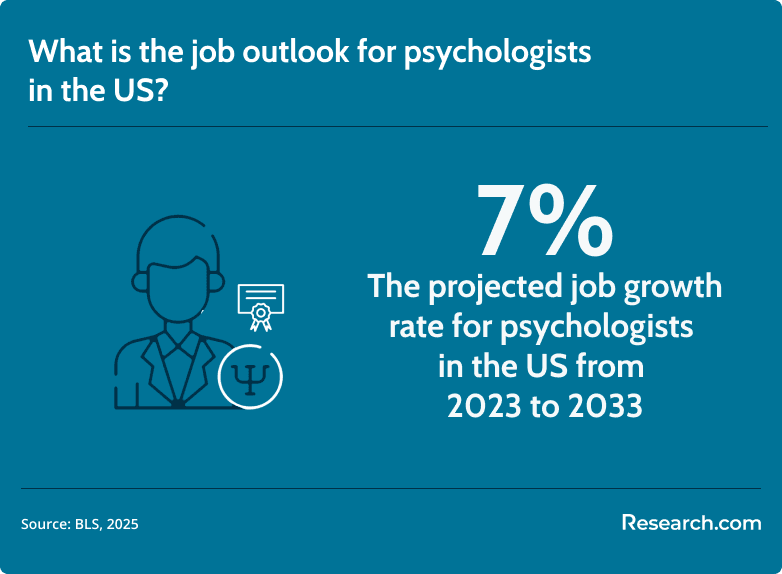
The labor market for sports psychology graduates depends heavily on the role they pursue. Sports psychology itself is a specialized field, but graduates often work in broader categories tracked by the US Bureau of Labor Statistics, such as psychologists, coaches and scouts, exercise physiologists, health education specialists, and school and career counselors and advisors. According to US BLS information cited for 2025, several related occupations are projected to grow from 2023 to 2033.
- Psychologists (7%): Employment for psychologists in the US is projected to grow faster than average, with about 13,000 new job openings per year as demand for mental health and performance-related support continues.
- Coaches and Scouts (9%): Employment for coaches and scouts is projected to grow as interest in sports instruction and talent recruitment remains strong, with approximately 41,800 annual openings over the decade.
- Exercise Physiologists (10%): Employment for exercise physiologists is projected to grow quickly within health and fitness fields, with an average of around 1,600 new positions each year as preventive and rehabilitative care remains important.
Students should interpret these projections carefully. A sports psychology degree can support entry into related fields, but job titles, salaries, and advancement depend on experience, credentials, location, employer type, licensure, and professional network. No degree can guarantee a specific job or wage.
How Do Online Sports Psychology Programs Support Research and Evidence-Based Practice?
Strong online sports psychology programs teach students to evaluate claims, read research critically, and apply evidence-based strategies rather than relying on motivational slogans or untested techniques. Research methods, quantitative analysis, literature review, and data-informed case work help students understand which interventions have support and which require caution. This matters because athletes, coaches, and organizations may seek quick performance fixes, while ethical practice requires careful assessment, appropriate referral, and strategies grounded in research.
Students who plan to pursue doctoral study, publish research, work in collegiate athletics, or consult with high-performance teams should look for programs with thesis options, faculty-led projects, research design coursework, and opportunities to analyze real or simulated performance data.
How Do Accreditation and Licensing Impact Online Sports Psychology Degree Programs?
Accreditation and licensing are separate issues, and students should understand both before enrolling. Institutional accreditation helps show that a college or university meets recognized academic standards. Licensing is the legal authorization to practice in a regulated role, such as psychologist or counselor, and it is controlled by state boards. An accredited online sports psychology degree may be academically legitimate, but that does not mean it automatically satisfies licensing rules.
| Topic | What It Means | Why Students Should Care |
| Institutional accreditation | The college or university is reviewed by a recognized accrediting body. | It can affect financial aid eligibility, transfer credit, employer recognition, and graduate school options. |
| Program curriculum | The courses and field experiences determine what competencies students develop. | A program can be accredited institutionally but still not match a student’s career goal. |
| State licensure | A state board sets education, supervised experience, examination, and application requirements for regulated practice. | Students pursuing clinical roles must confirm requirements in the state where they plan to work. |
| Professional certification | Optional or employer-preferred credentials can signal specialized skill in performance, coaching, or behavior analysis. | Certifications may strengthen employability but do not replace licensure where licensure is required. |
Can Additional Certifications Enhance Career Prospects in Sports Psychology?
Additional certifications can help graduates demonstrate focused skills, especially in mental performance coaching, behavior analysis, coaching, fitness, or health behavior. Certifications are most useful when they align with the graduate’s intended setting. For example, a coach working with athletes may benefit from mental performance credentials, while a professional working with behavior change may explore behavioral science pathways such as the most affordable BCBA online programs. Students should confirm whether a certification is recognized by employers in their target field before investing time and money.
- Use certifications strategically: Choose credentials that support a specific role rather than collecting unrelated credentials.
- Check prerequisites: Some certifications require graduate coursework, supervised hours, exams, or continuing education.
- Understand limits: A certification may expand professional credibility but does not authorize clinical practice if state licensure is required.
- Ask employers: Athletic departments, private performance companies, rehabilitation centers, and schools may value different credentials.
What Are the Benefits of an Accelerated Curriculum in Online Sports Psychology Programs?
An accelerated online sports psychology curriculum can help motivated students finish sooner, reduce time away from career advancement, and maintain momentum through closely sequenced courses. This format may be especially helpful for working coaches, teachers, trainers, or psychology graduates who already understand the field and can manage a demanding workload. Students comparing faster psychology pathways may also review an accelerated psychology degree to understand how condensed study formats differ across programs.
Speed has trade-offs. Accelerated courses can require heavy weekly reading, writing, discussion, and project work. Students with full-time jobs, travel-heavy coaching schedules, caregiving responsibilities, or limited academic preparation should ask for a realistic weekly time estimate before enrolling.
| Potential Benefit | Possible Trade-Off | Best For |
| Faster completion | Less time to absorb complex theory and research if the pace is too intense | Students with strong time management and clear goals |
| Career momentum | Limited flexibility during busy work or athletic seasons | Professionals who want to transition quickly or qualify for advancement |
| Structured progression | Fewer breaks between courses | Students who prefer a planned sequence and steady deadlines |
| Potential cost efficiency | Savings are not guaranteed if fees, repeated courses, or reduced work hours offset tuition savings | Students who calculate total cost carefully before enrolling |
What Graduates Say About Fast-Track Online Sports Psychology Degree Programs
- Grace: "The online format made it possible for me to keep coaching while completing my degree. I was able to use mental skills concepts with my team almost immediately, especially around focus, confidence, and morale."
- Theo: "I expected distance learning to feel disconnected, but the faculty support and course discussions helped me stay engaged. The program gave me access to sport psychology coursework without relocating."
- Makayla: "The applied assignments and mental performance training gave me tools I could use in a rehabilitation setting. Seeing those strategies help clients made the degree feel practical, not just academic."
Questions to Ask Before Applying
- Is the institution accredited, and by which accrediting body?
- Does the program prepare students for performance consulting, coaching, research, doctoral study, counseling, or another outcome?
- Does the degree meet any requirements for licensure or certification in my state or intended profession?
- Are internships, practicums, capstones, or thesis projects required?
- If fieldwork is required, does the school arrange placements or must students find their own?
- What is the total estimated cost through graduation, including tuition, fees, books, and placement-related expenses?
- Are courses asynchronous, synchronous, self-paced, cohort-based, or accelerated?
- What support is available for online students, including advising, career services, library access, tutoring, and faculty mentoring?
- What types of jobs have recent graduates pursued, and what additional credentials did they need?
- Can I speak with an admissions advisor, program director, or current student before applying?
Key Insights
- An online sports psychology degree can be valuable for students interested in mental performance, coaching, athlete wellness, exercise behavior, and applied psychology, but the right program depends on the career outcome you want.
- Most online sports psychology master’s programs take about 1.5 to 3 years, with timelines shaped by enrollment status, credit load, internship requirements, and capstone or thesis expectations.
- Accreditation matters, but it is not the same as licensure. Students who want to become licensed psychologists or counselors must verify state-specific requirements before enrolling.
- Costs vary widely, so compare total program cost instead of focusing only on per-credit tuition. Fees, books, travel, and unpaid fieldwork can affect affordability.
- Online programs can be credible and flexible, but students should confirm how field experiences, mentorship, networking, and applied training are delivered.
- Career options may include coaching, performance consulting, exercise physiology, health education, counseling-related roles, research, or doctoral study, but some paths require additional credentials.
- The strongest program choice is not always the fastest or cheapest. It is the one that aligns with your intended role, credential needs, budget, schedule, and preferred learning environment.
References:
- National Center for Education Statistics. (2024, May). Graduate Degree Fields. https://nces.ed.gov/programs/coe/indicator/ctb/graduate-degree-fields
- US Bureau of Labor Statistics. (2025, April 18). Coaches and Scouts. Occupational Outlook Handbook. https://www.bls.gov/ooh/entertainment-and-sports/coaches-and-scouts.htm
- US Bureau of Labor Statistics. (2025, April 18). Exercise Physiologists. Occupational Outlook Handbook. https://www.bls.gov/ooh/healthcare/exercise-physiologists.htm
- US Bureau of Labor Statistics. (2025, April 18). Health Education Specialists. Occupational Outlook Handbook. https://www.bls.gov/ooh/community-and-social-service/health-educators.htm
- US Bureau of Labor Statistics. (2025, April 18). Psychologists. Occupational Outlook Handbook. https://www.bls.gov/ooh/life-physical-and-social-science/psychologists.htm
- US Bureau of Labor Statistics. (2025, April 18). School and Career Counselors and Advisors. Occupational Outlook Handbook. https://www.bls.gov/ooh/community-and-social-service/school-and-career-counselors.htm
- US Bureau of Labor Statistics. (2025). Occupational Employment and Wage Statistics, Industry: Cross-industry, Private, Federal, State, and Local Government. Occupational Employment and Wage Statistics Query System. https://data.bls.gov/oes/#/industry/000000
- ZipRecruiter. (2025). Sport Psychologist Salary. https://www.ziprecruiter.com/Salaries/Sport-Psychologist-Salary
Other Things You Need to Know about Accelerated Online Sports Psychology Degree Programs
In 2027, expect the fastest online sports psychology degree programs to require a bachelor's degree for entry, GRE scores, and relevant work or internship experience. Coursework typically covers performance enhancement, mental health, and counseling. Some programs may also expect a capstone project or thesis.
For 2027's fastest online sports psychology degree programs, you generally need a reliable internet connection, a computer with updated software, webcam access, and digital literacy skills. Specific technical requirements vary by institution, so check with the program for detailed specifications.
Yes, many accelerated online sports psychology programs accept transfer credits, usually after an official transcript evaluation. Schools commonly cap transfer credit at 60 to 90 semester hours for a bachelor’s degree. Credits must come from an accredited institution and match required course outcomes.