2027 Best Online Master’s in Organizational Psychology Degree Programs

Co-Founder and Chief Data Scientist
An online master’s in organizational psychology is for professionals who want to understand how people behave at work—and use that knowledge to improve hiring, leadership, training, culture, employee well-being, and organizational performance. It can be a practical graduate path for people in human resources, consulting, talent development, operations, leadership, research, and workplace analytics who need flexibility but still want a rigorous psychology-based credential.
This guide explains what you can expect from an online organizational psychology master’s program, how long it takes, what it may cost, which courses and specializations are common, and how to compare programs before enrolling. It also reviews career paths, salary considerations, accreditation checks, return on investment, and current workplace trends shaping the field.
Quick Answer: Is an Online Master’s in Organizational Psychology Worth Considering?
An online master’s in organizational psychology can be worth considering if you want to apply psychology to workplace problems rather than pursue traditional clinical practice. Graduates often use the degree in human resources, organizational development, training, consulting, employee assessment, and leadership roles. According to the U.S. Bureau of Labor Statistics, industrial-organizational psychologists earned a median annual wage of $109,840, while psychologists overall had a median annual wage of $94,310. The degree is strongest for students who want evidence-based workplace roles and weakest for those who need a clinical license unless the program specifically meets licensure requirements.
Main Benefits of an Online Master’s in Organizational Psychology
- Graduates can apply psychological research in business, nonprofit, education, and government settings to improve employee performance, organizational culture, and workplace well-being.
- Industrial-organizational psychology can offer strong earning potential, with a reported median annual wage of $109,840 for industrial-organizational psychologists.
- Online delivery can help working adults continue their education without relocating or pausing their careers, although students should still compare total costs, technology requirements, and any residency expectations.
What can I expect from an online master’s program in organizational psychology?
An online master’s program in organizational psychology teaches students how to use psychological theory, research methods, and data analysis to solve workplace challenges. Instead of focusing on individual therapy, the curriculum usually examines employee motivation, leadership behavior, organizational change, team dynamics, assessment, talent selection, training, and workplace culture.
Students should expect a mix of reading-intensive coursework, research projects, applied case studies, group collaboration, and written analysis. Many programs are designed for working professionals, so courses may be asynchronous, synchronous, or a combination of both. A capstone, applied project, thesis, or dissertation-style research component may also be required, depending on the program.
| What you study | How it is used at work | Why it matters |
| Employee assessment and selection | Improving hiring, promotion, and evaluation processes | Organizations need fair, valid, and legally defensible talent decisions. |
| Motivation and job attitudes | Studying engagement, satisfaction, retention, and performance | Better insight into employee behavior can support stronger workforce planning. |
| Leadership and organizational change | Helping teams adapt to restructuring, growth, or new strategy | Change efforts often fail when leaders ignore human behavior and culture. |
| Research methods and analytics | Using evidence to evaluate programs, surveys, and interventions | Employers increasingly expect data-informed HR and people decisions. |
Where can I work with an online master’s program in organizational psychology?
Graduates may work in corporate HR departments, consulting firms, government agencies, universities, research organizations, healthcare systems, nonprofit organizations, and large employers with internal talent or organizational development teams. Their work often centers on improving how people are recruited, trained, evaluated, motivated, led, and supported.
BLS data cited for this field shows that scientific research and development services employed 380 industrial-organizational psychology professionals. Colleges, universities, and professional schools employed 180, while state governments, excluding schools and hospitals, employed 120. Local governments and elementary and secondary schools employed 60 and 40 individuals, respectively. California had the highest employment level, with 490 positions.
How much can I make with an online master’s program in organizational psychology?
Earnings depend on job title, location, employer, experience, and whether the role is classified as an industrial-organizational psychologist or a related business, HR, consulting, or training position. The BLS reports a median annual wage of $109,840 for industrial-organizational psychologists. For psychologists overall, the reported median annual wage is $94,310.
Some sectors report higher pay than others. The management of companies and enterprises had an annual mean wage of $142,210 for industrial-organizational psychologists. California reported an annual mean wage of $137,540, making it a notable state for professionals comparing organizational psychology salary potential by location.
- 2027 online master’s programs in organizational psychology
- Program length and completion timelines
- Online versus on-campus organizational psychology programs
- Average program cost
- Financial aid options
- Common courses
- Available specializations
- How to choose the right program
- Career paths after graduation
- Interdisciplinary career opportunities
- How to verify accreditation and program quality
- Career services and networking support
- Job market outlook
- Organizational psychology and therapeutic practice
- Supplemental certifications
- Forensic psychology and organizational strategy
- Return on investment
- Emerging trends
- Continuing education after the master’s degree
- How to evaluate the cheapest online master’s options
- Advanced research opportunities
- Specialization and online MBA leadership pathways
2027 Best Online Master’s Program in Organizational Psychology
Students comparing online psychology degree options should look beyond convenience and ask whether the curriculum, faculty, research training, and career outcomes match their goals. The programs below represent online master’s options in organizational psychology or closely related applied psychology fields. Use this list as a starting point, then verify current tuition, admissions requirements, accreditation, and course format directly with each institution before applying.
How do we rank schools?
Research.com rankings are developed through research and data analysis. For additional details, see our ranking methodology. Sources used in the ranking process include:
- IPEDS database
- Peterson’s database
- Distance Learning Licensed Data Set, College Scorecard database
- National Center for Education Statistics
| School | Program length | Credits | Cost information | Accreditation |
| University of Southern California | 16 months full-time; 5 years part-time | 20 | $2,137 per credit | Western Association of Schools and Colleges (WASC) |
| Golden Gate University | 1 to 2 years | 33 | $1,090 per credit | Western Association of Schools and Colleges (WASC) |
| Colorado State University | 2 to 4 years | 38 | $770 per credit | Higher Learning Commission (HLC) |
| University of Essex | 2 years | 180 | £12,167 U.K.; £12,428 international | British Royal Charter |
| University of London | 1 to 5 years | 180 | £1,573 standalone module; £15,736 | Privy Council |
1. University of Southern California (USC)
The University of Southern California online MS in Applied Psychology combines organizational psychology with consumer psychology. The program is designed for professionals interested in applying behavioral science in areas such as human resources, market research, user experience research, and workforce strategy. Faculty include senior executives and active practitioners, which can be valuable for students who want applied, industry-facing instruction. USC states that tuition for online programs is aligned with its on-campus programs.
- Program length: 16 months full-time; 5 years part-time
- Tracks/concentrations: Organizational and Consumer Psychology
- Cost per credit: $2,137
- Required credits to graduate: 20
- Accreditation: Western Association of Schools and Colleges (WASC)
2. Golden Gate University
Program information for Golden Gate University’s online Master of Arts in Industrial-Organizational Psychology describes a curriculum focused on major theories, research tools, and professional practice in the field. The degree can support students who want to move into leadership, consulting, or organizational improvement roles across industries such as entertainment, technology, pharmaceuticals, and global consulting.
- Program length: 1 to 2 years
- Tracks/concentrations: Organizational and Consumer Psychology
- Cost per credit: $1,090
- Required credits to graduate: 33
- Accreditation: Western Association of Schools and Colleges (WASC)
3. Colorado State University
Colorado State University’s Master of Applied Industrial/Organizational Psychology emphasizes applied research and evidence-based organizational practice. Students study methods used to evaluate workplace problems, support talent acquisition, improve leadership development, and assess organizational performance. The program may be a good fit for learners who want practical I-O psychology training without relocating.
- Program length: 2 to 4 years
- Tracks/concentrations: None
- Cost per credit: $770
- Required credits to graduate: 38
- Accreditation: Higher Learning Commission (HLC)
4. University of Essex
The University of Essex online MSc in Organisational Psychology is a part-time, fully online program. Coursework addresses recruitment, employee motivation, organizational behavior, psychological assessment in the workplace, and research methods. Students study both quantitative and qualitative approaches, and the program requires a dissertation.
- Program length: 2 years
- Tracks/concentrations: None
- Full tuition fee: £12,167 U.K.; £12,428 international
- Required credits to graduate: 180
- Accreditation: British Royal Charter
5. University of London
Birkbeck College, part of the University of London, offers an online MSc in Organizational Psychology. The program explores psychological and social processes in organizations, moving from foundational theories to contemporary research. Its flexible structure allows students to complete the degree over one to five years.
- Program length: 1 to 5 years
- Tracks/concentrations: None
- Full tuition fee: £1,573 standalone module; £15,736
- Required credits to graduate: 180
- Accreditation: Privy Council
What Graduates Say About Online Organizational Psychology Programs
-
: "
Studying organizational psychology online made it possible for me to keep working while completing graduate-level coursework. The format gave me flexibility, but the discussions with classmates from different locations also expanded how I think about workplace behavior. Emily
"
-
: "
The program helped me connect theory with real organizational problems. Case studies, virtual collaboration, and applied projects gave me tools I could use to better understand culture, communication, and employee motivation. Raj
"
-
: "
Completing the degree online fit my schedule while still challenging me academically. The forums, research assignments, and digital resources helped me engage deeply with the material and apply it in my organization. Carlos
"
Key Findings
- In 2024, 2,240 graduate degrees were awarded in industrial and organizational psychology.
- The average wage in the workforce for people with a psychology background is $94,310.
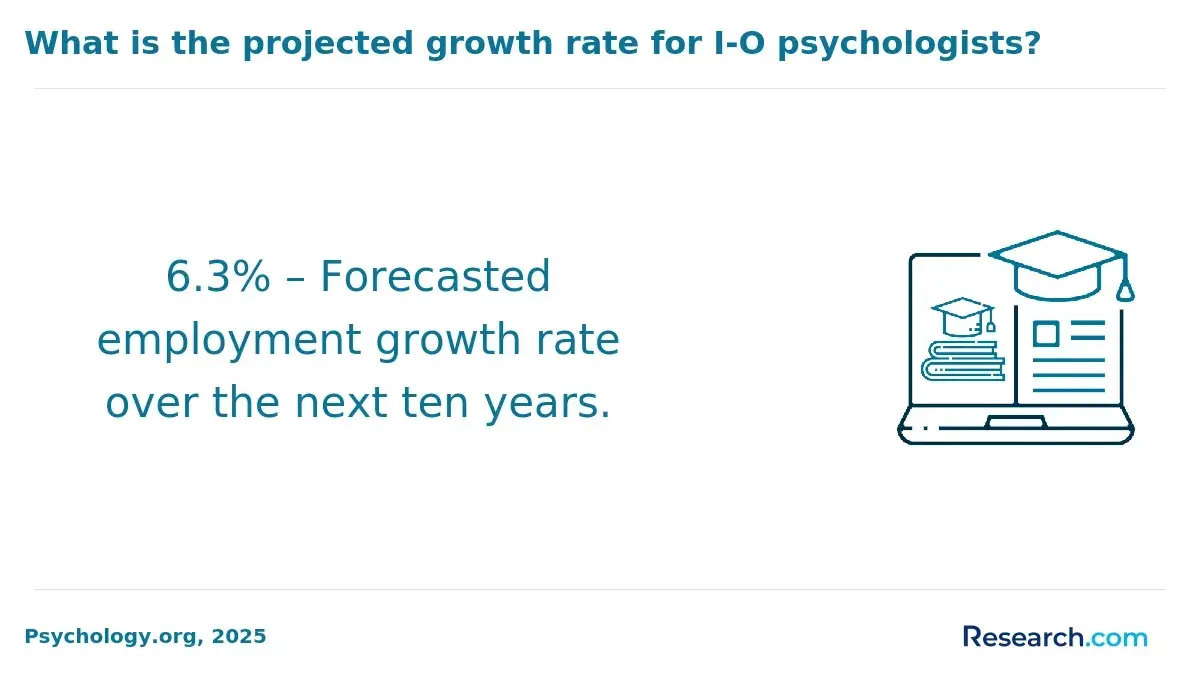
- Employment for I-O psychologists is projected to grow by 6% through 2034, with around 400 annual job openings.
- Management, scientific, and technical consulting services represent the largest employment sector for I-O psychologists, with 570 professionals.
- The management of companies and enterprises is the top-paying industry for industrial-organizational psychologists, with an annual mean wage of $142,210.
- California has the highest employment level for industrial-organizational psychologists and reports an annual mean wage of $137,540.
How long does it take to complete an online master’s program in organizational psychology?
Most online organizational psychology master’s programs can be completed in one to five years, depending on course load, program design, transfer policies, and whether students enroll full time or part time. USC’s full-time option takes 16 months, while its part-time path can take 5 years. Other examples include Golden Gate University at 1 to 2 years, the University of Essex at 2 years, Colorado State University at 2 to 4 years, and the University of London at 1 to 5 years.
When comparing timelines, ask whether the schedule is realistic for your work and personal obligations. A shorter program may reduce time out of the job market, but it can also require heavier weekly study. A part-time format may be easier to manage, but it can extend tuition payments and delay career benefits. For broader context on graduate timelines, review how master’s degree length can vary by format and field. Students also comparing faster undergraduate pathways may find accelerated online bachelor’s degree options useful for planning a longer education path.
How does an online master’s program in organizational psychology compare to an on-campus program?
Online and campus-based organizational psychology programs can cover the same core topics, but the learning experience is different. Online programs generally offer more scheduling flexibility and remove relocation barriers. Campus programs may offer more face-to-face interaction, easier access to local research labs, and in-person networking. The better choice depends on how you learn, whether you need flexibility, and how important campus-based opportunities are to your goals.
Students who learn well independently may appreciate the online format, especially if work or family responsibilities make weekly campus attendance difficult. Research on independent learning preferences, including work published through ScienceDirect, can help students think more carefully about whether online learning matches their habits. If you are comparing broader options, Research.com also reviews online master’s degrees in psychology and state-specific psychology education resources such as online psychology programs in Ohio.
| Factor | Online program | On-campus program |
| Flexibility | Usually stronger for working adults and remote learners | Usually requires scheduled travel or relocation |
| Networking | Often virtual through discussion boards, alumni groups, and online events | Often easier through in-person faculty, peers, and local employers |
| Learning style | Best for self-directed students who can manage deadlines independently | Best for students who prefer structured classroom interaction |
| Cost considerations | May reduce commuting, housing, and relocation expenses | May involve campus fees, transportation, and living costs |
What is the average cost of an online master’s program in organizational psychology?
The average tuition cost cited for an online master’s program in organizational psychology is $9,730, with typical tuition ranging from $8,000 to $10,800. This can be lower than the reported $30,000 to $120,000 range for in-person master’s degrees, although actual costs vary by institution, residency status, fees, books, technology, and program length.
Do not compare programs by tuition alone. A lower-cost program may become more expensive if it has high fees, required campus visits, limited transfer credit acceptance, or weak career services. Students focused on affordability should review the broader cost of online psychology degrees and compare total price, not just advertised tuition. Those mapping a longer academic pathway may also want to examine affordable online bachelor’s degree options before graduate study.
What are the financial aid options for students enrolling in an online master’s program in organizational psychology?
Online graduate students may be eligible for several types of financial aid, but eligibility depends on the school, enrollment level, accreditation status, and individual circumstances. Students comparing online psychology programs should confirm whether the institution participates in federal aid programs and whether online students receive the same aid consideration as campus students.
- Federal student loans: Eligible students may use federal loans after completing the Free Application for Federal Student Aid, commonly known as the FAFSA.
- Scholarships: Schools, professional associations, employers, and private organizations may offer awards based on merit, background, career goals, or field of study.
- Grants: Some grants are need-based and do not require repayment, although graduate-level grant availability may be more limited than undergraduate aid.
- Work-study programs: Some institutions offer part-time work opportunities that can help students earn money while gaining relevant experience.
- Employer tuition reimbursement: Professionals already working in HR, training, leadership, analytics, or consulting should ask whether their employer helps pay for job-related graduate education.
What are the prerequisites for enrolling in an online master’s program in organizational psychology?
Admissions requirements vary, but most online master’s programs in organizational psychology expect applicants to show readiness for graduate-level research, writing, and applied psychology coursework. A psychology background can help, but many programs also admit students from business, education, social science, human resources, or related fields.
- Bachelor’s degree: Applicants generally need a bachelor’s degree from an accredited institution. A psychology-related background, including areas such as sports psychology undergraduate study, may be useful, but some programs welcome business and other majors.
- Minimum GPA: Many programs set a GPA expectation around 3.0.
- GRE scores: Some programs still request GRE scores, while others have made them optional or removed the requirement.
- Letters of recommendation: Academic or professional references are often used to evaluate readiness, work ethic, and potential for success.
- Statement of purpose: Applicants usually explain why they want to study organizational psychology, how the program fits their career goals, and why they are prepared for graduate study. Students exploring the field more broadly can review industrial-organizational psychology degree pathways.
- Relevant experience: HR, leadership, research, consulting, training, or workplace analytics experience may strengthen an application, even when it is not mandatory.
What courses are typically in an online master’s program in organizational psychology?
Coursework usually blends psychology, research design, organizational behavior, and applied business problem-solving. The exact curriculum depends on whether the program is more research-focused, practitioner-focused, or designed as preparation for doctoral study.
- Introduction to organizational psychology: Surveys major concepts, theories, and applications related to behavior in workplace settings.
- Research methods in organizational psychology: Builds skills in qualitative and quantitative research, survey design, analysis, and evidence-based evaluation.
- Workplace motivation and attitudes: Examines job satisfaction, engagement, commitment, motivation, and factors that influence employee performance.
- Leadership and management: Reviews leadership theories, management practices, power, communication, and their effects on organizational culture.
- Organizational development and change: Covers change models, intervention design, resistance to change, and strategies for improving organizations.
- Psychology of team dynamics: Studies collaboration, conflict, group decision-making, communication, and team effectiveness.
- Employee assessment and selection: Focuses on job analysis, selection tools, candidate evaluation, and fair hiring processes.
What types of specializations are available in the online master’s program in organizational psychology?
Specializations help students connect the degree to a specific career direction. Before choosing one, think about whether you want to work in HR, consulting, analytics, leadership development, diversity and inclusion, occupational health, or research. Students wondering whether psychology is a difficult major can review whether a psychology degree is worth it before committing to a graduate-level specialization.
- Human resources management: Applies psychological principles to hiring, onboarding, training, performance evaluation, and employee relations.
- Talent development and training: Focuses on designing learning programs, evaluating training outcomes, and improving employee capability.
- Change management: Prepares students to help organizations communicate, plan, and implement major transitions.
- Consulting psychology: Builds skills for advising leaders, diagnosing organizational problems, and recommending interventions.
- Occupational health psychology: Examines stress, safety, work-life balance, burnout, and employee well-being.
- Diversity and inclusion: Addresses bias, inclusive culture, equitable hiring, and organizational policies that support diverse workforces.
How to Choose the Best Online Master’s Program in Organizational Psychology
The best program is not always the highest-ranked or the cheapest. It is the one that matches your career goal, schedule, budget, learning style, and need for academic or professional support. Use the questions below before applying.
| Decision factor | What to check | Why it matters |
| Accreditation | Confirm institutional accreditation from a recognized accreditor. | Accreditation affects credibility, financial aid eligibility, credit transfer, and employer recognition. |
| Curriculum | Look for research methods, assessment, leadership, change, and applied projects. | The curriculum should prepare you for the work you want to do after graduation. |
| Faculty expertise | Review faculty research, industry experience, and practitioner background. | Faculty strengths often shape electives, mentorship, and applied learning opportunities. |
| Format | Check whether classes are asynchronous, live, hybrid, cohort-based, or self-paced. | The schedule must match how you learn and how much time you can commit. |
| Career support | Ask about coaching, resume help, alumni networking, internships, and employer connections. | Career services can be especially important for online students who are changing fields. |
| Total cost | Include tuition, fees, books, technology, residencies, and time to completion. | A program that looks inexpensive may cost more once all required expenses are included. |
Common mistakes to avoid when choosing a program
- Choosing only by tuition: A low sticker price is useful, but poor support, limited electives, or weak employer recognition can reduce long-term value.
- Ignoring accreditation: Always verify accreditation before applying, especially if you may transfer credits or continue to doctoral study.
- Assuming online means easier: Graduate-level online programs can be demanding and require strong time management.
- Overlooking career fit: A research-heavy program may not be ideal if you want a practitioner role, and a practitioner-heavy program may not be ideal if you plan to pursue a doctorate.
- Confusing organizational psychology with clinical psychology: Most organizational psychology programs do not prepare graduates for therapy licensure unless specifically designed to meet clinical requirements.
What career paths are available for graduates of online master’s programs in organizational psychology?
An online master’s in organizational psychology can lead to roles that focus on people, performance, systems, leadership, and workplace improvement. Some graduates pursue I-O psychology roles directly, while others move into HR, training, talent acquisition, organizational development, consulting, employee relations, or workforce analytics.
The degree may also support adjacent paths that require knowledge of human behavior and learning environments. Students comparing related graduate options can review general master’s degree pathways and Research.com’s guide to organizational psychology careers.
| Career path | Typical focus | Estimated salary |
| Human Resources Manager | Recruitment, employee relations, compliance, training, and HR strategy | $140,030 per year |
| Training and Development Manager | Employee learning, leadership development, onboarding, and skills programs | $127,090 per year |
| Organizational Development Consultant | Culture, change management, performance improvement, and organizational assessment | $115,672 per year |
| Talent Acquisition Specialist | Recruiting, candidate screening, employer branding, and selection processes | $64,954 per year |
| Employee Relations Specialist | Workplace concerns, conflict, policy interpretation, and employee experience | $77,020 |
Can an online master’s in organizational psychology pave the way for interdisciplinary career opportunities?
Yes. Because organizational psychology combines behavioral science, research, communication, leadership, and data-informed decision-making, it can support interdisciplinary roles outside traditional HR or I-O psychology. Graduates may apply these skills in workforce analytics, user research, change management, learning design, healthcare administration, higher education, public sector workforce planning, or organizational risk assessment.
Students interested in behavior, systems, and investigative thinking may also explore related areas such as criminal psychology careers. The key is to choose electives, projects, internships, or certifications that clearly connect organizational psychology training to the target field.
How Can I Verify the Accreditation and Quality of an Online Master’s in Organizational Psychology?
Start by confirming the institution’s accreditation through a recognized accrediting body. Then review the program’s curriculum, faculty qualifications, graduation requirements, student support, and career outcomes. If the school publishes completion rates, employment outcomes, or alumni profiles, use those details to evaluate whether graduates are reaching goals similar to yours.
Students planning to continue into doctoral study should ask whether credits transfer and whether the program includes sufficient research training. A strong master’s foundation can support later study in programs such as online doctoral programs in industrial-organizational psychology, but doctoral admissions are competitive and never guaranteed.
Questions to ask admissions advisors
- Is the institution regionally or nationally accredited by a recognized accreditor?
- Are online students taught by the same faculty as campus students?
- Does the program require a thesis, capstone, practicum, or dissertation-style project?
- What career services are available specifically for online graduate students?
- Can students choose electives in HR, analytics, leadership, DEI, consulting, or occupational health?
- What is the total estimated cost, including fees and required materials?
What career support services and networking opportunities are available post-graduation?
Career support varies widely by institution. Strong online programs may provide career coaching, resume and LinkedIn reviews, interview preparation, alumni networking, employer events, mentorship, virtual job fairs, and access to internship or project opportunities. These services are especially important if you are changing careers or moving from a general business role into people analytics, consulting, or organizational development.
When comparing support, ask whether services continue after graduation or end when you complete the degree. Also compare total program value with cost. Research.com’s guide to affordable online master’s degrees in psychology can help students evaluate price alongside academic and career features.
What is the job market for graduates with an online master’s program in organizational psychology?
The job market is steady for industrial-organizational psychologists, with BLS projecting 6% employment growth through 2034 and around 400 annual job openings. Graduates may also compete for related roles in HR management, training, consulting, employee relations, workforce analytics, and organizational development that are not always classified under the I-O psychologist occupation.
The degree’s value depends partly on how clearly students translate coursework into employer needs. Experience with surveys, assessment, employee data, leadership development, program evaluation, and change management can make a graduate more competitive. Salary potential is also role-specific. Industrial-organizational psychologists had a median annual wage of $109,840, but related HR or consulting roles may pay more or less depending on responsibility, location, and experience.
Can Organizational Psychology Enhance Your Therapeutic Practice?
Organizational psychology can strengthen some therapy-adjacent work by improving a professional’s understanding of conflict, communication, stress, leadership, burnout, and workplace systems. Therapists who work with professionals, teams, or workplace-related stress may find organizational psychology concepts useful for understanding client environments and practice management.
However, an organizational psychology master’s is not the same as a clinical counseling or therapy degree. Anyone pursuing a therapy role should confirm state-specific education and licensure requirements. If you are exploring nontraditional routes, review the pathway for becoming a therapist without a psychology degree.
How can supplemental certifications boost my career in organizational psychology?
Supplemental certifications can help graduates signal focused expertise beyond the master’s degree. The right credential depends on the target role. For example, HR professionals may prioritize talent or people analytics credentials, consultants may seek change management training, and behavior-focused professionals may consider applied behavior analysis pathways.
Students interested in behavioral assessment and intervention may compare options such as an affordable online BCBA program. Before enrolling in any certificate, check whether employers in your target role recognize it and whether it requires supervised experience, exams, or continuing education.
How can forensic psychology insights boost organizational strategy?
Forensic psychology concepts can support organizational strategy when employers need stronger approaches to risk assessment, ethical decision-making, compliance, internal investigations, and conflict analysis. While forensic psychology and organizational psychology are distinct fields, both can involve behavior assessment, evidence gathering, and structured decision-making.
Professionals who want to combine workplace psychology with investigative or risk-focused work may explore interdisciplinary education, including the most affordable online master’s programs in forensic psychology. This path should be chosen carefully, based on the specific role you want, not simply because it sounds complementary.
What is the return on investment of an online master’s in organizational psychology?
ROI depends on program cost, how long you study, whether you keep working while enrolled, the salary range of your target role, and how effectively you use the degree to advance or change careers. A program with higher tuition may still be worthwhile if it offers strong employer recognition, applied projects, career support, and a curriculum aligned with your goals. A cheaper program may be the better choice if it is accredited, rigorous, and connected to the career outcomes you want.
Students should also compare organizational psychology with adjacent fields. For example, evaluating the forensic psychology career outlook can help clarify whether another specialization better fits your interests. The strongest ROI usually comes from matching the degree to a realistic job strategy before you enroll.
How to evaluate ROI before applying
- Identify three target job titles you would pursue after graduation.
- Compare the program curriculum against skills listed in job postings for those roles.
- Calculate total program cost, including fees, materials, and lost income if you reduce work hours.
- Ask the school for career outcome data, alumni examples, and employer connections.
- Consider whether a certificate, HR credential, MBA, or doctoral program would better support your goal.
What emerging trends in organizational psychology should students be aware of?
Organizational psychology is being shaped by changes in work design, technology, employee expectations, and organizational accountability. Students should choose programs that address current workplace realities rather than only traditional theories.
- Remote and hybrid work: Organizations need better ways to manage distributed teams, communication, engagement, trust, and performance across locations.
- Diversity, equity, and inclusion: Employers continue to evaluate hiring, promotion, culture, and bias through a more structured and evidence-informed lens.
- Employee well-being and mental health: Burnout, stress, workload, and work-life boundaries remain central issues for organizational leaders and HR teams.
- AI and data-informed decision-making: Analytics and artificial intelligence are changing recruitment, assessment, workforce planning, and performance management, making ethical and valid use of data increasingly important.
- Agile and adaptive organizations: Employers need people who can support resilience, learning, change readiness, and flexible structures as business conditions shift.
Why does continuing education matter after an online master’s in organizational psychology?
Continuing education helps organizational psychology professionals keep pace with changing workplace technology, labor expectations, assessment methods, and organizational practices. Some graduates pursue short certifications in areas such as HR analytics, change management, coaching, diversity and inclusion, or leadership development. Others continue into doctoral study if they want research, teaching, or senior consulting opportunities.
An online doctorate in psychology may be useful for professionals who want deeper research training, academic roles, or advanced specialization in organizational behavior, workforce analytics, or leadership development. However, doctoral study requires a substantial time and financial commitment, so students should compare the expected benefits against their career goals before enrolling.
What should I consider when looking for the cheapest online master’s in organizational psychology?
Affordability matters, but the cheapest program is not automatically the best value. A low-cost online master’s in organizational psychology should still be accredited, academically sound, career-relevant, and transparent about total expenses.
- Accreditation and reputation: Confirm that the institution is accredited and that employers or doctoral programs are likely to recognize the degree.
- Total cost: Include tuition, technology fees, textbooks, application fees, graduation fees, and any required travel.
- Financial aid: Ask about scholarships, grants, loans, payment plans, and employer reimbursement.
- Career services: A low-cost program with strong advising, job search support, and alumni access may offer better long-term value than a cheaper program with little support.
- Curriculum fit: Make sure the program teaches the skills required for your intended career, such as assessment, analytics, organizational change, or training design.
Students focused on price can compare Research.com’s list of the cheapest online master’s programs in organizational psychology.
What can advanced research opportunities contribute to my career growth?
Advanced research experience can help organizational psychology graduates move beyond general workplace knowledge and develop stronger skills in study design, data interpretation, survey analysis, intervention evaluation, and evidence-based recommendations. These skills are valuable in consulting, workforce analytics, organizational development, doctoral study, and research-focused roles.
Students interested in deeper behavioral science may also explore fields that connect brain, cognition, behavior, and performance. For example, online PhD and PsyD programs in neuropsychology can help students compare how different psychology specializations approach research and applied practice.
The Value of Specialization in an Online MBA in Organizational Leadership
An online master’s in organizational psychology is not the only graduate route for workplace leadership careers. Some professionals may be better served by an MBA in organizational leadership, especially if they want broader business training in strategy, finance, operations, and management rather than a psychology-centered curriculum.
When an MBA specialization may make more sense
An MBA in organizational leadership may be a stronger fit if your goal is executive management, operations leadership, entrepreneurship, nonprofit administration, or broader business strategy. Organizational psychology is usually the better fit if you want to focus on employee behavior, assessment, culture, research, talent systems, and workplace interventions.
Many programs, including those discussed in Research.com’s guide to the best online MBA programs in organizational leadership, allow students to choose electives or capstone topics that align with specific career goals. Comparing the MBA and organizational psychology paths can help you avoid choosing a degree that is impressive but misaligned.
| Choose this path | If your main goal is | Best fit for |
| Online master’s in organizational psychology | Applying psychology and research to workplace behavior | HR, I-O psychology, consulting, talent development, organizational development |
| Online MBA in organizational leadership | Building broad management and business leadership capability | Managers, executives, entrepreneurs, operations leaders, nonprofit administrators |
| Doctoral study in psychology | Research, teaching, advanced consulting, or deeper specialization | Future researchers, faculty, senior consultants, or highly specialized practitioners |
Key Insights
- An online master’s in organizational psychology is best for students who want to solve workplace problems through psychology, research, assessment, leadership, and organizational change—not for those seeking a clinical therapy credential.
- Program timelines vary widely, from 16 months to 5 years, so students should choose a pace that fits their work schedule and career timeline.
- Cost comparisons should include total expenses, not just tuition. The cited average tuition is $9,730, but fees, materials, and program length can change the real price.
- Career outcomes depend on how well the program aligns with target roles such as HR manager, training and development manager, organizational development consultant, talent acquisition specialist, or employee relations specialist.
- Accreditation, curriculum quality, faculty expertise, applied projects, and career services are the most important factors to verify before enrolling.
- AI, people analytics, remote work, employee well-being, DEI, and organizational agility are changing employer expectations, making data literacy and ethical assessment increasingly important.
- The strongest ROI comes from choosing a program only after identifying target jobs, required skills, total cost, and realistic advancement opportunities.
References:
- American Psychological Association. (2026). CWS Data Tool: Degrees in Psychology. APA.
- Emerson, M. S. (2025). Building a career in industrial-organizational psychology. Harvard Extension School.
- O*NET OnLine. (2025). Industrial-organizational psychologists. O*NET OnLine.
- U.S. Bureau of Labor Statistics. (2024). Field of degree: Psychology. BLS
- U.S. Bureau of Labor Statistics. (2025). Psychologists. BLS
- ZipRecruiter. (2026). Organizational Development Consultant Salary. ZipRecruiter. BLS psychologist data
- ZipRecruiter. (2026). Talent Acquisition Specialist Salary. ZipRecruiter. BLS psychologist data
Other Things You Should Know About Online Master’s Program in Organizational Psychology
Most online master’s programs in organizational psychology require 30 to 36 semester credits and take about 18 to 24 months to finish. Some accelerated programs compress the curriculum into 12 to 15 months, while part-time options may extend beyond two years.
In 2027, online Master’s programs in Organizational Psychology typically range in tuition costs from $15,000 to $45,000. Prices vary based on institution reputation, program length, and additional resources or specializations offered.