
2027 Best Online Applied Psychology Degree Programs

Co-Founder and Chief Data Scientist
Navigating the ins and outs of our daily existence requires the practice of applied psychology more than one might think. From diffusing conflict to designing better workplaces, it quietly shapes the world around us. It bridges the gap between research and everyday impact.
Professionals in this field use data and behavioral insights to improve mental health, boost performance, and guide decision-making. You’ll find applied psychologists in schools, hospitals, tech companies, and even courtrooms.
The best online applied psychology degree programs prepare students to think critically, act compassionately, and create measurable change. These programs offer the flexibility to learn from anywhere while diving deep into human behavior. In this guide, I've curated the top options that balance academic rigor with real-world relevance.
What are the key benefits of enrolling in online applied psychology programs?
- The job outlook for applied psychology roles is projected to grow 7% from 2023 to 2033, faster than the average for all occupations (BLS, 2025).
- The average annual salary for professionals in this field is approximately $73,456, with opportunities to earn more in specialized or leadership positions (ZipRecruiter, n.d.).
- Online programs provide flexible scheduling while covering real-world topics like behavioral assessment, organizational psychology, and mental health interventions.
What can I expect from online applied psychology programs?
In online applied psychology programs, you’ll study human behavior while learning how to apply that knowledge in fields like healthcare, business, and education. Plus, the online format adds flexibility without sacrificing quality, making it possible to advance your career from anywhere.
Here’s a breakdown of what you can expect from these programs:
- Core Coursework: Classes typically include topics like cognitive psychology, research methods, behavioral analysis, and ethics in practice.
- Hands-On Learning: Many programs incorporate virtual labs, case studies, or supervised fieldwork to build practical skills.
- Flexible Pacing: Choose between part-time and full-time schedules to fit your personal and professional life.
- Interactive Platforms: Access lectures, discussion boards, and simulations through user-friendly learning management systems.
- Career Preparation: Programs often include capstone projects or internships to prepare you for roles in counseling, human resources, or program evaluation.
- Turning Theory into Action: Leverage psychological principles to address real-world challenges in workplaces, schools, and communities.
Where can I work with a degree in an online applied psychology program?
With a degree in applied psychology, your career path is as versatile as human behavior itself. These programs prepare you to work wherever people, systems, and decisions intersect. From hospitals to high-tech startups, your understanding of behavior becomes a powerful professional tool.
Most common work settings include:
- Healthcare: Support mental health initiatives, patient care coordination, or behavioral health interventions.
- Corporate Environments: Work in human resources, employee training, or organizational development.
- Education Systems: Help design student support services or work in academic advising and learning assessment.
- Government Agencies: Contribute to public health campaigns, policy development, or community outreach programs.
- Nonprofits and NGOs: Develop programs focused on social services, advocacy, or crisis response.
How much can I make with a degree in an online applied psychology program??
Salaries in applied psychology can vary widely depending on your role, experience, and industry. Graduates often find opportunities to grow into higher-paying positions as they gain specialized skills and certifications.
Here’s a breakdown of what you might expect to earn at different stages of your career:
- Top Earners: Professionals in leadership, consulting, or specialized roles can make up to $137,500 annually.
- 75th Percentile: Experienced practitioners and mid-level managers often earn around $88,500 per year.
- Average Salary: The national average sits at approximately $73,456 annually across various roles.
- 25th Percentile: Entry-level positions typically start around $40,500 per year, with opportunities to increase over time.
- List of the Best Universities for Online Applied Psychology Programs for 2027 List of Programs
- How long does it take to complete an online applied psychology program? Completion Time
- How does an online applied psychology program compare to an on-campus program? How does an online applied psychology program compare to an on-campus program?
- What is the average cost of an online applied psychology program? Average Cost
- What are the financial aid options for students enrolling in online applied psychology programs? Financial Aid
- What are the prerequisites for enrolling in online applied psychology programs? Enrollment Prerequisites
- What courses are typically in online applied psychology programs? What courses are typically in online applied psychology programs?
- What types of specializations are available in online applied psychology programs? What types of specializations are available in online applied psychology programs?
- How to choose the best online applied psychology program? How to choose the best online applied psychology program?
- How can I verify the accreditation and quality of online applied psychology programs? How can I verify the accreditation and quality of online applied psychology programs?
- What career paths are available for graduates of online applied psychology programs? Career Paths
- What is the job market for graduates with a degree in online applied psychology program? Job Outook
- What is the return on investment for an online applied psychology degree? What is the return on investment for an online applied psychology degree?
- What hands-on experiences and fieldwork opportunities are offered in online applied psychology programs? What hands-on experiences and fieldwork opportunities are offered in online applied psychology programs?
Best Universities for Online Applied Psychology Programs for 2027
An online applied psychology degree is for students who want to study human behavior and use that knowledge in practical settings such as social services, health care, education, human resources, criminal justice, workplace training, and community programs. The main decision is not simply whether psychology interests you. It is whether the program you choose has the right accreditation, cost, format, transfer policy, career alignment, and preparation for your next step.
This guide is designed for working adults, transfer students, first-time college students, and career changers comparing online applied psychology bachelor’s programs. You will find ranked program options, cost and completion-time comparisons, admissions expectations, common courses, specialization choices, career paths, job outlook, financial aid options, and practical questions to ask before enrolling.
Quick answer: Is an online applied psychology degree worth considering?
An online applied psychology degree can be a strong option if you want a flexible bachelor’s program focused on applying behavioral science to real-world problems. It is especially useful for students aiming for entry-level roles in human services, behavioral health support, rehabilitation, human resources, organizational development, or graduate study in psychology-related fields. However, a bachelor’s degree alone usually does not qualify graduates to become licensed psychologists. Students who want clinical licensure should plan for graduate education and check state-specific requirements before choosing a program.
How Research.com evaluates online applied psychology programs
Choosing a college is a major financial and academic commitment, so rankings should be transparent and based on credible information rather than marketing language. Research.com evaluates online applied psychology programs using institutional data, program characteristics, affordability indicators, distance learning availability, and quality signals.
Our review draws from trusted education data sources, including the IPEDS database, Peterson’s database, the College Scorecard database, and the National Center for Education Statistics. For a deeper explanation of our ranking process, review the Research.com methodology.
Best online applied psychology programs at a glance
| Rank | School | Program focus | Program length | Cost detail | Credits | Accreditation |
| 1 | Saint Mary’s University of Minnesota | Organizational and applied social psychology | 1 year | $440 per credit | 33 | Higher Learning Commission (HLC) |
| 2 | Champlain College | Developmental, social, and cognitive psychology | 3 years and 4 months | $335 per credit | 40 | New England Commission of Higher Education (NECHE) |
| 3 | Colorado Christian University | Biblical Studies, Clinical Counseling, and Criminal Justice | 4 years | $494 per credit | 120 | Higher Learning Commission (HLC) |
| 4 | University of Phoenix | Applied psychology in media and technology | 4 years | $398 per credit | 120 | Higher Learning Commission (HLC) |
| 5 | University of New Hampshire | Organizational psychology | 4 years | $330 per credit | 120 | Higher Learning Commission (HLC) |
| 6 | Loyola University Chicago | Counseling and organizational psychology | 4 years | $825 per credit | 120 | Higher Learning Commission (HLC) |
| 7 | Arizona State University | Counseling and applied psychology | 4 years | $7,582 a year | 120 | Higher Learning Commission (HLC) |
| 8 | Concordia University Wisconsin | Applied psychology | 4 years | $500 per credit | 120 | Higher Learning Commission (HLC) |
| 9 | Point Loma Nazarene University | Applied psychology | 4 years | $560 per credit | 120 | WASC Senior College and University Commission (WSCUC) |
| 10 | Belhaven University | Christian ministries, criminal justice, and human services | 4 years | $455 per credit | 124 | Southern Association of Colleges and Schools Commission on Colleges (SACSCOC) |
1. Saint Mary’s University of Minnesota
Saint Mary’s University of Minnesota offers a Bachelor’s in Applied Psychology for students who want a fast route into behavior-focused work or graduate preparation. The program emphasizes applied social psychology and organizational psychology, making it a practical fit for students interested in workplace behavior, community settings, service organizations, or people-centered leadership roles.
- Program Length: 1 year
- Tracks/concentrations: Organizational and applied social psychology
- Cost per Credit: $440
- Required Credits to Graduate: 33
- Accreditation: Higher Learning Commission (HLC)
2. Champlain College
Champlain College offers a Bachelor of Arts in Applied Psychology built around using psychological concepts in personal, workplace, and community contexts. The program may appeal to students who want a broad behavioral science foundation connected to advocacy, wellness initiatives, team communication, and community leadership.
- Program Length: 3 years and 4 months
- Tracks/concentrations: Developmental, social, and cognitive psychology
- Cost per Credit: $335
- Required Credits to Graduate: 40
- Accreditation: New England Commission of Higher Education (NECHE)
3. Colorado Christian University
Colorado Christian University offers a Bachelor of Science in Applied Psychology that combines behavioral science coursework with a Christian perspective. Students can choose emphases that connect psychology to Biblical Studies, Clinical Counseling, and Criminal Justice, making the program a better fit for learners who want faith integration alongside academic preparation.
- Program Length: 4 years
- Tracks/concentrations: Biblical Studies, Clinical Counseling, and Criminal Justice
- Cost per Credit: $494
- Required Credits to Graduate: 120
- Accreditation: Higher Learning Commission (HLC)
4. University of Phoenix
The University of Phoenix offers a Bachelor of Science in Applied Psychology with a concentration in Media and Technology. This option is designed for students interested in how digital tools, online communication, platforms, and technology-mediated environments affect behavior, decision-making, relationships, and organizational interaction.
- Program Length: 4 years
- Tracks/concentrations: Applied psychology in media and technology
- Cost per Credit: $398
- Required Credits to Graduate: 120
- Accreditation: Higher Learning Commission (HLC)
5. University of New Hampshire
The University of New Hampshire offers a Bachelor of Science in Applied Psychology with an organizational psychology option. The program focuses on individual and group behavior while developing communication, research interpretation, quantitative reasoning, and critical thinking skills that can support employment or graduate study.
- Program Length: 4 years
- Tracks/concentrations: Organizational psychology
- Cost per Credit: $330
- Required Credits to Graduate: 120
- Accreditation: Higher Learning Commission (HLC)
6. Loyola University Chicago
Loyola University Chicago offers a Bachelor of Arts in Applied Psychology intended for adult learners who need flexibility through evening, weekend, and online coursework. The program is especially relevant for students interested in organizational psychology, health promotion, communication strategies, and applied behavioral science in professional settings.
- Program Length: 4 years
- Tracks/concentrations: Counseling and organizational psychology
- Cost per Credit: $825
- Required Credits to Graduate: 120
- Accreditation: Higher Learning Commission (HLC)
7. Arizona State University
Arizona State University offers an Online Bachelor of Science in Counseling and Applied Psychological Science with attention to diverse and underserved populations. Students study counseling-related concepts and applied psychology foundations for work in behavioral health, social services, community programs, and related fields.
- Program Length: 4 years
- Tracks/concentrations: Counseling and applied psychology
- Estimated Cost: $7,582 a year
- Required Credits to Graduate: 120
- Accreditation: Higher Learning Commission (HLC)
8. Concordia University Wisconsin
Concordia University Wisconsin offers an online Bachelor’s in Applied Psychology with flexible formats and start dates every eight weeks. The program is suited to working adults who want to study biological, psychological, and environmental influences on behavior while maintaining their current responsibilities.
- Program Length: 4 years
- Tracks/concentrations: Applied psychology
- Cost per Credit: $500
- Required Credits to Graduate: 120
- Accreditation: Higher Learning Commission (HLC)
9. Point Loma Nazarene
Point Loma Nazarene University offers an online Bachelor of Arts in Applied Psychology for students preparing for people-centered careers. The curriculum is grounded in American Psychological Association (APA)-defined principles and focuses on applying psychology to improve well-being in personal, community, and professional settings.
- Program Length: 4 years
- Tracks/concentrations: Applied psychology
- Cost per Credit: $560
- Required Credits to Graduate: 120
- Accreditation: WASC Senior College and University Commission (WSCUC)
10. Belhaven University
Belhaven University offers an online Bachelor’s in Applied Psychology that combines scientific study of behavior with a faith-informed framework. Coursework covers topics such as child development, abnormal psychology, counseling theory, cross-cultural practice, research, and statistics, with pathways tied to Christian ministries, criminal justice, and human services.
- Program Length: 4 years
- Tracks/concentrations: Christian ministries, criminal justice, and human services
- Cost per Credit: $455
- Required Credits to Graduate: 124
- Accreditation: Southern Association of Colleges and Schools Commission on Colleges (SACSCOC)
How long does it take to complete an online applied psychology program?
Most online applied psychology bachelor’s programs require about 120 credit hours, which is the common structure for a U.S. bachelor’s degree. A full-time student usually finishes in about 4 years, but the actual timeline depends on transferred credits, course load, term length, and whether the program uses accelerated sessions.
Students with prior college credits may be able to shorten the timeline through transfer-friendly or degree-completion formats. For example, Saint Mary’s University of Minnesota offers a 1 year completion path requiring at least 33 credit hours. Students who need the fastest possible route can also compare accelerated online psychology degree options.
| Student situation | Likely timeline | What to check before enrolling |
| First-time full-time bachelor’s student | About 4 years | Total credits, term schedule, required general education courses, and major course sequence |
| Transfer student with substantial credits | Potentially shorter than 4 years | Maximum transfer credits, minimum residency requirement, and whether old credits expire |
| Working adult taking part-time courses | Longer than full-time study | Course availability, academic advising, and whether key courses are offered every term |
| Degree-completion student | May finish quickly if prerequisites are complete | Exact credit evaluation before admission, not just a general estimate |
How does an online applied psychology program compare to an on-campus program?
Online and campus-based applied psychology programs can cover similar material, but the learning experience is different. Online programs tend to offer more schedule flexibility and may suit working adults, caregivers, military-affiliated students, and learners who cannot relocate. Campus programs may provide more structured in-person interaction, direct lab access, and face-to-face networking.
The best format depends on how you learn, how much structure you need, and whether your career goals require in-person fieldwork. Students comparing online education models across disciplines, including best online military science degree programs, will notice the same central trade-off: flexibility versus built-in campus structure.
| Factor | Online applied psychology | On-campus applied psychology |
| Schedule | Better for students balancing work, family, or location constraints | Better for students who prefer fixed class times and campus routines |
| Interaction | Discussion boards, video meetings, group projects, virtual advising, and remote collaboration | In-person discussion, informal networking, campus events, and immediate peer contact |
| Applied learning | May include case studies, simulations, virtual projects, and local fieldwork options | May include labs, campus research, live role-play, and in-person observation |
| Self-management | Requires strong time management and independent follow-through | Provides more external structure through class meetings and campus expectations |
| Best fit | Working adults, transfer students, remote learners, and self-directed students | Students who want campus life, in-person mentoring, and a traditional college environment |
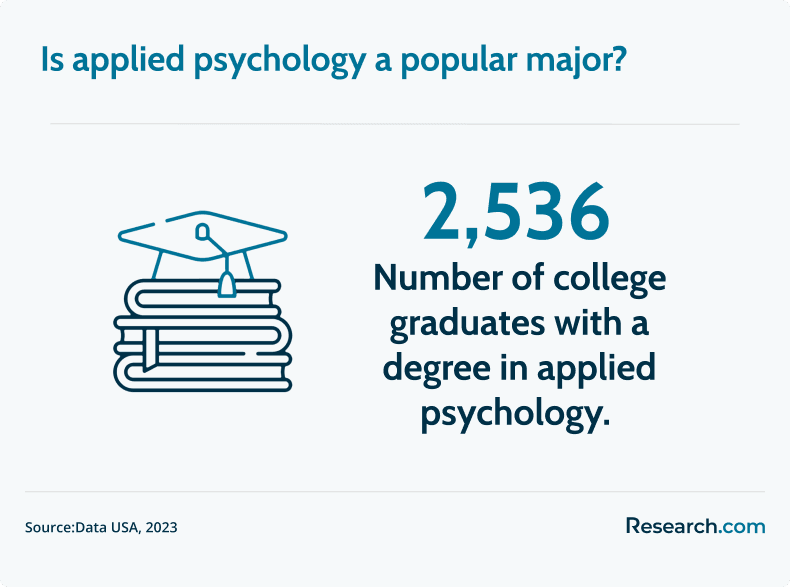
In 2023, 2,536 students graduated with a degree in applied psychology. That number reflects a specialized field within psychology, not a guarantee of employment. The value of the degree depends heavily on program quality, practical experience, graduate school plans, and how well students connect coursework to a career path.
What is the average cost of an online applied psychology program?
The average tuition per credit across online applied psychology programs is around $480. For a 120-credit bachelor’s degree, that equals roughly $58,000 in tuition before fees, books, technology costs, and other expenses. Lower-cost options in this list include Champlain College at $335 per credit and Saint Mary’s University of Minnesota at $440 per credit, though students should compare total required credits as well as per-credit pricing.
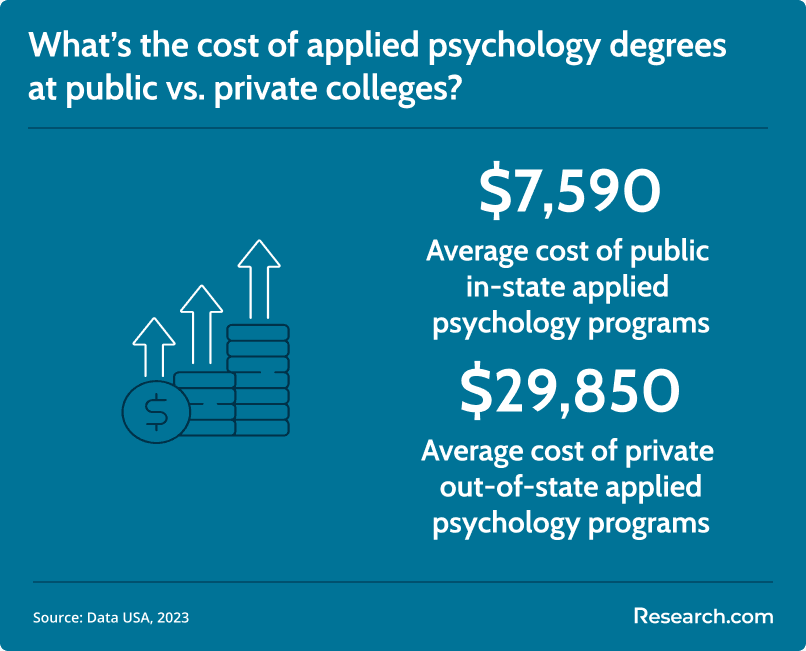
Public and private tuition can vary widely. The median in-state tuition for public applied psychology programs is about $7,590 per year, while private out-of-state programs are about $29,850 annually. Online programs may fall between these figures depending on residency rules, institutional pricing, transfer credits, and financial aid. Students comparing flexible graduate options in other education fields, such as best online master's in higher education programs, should use the same total-cost approach.
| Cost factor | Why it matters | Question to ask |
| Per-credit tuition | A low per-credit rate can still be expensive if the program requires many credits | What is the total tuition based on my transfer evaluation? |
| Transfer credits | Accepted credits can reduce both cost and time | How many of my credits will apply directly to degree requirements? |
| Fees | Online, technology, graduation, and course fees can change the real price | What mandatory fees are not included in the advertised tuition? |
| Books and materials | Psychology courses may require textbooks, assessments, or software | Are materials included, discounted, or billed separately? |
| Completion pace | Longer enrollment can increase indirect costs | Can I take enough courses each term to graduate on my target timeline? |
Cost should not be judged by tuition alone. A program with strong advising, relevant coursework, transfer flexibility, and career support may offer better value than a cheaper program that delays graduation or lacks applied experience. Still, students should avoid assuming that a higher price automatically means better outcomes.
What are the financial aid options for students enrolling in online applied psychology programs?
Online applied psychology students may qualify for federal aid, institutional aid, employer tuition support, state programs, scholarships, and awards connected to health care, child development, behavioral science, and social services. Eligibility depends on the school, enrollment status, FAFSA results, state residency, and award rules.
Funding options vary by field and credential type. Students reviewing specialized online programs in other areas, such as best online ethical hacking dual certification bootcamps, should note that aid rules can differ significantly between degree programs, certificates, and bootcamps.
- Federal Student Aid: Students who submit the FAFSA may be considered for federal grants, subsidized loans, unsubsidized loans, and work-study depending on eligibility and enrollment status.
- PATCH Scholarship Program: This program awards $750 to students building knowledge in early childhood care and applied social and behavioral sciences, with priority for applicants working in licensed child care settings.
- Blue Cross Blue Shield ND Caring Foundation Scholarship: This scholarship provides $2,500 to 30 North Dakota students pursuing health care-related degrees, including psychology, if they are full-time students attending school in-state.
- Good Samaritan Foundation Scholarship: This award provides $500 to students at multiple education levels in health care or social service pathways, including applied psychology.
- Peter K. New Award: This award offers $3,000 for student research in applied social and behavioral sciences and also includes funding to attend the Society for Applied Anthropology’s annual conference.
If you plan to continue into graduate study, build a multi-year funding strategy before choosing a bachelor’s program. Students considering clinical training should understand the difference between PhD and PsyD in clinical psychology because graduate school cost, funding, timeline, and licensure preparation can differ substantially.
What are the prerequisites for enrolling in online applied psychology programs?
Admissions requirements for online applied psychology bachelor’s programs are usually accessible, but they still require evidence that the student is prepared for college-level study and online learning. Requirements differ by school, especially for transfer students and degree-completion applicants.
As with specialized online programs in other disciplines, such as best online graduate certificate nursing informatics programs, prerequisites are meant to confirm academic readiness and help students avoid enrolling in a program they are not prepared to complete.
- High School Diploma or GED: Most bachelor’s programs require official proof of high school completion or an equivalent credential. Some schools may expect a minimum GPA, often around 2.5 or higher.
- College transcripts for transfer students: Applicants with prior college coursework usually need to submit official transcripts so the school can determine which credits apply.
- Introductory psychology background: Some programs prefer or require basic psychology coursework before advanced major courses.
- Technology readiness: Online students need reliable internet access, a suitable computer, and the ability to use learning management systems, video tools, and digital submissions.
- Interest in social or behavioral science: Coursework in sociology, anthropology, human development, education, or related areas can support readiness for applied psychology study.
- Time management: Online learning requires planning, consistent participation, and the ability to meet deadlines without daily in-person reminders.
- Statement of purpose or personal essay: Some schools ask applicants to explain their interest in psychology, career goals, and readiness for online learning.
- Letters of recommendation: Some programs request references from teachers, supervisors, or mentors who can speak to the applicant’s academic potential and reliability.
If you are still deciding between psychology pathways, compare the academic and career differences in this guide to clinical psychology and counseling psychology degrees comparison.
What courses are typically in online applied psychology programs?
Online applied psychology programs combine theory, research, ethics, and practical application. Students learn how people develop, think, behave, respond to environments, make decisions, and interact in groups. The strongest programs also teach students how to interpret data, evaluate programs, communicate ethically, and apply behavioral principles in real settings.
- Introduction to Psychology: Establishes the foundation for understanding behavior, emotion, cognition, motivation, learning, development, and mental processes.
- Applied Behavior Analysis (ABA): Covers behavior-change principles used in educational, organizational, developmental, and clinical-adjacent settings.
- Program Evaluation and Outcome Assessment: Teaches students how to evaluate whether services, interventions, or community programs are producing intended results.
- Cultural and Social Diversity in Applied Psychology: Examines how culture, identity, inequality, and social context influence behavior and intervention planning.
- Social Psychology: Explores persuasion, group behavior, social influence, attitudes, interpersonal relationships, and conflict.
- Biopsychology: Introduces the biological systems related to behavior, including the brain, nervous system, hormones, and neurotransmission.
- Ethics in Psychology: Reviews confidentiality, informed consent, professional boundaries, responsible communication, and ethical decision-making.
- Forensic and Legal Psychology: Looks at psychology in legal and correctional contexts. Students interested in this area can review forensic psychologist duties to understand how advanced roles function in practice.
What types of specializations are available in online applied psychology programs?
Specializations help students connect psychology coursework to a specific setting or population. Not every school offers every track, and some programs provide electives rather than formal concentrations. Students should choose a specialization based on career goals, graduate school plans, and the type of work environment they want.
| Specialization | Best for students interested in | Important caution |
| Health Psychology | Wellness, patient behavior, public health, and health education | Clinical roles may require graduate training or licensure |
| Industrial-Organizational Psychology | Workplace culture, employee behavior, training, and leadership | Advanced consulting or psychologist roles often require graduate study |
| Forensic Psychology | Criminal justice, correctional systems, courts, and offender rehabilitation | Some legal or evaluation roles require advanced credentials |
| Educational Psychology | Learning behavior, school support, student development, and instructional design | School-based licensed roles may have state-specific requirements |
| Sports Psychology | Performance, motivation, coaching support, and athletic wellness | Independent practice generally requires advanced education |
| Substance Use and Addictions | Recovery support, prevention programs, counseling-adjacent roles, and rehabilitation services | Counseling titles and licensure rules vary by state |
| Behavioral Economics and Decision Making | Marketing, policy, user research, product behavior, and decision science | Strong research and data skills are especially important |
Students drawn to workplace behavior can learn more about what an organizational psychologist does, but they should remember that many psychologist titles require graduate-level preparation.
How to choose the best online applied psychology program?
The best online applied psychology program is the one that fits your academic background, budget, schedule, career goals, and graduate school plans. A highly ranked program may still be the wrong choice if it does not accept your credits, lacks the specialization you need, or does not support your intended career path.
- Confirm institutional accreditation: For bachelor’s programs, regional or recognized institutional accreditation is essential for credit transfer, graduate admission, and employer recognition. APA accreditation generally applies to certain doctoral, internship, and postdoctoral psychology training, not standard bachelor’s programs.
- Match the curriculum to your goal: A student interested in HR should look for organizational psychology and research courses, while a student aiming for behavioral health support may need counseling-related, ethics, crisis, and human services coursework.
- Ask for a transfer-credit evaluation early: Do not rely on informal estimates. Ask how many credits will transfer and which degree requirements they satisfy.
- Review faculty background: Faculty with applied experience can strengthen courses through case studies, field examples, and practical assignments.
- Look for applied learning: Case simulations, capstones, local field projects, virtual labs, internships, or service-learning can help turn coursework into resume evidence.
- Check research and data training: Applied psychology careers increasingly reward students who can interpret data, evaluate programs, and communicate evidence clearly.
- Evaluate online student support: Ask about tutoring, advising, library access, career services, disability accommodations, mental health support, and hours for working adults.
- Clarify graduate school preparation: If your goal is counseling, clinical psychology, school psychology, behavior analysis, or forensic psychology, ask whether the curriculum includes prerequisites commonly expected by graduate programs.
Questions to ask before enrolling
- Is the institution accredited by a recognized accreditor?
- Does the program meet my state’s requirements if I plan to pursue a licensed role later?
- How many of my transfer credits will count toward the major, not just electives?
- What is the full cost after tuition, fees, books, and required technology?
- Are courses asynchronous, synchronous, or a mix of both?
- Does the program include a capstone, internship, practicum, field project, or portfolio?
- What career services are available to fully online students?
- What graduate programs have recent students entered?
How can I verify the accreditation and quality of online applied psychology programs?
Start by checking the school’s accreditation status directly through the accreditor and recognized databases rather than relying only on the school’s website. Then review the program’s curriculum, faculty qualifications, student support, graduation indicators, transfer policies, and career services. If affordability is a major concern, compare accredited low-cost options such as an affordable online bachelor's degree in psychology before committing.
Quality also depends on fit. A strong program for a future HR specialist may not be the best program for a student planning to pursue counseling graduate school. Look for evidence that the program supports your intended outcome, not just general claims about flexibility or career readiness.
What career paths are available for graduates of online applied psychology programs?
Graduates with an online applied psychology degree can pursue roles that use behavioral insight, communication skills, research literacy, and people-focused problem-solving. Many entry-level roles are in support, coordination, case management, human services, organizational support, and community settings. Licensed psychologist roles typically require graduate education.
| Career path | What the role often involves | Typical next step for advancement |
| Behavioral Health Specialist | Supports individuals facing behavioral, emotional, or mental health challenges in clinics, schools, or community programs | Graduate study, supervised experience, or related credentials |
| Human Resources Specialist | Uses behavioral knowledge in recruiting, employee relations, training, engagement, and workplace policy | HR certifications, organizational psychology coursework, or management experience |
| Rehabilitation Coordinator | Helps clients build independence, access services, and track progress toward support goals | Graduate study in counseling, rehabilitation, social work, or related fields |
| Organizational Development Specialist | Supports leadership development, culture improvement, training, and internal research | Advanced study in industrial-organizational psychology, HR, or organizational leadership |
| Probation or Correctional Officer | Balances monitoring, accountability, rehabilitation support, and service coordination in justice settings | Agency training, criminal justice experience, or graduate education |
| School Social Worker | Supports students facing social, emotional, family, or behavioral barriers to learning | Review state-specific school social worker requirements |
| Alcohol and Drug Counselor | Supports individuals with substance use challenges through recovery planning, education, and counseling-adjacent services | State-approved counseling credentials, supervised hours, or graduate study |
Students interested in specialized graduate pathways should compare costs carefully. For example, a cheap online masters forensic psychology program may make sense for students targeting criminal justice or legal psychology roles after completing a bachelor’s degree.
What is the job market for graduates with a degree in online applied psychology programs?
The job market for applied psychology graduates depends on the role. A bachelor’s degree can support entry-level work in people-centered fields, while psychologist roles usually require graduate education and, in many cases, licensure. Students should distinguish between psychology-related jobs available with a bachelor’s degree and licensed psychologist positions.
- Steady Job Growth: Overall employment of psychologists is projected to grow 7% from 2023 to 2033, which is faster than the average for all occupations.
- Annual Openings: Approximately 13,000 job openings are expected each year, largely because of workers changing jobs, leaving the labor force, or retiring.
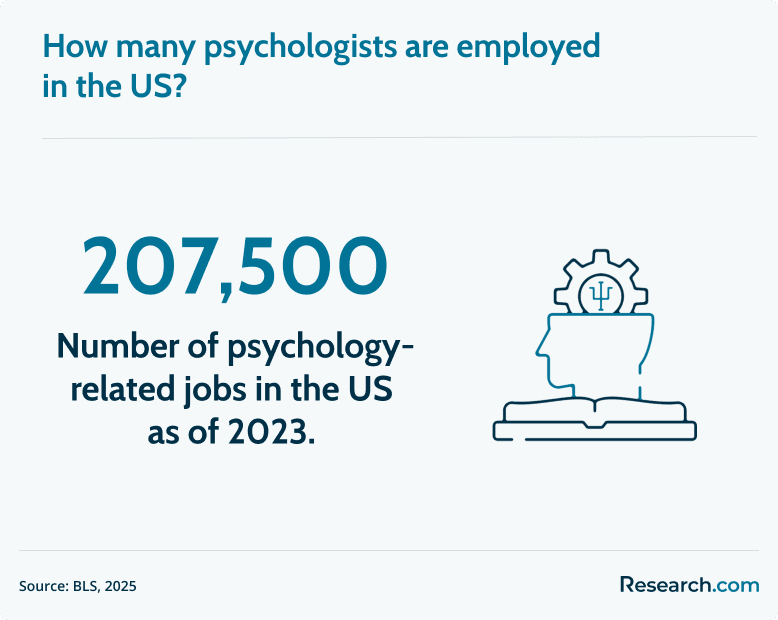
- Employment Volume: The psychology field currently includes about 207,500 psychology-related jobs across the US.
- Clinical demand: Clinical, counseling, and school psychologists remain important as mental health needs affect hospitals, schools, mental health centers, and social service agencies.
- School-based need: Student mental health, behavioral support, and learning challenges continue to make school psychology expertise valuable.
- Workplace applications: Employers use industrial-organizational psychology concepts to improve hiring, training, morale, leadership, and organizational effectiveness.
How AI and technology are affecting applied psychology careers
AI tools, digital assessments, telehealth platforms, online learning systems, and workplace analytics are changing how behavioral data is collected and used. Applied psychology students should become comfortable with ethical data interpretation, privacy concerns, digital communication, and evidence-based evaluation. Technology can support screening, training, and program analysis, but it does not replace human judgment, ethical reasoning, cultural competence, or supervised professional practice.
What is the return on investment for an online applied psychology degree?
The return on investment for an online applied psychology degree depends on total cost, time to completion, transfer credits, financial aid, employment goals, and whether graduate school is required for the career you want. A lower-cost program with strong credit transfer may produce better value than a more expensive program that takes longer to complete.
Students should calculate ROI using realistic assumptions. Compare total tuition and fees against the types of roles available with a bachelor’s degree, then factor in the cost of graduate education if your goal requires licensure or advanced practice. Do not assume that completing a psychology degree automatically leads to a psychologist salary.
What hands-on experiences and fieldwork opportunities are offered in online applied psychology programs?
Online applied psychology programs may include applied projects, case analyses, virtual simulations, research assignments, capstones, community-based projects, internships, or local fieldwork. Availability varies widely, so students should ask whether practical learning is required, optional, virtual, local, or tied to a current workplace.
Students interested in behavior analysis should ask whether courses align with their long-term credentialing goals. Some students may later compare affordable BCBA accredited programs online if they want a more specialized path in applied behavior analysis.
Common mistakes to avoid when choosing an online applied psychology program
- Choosing a program without checking accreditation: Accreditation affects transfer credits, graduate school options, employer recognition, and financial aid eligibility.
- Looking only at per-credit tuition: Total credits, fees, transfer policies, and time to completion can change the real cost.
- Assuming a bachelor’s degree leads to licensure: Licensed psychologist, counselor, school psychologist, and clinical roles usually require additional education and state-specific requirements.
- Ignoring transfer-credit rules: A school may accept credits as electives without applying them to major or graduation requirements.
- Overlooking field experience: Applied psychology is stronger when students complete projects, internships, simulations, or capstones that show practical skills.
- Relying only on rankings: Rankings are useful starting points, but fit, cost, format, and career alignment matter more for individual outcomes.
- Assuming online means self-paced: Some online programs have strict weekly deadlines, live sessions, group projects, or fixed course sequences.
Here’s What Graduates Have to Say About Their Online Degrees in Applied Psychology
- : "Completing applied psychology online made it possible for me to keep working full time while studying a field I cared about. I expected flexibility, but I did not expect the online discussions and faculty support to feel as connected as they did. — Danica"
- : "The online format helped me build more than academic knowledge. I became better at managing deadlines, communicating in digital settings, and using psychology concepts in remote professional environments. Those skills now help me in my work as a behavioral health coordinator. — Francis"
- : "The strongest part of the program was how practical the assignments felt. Whether I was studying team behavior or crisis support, I could connect the material to my mental health volunteer work right away. — Barry"
Key Insights
- An online applied psychology degree is best for students who want to apply behavioral science in workplaces, social services, health care support, education, criminal justice, or community programs.
- Most bachelor’s programs require about 120 credits and take about 4 years, but transfer-friendly and accelerated options can shorten the timeline.
- The average tuition per credit across online applied psychology programs is around $480, but total cost depends on credits required, transfer acceptance, fees, aid, and completion pace.
- Regional or recognized institutional accreditation is essential. Do not assume that APA-defined curriculum language means a bachelor’s program is APA-accredited.
- A bachelor’s degree can support entry-level psychology-related roles, but licensed psychologist and many counseling roles usually require graduate education and state-specific credentials.
- The strongest programs include applied learning, research and data coursework, ethical practice, diverse population training, and career support for online students.
- Before enrolling, ask for a written transfer evaluation, full cost estimate, course format details, fieldwork expectations, and graduate school preparation information.
References:
- Arizona State University. (n.d.). Online Bachelor of Science in Counseling and Applied Psychological Science. Asuonline.asu.edu. Retrieved 5 August 2025.
- Belhaven University. (n.d.). Online Applied Psychology. Belhaven.edu. Retrieved 5 August 2025.
- Blue Cross Blue Shield of North Dakota. (n.d.). BCBSND Caring Foundation announces 2024–2025 scholarship recipients. Bcbsnd.com. Retrieved 5 August 2025.
- Champlain College. (n.d.). Bachelor’s in Applied Psychology. Online.champlain.edu. Retrieved 5 August 2025.
- Colorado Christian University. (n.d.). Psychology programs. Ccu.edu. Retrieved 5 August 2025.
- Data USA. (n.d.). Applied psychology. Datausa.io. Retrieved 5 August 2025.
- Good Samaritan Foundation. (n.d.). Scholarships. Gsftx.org. Retrieved 5 August 2025.
- Loyola University Chicago. (n.d.). Applied Psychology, B.A. Gpem.luc.edu. Retrieved 5 August 2025.
- PATCH Hawaii. (n.d.). Scholarship programs. Patchhawaii.org. Retrieved 5 August 2025.
- Peter K. New Award. (n.d.). Society for Applied Anthropology. Appliedanthro.org. Retrieved 5 August 2025.
- Phoenix University. (n.d.). Bachelor of Science in Applied Psychology with a concentration in Media and Technology. Phoenix.edu. Retrieved 5 August 2025.
- Point Loma Nazarene University. (n.d.). Applied Psychology, B.A. Online. Pointloma.edu. Retrieved 5 August 2025.
- Saint Mary’s University of Minnesota. (n.d.). B.S. in Applied Psychology. Smumn.edu. Retrieved 5 August 2025.
- University of New Hampshire. (n.d.). B.S. in Applied Psychology – Organizational Psychology Option. Cps.unh.edu. Retrieved 5 August 2025.
- US Bureau of Labor Statistics. (2025). Occupational employment and wage statistics: Clinical, counseling, and school psychologists. Bls.gov. Retrieved 5 August 2025.
- US Bureau of Labor Statistics. (2025). Psychologists. Bls.gov. Retrieved 5 August 2025.
- Zippia. (n.d.). Psychologist education requirements. Zippia.com. Retrieved 5 August 2025.
- ZipRecruiter. (n.d.). Applied Psychology Salary. Ziprecruiter.com. Retrieved 5 August 2025.
Other Things You Need to Know About Online Applied Psychology Programs
Many 2027 online applied psychology bachelor’s programs require 120 to 240 supervised practicum hours, often completed at an approved site near the student’s home. Some programs waive fieldwork for fully academic tracks, but licensure-oriented options usually require documented supervision and an agency contract.
In 2027, graduates of online applied psychology degree programs can pursue careers in fields such as counseling, human resources, market research, and organizational development. They may work in roles like mental health counselor, HR specialist, or behavior analyst depending on their specialization.


