2027 Accreditation for Psychology Programs: How to Make Sure If Your Program is Accredited

Co-Founder and Chief Data Scientist
Did you know that in the U.S. there are over 400 APA-accredited doctoral psychology programs and nearly 700 accredited internships? With so many options, figuring out which programs are truly recognized can feel overwhelming.
This article breaks down how to confirm accreditation for 2027, why it matters, and what’s at stake. By the end, you’ll know exactly how to verify a psychology program’s credibility before investing your time and money.
Key Things You Should Know About Psychology Programs:
- Only graduates of accredited psychology programs are typically eligible for state licensure and competitive employment.
- APA, PCSAS, NASP, and MPCAC are recognized for psychology; unrecognized accrediting bodies may not count.
- Programs can lose or gain status, so always confirm accreditation in the year you apply.
- Accreditation for Psychology Programs: How to Make Sure If Your Program is Accredited in 2027 Accreditations
- How do I quickly check if a psychology program is accredited for 2027? Accreditation Check
- What’s the difference between institutional accreditation and program accreditation for psychology? Accreditation Types
- How long does accreditation last, and can a program lose it? Accreditation Length
- Will accreditation impact my eligibility for licensure in my state or province? Licensure Eligibility
- APA vs. PCSAS: which accreditation should I choose for my career goals? APA vs. PCSAS
- How do I verify that an online or hybrid psychology program meets recognized standards? How do I verify that an online or hybrid psychology program meets recognized standards?
- What red flags suggest a program’s accreditation is fake, expired, or not recognized? Red Flags
- Do I need programmatic accreditation if I’m aiming for school psychology, counseling/mental health, or I/O psychology? Do I need programmatic accreditation if I’m aiming for school psychology, counseling/mental health, or I/O psychology?
- How can I confirm a U.S. psychology program’s accreditation through the Department of Education or CHEA? How can I confirm a U.S. psychology program’s accreditation through the Department of Education or CHEA?
- How can I assess long-term career outcomes from accredited psychology programs? How can I assess long-term career outcomes from accredited psychology programs?
- Are accredited online PsyD programs a viable alternative to traditional options? Are accredited online PsyD programs a viable alternative to traditional options?
Psychology Program Accreditation: How to Verify a Program Before You Enroll in 2027
Choosing a psychology program is not only an academic decision. If you plan to become licensed, work in schools, enter clinical practice, pursue doctoral training, or transfer credits later, accreditation can determine whether your degree is accepted. A program may look credible on a university website, but that does not always mean it meets the standards required by licensing boards, employers, internship sites, or graduate schools.
This guide explains how psychology accreditation works, which accrediting bodies matter, how to confirm a program’s status, and what to ask before you apply. It is written for students comparing campus, online, and hybrid psychology programs at the master’s, doctoral, internship, postdoctoral, counseling, school psychology, and applied psychology levels.
Quick Answer: How do you know if a psychology program is accredited?
To verify a psychology program, check both the institution and the specific program. First, confirm that the college or university is accredited by an accreditor recognized by the U.S. Department of Education or CHEA. Then verify whether the psychology program itself is accredited by the relevant professional accreditor, such as APA, PCSAS, NASP, or MPCAC, depending on your field. Do not rely only on a school’s marketing page; confirm the status in official accreditor databases.
| What to check | Why it matters | Where to verify |
| Institutional accreditation | Confirms the overall college or university meets recognized academic and administrative standards. | USDE and CHEA databases |
| Programmatic accreditation | Confirms the psychology program meets field-specific standards tied to training, supervision, faculty, and outcomes. | APA, PCSAS, NASP, or MPCAC directories |
| State licensure alignment | Determines whether the degree can support licensure, certification, or exam eligibility where you plan to work. | State psychology, counseling, or education board |
| Current accreditation status | Shows whether a program is fully accredited, on probation, under review, or no longer accredited. | Official accreditor status pages |
Which accrediting bodies matter for psychology programs?
The right accreditor depends on the type of psychology program and the career you want. A student seeking clinical psychologist licensure has different accreditation concerns than a student entering school psychology, counseling, industrial-organizational psychology, or a research-focused doctoral program.
APA: American Psychological Association
The APA Commission on Accreditation is the best-known accreditor for professional psychology training in the United States. It reviews doctoral programs, internships, and postdoctoral residencies in areas such as clinical, counseling, and school psychology. Students pursuing psychologist licensure should pay close attention to APA status because many licensing boards, employers, internship sites, and postdoctoral settings treat APA accreditation as a major indicator of acceptable professional preparation.
PCSAS: Psychological Clinical Science Accreditation System
PCSAS, founded in 2007, accredits doctoral programs that emphasize psychological clinical science, research quality, and evidence-based practice. It is recognized by CHEA and by some licensing boards. PCSAS may be a strong fit for students who want a clinical psychology doctorate grounded heavily in research, academic work, intervention science, or evidence-based clinical training.
NASP: National Association of School Psychologists
NASP reviews specialist-level and doctoral school psychology programs. Its standards focus on preparing graduates to serve students, families, educators, and school systems in K–12 environments. If your goal is to become a school psychologist, NASP approval can be especially important because state education agencies and school districts may reference NASP-aligned preparation when evaluating certification eligibility.
MPCAC: Masters in Psychology and Counseling Accreditation Council
MPCAC accredits master’s programs in counseling and psychology-related fields, including mental health counseling and applied psychology. It is not identical to APA accreditation and is not accepted in every licensure context, but it can signal that a master’s program has been reviewed against professional training expectations. Students considering counseling licensure should compare MPCAC status with their state board’s specific education requirements.
Institutional accreditors recognized by CHEA or the U.S. Department of Education
Programmatic accreditation does not replace institutional accreditation. The university itself should also be accredited by an agency recognized by CHEA or the U.S. Department of Education. Institutional accreditation affects degree credibility, federal financial aid eligibility, transfer credit acceptance, and graduate school recognition. This same principle applies in other fields; for example, library science students often verify ALA-accredited master’s programs in library science before enrolling because national recognition can affect career options.
| Accreditor | Best suited for | Most important career use |
| APA | Doctoral, internship, and postdoctoral training in professional psychology | Clinical, counseling, and school psychologist licensure pathways |
| PCSAS | Research-intensive clinical science doctoral programs | Evidence-based clinical science, research, academic, and policy-oriented careers |
| NASP | School psychology specialist and doctoral programs | K–12 school psychologist certification and employment |
| MPCAC | Master’s-level counseling and psychology programs | Counseling preparation where accepted by state boards and employers |
| CHEA/USDE-recognized institutional accreditors | Entire colleges and universities | Degree legitimacy, federal aid, transferability, and graduate study |
How do I quickly check if a psychology program is accredited in 2027?
The fastest way to verify accreditation is to search official databases, not just the school’s website. University pages can be outdated, incomplete, or worded in ways that sound stronger than the actual status. Use the following process before applying or paying a deposit.
- Search the APA accreditation portal. Use APA’s official listings for doctoral programs, internships, and postdoctoral residencies in professional psychology.
- Confirm institutional accreditation through USDE or CHEA. These databases show whether the college or university is recognized by a legitimate institutional accreditor.
- Check the PCSAS directory. If the program claims clinical science accreditation, confirm that the doctoral program appears in PCSAS’s official list.
- Review NASP or MPCAC directories when relevant. School psychology and master’s counseling-related programs should be checked with the accreditor that matches the credential and career path.
- Compare the school’s claim with the accreditor’s wording. Look for the exact campus, degree level, program name, accreditation status, and review date.
- Contact the state board before enrolling. If your career requires licensure or certification, ask whether graduates from that specific program meet education requirements.
This is especially important for students comparing online master’s degrees in psychology, because online delivery does not automatically mean a program satisfies supervised practice, internship, practicum, or state licensure rules.
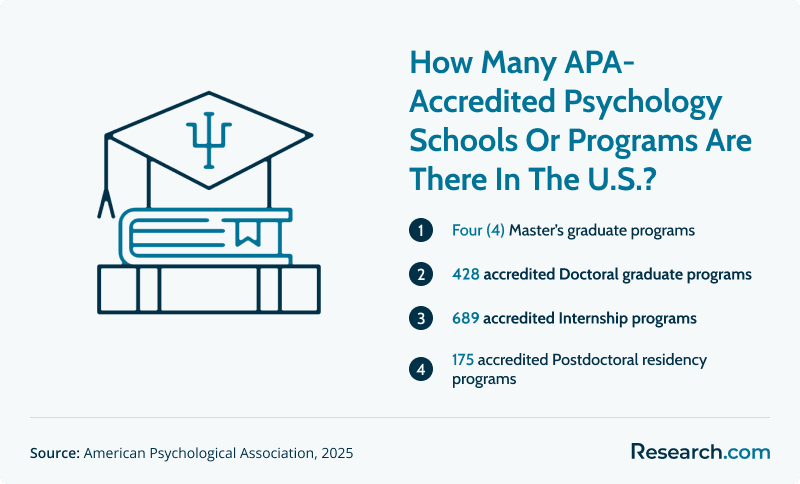
The visual below summarizes the current breakdown of APA-accredited psychology training categories in the United States. Use it as a reminder that accreditation is tied to specific program types and training stages, not just to a university’s general reputation.
What is the difference between institutional accreditation and programmatic accreditation in psychology?
Institutional accreditation and programmatic accreditation answer two different questions. Institutional accreditation asks whether the college or university is legitimate as a whole. Programmatic accreditation asks whether a specific psychology program meets professional standards for a particular field.
| Type of accreditation | What it evaluates | Why psychology students should care |
| Institutional accreditation | The entire school, including academic governance, student support, finances, faculty policies, and degree quality. | It affects federal financial aid, credit transfer, graduate admissions, and whether the degree is broadly recognized. |
| Programmatic accreditation | A specific psychology, counseling, school psychology, internship, or residency program. | It may affect licensure, certification, internship eligibility, employer acceptance, and professional mobility. |
A university can be institutionally accredited while a particular psychology program lacks programmatic accreditation. The reverse is also important: a program’s professional recognition is not enough if the institution itself is not properly accredited. Students exploring practice-focused options, including online clinical psychology programs, should verify both levels before assuming the degree will support licensure.
How long does psychology accreditation last, and can a program lose it?
Accreditation is not a one-time approval that lasts forever. Programs are reviewed periodically and must continue meeting standards related to curriculum, faculty qualifications, supervised training, student outcomes, governance, and ethical practice. Reviews may occur on a multi-year cycle, and a program can receive warnings, be placed on probation, or lose accreditation if it fails to correct problems.
What if my program loses accreditation while I am enrolled?
If accreditation changes during your enrollment, your options depend on the accreditor, the timing, the state board, and the school’s plan for current students. Some accreditors may require a teach-out arrangement so enrolled students can finish under defined conditions. However, a teach-out does not always guarantee licensure eligibility in every jurisdiction.
Before staying in a program with accreditation problems, ask three questions: Was the program accredited when I enrolled? Will it be accredited when I graduate? Will my state licensing or certification board accept the degree if the program is on probation or loses recognition? Students planning supervised practice, internships, or psychology training opportunities should monitor accreditation status throughout the program, not only during admissions.
The chart below shows the distribution of board-certified psychologists across states, with California, New York, and Florida leading. It reinforces why recognized training pathways matter: state-level licensure systems and local workforce needs often depend on graduates whose education can be verified.
Will accreditation affect my eligibility for licensure in my state or province?
Yes. Accreditation can be one of the most important factors in licensure eligibility. Psychology, school psychology, and counseling boards often review whether your degree came from a recognized institution and whether the specific program meets professional education standards. A non-accredited or poorly aligned program can create barriers to exams, supervised practice approval, state applications, or certification.
Accreditation also affects mobility. If you move after graduation, a new licensing board may review your education again. A degree from a recognized program is usually easier to evaluate than one from a school with unclear or unrecognized accreditation. This matters for clinical roles, school-based positions, counseling pathways, and advanced psychology careers. Many higher-paying psychology career paths also expect education that can withstand licensing and employer review.
Do not assume that national accreditation language on a website equals licensure approval in your state. Always check the board where you plan to practice, and if you may relocate, check more than one jurisdiction before enrolling.
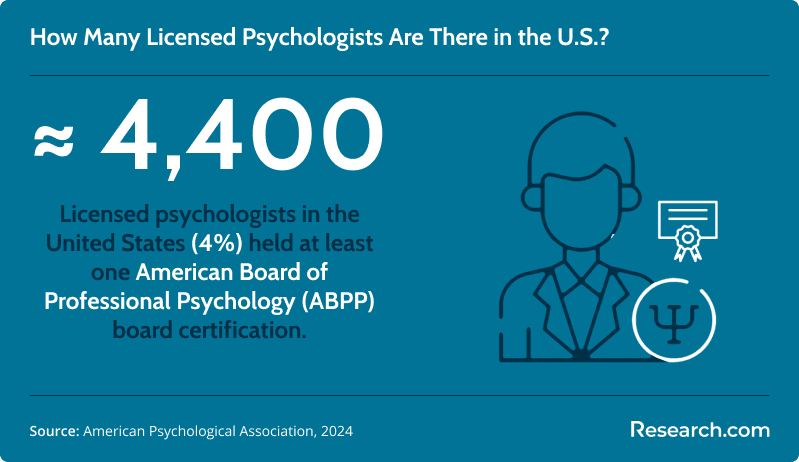
The infographic below shows the number of licensed psychologists in the United States who hold ABPP board certification. It illustrates how accreditation, licensure, supervised experience, and specialty certification can work together to shape professional credibility over time.
APA vs. PCSAS: which accreditation is better for your goals?
APA and PCSAS both matter in doctoral-level psychology, but they are not interchangeable for every student. The better choice depends on whether your priority is broad licensure portability, research-intensive clinical science training, academic placement, or evidence-based practice.
| Factor | APA accreditation | PCSAS accreditation |
| Primary emphasis | Professional psychology preparation, including clinical, counseling, and school psychology training. | Clinical science, research rigor, and evidence-based psychological practice. |
| Common student goal | Licensure-focused clinical or counseling practice with broader recognition. | Research-heavy clinical psychology, academic work, scientific leadership, or evidence-based intervention development. |
| Licensure portability | Often the more widely recognized route for state licensure review. | Recognized by CHEA and some boards, but students should verify acceptance by state. |
| Best fit | Students who want maximum flexibility across clinical settings and jurisdictions. | Students strongly committed to clinical science and research-driven training. |
If your main goal is to become licensed for clinical practice in as many jurisdictions as possible, APA accreditation is typically the safer path to investigate first. If you want a doctorate centered on clinical science and research, PCSAS may align better with your goals. Students comparing doctoral programs in psychology should check both accreditation status and the licensing rules in the states where they may eventually practice.
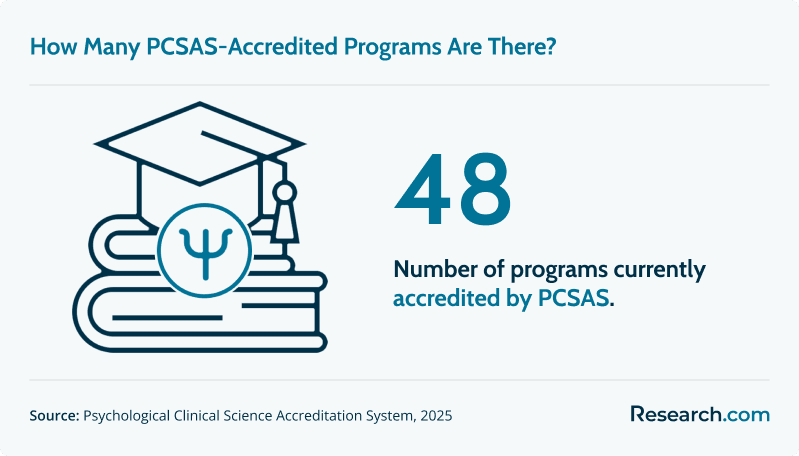
The infographic below notes that PCSAS currently accredits 48 programs. That figure highlights its growing role in clinical science training, but it also shows why students should compare recognition carefully when choosing between APA and PCSAS routes.
How can I verify that an online or hybrid psychology program meets recognized standards?
Online and hybrid psychology programs can be legitimate, but students must look closely at accreditation, supervised experiences, residency requirements, and state authorization. A program delivered online may still require in-person practicums, internships, campus intensives, or locally approved supervision. The key question is not simply whether the classes are online; it is whether the full program meets the requirements for your goal.
- Verify the school’s institutional accreditation. Confirm the university appears in USDE or CHEA-recognized databases.
- Check the program’s professional accreditation. Search the APA, NASP, PCSAS, or MPCAC directory that applies to the program type.
- Ask how clinical or field training is arranged. Find out who approves practicum sites, who provides supervision, and whether placements are available in your location.
- Confirm state authorization. Online programs may not be authorized to enroll students in every state or may not meet every state’s professional requirements.
- Review outcomes. Ask for licensure exam pass rates, internship match data, completion rates, job placement information, and alumni roles when available.
- Get answers in writing. Save emails from admissions, program directors, and licensing boards, especially if licensure is part of your plan.
Students considering combined pathways should also evaluate whether dual degree programs in psychology provide clear accreditation coverage for each credential, not just for the university overall.
| Online program question | Why it matters |
| Is the program accredited for my specific degree level? | Accreditation may apply to one program but not another program at the same school. |
| Will I need in-person clinical hours? | Psychology and counseling programs often require supervised fieldwork that cannot be completed only through online coursework. |
| Does the program meet requirements in my state? | Licensure rules vary, and a program may be acceptable in one jurisdiction but not another. |
| Who secures practicum or internship sites? | Some programs place students; others expect students to locate approved sites independently. |
| Are outcomes publicly available? | Transparent programs are more likely to share completion, licensure, internship, and employment data. |
What red flags suggest a psychology program’s accreditation is fake, expired, or not recognized?
Some schools use accreditation language that sounds official but does not help with licensure, transfer credits, employment, or graduate admissions. Be cautious when a program’s claims cannot be verified outside its own website.
| Red flag | Why it is risky | Better action |
| The accreditor is not recognized by USDE or CHEA. | The credential may not be accepted by licensing boards, employers, or other schools. | Search the accreditor in official USDE and CHEA databases. |
| The program does not appear in the accreditor’s directory. | The school may be exaggerating, mislabeling, or relying on outdated information. | Use the accreditor’s public program list to confirm status. |
| The website says “accredited” without naming the agency. | Vague claims make it difficult to verify legitimacy. | Ask for the accreditor name, accreditation dates, and official listing. |
| The program is on probation or has an expired status. | Graduation timing may affect licensure or certification eligibility. | Contact the accreditor and state board before enrolling. |
| Admissions staff pressure you to enroll quickly. | High-pressure tactics can distract from unresolved accreditation or outcome concerns. | Pause until you independently verify all claims. |
Careful verification protects you from spending time and money on a degree that may not support your goals. The same decision discipline applies when families compare specialized educational options such as schools for exceptional students: reputation matters, but documented standards matter more.
Do school psychology, counseling, mental health, and I/O psychology programs need programmatic accreditation?
The need for programmatic accreditation depends on whether your target role is licensed, certified, or employer-regulated. In fields tied directly to public practice, accreditation can be essential. In applied business or research roles, institutional accreditation may carry more weight than programmatic review.
| Specialty | How accreditation usually matters | Student takeaway |
| School psychology | NASP recognition may support state certification and K–12 employment pathways. | Check NASP status and state education department rules before enrolling. |
| Counseling or mental health | MPCAC or another relevant counseling accreditation may help demonstrate professional preparation, depending on state rules. | Compare the curriculum against your state board’s licensure requirements. |
| Clinical psychology | APA or PCSAS status can affect doctoral training recognition, internships, and licensure review. | Prioritize accreditation and internship placement outcomes. |
| Industrial-organizational psychology | Licensure is often less central, and employers may focus on institutional accreditation, methods training, analytics, and experience. | Review employer expectations, faculty expertise, practicum opportunities, and alumni outcomes. |
| Forensic or applied psychology | Requirements vary based on whether the role involves clinical practice, research, consulting, or legal-system work. | Match accreditation to the exact job function, not only the program title. |
If your intended role requires licensure, certification, or supervised practice approval, programmatic accreditation should be a priority. If your goal is research, consulting, human resources, analytics, or business-oriented work, a strong institutionally accredited program may be enough, but you should still examine outcomes. Requirements differ across specialties just as career expectations differ in areas such as forensic psychology careers.
The chart below shows how ABPP-certified psychologists are distributed by specialty. It underscores an important point: advanced recognition often builds on verified education, supervised experience, licensure, and specialty training over many years.
How can I confirm a U.S. psychology program’s accreditation through the Department of Education or CHEA?
The U.S. Department of Education and CHEA are the best starting points for checking whether an institution or accreditor is recognized. They do not replace state licensing boards, but they help you identify whether a school’s accreditation claim is legitimate.
- Search the U.S. Department of Education database. Visit the Database of Accredited Postsecondary Institutions and Programs and look up the institution or accreditor.
- Use CHEA’s search tools. Review CHEA databases and directories to confirm recognition and institutional listings.
- Check the professional accreditor separately. If a program claims APA, NASP, PCSAS, or MPCAC accreditation, confirm the exact program in that accreditor’s directory.
- Match the name carefully. Pay attention to campus location, degree title, delivery format, and accreditation dates.
- Ask the licensing board the final question. If your goal is practice, ask whether the program meets education requirements for your intended license or certification.
This verification step is important for any psychology pathway, including specialized areas such as sports psychology careers, where job titles, credentials, and practice permissions can vary by role and jurisdiction.
What graduates say about accredited psychology programs
-
: "Earning my psychology degree online helped me keep working while I studied, but accreditation was what made the program feel like a safe investment. I knew I was choosing a degree that employers and licensing reviewers could take seriously.
—Marian"
-
: "The program was demanding in the right ways. Because it met recognized accreditation standards, I could focus on research, supervised practice, and exam preparation instead of worrying whether my education would be accepted later.
—Dimas"
-
: "The online format gave me flexibility, but the strongest part was the structure behind it: faculty support, case-based learning, field expectations, and accreditation that matched my professional plans.
—Kaelin"
How to choose an accredited psychology program: practical checklist
Accreditation is necessary, but it is not the only factor that determines whether a program is a good fit. Use accreditation as your first filter, then compare cost, format, fieldwork, outcomes, faculty support, and licensing alignment.
- Define your target role first. Decide whether you want clinical practice, school psychology, counseling, research, I/O psychology, forensic work, sports psychology, or another specialty.
- Identify the license or credential required. Review state or provincial requirements before choosing a degree level or program type.
- Verify institutional and programmatic accreditation. Check official databases rather than relying only on admissions materials.
- Review fieldwork requirements. Ask how practicums, internships, residencies, supervision, and site approvals work.
- Compare total cost, not just tuition. Include fees, travel, campus intensives, books, background checks, internship costs, and lost work time.
- Ask for outcomes. Request completion rates, licensure pass rates, internship match information, employment data, and alumni career examples.
- Consider transfer and doctoral options. If you may pursue another degree later, ask how credits and prerequisites are evaluated.
- Get licensure answers in writing. Keep documentation from the program and state board, especially if you study online or live outside the school’s state.
How should I evaluate career outcomes and return on investment from an accredited psychology program?
To assess long-term value, look beyond whether a program is accredited. Accreditation confirms that a program meets defined standards, but ROI depends on cost, completion time, licensure eligibility, field placement quality, debt, and the career paths graduates actually enter. Strong programs should be able to discuss alumni outcomes, licensure preparation, supervised training access, and common job titles for graduates.
Ask whether the program publishes independent or verifiable outcome data, including board exam pass rates where applicable, job placement information, internship or practicum success, and alumni advancement. If you are comparing adjacent behavioral science routes, affordability also matters. For example, students exploring behavior analysis may compare options such as the most affordable online BCBA programs while still checking accreditation, supervised experience requirements, and certification alignment.
Are accredited online PsyD programs a credible alternative to campus-based programs?
Accredited online PsyD programs can be viable for some students, but only if they meet the same professional expectations that matter for licensure and practice. The delivery format is less important than the program’s accreditation status, supervised clinical training, faculty qualifications, assessment methods, residency or intensive requirements, and state licensure alignment.
Before choosing an online PsyD, confirm whether the program is accredited for the specific doctoral credential, whether it supports internship placement, and whether graduates are eligible for licensure where you plan to work. Compare flexibility against the realities of doctoral psychology training: clinical hours, supervision, assessment practice, research expectations, and in-person experiences may still be required. Students comparing options can review online PsyD programs while using official accreditation and licensing checks as the final filter.
Common mistakes to avoid when checking psychology accreditation
| Mistake | Why it causes problems | What to do instead |
| Assuming a well-known university has every psychology program accredited. | Accreditation may apply to the institution but not to the specific degree. | Search the program name in the relevant accreditor’s directory. |
| Choosing based only on tuition. | A cheaper program that does not support licensure can become more expensive in the long run. | Compare total cost against licensure eligibility and outcomes. |
| Trusting “nationally accredited” wording without checking recognition. | Some accreditation claims do not carry weight with licensing boards or employers. | Verify the accreditor through USDE or CHEA. |
| Ignoring state-specific requirements. | Psychology and counseling rules can vary widely by jurisdiction. | Contact the board in the state or province where you plan to practice. |
| Assuming online programs have local placements arranged. | Some students discover too late that approved supervision is difficult to secure nearby. | Ask who is responsible for finding and approving field sites. |
| Relying only on rankings or testimonials. | Rankings may not reflect licensure fit, fieldwork quality, or accreditation status. | Use rankings as one input, not as proof of professional eligibility. |
Questions to ask before enrolling in a psychology program
- Is the college or university institutionally accredited by a CHEA- or USDE-recognized accreditor?
- Is this specific psychology program accredited by APA, PCSAS, NASP, MPCAC, or another relevant professional accreditor?
- Does accreditation apply to the exact campus, degree level, and delivery format I am considering?
- Is the program fully accredited, on probation, under review, or seeking accreditation?
- Will this degree meet licensure or certification requirements in my state or province?
- What practicum, internship, residency, or supervised experience is required?
- Who helps students secure approved field placements?
- What are the program’s completion, licensure, internship, and employment outcomes?
- How often is accreditation reviewed, and when is the next review?
- What happens to current students if accreditation status changes?
References:
- ABPP. Mapping the ABPP Specialist Workforce.
- American Psychological Association. Accreditation Portal.
- American Psychological Association. Top Psychology Specialties.
- Psychological Clinical Science Accreditation System. Accredited Programs.
Key Insights
- Psychology students should verify both institutional accreditation and programmatic accreditation before enrolling.
- APA, PCSAS, NASP, and MPCAC serve different psychology pathways; the right accreditor depends on your intended role.
- Licensure-focused students should contact their state or provincial board before assuming a program qualifies them for practice.
- Online and hybrid psychology programs require extra scrutiny because supervised fieldwork, state authorization, and residency requirements may vary.
- Accreditation can change, so students should monitor a program’s status from application through graduation.
- A legitimate program should clearly identify its accreditor, appear in official directories, and provide transparent information about outcomes and field training.
- The safest enrollment decision combines accreditation verification, licensing alignment, cost analysis, outcome review, and written confirmation from relevant boards or program officials.
Other Things You Should Know About Accreditation for Psychology Programs
A psychology program should provide the accrediting agency name, the current accreditation status, the approval period, and the exact program or degree covered. In the United States, look for recognition by the APA or, for some counseling-related psychology programs, CACREP; the status should match the specific campus and degree level.
Psychology programs typically need to renew their accreditation every 7-10 years, though this can vary depending on the accrediting body. For accurate information, check with the specific accrediting agency, such as the American Psychological Association, which provides detailed renewal timelines.
Accreditation for psychology programs in 2027 is primarily conducted by the American Psychological Association (APA) for doctoral programs and the Master’s in Psychology and Counseling Accreditation Council (MPCAC) for master’s programs. Verify these bodies for up-to-date standards specific to your program type.