2027 Certifications and Training for Psychology Undergraduate Students?

Co-Founder and Chief Data Scientist
The world has come to recognize the importance of professionals in the field of psychology over the years. For instance, 90% of the American public believe that the United States (US) is experiencing a mental health crisis (Lopes, Kirzinger, & Sparks, 2022). The ongoing shortage of mental healthcare workers across the country has also been negatively impacting the alarming situation.
Fortunately, psychology undergraduate students can help by pursuing certifications offered by reputable credentialing agencies while still completing their college education. To help you in your search for credentials, I crafted this extensive guide to certifications that undergraduate students are eligible for. Below, I also discuss available occupations, salary potential, career outlook, options for continuing education, and alternative career paths.
What benefits do psychology undergraduate students get from earning certifications?
- Several certifications are available to psychology undergraduate students, including the Registered Behavior Technician® certification and the International Certified Addiction Professional-Prevention I credential. These certifications validate the knowledge and skills of these students and improve their career readiness.
- Certifications can also expand psychology undergraduate students’ career options. They may be eligible for entry-level roles in mental health support, organizational development, and education, among other relevant fields.
- Psychology majors with certifications may also strengthen their applications to graduate degree programs. Additional academic credentials may demonstrate initiative and mastery of essential skills.
- What certifications can psychology undergraduate students get? Certifications
- What internship opportunities are available to psychology undergraduate students? Internship Programs
- What volunteer opportunities are available to psychology undergraduate students? Volunteer Programs
- What training programs are available to psychology undergraduate students? Training Programs
- What skills can psychology undergraduate students develop from training programs? Core Skills
- What jobs can psychology undergraduate students with certifications get? Available Jobs
- How much can psychology undergraduate students earn with certifications? Salary Prospects
- Are Psychology Certifications Worth the Investment? Are Psychology Certifications Worth the Investment?
- Which industries can psychology undergraduate students find training opportunities in? Which industries can psychology undergraduate students find training opportunities in?
- Which factors should psychology undergraduates consider when selecting certification programs? Which factors should psychology undergraduates consider when selecting certification programs?
- What are the continuing-education options available to psychology undergraduate students? What are the continuing-education options available to psychology undergraduate students?
- What alternative degrees can I take up instead of psychology? What alternative degrees can I take up instead of psychology?
Psychology Undergraduate Certifications: What They Are and When They Help
Psychology majors often face the same problem: a bachelor’s degree builds a strong foundation in human behavior, research, and communication, but many entry-level employers also want proof that students can apply those skills in real settings. Certifications, internships, volunteer work, and short training programs can help close that gap.
This guide explains which certifications psychology undergraduate students can realistically pursue, how those credentials connect to jobs, what salary data shows, where to find internships and volunteer experience, and how to decide whether a certification is worth your time and money. It is written for current psychology students, recent graduates, and students comparing psychology with related fields such as social work, human services, counseling, and sociology.
Quick answer: What certifications can psychology undergraduate students get?
Psychology undergraduate students can pursue entry-level or paraprofessional credentials in areas such as applied behavior analysis, addiction services, prevention, recovery support, and human services. Common options include the Registered Behavior Technician® credential from the Behavior Analyst Certification Board, addiction-related credentials from the Center for Credentialing and Accreditation, and the National Certified Addiction Counselor, Level I credential for eligible addiction professionals.
The best certification depends on your intended career path. Students interested in autism services or behavior intervention may benefit from an RBT credential. Students drawn to substance use treatment, prevention, or recovery support may consider addiction-related credentials. Students planning graduate school should also check whether a certification supports their long-term licensure or degree goals.
| Certification area | Best fit for psychology students interested in | Typical value | Important caution |
| Applied behavior analysis | Autism services, behavioral intervention, developmental disabilities, clinical support roles | Provides structured training for paraprofessional behavior-support work | Higher-level behavior analyst roles have additional education, supervised experience, and continuing-education expectations, including topics such as BCBA continuing education requirements |
| Addiction prevention and treatment | Substance use services, prevention education, recovery support, community programs | Can help students demonstrate commitment to addiction-related work | Some credentials require supervised work experience or an active license or credential |
| Human services and community support | Case management, nonprofit work, social service agencies, outreach programs | Can strengthen applications for entry-level helping-profession roles | Employer requirements vary widely by state, agency, and role |
| Research and clinical exposure | Graduate school preparation, clinical research, public health, mental health research | Builds experience with data, ethics, populations, and professional settings | Training or internship experience is not the same as independent clinical licensure |
Behavior Analyst Certification Board Certification
The Behavior Analyst Certification Board offers the Registered Behavior Technician credential, commonly called RBT. This is a paraprofessional credential in behavior analysis and can be a practical option for undergraduate psychology students because academic eligibility requires a high school diploma or the equivalent. Applicants must also complete a 40-hour training program and pass the RBT Initial Competency Assessment.
RBT certification is most relevant for students who want supervised experience in applied behavior analysis, often in settings serving children, people with developmental disabilities, or clients receiving behavior-support services. It can also help students test whether behavior analysis is a good long-term fit before committing to graduate-level preparation.
Center for Credentialing and Accreditation Certifications
The Center for Credentialing and Accreditation offers four credentials that may interest psychology undergraduates who want to work in addiction prevention, treatment, or recovery support:
- International Certified Addiction Professional Prevention I
- ICAP Treatment I
- ICAP Treatment II
- ICAP Recovery Support
Applicants need at least a high school diploma or the equivalent. Depending on the credential, students may also need to complete required training hours and supervised work experience. These credentials can be especially useful for students exploring substance use services, community behavioral health, or nonprofit recovery programs.
National Certification Commission for Addiction Professionals Certification
The National Certification Commission for Addiction Professionals offers the National Certified Addiction Counselor, Level I credential. This voluntary credential is designed for professionals working in substance use disorders and addiction-related fields. Applicants must have a high school diploma, the equivalent, or higher, and they must also hold an active credential or license as a substance use disorders counselor, addiction counselor, or professional counselor.
Because this credential has professional credential or licensure requirements, undergraduate students should read the eligibility rules carefully before investing in preparation. It may be more appropriate for students already working in addiction services or planning a supervised pathway after graduation.
Internships for Psychology Undergraduates: Where to Get Real Experience
Internships help psychology students move from classroom learning to professional practice. They can also clarify whether you prefer research, direct service, community programs, clinical support, public health, or graduate study. A strong internship can strengthen a resume, provide references, and help you discuss your career goals more clearly in job or graduate-school applications.
National Institute of Mental Health
The NIMH Summer Internship Program is available to students ranging from high school through professional degree levels. Participants assist National Institutes of Health investigators with biomedical, behavioral, and social science research. For psychology students who are considering research careers or graduate study, this kind of experience can be especially valuable because it exposes them to scientific teams, research ethics, data collection, and the pace of federally supported research environments.
Columbia-WHO Center for Global Mental Health
The Columbia-WHO Center for Global Mental Health offers an Undergraduate Summer Internship for senior undergraduate students. The 8-week program includes global mental health research projects and professional-development sessions.
Students who are curious about research careers can use programs like this to understand what clinical research career paths look like before choosing a graduate program or full-time research role.
Karen M. Gil Internship Program
The University of North Carolina at Chapel Hill offers the Karen M. Gil Internship Program for undergraduate psychology and neuroscience majors. The merit-based program places 10 to 13 qualified students at Triangle-area worksites, provides monthly stipends, and awards 3-hour course credit.
| Internship type | What students usually gain | Best for students considering |
| Research internship | Exposure to study design, data collection, literature review, ethics, and research teams | Graduate school, clinical research, public health, academic research |
| Clinical support internship | Observation of client services, documentation practices, care teams, and supervised support work | Counseling, clinical psychology, social work, psychiatric technician roles |
| Community agency internship | Experience with outreach, case support, resource navigation, and program delivery | Human services, nonprofit management, social and community service work |
| Workplace or HR-related internship | Exposure to employee support, organizational behavior, training, assessment, and communication | Industrial-organizational psychology, human resources, business roles |
Volunteer Opportunities That Build Psychology-Related Skills
Volunteer work can be more than a resume line. For psychology undergraduates, it can build listening skills, cultural awareness, crisis-response judgment, teamwork, and comfort working with vulnerable populations. It can also help students decide whether they are suited for emotionally demanding helping roles before applying for jobs or graduate programs.
The Trevor Project
The Trevor Project is a US nonprofit focused on suicide prevention for LGBTQ+ youth. It invites eligible individuals to serve as volunteer crisis counselors. Applicants must meet requirements that include being at least 18 years old, living in the US, and committing at least 1 year as a volunteer after training.
This kind of role can be meaningful, but students should also be realistic about the emotional responsibility involved. Crisis-support volunteering requires reliability, boundaries, and a willingness to follow protocols rather than trying to act as an independent therapist.
American Psychological Association ACT Raising Safe Kids Program
The American Psychological Association offers volunteer-related opportunities through programs such as ACT Raising Safe Kids. The program teaches positive parenting skills to parents and caregivers of children from birth to age 10. Qualified individuals can become ACT Facilitators through their own organizations.
ACT Facilitators help their organizations participate in the program, plan sessions, and deliver sessions for parents and caregivers. Eligibility includes having an associate or bachelor’s degree in a relevant field, such as psychology, education, or social work.
Indiana University Bloomington Volunteer Opportunities
Indiana University Bloomington maintains a list of volunteer opportunities for psychology students involving children, adults, and animals. Examples for children include College Mentors for Kids, the Autism Mentoring Program, and Big Brothers Big Sisters of South Central Indiana.
Adult-focused examples include Best Buddies Indiana, which supports friendship-building, integrated employment, and leadership development for people with intellectual and developmental disabilities. Another example is Mental Health America-Monroe County, where volunteers may assist with support groups for people with mental health concerns and their family members or friends.
Training Programs for Psychology Undergraduates and Future Graduate Students
Training programs can help psychology undergraduates build focused knowledge without committing immediately to a full graduate degree. Some programs are designed for current undergraduates, while others are intended for graduate students, doctoral students, or professionals. Before applying, check the eligibility level, cost, time commitment, whether the program offers credit, and whether the training is recognized by employers or graduate programs.
American Psychological Association Training and Webinars
The APA provides training resources and webinars on psychology careers, psychological research, professional development, practice issues, and continuing education. These resources can help undergraduates understand the field beyond their major requirements.
Students preparing for graduate school should also understand how psychology program accreditation works. Accreditation matters because it can affect eligibility for internships, doctoral training, licensure pathways, financial aid, and employer recognition.
Brown University Clinical Psychology Internship Training Program
Brown University offers a clinical psychology internship training program that provides a year of predoctoral-level training in assessment, therapy, consultation, and clinical research. Training areas include adult, child, health psychology and behavioral medicine, and neuropsychology.
This is not a typical undergraduate internship. It is better understood as an example of the advanced supervised training that clinical psychology students may encounter later in doctoral preparation. Undergraduates can still review programs like this to understand the long-term path toward clinical psychology careers.
Skills Psychology Students Can Prove Through Certifications and Field Experience
Certifications are useful when they show an employer that a student can do something specific, not just that they attended a course. The strongest credentials connect to observable skills: following ethical protocols, documenting services accurately, working under supervision, communicating with clients, or applying evidence-informed methods.
- Applied behavior support: Credentials such as RBT can show that a student understands behavior principles and can assist with behavior-intervention services under supervision.
- Communication and rapport-building: Counseling-related, crisis-support, or human-services training can help students demonstrate active listening, empathy, boundary setting, and professional communication. These skills also matter in digital care environments, including roles connected to teletherapy counseling and online mental health services.
- Research and analytical thinking: Research internships and methods training can show that a student can read studies, work with data, document procedures, and support evidence-based projects.
- Ethical judgment: Psychology-related work often involves confidentiality, vulnerable populations, and strict supervision. Training that emphasizes ethics can help students avoid overstepping their role.
- Case support and resource navigation: Human-services experience can show that a student understands how clients connect with healthcare, housing, education, employment, or community resources.
| Skill | How students can demonstrate it | Why employers care |
| Client communication | Crisis-line volunteering, human-services internships, supervised support roles | Entry-level psychology-related jobs often involve direct contact with clients or families |
| Research literacy | Lab work, research internships, methods training, data projects | Graduate programs and research employers value evidence-based thinking |
| Behavioral observation | RBT training, autism-services experience, developmental-support roles | Behavioral roles require careful observation and accurate documentation |
| Professional boundaries | Ethics training, supervised volunteer work, agency-based internships | Students must know what they can and cannot do without licensure |
| Cultural responsiveness | Community volunteering, global mental health exposure, service-learning | Psychology-related work often serves diverse populations with different needs |
Jobs Psychology Undergraduates Can Pursue With Certifications
Certifications do not make an undergraduate student a licensed psychologist. However, they can help students qualify for or compete for supervised entry-level roles in behavioral health, human services, community programs, education, corrections, and healthcare support. Students should compare job postings in their state because titles and requirements vary by employer.
Psychology students researching in-demand psychology-related jobs may encounter roles such as the following:
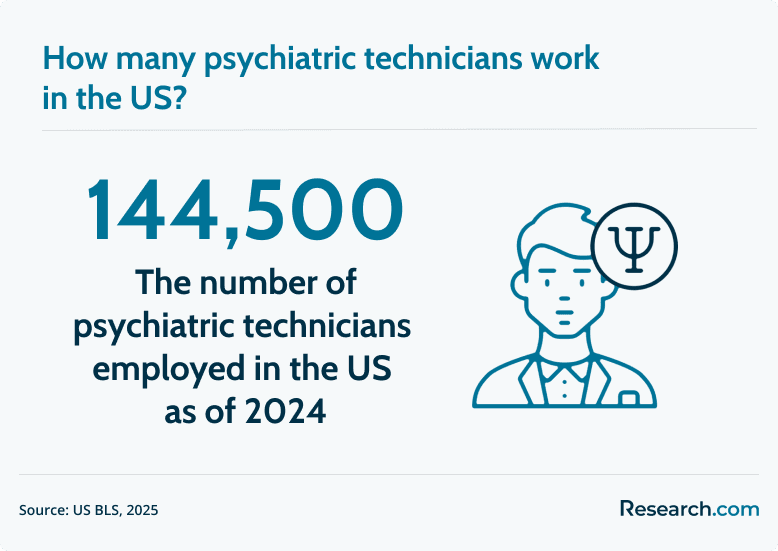
- Psychiatric technicians: Students with mental health support training may assist with daily care for patients with psychiatric conditions in hospitals or residential settings. They may help monitor treatment plans under supervision. In 2024, 144,500 psychiatric technicians were employed in the US (US BLS, 2025).
- Social and human service assistants: Students with counseling, case support, or human-services preparation may help individuals and families connect with community resources, healthcare, or social services. In 2024, 449,600 social and human service assistants worked in the US (US BLS, 2025).
- Health education specialists: Psychology students with health education preparation may help design and deliver programs focused on preventive care and healthy behaviors in schools, nonprofits, healthcare organizations, or public health settings. In 2024, 71,800 health education specialists were employed in the US (US BLS, 2025).
- Probation officers and correctional treatment specialists: Psychology majors with criminal justice-related preparation may support rehabilitation planning, monitor probation compliance, and assist reintegration efforts for people involved in the justice system. In 2024, 92,300 of these specialists were employed in the US (US BLS, 2025).
- Social and community service managers: With additional experience and leadership preparation, psychology graduates may move into roles that oversee programs, manage staff, and coordinate services addressing community needs. In 2024, 219,800 social and community service managers worked in the US (US BLS, 2025).
Students who want to focus on addiction-related services may also compare options such as a fast-track online addiction psychology degree, especially if they plan to build credentials beyond the undergraduate level.
| Career direction | Helpful undergraduate preparation | Good next step |
| Behavior technician or autism services | RBT credential, child development coursework, supervised behavioral experience | Compare ABA-related graduate pathways and state requirements |
| Addiction services | Addiction counseling or recovery support training, volunteer work in recovery programs | Check state credentialing rules before choosing a paid program |
| Human services | Case management exposure, nonprofit volunteering, crisis-support training | Build experience with local agencies and document measurable responsibilities |
| Research assistant | Statistics, research methods, lab work, data collection experience | Ask faculty about labs, honors projects, or summer research programs |
| Organizational or HR path | Industrial-organizational psychology coursework, HR internship, communication training | Consider graduate study or HR credentials aligned with employer expectations |
How Much Can Psychology Undergraduates Earn With Certifications?
Pay depends on the job title, employer, state, experience level, schedule, and whether the role requires a completed degree, license, or specialized training. Certifications can improve a student’s competitiveness, but they do not guarantee a specific salary.
For psychiatric technicians in the US, a role for which postsecondary certificates may be relevant, the median annual wage was $42,200 in May 2024. That was below the $49,500 median annual wage for all US occupations during the same period (US BLS, 2025).
Some related entry-level roles show higher median wages. Social and human service assistants had a May 2024 median annual wage of $45,120. The typical entry requirement for this occupation is a high school diploma or the equivalent, although employers may prefer additional education or experience for some roles.
Completing a bachelor’s degree can expand the roles available to psychology students, especially when paired with relevant certifications, internships, or specialized experience. For example, health education specialists typically need at least a bachelor’s degree in a relevant field and had a median annual wage of $63,000 in May 2024, which was higher than the median for all US occupations (US BLS, 2025).
Students planning a longer-term path in workplace behavior, analytics, or organizational consulting may also compare options such as the shortest online master’s programs in industrial-organizational psychology as part of their career planning.
| Occupation | May 2024 median annual wage | How certifications may help |
| Psychiatric technicians | $42,200 | Can support readiness for supervised mental health care environments |
| Social and human service assistants | $45,120 | Can show preparation for case support, communication, and community-resource work |
| Health education specialists | $63,000 | Can strengthen public health, prevention, and education-focused applications |
The chart below visualizes May 2024 median annual wages for occupations available to psychology undergraduate students with relevant certifications, based on 2025 US BLS data.
Are Psychology Certifications Worth the Investment?
Psychology certifications can be worth it when they match a specific job goal, meet recognized employer or credentialing standards, and help you gain supervised experience. They are less useful when they are expensive, poorly recognized, unrelated to your target role, or marketed as a shortcut to licensed clinical practice.
Before paying for a certification, compare the cost with realistic outcomes. Ask whether the credential appears in job postings, whether it meets state or employer requirements, whether it includes supervised practice, and whether it supports your next education step. Students interested in behavior analysis should also compare degree pathways carefully, including options such as affordable online BCBA-related programs, while remembering that advanced roles require more than an entry-level certificate.
| Certification is more likely to be worth it if... | Certification may not be worth it if... |
| It is required or preferred in local job postings | You cannot find employers that recognize it |
| It leads to supervised field experience | It is only a short course with no practical application |
| It fits your planned graduate-school or career pathway | It does not connect to your intended specialization |
| The total cost is manageable and transparent | The provider is unclear about fees, renewal rules, or eligibility limits |
| It has clear renewal, ethics, and competency requirements | It promises career outcomes that no credential can guarantee |
Industries Where Psychology Undergraduates Can Find Training and Entry-Level Experience
Psychology students can look for training and early-career opportunities in behavioral health, substance use treatment, residential care, local and state government, family services, public health, schools, corrections, and nonprofit organizations. The right setting depends on whether you want direct care, research, education, administration, advocacy, or program management.
In 2024, the US employed around 144,500 psychiatric technicians. Psychology majors may prepare for related roles by combining coursework with relevant certifications, training programs, and practical experience. Looking at where psychiatric technicians work can help students identify employers that may value mental health support skills.
The sectors with the largest shares of psychiatric technicians in 2024 were (US BLS, 2025):
- Psychiatric and Substance Abuse Hospitals, State: 24%
- Psychiatric and Substance Abuse Hospitals, Private: 18%
- State Government, Excluding Education and Hospitals: 18%
- Residential Mental Health and Substance Abuse Facilities: 7%
- Outpatient Mental Health and Substance Abuse Centers: 2%
Students considering social and human service assistant roles can also examine where these workers are employed. The largest employing sectors in 2024 were (US BLS, 2025):
- Individuals and Family Services: 28%
- Local Government, Excluding Education and Hospitals: 11%
- Community Food and Housing, Emergency and Other Relief Services, and Vocational Rehabilitation Services: 11%
- Nursing and Residential Care Facilities: 10%
- State Government, Excluding Education and Hospitals: 8%
How to Choose the Right Certification as a Psychology Undergraduate
The best certification is not always the most recognizable one. It is the credential that fits your career goal, is accepted by relevant employers, meets any state or agency requirements, and gives you skills you can actually use. Students should be especially careful with programs that imply they lead to independent counseling or clinical practice without explaining licensure limits.
If you are comparing undergraduate certificates, graduate certificates, or doctoral-level pathways, make sure the program level matches your goal. For example, students exploring advanced clinical training may eventually research options such as online PsyD programs, but those are very different from short undergraduate-friendly certifications.
| Question to ask | Why it matters |
| Is the credential recognized by employers in my area? | A certification has limited value if local agencies do not request or respect it |
| Does it require supervised experience? | Supervision can make training more credible and help students avoid practicing beyond their role |
| What are the full costs? | Students should include application fees, training costs, exam fees, renewal fees, materials, and time away from paid work |
| Does it support my long-term plan? | A credential should connect to your intended field, such as behavior analysis, addiction services, research, HR, or human services |
| Are there renewal or continuing-education requirements? | Some credentials require ongoing education, fees, or documented work experience |
| Does it affect licensure eligibility? | Many psychology-related licenses require specific graduate degrees and supervised hours, not just a certificate |
The chart below shows the largest employers of psychiatric technicians in the US in 2024, based on 2025 US BLS data.
Continuing-Education Options After an Undergraduate Psychology Degree
After earning a psychology bachelor’s degree, students can continue building qualifications through graduate school, post-baccalaureate certificates, professional development, supervised employment, or research experience. The right next step depends on whether the student wants licensure, a research career, a business role, a human-services role, or a specialized clinical-support path.
- Graduate degrees: Master’s and doctoral programs allow students to specialize in areas such as clinical psychology, counseling psychology, school psychology, industrial-organizational psychology, or research psychology. Some licensure pathways require graduate education, supervised practice, exams, and state approval.
- Post-baccalaureate certificates: These programs provide focused study in areas such as applied behavior analysis, substance abuse counseling, forensic psychology, or research methods without requiring immediate enrollment in a full graduate degree.
- Professional development courses: Short-term training in research methods, data analytics, human resources, ethics, crisis response, or community services can help graduates stay competitive in psychology-adjacent careers.
- Supervised work experience: Entry-level work in residential care, autism services, human services, research labs, or community organizations can help graduates decide whether to pursue advanced training.
Students interested in neuropsychology should expect a longer academic path and can begin by reviewing options such as online PhD and PsyD programs in neuropsychology. Online study may provide flexibility, but students should verify accreditation, clinical training requirements, and whether the program supports their intended career path.
Alternative Degrees to Psychology
Psychology is a strong option for students interested in behavior, mental health, research, and human development, but it is not the only route into helping professions or people-focused careers. Some students may be better served by a degree with a clearer direct-practice path, stronger policy focus, or more immediate connection to case management or social services.
| Alternative degree | What it emphasizes | When it may be a better fit than psychology |
| Sociology | Social systems, institutions, inequality, group behavior, and culture | You are more interested in communities, policy, research, or social patterns than individual behavior |
| Social work | Direct support, advocacy, case management, social welfare systems, and client services | You want a clearer path into social services, casework, or licensed social work with the right graduate preparation |
| Human services | Practical helping skills, program coordination, community resources, and service delivery | You want applied training for nonprofit, community agency, or support-service roles |
Students who want an advanced counseling-related pathway can also compare accelerated options such as the shortest online counseling psychology master’s programs, while confirming that any program they consider meets the requirements for their intended state and career.
Common Mistakes Psychology Students Make When Choosing Certifications
- Choosing a certification before choosing a career direction: A credential should support a specific goal, such as behavior technician work, addiction services, research, HR, or human services.
- Assuming a certificate equals licensure: Most independent clinical roles require graduate education, supervised practice, exams, and state licensure.
- Ignoring state rules: Addiction counseling, school-based work, behavioral services, and clinical roles may have state-specific requirements.
- Focusing only on tuition or course price: Students should also consider exam fees, renewal fees, supervision costs, materials, commuting, and unpaid hours.
- Relying only on rankings or marketing claims: Job postings, employer recognition, accreditation, and graduate-school requirements are usually more useful than promotional language.
- Overlooking internships and volunteer work: Experience can be just as important as a credential, especially for students applying to graduate school or entry-level helping roles.
- Taking advanced training too early: Some programs are designed for doctoral students or professionals, not undergraduates. Always check eligibility before applying.
Student Perspectives on Psychology Certifications and Career Preparation
- Gregory: "Completing RBT training during my psychology program helped me understand applied behavior analysis outside the textbook. The supervised experience made interviews easier because I could talk about actual client-support work, not just coursework."
- Colin: "My addiction-services certification helped me connect what I learned in class with the day-to-day realities of rehabilitation settings. It also showed me how important supervision, ethics, and documentation are in client care."
- Nina: "I paired psychology coursework with HR-focused training because I was interested in workplace behavior. That combination helped me explain how psychology applies to hiring, employee support, and organizational communication."
Practical Steps: How to Build a Strong Psychology Undergraduate Profile
- Pick a target direction. Decide whether you are most interested in clinical support, research, behavior analysis, addiction services, human services, education, HR, or graduate school.
- Review job postings early. Search for entry-level roles in your area and note which certifications, skills, and experiences employers actually request.
- Talk with faculty and career advisors. Ask which internships, labs, agencies, or credentials have helped past students reach similar goals.
- Check accreditation and eligibility. If a program connects to graduate study or licensure, confirm that it meets the standards required for your intended pathway.
- Prioritize supervised experience. Employers and graduate programs often value hands-on experience, especially when it involves documentation, ethics, teamwork, and client or participant interaction.
- Track your accomplishments. Keep records of training hours, supervision, projects, populations served, research tasks, and measurable outcomes.
- Reassess before paying for another credential. If a certification does not move you closer to a job, graduate program, or required competency, it may not be the best use of your resources.
Key Insights
- Psychology undergraduates can pursue useful certifications in behavior analysis, addiction services, prevention, recovery support, and related human-services areas, but the right choice depends on career goals.
- The RBT credential is one of the most accessible psychology-related certifications because academic eligibility requires a high school diploma or equivalent, along with a 40-hour training program and competency assessment.
- Addiction-related credentials can be valuable, but students must check eligibility carefully because some require supervised experience, an active credential, or a license.
- Certifications can improve employability, but they do not replace graduate education or state licensure for independent clinical practice.
- Internships, volunteer roles, and research experience are often as important as certificates because they provide evidence of real-world skills.
- Salary outcomes vary by occupation. May 2024 median annual wages included $42,200 for psychiatric technicians, $45,120 for social and human service assistants, and $63,000 for health education specialists (US BLS, 2025).
- Students should evaluate certifications by employer recognition, state requirements, cost, supervision, renewal rules, and alignment with long-term plans.
- The strongest undergraduate strategy combines coursework, one or two targeted credentials, supervised field experience, faculty mentorship, and a clear plan for either employment or graduate study.
References
- Lopes, L., Kirzinger, A., & Sparks, G. (2022, October 05). KFF/CNN Mental Health in America Survey. KFF. https://www.kff.org/mental-health/kff-cnn-mental-health-in-america-survey/#2a51a1e8-c1f5-43ff-b2f9-4f7a9c4fa802
- US Bureau of Labor Statistics. (2025, August 28). Health Education Specialists. Occupational Outlook Handbook. https://www.bls.gov/ooh/community-and-social-service/health-educators.htm
- US Bureau of Labor Statistics. (2025, August 28). High School Teachers. Occupational Outlook Handbook. https://www.bls.gov/ooh/education-training-and-library/high-school-teachers.htm
- US Bureau of Labor Statistics. (2025, August 28). Marriage and Family Therapists. Occupational Outlook Handbook. https://www.bls.gov/ooh/community-and-social-service/marriage-and-family-therapists.htm
- US Bureau of Labor Statistics. (2025, August 28). Probation Officers and Correctional Treatment Specialists. Occupational Outlook Handbook. https://www.bls.gov/ooh/community-and-social-service/probation-officers-and-correctional-treatment-specialists.htm
- US Bureau of Labor Statistics. (2025, August 28). Psychiatric Technicians and Aides. Occupational Outlook Handbook. https://www.bls.gov/ooh/healthcare/psychiatric-technicians-and-aides.htm
- US Bureau of Labor Statistics. (2025, August 28). Psychologists. Occupational Outlook Handbook. https://www.bls.gov/ooh/life-physical-and-social-science/psychologists.htm
- US Bureau of Labor Statistics. (2025, August 28). Social and Community Service Managers. Occupational Outlook Handbook. https://www.bls.gov/ooh/management/social-and-community-service-managers.htm
- US Bureau of Labor Statistics. (2025, August 28). Social and Human Service Assistants. Occupational Outlook Handbook. https://www.bls.gov/ooh/community-and-social-service/social-and-human-service-assistants.htm
- US Bureau of Labor Statistics. (2025, August 28). Social Workers. Occupational Outlook Handbook. https://www.bls.gov/ooh/community-and-social-service/social-workers.htm
Other Things You Should Know About Getting Undergraduate Psychology Certifications
The most common option is the CITI Program’s Social and Behavioral Research course, which many universities require before students join lab studies. It usually ends with an online quiz and a completion certificate. Some institutions also accept NIH training on human-subjects protections.
Certain certifications in 2027, like the Applied Behavior Analysis (ABA) certification, offer psychology undergraduates practical experience through supervised internships or practicum components, ensuring they gain hands-on skills while completing academic requirements.