2027 Fastest Online Addiction Psychology Degree Programs

Co-Founder and Chief Data Scientist
A new report from Trust for America’s Health shows that deaths from alcohol, drug use, and suicide declined in 2023, continuing a downward trend for the second year after two decades of sharp increases. While this progress signals improvements in public health and addiction treatment, the need for well-trained professionals remains urgent.
Reducing harm and supporting recovery requires a sustained and educated workforce. Pursuing an online addiction psychology degree is one way for students to join this critical effort. These programs prepare graduates to assess, treat, and support individuals struggling with addiction in various clinical, community, and organizational settings.
In this guide, I will spotlight the fastest online addiction psychology degree programs to help you get started sooner. I will also cover degree structures, salary expectations, long-term job outlooks, and the many professional opportunities this field has to offer.
What are the benefits of getting into accelerated online addiction psychology degree programs?
- Accelerated online addiction psychology degree programs help students learn from anywhere and manage coursework around their personal and professional schedule.
- Graduates gain practical training in addiction assessment, treatment planning, and case management and can work in psychology, counseling, social services, rehabilitation, and healthcare.
- Graduates can earn an annual salary of $60,000 to $100,000 or more, depending on the specific role.
What can I expect from accelerated online addiction psychology degree programs?
Accelerated online addiction psychology programs help students complete their degrees in a shorter time frame without sacrificing academic quality. Courses are often delivered in condensed formats allowing students to progress quickly through the curriculum. This pace requires consistent focus but offers the flexibility to study from anywhere, making it ideal for working adults or those with other commitments.
Students in these programs learn addiction assessment, counseling techniques, treatment planning, and co-occurring disorders. Many programs also include coursework in case management, ethics, and prevention strategies. An online addiction psychology degree may also offer options for internships, virtual simulations, or supervised fieldwork to help students apply what they have learned in real-world settings.
Where can I work with an online addiction psychology degree?
An online addiction psychology degree prepares graduates to work in a range of settings where addiction treatment, prevention, and recovery services are needed.
- Substance Abuse Treatment Centers: These facilities focus on helping individuals recover from drug or alcohol dependence.
- Private Practice: This offers licensed professionals the opportunity to provide individualized addiction counseling or psychological services in an independent setting.
- Community Mental Health Clinics: These serve diverse populations facing mental health and substance use challenges.
- Correctional Facilities: Addiction specialists in these settings support incarcerated individuals dealing with substance use.
- Hospitals and Healthcare Systems: Integrated care teams in emergency departments or behavioral health units support patients with co-occurring health and substance use issues.
- Nonprofit Organizations: Many nonprofits focus on addiction education, prevention, and recovery support through outreach programs, workshops, or peer support groups.
How much can I make with an online addiction psychology degree?
According to the U.S. Bureau of Labor Statistics, clinical and counseling psychologists earn an average of $106,850 yearly, with salaries ranging from $50,470 to $170,150. Substance abuse, behavioral disorder, and mental health counselors make $65,100 annually, with earnings between $39,090 and $98,210.
Meanwhile, mental health and substance abuse social workers earn $68,290, with salaries ranging from $39,620 to $104,130. Entry-level professionals tend to earn on the lower end, while experienced workers with advanced credentials earn more.
Addiction psychologists often earn more than counselors and social workers due to their clinical training. However, advanced certifications can also raise their earning potential. Work setting matters as well. For example, professionals in home health care services and business, labor, or political organizations can earn between $65,000 and $140,000.
Location also impacts pay. For instance, counselors in Alaska earn $88,870, largely due to high demand and the state’s cost of living. Social workers in New York make up to $96,240 annually, while psychologists in Colorado and Oregon earn over $129,000, reflecting a combination of demand, professional shortages, and robust behavioral health funding.
With these in mind, aspiring addiction professionals should weigh not only their education and credentials but also job location and work setting when evaluating potential income and career opportunities.
- Fastest Online Addiction Psychology Degree Programs for 2027 List of Programs
- How is an accelerated online addiction psychology degree program different from clinical psychology? How is an accelerated online addiction psychology degree program different from clinical psychology?
- How long does it take to complete an accelerated online addiction psychology degree program? Completion Time
- What is the average cost of an accelerated online addiction psychology degree program? Program Cost
- What courses are included in an accelerated online addiction psychology degree program? What courses are included in an accelerated online addiction psychology degree program?
- What certifications do graduates of accelerated online addiction psychology degree programs need? What certifications do graduates of accelerated online addiction psychology degree programs need?
- What is the difference between an addiction psychologist and other addiction experts? What is the difference between an addiction psychologist and other addiction experts?
- How to choose the best accelerated online addiction psychology degree program? Program Criteria
- How can you finish an accelerated online addiction psychology degree program faster? How can you finish an accelerated online addiction psychology degree program faster?
- What career paths are available to graduates of accelerated online addiction psychology degree programs? Career Paths
- What is the job market for graduates with an accelerated online addiction psychology degree? Job Outlook
- Is accreditation a critical factor in choosing an accelerated online addiction psychology degree program? Is accreditation a critical factor in choosing an accelerated online addiction psychology degree program?
- What are the admission requirements for accelerated online addiction psychology degree programs? What are the admission requirements for accelerated online addiction psychology degree programs?
- Is an online addiction psychology degree respected by employers? Is an online addiction psychology degree respected by employers?
- What challenges do accelerated online addiction psychology degree programs present? What challenges do accelerated online addiction psychology degree programs present?
Fastest Online Addiction Psychology Degree Programs for 2027
Choosing an accelerated online addiction psychology degree is usually about more than graduating quickly. You may be trying to qualify for addiction counseling roles, move up in behavioral health, prepare for graduate study, or complete a psychology-focused credential without pausing your career. The challenge is that “addiction psychology” programs vary widely: some are bachelor’s degrees, some are master’s programs, some are non-licensure psychology degrees, and others are addiction studies or counseling-oriented pathways.
This guide explains the fastest online addiction psychology-related degree options, how long they take, what they cost, which credentials they may support, and how to decide whether a fast online program is the right move. You will also learn how addiction psychology differs from clinical psychology, what courses to expect, how accreditation affects your options, and which career paths may be available after graduation. If you are comparing psychology pathways more broadly, programs similar to the fastest online school psychology programs can help you understand how accelerated formats work across the field.
Quick answer: What is the fastest online addiction psychology degree?
The fastest listed online option is Virginia Commonwealth University’s MS in Addiction Studies, which can be completed in 12 months. Arizona State University and Regent University also offer graduate-level online programs that may be completed in 12–24 months. Bachelor’s programs generally take 3–4 years, although transfer credits, year-round enrollment, and short course terms may shorten the timeline. Doctoral study takes longer; National University’s PhD pathway listed here has a program length of 46 months.
How do we rank schools?
Research.com evaluates accelerated addiction psychology-related programs by looking at completion speed, online flexibility, academic quality, accreditation, curriculum relevance, and the usefulness of the program for students pursuing addiction services, counseling preparation, research, or behavioral health careers. Our ranking process follows Research.com’s inclusive methodology and is designed to help students compare programs with both speed and quality in mind.
The ranking also draws from established education data sources, including the Integrated Postsecondary Education Data System, Peterson’s database and its Distance Learning Licensed Data Set, College Scorecard, and the National Center for Education Statistics (NCES).
| Rank | School | Online program | Program length | Credits required | Cost | Accreditation |
| 1 | Arizona State University | MS in Addiction Psychology | 12–24 months | 45 | $945 per credit hour | Higher Learning Commission (HLC) |
| 2 | Virginia Commonwealth University | MS in Addiction Studies | 12 months | 36 | $900 per credit hour | Southern Association of Colleges and Schools Commission on Colleges (SACSCOC) |
| 3 | Regent University | MS in Psychology, Addictions | 12–24 months | 39 | $695 per credit hour | SACSCOC |
| 4 | Southern New Hampshire University | BA in Psychology, Addiction Studies | 3–4 years | 120 | $342 per credit hour | New England Commission of Higher Education (NECHE) |
| 5 | Walden University | BS in Psychology, Addiction Studies | 3–4 years | 181 quarter credits | $350 per quarter hour | HLC |
| 6 | Purdue Global | BS in Psychology in Addictions | 3–4 years | 180 quarter credits | $371 per credit | National Addiction Studies Accreditation Commission (NASAC), HLC |
| 7 | University of New Hampshire | BS in Applied Psychology, Addictions Studies | 3–4 years | 120 | $330 per credit hour | New England Commission on Higher Education (NECHE) |
| 8 | Liberty University | BS in Psychology, Addictions and Recovery | 3–4 years | 120 | $390 full-time, $455 part-time per credit hour | SACSCOC |
| 9 | Averett University | BS in Psychology, Substance Abuse Counseling | 3–4 years | 120 | $480 per credit hour | SACSCOC |
| 10 | National University | PhD in Psychology, Substance-Related and Addictive Disorders | 46 months | 60 | $1,114 per credit hour | WASC Senior College and University Commission (WSCUC) |
1. Arizona State University
Arizona State University offers an online MS in Addiction Psychology for students who want graduate training connected to addiction counseling and behavioral health practice. The curriculum uses 7.5-week courses and covers counseling methods, clinical program operations, and case coordination for people affected by substance use disorders.
Applicants do not have to hold a behavioral health background, although prior experience in the field may be helpful. ASU is a NAADAC Approved Education Provider, which is relevant for students who want addiction-focused education aligned with professional expectations for work involving substance use and co-occurring disorders.
- Program Length: 12–24 months
- Tracks/Concentrations: Addiction Psychology
- Cost per Credit Hour: $945
- Required Credits to Graduate: 45
- Accreditation: Higher Learning Commission (HLC)
2. Virginia Commonwealth University
Virginia Commonwealth University delivers an online MS in Addiction Studies in collaboration with King’s College London and the University of Adelaide. The degree is not a psychology program in the narrow sense, but it provides advanced study in addiction science, treatment systems, public health, research, and global policy.
Students are enrolled through all three participating universities and can use each school’s online learning resources during the program. This option is especially relevant for students interested in addiction research, PhD preparation, or a master’s credential that supports advancement in treatment, policy, or public health settings.
- Program Length: 12 months
- Tracks/Concentrations: Addiction Studies
- Cost per Credit Hour: $900
- Required Credits to Graduate: 36
- Accreditation: Southern Association of Colleges and Schools Commission on Colleges (SACSCOC)
3. Regent University
Regent University offers an online MS in Psychology with an Addictions concentration. This non-licensure program is designed for students who want to examine addictive behavior through psychological theory, research, prevention, intervention, and recovery frameworks.
The curriculum addresses the addiction cycle, evidence-based responses, spiritual dimensions of recovery, community support, and multicultural considerations. It can be a practical academic foundation for students interested in addiction research, doctoral preparation, or behavioral health roles that do not require independent clinical licensure.
- Program Length: 12–24 months
- Tracks/Concentrations: Addictions
- Cost per Credit Hour: $695
- Required Credits to Graduate: 39
- Accreditation: SACSCOC
4. Southern New Hampshire University
Southern New Hampshire University offers an online BA in Psychology with an Addiction Studies concentration. The program introduces students to the development of addictive behavior and the biological, psychological, and social factors that influence substance use and recovery.
Courses also address research, ethics, prevention, and treatment-related concepts. SNHU’s 8-week terms may appeal to students who want a flexible bachelor’s pathway that allows them to complete courses in a shorter academic format.
- Program Length: 3–4 years
- Tracks/Concentrations: Addiction Studies
- Cost per Credit Hour: $342
- Required Credits to Graduate: 120
- Accreditation: New England Commission of Higher Education (NECHE)
5. Walden University
Walden University offers a BS in Psychology with an Addiction Studies focus. Students study substance use disorders and their effects on individuals, families, and communities while developing case management skills such as assessment, planning, client advocacy, and service coordination.
The program also covers ethical practice, professional standards, current research, and addiction treatment approaches. Its coursework is designed to reflect competencies associated with the IC&RC Alcohol and Drug Counselor (ADC) certification exam.
- Program Length: 3–4 years
- Tracks/Concentrations: Addiction Studies
- Cost per Quarter Hour: $350
- Required Credits to Graduate: 181 quarter credits
- Accreditation: HLC
6. Purdue Global
Purdue Global offers an online BS in Psychology in Addictions that covers prevention, assessment, intervention, treatment, and case management. The program fulfills educational requirements for students who plan to pursue optional NCAC Level I and II certifications.
The degree is built for online flexibility, and students generally spend 15–18 hours per week on coursework. Purdue Global also offers the opportunity to earn a Peer Recovery Support Specialist micro-credential, along with customizable study options.
- Program Length: 3–4 years
- Tracks/Concentrations: Business Foundations; Practicum Track
- Cost per Credit: $371
- Required Credits to Graduate: 180 (quarter credits)
- Accreditation: National Addiction Studies Accreditation Commission (NASAC), HLC
7. University of New Hampshire
The University of New Hampshire offers an online BS in Applied Psychology that studies behavior at both the individual and social levels. Students build applied skills in communication, research interpretation, analysis, and critical thinking.
The addiction studies option includes coursework on addiction biology, counseling approaches, and support for people and communities affected by substance use. Graduates may use the degree for human services roles or as preparation for further psychology-related education.
- Program Length: 3–4 years
- Tracks/Concentrations: Addictions Studies
- Cost per Credit Hour: $330
- Required Credits to Graduate: 120
- Accreditation: New England Commission on Higher Education (NECHE)
8. Liberty University
Liberty University offers an online BS in Psychology with an Addictions and Recovery concentration. The program uses 8-week courses and allows transfer credit for up to 75% of the degree, which may help qualified students reduce their time to completion.
The curriculum focuses on understanding, identifying, and treating substance use disorders through client-centered care. Students also study addiction recovery through scientific and faith-informed perspectives, which may appeal to learners seeking a Christian academic environment.
- Program Length: 3–4 years
- Tracks/Concentrations: Addictions and Recovery
- Cost per Credit Hour: $390 (full-time), $455 (part-time)
- Required Credits to Graduate: 120
- Accreditation: SACSCOC
9. Averett University
Averett University offers a BS in Psychology with a Substance Abuse Counseling concentration. The program combines psychology, human behavior, and evidence-based counseling concepts while meeting the academic requirements to sit for the Substance Abuse Counselor Certification Exam.
Students may move more quickly by taking up to 18 credits per semester. Courses are asynchronous, class sizes are small, and internship experiences may be completed in the student’s local community.
- Program Length: 3–4 years
- Tracks/Concentrations: Substance Abuse Counseling
- Cost per Credit Hour: $480
- Required Credits to Graduate: 120
- Accreditation: SACSCOC
10. National University
National University offers a PhD in Psychology with a Substance-Related and Addictive Disorders specialization. This is a non-licensure doctoral program for professionals who want advanced academic training in addiction, behavioral health, research, or teaching.
Students study theories, assessment considerations, and treatment approaches related to alcohol, drugs, marijuana, addictive behavior, and co-occurring mental health conditions. The program may fit educators, researchers, and practitioners who want deeper subject-matter expertise rather than a direct route to psychologist licensure.
- Program Length: 46 months
- Tracks/Concentrations: Substance-Related and Addictive Disorders
- Cost per Credit Hour: $1,114
- Required Credits to Graduate: 60
- Accreditation: WASC Senior College and University Commission (WSCUC)
How is an accelerated online addiction psychology degree program different from clinical psychology?
An accelerated online addiction psychology program focuses on substance use, addictive behavior, recovery, prevention, treatment systems, counseling support, and case management. Clinical psychology is broader and prepares students to assess, diagnose, and treat a wider range of mental, emotional, and behavioral disorders.
The distinction matters because the two paths can lead to very different credentials. Many online addiction psychology degrees support non-licensure roles, addiction counseling preparation, research, human services, or graduate school entry. By contrast, APA PsyD programs are doctoral, clinically intensive, and designed around supervised practice, internships, and psychologist licensure preparation.
Psychology continues to attract large numbers of students. According to the American Psychological Association (2023), U.S. colleges awarded 140,711 bachelor’s degrees in psychology in 2023. That popularity makes careful program selection important: two psychology degrees with similar names may not prepare students for the same jobs or licenses.
| Factor | Accelerated online addiction psychology | Clinical psychology |
| Main focus | Substance use disorders, addiction recovery, prevention, counseling support, case management, and addiction science | Assessment, diagnosis, psychotherapy, psychological testing, and treatment for many types of mental health conditions |
| Common degree levels | Bachelor’s, master’s, and non-licensure doctoral options | Usually doctoral study for independent psychologist licensure |
| Typical outcome | Behavioral health, addiction services, human services, research support, or further study | Licensed psychologist roles, clinical practice, research, or academic careers |
| Licensure considerations | May support counselor certification or licensure depending on the state, degree level, and supervised experience | Requires doctoral training, supervised clinical hours, and state licensure for independent practice |
How long does it take to complete an accelerated online addiction psychology degree program?
Completion time depends mainly on degree level, transfer credits, term length, and whether you study full time or part time. A bachelor’s degree in psychology commonly takes four years, but accelerated online formats may reduce that timeline when students transfer credits, enroll year-round, or take condensed courses. Master’s programs that often take about two years may be completed in 12 to 18 months in accelerated formats.
Fast programs require consistent weekly effort. Many accelerated online courses run five to eight weeks, which means assignments, readings, discussions, and exams arrive quickly. Students who work full time should review weekly workload expectations before committing to a heavy course load.
Academic speed is only one part of the timeline. Students pursuing addiction counselor certification may also need supervised fieldwork, practicum hours, post-degree experience, or state-specific exams. These requirements can extend the total time from enrollment to professional credentialing.
| Degree level | Typical accelerated timeline in this guide | Best for | Watch for |
| Bachelor’s | 3–4 years | Students seeking entry-level behavioral health, human services, recovery support, or graduate school preparation | Transfer credit limits, practicum availability, and whether the program supports state certification goals |
| Master’s | 12 months to 24 months | Students who already hold a bachelor’s degree and want advanced addiction training or career advancement | Licensure alignment, supervised experience requirements, and whether the degree is counseling-focused or non-licensure |
| Doctoral | 46 months | Professionals pursuing research, teaching, or advanced specialization in addiction-related psychology | Whether the doctorate is licensure-track or non-licensure |
What is the average cost of an accelerated online addiction psychology degree program?
The cost of an accelerated online addiction psychology degree depends on the school, degree level, credit requirements, tuition structure, transfer credits, and fees. A shorter program is not always cheaper; a high per-credit tuition rate can offset the savings from graduating faster.
According to Ma et al. (2024), average tuition and fees for bachelor’s programs at public institutions are $8,990. For master’s programs, the figure is $9,560, and for doctoral programs it is $12,270. At private institutions, total costs can double and may range from $30,000 to $55,000 or more.
Doctoral psychology programs can require a much larger investment. The average cost of PsyD program tuition typically ranges from $90,000 to over $100,000 depending on the institution and program length.
Online study can reduce some costs, especially relocation, commuting, and campus housing. Some schools also offer online tuition discounts, military-affiliated rates, employer tuition benefits, or opportunities to earn credit through prior learning. Still, students should compare the total program price rather than tuition alone.
| Cost factor | Why it matters | Question to ask before enrolling |
| Per-credit or per-term tuition | Programs with fewer credits may still be costly if the rate is high. | What is the full tuition cost to finish the degree, not just the advertised rate? |
| Fees | Technology, graduation, course, and clinical placement fees can add up. | Which mandatory fees apply to online students? |
| Transfer credits | Accepted credits may shorten the timeline and reduce tuition. | How many credits can I transfer, and which credits apply to my major? |
| Fieldwork costs | Practicums and internships may require background checks, travel, supervision, or liability coverage. | Does the program help online students find approved local placements? |
| Licensure or certification preparation | Extra exams, applications, and supervised hours may cost money after graduation. | Which credential does this program prepare me for in my state? |
What courses are included in an accelerated online addiction psychology degree program?
Most online addiction psychology programs combine general psychology with focused addiction studies. Students usually take courses in research methods, statistics, pharmacology, abnormal psychology, lifespan development, counseling concepts, ethics, and human behavior.
Specialized coursework then connects those foundations to substance use disorders, prevention, treatment, family systems, public policy, and recovery support. The exact curriculum depends on degree level and whether the program is built for psychology, addiction studies, counseling preparation, or human services.
- Assessment and Diagnosis: Students learn how substance use symptoms are identified through screening, interviewing, diagnostic criteria, and case formulation.
- Addictions Counseling: This course introduces counseling theories, motivational interviewing, relapse prevention, treatment planning, and evidence-based strategies for addiction recovery.
- Social Aspects and Contemporary Issues in Addictions: Students examine how addiction is shaped by family systems, income, race, gender, stigma, and access to care. Coursework related to social context may overlap with topics found in the fastest online sociology bachelor’s degree programs.
- Public Policy and Addiction Advocacy: This course explores how laws, healthcare systems, public funding, and community advocacy influence prevention and treatment access.
- Comorbidity in Substance Use Related Problems: Students study the connection between substance use disorders and mental health conditions, including integrated treatment and collaborative care models.
- Group Therapy: This course covers group facilitation, peer support, recovery groups, relapse prevention groups, group development, and therapeutic communication.
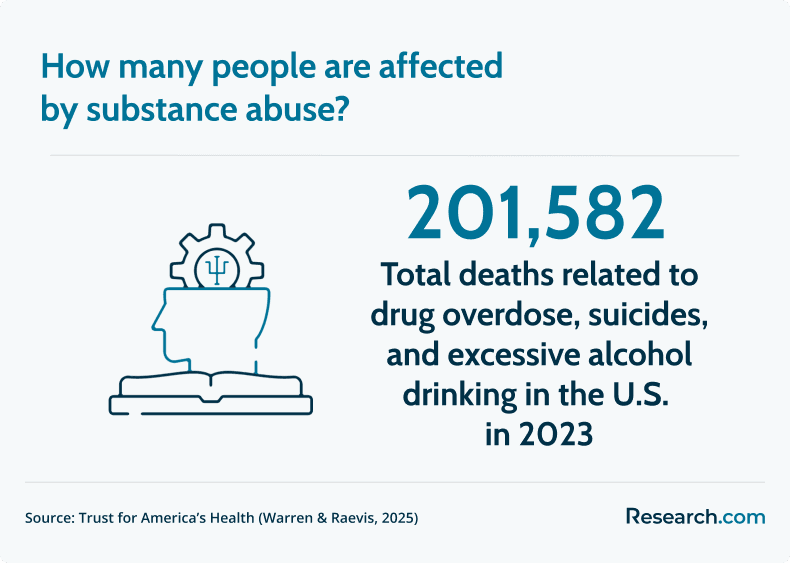
The stakes are high for addiction-related work. Warren & Raevis (2025) reported 201,582 deaths from alcohol, drugs, and suicide in 2023 alone. A focused curriculum can help students build the knowledge needed to support prevention, treatment, advocacy, and recovery work in communities affected by these issues.
What certifications do graduates of accelerated online addiction psychology degree programs need?
Certification requirements depend on your state, degree level, job title, and scope of practice. A bachelor’s degree may support entry-level or support roles, while many counseling and clinical roles require graduate education, supervised experience, exams, and state approval.
Bachelor’s graduates may strengthen their resumes with supplemental training such as Psychological First Aid Training, Mental Health First Aid Training, SMART Recovery Volunteer Training, or the Certified in Thanatology credential. These do not replace state licensure when licensure is required, but they may show readiness for community support, case management, or recovery-oriented work.
Graduate-level students and licensed professionals may pursue addiction-focused credentials such as:
- American Board of Professional Psychology: ABPP offers a specialty certification in Addiction Psychology for licensed psychologists who can demonstrate advanced competence in substance use assessment and treatment.
- National Certification Commission for Addiction Professionals - NCAC: NCC AP offers National Certified Addiction Counselor credentials at Levels I and II for professionals trained in addiction prevention, intervention, treatment, and recovery support.
- National Certification Commission for Addiction Professionals - MAC: NCC AP also offers the Master Addiction Counselor credential for qualified master’s-level professionals with supervised experience and a passing certification exam score.
- Center for Credentialing and Accreditation: CCA offers the International Certified Addiction Professional credential, which reflects international standards in addiction counseling, ethics, and treatment planning.
If your goal is licensed counseling, compare addiction psychology programs with best online counselor education programs, because counseling degrees may align more directly with licensure requirements in some states.
Certification also helps professionals respond to changing substance use and behavioral health patterns. America’s Health Rankings noted in its America's Health Rankings 2024 Report that non-medical drug use increased among Americans in 2024, while excessive drinking, frequent mental distress, and smoking declined. The report also identified rising e-cigarette use as a concern. These shifts make continuing education and credential maintenance important for addiction professionals.
This chart displays some of the behavioral and health outcomes among U.S. adults.
What is the difference between an addiction psychologist and other addiction experts?
Addiction treatment teams often include psychologists, counselors, social workers, case managers, peer recovery specialists, prevention professionals, and medical providers. They may all support recovery, but they do not have the same training or legal scope of practice.
An addiction psychologist is a licensed psychologist with doctoral-level training who can assess, diagnose, and treat mental health conditions, including substance use disorders. Addiction counselors and related professionals may hold bachelor’s or master’s degrees and often focus on counseling, treatment planning, relapse prevention, recovery support, and client advocacy.
The difference between addiction counseling and psychology degree programs becomes clear when you compare depth of psychological assessment, licensure authority, clinical training, and career endpoint. Psychology offers a broader diagnostic and therapeutic framework, while addiction counseling is usually more targeted toward direct substance use treatment and recovery support.
| Role | Typical education | Common responsibilities | Important limitation |
| Addiction psychologist | Doctoral degree, supervised clinical training, and state licensure | Assessment, diagnosis, psychotherapy, psychological testing, treatment planning, and research | Requires a long training pathway and licensure before independent practice |
| Addiction counselor | Often a master’s degree for licensed roles; requirements vary by state | Individual and group counseling, recovery planning, relapse prevention, and client support | Scope of diagnosis and independent practice depends on state law and credential level |
| Case manager | Often bachelor’s-level preparation or related human services training | Service coordination, referrals, advocacy, care planning, and follow-up support | Usually does not provide independent psychotherapy |
| Peer recovery specialist | Training and certification requirements vary | Peer support, recovery coaching, resource connection, and encouragement based on lived experience | Not a substitute for licensed clinical care |
Where these roles overlap
- They support people affected by substance use and recovery challenges.
- They may work in outpatient programs, community agencies, hospitals, correctional settings, or residential treatment environments.
- Regulated roles follow ethical standards and often require continuing education.
Where the roles differ
- Addiction psychologists complete doctoral training, while counselors often need a master’s degree for licensed counseling roles.
- Psychologists complete extensive clinical training ranging from 1,500 to 6,000 hours, while counselors generally complete between 2,000 and 3,000 hours of supervised experience.
- Psychologists can conduct broad psychological assessments and diagnose many mental health conditions; counselors focus on treatment and support, and in some states may diagnose substance abuse or mental health disorders within a limited scope.
How to choose the best accelerated online addiction psychology degree program
The best program is not simply the shortest one. It is the program that matches your career goal, state credentialing rules, budget, schedule, and preferred learning style. Before enrolling, confirm whether the degree prepares you for employment, certification, graduate admission, or licensure in the place where you plan to work.
- Accreditation: Choose an institutionally accredited school. Accreditation affects federal aid eligibility, credit transfer, graduate school admission, and employer confidence. Comparing options such as the most online psychology bachelor's degree programs can also help you evaluate cost alongside institutional quality.
- Licensure and certification fit: Ask whether the program meets educational requirements for your intended credential in your state. Do not assume that an online program automatically qualifies you for counseling licensure.
- Faculty background: Look for instructors with advanced degrees, addiction treatment experience, research expertise, or professional credentials related to behavioral health.
- Practicum or internship support: If fieldwork is required, confirm whether online students receive help finding approved placements near home.
- Transfer credit policy: Students with previous college coursework should ask how many credits can transfer and whether those credits apply to general education, electives, or major requirements.
- Cost and aid: Compare full program cost, not just tuition per credit. Ask about scholarships, military rates, employer reimbursement, and additional fees.
- Career services: Strong programs should help students understand certification steps, prepare resumes, locate field placements, and identify realistic entry-level roles.
Students comparing addiction psychology with other applied behavioral fields may also want to review options such as the most affordable BCBA online degree programs. The right pathway depends on whether you want to work primarily with addiction, counseling, behavior analysis, mental health, or human services populations.
Common mistakes to avoid when choosing a program
| Mistake | Why it can hurt you | Better approach |
| Choosing the fastest program without checking licensure rules | You may graduate quickly but still lack required coursework or supervised experience. | Contact your state licensing or certification board before applying. |
| Looking only at tuition per credit | Fees, transfer limits, and extra credentialing costs can change the true price. | Calculate total cost from enrollment through graduation and certification. |
| Assuming all online psychology degrees are viewed the same | Employers and graduate schools may look closely at accreditation, curriculum, and field experience. | Prioritize accredited schools and programs with addiction-specific coursework. |
| Ignoring practicum requirements | A program may require fieldwork that is hard to arrange in your area. | Ask who secures placements and what happens if no local site is available. |
| Relying only on rankings | A highly ranked program may not fit your state, schedule, budget, or credential goal. | Use rankings as a shortlist, then verify fit with advisors and licensing boards. |
If you are still exploring broad online degree options, comparing value and flexibility in areas such as the best online humanities degree programs can help you think more carefully about cost, transfer credits, and long-term utility across online education.
How can you finish an accelerated online addiction psychology degree program faster?
Finishing faster requires planning before the first term begins. The students who move most efficiently usually know which credits transfer, which courses are offered each term, whether fieldwork is required, and how the program sequence connects to their career goal.
- Request a transfer credit evaluation before enrolling so you know how many prior credits apply to the degree.
- Ask whether professional, military, or life experience can be evaluated for academic credit.
- Take the maximum course load only if your work and family schedule can support it.
- Choose programs with five- to eight-week terms if you want more opportunities to complete courses throughout the year.
- Enroll in summer, winter, or other available sessions when possible.
- Meet with an advisor early to map every required course through graduation.
- Use tutoring, writing support, and instructor office hours before academic problems slow your progress.
- Confirm certification or graduate school requirements so you do not waste time on electives that do not help your goal.
- Compare addiction psychology with addiction counseling or addiction studies programs if those degrees offer a more direct route to your intended credential.
What career paths are available to graduates of accelerated online addiction psychology degree programs?
Graduates may work in addiction services, behavioral health, recovery support, human services, research, community programs, correctional treatment, or graduate-level clinical preparation. The exact role depends on degree level, state rules, supervised experience, and whether the graduate holds the required license or certification.
| Career path | Average wage listed | What the role does | Typical credential consideration |
| Recovery Coaches | $40,551 | Support clients through recovery goals, peer meetings, crisis support, and relapse prevention strategies. | Training or peer recovery credentials may be required depending on employer and state. |
| Clinical Research Assistants | $44,863 | Assist with addiction research, data collection, participant interviews, literature reviews, and study coordination. | Bachelor’s-level research skills are often useful; graduate study may support advancement. |
| Addiction Prevention Specialists | $59,014 | Create and deliver prevention programs with schools, health departments, nonprofits, and advocacy groups. | Public health, prevention, or addiction-related credentials may strengthen qualifications. |
| Substance Abuse Counselors | $65,100 | Provide individual and group support for people recovering from alcohol or drug addiction. | Licensure requirements vary by state and may include supervised experience. |
| Substance Abuse Social Workers | $68,290 | Counsel clients and families, connect people with housing, healthcare, employment, and community resources. | Social work roles generally have separate degree and licensure expectations. |
| Correctional Treatment Specialists | $71,530 | Develop rehabilitation and reintegration plans for people in correctional, probation, or parole systems. | Requirements vary by employer and jurisdiction. |
| Social and Community Service Managers | $86,100 | Manage programs, staff, budgets, grant proposals, evaluations, and compliance for service organizations. | Experience plus a related degree may be important for management roles. |
| Clinical Psychologists | $106,850 | Diagnose and treat mental, emotional, and behavioral disorders using evidence-based psychological methods. | Requires a PhD or PsyD, supervised clinical training, and state licensure. |
Students considering advanced clinical roles should compare the clinical psychologist vs clinical mental health counselor career path before choosing a graduate program. The two careers can overlap in mental health care, but their education, scope of practice, licensure process, and timeline are different.
This chart displays the average wages of various professionals in this field.
What is the job market for graduates with an accelerated online addiction psychology degree?
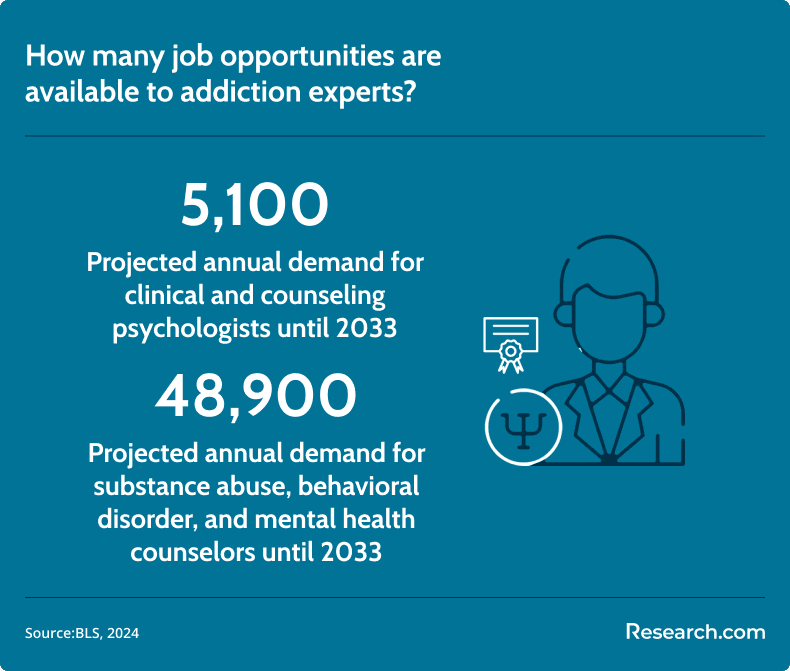
The behavioral health labor market remains favorable for many addiction-related roles, particularly as communities continue responding to substance use, mental health needs, and co-occurring disorders. According to the BLS, clinical and counseling psychologists are projected to see 13.3% job growth from 2023 to 2033. Employment for substance abuse, behavioral disorder, and mental health counselors is projected to increase by 18.8%.
Demand is connected to treatment needs in hospitals, outpatient programs, residential settings, community clinics, correctional systems, and public agencies. Retirements and career changes may also create openings for new workers entering behavioral health.
Students should still avoid assuming that degree completion guarantees a specific role or salary. The best outcomes usually depend on licensure fit, supervised experience, local demand, certification, and the graduate’s ability to work with diverse clients. Behavioral science remains a strong area to watch among psychology jobs in demand, especially for students willing to serve high-need communities.
Here’s What Graduates Have to Say About Their Online Addiction Psychology Degree Programs
- : "I was nervous about managing school while working, but the online format gave me enough control over my schedule to keep going. Being able to log in after my shifts at a recovery center made the program realistic for me. The case-based assignments were especially useful because they connected directly to the client situations I was beginning to see at work. Even though the program was online, my instructors were responsive and invested in my progress. — Devon"
- : "I had already been working in behavioral health, so I needed a degree that did not treat me like a complete beginner. The coursework built on what I knew and pushed me to use more evidence-based approaches. I could apply new concepts to my job almost immediately, which made the accelerated pace feel worthwhile instead of overwhelming. — Caitlyn"
- : "I wanted practical preparation, not just theory. My program helped me complete a master’s in under three years and move into work as a substance use counselor. The treatment planning models I learned are still part of my daily work with clients, and the degree helped me see a long-term future in the field. — Phillip"
Is accreditation a critical factor in choosing an accelerated online addiction psychology degree program?
Yes. Accreditation is one of the first things to verify because it affects financial aid, credit transfer, graduate school admission, employer recognition, and sometimes licensure or certification eligibility. At minimum, the institution should be accredited by a recognized accrediting agency. Programmatic accreditation may also matter for addiction studies or counseling-related pathways, depending on the credential you plan to pursue.
Do not rely only on a school’s marketing language. Check the accreditor’s website, confirm the school’s current status, and ask the program directly whether its curriculum aligns with your state’s addiction counseling or behavioral health credential requirements. Accreditation does not guarantee employment, but lack of appropriate accreditation can create serious barriers.
What are the admission requirements for accelerated online addiction psychology degree programs?
Admission requirements vary by degree level and school. Bachelor’s programs typically require official transcripts and proof of prior education. Graduate programs commonly ask for official transcripts, a minimum undergraduate GPA, a personal statement, a resume, and references. Some programs may prefer or recommend prior coursework or experience in psychology, counseling, human services, behavioral health, or a related field.
Accelerated programs may be especially demanding, so admissions teams may look for evidence that applicants can manage condensed coursework. Before applying, ask whether prerequisite courses are required, whether transfer credits will be reviewed before admission, and whether professional experience can strengthen your application.
Is an online addiction psychology degree respected by employers?
An online addiction psychology degree is most likely to be respected when it comes from an accredited institution, includes relevant addiction-focused coursework, and aligns with the credential expected for the job. Employers generally care less about whether coursework was online and more about whether the graduate has the right education, field experience, certification, licensure eligibility, and practical skills.
Students who are unsure about employer perception can review broader guidance on whether is an online degree in psychology respected and then compare that advice with local job postings in addiction counseling, recovery support, and behavioral health. Job ads can reveal which degrees and credentials employers actually request.
What challenges do accelerated online addiction psychology degree programs present?
Accelerated online programs can be efficient, but they are not easy. Short terms compress readings, assignments, discussions, and exams into a tight schedule. Students need strong time management, consistent internet access, clear weekly study blocks, and the confidence to ask for help quickly.
Online addiction psychology students may also face practical challenges, such as arranging local internships, completing group projects across time zones, learning new digital platforms, or balancing emotionally heavy course topics with work and family responsibilities. Students comparing faster psychology pathways can review online accelerated psychology degree options to understand how workload, pacing, and flexibility differ across programs.
Questions to ask before applying
- Is the institution currently accredited by a recognized accreditor?
- Is the program licensure-track, certification-aligned, or non-licensure?
- Will this degree meet educational requirements in the state where I plan to work?
- How many of my previous credits will transfer into the major?
- Are courses asynchronous, synchronous, or a mix of both?
- How many hours per week should I expect to study?
- Does the program include practicum or internship hours?
- Who helps online students find field placements?
- What is the full program cost, including fees?
- What career services are available to online students and alumni?
References:
- Ma, J., Pender, M., & Oster, M. (2024). Trends in College Pricing and Student Aid 2024. College Board. https://research.collegeboard.org/trends/college-pricing
- PayScale. (2025, July 16). Average Clinical Research Assistant Hourly Pay. Retrieved July 25, 2025, from https://www.payscale.com/research/US/Job=Clinical_Research_Assistant/Hourly_Rate
- Substance Abuse and Mental Health Services Administration. (2024). Key substance use and mental health indicators in the United States: Results from the 2023 National Survey on Drug Use and Health. Center for Behavioral Health Statistics and Quality. https://www.samhsa.gov/data/report/2023-nsduh-annual-national-report
- U.S. Bureau of Labor Statistics. (2024). Clinical and counseling psychologists, May 2024 OEWS Profiles [Interactive data]. Occupational Employment and Wage Statistics (OEWS) Profiles. Retrieved July 25, 2025, from https://data.bls.gov/oesprofile
- U.S. Bureau of Labor Statistics. (2025, April 18). Occupational projections, 2023–33, and worker characteristics, 2023 (Numbers in thousands). Employment Projections. https://www.bls.gov/emp/tables/occupational-projections-and-characteristics.htm
- Warren, M. & Reavis, B. (2025, May). Pain in the Nation 2025: The Epidemics of Alcohol, Drug, and Suicide Deaths. Trust for America’s Health. https://www.tfah.org/report-details/pain-in-the-nation-2025
- ZipRecruiter. (2025, July 18). Substance Abuse Recovery Coach Salary. Retrieved July 25, 2025, from https://www.ziprecruiter.com/Salaries/Substance-Abuse-Recovery-Coach-Salary#Yearly
Key Insights
- The fastest program listed is Virginia Commonwealth University’s 12-month MS in Addiction Studies, while other graduate options in this guide can take 12–24 months.
- Bachelor’s programs usually take 3–4 years, but transfer credits, short terms, and year-round enrollment can help motivated students finish sooner.
- Addiction psychology is not the same as clinical psychology. Addiction-focused programs may support counseling, recovery, human services, or research roles, while licensed psychologist practice generally requires doctoral training.
- Licensure and certification rules vary by state. Always confirm requirements with the appropriate state board before enrolling.
- Accreditation is essential for financial aid, credit transfer, employer recognition, and future education options.
- Cost should be calculated as a total degree investment, including tuition, fees, transfer credits, fieldwork expenses, and post-graduation certification or licensure costs.
- Graduates can pursue roles in recovery support, addiction prevention, research assistance, substance abuse counseling, correctional treatment, social services management, or advanced clinical psychology with further education.
- The best accelerated program is the one that fits your credential goal, state requirements, budget, schedule, and capacity for intensive online coursework—not simply the one with the shortest advertised timeline.
Other Things You Should Know About the Fastest Online Addiction Psychology Degree Programs
In 2027, online addiction psychology programs may require clinical practicums involving 150-300 hours of supervised fieldwork. These experiences are often facilitated through partnerships with health centers, ensuring practical exposure to addiction treatment under licensed professionals.
Most addiction psychology graduates who pursue clinical licensure must pass the National Clinical Mental Health Counseling Examination, or NCMHCE, and meet state supervision hours. Some states also require the National Counselor Examination, plus a background check and official transcript review before approval.