
2027 Most Affordable Online Early Childhood Development Degree Programs

Co-Founder and Chief Data Scientist
Choosing an online Early Childhood Development degree is not just a question of convenience. For many teachers, childcare professionals, program coordinators, and career changers, the bigger decision is whether a graduate program will improve their qualifications, fit their schedule, meet employer or licensure expectations, and justify the cost.
This guide focuses on online master’s-level Early Childhood Development and Early Childhood Education programs in the USA, with an emphasis on affordability, program quality, admissions requirements, career outcomes, and practical decision-making. You will learn how to compare programs, what to check before applying, how online fieldwork usually works, what roles graduates pursue, and which mistakes can lead to wasted time or money.
Quick answer: Is an online Early Childhood Development degree worth it?
An online Early Childhood Development degree can be worthwhile if you already work with young children or want to move into curriculum, leadership, early intervention, advocacy, or program administration. The strongest value usually comes from choosing an accredited program that aligns with your state’s licensure rules, offers meaningful applied learning, and fits your budget without requiring excessive debt.
It may not be the right choice if you need initial teacher licensure and the program is clearly labeled non-licensure, if your state requires in-person clinical experiences the program cannot support, or if the total cost is too high compared with the roles you plan to pursue.
What are the benefits of getting an online Early Childhood Development Degree Program qualification?
- More career options: A graduate credential in Early Childhood Development can support movement into roles such as Early Childhood Program Director, Curriculum Specialist, and Early Intervention Specialist.
- Potential for higher earnings: Depending on the position and location, professionals with an Early Childhood Development degree, especially at the master’s level, can see median salary ranges of approximately $50,000 to $70,000 annually.
- Flexible study format: Online coursework can make graduate education more realistic for working educators, parents, and childcare professionals who cannot relocate or attend campus several days a week.
- Stronger professional judgment: Master’s programs usually go beyond classroom techniques and examine child development research, assessment, family systems, equity, policy, and leadership.
What can I expect from an online Early Childhood Development Degree Program?
An online Early Childhood Development program typically combines child development theory, early learning pedagogy, assessment, family engagement, and leadership. At the master’s level, the focus is usually less about basic childcare practice and more about designing, evaluating, improving, and leading programs for young children.
- Advanced child development content: Students study cognitive, language, physical, and social-emotional development from infancy through the early years, including typical and atypical development patterns.
- Curriculum and instruction: Coursework often addresses developmentally appropriate practice, early literacy, play-based learning, inclusive instruction, and classroom assessment.
- Family and community partnerships: Programs usually teach strategies for working with families, community agencies, and culturally diverse populations.
- Policy, advocacy, and leadership: Graduate students may examine early childhood systems, funding, quality standards, staff supervision, and advocacy for children and families.
- Applied learning: Even when coursework is fully online, programs may use field projects, supervised experiences in local settings, case studies, video observations, simulations, or action research.
| Program feature | What it means for students | Why it matters |
| Licensure or non-licensure design | Some programs prepare licensed teachers for advancement; others do not lead to licensure. | This affects whether the degree can help you qualify for public school teaching roles. |
| Asynchronous courses | Students complete work on their own schedule within weekly deadlines. | Best for working adults who need maximum flexibility. |
| Synchronous courses | Students attend live online class meetings. | Useful for discussion and structure, but less flexible. |
| Field experience or practicum | Students complete supervised work, observation, or projects in early childhood settings. | Important for skill development and, in some cases, licensure or employer expectations. |
| Specialization options | Programs may offer tracks in leadership, diversity, policy, special education, or early childhood education. | Concentrations should match your intended career path. |
Where can I work with an online Early Childhood Development Degree Program qualification?
Graduates can work in direct education, administration, support services, advocacy, and policy. The exact options depend on prior experience, licensure status, state requirements, and whether the program includes fieldwork or a teaching credential pathway.
- Public and private schools: Graduates may work in pre-kindergarten, early elementary, coaching, intervention, or instructional support roles when they meet state and district requirements.
- Childcare centers and Head Start programs: Common roles include center director, administrator, program coordinator, lead teacher, trainer, or quality improvement specialist.
- Early intervention agencies: Professionals may support infants, toddlers, and young children with developmental delays or disabilities, often in partnership with families and service teams.
- Nonprofit organizations: Graduates may become child advocates, family support specialists, community outreach coordinators, or policy staff.
- Government agencies: Some work on early learning standards, program oversight, family services, quality initiatives, or public preschool expansion.
- Other education-related settings: Children’s museums, family resource centers, consulting firms, and professional development organizations may also hire early childhood specialists.
How much can I make with an online Early Childhood Development Degree Program qualification?
Salaries in early childhood development vary widely because the field includes classroom teaching, center leadership, public school roles, intervention services, nonprofit work, and policy positions. A master’s degree may improve eligibility for higher-level roles, but it does not guarantee a specific salary.
- Preschool/Childcare Center Director: Median annual salary is around $54,000, with variation by center size, funding model, and administrative responsibility.
- Early Childhood Education Specialist/Instructional Coordinator: Average salary is around $67,000 to $75,000, reflecting specialized expertise and leadership duties.
- Early Intervention/Special Education Roles: Salaries often range from $60,000 to $80,000 or more because these jobs require specialized skills.
- General Early Childhood Teacher: Average pay is around $40,000-$45,000, although a master’s degree may place some educators on higher salary schedules.
- Executive Director of Early Childhood Organizations: Senior organizational leaders may earn significantly more, potentially exceeding $85,000 annually.
- Most Affordable Online Early Childhood Development Degree Programs for 2027
- How to choose the best online Master’s in Early Childhood Development program
- Prerequisites and application process for online Master’s in Early Childhood Development programs
- Essential skills taught in strong online Master’s in Early Childhood Development programs
- Career prospects after an online Master’s in Early Childhood Development
- Program costs and financing options
- Salary expectations after earning an online Master’s in Early Childhood Development
- Online versus in-person Master’s in Early Childhood Development programs
- Accreditation and student support services
- Balancing affordability with program quality
- Subspecialties and career paths for graduates
- Job market for online Master’s in Early Childhood Development graduates
- Industry trends and future outlook
- Doctoral pathways after an online Master’s in Early Childhood Development
- How online programs provide hands-on learning
Most Affordable Online Early Childhood Development Degree Programs for 2027
How do we rank schools?
Because graduate school is a major financial and professional commitment, the ranking process prioritizes transparent information that students can use to compare programs more confidently.
The ranking draws on established education data sources, including:
- the IPEDS database
- Peterson's database, including the Distance Learning Licensed Data Set
- the College Scorecard database
- the National Center for Education Statistics
Affordability is important, but it should not be the only factor. Students should also verify accreditation, licensure alignment, fieldwork expectations, faculty expertise, course format, graduation requirements, and student support.
| Rank | School | Program focus | Cost information provided | Credits | Accreditation |
| 1 | Central Methodist University | Early Childhood Education emphasis | $8,250 per year | 36 credits | Higher Learning Commission (HLC) |
| 2 | Fort Hays State University | Early Childhood Unified, birth–age 8, general and special education | $7,720 per year | 36 credits | Higher Learning Commission (HLC) |
| 3 | Liberty University | Curriculum and Instruction with Early Childhood Education specialization | $7,470 per year | 36 credits | Southern Association of Colleges and Schools Commission on Colleges (SACSCOC) |
| 4 | University of West Alabama | Early Childhood Education | $9,750 per year | 34 credits | Southern Association of Colleges and Schools Commission on Colleges (SACSCOC) |
| 5 | West Chester University of Pennsylvania | Early Childhood Education | $6,943 per year | 30 credits | Middle States Commission on Higher Education (MSCHE) |
| 6 | Eastern New Mexico University | Early Childhood Education | $6,174 per year | 36 credits | Higher Learning Commission (HLC) |
| 7 | Northwestern College | Early Childhood | $11,220 total program cost | 33 credits | Higher Learning Commission (HLC) |
| 8 | Texas A&M University at Commerce | Early Childhood Education | $14,676 for Texas residents; $29,364 for out-of-state students | 36 credits | Southern Association of Colleges and Schools Commission on Colleges (SACSCOC) |
| 9 | University of Missouri | Learning, Teaching and Curriculum with Early Childhood Education emphasis | $16,854 total program cost | 30 credits | Higher Learning Commission (HLC) |
| 10 | Walden University | Early Childhood Studies, non-licensure | $21,840 total program cost | 30 credits | Higher Learning Commission (HLC) |
1. Central Methodist University
Central Methodist University offers an online Master of Science in Education with an Early Childhood Education emphasis for certified teachers who want deeper preparation in child development, curriculum, assessment, and instructional leadership. The program is built for working professionals and includes flexible online coursework, research-based practice, technology integration, family and community topics, and applied projects or field experiences.
- Program Length: Varies; typically 1–2 years, based on course load
- Tracks/Concentrations: Early Childhood Education
- Tuition Cost: $8,250 per year, online graduate tuition
- Required Credits to Graduate: 36 credits, as stated on the university’s graduate catalog
- Accreditation: Higher Learning Commission (HLC)
2. Fort Hays State University
Fort Hays State University provides an online Master of Science in Education: Early Childhood Unified for educators focused on children from birth through age 8. The program combines general and special education preparation, with attention to assessment, curriculum planning, inclusion, family partnerships, and early childhood settings such as schools, intervention programs, and community agencies.
- Program Length: Typically 2 years, part-time
- Tracks/Concentrations: Early Childhood Unified, birth–age 8, general and special education
- Tuition Cost: $7,720 per year, online graduate tuition
- Required Credits to Graduate: 36 credits, as listed in the graduate catalog
- Accreditation: Higher Learning Commission (HLC)
3. Liberty University
Liberty University’s online Master of Education in Curriculum and Instruction with an Early Childhood Education specialization is designed for educators who want to improve early childhood teaching practice, curriculum design, and classroom management. Courses are offered in 8-week sessions with multiple start dates, and students may transfer up to 50% of degree credits. The program does not lead to licensure and may be best suited for private, Christian, childcare, paraprofessional, or non-licensure career goals.
- Program Length: Varies; typically 1.5–2 years, depending on course load
- Tracks/Concentrations: Early Childhood Education
- Tuition Cost: $7,470 per year, online graduate tuition
- Required Credits to Graduate: 36 credits, as stated in the graduate catalog
- Accreditation: Southern Association of Colleges and Schools Commission on Colleges (SACSCOC)
4. University of West Alabama
The University of West Alabama offers an online Master of Education in Early Childhood Education for certified teachers seeking stronger preparation in curriculum planning, assessment, instructional leadership, technology use, and family engagement for preschool through third grade. Courses use an accelerated, eight-week format, and the program emphasizes diverse learners, mentoring, and advocacy for high-quality early learning.
- Program Length: 1–2 years, with accelerated eight-week courses
- Tracks/Concentrations: Early Childhood Education
- Tuition Cost: $9,750 per year, online graduate tuition
- Required Credits to Graduate: 34 credits, as listed in the graduate catalog
- Accreditation: Southern Association of Colleges and Schools Commission on Colleges (SACSCOC)
5. West Chester University of Pennsylvania
West Chester University of Pennsylvania offers an online Master of Education in Early Childhood Education for working educators who want graduate-level preparation in child development, research, curriculum, assessment, and leadership. The program can be completed in five semesters, includes synchronous and asynchronous learning, and requires at least one year of experience working with children.
- Program Length: 5 semesters, approximately 1.5–2 years
- Tracks/Concentrations: Early Childhood Education
- Tuition Cost: $6,943 per year, online graduate tuition
- Required Credits to Graduate: 30 credits, as stated in the graduate catalog
- Accreditation: Middle States Commission on Higher Education (MSCHE)
6. Eastern New Mexico University
Eastern New Mexico University’s fully online Master of Education in Early Childhood Education is intended for educators and related professionals who want graduate training in child development, culturally responsive practice, early literacy, curriculum planning, assessment, family engagement, and leadership. The asynchronous structure supports working adults, and teaching experience is recommended but not always required.
- Program Length: Typically 1–2 years, flexible pace
- Tracks/Concentrations: Early Childhood Education
- Tuition Cost: $6,174 per year, in-state and out-of-state online tuition
- Required Credits to Graduate: 36 credits, as listed in the graduate catalog
- Accreditation: Higher Learning Commission (HLC)
7. Northwestern College
Northwestern College offers an online Master of Education in Early Childhood for current educators who want to strengthen child development knowledge and classroom practice. The program uses eight-week courses, allows self-paced progress, and includes topics such as early literacy, technology-supported teaching, diverse learner needs, reflective practice, and practical application in early childhood settings.
- Program Length: Less than 2 years, self-paced, eight-week courses
- Tracks/Concentrations: Early Childhood
- Tuition Cost: $11,220 total program cost, online rate
- Required Credits to Graduate: 33 credits, as stated in the graduate catalog
- Accreditation: Higher Learning Commission (HLC)
8. Texas A&M University at Commerce
Texas A&M University at Commerce offers a 100% online Master of Education in Early Childhood Education for educators interested in pedagogy, advanced child development, literacy, creative arts, curriculum development, electives, and research. The 36-credit program is designed for working professionals and prepares graduates for advanced teaching, curriculum, and leadership responsibilities.
- Program Length: Typically 2 years, flexible pace
- Tracks/Concentrations: Early Childhood Education
- Tuition Cost: $14,676 for Texas residents; $29,364 for out-of-state students, total program cost
- Required Credits to Graduate: 36 credits
- Accreditation: Southern Association of Colleges and Schools Commission on Colleges (SACSCOC)
9. University of Missouri
The University of Missouri offers an online Master of Education in Learning, Teaching and Curriculum with an Early Childhood Education emphasis. This 30-credit program is designed for experienced educators and includes early childhood coursework, learning and teaching content, electives, research-based practice, assessment, and curriculum design. Admission requires a bachelor’s degree in education or a related field and at least two years of teaching experience.
- Program Length: Typically 2 years, flexible pace
- Tracks/Concentrations: Early Childhood Education
- Tuition Cost: $16,854 total program cost
- Required Credits to Graduate: 30 credits
- Accreditation: Higher Learning Commission (HLC)
10. Walden University
Walden University’s online Master of Science in Early Childhood Studies is a non-licensure program for educators, administrators, advocates, and related professionals who want to study early childhood development, leadership, policy, diversity, and social change. Students may choose specializations in Administration, Management, and Leadership; Teaching and Diversity in Early Childhood Education; or Early Childhood Public Policy and Advocacy.
- Program Length: Typically 18–24 months, flexible pace
- Tracks/Concentrations: Administration, Management, and Leadership; Teaching and Diversity; Public Policy and Advocacy
- Tuition Cost: $21,840 total program cost, as listed on the university website
- Required Credits to Graduate: 30 credits
- Accreditation: Higher Learning Commission (HLC)
How do I choose the best online Master's in Early Childhood Development program for my specific needs and career goals?
The best online Master’s in Early Childhood Development program is the one that matches your career target, licensure needs, schedule, budget, and preferred learning style. A low tuition rate is valuable, but it should not outweigh accreditation, state authorization, practical experience, and career alignment.
| If your goal is... | Look for programs with... | Be cautious about... |
| Public school teaching or advancement | State-approved teacher preparation, licensure alignment, field placements, and clear certification guidance | Non-licensure programs that do not meet your state’s requirements |
| Childcare center leadership | Courses in administration, supervision, budgeting, quality improvement, and family engagement | Programs focused only on classroom instruction |
| Curriculum or instructional coaching | Advanced curriculum design, assessment, early literacy, and professional development coursework | Programs without applied curriculum projects |
| Early intervention or special education | Birth–age 8 content, inclusive practice, developmental assessment, and special education preparation | Programs that mention inclusion but lack specialized coursework |
| Policy, advocacy, or nonprofit work | Public policy, research, family systems, equity, and advocacy courses | Programs designed only for licensed classroom teachers |
| Doctoral study later | Research methods, applied research projects, faculty mentorship, and thesis or capstone options | Programs with little research training or no academic writing support |
- Check accreditation first: Confirm institutional accreditation through recognized agencies, because employers, licensure boards, and doctoral programs often rely on it.
- Review the curriculum in detail: Course titles alone are not enough. Read descriptions to see whether the program emphasizes infant-toddler development, special education, leadership, policy, curriculum, or another area.
- Ask about licensure outcomes: If you need a credential, request written confirmation that the program meets requirements in your state.
- Evaluate faculty experience: Strong programs use instructors with research knowledge, field experience, and current expertise in early childhood practice.
- Compare course delivery formats: Asynchronous programs work well for self-directed students; live online classes may be better if you want structure and discussion.
- Look for applied learning: Practicums, field projects, local observations, action research, and supervised experiences can make the degree more valuable.
- Assess student services: Online students should have access to advising, tutoring, library support, technical help, career services, and faculty communication.
Public preschool enrollment in the U.S. generally rose between 2015 and 2023, according to the National Institute for Early Education Research (NIEER). Total enrollment was 1.4 million in 2015, increased to 1.5 million in both 2016 and 2017, and reached 1.6 million by 2018. Enrollment stayed at 1.6 million through 2019 and 2020 before falling to 1.3 million in 2021, a decline likely connected to the COVID-19 pandemic.
Enrollment then recovered to 1.5 million in 2022 and returned to 1.6 million in 2023, matching the earlier pre-pandemic high. The graph below shows this overall upward pattern, the disruption in 2021, and the rebound that followed in 2022 and 2023. For prospective graduate students, the trend points to continued public attention on preschool access and program quality.
What are the prerequisites and application process for online Master's in Early Childhood Development programs?
Admissions requirements differ by university, but most online Master’s in Early Childhood Development programs expect applicants to show academic readiness, relevant experience or motivation, and the ability to complete graduate-level work with children or early learning systems.
- Bachelor's Degree: A bachelor’s degree from a regionally accredited institution is commonly required. Many applicants have backgrounds in education, child development, psychology, family studies, or related fields. Students still exploring undergraduate pathways can compare affordable early childhood education degree online options before applying to graduate school.
- Minimum GPA: Many programs ask for an undergraduate GPA around 3.0 on a 4.0 scale, although some schools review professional experience, essays, or conditional admission materials.
- Official transcripts: Applicants typically submit transcripts from every college or university previously attended.
- Letters of recommendation: Programs often request 2-3 recommendations from supervisors, faculty members, or professionals who can speak to the applicant’s readiness and work with children.
- Statement of purpose: A personal essay should explain your career goals, relevant experience, interest in early childhood development, and reasons for choosing the program.
- Resume or CV: Schools usually want a current summary of employment, education, certifications, volunteer work, and childcare or teaching experience.
- GRE scores: Some programs still require GRE scores, but many online master’s programs waive them for applicants with strong academic or professional backgrounds.
- Application fee: A non-refundable fee is often required when the application is submitted.
- Background check: Because students may work with children during field experiences or after graduation, background screening is common.
Applicants from outside education may need prerequisite coursework in child development, learning theory, or early childhood foundations. For example, a student moving from an unrelated technical route such as the cheapest data science training programs online should expect to explain the career transition clearly and may need additional preparation before admission.
- Shortlist programs that match your intended role.
- Confirm institutional accreditation and state authorization.
- Ask whether the program is licensure, endorsement, or non-licensure.
- Request the total program cost, including fees and books.
- Check fieldwork requirements before applying.
- Prepare transcripts, recommendations, resume, and statement of purpose early.
- Submit the FAFSA if you plan to use federal aid.
What essential skills will I learn in a top online Master's in Early Childhood Development program?
Strong online graduate programs develop advanced skills for working with young children, families, staff, and early learning systems. Students comparing online colleges for early childhood education should look for curricula that connect theory to real decisions in classrooms, centers, intervention programs, and policy settings.
- Advanced child development theory: Students examine cognitive, physical, language, social-emotional, and atypical development from birth through age eight.
- Curriculum design and implementation: Graduate coursework teaches students to build, adapt, and evaluate developmentally appropriate and inclusive learning experiences.
- Assessment and evaluation: Students learn to use assessment information to monitor growth, identify needs, plan instruction, and evaluate program effectiveness.
- Family and community engagement: Programs emphasize respectful communication with families and effective use of community resources.
- Advocacy and policy analysis: Students study how laws, funding, standards, and public policy shape early childhood services.
- Research methods and data use: Graduates learn to interpret research, apply evidence-based practices, and use data in decision-making.
- Leadership and administration: Coursework may cover staff supervision, program management, quality improvement, mentoring, and organizational change.
- Culturally responsive practice: Students learn to create inclusive environments that reflect children’s languages, cultures, identities, abilities, and family contexts.
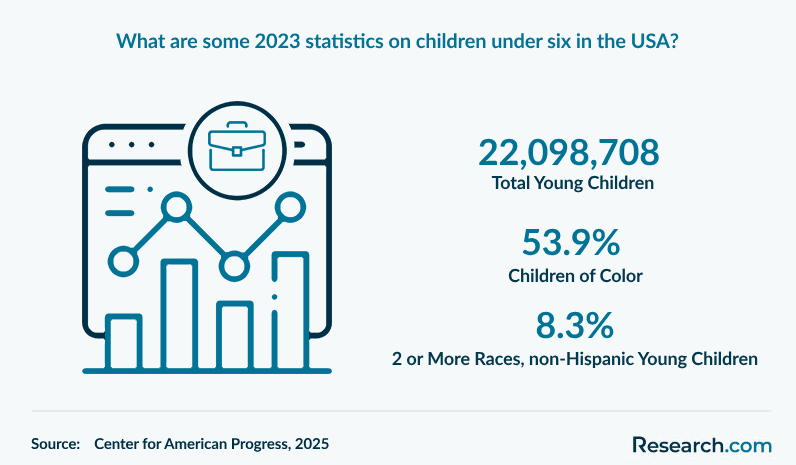
In 2023, the United States had an estimated 22,098,708 children under the age of 6, representing approximately 6.6% of the total U.S. population. This group was more racially and ethnically diverse than the country as a whole. Children of color made up 53.9% of young children, compared with 42.9% of the overall U.S. population.
Within that population, 26.6% of young children were Hispanic, compared with 19.4% of the total U.S. population. Black, non-Hispanic children represented 12.6% of young children, compared with 11.8% overall. Young children identifying as two or more races, non-Hispanic, accounted for 8.3%, almost double the 4.5% share in the broader U.S. population. These figures highlight why early childhood professionals need strong preparation in equity, language development, family engagement, and culturally responsive teaching.
The skill set is specialized and career-focused. In that sense, early childhood graduate programs resemble the affordable low cost master's in instructional design online pathway: both emphasize learner needs, curriculum design, evidence-based practice, and measurable educational outcomes, though they serve different age groups and work settings.
What are some career prospects after completing an online Master's in Early Childhood Development program?
An online Master’s in Early Childhood Development can help graduates move beyond entry-level classroom work into leadership, specialist, training, advocacy, and administrative roles. Graduates of affordable early childhood education degree online programs should still verify that their credential fits the requirements of their intended employer or state.
| Career path | Common responsibilities | What to verify before choosing this goal |
| Early Childhood Program Director/Administrator | Oversee staff, budgets, compliance, curriculum, enrollment, and program quality. | State director qualifications, required experience, and licensing rules for childcare centers. |
| Curriculum Specialist/Instructional Coordinator | Create learning materials, coach teachers, review assessments, and improve instruction. | Whether employers prefer teaching licensure, classroom experience, or curriculum credentials. |
| Early Intervention Specialist | Support infants and toddlers with developmental delays or disabilities through individualized services. | Certification, licensure, or agency requirements in your state. |
| Child and Family Advocate | Work with nonprofits or agencies to improve services, access, and policy for children and families. | Whether the role values policy, social services, bilingual skills, or nonprofit experience. |
| Professional Development Trainer | Train early childhood educators on best practices, compliance, assessment, and program improvement. | Required teaching background and experience leading adult learners. |
| Higher Education Instructor/Lecturer | Teach early childhood courses, often at community colleges or universities. | Whether a doctorate is required for the type of teaching role you want. |
| Early Childhood Consultant | Advise schools, centers, agencies, or families on quality, behavior, inclusion, or curriculum. | Your credibility, specialization, portfolio, and business development skills. |
| Policy Analyst | Research, evaluate, and shape early childhood policy at local, state, or national levels. | Whether the role requires policy analysis, research methods, or public administration experience. |
Many graduates pursue roles as preschool directors, curriculum developers, early intervention professionals, or policy advocates. This is similar in principle to focused career preparation in other care-oriented fields, such as the affordable dental assistant associate degree online, where a targeted credential can lead to specialized employment, although the industries and requirements are very different.
Professionals interested in early intervention can review role expectations through resources such as the Early intervention specialists career profile.
How much do online Master's in Early Childhood Development programs cost and what financing options are available?
Online Master’s in Early Childhood Development program costs differ by institution, residency status, credit requirement, fees, and whether tuition is charged per credit or as a total program price. Students should calculate the full cost before enrolling, not just the advertised tuition rate.
- Tuition per credit hour: Many programs charge by credit, with rates typically ranging from $300 to over $1,000 per credit, and total credit requirements often falling between 30-45 credits.
- Total program cost: Overall cost can range from approximately $10,000 at lower-cost public universities to upwards of $50,000 at private institutions, before books and fees.
- Additional fees: Technology, administration, graduation, background check, field placement, and course material fees can increase the total cost.
- Federal financial aid: Eligible students can complete the Free Application for Federal Student Aid (FAFSA) to apply for federal aid, including Direct Unsubsidized Loans.
- Scholarships and grants: Universities and outside organizations may offer education-related aid, including options connected to early childhood education or teaching.
- Employer tuition reimbursement: Some childcare centers, school districts, and education organizations help employees pay for graduate study.
- Payment plans: Many schools allow students to divide tuition into scheduled payments instead of paying all at once.
- Assistantships: Fully online programs may offer fewer assistantships, but some universities provide remote graduate work opportunities.
| Cost item | Question to ask | Why it affects affordability |
| Tuition | Is tuition charged per credit, per term, or as a total program cost? | Pricing models can make programs difficult to compare. |
| Fees | What mandatory online, technology, graduation, and fieldwork fees apply? | Fees can materially increase the final bill. |
| Transfer credits | Can I transfer graduate credits, and what is the maximum allowed? | Accepted credits can reduce time and cost. |
| Course load | Will part-time enrollment change my tuition, fees, or aid eligibility? | Part-time study can improve flexibility but may extend costs over time. |
| Fieldwork | Will I need to pay for background checks, travel, supervision, or placement requirements? | Practicum requirements may add indirect expenses. |
| Financial aid | What scholarships, grants, employer benefits, or payment plans are available? | Net cost matters more than sticker price. |
Students comparing education technology and early childhood options may notice similar financing structures. For example, an affordable masters in Ed Tech online may also offer grants, scholarships, flexible payments, and online delivery, but the career outcomes and curriculum focus are different.
How much can you earn after obtaining an online Master's in Early Childhood Development qualification?
A master’s degree can improve access to specialized or leadership positions, but salary depends on employer type, region, licensure, job title, experience, and funding source. Public school roles may follow salary schedules, while childcare centers, nonprofits, and private organizations may use different compensation models.
- Preschool and Childcare Center Directors: Directors may earn from $45,000 to $70,000 or more annually, depending on facility size, funding, responsibilities, and location.
- Instructional Coordinators/Curriculum Specialists: Professionals who design and oversee instructional programs may average between $60,000 and $80,000 annually.
- Early Childhood Special Education Teachers: Specialized roles often range from $50,000 to $75,000 per year, depending on district, credentials, and experience.
- Child and Family Advocates/Policy Analysts: Advocacy and policy professionals may earn $55,000 to $85,000 or more, especially at state or national levels.
- Higher Education Lecturers/Instructors: Teaching at community colleges or universities may start from $50,000 to $70,000, with potential growth by rank and experience.
- Experienced Classroom Teachers: A graduate degree can raise pay for some K-3 teachers, with averages for kindergarten and elementary teachers often in the $60,000-$70,000 range. Students focused on elementary classrooms can also review affordable master's degrees in elementary education online.
According to Payscale.com data from 2025, professionals with an online master’s in early childhood development may see different average annual salaries depending on the occupation. General early childhood educators in the US earned an average of $34,840. Location also mattered: Seattle, WA, showed an average of $41,621, while Issaquah, WA, showed $35,880. Preschool teachers, not special education, averaged around $39,194, Head Start teachers averaged $36,000, and preschool teacher assistants earned approximately $28,600.
Specialist and leadership roles reported higher averages. Early childhood education specialists earned about $45,500, and early childhood specialists earned $52,381. Elementary school teachers and kindergarten teachers averaged around $50,000 and $50,012, respectively. Director, child care, and child care center director roles both showed averages of $44,000, while early childhood program directors earned approximately $43,000. Special education teacher, preschool, and early intervention specialist roles averaged $47,000 and $45,000. Among the higher figures cited were child life specialists at $52,000, curriculum coordinators at $53,000, and educators at $59,817. Preschool and childcare center directors earned around $70,000 and above.
What are the key benefits and drawbacks of online versus in-person Master's in Early Childhood Development programs?
The right format depends on how you learn, how much schedule flexibility you need, whether you can travel to campus, and whether field experiences can be completed near you. Students who need flexibility may also compare related pathways such as a degree in elementary education online, especially if their long-term goal includes early elementary teaching.
| Format | Best for | Main advantages | Main drawbacks |
| Online | Working educators, parents, rural students, and students who cannot relocate | Flexible schedule, broader school choice, no commute, access from many locations | Requires self-discipline, less face-to-face interaction, possible technology challenges |
| In-person | Students who want campus structure, direct networking, and local field placements | Immediate faculty access, structured schedule, campus resources, in-person cohort experience | Less flexible, commute or relocation may be required, possible added housing or transportation costs |
| Hybrid | Students who want online convenience with some campus or field-based interaction | Balanced flexibility and direct contact, often useful for practicums | May still require travel and fixed meeting times |
Benefits of online programs
- Schedule flexibility: Many online programs allow students to complete coursework around work and family responsibilities.
- Geographic reach: Students can consider programs outside their immediate area without relocating.
- Professional diversity: Online cohorts often include educators and childcare professionals from different states, districts, and settings.
- Lower indirect costs: Students may avoid commuting, relocation, parking, and campus housing expenses.
Drawbacks of online programs
- Less in-person contact: Some students miss spontaneous classroom discussion and face-to-face faculty interaction.
- Greater need for self-management: Online learning requires organization, time management, and consistent motivation.
- Technology dependence: Internet access, learning platforms, and technical support become essential.
- Different access to campus services: Strong online programs offer virtual support, but students should verify what is actually available.
Benefits of in-person programs
- Direct relationships: Campus learning can make it easier to build rapport with faculty and classmates.
- Structured routine: Fixed meeting times can help students who prefer predictable schedules.
- Campus resources: Libraries, advising, career offices, research support, and events may be easier to use in person.
- Local field connections: Some campus programs have established relationships with nearby schools and early learning centers.
Drawbacks of in-person programs
- Lower flexibility: Required class times and campus attendance can conflict with employment or caregiving.
- Limited school choice: Students may be restricted to universities within commuting distance unless they relocate.
- Potential added expenses: Transportation, housing, parking, and campus fees can raise the total cost.
- Smaller geographic diversity: Cohorts may include fewer students from outside the local region.
How do accreditation and student support services impact program success?
Accreditation and student support can strongly influence whether an online program is worth choosing. Accreditation helps confirm that a university meets recognized academic standards. Student support determines whether online learners can get help when they need advising, technical assistance, writing support, library access, career guidance, or field placement coordination.
For early childhood programs, accreditation can also affect transfer credit, employer recognition, doctoral admission, and licensure review. Students should confirm institutional accreditation, ask whether the program has specialized education accreditation if relevant, and verify state authorization for online enrollment.
Student support matters because online learners can easily become disconnected if advising is weak. Before enrolling, ask how often advisors meet with students, whether faculty hold virtual office hours, how field placements are arranged, and what career services are available to online students. If you are considering long-term leadership or doctoral pathways, you may also want to compare support expectations with advanced programs such as Ed.D. online programs.
How can I balance program quality with affordability in an online Master’s in Early Childhood Development program?
The cheapest program is not always the best value, and the most expensive program is not automatically stronger. A good affordability decision weighs tuition against accreditation, curriculum relevance, graduation requirements, licensure alignment, applied learning, advising quality, and career fit.
- Start with total cost: Add tuition, fees, books, technology charges, and fieldwork-related expenses.
- Compare credits required: A lower per-credit price may not save money if the program requires more credits.
- Check transfer rules: Accepted graduate credits can shorten the program and reduce cost.
- Ask about licensure: A low-cost non-licensure program may be a poor fit if your goal requires certification.
- Review completion support: Delayed graduation increases the real cost of a degree.
- Consider career use: Choose a program that supports the specific role you want, not just a broad early childhood label.
Students comparing cost across education fields can also review options such as the cheapest masters of education online, but the final choice should be based on your intended age group, state requirements, and professional goals.
What subspecialties and career paths are available for online Master's in Early Childhood Development graduates?
An online Master’s in Early Childhood Development can support several subspecialties. Students comparing cheap education degrees online should choose a concentration that directly supports the work they want to do after graduation.
- Infant and Toddler Development: Focuses on children from birth to three years and may lead to work in childcare, home visiting, family services, or early intervention.
- Early Childhood Special Education: Prepares students to support children from birth to age 8 with developmental delays, disabilities, inclusive classroom needs, and individualized plans.
- Curriculum and Instruction: Emphasizes designing, implementing, and evaluating learning experiences in preschool and early elementary settings.
- Early Childhood Leadership and Administration: Supports careers in center management, Head Start leadership, state-funded preschool programs, staff development, and quality improvement.
- Child Advocacy and Policy: Fits students interested in public policy, nonprofit leadership, government agencies, and systems-level work for children and families.
- Play-Based Learning and Development: Focuses on the role of play in cognitive, language, social, and emotional growth.
- Family Support and Engagement: Prepares professionals to build partnerships with families, connect parents to resources, and support home-school collaboration.
- Early Literacy and Language Development: Supports work as a literacy coach, curriculum specialist, classroom leader, or language development advocate.
What is the job market like for online Master's in Early Childhood Development graduates?
The early childhood job market includes stable demand for classroom teachers as well as opportunities for advanced graduates in leadership, curriculum, intervention, quality improvement, and family services. Demand varies by state, public funding, school district hiring, childcare availability, and local workforce shortages.
- Demand for qualified staff: Employers continue to need professionals who understand child development, assessment, family engagement, and inclusive practice.
- Public investment matters: Preschool expansion, Head Start funding, and state early learning initiatives can affect job availability.
- Advanced roles require stronger preparation: Employers hiring specialists, directors, and coordinators often look for graduate education plus experience.
- Settings are varied: Graduates may work in public schools, private preschools, childcare centers, early intervention agencies, nonprofits, and government programs.
- Leadership gaps create opportunity: A master’s degree can help experienced professionals move into program administration and staff development.
- Specialized services remain important: Early childhood special education, intervention, family engagement, and curriculum coaching are common areas of need.
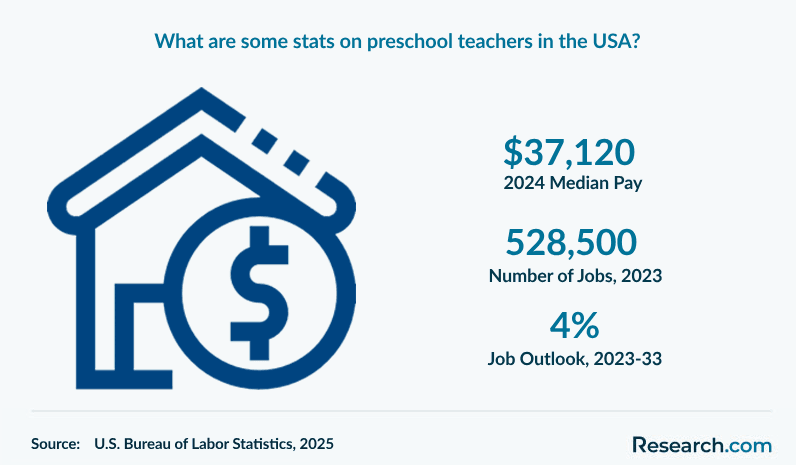
According to the U.S. Bureau of Labor Statistics, preschool teachers earned median pay of $37,120 per year in 2024, or $17.85 per hour. The typical entry-level education for preschool teachers is an associate's degree, and the occupation generally does not require prior related work experience or on-the-job training. In 2023, there were 528,500 preschool teacher jobs. Employment is projected to grow by 4% from 2023-33, which is considered as fast as the average for all occupations, with an employment change of 23,300 new jobs.
What are the current industry trends and future outlook for online Master's in Early Childhood Development graduates?
Early childhood development is changing as research, family needs, workforce pressures, child care affordability, technology, and public policy reshape how programs operate. Graduate students should understand these trends because they affect hiring, curriculum, leadership expectations, and the services families need.
- Social-emotional learning: Early childhood programs increasingly emphasize emotional regulation, empathy, relationship-building, and behavior support alongside academic readiness.
- Equity and inclusion: Diverse classrooms require educators who can support children across cultures, languages, abilities, and family structures.
- Trauma-informed practice: More programs seek professionals who understand how stress and trauma affect young children and families.
- Developmentally appropriate technology use: Early childhood educators need to use digital tools carefully, purposefully, and without replacing play, interaction, and hands-on learning.
- Growth in early intervention: Services for infants and toddlers with developmental delays continue to create demand for specialized knowledge.
- Data-informed improvement: Programs increasingly use assessment, observation, and research to evaluate instruction and program quality.
- Brain science and early learning research: Neuroscience continues to influence best practices in early childhood education and development.
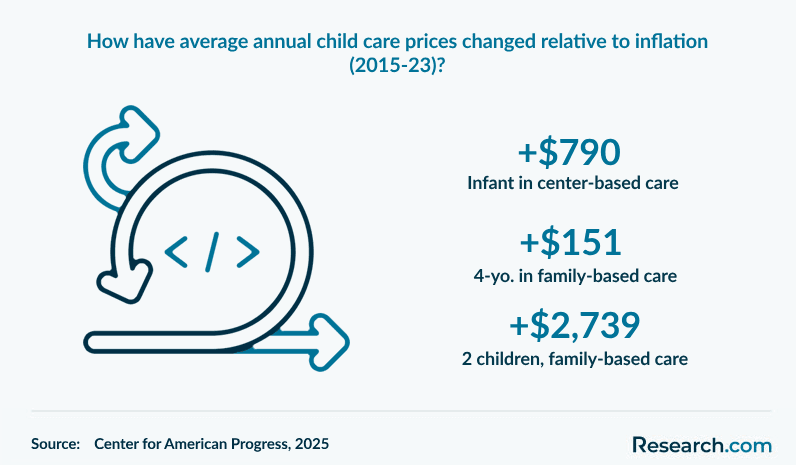
Child care affordability is another major force shaping the field. Between 2016 and 2023, annual child care expenses, adjusted for inflation, increased by $1,058 for two children in center-based care and by $2,739 for two children in family-based care. In 2023, average national child care costs represented 10% of median household income for two-parent families and 32% for single parents, above the federal affordability benchmark of 7%.
The data from 2016 to 2023 show that average annual child care price increases outpaced inflation across all listed options. The largest increases were in family-based care, with two children rising by +$2,739 and an infant rising by +$1,151. Center-based care also increased, with two children rising by +$1,058 and an infant rising by +$790. The smallest increases were for 4-year-olds in center-based care at +$268 and family-based care at +$151. These cost pressures affect families, providers, policymakers, and employers across the early childhood system.
Can an Online Master’s in Early Childhood Development Lead to Advanced Doctoral Opportunities?
Yes, an online Master’s in Early Childhood Development can support doctoral study if the program includes strong research preparation, academic writing, faculty mentorship, and applied inquiry. Students interested in future doctoral work should look for coursework in research methods, statistics or data analysis, program evaluation, policy, and evidence-based practice.
A master’s degree may help graduates pursue Ed.D., Ph.D., or related doctoral programs in education, child development, curriculum and instruction, educational leadership, or policy. Applicants should review each doctoral program’s admission requirements because some prefer a thesis, research project, teaching experience, leadership experience, or specific graduate prerequisites. Cost-conscious students planning long-term study may compare options such as cheap EdD programs.
How do online programs facilitate practical hands-on learning opportunities?
Online early childhood programs can still provide practical learning when they intentionally connect coursework to real settings. Common approaches include local field placements, supervised observations, video-based analysis, virtual simulations, case studies, action research, capstone projects, and mentorship from faculty or site supervisors.
Before enrolling, ask whether you must locate your own placement, whether the university approves local sites, what background checks are required, and whether your workplace can be used for assignments. Students interested in policy connections may also study how government and public systems affect early childhood services; for broader comparison, a program such as the cheapest online degree political science illustrates a different but policy-related academic route.
Common mistakes to avoid when choosing an online Early Childhood Development program
| Mistake | Why it can hurt you | Better approach |
| Choosing only by lowest tuition | The program may not match your career, licensure, or support needs. | Compare total cost, accreditation, outcomes, curriculum, and fieldwork. |
| Assuming online means no fieldwork | Many programs still require observations, practicums, or applied projects. | Ask how hands-on requirements are completed in your location. |
| Ignoring licensure language | A non-licensure program may not qualify you for public school teaching credentials. | Get written confirmation from the program and your state education agency. |
| Overlooking transfer policies | You may miss a chance to reduce time and cost. | Ask how many graduate credits can transfer and what documentation is needed. |
| Relying only on rankings | A ranked program may still be a poor personal fit. | Use rankings as a starting point, then evaluate fit and requirements. |
| Assuming salary gains are guaranteed | Pay depends on job title, location, employer, licensure, and experience. | Compare local job postings and salary schedules before borrowing. |
Questions to ask before applying
- Is the university institutionally accredited?
- Does the program lead to licensure, endorsement, advancement, or a non-licensure credential?
- Will the program meet requirements in my state?
- How much is the full program cost, including fees?
- How many credits are required to graduate?
- Can I transfer graduate credits?
- Are courses asynchronous, synchronous, or hybrid?
- What fieldwork, practicum, or applied learning is required?
- Can I complete fieldwork in my local area or workplace?
- What career services are available to online students?
- What types of jobs do graduates commonly pursue?
- Is the program appropriate for doctoral study later?
Key Insights
- Program fit matters more than format: Online study can be effective, but the program must match your licensure needs, career target, schedule, and state requirements.
- Affordability should be measured by total cost: Tuition, credits, fees, transfer policies, books, and fieldwork expenses all affect the real price of the degree.
- Accreditation is non-negotiable: Accreditation can influence employer recognition, transfer credit, licensure review, financial aid, and doctoral admission.
- Salary outcomes vary by role: Classroom, leadership, intervention, policy, and curriculum positions pay differently, and a master’s degree does not guarantee a specific salary.
- Early childhood work is becoming more specialized: Equity, inclusion, social-emotional learning, trauma-informed practice, data use, and early intervention are increasingly important.
- Public preschool enrollment recovered after a pandemic dip: State-funded preschool enrollment rose from 1.4 million in 2015 to 1.6 million in 2023, with a temporary decline to 1.3 million in 2021.
- The young child population is highly diverse: In 2023, there were 22,098,708 children under age 6 in the U.S., and 53.9% were children of color.
- The job market is stable but role-dependent: Preschool teachers had median pay of $37,120 in 2024, 528,500 jobs in 2023, and projected growth of 4% from 2023-33.
- Child care affordability affects the whole field: Between 2016 and 2023, inflation-adjusted annual prices rose by $1,058 for two children in center-based care and $2,739 for two children in family-based care.
References:
- Cole, P., Trexberg, K., & Schaffner, M. (2023). State of babies yearbook: 2023. ZERO TO THREE. Stateofbabies.org.
- PayScale. (2025). Early Childhood Educator (ECE) Salary. PayScale.
- PayScale. (2025). Preschool Teacher, (but not Special Education) Salary. PayScale.
- PayScale. (2025). Preschool Teacher Assistant Salary. PayScale.
- PayScale. (2025). Early Childhood Education Specialist Salary. PayScale.
- PayScale. (2025). Early Childhood Specialist Salary. PayScale.
- PayScale. (2025). Elementary School Teacher Salary. PayScale.
- PayScale. (2025). Director, Child Care Salary. PayScale.
- PayScale. (2025). Child Care Center Director Salary. PayScale.
- PayScale. (2025). Head Start Teacher Salary. PayScale.
- PayScale. (2025). Special Education Teacher, Preschool, Kindergarten, or Elementary School Salary. PayScale.
- PayScale. (2025). Kindergarten Teacher Salary. PayScale.
- PayScale. (2025). Early Childhood Program Director Salary. PayScale.
- PayScale. (2025). Family Service Worker Salary. PayScale. PayScale. (2025). Child Life Specialist Salary. PayScale.
- PayScale. (2025). Curriculum Coordinator Salary. PayScale.
- PayScale. (2025). Child Caregiver Salary. PayScale.
- PayScale. (2025). Early Intervention Specialist Salary. PayScale.
- PayScale. (2025). Educator Salary. PayScale.
- Schneider, A. (2025, January 30). A 2024 review of child care and early learning in the United States. Center for American Progress.
- Statista. (2025). Number of early childhood learning centers in the United States. Statista.
- U.S. Bureau of Labor Statistics. (2025). Preschool teachers. Occupational Outlook Handbook. U.S. Department of Labor.
Other Things You Should Know About Online Master's in Early Childhood Development Programs
Enrolling in an affordable online early childhood development degree program in 2027 can save money through reduced tuition costs, elimination of commuting expenses, and overall lower fees compared to traditional in-person programs. Additionally, online programs often allow for flexible schedules that can lead to savings on childcare and living expenses.
Whether online early childhood programs meet state licensing requirements varies significantly by program and state. Many degrees are designed to align with state licensure, especially if housed within a state-approved College of Education. However, direct confirmation with your specific state's Department of Education is crucial.
Some online programs focus on professional development or administration and do not lead to teaching certification. If licensure is your goal, ensure the program includes required supervised field experiences or student teaching that can be completed locally and meet your state's requirements. Always verify accreditation and explicit statements regarding state licensure.


