2027 Most Affordable Online Data Science Bootcamps

Co-Founder and Chief Data Scientist
Choosing an online data science bootcamp is usually a cost-and-outcomes decision: Will the program teach the right skills, fit your schedule, and help you compete for data jobs without taking on unnecessary debt? The data science platform market was valued at over $96 billion in 2023 and is expected to keep growing through 2030, but demand alone does not guarantee that every bootcamp is worth the price.
This guide is for career changers, recent graduates, analysts, developers, and working professionals who want practical data science training at a lower cost than many traditional degree programs. You will learn what affordable online data science bootcamps teach, how long they take, what they cost, how employers may view them, and how to compare programs before enrolling.
Quick answer: Are affordable online data science bootcamps worth considering?
Affordable online data science bootcamps can be a good option if you want job-focused training in Python, SQL, statistics, data visualization, machine learning, and portfolio development without committing to a longer academic degree. They are most useful for learners who can practice consistently, complete projects, and show employers evidence of their skills. They are less suitable for students who need deep research training, a graduate credential, or roles that strongly prefer advanced degrees.
What are the main benefits of an online data science bootcamp?
- Career-focused preparation: Graduates may pursue roles such as data analyst, data scientist, machine learning engineer, business intelligence analyst, and AI-focused specialist, depending on their background and portfolio strength.
- Strong salary potential: According to the US Bureau of Labor Statistics (BLS), the median annual wage for data scientists was $112,590 in May 2024, which is above the median for all occupations.
- Flexible learning: Online formats allow students to study from home, continue working, and choose part-time, full-time, or self-paced schedules when available.
- Lower upfront cost than many degrees: Some bootcamps cost under $1,000, while others charge several thousand dollars depending on mentorship, projects, career services, and financing options.
- Portfolio development: Many programs emphasize applied projects, which can help candidates demonstrate practical ability instead of relying only on a credential.
What can I expect from an online data science bootcamp?
An online data science bootcamp is a short, intensive training program built around applied technical skills. Instead of spending years on broad academic coursework, students typically work through a concentrated curriculum covering programming, statistics, data cleaning, visualization, machine learning, and business problem-solving.
Most programs use projects to help students turn lessons into portfolio pieces. A typical assignment might involve cleaning a messy dataset, building a dashboard, training a predictive model, or presenting findings to a nontechnical audience. Depending on the provider, students may also receive live instruction, recorded lessons, discussion groups, one-on-one mentoring, career coaching, mock interviews, and resume support.
| Bootcamp component | What it usually includes | Why it matters |
| Technical curriculum | Python, SQL, statistics, machine learning, data visualization, and data manipulation | Builds the core skills used in entry-level data roles |
| Hands-on projects | Case studies, capstones, dashboards, notebooks, and model-building assignments | Gives employers evidence of what you can do |
| Mentorship or instructor support | Live sessions, office hours, code reviews, or one-on-one feedback | Helps beginners avoid getting stuck and improves project quality |
| Career services | Resume review, interview practice, portfolio guidance, networking, or job-search coaching | Can improve your job-search process, though it does not guarantee employment |
| Learning format | Full-time, part-time, self-paced, live online, or hybrid online structures | Determines whether the program fits your work and family obligations |
Where can I work after completing an online data science bootcamp?
Data science skills are used well beyond technology companies. Bootcamp graduates may look for opportunities in finance, healthcare, retail, government, marketing, logistics, education technology, consulting, e-commerce, manufacturing, and nonprofit organizations. Any organization that collects customer, operational, financial, or product data may need people who can organize, analyze, visualize, and explain that information.
The best-fit workplace depends on your prior experience. A finance professional who learns Python and machine learning may be more competitive for risk analytics or financial analytics roles. A marketer may be a stronger candidate for marketing analytics. A software developer may be better positioned for machine learning engineering or data engineering than someone starting without programming experience.
How much can I make after completing an online data science bootcamp?
Salary outcomes vary widely by role, location, industry, prior experience, education level, technical portfolio, and interview performance. A bootcamp alone does not guarantee a specific salary. However, data science can lead to strong compensation for candidates who can demonstrate practical skills.
Entry-level data science roles commonly list salaries starting from $70,000 to $90,000 per year, depending on employer, location, and industry. According to BLS, the median annual wage for data scientists was $112,590 in May 2024. Professionals in higher-paying industries, including finance and software publishing, can earn well over $130,000 annually.
| Factor | How it can affect salary after a bootcamp |
| Prior work experience | Domain knowledge in finance, healthcare, operations, marketing, or software can make a candidate more attractive. |
| Portfolio quality | Clear, realistic projects often matter more than completing generic assignments. |
| Role type | Data analyst, data scientist, data engineer, and machine learning engineer roles may have different expectations and pay ranges. |
| Location and work model | Remote, hybrid, and major-market roles can differ in compensation and competition. |
| Education level | Some employers prefer candidates with bachelor’s, master’s, or doctoral training for advanced data science roles. |
- Most Affordable Online Data Science Bootcamps for 2027
- How long does an online data science bootcamp take?
- Online vs. on-campus data science bootcamps
- Average cost of an online data science bootcamp
- Financial aid and payment options for bootcamp students
- Prerequisites for online data science bootcamps
- Common online data science bootcamp courses
- Data science bootcamp specializations
- How to choose an affordable data science bootcamp
- Career paths after an online data science bootcamp
- When to consider an additional academic credential
- Job market outlook for bootcamp graduates
- Bootcamp vs. traditional master’s degree
- Employer views of online bootcamp credentials
- ROI of an online data science bootcamp
Most Affordable Online Data Science Bootcamps for 2027
How we evaluated these programs
A data science bootcamp can be a worthwhile investment only if the price, curriculum, support model, and career relevance match your goals. Research.com reviewed affordable online options with attention to cost, accessibility, program structure, and practical training value.
Our rankings draw on reputable education and institutional data sources, including the IPEDS database, Peterson’s database (Distance Learning Licensed Data Set), the College Scorecard database, and the National Center for Education Statistics.
For more information about how Research.com evaluates programs, review our ranking methodology.
1. Dallas Data Science Academy
Dallas Data Science Academy provides a budget-friendly online data analytics bootcamp aimed at beginners and working adults. Students attend live online classes twice per week for six weeks, then continue with six weeks of individual mentoring. The training includes SQL, Tableau, and Python, and graduates receive an IBM certificate. Learners also keep lifetime access to class recordings, which can be useful for review after the program ends.
- Program Length: 12 weeks (six weeks of live sessions and six weeks of mentoring)
- Tracks/Concentrations: Data Analysis, Artificial Intelligence
- Cost: $800
2. Simplilearn
Simplilearn offers an IBM-collaborative online data analytics bootcamp that blends self-paced lessons with live virtual classes. The curriculum includes SQL, Excel, R programming, Tableau, and a capstone project based on real-world applications. Students have access to 24/7 mentor support and an online learning community. The program can be completed in approximately 12 months when students dedicate a few hours each day.
- Program Length: Approximately 12 months
- Tracks/Concentrations: Data Analytics, Business Intelligence
- Cost: $1,499
3. TECH I.S.
TECH I.S. offers an online data science bootcamp for beginners who want a lower-cost route into the field. Coursework moves from foundational topics to more advanced material, including Python, visualization, statistics, and machine learning. Students can choose among self-paced, live online, and hybrid learning formats, which makes the program easier to align with different schedules and learning preferences.
- Program Length: Varies (self-paced or structured schedules)
- Tracks/Concentrations: Data Science Fundamentals, Machine Learning
- Cost: $2,500
4. Data Science Dojo
Data Science Dojo runs a 16-week online data science bootcamp covering machine learning, deep learning, and big data concepts. The program uses live classes and practical sessions to help students apply concepts rather than only study theory. Students receive a certificate after completing the program requirements.
- Program Length: 16 weeks
- Tracks/Concentrations: Data Science, Machine Learning
- Cost: $3,799
5. Turing College
Turing College delivers a self-paced online data analytics bootcamp in which students complete 12 projects and a capstone over six to 10 months. The program covers SQL, Python, Data Studio, and Tableau. Learners may specialize in product analytics, marketing analytics, monetization analytics, risk analytics, or financial analytics. Turing College reports a 97.9% job placement rate within six months of graduation.
- Program Length: Six to 10 months
- Tracks/Concentrations: Various analytics specializations
- Cost: $4,421
6. General Assembly
General Assembly offers a beginner-friendly online data analytics bootcamp in a 10-week, part-time format. Classes are held on weekday evenings, making the schedule more workable for employed students. The program focuses on turning raw data into useful insights and helping students create portfolio-ready work. No prerequisites are required.
- Program Length: 10 weeks (part-time)
- Tracks/Concentrations: Data Analytics
- Cost: $4,500
7. Thinkful
Thinkful offers a six-month, part-time online data science bootcamp. Students study analytics, experimentation, and machine learning while receiving one-on-one mentorship from professionals in the field. Thinkful also offers a job guarantee with tuition refunds if eligible graduates do not find employment within six months.
- Program Length: Six months (part-time)
- Tracks/Concentrations: Data Science, Machine Learning
- Cost: $7,999
8. TripleTen
TripleTen provides a 38-week online data science program for students who want a structured curriculum covering Python, SQL, and related data science skills. The program requires at least 20 hours per week. Financing is available through Upstart and Meritize, and applicants do not need prerequisites to apply.
- Program Length: 38 weeks
- Tracks/Concentrations: Data Science
- Cost: $9,700
9. Springboard
Springboard offers a six-month Data Science Career Track Bootcamp in an online format that combines self-paced study with personalized mentorship. Students learn tools such as Git, Python, and SQL, then apply them through real-world projects designed for portfolio development. Financing is available through Climb Credit, and scholarships may be offered to eligible students.
- Program Length: Six months
- Tracks/Concentrations: Data Science
- Cost: $9,900
10. DataCamp
DataCamp provides a self-paced online learning path for aspiring data professionals. Its curriculum can support learners from different industries and includes Python, R, Tableau, Power BI, and Apache Spark. Because the program is subscription-based, it may appeal to students who want flexible pacing and lower monthly payments.
- Program Length: Self-paced
- Tracks/Concentrations: Data Science, Data Analysis
- Cost: $12.42 to $33.25 per month
How long does an online data science bootcamp take?
Completion time depends on the provider, schedule, and how many hours you can study each week. Full-time programs may take 10 to 16 weeks, while part-time programs often run three to nine months. Self-paced options can be faster for highly motivated learners, but they can also stretch beyond a year if students do not set a consistent study routine.
Students who are working full time should pay close attention to weekly workload. A low-cost program is not truly affordable if the pace causes you to fall behind, drop out, or rush through projects without building a strong portfolio. Similar to flexible programs at the best online game design schools, online bootcamps often support different schedules through recordings, live sessions, mentor access, and asynchronous assignments.
| Format | Typical timeline | Best for | Main trade-off |
| Full-time online bootcamp | 10 to 16 weeks | Learners who can pause work or study intensively | Fastest path, but highest weekly workload |
| Part-time online bootcamp | Three to nine months | Working professionals and career changers | More manageable schedule, but slower completion |
| Self-paced program | Varies; may extend beyond a year | Disciplined learners needing maximum flexibility | Flexible and often cheaper, but requires strong self-management |
How does an online data science bootcamp compare to an on-campus program?
Flexibility and access
Online bootcamps are usually easier to fit around work, family, and location constraints. Students can learn from home, watch recorded lessons when available, and avoid commuting or relocation costs. This format is especially helpful for rural learners, international students, caregivers, and professionals who cannot attend classes during regular business hours.
Learning structure and support
Online and on-campus bootcamps often teach similar subjects: Python, SQL, statistics, machine learning, and visualization. The difference is how support is delivered. On-campus programs may provide more face-to-face collaboration and a fixed routine. Online programs may rely on virtual classrooms, chat communities, mentor calls, recorded lectures, and peer projects.
Career preparation
Employers usually care less about whether training happened online or in person and more about whether the candidate can solve problems, explain results, and use relevant tools. A strong online bootcamp can be valuable if it includes portfolio projects, instructor feedback, career coaching, and realistic assignments. As with an online master’s in artificial intelligence, students should evaluate curriculum depth, reputation, and outcomes instead of assuming the format alone determines quality.
| Comparison point | Online bootcamp | On-campus bootcamp |
| Schedule | Often flexible, with part-time or self-paced options | Usually more fixed and location-dependent |
| Cost considerations | May reduce commuting, housing, and relocation costs | May require travel or local attendance costs |
| Networking | Virtual communities, mentors, and online events | In-person classmates, instructors, and local employer connections |
| Accountability | Depends heavily on self-discipline and program support | Fixed class meetings may create stronger external structure |
| Best fit | Working adults, remote learners, and budget-conscious students | Learners who prefer in-person interaction and a campus routine |
What is the average cost of an online data science bootcamp?
Online data science bootcamps can cost under $1,000 or more than $15,000. Price usually reflects program length, live instruction, mentorship, career services, employer partnerships, capstone projects, and financing options. Many lower-cost programs fall in the $2,000 to $5,000 range, while programs with extensive coaching, job guarantees, or longer timelines may cost more.
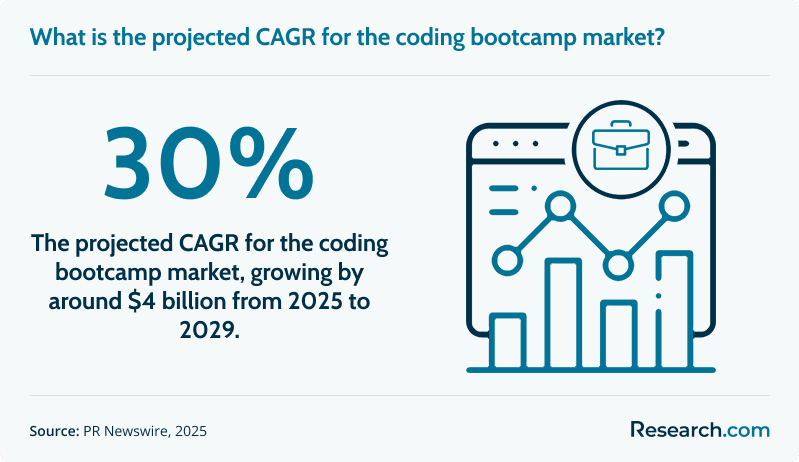
The coding bootcamp market is projected to grow by nearly $4 billion from 2025 to 2029, with a compound annual growth rate (CAGR) of approximately 30%, according to a Technavio report featured on PR Newswire. That growth reflects continuing interest in shorter, skills-based technology training. Students who want a broader credential and a longer timeline may also compare bootcamps with affordable online IT degrees.
| Cost item | What to check before enrolling |
| Tuition | Confirm the full price and whether discounts, scholarships, or payment plans change the final cost. |
| Required software or tools | Ask whether licenses, cloud credits, textbooks, or exam fees are included. |
| Career support | Find out whether coaching is included or limited to certain plans. |
| Financing fees | Review interest, origination fees, repayment start dates, and total repayment amount. |
| Opportunity cost | Consider reduced work hours, lost income, or additional childcare while studying. |
What financial aid options are available for online data science bootcamps?
Many bootcamps do not qualify for traditional federal financial aid, so students often need to use alternative funding sources. Before signing any agreement, compare the total repayment amount, refund policy, withdrawal rules, and employment conditions.
- Scholarships: Some providers offer tuition discounts for women in tech, underrepresented learners, veterans, or students with financial need.
- Income Share Agreements (ISAs): Students pay a percentage of future income for a set period after meeting employment or income conditions.
- Deferred tuition plans: These delay payment until after the program or after employment, but students should verify whether the amount is fixed and what happens if they do not find a job.
- Private loans: Some bootcamps work with lenders such as Climb Credit or Meritize, but repayment terms can vary.
- Employer sponsorship: Working professionals may be able to use tuition reimbursement or professional development funds.
If federal aid is important to your education plan, compare bootcamps with cheap online colleges that accept FAFSA, especially if you are open to a degree rather than a short-term training program.
What are the prerequisites for enrolling in an online data science bootcamp?
Many online data science bootcamps accept beginners, but “beginner-friendly” does not mean effortless. Students are usually better prepared if they have basic comfort with math, spreadsheets, logical reasoning, and independent problem-solving.
- Basic mathematics and introductory statistics
- Experience using spreadsheets or organizing data
- Willingness to learn coding, especially Python or SQL
- Analytical thinking and persistence when debugging errors
- Enough weekly time to complete lessons, exercises, and projects
A college degree is not always required for admission, although many data science professionals do hold degrees. According to Zippia, 51% of data scientists hold a bachelor’s degree, 34% have a master's degree, and 13% hold a doctorate. This does not mean a bootcamp cannot help you enter the field, but it does mean you should be realistic about competition for more advanced roles.
Learners interested in broader software roles may also compare these requirements with what you need to become an app developer, since programming, debugging, and product thinking can overlap with data work.
What courses are typically in an online data science bootcamp?
Most online data science bootcamps combine foundational programming with applied analytics and machine learning. The exact sequence varies, but strong programs usually move from data handling to modeling and communication.
- Programming fundamentals: Python, R, or another language used for data work
- Data manipulation: Cleaning, transforming, and analyzing data with tools such as Pandas and NumPy
- Statistics and probability: Concepts needed to interpret patterns, uncertainty, and model results
- SQL and databases: Querying, joining, and extracting structured data
- Machine learning: Supervised and unsupervised learning methods
- Data visualization: Charts, dashboards, and storytelling with tools such as Matplotlib, Seaborn, and Tableau
- Big data tools: Introductory exposure to systems such as Hadoop or Spark
- Capstone projects: Applied work that resembles business or research problems
The strongest projects are not just technical demonstrations. They show a clear question, explain the dataset, document assumptions, evaluate results, and communicate recommendations. Students should use coursework to build a data science portfolio that a hiring manager can understand quickly.
What types of specializations are available in online data science bootcamps?
Specializations help students connect data science training to a specific job target. Based on Zippia’s recent data on resume skills, common specialization areas include the following:
- Python programming: Useful for scripting, automation, analysis, machine learning workflows, and notebooks.
- General data science: A broad track covering statistics, data wrangling, visualization, and machine learning.
- Data visualization, including Tableau: Focuses on dashboards, reports, and communication for business decision-making.
- Java development: Helpful in enterprise settings or data applications that connect with software systems.
- Big data with Hadoop: Supports work with large-scale data processing and distributed systems.
- Data analytics: Emphasizes business questions, metrics, reporting, and actionable insights.
- Advanced tools and techniques: May include TensorFlow, predictive modeling, neural networks, Scala, and specialized machine learning methods.
| Career goal | Specialization to prioritize | Portfolio project idea |
| Data analyst | SQL, dashboards, statistics, and data visualization | Interactive dashboard explaining sales, customer, or operations trends |
| Data scientist | Python, statistics, machine learning, and model evaluation | Predictive model with clear assumptions, metrics, and limitations |
| Machine learning engineer | Python, algorithms, model deployment, and software fundamentals | End-to-end model pipeline with documentation and reproducible code |
| Business intelligence analyst | Tableau, Power BI, SQL, and stakeholder communication | Executive-ready dashboard with business recommendations |
| Big data-focused role | Hadoop, Spark, data pipelines, and cloud-adjacent tools | Large dataset processing project with performance considerations |
How do you choose the most affordable online data science bootcamp?
The cheapest bootcamp is not always the best value. A good affordable program should help you build relevant skills, complete credible projects, and understand how to present your work to employers. Use the total cost, not advertised tuition alone, when comparing programs.
- Calculate the full cost: Include tuition, payment fees, software, required materials, financing charges, and lost work hours.
- Match the schedule to your life: A full-time program may finish faster, but a part-time structure may be safer if you need to keep earning income.
- Review the curriculum carefully: Look for Python, SQL, statistics, visualization, machine learning, and portfolio work rather than vague promises.
- Check the support model: Ask how often you can meet instructors or mentors and whether feedback is personalized.
- Evaluate career services: Resume help, mock interviews, job-search strategy, and portfolio reviews can matter, especially for career changers.
- Verify outcomes claims: If a provider advertises placement rates, ask how the rate is calculated, which graduates are included, and what counts as employment.
- Read refund and withdrawal terms: Understand what happens if you need to pause, withdraw, or fail to complete the program.
| Question to ask | Why it matters |
| What exact projects will I finish? | Projects are often the strongest proof of bootcamp learning. |
| Who reviews my code and analysis? | Feedback quality affects whether you improve or simply complete assignments. |
| How many hours per week do successful students study? | This helps you judge whether the workload is realistic. |
| Are career services included in tuition? | Some programs limit coaching or charge extra for support. |
| What is the refund policy? | Withdrawal terms can affect your financial risk. |
| Does the program publish transparent outcomes? | Clear outcomes make it easier to evaluate value and credibility. |
Common mistakes to avoid when choosing a bootcamp
- Choosing only by price: Low tuition is helpful, but weak instruction or poor project feedback can limit your job readiness.
- Ignoring the weekly workload: Many students underestimate how much practice coding and statistics require.
- Assuming a job guarantee is simple: Guarantees often have conditions, deadlines, application requirements, and exclusions.
- Skipping portfolio review: Completing projects is not enough if they are not polished, explained, and relevant.
- Relying only on rankings: Rankings can narrow your search, but your background, schedule, budget, and career target should drive the final decision.
- Overlooking financing costs: A payment plan can make tuition feel affordable while increasing the total amount paid.
What career paths are available for graduates of online data science bootcamps?
Bootcamp graduates can pursue several data-focused roles, but the right target depends on their prior experience and technical depth. A beginner may start with data analyst or business intelligence roles, while someone with software engineering experience may be able to compete for more technical machine learning or data engineering positions.
- Data Analyst
- Machine Learning Engineer
- Business Intelligence Analyst
- Data Engineer
- Research Analyst
- Artificial Intelligence Specialist
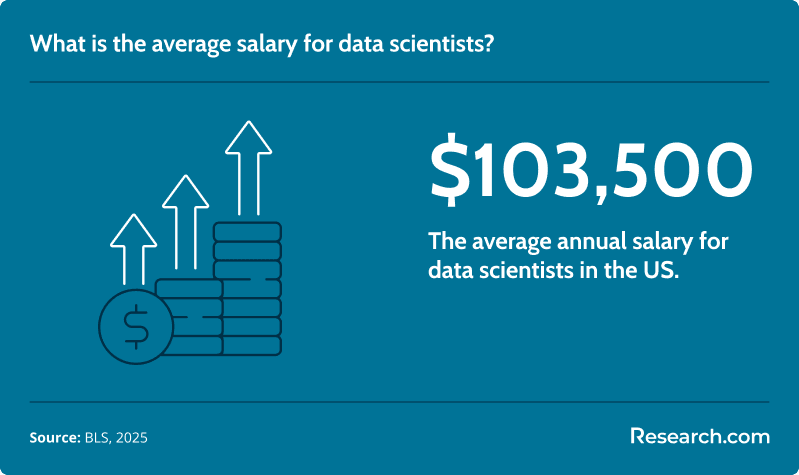
With experience, professionals may move into senior data science, analytics management, data science lead, or AI strategy roles. According to BLS, the median annual wage for data scientists in 2023 was $103,500, which was higher than the median wage for all occupations. Students interested in software-heavy roles can also review our full stack developer career guide.
| Role | Typical focus | Bootcamp preparation that helps |
| Data Analyst | Reports, dashboards, trends, and business questions | SQL, spreadsheets, statistics, Tableau, Power BI, and communication |
| Data Scientist | Modeling, experimentation, prediction, and insight generation | Python, statistics, machine learning, feature engineering, and portfolio projects |
| Machine Learning Engineer | Building and improving machine learning systems | Programming, algorithms, model evaluation, and software development practices |
| Business Intelligence Analyst | Data reporting for leaders and teams | Dashboarding, SQL, business metrics, and stakeholder communication |
| Data Engineer | Data pipelines, databases, and infrastructure | SQL, Python, databases, big data tools, and systems thinking |
Should I consider further academic credentials after a data science bootcamp?
A bootcamp can help you build practical skills quickly, but some career goals require deeper academic preparation. Advanced degrees may be useful for research-heavy roles, specialized scientific fields, senior technical positions, or employers that prefer graduate-level training. For example, a learner interested in combining analytics with biology or healthcare data may compare bootcamp training with a cheap online masters degree in bioinformatics.
Further education is most worth considering if it fills a clear gap: advanced statistics, research methods, domain expertise, or a credential required by your target employers. It may be less necessary if your goal is an analyst role where a strong portfolio, SQL ability, and business communication are the main hiring signals.
What is the job market for graduates of online data science bootcamps?
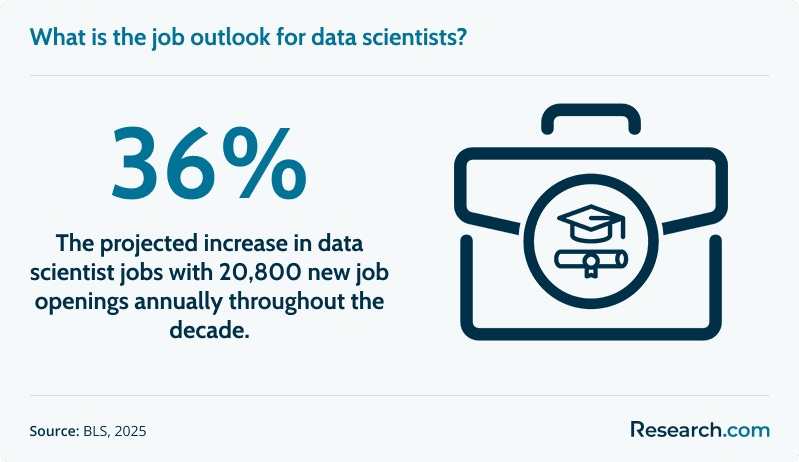
The labor market for data science professionals remains favorable, but competition can be high for entry-level roles. BLS projects employment for data scientists to grow 36% from 2023 to 2033, much faster than the average for all occupations. The agency also projects approximately 20,800 new job openings each year throughout the decade.
Demand is supported by the growing use of data in healthcare, finance, marketing, logistics, retail, software, and public-sector decision-making. Bootcamp graduates are most competitive when they combine technical training with a polished portfolio, clear communication, and relevant domain experience.
Current trends affecting data science bootcamp graduates
- AI is changing expectations: Employers increasingly value candidates who understand machine learning concepts, responsible model use, and how to evaluate outputs rather than simply run tools.
- Portfolio quality is becoming more important: Generic projects are easier to overlook. Strong candidates explain business context, data limitations, model choices, and practical recommendations.
- Data roles are spreading across industries: Finance, healthcare, logistics, and marketing teams need data skills even when they are not traditional tech departments.
- Credential stacking is common: Some learners combine bootcamps with certifications, degrees, or employer-sponsored training to strengthen their profile.
- Online learning is mainstream: Remote instruction is widely used, but students still need to verify mentor access, project feedback, and career support quality.
What do students often value in online data science bootcamps?
Students who choose online data science bootcamps often cite flexibility as the biggest advantage. Recorded lessons, evening study time, and remote access can make training possible for people who are working, caregiving, or living far from in-person programs.
Another commonly valued feature is mentorship. Regular check-ins, virtual office hours, and project feedback can help students stay accountable, especially when learning difficult topics such as Python, statistics, and machine learning for the first time.
Career support also matters. Resume preparation, mock interviews, portfolio reviews, and job-search guidance can help students translate technical coursework into employer-ready evidence. These services are helpful, but students should still expect to network, apply consistently, and keep improving their projects after graduation.
How do online bootcamps compare to traditional master's degree programs?
Online bootcamps and master’s programs serve different goals. A bootcamp is usually shorter, more applied, and focused on job-ready tools and portfolio projects. A master’s program generally offers deeper theory, broader academic study, research training, and a recognized graduate credential. Students comparing the two should look at cost, time, admissions requirements, employer expectations, and target roles. For a degree-based alternative, compare bootcamps with affordable online master’s in data science programs.
| Factor | Online data science bootcamp | Traditional master’s degree |
| Primary purpose | Fast, practical skill development | Advanced academic and theoretical preparation |
| Typical length | Weeks to months | Longer academic timeline |
| Admissions | Often beginner-friendly, though preparation helps | Usually requires a bachelor’s degree and formal admission |
| Credential | Certificate of completion or provider credential | Graduate degree |
| Best fit | Career changers seeking applied skills quickly | Students targeting advanced, research, or credential-preferred roles |
The better option depends on your career target. If you need a portfolio and practical tools quickly, a bootcamp may be enough to start. If you want advanced research roles, specialized scientific work, or a credential that some employers prefer, a master’s degree may offer stronger long-term alignment.
How do employers perceive online data science bootcamp credentials?
Employers usually evaluate bootcamp graduates by looking at skills evidence, not the certificate alone. A credible portfolio, clean code, well-explained analysis, and the ability to discuss trade-offs can carry more weight than simply listing a program name on a resume. Hiring teams may also consider prior work experience, education, internships, referrals, and interview performance.
Bootcamp credentials can be stronger when paired with recognized certifications, employer projects, open-source work, internships, or further study. Students who want a broader technology credential may compare bootcamps with the fastest online technology degree programs.
What is the return on investment of an online data science bootcamp?
Bootcamp ROI depends on total cost, completion time, job-search success, salary change, and whether the program helps you reach a realistic next role. A lower-priced bootcamp can have strong ROI if it leads to useful skills and a credible portfolio. A higher-priced program may still be worthwhile if it provides intensive mentorship, strong projects, and career support that fits your needs.
To evaluate ROI, compare tuition and financing costs against the type of role you are likely to pursue after graduation. Also account for opportunity cost, including reduced work hours or delayed income. If your long-term interest is in a different data-heavy field, compare bootcamp training with related academic paths such as online geoscience and geology degree programs before committing.
Practical steps before enrolling
- Define your target role: Decide whether you are aiming for data analyst, data scientist, machine learning engineer, business intelligence analyst, or another path.
- Audit your current skills: Identify gaps in math, Python, SQL, statistics, visualization, and business communication.
- Compare at least three programs: Review cost, schedule, curriculum, mentoring, career services, and refund rules side by side.
- Ask for project examples: A strong bootcamp should be able to explain what you will build and how projects are reviewed.
- Check outcomes carefully: Ask how placement rates are calculated and whether they apply to students like you.
- Plan your weekly schedule: Block study time before the program starts so you know the workload is realistic.
- Prepare your portfolio early: Save projects, document your process, and practice explaining your decisions in plain language.
Key Insights
- Affordable online data science bootcamps can be a practical path into analytics and data roles, but their value depends on curriculum depth, project quality, mentoring, and career support.
- Full-time bootcamps may take 10 to 16 weeks, while part-time options often last three to nine months; self-paced programs offer flexibility but require strong discipline.
- Online bootcamp tuition ranges from under $1,000 to more than $15,000, with many affordable programs falling in the $2,000 to $5,000 range.
- Because many bootcamps do not qualify for federal financial aid, students should compare scholarships, ISAs, deferred tuition, private loans, employer sponsorship, and total repayment costs.
- Core skills to look for include Python, SQL, statistics, machine learning, data visualization, data cleaning, and capstone projects that can support a job search.
- BLS reports a median annual wage for data scientists of $112,590 in May 2024 and projects 36% employment growth from 2023 to 2033, but individual outcomes depend on experience, location, role, and portfolio strength.
- A bootcamp is usually best for applied skill-building; a master’s degree may be better for research-heavy, specialized, or credential-preferred data science roles.
- Before enrolling, ask about total cost, weekly workload, project feedback, career services, outcomes data, refund policies, and whether the program matches your target role.
References:
- BLS. (2025, April 18). Data scientists. BLS.
- Grand View Research. (2025). Data Science Platform Market Size and Share Report, 2030. Grand View Research.
- PR Newswire. (2025, February 15). Coding Bootcamp Market to Grow by USD 3.98 Billion from 2025-2029, Driven by Demand for Software Developers & IT Professionals, Report on AI’s Impact on Market Trends - Technavio. Yahoo Finance.
- Zippia. (2025, January 8). Best Colleges and Degrees for Data Scientists. Zippia.
- Zippia. (2025, January 8). Data Scientist skills for your resume and career. Zippia.
Other Things You Should Know About the Most Affordable Online Data Science Bootcamps
When choosing an affordable online data science bootcamp in 2027, consider the curriculum's relevance to industry needs, the flexibility of course schedules, mentorship opportunities, job placement rates, and student reviews. These factors can help ensure you receive a quality education that aligns with your career goals.
When choosing an affordable online data science bootcamp in 2027, look for comprehensive curriculums covering Python, R, machine learning, and data visualization. Check if expert instructors are involved and verify the program includes career support services. Also, ensure that the bootcamp offers flexible scheduling to accommodate diverse learning paces.
In 2027, the average cost of an affordable online data science bootcamp ranges between $3,000 and $6,000. Factors such as program length, curriculum depth, and additional resources or mentorship can influence the final price within this range.