
2027 Most Affordable Online Data Analytics Degree Programs

Co-Founder and Chief Data Scientist
Choosing an online data analytics degree is partly an academic decision and partly a financial one. You need a program that teaches marketable skills such as statistics, SQL, Python, data visualization, and business problem-solving without creating unnecessary debt. That balance matters because about 80% of data analyst jobs require at least a bachelor’s degree, making college a common requirement for many entry-level analytics roles.
This guide is designed for high school graduates, transfer students, working adults, and career changers comparing affordable online data analytics bachelor’s programs for 2027. It explains what these programs include, how much they may cost, how online study compares with campus study, what financial aid options to review, and how to choose a program that fits your goals, schedule, and budget.
Quick Answer: What Is the Most Affordable Way to Earn an Online Data Analytics Degree?
The most affordable path is usually an accredited online bachelor’s program with low per-credit tuition, generous transfer credit policies, flat-rate tuition, or competency-based pricing. Students who already have college credits, industry certifications, or prior learning may reduce both time and cost. Before enrolling, compare total program cost, accreditation, required credits, technology fees, career support, and whether the curriculum includes practical tools such as SQL, Python, R, Tableau, Power BI, and statistics.
What are the benefits of getting an online data analytics degree?
- It can qualify you for several data-focused roles. Graduates often pursue jobs such as data analyst, business intelligence analyst, operations analyst, and, with additional training, data scientist.
- The earning potential is strong compared with many bachelor’s-level fields. The median salary for data analytics jobs is at around $84,348 per year, though actual pay depends on location, experience, industry, technical skills, and job title.
- The format works well for busy students. Online programs often provide flexible schedules and can reduce commuting or housing costs, which is helpful for learners who work, care for family members, or cannot relocate.
- The degree builds both technical and business skills. Strong programs teach students not only how to analyze data but also how to explain findings clearly to decision-makers.
What can I expect from an online data analytics degree?
An online data analytics bachelor’s degree teaches students how to collect, clean, analyze, visualize, and communicate data. Most programs combine math, computing, statistics, and business coursework so graduates can turn raw information into useful recommendations.
Core coursework commonly includes statistics, programming, database management, data visualization, data mining, predictive modeling, and analytics ethics. Many programs also require a capstone project, where students solve a realistic data problem, build a dashboard, or present an analysis to a simulated business audience. Some schools may include internship options or applied projects with external organizations.
Tuition for these programs typically ranges from $10,000 to $30,000 per year, depending on the school.
Online delivery usually includes recorded lectures, live sessions, discussion boards, coding assignments, virtual labs, quizzes, and team projects. Students should expect to use analytics software and collaborate remotely, which mirrors how many data teams work in professional settings.
| Program Component | What It Usually Covers | Why It Matters for Jobs |
| Statistics and probability | Descriptive statistics, inference, modeling, and hypothesis testing | Helps analysts interpret patterns without making unsupported conclusions |
| Programming | Python, R, scripting, or analytics-focused coding | Supports automation, data cleaning, and repeatable analysis |
| Databases | SQL, data storage, querying, and database structure | Prepares students to retrieve and organize business data |
| Visualization | Dashboards, charts, storytelling, Tableau, Power BI, or similar tools | Helps graduates communicate insights to nontechnical teams |
| Capstone or applied project | Realistic analytics project using data, tools, and written or oral presentation | Creates portfolio evidence for internships and entry-level roles |
Where can I work with an online data analytics degree?
Data analytics graduates work in organizations that rely on evidence-based decisions: technology firms, banks, hospitals, consulting companies, retailers, insurance companies, government agencies, logistics firms, and marketing teams. The job title may vary, but the core task is similar: use data to answer operational, financial, customer, product, or strategic questions.
According to the U.S. Bureau of Labor Statistics, as of May 2023, key industries employing data analysts and related roles include:
- Computer Systems Design Services: Employs 16,620 data professionals, accounting for nearly 34.63% of the sector’s workforce.
- Corporate Management: Employs about 12,570 data analysts, roughly 26.19% of industry jobs.
- Consulting Services: Employs around 7,270 data specialists, making up about 15.15% of its workforce.
- Research and Development: Employs approximately 5,840 data analysts, or 12.17% of the sector’s employment.
- Credit Services: Employs over 5,690 data analysts, about 11.86% of the industry’s workforce.
How much can I make with an online data analytics degree?
Data analytics can lead to salaries above many national wage benchmarks, but pay is not guaranteed by the degree alone. Employers also weigh internships, projects, technical skills, communication ability, industry knowledge, location, and experience.
The following median wages in 2025 are notably higher than the U.S. median hourly wage of $36.06, or $75,000 per year.:
- Data Analysts: $40.55 per hour; $84,348 per year
- Business Intelligence Analysts: $54.13 per hour; $112,590 per year
- Senior Data Analysts: $47.71 per hour; $99,231 per year
Entry-level data analysts typically start around $54,871 annually, while experienced professionals can earn $80,553 or more. Advanced degrees or certifications, like a master’s in data analytics, often boost salaries further, with averages reaching $100,906.
- Best Affordable Online Data Analytics Degree Programs for 2027
- How long does an online data analytics degree take?
- Online vs. on-campus data analytics degrees
- Average cost of an online data analytics degree
- Financial aid for online data analytics students
- Admission requirements and prerequisites
- Online data analytics degree vs. MBA
- Common data analytics courses
- Comparison with other professional online degrees
- Technology requirements and digital support
- Advanced academic and career-building options
- Data analytics specializations
- How to choose the right online data analytics program
- Return on investment
- Career paths after graduation
- Job market for online data analytics graduates
List of the Best Online Data Analytics Degree Programs for 2027
How do we rank schools?
Because affordability is only useful when paired with quality, our ranking process considers institutional data, program details, and indicators that help students compare online data analytics degrees more carefully. Research.com uses sources such as the IPEDS database, Peterson's database, the College Scorecard database, and The National Center for Education Statistics. These sources help evaluate programs using consistent education data. For more information about how Research.com evaluates schools and programs, visit the methodology page.
| School | Program Format | Required Credits, Units, or Courses | Listed Cost | Accreditation |
| Western Governors University | Fully online | 12 competency units per 6-month term | $3,835 per six-month term | Northwest Commission on Colleges and Universities (NWCCU) |
| Purdue University Global | Online | 180 credits | $371 per credit hour | Higher Learning Commission (HLC) |
| Southern New Hampshire University | Online | 120 credits | $330 per credit hour | New England Commission of Higher Education (NECHE) |
| Penn State World Campus | Online | 122 credits | $632/$678 per credit | Middle States Commission on Higher Education (MSCHE) |
| Eastern Oregon University | Online | 180 credits | $316 per credit hour | Northwest Commission on Colleges and Universities (NWCCU) |
| Franklin University | Online | 120 credits | $398 per credit hour | Higher Learning Commission (HLC) |
| Strayer University | Online | 40 courses | $1,525 per course | Middle States Commission on Higher Education (MSCHE) |
| Rasmussen University | Online | 90 credits | $307 per credit hour | Higher Learning Commission (HLC) |
| Southern Illinois University Edwardsville | Online | 120 credits | $479 per credit hour | Higher Learning Commission (HLC) / The Association to Advance Collegiate Schools of Business (AACSB International) |
| Colorado Technical University | Online | 180 credits | $340 per credit hour | Higher Learning Commission (HLC) / Accreditation Council for Business Schools and Programs (ACBSP) |
1. Western Governors University
Western Governors University offers a fully online Bachelor of Science in Data Analytics built for students who want a flexible, career-oriented route into analytics. The program uses a competency-based model, which may appeal to motivated learners who can move efficiently through material they already understand while developing skills in statistics, analysis, and predictive modeling.
- Required Units: 12 competency units per 6-month term
- Cost: $3,835 per six-month term
- Accreditation: Northwest Commission on Colleges and Universities (NWCCU)
2. Purdue University Global
The Bachelor of Science in Data Analytics at Purdue Global is designed to help students interpret complex information and support business decisions. Coursework combines data mining, statistical analysis, visualization, critical thinking, and applied problem-solving.
- Required Credits to Graduate: 180
- Cost: $371 per credit hour
- Accreditation: Higher Learning Commission (HLC)
3. Southern New Hampshire University
Southern New Hampshire University offers an online Bachelor of Science in Data Analytics that emphasizes data management, analysis, visualization, and applied projects. The program is suited for students who want a broad analytics foundation connected to business intelligence and technology roles.
- Required Credits to Graduate: 120
- Cost: $330 per credit hour
- Accreditation: New England Commission of Higher Education (NECHE)
4. Penn State World Campus
Penn State World Campus provides an online Bachelor of Science in Functional Data Analytics focused on using data to solve business problems. Students study areas such as data mining, predictive modeling, and decision-making strategies while building practical analytical skills.
- Required Credits to Graduate: 122
- Cost: $632/$678 per credit
- Accreditation: Middle States Commission on Higher Education (MSCHE)
5. Eastern Oregon University
The online Bachelor’s in Data Analytics from Eastern Oregon University develops skills in programming, statistical reasoning, data science, and communication. Students work with tools such as SQL, Python, and R while learning how to apply analytics to practical problems.
- Required Credits to Graduate: 180
- Cost: $316 per credit hour
- Accreditation: Northwest Commission on Colleges and Universities (NWCCU)
6. Franklin University
Franklin University offers an online Bachelor of Science in Analytics with a focus on Applied Data Science. The curriculum blends business, computer science, and data science so students can learn how to gather, analyze, interpret, and explain data in workplace contexts.
- Required Credits to Graduate: 120
- Cost: $398 per credit hour
- Accreditation: Higher Learning Commission (HLC)
7. Strayer University
Strayer University offers an online Bachelor of Science in Information Technology with a concentration in Data Analytics. Students study programming, databases, and statistical analysis while building the business and technical foundation needed to translate data into recommendations.
- Required Courses to Graduate: 40
- Cost: $1,525 per course
- Accreditation: Middle States Commission on Higher Education (MSCHE)
8. Rasmussen University
The online Bachelor’s in Data Analytics at Rasmussen University focuses on data interpretation, visualization, and statistical analysis. The program includes hands-on work with practical tools and offers flexible learning options for students managing school alongside other responsibilities.
- Required Credits to Graduate: 90
- Cost: $307 per credit hour
- Accreditation: Higher Learning Commission (HLC)
9. Southern Illinois University Edwardsville
The online BS in Business Administration with a specialization in Data Analytics at Southern Illinois University Edwardsville combines business fundamentals with analytics training. Students learn to use tools such as SQL and Python to support data-informed business decisions.
- Required Credits to Graduate: 120
- Cost: $479 per credit hour
- Accreditation: Higher Learning Commission (HLC) / The Association to Advance Collegiate Schools of Business (AACSB International)
10. Colorado Technical University
Colorado Technical University offers an online Bachelor of Science in Business Administration with a concentration in Data Analytics. The program pairs business coursework with data mining, visualization, and predictive modeling to prepare students for analytics work in organizational settings.
- Required Credits to Graduate: 180
- Cost: $340 per credit hour
- Accreditation: Higher Learning Commission (HLC) / Accreditation Council for Business Schools and Programs (ACBSP)
How long does it take to complete an online data analytics degree program?
A full-time student usually needs four years to finish an online bachelor’s degree in data analytics. That timeline is not fixed, however, because online programs vary widely in credit requirements, transfer policies, term length, and pacing.
Students with prior college credits may finish faster, often in two to three years if the school accepts a substantial number of transfer credits. Part-time students may need five to six years, especially if they take only one or two courses at a time while working or managing family responsibilities.
Accelerated and competency-based programs can shorten the timeline for students who can handle heavier workloads or already know some of the material. For instance, certain programs enable students to earn their bachelor's degree in as little as two years by combining transfer credits and intensive coursework.
On average, students across all fields finish online bachelor's degrees in about 52 months. Online programs often use the same academic content as campus programs, but the learning format gives students more control over when and where they study.
| Student Situation | Likely Timeline | What to Check Before Enrolling |
| First-time full-time student | Typically four years | Credit load, course sequencing, summer options |
| Transfer student | Sometimes two to three years | Maximum transfer credits and whether analytics prerequisites transfer |
| Part-time working adult | Often five to six years | Course rotation, term limits, advising support |
| Accelerated student | May be under three years | Workload expectations, tuition model, academic support |
How does an online data analytics degree program compare to an on-campus program?
An online data analytics degree can be a strong alternative to an on-campus program when it comes from an accredited institution and includes rigorous coursework, practical projects, and employer-relevant tools. The main difference is not usually the credential itself but how students learn, interact, manage time, and access support.
Flexibility and accessibility
Online programs are often the better fit for students who need to keep working while earning a degree. About 60% of online data analytics students also work full-time while earning their degree. This format can reduce relocation barriers and make college more realistic for career changers, parents, military learners, and rural students.
Recognition and outcomes
Approximately 75% of employers consider online degrees equal to on-campus ones when they come from accredited institutions. Students should still evaluate the school’s reputation, accreditation, career support, and portfolio opportunities because employers may ask about projects, technical skills, and experience more than the delivery format.
Growth in online enrollment
Enrollment in online undergraduate data analytics programs is rising by nearly 20% each year. That growth reflects stronger demand for flexible education in analytics and broader acceptance of remote learning models.
| Factor | Online Data Analytics Degree | On-Campus Data Analytics Degree |
| Schedule | Often more flexible, with asynchronous or hybrid course delivery | Usually follows set class times and campus schedules |
| Cost considerations | May reduce commuting, housing, and campus-related expenses | May include more campus fees, transportation, or relocation costs |
| Networking | Requires intentional use of virtual events, faculty office hours, and online communities | May provide easier access to in-person clubs, events, and informal networking |
| Learning style | Best for self-directed students who can manage deadlines independently | Best for students who prefer face-to-face structure and immediate classroom interaction |
| Employer perception | Strongest when accredited and supported by a portfolio of projects | Often familiar to employers, especially for schools with local recruiting pipelines |
What is the average cost of an online data analytics degree program?
The average cost of an online bachelor’s degree in data analytics ranges from $15,000 to $30,000. Online programs generally cost less than on-campus options, often saving students 20% to 30% on tuition and fees. Savings usually come from reduced commuting, housing, parking, and campus-related costs rather than from tuition alone.
Students should look beyond the advertised tuition rate. Technology fees, proctoring fees, course materials, software access, graduation fees, and repeated courses can raise the final price. These additional costs usually add a few hundred dollars each semester.
Nearly 70% of online students receive financial aid or scholarships, which can lower the total cost significantly. Some schools use flat-rate tuition, which can benefit students who take heavier course loads. Others charge per credit, per course, per term, or through a competency-based model.
The average student loan debt for online undergraduates is similar to on-campus students, around $30,000. Tuition for data-related degrees has risen steadily, about 3% per year over the past five years, reflecting steady demand and improvements in program quality. Students comparing analytics majors may also want to review the difference between data science and computer science degrees, since curriculum, technical depth, and career outcomes can differ.
Cost-conscious students can also compare affordability across other online bachelor’s options, such as the cheapest online bachelor's degree in sustainability, to understand how tuition models and online delivery vary by field.
| Cost Item | Why It Matters | Question to Ask |
| Tuition | The largest direct cost for most students | Is tuition charged per credit, per course, per term, or as a flat rate? |
| Transfer credits | Accepted credits can shorten the program and reduce total cost | How many credits can I transfer, and will they apply to major requirements? |
| Technology fees | Online programs may charge for platforms, testing, or digital tools | What fees are mandatory each term? |
| Software and equipment | Analytics courses may require a capable computer and specialized tools | Are software licenses included in tuition? |
| Time to completion | Taking longer may increase living expenses and delay earnings growth | What is the realistic timeline for students with my schedule? |
What are the financial aid options for students enrolling in an online data analytics degree program?
Online students at eligible accredited institutions can often use many of the same financial aid options as campus students. Roughly 60% of online students receive federal financial aid, which can reduce the amount paid out of pocket.
Federal financial aid options
Students should usually start by completing the FAFSA and reviewing federal aid before considering private borrowing. Federal options may include:
- Grants: Need-based aid that generally does not have to be repaid.
- Federal loans: Borrowed funds that must be repaid with interest, usually with more borrower protections than private loans.
- Work-study programs: Part-time employment opportunities for eligible students.
Scholarships and alternative aid
Over 1,200 scholarships are available nationally for students in STEM fields like data analytics. Awards may be based on academic merit, financial need, major, military status, employer partnerships, location, or underrepresented student status.
Additional financial support options
Some universities offer monthly payment plans, employer tuition reimbursement coordination, military tuition benefits, or institutional grants. Private loans may fill a gap, but they often have higher interest rates and fewer protections than federal loans.
Important consideration
The default rate for private loans (~10%) is about double that of federal loans (~5%), making federal aid the safer and more flexible option for most online students.
What are the prerequisites for enrolling in an online data analytics degree program?
Most online bachelor’s programs in data analytics are designed for a broad range of students, including beginners. The minimum requirement is usually a high school diploma or GED, and many programs expect a GPA between 2.5 and 3.0.
Academic and application requirements
Prior coding experience is often helpful but not always required. A stronger math foundation can make early coursework easier, especially in statistics, programming logic, and modeling. Recommended preparation often includes:
- Algebra
- Statistics
- General science
Applicants commonly submit:
- Official or unofficial transcripts
- A completed online application
- Occasionally, a personal statement
Test scores and selectivity
About 60% of programs are test-optional, allowing students to apply without SAT or ACT scores. Acceptance rates typically range from 50% to 70%, making these programs moderately selective.
Students without a technical background should not assume they are disqualified. Many programs begin with introductory courses in programming, statistics, information systems, or data literacy. Applicants deciding between technical fields may also compare the career path cyber security vs computer science degree options before choosing a major.
Students who want a lower-risk way to build confidence before enrolling may consider affordable data science training programs online, especially if they need practice with statistics, coding, or data modeling before committing to a full bachelor’s degree.
Is an Online Data Analytics Degree Program a Competitive Alternative to an MBA?
An online data analytics degree and an MBA serve different goals. A data analytics degree is usually the better fit for students who want technical roles involving statistics, programming, databases, dashboards, and predictive analysis. An MBA is broader and typically emphasizes management, leadership, finance, strategy, operations, and organizational decision-making.
If your target role is data analyst, business intelligence analyst, analytics specialist, or a technical business analyst, a data analytics degree may provide a more direct skill set. If your goal is senior management, executive leadership, consulting, or cross-functional business strategy, an MBA may make more sense. Some professionals eventually combine both paths by earning technical credentials first and business graduate education later. For students who want the broader management route, Research.com also covers cheap online MBA programs.
| Path | Best For | Main Emphasis | Potential Limitation |
| Online data analytics degree | Students aiming for analytics, BI, reporting, or data-focused roles | SQL, Python or R, statistics, visualization, data management | Less emphasis on broad executive leadership than an MBA |
| MBA | Professionals seeking management, strategy, or leadership roles | Finance, operations, leadership, marketing, strategy | May not provide enough hands-on technical analytics training by itself |
What courses are typically in an online data analytics degree program?
Most online data analytics programs build from foundational math and computing courses into applied analytics projects. Approximately 85% of these programs incorporate programming languages such as Python or R into their curricula. Around 70% of programs integrate hands-on projects or labs to provide practical experience.
Common subjects include statistics, programming, SQL, database systems, data visualization, business analytics, data ethics, machine learning basics, predictive analytics, and research methods. Many programs also include a capstone project or internship, allowing students to demonstrate applied skills.
Students may also choose electives in areas such as artificial intelligence (AI), business analytics, healthcare analytics, finance analytics, or machine learning. Enrollment in these electives has seen a 40% increase in recent years.
Employers often look for candidates who can combine technical ability with clear communication. That is why strong programs require students to interpret results, explain limitations, and present findings to nontechnical audiences. Students interested in specialized analytics work can also research adjacent roles, such as those discussed in Research.com’s guide to environmental data analyst salary and career paths.
Some learners may pair analytics study with technical design or engineering tools. For example, cheapest online autocad certificate courses may be useful for students interested in spatial data, design workflows, manufacturing, architecture, or engineering-adjacent roles.
How do online data analytics degrees compare with other professional online degree programs?
Online data analytics degrees are built around quantitative reasoning, computing, databases, visualization, and applied problem-solving. Other professional online degrees prepare students for different industries and credentialing expectations. For example, healthcare programs may focus on clinical knowledge, patient care, and professional standards, as seen in online PharmD programs.
The right choice depends on your target occupation. Data analytics is a strong option if you want to work with business, financial, operational, healthcare, marketing, or product data. A healthcare, education, business, or IT degree may be better if your long-term goal requires a different license, professional scope, or industry-specific credential.
What technical requirements and digital support services are essential for online data analytics degree programs?
Online analytics students need reliable technology because coursework often involves coding environments, databases, dashboards, video meetings, and virtual labs. Before enrolling, ask the school for its current hardware and software requirements. A modern computer, webcam, microphone, updated browser, high-resolution display, and dependable high-speed internet connection are usually important.
Programs may require Python, R, SQL client tools, spreadsheet software, statistical packages, visualization platforms, and access to a learning management system. Students should also confirm whether licenses are included or must be purchased separately.
Support services matter as much as hardware. Look for 24/7 IT help, online tutoring, virtual library access, writing support, advising, career coaching, and clear procedures for resolving technology problems during exams or project deadlines. Strong digital skills can also transfer to other sectors, including some roles discussed in Research.com’s guide to highest paying medical jobs with bachelor's degree.
What advanced academic opportunities can further boost my career?
An online data analytics degree can be the first step in a longer credential strategy. After graduation, professionals may pursue certificates in machine learning, cloud analytics, business intelligence tools, advanced statistics, data engineering, or industry-specific analytics. Graduate study can also help students move toward senior analytics, data science, research, or leadership roles.
The best next step depends on your intended industry. A healthcare analyst may benefit from healthcare data, privacy, and clinical operations knowledge. A finance analyst may need stronger modeling and risk analysis. A product analyst may need experimentation, user behavior analysis, and visualization skills. Professionals who want to combine healthcare and data may also explore programs such as the most affordable online Pharm D programs, depending on their long-term goals.
What types of specializations are available in an online data analytics degree program?
Specializations help students connect analytics training to a specific industry or technical function. They are not always required, but they can make your coursework and portfolio more aligned with the jobs you want after graduation.
Common Specializations
Around 60% of programs offer concentration areas such as:
- Business analytics: Focuses on using data to improve corporate strategy, operations, marketing, and performance.
- Healthcare analytics: Applies analytics to patient care, hospital operations, public health, and medical research.
- Finance analytics: Covers risk, investment modeling, economic forecasting, budgeting, and financial decision support.
- Machine learning: Introduces algorithmic modeling, prediction, classification, and pattern recognition.
- Data engineering: Focuses on pipelines, databases, data architecture, and the infrastructure that supports analytics.
Career Impact
Specializations can influence where you apply and which skills you emphasize in your portfolio:
- The healthcare sector is projected to add 1.6 million jobs between 2023 and 2033, comprising about 24% of all new jobs in that period
- Financial analyst roles are expected to grow 9% from 2021 to 2031
Salaries also vary:
- Business analysts average $86,122 per year
- Machine learning engineers average $166,574 per year
Skill Certifications and Trends
Employers increasingly seek candidates with certifications in SQL, Python, and Tableau. Enrollment data shows strong student interest in specializations that blend data skills with industry applications, especially in business, healthcare, and technical domains.
How to Choose the Best Online Data Analytics Degree Program
The best online data analytics program is not always the cheapest one. It is the accredited program that teaches relevant tools, fits your schedule, accepts your credits, provides support, and leads toward the roles you actually want. Use the steps below to compare programs more carefully.
1. Confirm accreditation first
Accreditation affects financial aid eligibility, transfer credit, graduate school options, and employer confidence. Verify institutional accreditation through recognized sources before applying, especially if a program advertises unusually low tuition or accelerated completion.
2. Review the curriculum for job-ready skills
Look for statistics, SQL, Python or R, databases, visualization, machine learning foundations, ethics, and applied projects. A program with no hands-on work may leave you with a degree but too little portfolio evidence.
3. Compare career support
Strong programs offer resume help, mock interviews, internship guidance, portfolio support, employer events, and job-search coaching. Online students should ask whether these services are available remotely and whether they are included in tuition.
4. Research faculty access and class size
Programs with low student-to-faculty ratios may provide more personalized attention. Smaller class sizes (around 12 students) have been found to enhance learning in online STEM courses. Conversely, some introductory online courses may exceed 200 students, which can affect engagement.
5. Study graduate outcomes carefully
Employment outcomes can help you judge whether a program’s claims match its results. For example, Georgia Tech’s Online Master of Science in Analytics reports that 44.4% of graduates become data scientists. When reviewing any program, ask for outcome data that is specific, recent, and relevant to your degree level.
6. Evaluate student support
Online learners need reliable advising, tutoring, technical support, library access, and clear communication. Programs with strong support systems are often better equipped to help students persist through difficult courses such as statistics, programming, and database management.
| Common Mistake | Why It Can Hurt You | Better Approach |
| Choosing only by the lowest tuition | A cheap program may cost more if credits do not transfer or support is weak | Compare total cost, completion time, transfer credits, and outcomes |
| Ignoring accreditation | It may affect aid, credit transfer, and employer recognition | Verify accreditation before applying |
| Assuming all online programs are equally flexible | Some require live attendance, group projects, or fixed schedules | Ask about synchronous sessions, deadlines, and course pacing |
| Skipping the curriculum review | You may graduate without skills employers expect | Look for SQL, Python or R, visualization, statistics, and projects |
| Relying only on rankings | A ranked school may still be a poor fit for your budget or goals | Use rankings as one input, not the final decision |
| Forgetting software and technology costs | Extra expenses can change affordability | Request a full fee and software estimate |
What is the return on investment for an online data analytics degree?
Return on investment depends on the relationship between total program cost, debt, completion time, job placement, salary growth, and whether the degree helps you enter or advance in analytics. A lower tuition rate improves ROI only if the program also provides the skills and credibility needed to compete for jobs.
To estimate ROI, compare tuition and fees against likely earnings for roles such as data analyst, business intelligence analyst, operations analyst, or senior data analyst. Also account for opportunity cost: a longer program may delay career entry, while a faster program may require a heavier workload. If you are comparing analytics with broader business leadership options, reviewing programs such as the cheapest online MBA with specialization in healthcare management can help you evaluate whether a technical analytics path or management-focused path better fits your goals.
What career paths are available for graduates of an online data analytics degree program?
Graduates can pursue analytics roles in business, technology, healthcare, finance, marketing, logistics, insurance, government, and e-commerce. Many start in analyst roles and later move into senior, specialized, or leadership positions after building experience and technical depth.
Common Entry-Level Roles
- Data Analyst: Collects, cleans, organizes, analyzes, and explains data to support decisions.
- Business Analyst: Studies business processes and recommends improvements based on data and stakeholder needs.
- Operations Analyst: Uses data to improve workflows, resource allocation, performance, and efficiency.
Some roles overlap with programming and automation, especially when analysts write scripts, build dashboards, or work with databases. Students interested in that overlap may also review the computer programmer career path.
Industry Demand and Degree Value
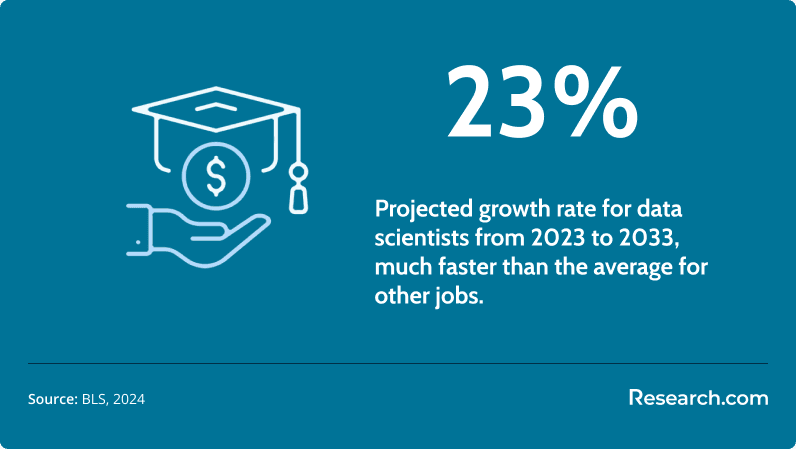
The U.S. Bureau of Labor Statistics projects a 36% growth in data scientist jobs by 2033, much faster than average. About 80% of data analyst jobs require at least a bachelor’s degree, reinforcing the value of completing a full degree program for many entry-level applicants.
Long-Term Advancement
With experience, strong projects, and continued training, graduates may move into roles such as:
- Data Scientist
- Analytics Manager
- Chief Data Officer
Advancement often requires more than the degree. Employers may look for professional experience, industry expertise, leadership ability, and continued skill development in Python, R, SQL, machine learning, cloud platforms, and analytics tools.
Data analytics graduates can also pursue roles similar in technical demand to those supported by credentials such as the cheapest CompTIA network training course online, particularly in organizations that value both data and IT infrastructure knowledge.
What is the job market for graduates with an online data analytics degree program?
The job market for data analytics graduates remains strong because organizations continue to rely on data for forecasting, customer insights, fraud detection, operational improvement, financial planning, and product decisions. Employment of data scientists is projected to grow 36% from 2023 to 2033, significantly faster than the average for all occupations.
Online degree holders can be competitive when their program is accredited and their skills are visible through projects, internships, dashboards, code samples, or capstone work. A survey found that 74% of employers recognize online learning as equivalent to traditional in-person education.
Industries such as finance, healthcare, marketing, and e-commerce are actively hiring data analytics graduates. Employers commonly prioritize SQL, Python, and visualization platforms such as Tableau and Power BI. SQL is especially important because analysts often need to retrieve information from company databases before they can analyze it.
Salary trends are favorable, with the average salary for a data analyst in the United States being $82,841 per year. Students comparing related technical careers may also find a computer engineer career guide useful for understanding how analytics, computing, and engineering roles differ.
References
- Staff, C. (2024, November 5). How fast can you get a bachelor’s degree online? Coursera. https://www.coursera.org/articles/how-fast-can-you-get-a-bachelors-degree-online
- Krause, C. (2024, October 17). What employers think about online degrees | Abilene Christian University. Abilene Christian University. https://acu.edu/2023/08/29/what-employers-think-about-online-degrees/
- Additional source links reviewed in the original article include https://online.uc.edu/blog/business-analytics-masters-in-person-vs-online/, https://nscresearchcenter.org/current-term-enrollment-estimates/, https://research.collegeboard.org/trends/college-pricing, https://nces.ed.gov/, https://nces.ed.gov/programs/coe/indicator/cpb, https://www.thetimes.com/business-money/technology/article/times-recruitment-pays-to-work-in-data-zpfqt7mwn, https://altarum.org/news-and-insights/health-care-employment-growth-projected-moderate-remain-higher-other-industries, and https://www.nobledesktop.com/careers/financial-analyst/job-outlook.
- Thornett, R. C. (2022, August 6). Beyond Student-Faculty Ratios — The James G. Martin Center for Academic Renewal. The James G. Martin Center for Academic Renewal. https://jamesgmartin.center/2022/07/beyond-student-faculty-ratios
- Class size in online courses: What the research says | Quality matters. (2019, August 20). https://www.qualitymatters.org/qa-resources/resource-center/articles-resources/research-on-class-size
- Strahl, A. (2025, February 28). 7 Data analytics jobs that are in demand. Dataquest. https://www.dataquest.io/blog/data-analyst-jobs
- Melendez, J. (2024, September 16). How many people get hired as data analysts: experience, education, and the current job market. https://www.linkedin.com/pulse/how-many-people-get-hired-data-analysts-experience-current-melendez-wq4ge
- Staff, C. (2025, March 21). How much do data analysts make? Your 2025 salary guide. Coursera. https://www.coursera.org/articles/how-much-do-data-analysts-make-salary-guide
- Data scientists. (2025, April 18). Bureau of Labor Statistics. https://www.bls.gov/ooh/math/data-scientists.htm
- Online vs. In-Person Master of Data Science | MDS@Rice. (n.d.). https://csweb.rice.edu/academics/graduate-programs/online-mds/blog/online-vs-in-person-master-of-data-science
- E-Learning/Online Learning Statistics | Grateful Care ABA. (n.d.). https://www.gratefulcareaba.com/blog/e-learning-online-learning-statistics
- Staff, C. (2025b, April 8). 7 In-Demand Data Analyst Skills to get you hired in 2025. Coursera. https://www.coursera.org/articles/in-demand-data-analyst-skills-to-get-hired
- 2025 Data Analyst salary in US | Built in. (n.d.). https://builtin.com/salaries/us/data-analyst
- Will data analysts be replaced by AI? (2025, January 21). Syntax Technologies. https://www.syntaxtechs.com/blog/will-data-analysts-be-replaced-by-ai
- Allen. (2025, May 9). Will AI replace data analysts? Here’s what experts are saying in 2025 | 1Byte. 1Byte. https://blog.1byte.com/will-ai-replace-data-analysts
- Witczak, K. (2025, February 10). The unseen side of data analytics: exploring the disadvantages and challenges. KajoData. https://kajodata.com/en/work/data-analyst-disadvantages-challenges
- Interview Guy Editorial Team. (n.d.). 25 Disadvantages of being an analyst (Report writing woes). Interview Questions. https://interviewguy.com/disadvantages-of-being-an-analyst/
- Layne, J. (2025, March 21). Pros and Cons of Data Analyst | LuxWisp. Ablison. https://www.luxwisp.com/pros-and-cons-of-data-analyst/
- Gaikwad, R. (2024, December 11). How much mathematics is required for your data analyst career? https://www.linkedin.com/pulse/how-much-mathematics-required-your-data-analyst-career-rashmi-gaikwad-tdsdc
- Information Security Analysts. (2025, April 18). Bureau of Labor Statistics. https://www.bls.gov/ooh/computer-and-information-technology/information-security-analysts.htm
- Program outcome and accreditation-related links reviewed in the original article include https://www.analytics.gatech.edu/inside-our-program/reports-statistics and https://citejournal.org/volume-13/issue-4-13/current-practice/technology-supported-assessment-systems-a-comparison-of-accredited-and-unaccredited-programs.
Key Insights
- Affordability depends on total cost, not just tuition. Compare per-credit rates, fees, transfer credits, software costs, pacing, and financial aid before choosing a program.
- Accreditation is nonnegotiable. It can affect federal aid, credit transfer, graduate school options, and employer confidence.
- Online degrees can be competitive when they are rigorous. Employers are more likely to value programs that include SQL, Python or R, statistics, visualization, databases, and applied projects.
- The best program is the one aligned with your target role. Business analytics, healthcare analytics, finance analytics, machine learning, and data engineering tracks can lead to different skill sets and job options.
- Career outcomes are not automatic. Build a portfolio, complete applied projects, seek internships when possible, and practice explaining data insights clearly.
- Online data analytics degrees are strongest for self-directed learners. The format rewards students who can manage deadlines, troubleshoot technology, and ask for support early.
Other Things You Should Know About Online Data Analytics Degree Programs
Yes. Many affordable online data analytics degrees require a capstone in the final term, often worth 3 to 6 credits. Students usually complete a data analysis project using real or simulated datasets and present findings in a written report, dashboard, or recorded presentation.
Applicants typically need a high school diploma or equivalent, a satisfactory GPA, and possibly prerequisite courses in mathematics or statistics. Some programs may also require proficiency in computer science basics before admission into an affordable data analytics degree program in 2027.





