2027 Best Data Science Bootcamps

Co-Founder and Chief Data Scientist
Choosing a data science bootcamp is a high-stakes education decision. Programs can look similar on the surface, but they differ sharply in curriculum depth, career support, admission expectations, financing terms, project quality, and employer recognition. For career changers, recent graduates, analysts, programmers, and working professionals who want a faster route into data roles, the right bootcamp can help build practical skills without committing to a full degree. The wrong one can leave you with gaps, debt, and an unclear job path.
This guide explains how data science bootcamps work, what strong programs should teach, how much they may cost, what jobs graduates typically pursue, and how to compare bootcamps against degrees, self-study, and advanced credentials. You will also find practical questions to ask before enrolling, common mistakes to avoid, and a 2027 list of notable programs to investigate.
Quick answer: Are data science bootcamps worth considering?
A data science bootcamp can be worth considering if you want structured, career-focused training in Python, SQL, statistics, machine learning, data visualization, and portfolio development. Bootcamps are best suited for learners who can handle an intensive pace, practice consistently outside class, and verify a program’s outcomes before paying. They are not a guaranteed shortcut to a data scientist title, and many employers still prefer candidates with a bachelor’s degree, strong math foundations, prior technical experience, or a substantial project portfolio.
What are the benefits of attending a Data Science Bootcamp?
- Focused career preparation: A bootcamp concentrates on the tools and workflows commonly used in data teams, which can be more direct than taking unrelated general education courses.
- Project-based learning: Strong programs require students to clean datasets, write code, build models, explain findings, and present results in ways employers can evaluate.
- Faster skill development: Instead of spreading training across several years, bootcamps compress technical instruction into an intensive format.
- Career-change support: Many programs include résumé reviews, mock interviews, portfolio coaching, and networking opportunities designed for people entering a new field.
- Exposure to high-demand work: Graduates may pursue roles in data analysis, business intelligence, machine learning support, data engineering support, and analytics-focused positions across multiple industries.
What can I expect from a Data Science Bootcamp?
A data science bootcamp is usually built around practical training rather than broad academic theory. Expect a fast schedule, frequent assignments, applied projects, and steady feedback. The best programs do not only teach syntax; they teach students how to frame a business question, prepare messy data, select an appropriate analytical method, communicate uncertainty, and explain recommendations to nontechnical stakeholders.
| Bootcamp component | What it should include | Why it matters |
| Programming foundation | Python, R, notebooks, version control, and code review practices | Employers need candidates who can write clean, reproducible analytical code. |
| Data handling | SQL, data cleaning, data wrangling, missing-value treatment, and feature preparation | Real-world data is rarely clean, and preparation often determines project quality. |
| Statistics and modeling | Regression, hypothesis testing, classification, decision trees, model evaluation, and machine learning workflows | Students need to understand when a method is appropriate and how to interpret results responsibly. |
| Portfolio projects | Capstone projects, real-world datasets, written reports, and presentations | A strong portfolio can help offset limited work experience, especially for career changers. |
| Career support | Interview practice, LinkedIn and résumé help, networking events, job-search accountability, and alumni access | Technical training alone is usually not enough to secure interviews or convert them into offers. |
Where can I work after completing a Data Science Bootcamp?
Bootcamp graduates can look beyond traditional technology companies. Any organization that collects operational, customer, financial, clinical, product, or marketing data may need people who can analyze trends and support better decisions. Your first role may be closer to data analyst or business intelligence analyst than senior data scientist, especially if you are entering the field without prior technical experience.
- Technology companies: Graduates may support analytics, experimentation, product insights, machine learning projects, or internal reporting.
- Finance: Data skills are useful in risk modeling, fraud detection, portfolio analysis, compliance monitoring, and quantitative decision support.
- Healthcare: Analysts may work with patient outcomes, resource utilization, operational efficiency, or healthcare reporting.
- E-commerce and retail: Data teams use analytics to study customer behavior, pricing, inventory, marketing performance, and conversion funnels.
- Consulting firms: Consultants apply data methods to client problems across industries, often requiring strong communication and presentation skills.
- Research and development: Some graduates support research teams, although research scientist roles often require deeper academic preparation.
How much can I make after completing a Data Science Bootcamp?
Earnings depend on your prior experience, location, employer, portfolio quality, role type, and ability to pass technical interviews. Bootcamp completion alone does not guarantee a salary range, but the following figures provide a useful way to compare common role targets.
- Data Analyst: $60,000 - $90,000 per year
- Data Scientist: $90,000 - $140,000 per year
- Machine Learning Engineer: $110,000 - $160,000+ per year
- Senior Data Scientist: $140,000 - $200,000+ per year
- List of the Best Data Science Bootcamps for 2027
- How do I choose the best data science bootcamp for my specific needs and career goals?
- What are the prerequisites and application process for data science bootcamps?
- What essential skills and programming languages will I learn in a top data science bootcamp?
- What are some career prospects after completing a data science bootcamp?
- How much do data science bootcamps cost and what financing options are available?
- How much can you earn as a data scientist?
- What are the key differences, benefits, and drawbacks of online versus in-person data science bootcamps?
- How do data science bootcamps compare to traditional degree programs?
- Should I pursue advanced degrees after completing a data science bootcamp?
- How does the duration of data science bootcamps compare to cybersecurity programs?
- How do data science bootcamp programs foster continuous professional growth?
- What subspecialties and career paths are available for data scientists?
- What is the return on investment for a data science bootcamp?
- What are the potential pitfalls of data science bootcamps and how can I mitigate them?
- What is the job market like for data scientists?
- What strategic industry partnerships support career transitions in data science?
- What are the current industry trends and future outlook for data science careers?
- What accreditation and certification standards should I expect from data science bootcamps?
- How are data science bootcamps integrating artificial intelligence into their curriculum? Review accreditation questions and current data science trends
List of the Best Data Science Bootcamps for 2027
The programs below are notable data science bootcamps to compare, not a one-size-fits-all ranking. Use this list as a starting point, then verify current tuition, admissions requirements, refund terms, student outcomes, career services, and curriculum before applying.
| Bootcamp | Format and focus | Program length | Tuition and requirements noted |
| Bloom Institute of Technology | Online training in Web Development, Data Science, and Backend Development with live remote classes, mentorship, projects, and code reviews | 6 months for Web Development and Data Science, 9 months for Backend Development | No upfront cost through an Income Share Agreement option; completion of 900+ hours of hands-on technical experience for Web Development and Data Science, and 1,400+ hours for Backend Development |
| BrainStation | Intensive data science training covering Python, Pandas, Hadoop, R, SQL, and Spark | Varies, with intensive programs available | Approximately $15,000 for intensive in-person programs; students complete coursework, projects, and proficiency demonstrations |
| Coding Dojo | Remote classroom programs in Software Development, Cybersecurity, and Data Science & Machine Learning | Varies by program | $16,995 for full-time programs and $9,995 for part-time programs; requires coursework, projects, and technology proficiency demonstrations |
| Data Science Dojo | Onsite and online training in Data Science and Data Engineering, including machine learning, visualization, and big data topics | Varies by program | $2,799 to $3,499, depending on course and location; requires coursework, projects, and demonstrations using data science technologies |
| Deep Dive Coding | Online bootcamp focused on software design principles, data structures, algorithms, clean code, design patterns, and web development with JavaScript | 8 weeks | Total Cost for Part-Time Class or Full-Time Bootcamp: $10,995; students solve complex problems, apply design patterns, complete coursework, and present ideas |
| Flatiron School | Immersive data science bootcamp covering data analysis, machine learning, tools, programming, and applied projects | Varies, with full-time and part-time options available | Varies; students should check the school website for current pricing and must complete coursework, projects, and core data science skill requirements |
| LearningFuze | Full-time and part-time online and in-person programs in Web Development and Data Science, including artificial intelligence, machine learning, Python, statistical analysis, and models | Varies, with full-time and part-time options | Varies; applicants should check the school website for current pricing and expect coursework, projects, and demonstrations of data science proficiency |
| Springboard | Online Data Science Foundations to Core bootcamp with mentor support, Python, statistics, machine learning, visualization, and an advertised job guarantee | 7 months, part-time | $9,900 upfront tuition with discount; requires all mandatory coursework, core projects, career development tasks, and post-completion job search requirements |
How do I choose the best data science bootcamp for my specific needs and career goals?
The best data science bootcamp is the one that matches your current skill level, target role, schedule, budget, and learning style. A program that works well for a software engineer moving into machine learning may not be right for a marketer trying to become a data analyst. Start with the job you want, then work backward to the curriculum and support you need.
| Decision factor | What to look for | Warning sign |
| Target role alignment | Clear pathways for data analyst, data scientist, machine learning, business intelligence, or data engineering roles | The program uses “AI” or “data science” broadly without explaining job-specific outcomes. |
| Curriculum depth | Python, SQL, statistics, machine learning, visualization, projects, and model evaluation | The syllabus is vague, outdated, or too light on statistics and real datasets. |
| Instructor and mentor quality | Instructors with relevant technical and industry experience, plus regular feedback | Students mostly self-study with minimal access to qualified help. |
| Career services | Mock interviews, portfolio coaching, job-search plans, networking, and employer connections | Career support is described in general terms but not documented. |
| Outcome transparency | Placement definitions, time frames, eligible graduates, job titles, and salary reporting methods | The provider advertises impressive results without explaining how they were calculated. |
| Financing terms | Clear tuition, refund rules, loan costs, ISA terms, and payment deadlines | The advertised price excludes fees or shifts risk to the student through unclear repayment terms. |
Questions to ask before enrolling
- Which roles do most graduates actually obtain: data analyst, data scientist, BI analyst, machine learning engineer, or another role?
- What percentage of students complete the program, and how is completion defined?
- Are job placement figures independently verified, and do they exclude students who did not meet job-search rules?
- How many portfolio projects will I finish, and will they use real-world datasets?
- How often will instructors review my code and analytical reasoning?
- What happens if I fall behind, fail an assessment, or need to pause the program?
- Do financing options increase the total cost compared with paying upfront?
What are the prerequisites and application process for data science bootcamps?
Admissions standards vary widely. Some programs welcome motivated beginners, while others expect prior programming, statistics, algebra, or professional analytics experience. Read the prerequisites carefully because data science is more math-heavy than many general coding bootcamps.
- Technical baseline: Many programs expect comfort with problem-solving, spreadsheets, basic programming concepts, and mathematical reasoning.
- Programming preparation: If you have no coding background, begin with Python fundamentals before applying. Learners who want a broader academic path may also compare bootcamps with accelerated online computer science degree options.
- Application materials: Expect an online application, short essays or motivation questions, technical screening, logic assessment, or interview depending on the provider.
- Interview readiness: Be prepared to explain why you want data science, how you study independently, and how you handle difficult technical problems.
- Pre-work: Strong bootcamps often assign pre-course work in Python, statistics, SQL, or data analysis to bring students to a common starting point.
Before applying, complete a small project such as cleaning a public dataset, writing basic Python analysis, or building a simple dashboard. This helps you test your interest and gives admissions teams evidence that you understand the work involved.
What essential skills and programming languages will I learn in a top data science bootcamp?
A strong data science bootcamp should teach more than a list of tools. It should help you understand the complete workflow: define a question, acquire data, clean it, explore it, model it, validate the results, communicate findings, and document limitations.
- Python: Python is widely used for data cleaning, analysis, automation, machine learning, and notebooks.
- R: R remains useful for statistics, reporting, exploratory analysis, and visualization-heavy analytical work.
- SQL: SQL is essential for retrieving, filtering, joining, and aggregating data from relational databases.
- Machine learning algorithms: Students should learn models such as linear regression, decision trees, neural networks, and the evaluation methods used to judge performance.
- Data visualization: Tools such as Matplotlib and Seaborn help analysts turn results into charts that business stakeholders can understand.
- Statistical analysis: Core concepts such as hypothesis testing, sampling, regression analysis, and uncertainty are fundamental to responsible interpretation.
- Data cleaning and preprocessing: Missing values, outliers, inconsistent formats, and duplicate records must be handled before analysis.
- Data wrangling: Students learn to reshape and combine datasets so they can be analyzed or used in models.
- Natural Language Processing (NLP): NLP introduces methods for analyzing text, classification, sentiment, and language-based applications.
- Time series analysis: Time-based data skills support forecasting, trend analysis, and monitoring use cases.
- Cloud computing: Exposure to AWS, Azure, or GCP helps students understand scalable storage, processing, and deployment environments.
Statista’s worldwide developer survey shows JavaScript as the most used programming language at 62.3%, followed by HTML/CSS at 52.9%. Python and SQL both appear at 51%, while TypeScript is listed at 38.5%. Bash/Shell, Java, C#, C++, and C range from 33.9% to 20.3%. These figures show broad developer usage, not a ranking of what every data science learner should prioritize. For data science bootcamp applicants, Python and SQL usually deserve special attention because they are central to many analytics workflows.
What are some career prospects after completing a data science bootcamp?
Bootcamp graduates usually compete for applied data roles where they can demonstrate portfolio projects, programming ability, analytical thinking, and communication skills. The exact title you can pursue depends heavily on your previous experience. A bootcamp graduate with a software background may be more competitive for machine learning engineering work, while someone from operations, marketing, finance, or healthcare may transition more naturally into analytics roles in the same industry.
| Role | Typical focus | Best fit for bootcamp graduates who have... |
| Data Analyst | Reporting, dashboards, SQL analysis, trend identification, and stakeholder support | Strong SQL, visualization, spreadsheet, and communication skills |
| Data Scientist | Statistical modeling, experimentation, machine learning, and complex analytical projects | Solid Python, statistics, modeling, and portfolio evidence |
| Machine Learning Engineer | Model development, deployment, monitoring, and production systems | Prior software engineering experience plus machine learning knowledge |
| Business Intelligence Analyst | Dashboards, KPIs, business reporting, and decision support | SQL, data visualization, business domain knowledge, and stakeholder communication |
| Data Engineer | Data pipelines, databases, infrastructure, and data processing systems | Programming, SQL, cloud exposure, and interest in backend systems |
| Marketing, Product, Risk, or Healthcare Data Analyst | Domain-specific analytics for customer, product, financial, or clinical questions | Relevant industry experience combined with data analysis skills |
- Data Scientist: Uses statistical and machine learning methods to extract insights from complex datasets.
- Data Analyst: Prepares, analyzes, and reports on data to support business decisions.
- Machine Learning Engineer: Builds and deploys models, often requiring stronger software engineering ability.
- Business Intelligence Analyst: Converts data into dashboards, reports, and metrics for business teams.
- Database Administrator: Maintains databases and supports data integrity, accessibility, and performance.
- Data Engineer: Develops pipelines and infrastructure so analysts and data scientists can work with reliable data.
- Quantitative Analyst: Applies mathematics and statistics to financial modeling, risk, and investment problems.
- Research Scientist: Develops methods and conducts research, usually requiring advanced technical or academic preparation.
- AI Specialist: Works on AI-focused applications, models, and implementation problems.
- Big Data Engineer: Designs large-scale processing systems using technologies such as Hadoop and Spark.
- Data Consultant: Helps organizations use data to improve strategy, operations, and decision-making.
- Marketing Analyst: Studies customer behavior, campaign results, and market performance.
- Product Analyst: Uses product and user data to guide product improvements and growth strategy.
- Risk Analyst: Builds analytical models to identify, estimate, and reduce business risk.
- Healthcare Data Analyst: Uses healthcare data to support patient outcomes, reporting, and operational improvements.
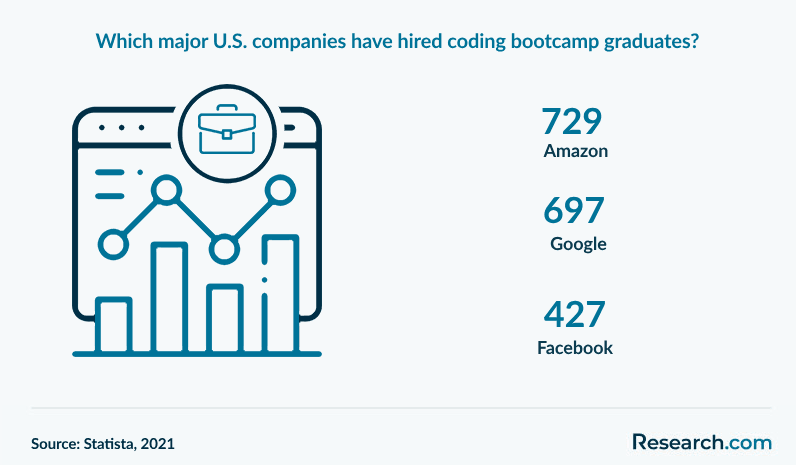
Statista data on coding bootcamp graduates employed at leading companies in the United States in 2020 shows Amazon hiring 729 graduates and Google hiring 697. Facebook hired 427, Microsoft hired 412, and 310 graduates were freelance self-employed. JP Morgan Chase hired 270, IBM hired 258, Accenture hired 228, Apple hired 228, and Booz Allen Hamilton hired 212. This data covers coding bootcamp graduates broadly, so it should not be interpreted as a guaranteed outcome for data science bootcamp students.
How much do data science bootcamps cost and what financing options are available?
Data science bootcamp pricing can vary substantially. Published tuition may not reflect the total cost if you must also cover prep courses, software, hardware, exam fees, missed work hours, relocation, or financing charges. Compare the full cost of attendance, not only the advertised tuition.
- Upfront tuition: Students pay the full amount before or at the start of the program, sometimes in exchange for a discount.
- Installment plans: Tuition is divided into scheduled payments, which can reduce immediate pressure but may still require steady cash flow.
- Income share agreements (ISAs): Students pay a share of future income after meeting specified employment or salary conditions. Read caps, payment windows, and definitions carefully. Workers comparing employer-sponsored technology training may also look at affordable online cybersecurity degree costs as a longer-form alternative.
- Deferred tuition: Payment begins after graduation or employment, but the total obligation can be higher than the sticker price.
- Scholarships: Some providers offer merit-based or need-based awards that lower the amount owed.
- Loans: Private financing can spread payments over time, but interest and fees can increase the total cost.
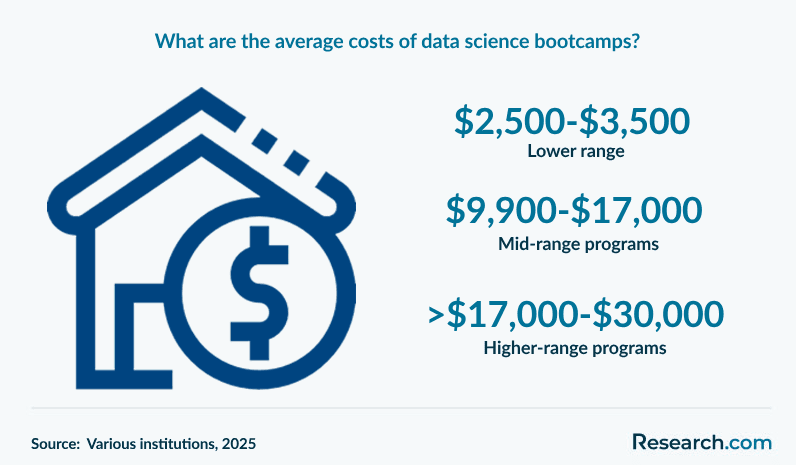
Reported data science bootcamp tuition ranges from approximately $2,500 to $30,000. Deep Dive Coding and Data Science Dojo appear in the lower range at roughly $2,500 to $3,500. Coding Dojo and Flatiron School are described as mid-range options between $9,900 and $17,000. BrainStation’s tuition is listed at a fixed $16,500. Codeup’s program costs around $27,500, Bloom Institute of Technology is cited at $30,000, and Springboard is listed at $9,900.
| Cost category | Examples from available figures | What to verify |
| Lower-range programs | Roughly $2,500 to $3,500, including Deep Dive Coding and Data Science Dojo | Whether the program is long enough and deep enough for your target role |
| Mid-range programs | $9,900 to $17,000, including Coding Dojo, Flatiron School, and Springboard at $9,900 | Career services, completion rules, financing terms, and project expectations |
| Higher-priced programs | BrainStation at $16,500, Codeup around $27,500, and Bloom Institute of Technology at $30,000 | Whether the additional cost is justified by support, outcomes, schedule, and employer access |
How much can you earn as a data scientist?
Data scientist compensation is shaped by role seniority, location, industry, technical specialization, education, and prior experience. A bootcamp can help build skills, but employers typically pay for demonstrated ability, not the credential by itself.
- Entry-level salaries: Commonly range from $60,000 to $90,000 per year, depending on employer, location, and role scope.
- Mid-level salaries: Professionals with several years of relevant experience may earn between $90,000 and $130,000 per year.
- Senior-level salaries: Experienced data scientists can reach $130,000 to $200,000 or more per year, especially in leadership or specialized roles.
- Location differences: Major technology markets such as San Francisco, New York, and Seattle often pay more, although cost of living may also be higher.
- Industry effects: Technology, finance, and healthcare can offer strong compensation for data professionals with the right mix of technical and domain expertise.
Available salary figures show wide variation among data science occupations. “Head of Data Science” roles average $281,260, while “Data Scientist Economist” roles average $179,329. “Data Science Engineer” positions average $162,886. General “Data Scientist” and “Analyst, Data Science” roles are around $123,000. Entry-level data scientist figures also vary: a general “Entry-Level Data Scientist” average is $106,104, while organization-specific examples include Verizon at $85,965 and the NSA at $92,534.
Students interested in fintech or finance-heavy analytics should remember that domain knowledge can strengthen a data profile. For example, combining analytics training with coursework from online bachelor’s degrees in finance may help learners understand financial products, markets, risk, and reporting more deeply.
What are the key differences, benefits, and drawbacks of online versus in-person data science bootcamps?
The better format depends on how you learn, how much structure you need, where you live, and whether you can pause work or family obligations. Online bootcamps are not automatically easier, and in-person bootcamps are not automatically better. The main question is which environment will help you stay consistent and get useful feedback.
| Format | Advantages | Trade-offs | Best for |
| Online bootcamp | Flexible location, easier access for remote students, and often more schedule options | Requires discipline, reliable technology, and proactive communication | Working adults, parents, rural learners, and students who cannot relocate |
| In-person bootcamp | Structured environment, face-to-face collaboration, and easier real-time interaction | May cost more, require commuting or relocation, and offer less schedule flexibility | Learners who benefit from daily structure and immediate peer interaction |
| Hybrid bootcamp | Mixes remote flexibility with some live or campus-based engagement | Quality depends heavily on scheduling, instructor access, and support design | Students who want flexibility but still value occasional direct interaction |
- Choose online if you need geographic flexibility and can manage your time without constant supervision.
- Choose in-person if you learn best through live discussion, scheduled accountability, and peer collaboration.
- Choose hybrid if you want remote convenience but still need structured touchpoints.
How do data science bootcamps compare to traditional degree programs?
Bootcamps and degrees solve different problems. Bootcamps are shorter, narrower, and more job-skill oriented. Degree programs usually provide broader academic preparation, more theory, general education, research exposure, and a credential that some employers still prefer or require. Learners comparing database-focused academic routes can review top bachelor’s degree programs in database management, while those exploring high-paying technology roles can compare outcomes with computer science salary and career paths.
| Path | Strengths | Limitations | When it makes sense |
| Data science bootcamp | Fast, practical, portfolio-focused, and often designed for career changers | May not provide enough theory for advanced research or highly competitive machine learning roles | You need applied skills quickly and already have, or can build, supporting experience |
| Bachelor’s degree | Recognized credential, broader foundations, and access to internships and academic networks | Longer time commitment and usually more expensive overall | You are early in your education or targeting employers that prefer formal degrees |
| Master’s degree | Advanced theory, specialization, and stronger preparation for research or senior technical roles | Requires prior academic preparation and significant time and cost investment | You already have a bachelor’s degree and want deeper specialization |
| Self-study | Low cost and highly flexible | No built-in structure, feedback, credential, or career services | You are disciplined, already technical, and can build strong public projects independently |
Should I pursue advanced degrees after completing a data science bootcamp?
An advanced degree is not always necessary after a bootcamp, but it can be valuable if your goals require deeper theory, research preparation, leadership credibility, or specialization in machine learning, AI, statistics, or computer science. If you discover after a bootcamp that you want more rigorous academic training, compare programs such as online master’s in computer science programs.
Some learners may also broaden their technical profile through adjacent bootcamps rather than degrees. For example, someone who wants to pair analytics with user-facing application work can compare front-end development coding bootcamps. This may be useful for analysts building dashboards, data products, or interactive web-based tools.
How does the duration of data science bootcamps compare to cybersecurity programs?
Many data science bootcamps run in condensed formats, often ranging from 10 to 24 weeks depending on the schedule and intensity. Cybersecurity programs can follow different timelines because they may emphasize networking, systems, risk, compliance, incident response, and security tools. If you are deciding between analytics and security careers, compare the time commitment with guidance on how long cybersecurity school takes.
Duration should not be your only comparison point. A shorter program may be useful if you already have technical experience. A longer program may be better if you need more time for math, coding, projects, and interview preparation.
How do data science bootcamp programs foster continuous professional growth?
Data science changes quickly, so a bootcamp should teach graduates how to keep learning after the final project. Valuable long-term support may include alumni communities, mentor access, advanced workshops, employer events, updated learning materials, and channels for graduates to share job leads or technical resources.
Some professionals later choose a broader academic credential to support advancement. For learners who want a structured technology foundation beyond a bootcamp, an online information technology degree may complement applied data science training.
What subspecialties and career paths are available for data scientists?
Data science is not a single job. As professionals gain experience, they often move into specialties that combine technical depth with industry knowledge. The best specialty for you depends on whether you prefer modeling, infrastructure, communication, product strategy, research, or domain-specific analysis.
- Machine Learning Engineering: Builds and deploys machine learning systems for production use.
- Natural Language Processing (NLP): Focuses on text, language models, classification, sentiment, and language understanding.
- Computer Vision: Develops models that interpret images, video, and visual patterns.
- Deep Learning: Uses neural networks for complex tasks such as image recognition and speech processing.
- Data Engineering: Designs data pipelines, warehouses, and processing systems.
- Business Intelligence: Turns data into dashboards, metrics, and decision-support tools.
- Data Visualization: Communicates findings through clear, interactive, and audience-appropriate visuals.
- Statistical Modeling: Applies statistical methods to explain relationships, test assumptions, and forecast outcomes.
- Quantitative Finance: Uses data science methods for financial analysis, risk, and investment models.
- Healthcare Analytics: Studies healthcare operations, outcomes, and reporting needs. Students comparing management-focused health programs can review online MBA healthcare management programs.
- Marketing Analytics: Measures customer behavior, campaign effectiveness, segmentation, and growth opportunities.
- Product Analytics: Uses user behavior and product data to improve strategy and design.
- Cybersecurity Analytics: Applies data methods to detect anomalies, threats, and security risks.
- Internet of Things (IoT) Analytics: Analyzes data generated by connected devices and sensors.
- Geospatial Data Analysis: Works with location-based datasets to identify spatial patterns.
As your goals become more specialized, a graduate credential may become more attractive. Cost-sensitive learners can compare affordable online master’s in data science programs after gaining practical experience.
If your main interest is not analysis but building complete web applications, a data science bootcamp may not be the best fit. In that case, compare full-stack web development coding bootcamps instead.
What is the return on investment for a data science bootcamp?
Bootcamp ROI is the relationship between what you invest and what you gain. The investment includes tuition, financing costs, time away from work, opportunity cost, equipment, and job-search time. The return may include faster entry into data work, salary growth, a stronger portfolio, employer connections, and a clearer career direction.
| ROI question | Why it matters |
| How much will I pay in total, including financing? | A lower monthly payment can still mean a higher total obligation. |
| What job title am I realistically targeting first? | Data analyst and BI roles may be more realistic entry points than senior data scientist roles. |
| How long can I afford to job search after graduation? | Career transitions can take time, especially in competitive markets. |
| Does the program’s portfolio match employer expectations? | Projects should demonstrate practical skills, not only completed assignments. |
| Would a degree produce better long-term value for my goal? | For some careers, an academic path such as an online electrical engineering degree may offer a different kind of return. |
What are the potential pitfalls of data science bootcamps and how can I mitigate them?
The biggest bootcamp risks are paying for a program that does not match your readiness, target role, or local job market. Many disappointing outcomes happen when students focus on brand names or short timelines without checking curriculum quality, support, and employer expectations.
| Common mistake | Better approach |
| Choosing based only on advertised job placement | Ask how placement is calculated, which jobs count, and which graduates are included. |
| Ignoring prerequisites | Build Python, SQL, math, and statistics foundations before starting. |
| Looking only at tuition | Compare total cost, financing fees, lost income, equipment, and refund policies. |
| Assuming a bootcamp guarantees a data scientist role | Plan for realistic entry points such as data analyst, BI analyst, or junior analytics roles. |
| Skipping accreditation and consumer-protection checks | Verify the provider’s legal status, refund rules, financing terms, and complaint history. |
| Relying only on rankings | Speak with alumni, review portfolios, inspect syllabi, and compare career services. |
| Failing to compare alternatives | Consider lower-cost education pathways, including affordable online engineering colleges, if your goals require a formal degree. |
What is the job market like for data scientists?
The labor market for data scientists remains strong, but it is also more competitive than many bootcamp ads suggest. Employers increasingly expect candidates to show applied ability, communicate clearly, understand business context, and work responsibly with AI-assisted tools. A bootcamp can help, but your portfolio, interview performance, domain knowledge, and prior experience matter.
- Broad demand: Data science skills are used in technology, finance, healthcare, retail, consulting, government, and research.
- Skill expectations: Employers often look for Python, SQL, statistics, visualization, machine learning basics, and clear communication.
- BLS data: The Bureau of Labor Statistics reports a 2023 median annual pay for data scientists of $108,020, or $51.93 per hour.
- Education expectations: A bachelor’s degree is the typical entry-level education, while no work experience or on-the-job training is generally required for the occupation as reported.
- Growth outlook: In 2023, there were 202,900 data scientist jobs. The 2023-33 job outlook is projected at 36%, much faster than the average for all occupations, with an expected employment change of 73,100 jobs.
- Related technology paths: Learners comparing adjacent fields can review the computer programmer career path, which also spans many industries and specializations.
Because a bachelor’s degree is commonly listed as typical entry-level education, students without a degree should be realistic about employer filters. Those seeking a faster formal credential may compare accelerated online bachelor degree programs alongside bootcamp options.
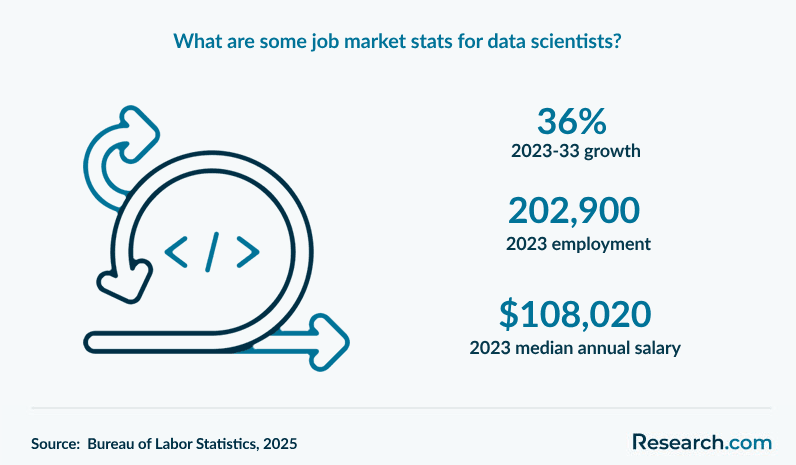
The projected 36% growth rate and 73,100 expected employment change indicate strong demand, but they do not remove the need for a credible portfolio, interview preparation, and a targeted job-search strategy.
What strategic industry partnerships support career transitions in data science?
Industry partnerships can strengthen a bootcamp when they lead to practical projects, employer feedback, hiring events, internships, mentorship, or curriculum updates. The value is in the access and experience students actually receive, not simply the presence of employer logos on a website.
When evaluating partnerships, ask whether students work on real datasets, receive feedback from practitioners, meet hiring managers, or gain exposure to specialized fields. Healthcare-focused learners, for example, may compare analytics training with online health informatics programs if they want to work with clinical data, health systems, or patient information workflows.
What are the current industry trends and future outlook for data science careers?
Data science careers are being reshaped by AI tools, cloud infrastructure, larger datasets, stronger governance expectations, and growing demand for professionals who can explain models responsibly. Bootcamps should reflect these changes without overselling them.
- Artificial intelligence and machine learning: AI and ML are increasingly embedded in analytics workflows, model development, automation, and decision support.
- Cloud computing: Platforms such as Amazon Web Services (AWS), Azure, and GCP support scalable storage, processing, and deployment.
- Big data: Organizations continue to manage large and varied datasets, which increases the need for strong data engineering and governance practices.
- Data visualization: Stakeholders need clear dashboards and visual explanations, not only technical model outputs.
- Natural Language Processing: Text analytics, classification, sentiment analysis, and chatbot-related applications remain important areas of applied data science.
- Ethical AI: Employers increasingly care about fairness, transparency, privacy, bias, documentation, and responsible model use.
Here’s What Graduates Say About Their Data Science Bootcamps
-
: "
The career switch felt intimidating at first, but project work and mentor feedback helped me connect the theory to real business problems. After graduation, I felt much more prepared to discuss Python, modeling, and portfolio projects in interviews. Zion
"
-
: "
The online schedule made it possible to keep working while studying. The most useful part was learning how to turn messy datasets into models and presentations that business teams could actually use. Ashley
"
-
: "
I enrolled because I wanted stronger career support. The résumé reviews, mock interviews, and alumni connections helped me move from coursework into a real job search with more structure. Katelyn
"
What accreditation and certification standards should I expect from data science bootcamps?
Most data science bootcamps are not accredited in the same way colleges and universities are. That does not automatically make them poor choices, but it does mean students must verify quality through other evidence: curriculum transparency, instructor credentials, student outcomes, refund policies, financing disclosures, employer relationships, and alumni feedback.
Some bootcamps may offer certificates of completion or preparation for vendor-related tools, but a bootcamp certificate is not the same as a degree. Ask whether the certificate is recognized by employers, whether it requires assessed projects, and whether students can show their work publicly. If you are comparing practical tech credentials across fields, you can also review how specialized programs present outcomes, such as the best online game development degree programs.
How are data science bootcamps integrating artificial intelligence into their curriculum?
AI is now difficult to separate from data science training. Strong bootcamps should teach machine learning foundations, model evaluation, responsible AI use, prompt-aware workflows where relevant, and the limits of automated tools. Students should learn how to use AI support without outsourcing their understanding of data preparation, statistics, validation, or interpretation.
Look for AI modules that include real datasets, model comparison, documentation, bias considerations, and deployment context. Learners who want more formal preparation in this area can compare bootcamp training with online artificial intelligence degrees.
Key Insights
- A bootcamp is a skills accelerator, not a job guarantee: It can help you build Python, SQL, statistics, machine learning, and portfolio experience, but hiring still depends on your background, projects, market, and interview performance.
- Match the program to your target role: Data analyst, BI analyst, data scientist, data engineer, and machine learning engineer roles require different depths of coding, math, infrastructure, and domain expertise.
- Verify outcomes before paying: Ask how job placement is calculated, which graduates are included, what roles count, and whether salary claims are independently supported.
- Costs vary widely: Data science bootcamp tuition ranges from approximately $2,500 to $30,000, with lower-range, mid-range, and higher-priced programs offering different levels of depth and support.
- Salary potential is strong but uneven: The BLS reported 2023 median annual pay for data scientists of $108,020, or $51.93 per hour, while other salary figures vary by title, seniority, organization, and specialization.
- Job growth is favorable: Data scientist employment is projected to grow 36% from 2023-33, with an expected employment change of 73,100 jobs, but competition for entry-level roles can still be intense.
- Online versus in-person is a learning-style decision: Online programs offer flexibility; in-person programs offer structure and direct interaction. Choose the format that will keep you accountable.
- Degrees still matter for some employers: A bootcamp may be enough for certain applied analytics roles, but bachelor’s or master’s programs may be better for research-heavy, advanced, or degree-filtered positions.
- AI is changing expectations: Bootcamps should now teach responsible AI use, machine learning foundations, cloud awareness, model evaluation, and ethical data practices.
References:
- Datausa.io. (2025). Data Scientists and Mathematical Science Occupations. Datausa.io.
- Glassdoor. (2025, March 1). Entry Level Data Scientist Salaries. Glassdoor.
- Indeed.com. (2025, March 1). Entry Level Data Scientist Salary in United States. Indeed.com.
- Salary.com. (2025, February 1). Analyst, Data Science Salary. Salary.com.
- Salary.com. (2025, January 1). Data Science Engineer Salary. Salary.com.
- Salary.com. (2025, January 1). Data Scientist Economist Salary. Salary.com.
- Salary.com. (2025, January 1). Data Scientist Salary. Salary.com.
- Salary.com. (2025, January 1). Head of Data Science Salary in the United States. Salary.com.
- Statista. (2021, April). Coding bootcamp graduates employed at leading companies in the United States in 2020, by company. Statista.
- Statista. (2024). Worldwide developer survey: Most used languages. Statista.
- Zippia.com. (2025, March 1). Entry Level Data Scientist Salary. Zippia.com.
Other Things You Should Know About Data Science Bootcamps
The best data science bootcamps of 2027 focus on a robust curriculum that covers machine learning, data visualization, statistics, and Python programming. They also emphasize hands-on projects, personalized mentorship, and strong career support, ensuring students have the skills and networks needed for successful careers in data science.
The best data science bootcamps in 2027 typically cover Python programming, machine learning algorithms, data visualization, statistical analysis, and big data tools like Hadoop and Spark. Advanced courses may dive into deep learning and neural networks, equipping students with skills needed for modern data-driven roles.
The best data science bootcamps in 2027 often boast job placement rates of 80% to 95% within six months of graduation. They typically offer robust career services, including resume workshops, interview preparation, and strong industry connections, to support graduates in securing employment quickly.