2027 Fastest Online Master’s Degree Programs in Data Science

Co-Founder and Chief Data Scientist
As a specialist in career and education planning, I frequently assist professionals aiming for rapid advancement in the data science field. The pursuit of the fastest online master's degree is a popular goal, yet the process is fraught with challenges. The digital landscape is cluttered with programs making bold claims about completion times, making it difficult to discern credible, high-value options from those that are merely well-marketed.
The critical task is to evaluate a program's true value and rigor beyond its advertised speed. My purpose is to provide expert clarity, helping you identify a genuinely accelerated program that upholds academic standards and meets your career objectives.
What are the benefits of getting an online Master's degree in Data Science?
- Career Advancement: Opens pathways to senior-level roles like Senior Data Scientist, Machine Learning Engineer, AI Specialist, and Director of Analytics.
- Earning Potential: Professionals with a master's degree can command median salaries in the range of $120,000 to over $150,000 annually, with significant growth potential.
- Flexible Learning: The online format provides the convenience of studying from anywhere, allowing you to balance advanced education with your current career and personal commitments.
What can I expect from the fastest online Master's in Data Science programs?
- Focused Advanced Topics: Expect an intensive curriculum centered on key areas like machine learning, statistical modeling, big data technologies, and programming with Python or R.
- Structured Curriculum: Delivery typically combines recorded video lectures, live online class sessions, hands-on coding assignments, and a final capstone project.
- Applied Strategic Knowledge: Emphasis on solving real-world business challenges through predictive modeling, data-driven insights, and ethical AI principles.
- Condensed Timeline: Programs are designed to be completed quickly, often in 12 to 24 months, to accelerate your career transition or promotion.
- Networking Opportunities: Connect with experienced faculty and a diverse cohort of professional peers from tech, finance, healthcare, and other data-driven industries.
Where can I work with a qualification from the fastest online Master's in Data Science programs?
- Technology Sector: Drive innovation at tech giants or startups by developing algorithms, building recommendation engines, and improving products.
- Finance and Insurance: Work as a quantitative analyst or risk management specialist, creating models for fraud detection, algorithmic trading, and market forecasting.
- Healthcare and Biotechnology: Analyze clinical trial data, conduct genomic research, and build predictive models for patient outcomes.
- E-commerce and Retail: Oversee complex analytics for supply chain optimization, customer segmentation, and demand forecasting.
- Consulting Firms: Advise various clients on how to implement AI, build a data strategy, and extract value from their business data.
- Pathway to Leadership: The degree provides a strong foundation for moving into executive roles like Director of Data Science or Chief Data Officer.
How much can I make with an online Master's degree program in Data Science?
- Analyst-Level Roles: Professionals in positions like Data Analyst or Business Intelligence Analyst with a master's degree typically earn between $85,000 and $110,000.
- Scientist-Level Roles: Experienced individuals in positions like Data Scientist or Machine Learning Engineer can expect salaries ranging from $120,000 to $160,000.
- Senior & Specialized Roles: Senior leadership and highly specialized positions like Principal Data Scientist or Director of Analytics can command salaries well over $170,000 annually.
- Fastest Online Master's Degree Programs in Data Science for 2027 List of Programs
- What is the average cost of an online Master's degree in Data Science? Cost
- What are the financial aid options for an online Master's degree in Data Science? Financial Aid
- What are the prerequisites for enrolling in an online Master's degree in Data Science? What are the prerequisites for enrolling in an online Master's degree in Data Science?
- What courses are typically in an online Master's degree in Data Science? What courses are typically in an online Master's degree in Data Science?
- What types of specializations are available for Master's degree in Data Science graduates? Specializations
- How do you choose the best among the fastest online Master's degree programs in Data Science? How do you choose the best among the fastest online Master's degree programs in Data Science?
- What career paths are available for graduates of online Master's degree programs in Data Science? Career paths
- How much can I earn with an online Master's degree in Data Science? Salaries
- What is the job market like for graduates of an online Master's degree program in Data Science? Job Market
- What are some current and future trends in data science? What are some current and future trends in data science?
- What challenges should prospective students consider in accelerated online Master's in Data Science programs? What challenges should prospective students consider in accelerated online Master's in Data Science programs?
Fastest Online Master's Degree Programs in Data Science for 2027
Choosing an accelerated online master’s in data science is not just about finding the shortest program. The better question is whether a program can help you build advanced skills in statistics, programming, machine learning, data engineering, visualization, and applied analytics without forcing you to pause your career or overpay for a credential that does not match your goals.
This guide is for working professionals, career changers, analysts, software developers, engineers, and recent graduates who want a faster path into data science or a higher-level analytics role. You will find ranked program options, cost and financial aid considerations, admissions requirements, common courses, specialization choices, salary and labor market data, and practical questions to ask before enrolling.
Quick answer: What is the fastest online master’s in data science?
Several online master’s in data science programs can be completed in about one year to two years, depending on course load, transfer policies, prerequisites, and whether the student studies full time or part time. Syracuse University lists completion in as little as 1 year, while Northwestern University, Johns Hopkins University, Rice University, Indiana University, and other universities offer accelerated or flexible paths that commonly fall within the 18–24 month range.
The fastest program is not automatically the best choice. Students should compare accreditation, curriculum depth, live versus asynchronous learning, capstone requirements, tuition structure, employer recognition, and whether the program’s prerequisites match their background.
How do we rank schools?
Because a graduate degree requires a major investment of time and money, Research.com evaluates programs using transparent criteria and publicly available institutional data. Our ranking methodology draws from respected education data sources, including:
- IPEDS database
- Peterson's database, including the Distance Learning Licensed Data Set
- College Scorecard database
- National Center for Education Statistics
Use the ranking as a starting point, then verify current tuition, admissions rules, course delivery format, and graduation timelines directly with each school.
Fast comparison of featured online master’s in data science programs
| School | Program length | Credits or courses required | Tuition listed | Best fit for |
| Johns Hopkins University | 18-24 months | 30 credits | $54,550 total program cost | Students seeking applied mathematics, computer science, and technical focus areas |
| Bellevue University | Typically 18 months (full-time) | 30 | $680 per credit (in-class or online) | Working adults who want a fully online, practice-oriented program |
| DePaul University | Typically 2 years (full-time) | 48-60 credits | $811 per credit (in-state and out-of-state) | Students who want concentration choices in computing, health care, or marketing |
| Indiana University | 18–24 months (full-time) | 30 | $490 per credit (in-state), $812.50 per credit (out-of-state) | Learners who want interdisciplinary coursework and elective flexibility |
| Northwestern University | 1.5–2 years (part-time); accelerated options available | 12 courses | $5,098 per course (in-state and out-of-state) | Professionals seeking leadership, AI, analytics management, or entrepreneurship options |
| Rice University | 18–24 months (full-time); up to 3.5 years (part-time) | 31-34 | $1,667 per credit hour (in-state and out-of-state) | Students who want live sessions, small-group support, and applied capstone work |
| Southern Methodist University | 20–28 months (full-time) | 33.5 | $$1,130 per credit | Learners who value case studies, workshops, and an on-campus immersion |
| Syracuse University | as little as 1 year | 34 | $1,945 per credit (in-state and out-of-state) | Students looking for a fast STEM-designated applied data science program |
| University of California Berkeley | 12–32 months (depending on pace) | 27 | $$2,850 per credit (in-state and out-of-state) | Students seeking a highly structured online MIDS with live classes and a capstone |
| University of Illinois Urbana-Champaign | 1–3 years (self-paced) | 32 | $520/credit online | Cost-conscious students who want a Coursera-delivered, non-thesis program |
1. Johns Hopkins University
The online Master of Science in Data Science at Johns Hopkins University is designed for professionals who want graduate-level depth in both computer science and applied mathematics. GRE scores are not required for admission, and the program is structured around technical preparation for specialized data science roles.
Courses are taught by senior engineers and data scientists who connect theory to workplace problems. Students study topics such as Machine Learning and Data Visualization while learning to work with large datasets, automated modeling, and applied analytical systems.
Students select a focus area, such as Machine Learning and AI or Operations Research, and complete at least three courses in that domain. The program also includes an optional capstone project, online and hybrid formats, prerequisite proficiency exams, a graduate certificate in data science, and a post-master’s certificate for continued study.
- Program Length: 18-24 months
- Tracks/Concentrations: Data Management and Cloud Computing, Information Technology and Computation, Machine Learning and Artificial Intelligence, Operations Research
- Tuition Cost: $54,550 total program cost
- Required Credits to Graduate: 30 credits
- Accreditation: Middle States Commission on Higher Education (MSCHE)
2. Bellevue University
Bellevue University offers a 100% online M.S. in Data Science for students who want applied training without relocating or leaving work. The program emphasizes hands-on practice in data analysis, machine learning, and visualization.
The curriculum introduces commonly used tools such as Python, R, Tableau, and Power BI. Students learn to analyze large datasets, build predictive models, and explain results in ways that stakeholders can use.
The program does not require the GRE, and its structure supports both full-time and part-time learners. Faculty with industry experience help connect technical coursework to workplace applications.
- Program Length: Typically 18 months (full-time)
- Tracks/Concentrations: None specified
- Tuition Cost: $680 per credit (in-class or online)
- Required Credits to Graduate: 30
- Accreditation: Higher Learning Commission (HLC)
3. DePaul University
The online M.S. in Data Science at DePaul University gives students a broad foundation in data analytics, machine learning, and big data tools. The program is built for students who need both technical fluency and the ability to communicate analytical results to nontechnical audiences.
Coursework covers the data science lifecycle, including data preparation, normalization, predictive modeling, model evaluation, and interpretation. Students gain experience moving from data collection to actionable analysis.
DePaul offers multiple concentrations. Computational Methods focuses on large-scale technical data problems, Health Care applies analytics to patient and health outcomes, Marketing connects data science to strategic marketing decisions, and the Standard option supports broader customization.
- Program Length: Typically 2 years (full-time)
- Tracks/Concentrations: Computational Methods, Health Care, Marketing, and Standard
- Tuition Cost: $811 per credit (in-state and out-of-state)
- Required Credits to Graduate: 48-60 credits
- Accreditation: Higher Learning Commission (HLC)
4. Indiana University
Indiana University offers a fully online M.S. in Data Science that draws from engineering, informatics, and statistics. It is a strong option for students who want an interdisciplinary degree with room to shape the curriculum around career interests.
The program includes core courses, specialization coursework, electives, and a final capstone. Students choose a statistics course from approved options and complete machine learning coursework such as Elements of Artificial Intelligence or Deep Learning Systems.
Specialization areas include Data Analytics and Visualization, Intelligent Systems Engineering, and Cybersecurity. Electives such as Social Media Mining, Computer Vision, and Usable Artificial Intelligence allow students to pursue more focused technical interests. The capstone may be completed through Data Science in Practice or an independent study.
- Program Length: 18–24 months (full-time)
- Tracks/Concentrations: Data Science
- Tuition Cost: $490 per credit (in-state), $812.50 per credit (out-of-state)
- Required Credits to Graduate: 30
- Accreditation: Higher Learning Commission (HLC)
5. Northwestern University
Northwestern University offers a fully online M.S. in Data Science for students preparing for technical, analytical, and leadership roles. The curriculum includes database systems, R, Python, Go, analytical modeling, and management-oriented data science skills.
Students can choose a flexible part-time format or an accelerated full-time option that may be completed in one year. The part-time route offers quarterly starts and may be completed in as little as two years.
Concentration options include Artificial Intelligence, Data Engineering, Technology Entrepreneurship, Analytics and Modeling, Analytics Management, and General Data Science. Students can also tailor coursework around programming preferences and professional goals.
- Program Length: 1.5–2 years (part-time); accelerated options available
- Tracks/Concentrations: Analytics and Modeling, Analytics Management, Artificial Intelligence, Data Engineering, Technology Entrepreneurship, General Data Science
- Tuition Cost: $5,098 per course (in-state and out-of-state)
- Required Credits to Graduate: 12 courses
- Accreditation: Higher Learning Commission (HLC)
6. Rice University
The online Master of Data Science at Rice University is aimed at working professionals who want advanced training in computational and statistical methods. The part-time format combines self-paced learning with live weekly sessions, and online graduates receive the same diploma as on-campus students.
Students may specialize in Machine Learning or Business Analytics. The Machine Learning path supports AI model development, while Business Analytics prepares students to use data for strategic decision-making.
Rice includes a hands-on capstone and opportunities connected to the D2K Lab. Students receive support through small-group sessions, office hours, career services, and mentorship from faculty in computer science and analytics. The program offers three admissions cycles per year, and merit-based scholarships are available for early applicants.
- Program Length: 18–24 months (full-time); up to 3.5 years (part-time)
- Tracks/Concentrations: Machine Learning, Business Analytics
- Tuition Cost: $1,667 per credit hour (in-state and out-of-state)
- Required Credits to Graduate: 31-34
- Accreditation: Southern Association of Colleges and Schools Commission on Colleges (SACSCOC)
7. Southern Methodist University (SMU)
Southern Methodist University offers a fully online Master of Science in Data Science that was developed with practitioner input and draws from three SMU schools. The interdisciplinary structure is useful for students who want both programming depth and business-facing analytical skills.
Students build skills in statistical analysis and programming with tools such as SAS, Python, and R. They also learn to work with unstructured data, communicate results clearly, and create visualizations for decision-makers.
The program can be completed in as little as 20 months. Students may specialize in Machine Learning & Artificial Intelligence or Decision Analytics. Case studies, workshops, applied projects, and a required on-campus immersion support professional networking and practice-based learning.
- Program Length: 20–28 months (full-time)
- Tracks/Concentrations: Machine Learning Specialization, Business Analytics Specialization
- Tuition Cost: $$1,130 per credit
- Required Credits to Graduate: 33.5
- Accreditation: Southern Association of Colleges and Schools Commission on Colleges (SACSCOC)
8. Syracuse University
The online M.S. in Applied Data Science at Syracuse University is a STEM-designated program for professionals who want advanced skills in data analytics, machine learning, data management, and applied information science.
The curriculum includes a primary required core and a secondary core that functions as the student’s data science concentration. Available tracks include Artificial Intelligence, Big Data, Language Analytics, Project Management, Visual Analytics, Data and Business Analytics, and Data Pipelines and Platforms.
Students complete an exit portfolio of projects and gain applied experience through consulting work, research lab participation, internships, and courses using industry datasets. Career support includes advising, resume development, and access to the iSchool alumni network.
- Program Length: as little as 1 year
- Tracks/Concentrations: Artificial Intelligence, Big Data, Data and Business Analytics, Data Pipelines and Platforms, Language Analytics, Project Management, Visual Analytics
- Tuition Cost: $1,945 per credit (in-state and out-of-state)
- Required Credits to Graduate: 34
- Accreditation: Middle States Commission on Higher Education (MSCHE)
9. University of California Berkeley
The online Master of Information and Data Science at University of California Berkeley, commonly known as MIDS, prepares students to solve real-world data problems through a multidisciplinary curriculum grounded in computer science, statistics, data engineering, machine learning, and responsible data use.
The program uses weekly Zoom classes, GitHub-based collaboration, and project-driven coursework. Students can choose a 20-month standard path or a 12-month accelerated option, with additional pacing flexibility up to 32 months.
Courses include Applied Machine Learning and content focused on the ethical and social implications of data. A team-based capstone requires students to build a web-based deliverable and may lead to consideration for the Hal R. Varian MIDS Capstone Award.
- Program Length: 12–32 months (depending on pace)
- Tracks/Concentrations: None specified; customizable electives
- Tuition Cost: $$2,850 per credit (in-state and out-of-state)
- Required Credits to Graduate: 27
- Accreditation: Western Association of Schools and Colleges (WASC)
10. University of Illinois Urbana-Champaign
The University of Illinois Urbana-Champaign offers an online M.S. in Data Science through Coursera. The program is non-thesis and coursework-only, with academic oversight from Illinois faculty.
Students complete coursework across four required breadth areas: machine learning, data mining, data visualization, and cloud computing. The program also requires three advanced courses and approved electives.
GRE scores are not necessary for admission, and letters of recommendation are generally not required. Qualified graduates from select Illinois undergraduate programs who meet GPA standards may be eligible for guaranteed admission.
- Program Length: 1–3 years (self-paced)
- Tracks/Concentrations: None specified
- Tuition Cost: $520/credit online
- Required Credits to Graduate: 32
- Accreditation: Higher Learning Commission (HLC)
What is the average cost of an online Master's degree in Data Science?
The price of an online master’s in data science depends on the institution, public or private status, residency rules, credit requirements, and fees. Many programs require between 30 to 36 credit hours, although some programs require more. Related options, such as the best MBA in Data Science degree programs, may follow different tuition models because they combine business and analytics coursework.
| Cost category | Typical range or consideration | What to verify before enrolling |
| Public university in-state tuition | Approximately $10,000 to $35,000 for the full program | Whether online students receive in-state pricing or a separate online rate |
| Public university out-of-state tuition | Often between $30,000 and $60,000 | Whether residency affects online tuition |
| Private university tuition | Often from $40,000 to over $80,000 | Whether institutional scholarships reduce the listed price |
| Per-credit tuition | Around $500 to over $2,000 per credit hour | Total credits required, not just the advertised per-credit rate |
| Additional expenses | Technology fees, application fees, digital textbooks, software, and course materials | Whether fees are charged per term, per course, or per credit |
Students interested in analytics-heavy operational roles may also compare data science programs with an accelerated industrial engineering master's online, especially if their career goals involve operations research, production systems, optimization, or engineering analytics.
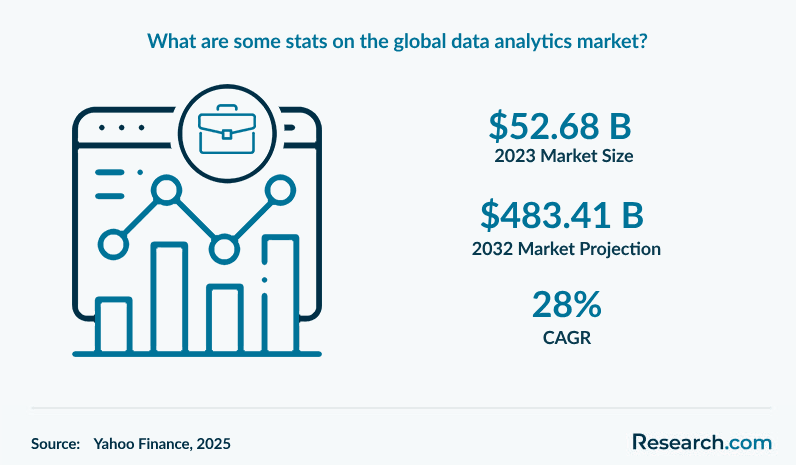
The broader analytics market helps explain why these programs remain popular. The data analytics market was valued at USD 52.68 billion in 2023, with projections indicating growth to USD 483.41 billion by 2032. That forecast represents a compound annual growth rate (CAGR) of 28.0% for 2024-2032. Growth is tied to organizational adoption of artificial intelligence, machine learning, big data platforms, and advanced analytics for decision-making and operational improvement.
If you are deciding between closely related fields, Research.com also explains what is the difference between data science and business analytics and how each path can lead to different roles.
What are the financial aid options for an online Master's degree in Data Science?
Graduate data science programs can be expensive, but students rarely have to rely on one funding source. Even the cheapest online data science masters programs may offer aid, scholarships, payment plans, or employer-supported options.
- Federal student aid: Complete the Free Application for Federal Student Aid (FAFSA) to be considered for federal aid, including Direct Unsubsidized Loans.
- Military and veteran benefits: Active-duty service members, veterans, and eligible family members may use benefits such as the Post-9/11 GI Bill or Yellow Ribbon Program, depending on school participation and student eligibility.
- Employer tuition assistance: Professionals already working in analytics, IT, finance, health care, software, or operations should ask whether their employer offers tuition reimbursement or professional development funding.
- Scholarships and grants: Universities, professional associations, and STEM-focused organizations may offer awards for graduate students in data science or related fields.
- State-specific aid: Some states provide grants or assistance for residents pursuing graduate education, although eligibility rules vary.
What are the prerequisites for enrolling in an online Master's degree in Data Science?
Admissions standards vary, but most online master’s in data science programs expect applicants to show readiness for graduate quantitative work. A student without recent coursework in programming, statistics, calculus, or linear algebra may need prerequisites before starting core classes.
| Requirement | What it usually means | Decision tip |
| Bachelor's degree | A degree from a regionally accredited institution, often in computer science, statistics, math, engineering, or another quantitative field | Ask whether nontechnical majors can qualify through prerequisite courses or professional experience |
| Minimum GPA | Many programs look for around 3.0 on a 4.0 scale | Students below the threshold should ask about conditional admission |
| Professional experience | Some programs prefer experience in software development, data analysis, IT, or related work | Use a resume and statement of purpose to connect experience to data science goals |
| Application materials | Official transcripts, resume, recommendations, and a statement of purpose are common | Check whether recommendations are required or optional |
| Standardized tests | Many online programs have waived GRE or GMAT requirements, but some may still request scores | Confirm the current policy before spending time or money on testing |
If your bachelor’s degree is not in a technical or quantitative field, one of the best bootcamps for data science may help you test your interest, strengthen basic skills, or prepare for prerequisites before applying to a master’s program.
What courses are typically in an online Master's degree in Data Science?
An online master’s in data science usually blends statistics, programming, machine learning, databases, visualization, ethics, and applied projects. Even affordable universities in USA for MS in Data Science tend to include a similar technical core, although course titles and depth vary.
- Introduction to Data Science: Covers the data science workflow, organizational use cases, ethical issues, and the responsibilities of data professionals.
- Statistical Modeling and Inference: Builds skills in hypothesis testing, regression, uncertainty, and statistical reasoning.
- Machine Learning: Introduces predictive modeling methods for classification, regression, clustering, and model evaluation.
- Data Engineering and Big Data Systems: Focuses on databases, pipelines, cloud platforms, storage, and large-scale data processing.
- Data Visualization and Communication: Teaches students to present findings clearly to technical teams, executives, clients, or public audiences.
- Programming for Data Science: Typically uses Python or R and includes libraries for data cleaning, analysis, visualization, and modeling.
- Ethics and Law in Data Science: Examines privacy, fairness, accountability, transparency, bias, and legal considerations in data use.
Data science is also becoming more established as an academic discipline. Based on a 2023 report by the American Statistical Association using degree completion data from the National Center for Education Statistics, undergraduate degrees in data science rose from 84 in 2020 and 165 in 2021 to 897 in 2022. Bachelor’s degrees in data analytics increased from 325 in 2020 and 455 in 2021 to 767 in 2022.
At the graduate level, master’s degrees in newly introduced data science and data analytics categories increased by more than a factor of four since the 2019-2020 academic year. The number of universities offering these master’s degrees has more than doubled, and the first 13 PhDs in data science were conferred in 2022.
Professionals focused on health care leadership may also compare analytics-oriented graduate study with one of the shortest nurse executive leadership MSN online programs, particularly if their goal is clinical administration rather than general data science.
What types of specializations are available for Master's degree in Data Science graduates?
Specializations help students align their degree with a specific job family. A general data science curriculum can be valuable, but a focused track may be better for students targeting AI engineering, health analytics, business intelligence, or infrastructure-heavy data roles.
| Specialization | Main focus | Common career alignment |
| Machine Learning Engineering | Building, deploying, monitoring, and maintaining machine learning models | Machine learning engineer, applied AI engineer, MLOps-focused roles |
| Business Analytics | Using analytics to improve marketing, finance, forecasting, operations, and strategy | Analytics consultant, business analyst, BI manager |
| Artificial Intelligence | Deep learning, natural language processing, computer vision, and advanced AI methods | AI specialist, NLP analyst, computer vision engineer |
| Data Engineering | Designing data pipelines, architecture, storage, and processing systems | Data engineer, cloud data specialist, analytics platform engineer |
| Health Analytics | Applying analytics to health care, public health, clinical informatics, and biomedical data | Health data analyst, clinical informatics analyst, public health analytics specialist |
| Data Visualization | Turning data into dashboards, charts, reports, and decision-ready visuals | Visualization specialist, BI developer, analytics communicator |
How do you choose the best among the fastest online Master's degree programs in Data Science?
The best accelerated program is the one that fits your background, schedule, budget, and target role. A program that is “fast” but too theoretical, too expensive, or misaligned with your career goals can be a poor investment.
Questions to ask before applying
- Is the school accredited? Confirm institutional accreditation before evaluating rankings, tuition, or course titles.
- Does the curriculum match the job you want? Machine learning, data engineering, business analytics, and health analytics require different course strengths.
- How accelerated is the accelerated path? Ask how many courses you must take per term and whether the pace is realistic while working.
- Are prerequisites built in or separate? Students without programming or statistics preparation may need additional time before core courses.
- Is there a capstone or portfolio? Applied projects can help demonstrate skills to employers.
- What support do online students receive? Review tutoring, technical support, advising, faculty access, and career services.
- What is the true total cost? Include tuition, fees, textbooks, software, travel for immersions, and lost income if reducing work hours.
Common mistakes when choosing an online data science master’s
| Mistake | Why it can hurt you | Better approach |
| Choosing only the shortest program | A compressed timeline may leave too little time for projects, math, or coding practice | Balance speed with curriculum depth and portfolio opportunities |
| Ignoring accreditation | Employers and financial aid eligibility may depend on institutional legitimacy | Verify accreditation through recognized agencies and school disclosures |
| Comparing only tuition per credit | A low per-credit price can still be expensive if the program requires many credits or fees | Calculate total program cost |
| Assuming online means fully flexible | Some programs require live sessions, group projects, or campus immersions | Ask about synchronous meetings and residency requirements |
| Skipping prerequisite review | Weak preparation in Python, statistics, or linear algebra can make accelerated coursework difficult | Complete refreshers, bridge courses, or bootcamps before enrolling |
| Relying only on rankings | A highly ranked program may not fit your budget, learning style, or career target | Use rankings as one input, not the only decision factor |
Students with specialized clinical goals should avoid assuming that a data science master’s is the right credential for every health-related analytics role. For example, a licensed clinician focused on pediatric care may find a narrower credential, such as the fastest online pediatric nurse practitioner graduate certificate, more aligned with practice requirements.
What career paths are available for graduates of online Master's degree programs in Data Science?
A master’s in data science can support careers in technology, finance, health care, retail, government, research, manufacturing, consulting, and nonprofit work. The strongest outcomes usually go to graduates who combine the degree with a strong project portfolio, domain knowledge, communication skills, and experience using industry tools.
| Career path | What the role does | Skills to emphasize |
| Data Scientist | Uses statistics, machine learning, and programming to solve complex business or research problems | Modeling, experimentation, Python or R, communication |
| Machine Learning Engineer | Builds, deploys, and scales machine learning systems | Software engineering, model deployment, cloud tools, MLOps |
| Data Analyst | Analyzes trends, builds reports, and supports decisions through data interpretation | SQL, visualization, statistics, stakeholder communication |
| Data Engineer | Designs and maintains systems for collecting, storing, and processing data | Databases, pipelines, distributed systems, cloud platforms |
| Business Intelligence (BI) Developer | Creates dashboards, reporting systems, and performance tracking tools | Dashboard design, SQL, metrics, visualization platforms |
| Quantitative Analyst | Develops mathematical models for trading, pricing, risk, and financial strategy | Statistics, finance, programming, optimization |
| Analytics Manager or Director | Leads analytics teams and translates data work into organizational strategy | Leadership, project management, data governance, business strategy |
How much can I earn with an online Master's degree in Data Science?
Salaries in data science vary widely by role, location, seniority, industry, technical specialization, and management responsibility. A master’s degree may strengthen a candidate’s profile, but it does not guarantee a specific salary.
| Role or level | Salary information stated | How to interpret it |
| Data Analyst | Approximately $85,000 to over $110,000 annually for a data analyst with a master's degree | Actual pay depends heavily on industry, tools used, and years of experience |
| Data Scientist | Often between $120,000 and $150,000 per year | Higher compensation is more common in competitive markets and specialized roles |
| Machine Learning Engineer | $130,000 to $170,000 or higher | Strong software engineering and deployment skills can affect compensation |
| Data Engineering | $115,000 to well over $160,000 with experience and promotions | Cloud, pipeline, and architecture skills are important salary drivers |
| Management and Leadership Roles | Can exceed $180,000 annually | Leadership roles typically require both technical credibility and management ability |
Professionals interested in data-informed mental health practice may also compare this pathway with a fast track counseling psychology degree online, since counseling and clinical roles have different training, licensure, and career requirements than data science roles.
Based on data from June 2025, the average salary for a Data Scientist in the United States is $116,447 annually. State and city differences are significant: California reports an average of $128,441, Massachusetts reports $126,729, San Jose, CA reports $146,874, and San Francisco, CA reports $145,430.
Compensation also rises with seniority. The data shows $74,860 for a Data Scientist Intern and $82,554 for a Data Scientist I. Higher levels include $125,981 for a Data Scientist III and $224,987 for a Data Scientist VI. Principal Data Scientists earn an average of $187,965, while a Chief Data Scientist earns $402,396. The national median salary shows a slight decrease from $100,559 in 2023 to $99,761 in 2025.
The main takeaway is that location and level matter. Entry-level, senior individual contributor, principal, and executive data science roles occupy very different compensation bands.
What is the job market like for graduates of an online Master's degree program in Data Science?
The labor market for data science remains strong because organizations across sectors need professionals who can turn raw data into decisions, products, forecasts, and automated systems. Graduates may find opportunities in the public sector, private companies, nonprofits, consulting firms, and research organizations.
- Government sector: Agencies use data science for policy analysis, intelligence, public health, infrastructure, fraud detection, and operational efficiency.
- Private sector: Companies hire data professionals to improve marketing, pricing, logistics, product development, customer analytics, and risk management.
- High-demand specializations: Artificial intelligence, machine learning, and data engineering remain important technical areas. Students comparing tech fields may also review cybersecurity vs data science.
- Nonprofit organizations: Research, humanitarian, public health, and advocacy groups use data to measure outcomes and improve programs.
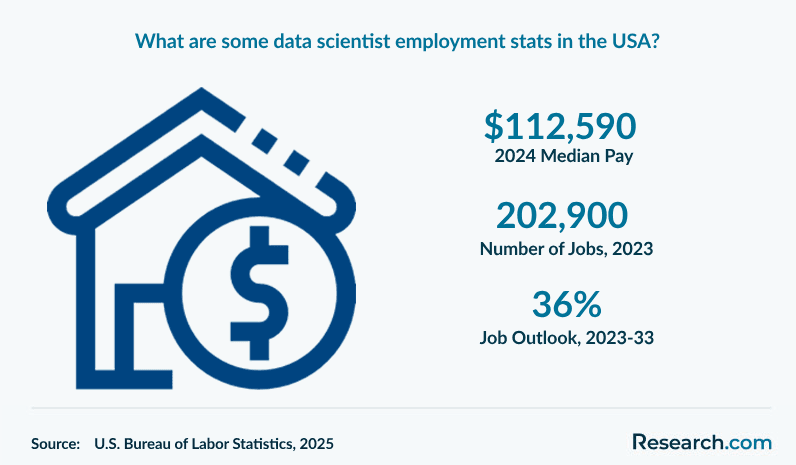
According to the U.S. Bureau of Labor Statistics, the median pay for data scientists in 2024 was $112,590 per year, or $54.13 per hour. The occupation had 202,900 jobs in 2023.
The BLS projects 36% job growth from 2023 to 2033, which is much faster than the average for all occupations. That projection represents an employment change of 73,100 new positions. The typical entry-level education listed is a bachelor's degree, with no related work experience or on-the-job training generally required.
What are some current and future trends in data science?
Data science is changing quickly as organizations adopt AI tools, automate workflows, and place greater emphasis on governance, ethics, and reliable model deployment. Students should choose programs that teach durable foundations, not just the tools that are popular in one hiring cycle.
- Generative AI and Large Language Models (LLMs): Organizations use these systems for code support, content generation, search, summarization, and natural language tasks.
- MLOps: Employers increasingly need professionals who can move models from development into reliable production environments.
- Data-centric AI: More attention is shifting toward the quality, labeling, documentation, and management of the data used to train AI systems.
- Ethical AI and responsible data use: Ethical AI is now central because biased, opaque, or poorly governed systems can create legal, operational, and social risk.
- Data as a Service (DaaS) and data products: Cloud platforms and sharing tools are encouraging organizations to manage data as a reusable product.
- Graph Neural Networks (GNNs): Network-based data in social platforms, supply chains, fraud detection, and recommendation systems creates demand for graph-based modeling techniques.
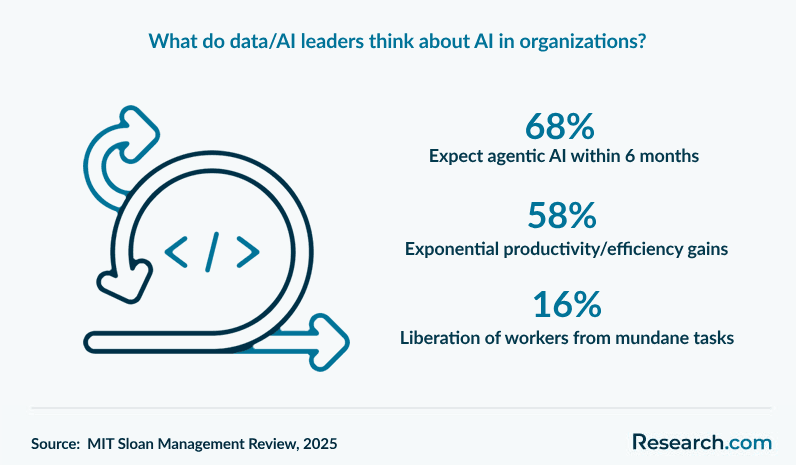
Recent MIT Sloan data from 2025 highlights both excitement and friction around AI adoption. 68% of IT leaders expect agentic AI within six months or less, while 37% believe they already have it in place. On productivity, 58% of data and AI leaders report exponential gains from AI, and one Goldman Sachs case showed about a 20% increase in developer productivity. A longer-term economic prediction, however, points to a smaller productivity increase of only 0.5% over the next decade.
The biggest barrier may be organizational culture. While 94% of data and AI leaders say interest in AI is increasing attention to data, 92% identify cultural challenges as the main obstacle to becoming a data-driven organization. Only 37% believe their organization is data- and AI-driven, and 33% say it has a data-driven culture. In one large insurance firm, unstructured data accounted for 97% of all data, underscoring the importance of managing messy, complex information.
For students, this means technical training should be paired with communication, governance, ethics, change management, and business understanding. Many organizations do not fail at AI because they lack tools; they fail because they cannot integrate data practices into daily decisions.
Is an Online Master's in Data Science a Cost-Effective Investment?
An online master’s in data science can be cost-effective when it helps a student move into a higher-paying role, qualify for technical advancement, or shift into a field with stronger long-term demand. The value is weaker if the student overpays, enrolls without the needed prerequisites, chooses a program with limited projects, or studies a specialization that does not match hiring needs.
To evaluate return on investment, compare total program cost with expected career outcomes, not just advertised salaries. Include tuition, fees, financing costs, time to completion, work schedule changes, and opportunity cost. Students considering broader technology careers may also compare data science with the cheapest software engineering degree options, especially if their stronger interest is building software rather than modeling data.
Do employers recognize online Master's in Data Science degrees?
Employers generally focus on the reputation and accreditation of the institution, the rigor of the curriculum, and the applicant’s demonstrated skills rather than the online format alone. A respected online degree from an accredited university, supported by strong projects and relevant technical skills, can be competitive in the job market.
Students should still be cautious. Not all online programs offer the same level of faculty access, career support, live interaction, project depth, or employer engagement. Candidates who can show a strong GitHub portfolio, capstone work, internship experience, or measurable workplace projects are usually better positioned than those who rely only on the degree title.
Students interested in analytics for health systems may also compare data science with the fastest health informatics online masters, which may be better aligned with electronic health records, clinical data workflows, and health care operations.
What challenges should prospective students consider in accelerated online Master's in Data Science programs?
Accelerated online data science programs can be demanding. Students may need to learn advanced statistics, programming, machine learning, databases, and cloud-based tools while balancing work and personal responsibilities.
- Compressed workload: Faster completion often means heavier weekly study requirements.
- Technical ramp-up: Students without Python, statistics, or linear algebra experience may struggle early.
- Limited recovery time: Falling behind in an accelerated course can be harder to fix than in a traditional semester.
- Group project coordination: Online teamwork across time zones can add scheduling pressure.
- Career transition gap: A degree alone may not be enough for students without a portfolio or relevant experience.
- Support variation: Advising, tutoring, technical help, and career services differ widely by school.
Students comparing accelerated professional degrees in other sectors can also review options such as a health administration degree online to understand how pace, support services, and career outcomes vary by field.
Here's What Graduates Say About Their Online Master's Degree in Data Science Programs
- : "I finished my online master’s in data science in 18 months while keeping my full-time job. The flexible schedule helped, but the machine learning and predictive analytics courses were what helped me qualify for a senior data scientist role. — Pete"
- : "The project-based format made the transition from software engineering to machine learning engineering much easier. Working with real datasets and instructors with industry backgrounds made the material feel directly connected to the job I wanted. — Conrad"
- : "The program moved quickly, but it still gave me enough time to connect theory with practice. My capstone project solved a real business problem and became one of the strongest examples I could discuss with employers. — Meggy"
References
- American Statistical Association. (2023, December 1). Degrees in statistics and biostatistics continue to grow. Amstat News. American Statistical Association.
- MIT Sloan Management Review. (2025, January 8). Five trends in AI and data science for 2025. MIT Sloan Management Review.
- Salary.com. (2025). Data scientist salary. Salary.com.
- U.S. Bureau of Labor Statistics. (2024, April 16). Data scientists. Occupational Outlook Handbook. U.S. Bureau of Labor Statistics.
- Yahoo Finance. (2025, February 27). Data analytics market size to surpass USD 303.4 billion by 2030, exhibiting a 27.26% CAGR. Yahoo Finance.
Key Insights
- The fastest online master’s in data science programs can often be completed in about one to two years, but the right choice depends on workload, prerequisites, curriculum quality, and career fit.
- Syracuse University lists completion in as little as 1 year, while several other featured programs fall in the 18–24 month range or offer accelerated pacing.
- Do not compare programs by tuition per credit alone. Total credits, fees, residency pricing, immersions, software, and time away from work can change the real cost.
- Accreditation, applied projects, faculty access, career support, and portfolio-building opportunities are more important than speed alone.
- Data science career options include data scientist, machine learning engineer, data analyst, data engineer, BI developer, quantitative analyst, and analytics manager.
- BLS data reports a 2024 median pay of $112,590 per year for data scientists and projected job growth of 36% from 2023 to 2033.
- AI, MLOps, responsible data use, unstructured data, and data-centric AI are shaping employer expectations, so students should choose programs that teach both technical tools and durable analytical judgment.
Other Things You Should Know About the Fastest Online Master's Degree in Data Science Programs
Yes. Many accelerated online master’s in data science are STEM-designated if the curriculum includes approved coursework in statistics, machine learning, programming, and data modeling. STEM designation is granted by the U.S. Department of Homeland Security and can support up to 24 months of OPT extension for eligible international students.
The fastest online Master’s programs in Data Science in 2027 typically require a minimum of 30 to 36 credit hours for completion. This allows students to finish their degrees in less time compared to traditional programs.