
2027 Best Master’s Degree Programs in Data Analytics

Co-Founder and Chief Data Scientist
Choosing a master’s degree in data analytics is a high-stakes decision because programs can look similar on the surface while differing sharply in cost, technical depth, flexibility, employer connections, and career outcomes. The right program can help you build advanced skills in statistics, programming, machine learning, data visualization, business intelligence, and data governance. The wrong fit can leave you with avoidable debt, weak portfolio experience, or coursework that does not match the roles you want.
This guide is for working professionals, recent graduates, career changers, and technical specialists comparing graduate data analytics programs for 2027. It explains what to expect from a master’s in data analytics, how long programs take, what they cost, what financial aid may be available, which prerequisites matter, and how to evaluate program quality. It also reviews leading programs based on curriculum structure, accreditation, industry relevance, and career support, while helping you decide whether this degree is worth the investment for your goals.
The demand signal remains strong. The global data analytics market is expected to reach $303.4 billion by 2032, reflecting the continued expansion of data-driven decision-making across business, healthcare, finance, technology, education, and public-sector organizations. Still, a growing market does not make every degree equally valuable. You need to compare programs carefully.
Quick answer: Is a master’s degree in data analytics worth it?
A master’s degree in data analytics can be worth it if you want to move into higher-skill analytics roles, build a stronger technical portfolio, qualify for data science or machine learning-adjacent positions, or transition from a business, engineering, science, or nontechnical background into data-focused work. It is most valuable when the program includes applied projects, strong programming and statistics coursework, employer-relevant tools, career support, and recognized institutional accreditation.
It may not be the best first step if you only need entry-level spreadsheet, SQL, or dashboard skills, if you already have a strong analytics portfolio and experience, or if the program’s total cost is too high relative to your expected salary gain. Before enrolling, compare tuition, completion time, employer outcomes, prerequisites, transfer policies, and whether the curriculum supports your target roles.
What are the main benefits of earning a master’s degree in data analytics?
- Broader career options in data-heavy industries. Graduates may pursue roles in technology, healthcare, finance, consulting, higher education, insurance, operations, marketing, and business intelligence. Common titles include data analyst, data scientist, business intelligence analyst, data engineer, and machine learning engineer.
- Stronger earning potential than many entry-level analytics paths. Professionals with a data analytics master's program earn an average annual salary of $82,640, while experienced professionals can earn upwards of $120,500. Salaries vary by role, location, industry, employer, experience, and technical specialization.
- Advanced technical and decision-making skills. A strong graduate program can deepen your ability to work with statistical models, machine learning methods, big data tools, data visualization platforms, cloud-based data systems, and analytics-driven business strategy.
- Better preparation for cross-functional work. Data analytics professionals often translate technical findings for executives, product teams, clinicians, financial managers, marketing leaders, and policy teams. Programs that combine technical depth with communication practice can improve career readiness.
What should you expect from a master's degree in data analytics?
A master’s degree in data analytics is designed to move students beyond basic reporting into advanced analysis, predictive modeling, data management, and evidence-based decision-making. Most programs include coursework in statistics, programming, databases, data visualization, machine learning, and business intelligence. Many also require a capstone, practicum, or applied project where students analyze real datasets and present findings to technical and nontechnical audiences.
Programs differ in emphasis. Some are housed in computer science departments and lean heavily into algorithms, programming, and machine learning. Others sit within business schools and focus more on analytics strategy, dashboards, operations, and decision support. Interdisciplinary programs may combine computer science, statistics, systems engineering, management, and domain-specific electives.
| Program feature | What it means for students | Why it matters when comparing programs |
| Core technical courses | Usually includes statistics, SQL, Python or R, databases, machine learning, and data visualization | Determines whether the degree prepares you for technical analytics roles or mainly business reporting roles |
| Capstone or practicum | Students apply analytics methods to a real or simulated business problem | Helps build a portfolio that can be discussed in interviews |
| Internship access | Some programs connect students with employers, labs, or industry-sponsored projects | Especially useful for career changers and students without prior analytics experience |
| Specializations | Options may include data science, business analytics, data engineering, cybersecurity analytics, or AI-related coursework | Allows students to align the degree with specific career goals |
| Total cost | Tuition costs vary widely, typically ranging from $20,000 to $60,000, depending on the institution and program format | Affects return on investment, borrowing needs, and payback timeline |
Where can you work with a master's degree in data analytics?
Graduate-level analytics skills are useful anywhere organizations collect, store, interpret, and act on data. Some graduates work in dedicated analytics teams, while others support product, finance, healthcare, operations, marketing, cybersecurity, supply chain, or research units.
Among sectors with the most job offers, the distribution includes:
- IT Services and IT Consulting (15%)
- Software Development (11%)
- Staffing and Recruiting (9%)
- Technology, Information, and Internet (5%)
- Hospitals and Healthcare (4%)
- Higher Education (3%)
- Financial Services (3%)
- Business Consulting and Services (3%)
- Investment Management (2%)
- Others (45%)
How much can you make with a master's degree in data analytics?
A master’s degree can improve earning potential, but salary outcomes are not guaranteed. Compensation depends on your job title, location, employer, industry, years of experience, technical skills, portfolio, and ability to communicate business impact.
- Average salary. Professionals with this degree earn an average of $82,640 annually, or approximately $39.73 per hour.
- Industry differences. Pay can vary by sector. For example, data analysts in the insurance sector have an average annual pay of $82,640.
- Experience range. Entry-level roles start around $62,500, while experienced professionals can earn up to $120,500 annually.
- Degree and certification effects. Additional education or specialized credentials may support higher compensation. For example, database administrators with a master's degree earn about $96,028, compared to $75,807 for those with a bachelor's.
- Best master's degree in data analytics programs for 2027
- How long does a master's degree in data analytics take?
- How much does a master's degree in data analytics cost?
- What financial aid options are available?
- What prerequisites do applicants need?
- How can a master’s in data analytics build on a 2 year computer science degree?
- How should you evaluate ROI?
- Why do data security and privacy matter in analytics programs?
- Can this degree help you move into AI-driven roles?
- What courses are common in data analytics master’s programs?
- What specializations are available?
- What research and interdisciplinary options should you look for?
- How does cybersecurity knowledge strengthen analytics careers?
- How should you choose the best data analytics master’s program?
- What careers are available after graduation?
- What trends are changing data analytics master’s programs?Career outcomes to compare
- Can data analytics programs offer affordable routes into AI?
- Do these programs connect theory with workplace practice?
- What is the job market for master’s graduates in data analytics?
Best Master's Degree in Data Analytics Programs for 2027
How we evaluate the programs
Because a graduate degree can affect your finances, schedule, and career direction for years, program rankings should be transparent and based on credible data. Our evaluation considers curriculum structure, academic quality, institutional accreditation, cost information, career support, and evidence of industry relevance. We use established sources including the IPEDS database, Peterson's database, the College Scorecard database, and The National Center for Education Statistics. To understand how Research.com evaluates schools and programs, see Research.com's methodology page.
1. San José State University
San José State University offers a master of science in data analytics that combines analytics, data engineering, and emerging technology topics, including generative AI models and Large Language Models (LLM). Developed with input from Silicon Valley industry leaders, the two-year program includes specialization options in analytics technologies and data engineering.
- Required Credits to Graduate: 30
- Cost: 3,371 per semester for California residents (6 units); non-residents pay an additional $420 per unit.
- Accreditation: WASC Senior College and University Commission (WSCUC)
2. George Washington University
George Washington University offers a master of science in data analytics that draws from computer science, business analytics, and systems engineering. Students choose from two tracks: Computer Science or Engineering Management & Systems Engineering. The program is a good fit for students who want a technically grounded analytics education with room to connect data work to complex organizational systems.
- Required Credits to Graduate: 30
- Cost: $2,195 per credit hour
- Accreditation: Middle States Commission on Higher Education (MSCHE)
3. Webster University
Webster University offers a master of science in data analytics focused on data analysis, programming, and statistical methods. Coursework includes Analytics Programming with R, Applied Business Statistics, and Data Mining. Students complete practical assignments that help connect analytical techniques with workplace-style problems.
- Required Credits to Graduate: 36
- Cost: $752 per credit hour
- Accreditation: Higher Learning Commission (HLC)
4. University of San Francisco
The University of San Francisco offers a 12-month master of science in data analytics built around applied experience and employer engagement. Students complete a nine-month practicum with partner companies and study topics such as machine learning, statistical modeling, and data visualization. Over 90% of graduates secure employment within three months, joining firms like Google, Amazon, and Apple.
- Required Credits to Graduate: 35
- Cost: $1,695 per credit
- Accreditation: WASC Senior College and University Commission (WSCUC)
5. University of Tennessee - Chattanooga
The University of Tennessee - Chattanooga offers a master of science in data analytics with online and hybrid study options. The curriculum blends computer science and business analytics, preparing students to analyze large datasets and translate findings into business decisions.
- Required Credits to Graduate: 30
- Cost: $478 per credit hour for in-state students; Out-of-state: $1,856 per credit hour.
- Accreditation: Southern Association of Colleges and Schools Commission on Colleges (SACSCOC)
6. University of La Verne
The University of La Verne offers a master of science in data analytics at the La Verne campus. The program prepares students to use big data for business decision-making and includes concentrations in marketing analytics and supply chain analytics. It may suit students who want analytics training connected to business intelligence, operations, and strategy.
- Required Credits to Graduate: 30
- Cost: $955 per credit hour
- Accreditation: Western Association of Schools and Colleges (WASC) Senior College and University Commission
7. Binghamton University
Binghamton University offers a master of science in data analytics designed for completion in 10 months. The program covers analytics fundamentals while allowing students to pursue specific interests. Hands-on projects include real-world data problems from sectors such as business, non-profits, and healthcare, giving students practical experience with industry partner challenges.
- Required Credits to Graduate: 30
- Cost: $471 per credit hour for residents; $565 per credit hour for non-residents.
- Accreditation: Middle States Commission on Higher Education (MSCHE)
8. University of the Incarnate Word
The University of the Incarnate Word offers a master of science in data analytics that prepares students to collect, manage, analyze, and interpret data across sectors. The curriculum emphasizes ethical data use, data storytelling, strategic decision-making, and current business technologies.
- Required Credits to Graduate: 30
- Cost: $1,030 per credit hour for full-time graduate students; $1,030 per credit hour for part-time graduate students.
- Accreditation: Southern Association of Colleges and Schools Commission on Colleges (SACSCOC)
9. The Catholic University of America
The Catholic University of America offers an interdisciplinary master of science in data analytics developed with guidance from industry leader Booz Allen Hamilton. Students build skills in data analysis, statistical modeling, data-driven decision-making, real-world datasets, and modern analytical tools.
- Required Credits to Graduate: 30
- Cost: $1,850 per credit hour
- Accreditation: Middle States Commission on Higher Education (MSCHE)
10. University of Houston – Downtown
The University of Houston–Downtown offers a master of science in data analytics with evening and weekend classes. The program is designed for working professionals who want to develop statistical, computational, big data project management, and communication skills while maintaining employment.
- Required Credits to Graduate: 36
- Cost: $441.25 per semester credit hour for Texas residents; $807.25 for non-residents
- Accreditation: Southern Association of Colleges and Schools Commission on Colleges (SACSCOC)
How long does it take to complete a master's degree in data analytics program?
Most master’s programs in data analytics take one to three years, depending on program design, your prior coursework, and whether you study full time or part time. Accelerated programs may compress the timeline, while part-time plans can make the degree more manageable for working professionals.
| Student profile | Typical completion time | What affects the timeline |
| Student without a data analytics undergraduate background | Approximately 24 to 36 months | Bridge courses in programming, statistics, databases, or quantitative methods may be required before advanced coursework |
| Student with prior data analytics or related preparation | About 12 to 24 months | Previous coursework may satisfy foundational requirements and allow faster movement into graduate-level analytics topics |
| Full-time accelerated student | Less than 12 months in some programs | Requires a demanding course load, strong preparation, and often year-round study |
| Part-time working professional | Often up to three years or more | Course availability, employer demands, family obligations, and internship or capstone timing can extend completion |
If speed is a priority, compare accelerated formats carefully. Some fastest online masters programs can reduce time to completion, but shorter does not always mean better. Check whether the program still includes adequate project work, faculty access, career services, and enough time to build a strong portfolio.
What is the average cost of a master's degree in data analytics program?
The cost of a master’s degree in data analytics varies by school type, residency status, credit requirements, delivery format, and fees. Tuition alone does not show the full price. Students should also estimate technology fees, software subscriptions, books, equipment, travel, exam fees, lost work hours, and living expenses if relocating.
- Public versus private institutions. Private nonprofit universities usually charge more than public institutions. According to the Education Data Initiative, the average annual cost of tuition at a private nonprofit four-year institution is $38,421, while in-state tuition at a public four-year institution averages $9,750 per year.
- In-state versus out-of-state tuition. Public universities often price programs differently for residents and non-residents. For example, the University of Houston–Downtown's master of science in data analytics program charges Texas residents $413.50 per credit hour, whereas non-residents pay $772.50 per credit hour. Because tuition can change, applicants should verify current rates directly with the school.
- Additional fees. Technology fees, lab fees, graduation fees, remote learning charges, and analytics software costs can change the total amount you pay. Always request a full cost-of-attendance estimate before applying.
| Cost factor | Why it matters | Question to ask before enrolling |
| Tuition per credit | Programs with the same degree title may differ substantially in price | What is the total tuition for all required credits? |
| Credit requirement | A lower per-credit rate may still lead to a higher total cost if the program requires more credits | How many credits are required to graduate? |
| Residency rules | Out-of-state students may pay significantly more at public universities | Can online students qualify for in-state, regional, or special program tuition? |
| Fees and materials | Analytics programs may require software, cloud platforms, or specialized technology | Which costs are not included in advertised tuition? |
| Opportunity cost | Full-time study may reduce income while part-time study may lengthen the timeline | Can I keep working while completing the program? |
The table below provides a detailed comparison of tuition rates across various master's programs in data analytics. It highlights the cost per credit hour, which varies significantly between universities.
What are the financial aid options for students enrolling in a master's degree in data analytics program?
Graduate education can be expensive, but students may be able to combine several funding sources to reduce out-of-pocket costs. Start by asking each school for a complete list of institutional aid, employer partnership discounts, assistantships, and payment plans.
- Scholarships. Universities, professional associations, private organizations, and employers may offer scholarships for graduate students in analytics, data science, technology, business, or STEM fields. Awards may be merit-based, need-based, identity-based, or tied to a research interest.
- Graduate assistantships. Assistantships may involve research, teaching, tutoring, lab support, or administrative work. In exchange, students may receive a stipend and tuition remission, depending on the institution and appointment.
- Federal financial aid. Eligible students can use FAFSA (Free Application for Federal Student Aid) to access federal loans and other aid options. Graduate students should understand loan limits, interest, repayment terms, and whether borrowing aligns with expected earnings.
- Employer sponsorships. Some employers offer tuition reimbursement or sponsorship for degrees connected to current or future job responsibilities. These benefits may require grade minimums, manager approval, or a work commitment after graduation.
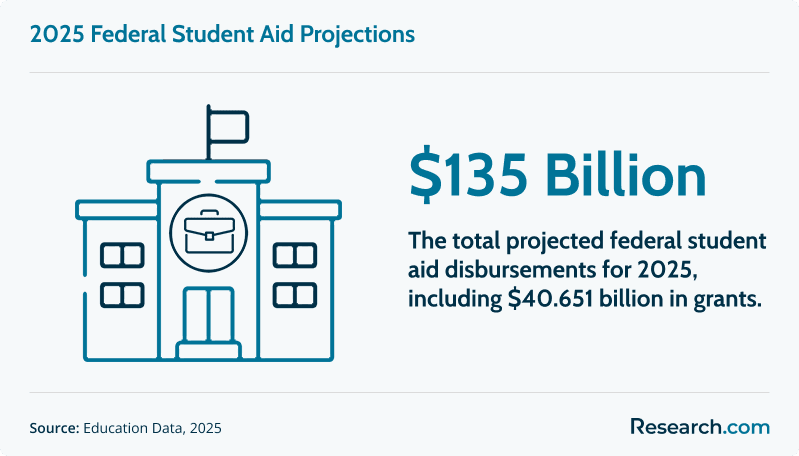
In 2025, federal student aid disbursements are projected to total $135 billion, with $40.65 billion allocated for grants. Students should confirm eligibility early because aid rules, deadlines, and institutional funding limits vary.
| Funding option | Best for | Important caution |
| Scholarships | Students with strong academics, specific backgrounds, or targeted career interests | Deadlines may occur before admission decisions |
| Assistantships | Students who can work on campus or remotely for a department | Availability can be limited and competitive |
| Federal aid | Eligible students who need financing beyond savings or scholarships | Loans must be repaid with interest |
| Employer tuition support | Working professionals whose degree supports business needs | Reimbursement policies may require continued employment |
What are the prerequisites for enrolling in a master's degree in data analytics program?
Admissions requirements vary, but most programs want evidence that applicants can handle graduate-level quantitative, technical, and analytical coursework. Applicants from computer science, mathematics, statistics, engineering, economics, business, information systems, and related fields may have an easier transition, but many programs also consider career changers who complete prerequisite coursework.
- Bachelor’s degree. Applicants typically need a bachelor’s degree from an accredited institution. Degrees in computer science, mathematics, statistics, or business are often preferred. Many programs look for a minimum undergraduate GPA around 3.0, although some schools offer flexibility based on experience or supplemental evidence.
- Programming preparation. Programs may expect familiarity with Python, R, SQL, or another programming language used for data manipulation and analysis. Some schools require a prior college-level programming course.
- Quantitative background. Statistics, calculus, linear algebra, probability, or research methods may be required or strongly recommended, especially for programs with data science or machine learning emphasis.
- Professional experience. Work experience is not always mandatory, but experience in analytics, IT, business intelligence, finance, operations, research, or related fields can strengthen an application.
- Application materials. Applicants are often asked for a résumé, statement of purpose, letters of recommendation, transcripts, and sometimes a portfolio or evidence of technical work.
- Standardized test scores. GRE or GMAT scores may be required by some institutions, particularly when an applicant’s GPA or academic background is below the preferred threshold. Many programs now waive or make these exams optional.
How does a master's degree in data analytics complement a 2 year computer science degree?
A master’s in data analytics can build on the programming, algorithms, database, and software development foundation gained through a 2 year computer science degree. The computer science background helps students understand how systems process data, while the analytics master’s adds statistical modeling, machine learning, visualization, data storytelling, and decision-support methods.
This combination can be especially useful for students who enjoy technical problem-solving but want to work closer to business strategy, predictive modeling, AI-enabled applications, or data product development. Before enrolling, confirm whether your computer science credits satisfy prerequisite requirements and whether you need additional coursework in statistics or probability.
Does a Master's in Data Analytics Deliver a Strong Return on Investment?
A master’s in data analytics delivers a strong return on investment only when the career benefits justify the total cost, time, and opportunity cost. To evaluate ROI, compare tuition and fees against realistic salary changes, promotion potential, job mobility, and the strength of your existing skills. Do not assume the degree alone will produce a salary jump.
Use a practical payback calculation: estimate your total program cost, subtract grants or employer support, then compare the remaining cost with the additional annual earnings you reasonably expect after graduation. Also compare target analytics roles with related technology paths, including opportunities described in Research.com’s guide to highest paid computer science jobs.
| ROI factor | Good sign | Warning sign |
| Curriculum alignment | Courses match target roles such as data scientist, BI analyst, or data engineer | Coursework is broad but shallow, with limited technical depth |
| Applied portfolio | Capstone, practicum, internship, or employer-sponsored project is required | Few opportunities to produce work samples |
| Cost control | Scholarships, assistantships, employer aid, or affordable public tuition reduce debt | High borrowing with uncertain salary improvement |
| Career services | Dedicated analytics career coaching, employer connections, and alumni outcomes are available | Career support is generic or hard to verify |
Does your master’s program integrate data security and privacy best practices?
Data analytics professionals often work with sensitive, regulated, or proprietary data. A strong master’s program should teach students how to handle data responsibly, not just how to model it. Look for coursework or modules covering data privacy, access controls, ethical analytics, bias, regulatory compliance, security risk, and responsible use of AI-enabled tools.
This is especially important in healthcare, finance, insurance, education, government, and cybersecurity-adjacent roles. Students interested in the security side of analytics can compare related career and compensation information in Research.com’s guide to cyber security salary.
Can a Master’s in Data Analytics Facilitate a Transition into AI-Driven Roles?
Yes, a data analytics master’s can support a move into AI-driven roles when the curriculum includes machine learning, model evaluation, programming, data engineering, natural language processing, deep learning fundamentals, and responsible AI practices. However, not every analytics degree is an AI degree. Some programs focus primarily on dashboards, reporting, and business intelligence.
If your goal is AI, compare course descriptions carefully and look for applied projects involving model development, cloud computing, unstructured data, and automation. Students who want a more AI-specific route can also review Research.com’s guide to an MS in AI online program.
What courses are typically in a master's degree in data analytics program?
Data analytics master’s programs usually combine quantitative methods, computing, data management, visualization, and applied decision-making. The balance varies by school, so applicants should read the catalog rather than relying only on program titles.
- Data analysis and statistics. Students study probability, hypothesis testing, regression, statistical inference, and other methods used to interpret data and support decisions.
- Computer science and programming. Coursework often includes Python, R, SQL, data structures, algorithms, databases, and software practices. Students who need additional preparation can compare a programming degree online with shorter prerequisite or certificate options.
- Machine learning. Students learn supervised and unsupervised learning, decision trees, neural networks, model validation, and predictive modeling techniques.
- Data visualization. Courses teach students to communicate findings through dashboards, charts, reports, and visual narratives using tools such as Tableau, Power BI, or Python libraries.
- Big data technologies. Students may work with distributed computing tools and large-scale data environments such as Hadoop and Spark.
- Business intelligence. These courses connect analysis to organizational decision-making, performance measurement, operations, strategy, and stakeholder communication.
Coursework is only part of career preparation. Employers also value hands-on projects, clean code, business communication, version control, data ethics, cloud familiarity, and the ability to explain trade-offs clearly.
What types of specializations are available in a master's degree in data analytics program?
Specializations help students tailor a data analytics master’s degree toward specific roles or industries. The right concentration depends on whether you want to build models, manage data infrastructure, advise business leaders, strengthen cybersecurity analytics, or work with large-scale AI-enabled systems.
| Specialization | What students learn | Best fit for |
| Data Science | Predictive modeling, advanced statistics, machine learning, and data visualization | Students targeting data scientist or applied machine learning roles |
| Data Engineering | Database design, ETL processes, data pipelines, storage systems, and big data tools | Students who want to build and maintain data infrastructure |
| Decision Process Engineering | Business process improvement, project management, decision intelligence, and analytics-driven change | Students interested in operations, consulting, and organizational strategy |
| Big Data Technologies | Large-scale data processing, AI and ML applications, Hadoop, Spark, and distributed systems | Students who want to work with high-volume, complex datasets |
| Cybersecurity Analytics | Threat detection, network log analysis, vulnerability identification, and risk-focused analytics | Students interested in security operations, fraud analysis, or cyber risk roles |
Students interested in cybersecurity analytics may also compare flexible options from cybersecurity schools online, especially if they want a program more directly focused on security practice.
What Research and Interdisciplinary Collaboration Opportunities Exist in Data Analytics Programs?
Research and interdisciplinary projects can make a data analytics master’s more valuable, particularly for students who want to work in healthcare, bioinformatics, finance, public policy, education, cybersecurity, or product analytics. Strong programs may offer industry-sponsored projects, faculty-led research, lab opportunities, consulting-style capstones, or partnerships with departments outside computer science and business.
Interdisciplinary work helps students learn domain context, which is often the difference between producing technically correct analysis and producing analysis that decision-makers can use. Students interested in health, biology, and computational research can compare related pathways such as an online master's in bioinformatics.
How Can Cybersecurity Knowledge Complement a Master's in Data Analytics?
Cybersecurity knowledge strengthens data analytics training because many analytics roles involve sensitive data, threat signals, fraud patterns, access logs, and risk indicators. Students who understand both analytics and security can help organizations detect anomalies, monitor systems, evaluate vulnerabilities, and protect data assets.
This combination can be useful for roles in security operations, fraud analytics, compliance, risk management, insurance, finance, and healthcare. If you are weighing security-focused pathways, compare degree levels, career goals, and earnings context using Research.com’s guide to associate's in cyber security degree salary.
How to Choose the Best Master's Degree in Data Analytics Program
The best master’s program is the one that matches your target role, budget, schedule, technical starting point, and preferred learning format. Rankings can help you discover options, but they should not replace your own due diligence.
- Define your target role first. A student aiming for business intelligence needs a different curriculum than someone targeting data engineering, data science, or machine learning engineering. Match electives, tools, and projects to job postings you would actually apply for.
- Check accreditation. Confirm institutional accreditation through recognized accrediting bodies. If you are considering distance learning, Research.com’s resource on nationally accredited online colleges can help you understand accreditation considerations, but always verify the school’s current status directly.
- Compare curriculum depth. Look beyond course names. Read descriptions for Python, R, SQL, statistics, databases, machine learning, visualization, cloud tools, ethics, and capstone requirements.
- Evaluate the format honestly. Online programs offer flexibility for working professionals. Campus programs may provide stronger face-to-face networking. Hybrid programs can balance structure and convenience, but may require travel.
- Ask about career support. Look for analytics-specific coaching, résumé review, interview preparation, employer events, internship connections, alumni networking, and transparent outcomes.
- Calculate full cost. Include tuition, fees, software, travel, books, lost wages, and loan interest. Compare the number to realistic salary gains, not best-case outcomes.
- Review admissions fit. If you lack prerequisites, ask whether the school offers bridge courses and whether those courses add cost or time.
| Common mistake | Why it can hurt you | Better approach |
| Choosing only by ranking | A highly ranked program may not match your budget, schedule, or target role | Use rankings as a starting point, then compare curriculum, outcomes, and cost |
| Ignoring accreditation | Accreditation can affect financial aid, employer recognition, and transfer options | Verify institutional accreditation before applying |
| Looking only at tuition | Fees, software, relocation, and lost income can change the total cost | Request a full cost-of-attendance estimate |
| Assuming online means easier | Online graduate analytics courses can be technically demanding and fast-paced | Ask about workload, live sessions, support, and project expectations |
| Skipping portfolio review | Employers often want proof that you can apply analytics methods | Choose a program with capstones, practicums, or substantial applied projects |
What career paths are available for graduates of a master's degree in data analytics program?
Graduates can pursue roles that involve collecting, cleaning, modeling, visualizing, interpreting, and communicating data. The right role depends on your technical depth, business knowledge, communication ability, and project experience.
1. Data Analyst
Data analysts collect, clean, analyze, and explain data so teams can make better decisions. They often use SQL, Excel, Tableau, Power BI, Python, or R to identify trends, build reports, and present findings. The role requires both technical accuracy and strong communication because analysts frequently work with business stakeholders. Students interested in marketing-focused analytics can also review Research.com’s marketing analyst career guide.
Median salary: $82,640 per year
2. Data Scientist
Data scientists use statistical modeling, machine learning, programming, and experimentation to solve complex problems and generate predictions or insights from large datasets. Some professionals strengthen their technical foundation through an online masters in computer science or a campus-based computer science program, especially when targeting more algorithm-intensive work.
Median salary: $122,738 per year
3. Business Intelligence Analyst
Business intelligence analysts turn organizational data into dashboards, reports, metrics, and recommendations. They track key performance indicators, analyze trends, and help leaders understand business performance. For a more detailed breakdown of responsibilities and skills, see Research.com’s business intelligence analyst career guide.
Median salary: $99,864 per year
4. Data Engineer
Data engineers design, build, and maintain the systems that move and store data. They create data pipelines, manage databases, optimize architecture, and support analysts and data scientists by making data reliable and accessible. Common tools may include Hadoop, Spark, cloud platforms, and database technologies.
Median salary: $129,716 per year
5. Machine Learning Engineer
Machine learning engineers build, test, deploy, and improve models that allow systems to learn from data. Their work may support recommendation engines, predictive analytics, fraud detection, natural language processing, or automation. The role requires strong programming, algorithm knowledge, model evaluation skills, and collaboration with data scientists and software engineers.
Median salary: $128,769 per year
Another related pathway is data architecture. Data architects design the structures that govern how data is collected, stored, integrated, and accessed across organizations. If that path interests you, review Research.com’s guide on the steps to become a data architect.
What emerging trends are shaping data analytics master’s programs?
Data analytics programs are changing as employers adopt AI tools, cloud platforms, automated workflows, and real-time decision systems. Many programs now update coursework to include machine learning, AI ethics, data privacy, cloud computing, real-time visualization, and applied industry projects. Flexible online options are also expanding for working adults, including related data science masters online programs.
These trends make curriculum review more important. A program that was strong several years ago may need updated coverage of AI-assisted analytics, responsible model use, security, cloud data stacks, and communication for decision-makers.
Can Data Analytics Master's Programs Provide Affordable Pathways to AI Specializations?
Some data analytics master’s programs now include AI-related electives, machine learning projects, or applied automation coursework, allowing students to gain AI exposure without completing a separate AI degree. This can be cost-effective if the analytics degree already matches your career goals and includes enough technical depth.
However, students should distinguish between light AI exposure and a truly AI-focused curriculum. If your goal is to specialize deeply in artificial intelligence, compare analytics programs with dedicated AI options, including Research.com’s guide to the cheapest online artificial intelligence degrees.
Do Master’s Programs in Data Analytics Effectively Bridge Theory and Practice?
The strongest data analytics master’s programs connect theory with practice through capstones, internships, practicum courses, employer-sponsored projects, research collaborations, and applied datasets. These experiences help students show employers how they solve problems, document methods, communicate findings, and make recommendations.
Practice-based learning is especially valuable for career changers and students without prior analytics roles. Interdisciplinary electives can also broaden perspective, including fields outside traditional analytics such as a game development degree online, where data can support user behavior analysis, product design, and performance optimization.
What is the job market for graduates with a master's degree in data analytics?
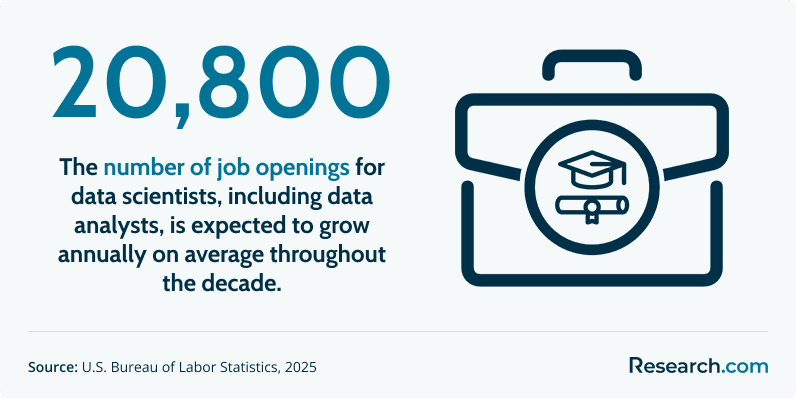
The job market for data analytics graduates is supported by organizations’ continued reliance on data-driven decision-making. The U.S. Bureau of Labor Statistics projects a 36% increase in data science jobs from 2022 to 2032, which is much faster than the average for all occupations. Opportunities exist in finance, healthcare, technology, consulting, insurance, education, retail, manufacturing, and government.
Graduates with a data analytics master's degree can expect competitive salaries, but results vary. As of 2027, data analysts earn an average annual salary of $68,359, with entry-level positions starting around $49,000 and experienced professionals earning up to $93,000. Senior data analysts see higher averages, with median salaries of approximately $91,448. Program quality, work experience, portfolio strength, technical specialization, and geographic market all influence outcomes. Students comparing flexible options can also review Research.com’s guide to top ranking online master's programs in data analytics.
Questions to ask before applying to a master’s in data analytics program
- Is the institution properly accredited, and can I verify that status independently?
- Does the curriculum match my target job title: data analyst, data scientist, BI analyst, data engineer, or machine learning engineer?
- Which programming languages, databases, visualization platforms, and machine learning tools will I actually use?
- Does the program include a capstone, practicum, internship, or employer-sponsored project?
- What is the full cost, including tuition, fees, software, books, travel, and loan interest?
- Can I complete the program while working, or will I need to reduce my hours?
- Are GRE or GMAT scores required, optional, or waived?
- Will I need bridge courses, and do those courses add time or cost?
- What career services are available specifically for analytics students?
- What outcomes can the school document, and how recent are those outcomes?
Key Insights
- A master’s in data analytics is most valuable when it combines statistics, programming, databases, machine learning, visualization, data ethics, and applied projects.
- Program fit matters more than program name alone. Compare curriculum, accreditation, cost, flexibility, project work, and career support before applying.
- Completion time usually ranges from less than 12 months in some accelerated formats to 24 to 36 months for students who need foundational coursework or study part time.
- Costs vary widely. Tuition, residency status, fees, software, and lost income should all be included in your ROI calculation.
- Strong programs help students build a portfolio through capstones, practicums, internships, or industry-sponsored projects.
- AI, cloud computing, privacy, cybersecurity, and real-time analytics are increasingly important. Look for programs that reflect current employer expectations.
- Salary outcomes can be strong, but they are not automatic. Your experience, technical skills, portfolio, location, and target role will shape your results.
References:
- Precedence Research. (2024). Data analytics market size, share & trends analysis report by solution, by application, by industry, by region, and segment forecasts, 2024 - 2032. Retrieved March 5, 2025, from Precedence Research.
- PayScale. (n.d.). Data Analyst salary. Retrieved March 5, 2025, from PayScale.
- SkillsGuide. (n.d.). Data Analyst skills. Retrieved March 5, 2025, from SkillsGuide.
- ZipRecruiter. (n.d.). Business Intelligence Analyst salary. ZipRecruiter. Retrieved March 5, 2025, from ZipRecruiter.
- ZipRecruiter. (n.d.). Data Analytics Analyst salary. Retrieved March 5, 2025, from ZipRecruiter.
- ZipRecruiter. (n.d.). Data Engineer salary. Retrieved March 5, 2025, from ZipRecruiter.
- ZipRecruiter. (n.d.). Data Scientist salary. Retrieved March 5, 2025, from ZipRecruiter
- ZipRecruiter. (n.d.). Machine Learning Engineer salary. Retrieved March 5, 2025, from ZipRecruiter.
- Zippia. (2024). Data Analyst demographics and statistics in the US. Zippia. Retrieved March 5, 2025, from Zippia.
Other Things You Should Know About Master's Degree in Data Analytics Programs
Essential technical skills for admission to top data analytics master's programs in 2027 include proficiency in programming languages such as Python and R, knowledge of machine learning algorithms, and experience with data visualization tools like Tableau. Understanding statistical modeling and database management systems is also crucial.
When choosing the best master’s program in data analytics for 2027, consider program curriculum, faculty expertise, industry connections, flexibility (online/in-person options), and alumni success. Additionally, ensure the program is updated with the latest technologies and techniques in data analytics to ensure relevance in an evolving field.
Many top programs require no standardized test, but some still ask for the GRE and use minimum quantitative-score thresholds. Typical admissions files include a bachelor’s degree, official transcripts, a statement of purpose, two letters of recommendation, and proof of English proficiency such as TOEFL or IELTS for international applicants.


