
2027 Data Science vs Computer Science Degree Programs: Explaining the Difference

Co-Founder and Chief Data Scientist
Choosing between a data science degree and a computer science degree is not just a question of which major sounds more technical. It is a decision about the kind of problems you want to solve: using data to explain, predict, and guide decisions, or designing the software, systems, and computing infrastructure that make technology work. Both routes can lead to strong technology careers, but they build different strengths and prepare graduates for different jobs.
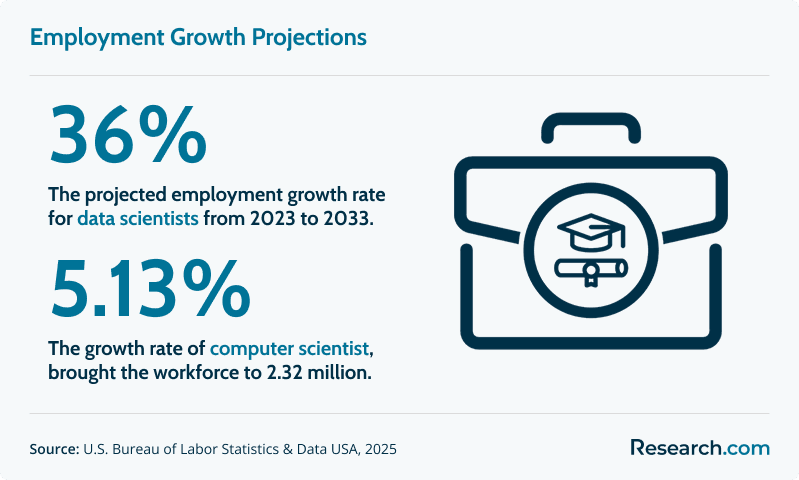
For students comparing majors, career changers weighing a second degree, or working professionals deciding whether to specialize, the distinction matters. Computer science jobs are projected to grow 5.13% annually, creating 356,700 openings per year, while data science will expand 36%, adding 20,800 jobs annually from 2023 to 2033. In practical terms, data science is growing faster, but computer science offers a broader and much larger employment base because computing skills apply across software, cybersecurity, cloud, education, healthcare, finance, and many other sectors.
This guide explains how data science and computer science degree programs differ in coursework, skills, cost, certifications, salaries, industries, and career outcomes. It also shows when each path makes sense, what questions to ask before enrolling, and how to avoid common mistakes when choosing a technology degree.
Quick answer: data science vs. computer science degree
A data science degree is usually the better fit if you want to work with statistics, machine learning, business intelligence, predictive modeling, and large datasets. A computer science degree is usually the stronger choice if you want a broader technology foundation in programming, algorithms, software engineering, systems, cybersecurity, cloud computing, and computing theory.
| Comparison point | Data science degree | Computer science degree |
| Primary focus | Analyzing data, building models, and translating findings into decisions | Designing software, systems, algorithms, networks, and computing tools |
| Best for students who like | Statistics, analytics, visualization, machine learning, and business problems | Programming, system design, software development, security, and computational logic |
| Common roles | Data analyst, data scientist, machine learning engineer, BI developer, data engineer | Software developer, systems analyst, cybersecurity analyst, cloud solutions architect, full stack developer |
| Typical education starting point | Bachelor’s degree, with master’s degrees or certifications useful for advanced roles | Bachelor’s degree, with certifications or graduate study useful for specialized roles |
| Labor market profile | Smaller occupation base with rapid projected growth | Larger technology workforce with broader job categories |
Key facts to know before choosing
- Education requirements differ by specialization. A bachelor’s degree is commonly the entry point in both fields, while graduate degrees, boot camps, and certifications can help candidates build advanced or job-specific skills.
- Demand is strong, but not identical. Data science jobs have reached 192,710 professionals, with a projected 36% growth from 2023 to 2033 and about 20,800 job openings annually. Computer science jobs represent a workforce of 2.32 million and a 5.13% annual growth rate.
- Work environments vary. Data scientists are often concentrated in computer systems design, insurance, consulting, research, and analytics-driven organizations. Computer scientists work across a wider set of sectors, including education, healthcare, finance, technology services, and infrastructure-heavy industries.
- Salary can be high in both fields. Data scientists earn a median annual salary of $160,772, with salaries ranging from $127,000 to $206,000. Computer scientists have a median salary of $188,033, with a range of $145,000 to $231,000.
- Your preferred work style matters. Data science is usually more focused on extracting meaning from information, while computer science is more focused on building and improving the systems that process, secure, and deliver that information.
- Data scientist vs. computer scientist: what do they actually do?
- Education requirements for data science and computer science in 2027
- Curriculum comparison: what you study in each degree
- Certifications that can strengthen each career path
- Degree cost comparison and financial aid considerations
- Career paths for data science and computer science graduates
- Are accelerated online computer science degrees worth considering?
- Can specializations such as game development change your career options?
- Skill differences between data science and computer science
- Internships, projects, and hands-on learning opportunities
- Do you need a graduate degree for data science or computer science?
- How interdisciplinary study can support technology careers
- How biotechnology can connect with computing and analytics
- Admissions requirements for data science and computer science programs
- Salary comparison for data science and computer science professionals
- Industries that hire data scientists and computer scientists
- How health informatics can expand technology career options
- Job outlook for data science and computer science graduates
Data scientist vs. computer scientist: what do they actually do?
The simplest way to separate the two fields is this: data scientists turn information into insight, while computer scientists build and improve the technology systems that make computing possible. There is overlap, especially in programming, databases, artificial intelligence, and machine learning, but the everyday work is usually different.
What data scientists typically do
Data scientists work with complex datasets to answer questions, predict outcomes, improve decisions, and identify patterns that are not obvious from raw information alone. Their work often combines statistics, coding, machine learning, business understanding, and communication.
- Gathering, cleaning, organizing, and validating large datasets before analysis.
- Using statistical methods to detect trends, relationships, risks, and opportunities.
- Developing predictive models with machine learning techniques.
- Creating dashboards, reports, charts, and visual explanations for decision-makers.
- Working with Python, R, SQL, and visualization platforms to analyze and present data.
- Partnering with business, product, finance, healthcare, or operations teams to solve measurable problems.
- Refining models as new data becomes available and business conditions change.
What computer scientists typically do
Computer scientists focus on computation itself: how software is designed, how systems operate, how algorithms solve problems, and how digital infrastructure can be made more secure, scalable, and efficient. Their work can range from application development to research, cloud architecture, cybersecurity, databases, and operating systems.
- Designing, coding, testing, and maintaining software systems and applications.
- Writing programs in languages such as Java, C++, Python, and related tools.
- Creating algorithms that improve speed, reliability, automation, and computational efficiency.
- Studying new technologies and applying them to improve system performance.
- Working with operating systems, databases, networks, protocols, and distributed systems.
- Improving software security, scalability, usability, and maintainability.
- Collaborating with engineers, developers, product teams, IT groups, and business leaders to deliver technical solutions.
Professionals from either field can move into technology leadership over time. If your long-term goal is to guide an organization’s technical strategy, learning how to become a CTO can help you understand the leadership, architecture, business, and management skills needed beyond the degree itself.
Education requirements for data science and computer science in 2027
Both fields require strong quantitative reasoning, programming ability, and disciplined problem-solving. A bachelor’s degree is typically the starting credential, but the academic emphasis differs. Data science programs place more weight on statistics, data mining, machine learning, and applied analytics, while computer science programs emphasize algorithms, programming, software design, systems, and computational theory.
Among data science professionals, 50.7% hold a bachelor’s degree, while 66.1% of those in computer science have attained the same level of education. Students who want to finish sooner while balancing work or family responsibilities may compare traditional options with a fast track bachelor degree online, especially if they already have transfer credits or prior college coursework.
Graduate education can be helpful for research-heavy, advanced analytics, AI, architecture, or leadership roles. However, a master’s degree is not automatically the right investment for every student. Before enrolling, compare the program’s curriculum, employer connections, project requirements, accreditation, career outcomes, and total cost. Boot camps and certifications can also supplement either degree by adding job-specific training in cloud platforms, security tools, data engineering, analytics software, or programming frameworks.
| Education option | When it may make sense | What to check first |
| Bachelor’s degree | You need a broad foundation and an entry-level credential for technology roles | Accreditation, curriculum depth, internship support, transfer policy, and career services |
| Master’s degree | You want advanced analytics, AI, research, systems design, leadership, or specialized technical roles | Total cost, prerequisites, employer demand, thesis or capstone format, and return on investment |
| Certification | You already have a degree or experience and need proof of a specific skill or platform | Employer recognition, renewal rules, exam cost, and whether hands-on practice is included |
| Boot camp | You want concentrated practical training in coding, analytics, cloud, or cybersecurity | Placement claims, project quality, refund policies, instructor background, and admissions standards |
Curriculum comparison: what you study in each degree
Data science and computer science programs both teach programming, mathematics, and technical problem-solving, but they use those foundations for different purposes. Data science curricula are built around extracting value from data. Computer science curricula are built around designing and understanding computing systems.
Coursework in data science programs
Data science coursework usually emphasizes applied analytics. Students learn how data is collected, prepared, stored, analyzed, modeled, and communicated. Common courses include statistics, probability, database management, machine learning, visualization, and programming in Python, R, and SQL. Many assignments are project-based because employers often expect graduates to show portfolios, models, dashboards, or analytics reports.
Students who want a faster route to completion may consider accelerated online degree programs, but they should make sure the shortened timeline still includes rigorous programming practice, statistics, data cleaning, and a substantial capstone or portfolio project.
Coursework in computer science programs
Computer science coursework is generally broader and more theory-heavy. Students study programming, algorithms, discrete mathematics, computer architecture, operating systems, networking, databases, software engineering, and computational logic. Depending on the program, students may also choose electives in artificial intelligence, cybersecurity, cloud computing, game development, mobile development, or distributed systems.
Typical curriculum areas
| Data science curriculum | Computer science curriculum |
| Mathematics, including linear algebra and calculus | Discrete mathematics |
| Statistics and probability | Computer architecture |
| Programming for data science | Operating systems |
| Data mining and warehousing | Algorithms and complexity |
| Machine learning and artificial intelligence | Programming paradigms |
| Ethics in data science | Artificial intelligence |
| Capstone projects involving real or simulated datasets | Software engineering principles |
| Electives in areas such as finance, healthcare, or marketing | Systems security |
Choose data science if you want to spend more time interpreting information and building models. Choose computer science if you want stronger training in how software and computing systems are created, optimized, and secured.
Certifications that can strengthen each career path
Certifications are not a substitute for a strong degree program, but they can help you demonstrate specific technical abilities to employers. Data science credentials usually validate skills in analytics, modeling, machine learning, cloud data tools, and data pipelines. Computer science-related credentials often focus on software development, cloud architecture, networking, systems, and cybersecurity.
Students and professionals who want targeted, flexible training can compare online certificate programs alongside degree options, especially when a specific platform or technical skill appears frequently in job descriptions.
Common certifications for data science professionals
- Microsoft Certified: Azure Data Scientist Associate: This credential focuses on using Azure Machine Learning to train, assess, and deploy models, making it most relevant for professionals working in Microsoft cloud environments.
- Google Professional Data Engineer: This Google Cloud certification validates knowledge of data processing systems, data analysis, security, quality, and infrastructure design on Google Cloud.
- IBM Data Science Professional Certificate: This beginner-accessible certificate introduces core topics such as Python, SQL, visualization, and machine learning.
- Certified Analytics Professional (CAP): CAP is a vendor-neutral analytics credential covering the process from defining business problems to deploying analytical solutions.
- Cloudera Data Platform Generalist Certification: This certification assesses familiarity with the Cloudera ecosystem, including big data concepts, processing tools, and analytics capabilities.
- SAS Certified Data Scientist: This credential covers advanced analytics, machine learning, and programming with SAS tools, which can be useful in organizations that rely heavily on statistical analysis.
Common certifications for computer science professionals
- CompTIA Security+: This entry-level security certification covers network security, threats, vulnerabilities, and risk management, making it useful for those exploring cybersecurity roles.
- AWS Certified Solutions Architect – Associate: This credential validates the ability to design and deploy applications on Amazon Web Services, which is valuable for developers, systems engineers, and cloud professionals.
- Cisco Certified Network Associate (CCNA): CCNA covers networking fundamentals, IP services, and security concepts for professionals who support or manage networked systems.
- Oracle Certified Java Programmer: This certification is designed for developers who want to demonstrate Java programming, debugging, and application deployment skills.
- Certified Ethical Hacker (CEH): CEH focuses on ethical hacking methods and defensive strategies for professionals pursuing security-oriented work.
- Microsoft Certified: Azure Solutions Architect Expert: This advanced cloud credential is aimed at professionals designing Azure-based infrastructure, networking, security, and cloud solutions.
Degree cost comparison and financial aid considerations
Degree cost varies widely in both fields, and the listed tuition is only part of the financial picture. Students should also account for fees, books, software, hardware, housing, transportation, lost work hours, transfer credit rules, and how long the program will actually take.
Data science degrees tend to cost more on average. The cost of a bachelor’s degree in data science depends on institution type, residency status, and program format. Annual tuition and fees can range from approximately $6,930 for in-state students at public institutions to $34,177 for out-of-state students, averaging around $66,272 for the entire degree. Online programs may offer lower-priced formats, with tuition rates as low as $3,835 per six-month term, depending on the institution.
Computer science bachelor’s degree costs also vary substantially. Annual tuition and fees can range from approximately $6,000 to over $40,000, depending on institution type, residency status, and delivery format. Some online degrees may be available for under $16,000 in total. Students comparing fields such as analytics and security should also look beyond price; this cybersecurity and data science programs comparison can help clarify how curriculum, career outcomes, and skill development differ.
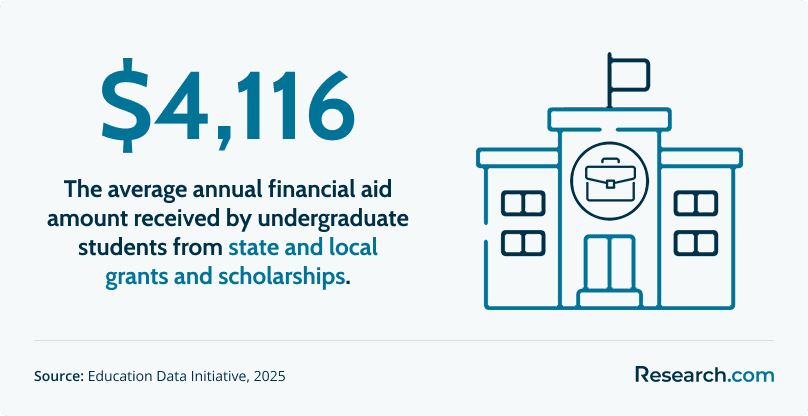
Financial aid can reduce out-of-pocket costs. According to EducationData.org, 33.2% of all undergraduates receive financial aid through state or local grants and scholarships. On average, an undergraduate receives $4,116 from state and local aid, which can help pay for tuition, books, fees, and other school-related expenses.
| Cost factor | Why it matters | Question to ask |
| Tuition and fees | Sticker price can differ sharply by public, private, in-state, out-of-state, online, and campus format | What is the full program cost, not just annual tuition? |
| Transfer credits | Accepted credits can shorten time to graduation and lower total cost | How many of my credits will apply to major requirements? |
| Program length | A cheaper annual rate may still cost more if the program takes longer | What is the typical completion time for students like me? |
| Technology requirements | Programming, analytics, cloud labs, and computing courses may require specific hardware or software | Are tools, lab access, or certification prep included in tuition? |
| Career support | Internships, employer projects, and portfolio support can affect job readiness | What placement, internship, and alumni support does the program provide? |
Career paths for data science and computer science graduates
Data science graduates usually move into roles centered on analytics, modeling, reporting, and data infrastructure. Computer science graduates usually enter roles involving software development, systems analysis, cybersecurity, cloud architecture, and application development. The right path depends on whether you prefer analyzing information or building technology systems.
Common roles for data science graduates
| Role | What the role does | Median salary |
| Data Analyst | Reviews structured datasets, identifies trends, prepares reports, and uses tools such as SQL, Excel, and visualization platforms to explain findings to stakeholders. | $82,640 |
| Data Scientist | Uses statistics, machine learning, and programming to solve complex problems, build predictive models, and support data strategy with structured and unstructured data. | $122,738 |
| Machine Learning Engineer | Builds, deploys, scales, and improves machine learning models so they can function reliably in production environments. | $128,769 |
| Business Intelligence (BI) Developer | Creates dashboards, reporting systems, and analytics tools that help organizations monitor performance and make better decisions. | $111,882 |
| Data Engineer | Designs and maintains data pipelines, storage systems, and infrastructure that make reliable data available for analysis. | $129,716 |
Common roles for computer science graduates
| Role | What the role does | Median salary |
| Software Developer | Designs, writes, tests, and maintains applications for web, mobile, desktop, enterprise, and systems environments. | $111,845 |
| Systems Analyst | Evaluates IT systems, translates business needs into technical requirements, and recommends improvements to make systems more effective. | $89,296 |
| Cybersecurity Analyst | Protects systems and networks by monitoring threats, assessing vulnerabilities, and implementing security controls. Students seeking a faster pathway into this area may compare accelerated online cybersecurity degree programs. | $99,400 |
| Cloud Solutions Architect | Designs cloud strategies, supports cloud migrations, and helps organizations build scalable, secure, and efficient environments on platforms such as AWS, Azure, or Google Cloud. | $150,241 |
| Full Stack Developer | Works across front-end interfaces, back-end systems, APIs, databases, and server-side logic to build complete web applications. | $123,262 |
Which career path is more flexible?
Computer science is typically the more flexible undergraduate major because it builds broad programming, systems, and software foundations that can support many technology roles. Data science can be highly valuable when you are confident you want analytics, AI, machine learning, or business intelligence work. Students who are uncertain may prefer computer science with data science electives, while students already committed to analytics may choose a dedicated data science program.
Are accelerated online computer science degrees worth considering?
Accelerated online computer science programs can be useful for motivated students who need a faster route into technical roles, especially those with previous college credits, strong self-discipline, or work experience. These programs often combine computing theory with practical labs, programming assignments, software projects, and system design exercises. A shorter format, however, should not mean weaker preparation. Students should verify that the curriculum includes algorithms, databases, operating systems, software engineering, and substantial coding practice.
If speed is a major factor in your decision, compare admission requirements, credit transfer policies, weekly workload, faculty access, project expectations, and employer connections before choosing a 1-year computer science degree online.
Can specializations such as game development change your career options?
Specialized tracks can shape your portfolio and the kinds of employers you attract. In computer science, concentrations such as game development, cybersecurity, artificial intelligence, and cloud computing allow students to apply core computing concepts to specific industries or products. Game development is especially interdisciplinary because it can combine programming, graphics, design, physics, storytelling, and interactive systems.
Data science programs are usually less focused on creative software production and more focused on analytics, modeling, and domain-specific data applications. If you want to combine technical computing with interactive media, a game development degree online may be a more targeted option than a general data science program.
Skill differences between data science and computer science
The two degrees share programming, logic, and problem-solving, but they prioritize different skill sets. Data science emphasizes mathematical modeling, analytics, and communication of findings. Computer science emphasizes software construction, system design, algorithmic efficiency, and technical architecture. Students still deciding between security, systems, and software may also find a cyber security and computer science programs comparison useful.
Technical skills most important in data science
- Statistical analysis: Data scientists need statistical reasoning to evaluate patterns, uncertainty, relationships, and predictive results.
- Machine learning: Skills in regression, classification, clustering, and related methods help professionals build models that make predictions or classify information.
- Programming with Python and R: These languages are widely used for cleaning data, running analyses, building models, and creating visual outputs.
- Data wrangling: Raw data is often incomplete or inconsistent, so data scientists must know how to clean, transform, and prepare it before analysis.
- Data visualization: Tools such as Tableau, Power BI, and Matplotlib help turn complex findings into visuals that nontechnical stakeholders can understand.
Technical skills most important in computer science
- Algorithm design: Computer scientists need to create efficient procedures for solving computational problems and improving performance.
- Software development: Strong developers understand clean code, testing, debugging, version control, maintainability, and software engineering practices.
- Programming with Java, C++, and Python: These languages support application development, systems programming, automation, databases, and many technical environments.
- Operating systems and networking: Understanding how systems communicate and manage resources is important for reliable, secure computing.
- Database management: Knowledge of SQL and NoSQL systems helps professionals design, query, maintain, and optimize data storage environments.
Soft skills both fields require
- Problem-solving: Both fields require the ability to break complex challenges into smaller, solvable parts.
- Critical thinking: Professionals must evaluate assumptions, test solutions, and avoid drawing weak conclusions from code or data.
- Communication: Data scientists explain analytical findings, while computer scientists explain technical designs, limitations, and trade-offs.
- Continuous learning: Tools, frameworks, platforms, and employer expectations change quickly in both fields.
- Attention to detail: A small data error or coding mistake can affect decisions, security, performance, or product reliability.
Internships, projects, and hands-on learning opportunities
Strong technology programs do more than assign exams. They give students opportunities to build proof of ability through internships, cooperative education, capstone projects, research labs, hackathons, open-source work, employer-sponsored projects, or applied consulting experiences. These experiences matter because entry-level candidates often need more than a transcript to compete; they need evidence that they can write code, analyze data, collaborate, document work, and solve practical problems.
In data science, look for programs that require real datasets, model evaluation, dashboard development, ethical data use, and portfolio-ready projects. In computer science, look for software builds, code reviews, systems labs, team-based development, security exercises, and architecture projects. Students planning advanced AI-related study may also compare the cheapest online masters in artificial intelligence options if cost is a major constraint.
Do you need a graduate degree for data science or computer science?
An advanced degree can help, but it is not always essential. In data science, graduate study can deepen training in advanced modeling, machine learning, statistics, artificial intelligence, and research methods. In computer science, graduate programs can strengthen expertise in algorithms, systems design, software architecture, distributed computing, security, or research-oriented computing problems.
The decision should come down to role requirements, cost, time, and expected benefit. If your target jobs consistently prefer graduate education, a master’s may be worthwhile. If employers mainly ask for programming ability, projects, cloud skills, analytics tools, or security certifications, a shorter credential or strong portfolio may be more efficient. Cost-conscious students considering analytics-focused graduate study can compare the cheapest online master's in data science options while still checking curriculum rigor and employer recognition.
How interdisciplinary study can support technology careers
Technology work increasingly intersects with other fields, including healthcare, finance, logistics, manufacturing, biotechnology, education, and public policy. Interdisciplinary education can help professionals apply technical skills in settings where domain knowledge matters. A data scientist who understands healthcare workflows, for example, may be better prepared to analyze clinical data. A computer scientist who understands business operations may design more useful enterprise software.
For professionals interested in healthcare and technology, low cost nursing informatics programs online may offer a focused way to combine clinical knowledge, information systems, and analytics skills.
How biotechnology can connect with computing and analytics
Biotechnology can complement a technology career for professionals interested in bioinformatics, medical technology, environmental analytics, laboratory data systems, or computational biology. This path is not the same as a standard computer science or data science route, but it can create specialized opportunities where biological knowledge and technical skill overlap.
Students considering this direction should compare curriculum requirements carefully because biotechnology programs may include biology, chemistry, lab science, data analysis, and technical computing. Salary considerations can also vary by role and industry, so reviewing masters of biotechnology salary information may help with planning.
Admissions requirements for data science and computer science programs
Admissions expectations depend on the school and degree level, but both fields usually favor applicants with strong math preparation, analytical ability, and evidence of technical interest. Data science programs often look for coursework or experience in statistics, programming, quantitative reasoning, and analytics. Computer science programs often place more emphasis on programming fundamentals, algorithms, mathematics, and computational thinking.
Application materials may include transcripts, personal statements, recommendations, resumes, project examples, or prerequisite coursework. If you lack a technical background, ask whether the program offers bridge courses in programming, calculus, discrete mathematics, statistics, or database fundamentals. Students interested in pairing computing with security may also explore the cheapest online cyber security degree options as a related pathway.
| Before applying, ask | Why it matters |
| Is the institution properly accredited? | Accreditation can affect transfer credits, financial aid eligibility, employer recognition, and graduate school options. |
| Are there prerequisite courses? | Missing math or programming prerequisites can delay graduation or require extra tuition. |
| Does the program include portfolio projects? | Projects help demonstrate ability to employers, especially for entry-level roles. |
| How are online labs and technical support delivered? | Students need reliable access to tools, systems, instructors, and troubleshooting help. |
| What career services are available for technology students? | Internship support, employer partnerships, resume help, and interview preparation can improve job readiness. |
Salary comparison for data science and computer science professionals
Salary potential is strong in both fields, but pay varies by role, employer, location, experience, education, and technical specialization. Students should treat salary figures as planning benchmarks, not guaranteed outcomes.
As of 2025, data scientists in the United States have an estimated total median pay of $160,772 per year. This includes an average base salary of $115,618 and additional compensation averaging $45,154. Total pay typically ranges from $127,000 to $206,000 annually.
Computer scientists in the United States have an estimated total median pay of $188,033 per year, with an average base salary of $132,180. Total pay generally ranges from $145,000 to $231,000 annually.
- Geographic location: Pay can differ substantially by region. In Los Angeles, CA, data scientists' total pay ranges up to $302,166. Experienced computer scientists in Los Angeles can also earn higher compensation, with salaries reaching up to $270,238.
- Industry and employer: Technology, finance, research, consulting, and high-demand technical employers may pay more than other sectors, depending on role and experience.
- Education and specialized skills: Graduate education, rare technical skills, and advanced expertise can affect compensation. Data scientists with a Ph.D. have an estimated total pay of $240,839 per year, including an average base salary of $146,529, making the field relevant for students researching high paying degrees.
- Experience: Data scientists with 10–14 years of experience earn around $145,791, and those with over 15 years earn approximately $215,402, meanwhile computer scientists earn an average of $217,765.
| Field | Estimated total median pay | Typical total pay range |
| Data scientists | $160,772 | $127,000 to $206,000 |
| Computer scientists | $188,033 | $145,000 to $231,000 |
Industries that hire data scientists and computer scientists
Data scientists are most valuable in organizations that collect large amounts of information and need to turn it into forecasts, operational improvements, customer insights, risk assessments, or strategic recommendations. The industries that employ the highest percentage of data scientists include:
- Computer systems design and related services (0.9%)
- Management of companies and enterprises (0.69%)
- Management, scientific, and technical consulting services (0.69%)
- Insurance Carriers (0.95%)
- Scientific research and development services (1.10%)
Computer scientists work across a broader set of employers because software, networks, databases, cloud systems, and security infrastructure are needed almost everywhere. Common sectors include technology services, education, healthcare, finance, consulting, insurance, and public-sector organizations.
Career options also extend into adjacent areas. For example, people seeking entry level cybersecurity jobs no experience may begin in support, IT, security operations, or analyst roles across finance, healthcare, government, and other security-sensitive sectors.
| Industries | Total Computer Scientists in Workforce |
| Computer Systems Design | 553,430 |
| Colleges, Universities & Professional Schools (including junior colleges) | 98,029 |
| Management, Scientific & Technical Consulting Services | 71,771 |
| Elementary & Secondary Schools | 67,653 |
| Insurance Carriers | 57,369 |
| Source: Data USA, 2022 |
How health informatics can expand technology career options
Health informatics is a good example of how data science and computer science skills can be applied in a specialized industry. Professionals in this area may work with clinical data, electronic health records, healthcare analytics, digital health tools, patient care workflows, compliance needs, and health IT systems.
This field can suit data science students who want to analyze healthcare information and computer science students who want to build, secure, or improve health technology platforms. For a deeper look at roles and career prospects, review the health informatics job outlook.
Job outlook for data science and computer science graduates
The outlook for both fields is positive, but the type of growth differs. Data science has a faster projected growth rate because more organizations are relying on analytics, automation, machine learning, and data-driven decision-making. Computer science has a much larger employment base because computing skills support a wider range of roles and industries.
According to the U.S. Bureau of Labor Statistics, employment of data scientists is projected to grow at 36% from 2023 to 2033. This is expected to produce approximately 20,800 job openings annually over the decade.
Computer science degree graduates also face strong opportunities. As of 2022, the workforce for computer science professionals reached 2.32 million, growing at a rate of 5.13% from the previous year. Common occupations for graduates include software development, computer systems management, and specialized computing roles.
Current trends affecting both fields
- Artificial intelligence is changing expectations. Data science programs increasingly emphasize machine learning, model evaluation, responsible AI, and data ethics. Computer science programs are also adding AI-related coursework in software engineering, systems, and automation.
- Employers want practical proof of skill. Portfolios, GitHub repositories, dashboards, capstone projects, internships, and applied research can matter as much as course titles.
- Cloud platforms are becoming standard. Data pipelines, analytics workloads, software deployment, cybersecurity, and systems architecture increasingly rely on cloud environments.
- Cybersecurity knowledge is valuable across roles. Even non-security positions benefit from understanding secure coding, data privacy, access control, and risk management.
- Interdisciplinary expertise can create an advantage. Healthcare, finance, insurance, biotechnology, education, and consulting often value candidates who understand both technology and the industry context.
How to choose between a data science and computer science degree
- Start with the work you want to do. If you want to analyze datasets, build models, and explain insights, data science may fit better. If you want to build software, systems, networks, or security tools, computer science may be stronger.
- Review real job postings. Search for five to ten roles you want after graduation and compare the required skills, degree preferences, tools, and experience expectations.
- Compare curriculum depth. Do not choose based on the major name alone. Read course descriptions and check whether the program includes the technical subjects employers expect.
- Check accreditation and transfer policies. Accreditation can affect financial aid, credit transfer, employer perception, and graduate school eligibility.
- Calculate total cost, not just tuition. Include fees, books, technology, time to completion, lost income, and whether credits will transfer.
- Look for hands-on experience. Prioritize programs with internships, capstones, industry projects, research, labs, or portfolio development.
- Ask about outcomes carefully. Salary and placement claims should be supported by clear data, not vague marketing language.
Common mistakes to avoid
| Mistake | Why it can hurt you | Better approach |
| Choosing based only on salary | High salary ranges do not guarantee your outcome, especially without experience or specialized skills. | Compare job duties, required skills, demand, and your long-term interest. |
| Ignoring accreditation | Unaccredited programs can create problems with financial aid, credit transfer, and employer recognition. | Verify institutional accreditation before applying. |
| Assuming all online programs are equal | Some online degrees offer strong labs and support; others may lack hands-on depth. | Review projects, faculty access, technical support, and employer partnerships. |
| Looking only at tuition | A low tuition rate may not reflect fees, extra terms, software, or credits that do not transfer. | Ask for the full estimated cost to graduation. |
| Choosing data science without enough math interest | Statistics, probability, and modeling are central to the field. | Take introductory statistics and Python before committing if you are unsure. |
| Choosing computer science without expecting theory | Algorithms, discrete math, architecture, and systems courses can be challenging but important. | Review the required courses and prepare for math-heavy technical work. |
| Relying only on rankings | Rankings may not reflect your goals, budget, location, transfer credits, or learning needs. | Use rankings as one input, then evaluate fit, cost, curriculum, and outcomes. |
Student perspectives on choosing data science or computer science
-
: "
I started with computer science because I wanted a deep technical base, then discovered through data science courses that I also liked using data to solve practical problems. Exploring both areas helped me choose a specialization instead of guessing too early. — Jennifer
"
-
: "
Data science felt challenging at first because of the math, but the project work made the concepts click. I liked connecting assignments to real business questions and graduating with skills I could apply immediately. — Rhea
"
-
: "
Computer science helped me understand how software and systems work underneath the surface. Seeing classmates move into data science showed me that neither path is automatically better. It depends on whether you are more motivated by building technology or interpreting information. — Gian
"
Key Insights
- Choose data science if your main interest is turning data into decisions. This path is strongest for students who enjoy statistics, machine learning, analytics, visualization, and business or research questions.
- Choose computer science if you want the broader technology foundation. Computer science is generally more flexible for software development, systems, cybersecurity, cloud architecture, databases, and technical leadership pathways.
- Data science is growing faster, but computer science has the larger job base. Data science is projected to grow 36% from 2023 to 2033, while computer science represents a workforce of 2.32 million with a 5.13% annual growth rate.
- Coursework should drive your decision more than the degree title. Compare required classes, projects, labs, internships, and tools before assuming one program is stronger than another.
- Cost and ROI depend on completion time, aid, transfer credits, and career support. Do not compare tuition alone; estimate the total cost to graduation and the quality of job preparation.
- Hands-on work is essential. Employers often want to see coding projects, data analysis portfolios, dashboards, models, internships, or capstone work.
- There is no universally better degree. The better option is the one that matches your strengths, preferred work style, target roles, and willingness to build the technical skills employers actually require.
References:
- Bureau of Labor Statistics. (n.d.). Data scientists. U.S. Department of Labor. Retrieved from BLS.
- Bureau of Labor Statistics. (n.d.). Occupational employment and wages, May 2020: Computer and information research scientists. U.S. Department of Labor. Retrieved from BLS.
- Data USA. (n.d.). Computer science. Retrieved from Data USA.
- Glassdoor. (n.d.). Computer scientist salary. Retrieved from Glassdoor.
- Glassdoor. (n.d.). Data scientist salary. Retrieved from Glassdoor.
- ZipRecruiter. (n.d.). Bi developer salary. Retrieved from ZipRecruiter.
- ZipRecruiter. (n.d.). Cloud solutions architect salary. Retrieved from ZipRecruiter.
- ZipRecruiter. (n.d.). Cyber security analyst salary. Retrieved from ZipRecruiter.
- ZipRecruiter. (n.d.). Data analyst salary. Retrieved from ZipRecruiter.
- ZipRecruiter. (n.d.). Data engineer salary. Retrieved from ZipRecruiter.
- ZipRecruiter. (n.d.). Data scientist salary. Retrieved from ZipRecruiter.
- ZipRecruiter. (n.d.). Full stack developer salary. Retrieved from ZipRecruiter.
- ZipRecruiter. (n.d.). Machine learning engineer salary. Retrieved from ZipRecruiter.
- ZipRecruiter. (n.d.). Software developer salary. Retrieved from ZipRecruiter.
- ZipRecruiter. (n.d.). Systems analyst salary. Retrieved from ZipRecruiter.
Other Things You Should Know About Data Science vs Computer Science Degree Programs
Students should consider their career goals, the curriculum focus, and the industry demand in 2027. Data science emphasizes statistics and data analysis, while computer science covers algorithms and software development. Understanding personal interests and market trends can guide the decision.
In 2027, data science often employs languages like Python and R due to their robust data analysis capabilities. In contrast, computer science covers a broader spectrum, including languages such as Java, C++, and Python, focusing on algorithms, software development, and systems infrastructure.


