
2027 Teacher Certification Types & Requirements in Tennessee

Co-Founder and Chief Data Scientist
If you want to teach in a Tennessee public school, certification is the credential that shows you meet the state’s education, testing, background, and classroom preparation standards. The right route depends on where you are starting: a first-time college student, a bachelor’s degree holder changing careers, an out-of-state teacher, a military professional, or an industry expert moving into career and technical education.
This guide explains the major Tennessee teacher certification types, the education and testing requirements, alternative routes, estimated costs, renewal rules, transferability, and practical questions to ask before choosing a program. It is designed to help you compare paths clearly, avoid costly mistakes, and choose the certification option that fits your subject area, timeline, and budget.
Quick Answer: Tennessee Teacher Certification at a Glance
- Tennessee uses multiple educator license categories, including practitioner, professional, JROTC, postsecondary educator, adjunct, occupational, and school services personnel licenses. Each route has its own education, testing, and experience requirements.
- Most classroom teachers need a bachelor’s degree, completion of a state-approved educator preparation program, required Praxis exams, supervised teaching experience, and a background check before earning full certification.
- The job outlook for certified teachers in Tennessee is positive, with steady demand connected to population growth and statewide efforts to strengthen education quality.
- Certified teachers in Tennessee earn an average salary of around $55,000 annually, though actual pay varies by district, experience, endorsement area, and role.
- Alternative certification can be a strong option for career changers who already have a bachelor’s degree and want a faster or job-embedded route into the classroom.
- What types of teaching licenses does Tennessee offer?
- What education do you need to become a certified teacher in Tennessee?
- Which exams are required for Tennessee teacher certification?
- Which Tennessee certification programs should you compare?
- Can you become a Tennessee teacher without an education degree?
- How much does teacher certification cost in Tennessee?
- What problems can slow down Tennessee teacher certification?
- Which endorsements can improve your teaching options?
- How long does Tennessee teacher certification take?
- How could policy changes affect certification timelines?
- How do you pursue physical education certification in Tennessee?
- How do you renew a Tennessee teaching license?
- Can a Tennessee teaching license transfer to another state?
- What are the benefits of Tennessee teacher certification?
- What professional support is available after certification?
What are the different types of teaching certifications in Tennessee?
Tennessee offers several educator license types because not every teacher enters the profession the same way. A recent college graduate, a licensed teacher moving from another state, a retired military officer, and a skilled trades professional may all qualify through different pathways.
The most important step is to identify the license that matches the role you want. Classroom teaching, career and technical education, JROTC, school counseling, and limited adjunct teaching do not always follow the same requirements.
| License type | Who it is generally for | How to think about it |
| Practitioner License | New teachers, recent graduates, and some out-of-state educators | This is the usual starting license for candidates completing or recently completing an approved educator preparation program. |
| Professional License | Educators who have completed the practitioner stage and demonstrated classroom competence | This is the longer-term credential for teachers who have met experience and professional expectations. |
| JROTC License | Qualified active or retired military personnel | This route allows eligible military professionals to teach Junior Reserve Officers' Training Corps programs. |
| Postsecondary Educator (PSE) License | College-level instructors moving into K-12 settings | This recognizes higher education teaching expertise for certain elementary or secondary school roles. |
| Adjunct License | Subject-matter experts teaching limited courses in high-need or critical shortage areas | This can permit up to three classes, but it is not the same as a full-time standard teaching license. |
| Practitioner Occupational Teacher License | Professionals with occupational or technical expertise | This pathway is commonly relevant for career and technical education subjects. |
| Practitioner School Services Personnel License | School counselors, psychologists, speech language pathologists, and similar support professionals | This license supports non-classroom instructional services that help students succeed academically and personally. |
If you are still exploring an entry-level education pathway, an online associate program can help you test your interest in the field before committing to a full licensure route. Research.com’s guide to online associate programs in education can be useful for comparing early academic options.
What are the education requirements to become a certified teacher in Tennessee?
For most Tennessee classroom teaching roles, certification begins with formal academic preparation. The state expects candidates to show both subject knowledge and the ability to manage instruction, assessment, student support, and classroom practice.
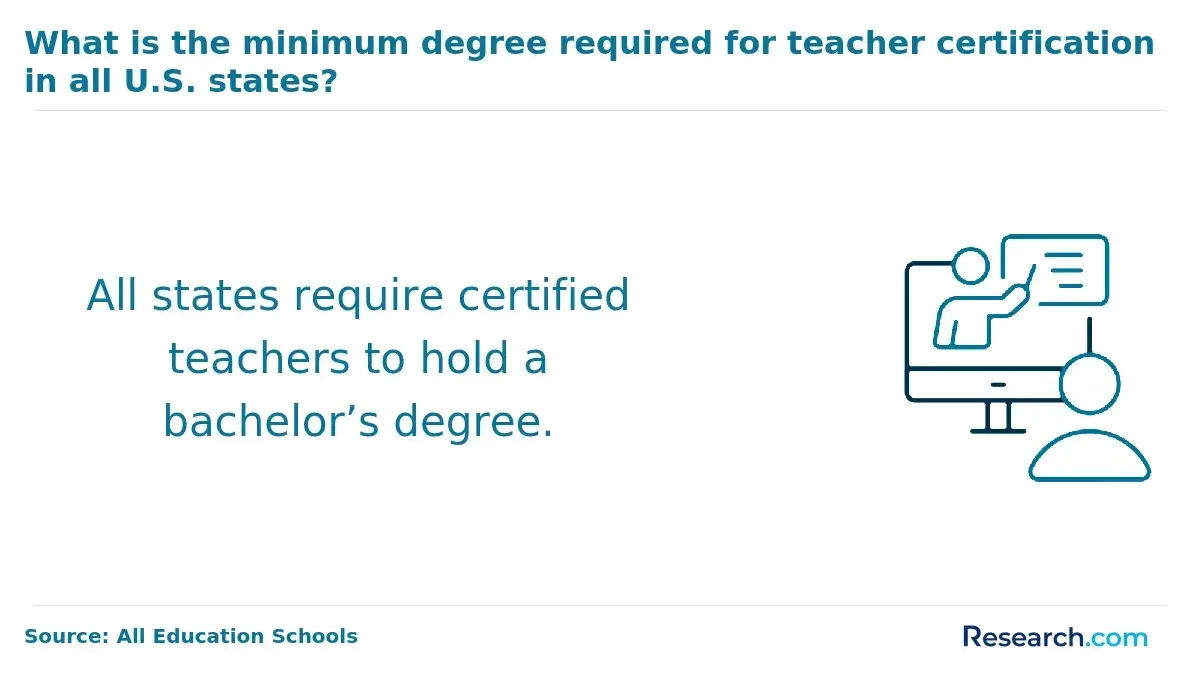
- Bachelor’s degree: Most candidates must hold at least a bachelor’s degree from a regionally accredited institution. The major or coursework should connect to the grade level or subject endorsement the candidate wants to teach.
- State-approved educator preparation program: Candidates typically complete an approved educator preparation program, often called an EPP. These programs cover teaching methods, classroom management, assessment, lesson design, and supervised practice.
- GPA requirement: A minimum undergraduate GPA of 2.50 is typically required, either overall or in the final 60 credit hours, depending on the route and program.
- Clinical or student teaching experience: Candidates must complete supervised classroom practice, such as student teaching, a practicum, an internship, or a job-embedded placement under approved supervision.
- Endorsement-specific coursework: Some teaching areas require additional preparation in fields such as literacy, special education, English as a Second Language, or other specialized subjects.
Traditional vs. alternative preparation: which fits your background?
| Path | Best fit | Main advantage | Main trade-off |
| Traditional bachelor’s degree with teacher preparation | First-time college students who know they want to teach | Licensure requirements are built into the degree plan | Usually requires a longer full-time college commitment |
| Post-baccalaureate certification | Bachelor’s degree holders who want structured teacher preparation | Can focus directly on licensure after completing a prior degree | May require additional tuition, coursework, and clinical placement time |
| Job-embedded or alternative certification | Career changers ready to work while completing requirements | Can shorten the transition into paid classroom work | Requires balancing teaching responsibilities with coursework and exams |
| Graduate education route | Candidates who want deeper academic preparation or future advancement options | Can combine licensure preparation with advanced study | Often costs more and may take longer than a licensure-only route |
Teachers who later want to move into leadership, higher education, research, or advanced academic roles may also consider graduate study. For long-term planning, review Research.com’s comparison of the best online doctorate programs in higher education.
What tests are required for teacher certification in Tennessee?
Tennessee uses licensure exams to verify that candidates have the academic, content-area, and instructional knowledge needed for the classroom. The exact exams depend on your endorsement area, grade band, preparation program, and prior licensure status.
- Basic skills exam: Many candidates take the Praxis Core Academic Skills for Educators, which measures reading, writing, and mathematics skills. Programs may use it for admission or early eligibility decisions.
- Content area exams: Praxis Subject Assessments, often called Praxis II, evaluate knowledge in the specific subject and grade level you plan to teach, such as Elementary Education or Secondary Mathematics.
- Pedagogy assessment: The Principles of Learning and Teaching exam assesses instructional planning, classroom management, learning theory, and teaching practice. It is commonly relevant for certain endorsements or out-of-state candidates.
- Program-based performance assessments: Tennessee does not require a statewide performance assessment such as edTPA, but individual educator preparation programs may require portfolio work, teaching observations, or other performance measures before recommending a candidate for licensure.
Test scores must be sent directly to the Tennessee Department of Education when required. Before registering, confirm the exact exam code and passing requirement with your educator preparation program or licensure advisor. Registering for the wrong Praxis test is one of the easiest ways to lose both time and money.
What are the best certification programs in Tennessee?
The best certification program is not automatically the most famous or the most selective. For licensure, the strongest choice is the program that is state-approved, aligns with your intended endorsement, offers reliable clinical placement support, prepares you for required exams, and fits your finances and schedule.
Several Tennessee institutions offer established teacher preparation options. When comparing them, look beyond reputation and ask how each program supports licensure completion, exam preparation, student teaching, and job placement.
- University of Tennessee, Knoxville – Educator Preparation Program: This public flagship option combines academic coursework with clinical practice and prepares candidates to meet degree, student teaching, and Praxis requirements.
- Vanderbilt University – Peabody College Teacher Preparation: Peabody College is known for selective admission, research-informed teacher preparation, mentorship, and a strong academic environment.
- Lipscomb University – Teacher Licensure Program: Lipscomb emphasizes classroom-ready preparation, support from experienced educators, diverse instructional strategies, and a minimum 2.75 GPA for admission.
- Christian Brothers University – Licensure Only Program: CBU is CAEP-accredited and state-approved, with undergraduate and graduate licensure routes that emphasize content knowledge, Praxis preparation, and initial license readiness.
How to evaluate a Tennessee teacher certification program
| Question to ask | Why it matters |
| Is the program approved for Tennessee licensure? | Only an approved route can properly support your application for the Tennessee license you need. |
| Does it match my endorsement area? | An elementary program, a secondary math route, a special education track, and a CTE pathway can have different requirements. |
| How are student teaching or clinical placements arranged? | A program with weak placement support can delay graduation or licensure recommendation. |
| What Praxis support is included? | Exam preparation, advising, and correct test selection can reduce retake risk. |
| Can I complete it while working? | Working adults may need online, evening, hybrid, or job-embedded options. |
| What is the total cost, not just tuition? | Fees, testing, books, background checks, and unpaid clinical time can change affordability. |
If cost is a major deciding factor, compare traditional programs with online and lower-cost education degree options. Research.com’s list of affordable online education degrees can help you identify programs that may fit a tighter budget.
Are there alternative routes to teacher certification in Tennessee?
Yes. Tennessee offers alternative pathways for people who did not complete a traditional undergraduate education degree but now want to teach. These routes are often designed for bachelor’s degree holders, career changers, professionals with technical expertise, and candidates who want to work in classrooms while finishing licensure requirements.
- Practitioner Teacher License: This route can serve candidates with a bachelor’s degree in any discipline who enroll in an approved educator preparation program and pass the required Praxis exams. It is valid for three years and can be renewed once.
- Practitioner Occupational Education License: This option is intended for career and technical education teachers. Candidates generally need admission to or completion of an approved educator preparation program and applicable Praxis exams.
- Job-embedded pathway: This route allows some candidates with a non-education bachelor’s degree to teach while completing required coursework. Some programs can lead to licensure in just one year without requiring a full graduate degree.
- Post-baccalaureate and master’s licensure programs: These programs provide structured pedagogy, supervised teaching, and licensure preparation for candidates who already hold a bachelor’s degree.
- Grow Your Own and apprenticeship models: These programs may combine no-cost teacher preparation with paid residency experiences through partnerships between districts and educator preparation providers.
Who should consider an alternative route?
- Adults who already have a bachelor’s degree and do not want to start over with a second undergraduate degree.
- Professionals in high-need subject areas who can bring real-world experience into the classroom.
- Career changers who can handle a demanding schedule that combines teaching, coursework, testing, and mentorship.
- Candidates who need a paid or lower-cost path and may benefit from residency or apprenticeship models.
Who may be better served by a traditional route?
- Students who have not yet earned a bachelor’s degree.
- Candidates who want more time to build classroom management skills before becoming the lead teacher.
- People who need a slower, more structured path with extensive advising before entering full-time teaching.
Alternative certification can be efficient, but it is not necessarily easy. Teaching while completing coursework can be intense, especially during the first year. Candidates should ask how much mentoring is provided, how quickly they are expected to assume classroom responsibility, and what happens if they need to retake an exam.
How much does it cost to get a teaching certification in Tennessee?
The cost of Tennessee teacher certification depends heavily on the route you choose. A traditional undergraduate path, a graduate licensure program, a licensure-only option, and an alternative certification program can have very different price tags.
| Cost category | Estimated amount stated | Planning note |
| Public university undergraduate tuition for in-state students | $8,000 to $13,000 per year | This usually applies to bachelor’s degree routes and does not always include all fees or living costs. |
| Public graduate education programs | $11,000 to $18,000 annually | Master’s or post-baccalaureate routes may cost more at private institutions. |
| iteachTennessee application fee | $0 | This is one example of an alternative certification cost structure. |
| iteachTennessee enrollment fee | $250 | Additional program costs still apply. |
| iteachTennessee total program cost | Around $4,250 | Payments may be available in installments during fieldwork. |
| Praxis or edTPA exam fees | $100 to $300 | Retakes can increase total cost. |
| Fingerprinting and background checks | $35 to $50 | These are commonly required for school placements and licensure. |
| Initial licensure application fee | Around $75 | Renewal fees vary by license type and timing. |
| Books, materials, and online resources | $200 to $500 | Costs depend on program format and course requirements. |
Financial support may be available through the Tennessee HOPE Scholarship, the Tennessee Teaching Scholars Program, Teacher Loan Forgiveness, and TEACH Grants, especially for candidates committed to high-need schools. Always confirm eligibility rules before assuming a scholarship or grant will apply to your situation.
Ways to reduce certification costs
- Choose a state-approved route before paying enrollment fees.
- Ask whether previous college credits can reduce coursework.
- Compare total program cost, not just tuition.
- Budget for exam retakes even if you hope not to need them.
- Look for district partnerships, paid residency models, or Grow Your Own options.
- Confirm whether online coursework meets Tennessee licensure requirements before enrolling.
If you are considering an online early childhood route and wondering what the academic workload may feel like, Research.com’s guide on whether an online bachelor’s degree in early childhood education is hard can help you set realistic expectations.
What challenges might I encounter during teacher certification in Tennessee?
The Tennessee certification process is manageable, but delays can happen when candidates misunderstand requirements or miss administrative details. The most common issues involve documentation, exam selection, clinical placements, background checks, and timing.
| Common challenge | What can go wrong | Better approach |
| Choosing a program too quickly | The program may not match your endorsement or Tennessee licensure goal. | Confirm state approval and endorsement alignment before enrolling. |
| Registering for the wrong Praxis exam | You may pay for a test that does not satisfy your intended license area. | Verify test codes with your program advisor before registration. |
| Underestimating clinical placement requirements | Student teaching or internship scheduling can delay completion. | Ask early how placements are secured and whether paid options exist. |
| Ignoring background check timing | School access or application processing may be delayed. | Complete fingerprinting and background steps as soon as instructed. |
| Focusing only on tuition | Testing, fees, materials, and unpaid time can make the route more expensive than expected. | Build a full certification budget before committing. |
| Assuming online means automatically acceptable | Not every online program is designed for Tennessee licensure. | Confirm the program’s Tennessee approval and field placement support. |
Administrative delays, record mismatches, shifting schedules, and changing state guidance can affect your timeline. Staying in regular contact with your licensure advisor and keeping copies of transcripts, exam results, background documents, and program approvals can prevent avoidable setbacks. If affordability is your biggest concern, compare strategies in Research.com’s guide to the least expensive ways to earn a Tennessee teaching credential.
What Subject-Specific Endorsements Can Amplify My Career Prospects?
Endorsements define what you are authorized to teach. Choosing the right endorsement can shape your hiring options, grade levels, subject focus, and long-term advancement opportunities. Tennessee schools may have stronger needs in some fields than others, so candidates should compare personal interest with local district demand.
- STEM-related endorsements: These can be valuable for candidates prepared to teach math, science, technology, or related subjects.
- Special education endorsements: These may expand opportunities to serve students with diverse learning needs and work in specialized instructional settings.
- English as a Second Language endorsements: These can prepare teachers to support multilingual learners and language development.
- Music and arts endorsements: These support specialized instruction in creative fields and may lead to school-based arts roles.
- Career and technical education endorsements: These can help industry professionals bring occupational expertise into classrooms.
Do not add an endorsement only because it sounds marketable. Ask whether you enjoy the subject, meet the coursework and testing requirements, and are willing to teach that content long term. If music instruction is your goal, Research.com’s guide on becoming a music teacher in Tennessee explains the specialized path in more detail.
How long does it take to get certified as a teacher in Tennessee?
The timeline depends on your starting point, route, program format, testing schedule, and whether you study full time or part time. A first-time college student and a career changer with a completed bachelor’s degree will usually follow different timelines.
| Certification route | Typical timeline stated | What affects the pace |
| Traditional bachelor’s degree pathway | About four years of full-time study | Includes degree coursework, approved teacher preparation, and a semester of student teaching. |
| Post-baccalaureate certification | One to two years of full-time study | Depends on required coursework, clinical placement, and exam completion. |
| Alternative certification programs | As little as one year in some programs, such as options from iteachTennessee | Often combines online coursework, internship or fieldwork, and Praxis preparation. |
| Student teaching or internship | At least one semester | All pathways require supervised classroom experience in some form. |
| Exam preparation | Several weeks to months | Timing depends on your subject area, study habits, testing availability, and whether retakes are needed. |
Some institutions, including the University of Tennessee and Middle Tennessee State University, offer routes for different candidate timelines, including post-baccalaureate options designed to finish in 12 to 18 months full-time. Transfer credits, accelerated coursework, part-time enrollment, exam retakes, and work or family obligations can all change the final timeline.
How might future policy changes influence the certification timeline for Tennessee teachers?
Certification requirements can change when state priorities, federal education policy, teacher workforce needs, testing expectations, or instructional technology standards shift. Future changes could affect program length, renewal rules, test requirements, clinical placement models, or available support for new teachers.
Because licensure is regulated, candidates should avoid relying only on older program brochures or informal advice. Before applying, check current Tennessee Department of Education guidance, confirm details with the educator preparation program, and ask how the program notifies students if certification rules change. For a closer look at timing differences, see Research.com’s guide on how long it takes to become a teacher in Tennessee.
How can I pursue physical education certification in Tennessee?
Physical education certification combines general teacher licensure requirements with subject-specific preparation in physical fitness, wellness, motor development, kinesiology, and age-appropriate instruction. Candidates should verify the endorsement requirements for physical education, required exams, clinical placement expectations, and any district-specific hiring preferences.
PE candidates should also pay attention to current school priorities around student health, inclusive activity design, and safe physical education instruction. Continuing education can help teachers keep lessons relevant as wellness expectations and student needs evolve. For step-by-step guidance, review Research.com’s resource on how to become a PE teacher in Tennessee.
How do you renew Tennessee teaching certification?
Tennessee teachers must keep their licenses active by meeting renewal requirements before the expiration date. Renewal is not just a paperwork task; it is also how the state verifies that educators continue professional learning and remain eligible to teach.
- License duration: Tennessee teaching licenses generally last for five years, and educators should renew before the license expires.
- Practitioner license renewal: A practitioner license that is not a 1st issuance generally requires 30 professional development points, or PDPs, during the license period.
- Professional license renewal: A professional license requires 60 PDPs or two years of qualifying teaching experience within the five-year period.
- Acceptable PDP sources: PDPs may come from approved college coursework, continuing education units, or other state-approved professional learning. Teachers should ask their district designee about pre-approval.
- TN Literacy Success Act: Educators must comply with TN Literacy Success Act requirements, which may include literacy training or assessments depending on their role.
- TNCompass submission: Renewal is completed through TNCompass by accessing the Educator Profile, choosing “Renew License” under the “Transaction” tab, uploading PDP documentation, and paying required fees.
- Background checks: A background check may be required, especially after a break in employment.
- Lapsed license reactivation: If a license lapses, educators can submit a reactivation request by October 1 of the expiration year. Missing that date may require a more involved reinstatement process.
Renewal checklist for Tennessee teachers
- Check your license expiration date early.
- Confirm whether you need 30 PDPs, 60 PDPs, or qualifying teaching experience.
- Keep documentation for every approved professional learning activity.
- Verify TN Literacy Success Act requirements for your role.
- Upload documents through TNCompass before the deadline.
- Save confirmation records after submission.
If you are thinking about adding graduate credentials while maintaining licensure, Research.com’s guide to career options with an online master’s degree in education can help you compare next steps.
Is teacher certification in Tennessee transferable to other states?
A Tennessee teaching license may help you pursue certification in another state through reciprocity, but it does not guarantee automatic licensure. Tennessee participates in the NASDTEC Interstate Agreement, which includes states such as Georgia, Texas, New York, and California. This agreement can reduce duplication, but each state still controls its own teacher licensing rules.
If you move, the receiving state may require additional exams, a background check, coursework in local education law, or a temporary or provisional license while you complete remaining conditions. The safest approach is to contact the licensing agency in the state where you plan to teach before resigning, relocating, or assuming your Tennessee credential will be accepted without extra steps.
Questions to ask before transferring a Tennessee teaching license
- Does the new state participate in NASDTEC reciprocity?
- Will my Tennessee endorsement match the new state’s endorsement categories?
- Are additional state-specific exams required?
- Can I teach under a temporary or provisional license while completing requirements?
- Do I need coursework in state history, reading instruction, special education, or local school law?
- How long will the review process take after I submit transcripts and test scores?
What are the benefits of having a teacher certification in Tennessee?
Teacher certification is more than a compliance requirement. It determines whether you can qualify for many public school teaching roles and can influence your mobility, advancement, pay structure, and access to district-supported professional growth.
- Access to more teaching roles: Certification is commonly required for public school positions and may also matter for charter schools and specialized programs.
- Stronger career stability: Tennessee’s positive job outlook and steady teacher demand can make certification valuable, particularly in high-need subjects and communities.
- Defined advancement pathways: Certified teachers may pursue additional endorsements, mentor roles, instructional leadership, or administrator preparation.
- Compensation and benefits access: Certified educators in Tennessee earn an average salary of around $55,000 annually, with benefits and retirement options varying by employer and district.
- Improved classroom preparation: Certification programs build skills in lesson planning, assessment, classroom management, differentiation, and student support.
- Professional credibility: Licensure signals that you have met state standards for academic preparation, testing, and supervised teaching practice.
Is Tennessee teacher certification worth it?
Teacher certification is worth pursuing if you want to teach in Tennessee public schools, qualify for standard classroom roles, or build a long-term education career. It may not be the right investment if you are unsure about teaching, want only occasional tutoring work, or are not ready for the cost, testing, and supervised classroom requirements.
The best decision depends on your subject area, local hiring market, financial situation, and willingness to complete state requirements. Before enrolling, compare at least three approved programs and ask each one for a full cost estimate, required exams, clinical placement details, and licensure outcomes.
What ongoing support and professional development opportunities are available to Tennessee teachers?
Certification is the beginning of a teaching career, not the end of preparation. Tennessee educators can continue developing through workshops, district professional learning, mentoring, coaching, peer observation, continuing education, and professional learning communities.
These supports can help teachers improve instructional strategies, respond to changing standards, prepare for license renewal, and add specialized skills. New teachers should ask their district what mentoring is available during the first year, how professional development points are tracked, and whether training is offered for literacy, special education, classroom technology, or multilingual learner support.
Educators interested in language instruction can review Research.com’s guide to ESL teacher requirements in Tennessee for more targeted information about that specialization.
What Teachers in Tennessee Say About Their Certification
-
: "
Getting my teaching certification in Tennessee changed how I viewed my long-term career. The schedule flexibility and competitive average salaries helped me support my family while doing work I care about. I feel that my role has both purpose and professional value. Phil
"
-
: "
Certification opened doors I did not expect. I have been able to mentor newer teachers, explore leadership responsibilities, and see a clearer path for growth within my school community. Mel
"
-
: "
The professional development opportunities have helped me keep improving. Workshops, training, and collaboration with other educators have made me more confident and more effective in the classroom. Dinah
"
Key Insights
- Tennessee teacher certification starts with choosing the correct license type. A practitioner license, professional license, occupational license, adjunct license, and school services personnel license serve different career goals.
- Most classroom teachers need a bachelor’s degree, an approved educator preparation program, required Praxis exams, supervised teaching experience, and proper documentation before licensure.
- Alternative routes can be faster and more affordable for bachelor’s degree holders, but they require strong time management because candidates may teach while completing coursework and exams.
- Cost varies widely. Public undergraduate tuition, graduate tuition, alternative program fees, testing, background checks, application fees, and materials should all be included in your budget.
- Endorsements matter. Your subject and grade-level authorization can affect where you are hired, what you teach, and how easily you move into specialized roles.
- Renewal planning should start before your license nears expiration. Track PDPs, TN Literacy Success Act requirements, TNCompass submissions, and documentation throughout the license period.
- Reciprocity can help Tennessee-certified teachers move to other states, but it is not automatic. Always check the receiving state’s exam, coursework, and background requirements.
- The smartest next step is to compare approved programs by endorsement fit, total cost, clinical placement support, Praxis preparation, schedule flexibility, and licensure advising—not by reputation alone.
Related Articles for Nearby States
- 2027 Teacher Certification Types & Requirements in Kentucky
- 2027 Teacher Certification Types & Requirements in Mississippi
- 2027 Teacher Certification Types & Requirements in Alabama
- 2027 Teacher Certification Types & Requirements in Georgia
- 2027 Teacher Certification Types & Requirements in North Carolina
- 2027 Teacher Certification Types & Requirements in Missouri
- 2027 Teacher Certification Types & Requirements in Arkansas
- 2027 Teacher Certification Types & Requirements in Virginia
- 2027 Teacher Certification Types & Requirements in Indiana
- 2027 Teacher Certification Types & Requirements in South Carolina
References:
- Happy Teacher. (n.d.). Renew Your Tennessee License. happyteacherpd.com.
- Moreland University. (n.d.). Discover 10 Benefits of Teaching in Tennessee. moreland.edu.
- Moreland University. (n.d.). How to Get Your Tennessee Teacher Certification. moreland.edu.
- Teach.com. (n.d.). Become a Teacher in Tennessee. teach.com.
- Teachers of Tomorrow. (2024, August 11). How to Become a Teacher in Tennessee in 2025. teachersoftomorrow.org.
- Teaching Certification. (n.d.). Tennessee Teacher Certification Renewal. teaching-certification.com.
- Walden University. (n.d.). Teacher Licensure Renewal | State Requirements for Teacher Licensure Renewal: Tennessee. walden.edu.
Other Things You Should Know About Teacher Certification in Tennessee
In 2027, Tennessee offers various teacher certification paths, including traditional educator preparation programs, alternative licensure routes like Teach for America, and transitional licenses for professionals with relevant industry experience. Each path has specific coursework, exam requirements, and supervised teaching components.
In 2027, individuals with a non-education degree can pursue teacher certification in Tennessee through alternative pathways like the Practitioner License route. This involves enrolling in a state-approved educator preparation program while teaching full-time. The program combines coursework and practical teaching experience.
The Tennessee Department of Education approves teacher licenses in 2027 through its Office of Educator Licensure and Preparation. Applicants submit credentials, test scores, and program records to that office, which reviews eligibility for initial, practitioner, and professional licensure.


