
2027 Art Teacher Certification and Requirements

Co-Founder and Chief Data Scientist
Becoming an art teacher is not as simple as being good at drawing, painting, design, or studio practice. In most K-12 public school settings, you need both art expertise and a state-approved teaching credential. That can make the path confusing for career changers, fine arts graduates, and students deciding whether to major in art education, education, or studio art.
The stakes are practical. There are 57,055 art teachers across all education levels, and many positions—especially in public schools—require state licensure, subject-area testing, student teaching, and continuing education. Requirements also vary by state, grade level, and employer type.
This guide explains what art teachers do, which degrees and certifications matter, how alternative certification works, what salaries look like, and how to compare your options before committing time and money to a program.
Key Insights
- For public K-12 schools, art teachers usually need state certification, not just artistic ability or a fine arts degree.
- The most direct route is often a state-approved bachelor’s degree in art education, but fine arts graduates may qualify through alternative certification if their state allows it.
- Certification requirements vary by state, grade level, and subject endorsement, so candidates should verify licensure rules before enrolling in any program.
- Postsecondary art teaching is a different career path from K-12 teaching and commonly requires graduate education.
- Salary estimates vary by source, location, employer, and experience; local district salary schedules are often more useful than national averages.
- Online and accelerated programs can be useful, but only if they meet state approval, student teaching, exam, and licensure requirements.
- Advanced degrees and additional certifications are most valuable when they support a specific goal, such as leadership, museum education, digital media instruction, curriculum design, or higher education teaching.
- The best program choice is the one that matches your target state, grade level, budget, schedule, and long-term career plan.
Quick answer: How do you become a certified art teacher?
To become a certified K-12 art teacher, you typically need a bachelor’s degree in art education, fine arts, education, or a related field; completion of a state-approved teacher preparation program; supervised student teaching; passing scores on required teacher certification exams; and an application for licensure through your state education agency. Candidates with a fine arts degree but no teaching degree may be able to use an alternative certification pathway, depending on the state.
Postsecondary art teaching is different. College and university roles often require graduate education. Zippia reports that 48% of postsecondary art teachers hold a doctoral or professional degree, 31% hold a master’s degree, and 16% hold a bachelor’s degree. O*NET Online reports a different distribution, with 32% of art teaching positions requiring a doctoral degree, 51% requiring a master’s degree, and 14% requiring a bachelor’s degree.
Key things to know before choosing an art teacher certification program
- Art education is a licensed teaching field in many school settings. If you want to teach in public K-12 schools, expect to meet state certification rules rather than relying only on your art portfolio or studio background.
- The profession is largely female. Women account for 74.5% of art teachers, while men account for 25.5%. This reflects broader education workforce patterns and also points to room for wider representation in the field.
- Most art teachers work in education. About 86% of art teacher jobs are in educational settings, which means licensure, school hiring cycles, and district requirements matter for many candidates.
- The degree you need depends on where you want to teach. K-12 roles commonly require at least a bachelor’s degree plus certification. Postsecondary positions are more likely to require a master’s, doctoral, or professional degree.
- Art certification can include subject-specific requirements. Many states require art content exams, studio-related coursework, portfolio review, or art education pedagogy in addition to general teacher preparation.
- Competition can be stronger in some districts. Because the total number of art teachers is smaller than many core subject areas, full-time jobs in well-funded districts or higher education may be competitive.
- Do art teachers need a different certification?
- How do state requirements for art teachers differ?
- Can you become an art teacher without a teaching degree?
- Which degrees are best for future art teachers?
- How much do art teachers make for 2027?
- What is a normal workday like for an art teacher?
- Where can art teachers work outside public schools?
- Why do school art programs often struggle for funding?
- What steps lead to art teacher certification?
- How can art teachers move into higher-paying or leadership roles?
- Should art teachers consider doctoral programs?
- Can interdisciplinary study improve art instruction?
- Can an online teaching degree help art educators build digital skills?
- Can affordable master’s programs support art teacher advancement?
- Which additional certifications can strengthen an art teacher’s career?
- Can accelerated certification help future art teachers enter the classroom faster?
- Can interdisciplinary studies deepen art teacher pedagogy?
- Can speech pathology communication strategies help art teachers?
What does an art teacher do?
An art teacher helps students build visual literacy, creative confidence, technical skill, and an understanding of art as a form of communication. The job can look different in an elementary classroom, middle school studio, high school advanced art course, community program, or college setting, but the core purpose is the same: guide students in making, interpreting, discussing, and improving art.
| Responsibility | What it means in practice |
| Teach art methods and media | Introduce students to drawing, painting, sculpture, ceramics, photography, digital media, design, or other media appropriate to the course and grade level. |
| Build standards-aligned lessons | Plan projects that connect technique, creativity, art history, critique, and student development goals. |
| Evaluate student work | Assess process, effort, craftsmanship, concept development, technical growth, and the ability to explain artistic choices. |
| Create a safe studio environment | Manage supplies, tools, cleanup routines, storage, safety procedures, and classroom expectations. |
| Support school culture | Organize student exhibitions, collaborate with other teachers, contribute to performances or events, and advocate for arts programming. |
Art teachers also work with students who have different learning needs, communication styles, motor skills, and confidence levels. Educators who want to focus more deeply on inclusive instruction may also compare art education with special education teaching requirements, since special education licensure follows its own pathway.
Do art teachers need a different certification than other teachers?
Yes, in many states art teachers need a teaching license with an art endorsement, art specialization, or subject-area authorization. The general process resembles other teacher certification routes, but art candidates often face extra requirements tied to studio practice, art history, visual culture, and art pedagogy.
A traditional bachelors in education online or campus-based education degree may cover general teaching foundations, but future art teachers should confirm that the program also meets the art-specific licensure requirements in the state where they plan to teach.
- General teaching requirements still apply. Candidates may need coursework in child development, lesson design, classroom management, assessment, and educational law.
- Art-specific testing may be required. States may use the Praxis Art Content Knowledge exam or a state-created assessment to evaluate visual arts knowledge.
- Portfolio or studio coursework may matter. Some programs or states expect evidence that candidates can work competently across multiple art forms.
- Certification may differ by grade band. A K-12 visual arts credential may not be the same as a secondary-only certification. Similar grade-level distinctions also appear in other fields, such as certification to teach secondary education.
- Licensure is not permanent without renewal. Many states require continuing education, professional development, or additional coursework to keep a teaching license active.
The key decision is not simply whether a program teaches art. It is whether the program leads to the exact credential your target state and school setting require.
What are the state-by-state certification requirements for art teachers?
Art teacher certification is controlled at the state level, so there is no single national checklist that applies everywhere. Most states require a bachelor’s degree, a teacher preparation program, field experience, and certification exams, but the details can vary significantly.
Some candidates later pursue graduate study to expand their credentials or move toward leadership. For example, educators working with younger learners may compare advanced options such as the cheapest online master's degree in early childhood education, while art teachers may choose graduate programs in art education, curriculum, educational leadership, or a related specialty.
| Requirement area | What to verify in your state | Why it matters |
| Approved degree or coursework | Whether the state requires art education, fine arts, education, or a specific sequence of pedagogy and studio courses. | A degree that is valuable artistically may not automatically satisfy teacher licensure rules. |
| Teacher preparation program | Whether the program is state-approved and includes required fieldwork. | Completing a non-approved program can delay licensure even if the coursework appears relevant. |
| Content exam | Whether the state uses Praxis Art Content Knowledge or another state-specific test. | Art candidates may need to prove subject knowledge separately from general teaching knowledge. |
| Student teaching | Required placement length, grade level, supervision rules, and evaluation process. | Student teaching is often required before full certification is granted. |
| Alternative certification | Whether fine arts graduates can teach while completing pedagogy coursework or exams. | This route can help career changers but still requires careful state approval. |
| Renewal rules | Professional development, continuing education, or retesting requirements. | Certification usually requires ongoing compliance after the first license is issued. |
States such as Texas, Florida, and California offer alternative routes for candidates with fine arts backgrounds who want to transition into teaching. However, alternative does not mean unregulated. Candidates still need to meet state rules, complete required training, and pass required assessments. Requirements also differ by teaching field; for example, the requirements to become a math teacher are not the same as those for visual arts.
Before enrolling, check your state Department of Education website and ask the school or program advisor one direct question: “Does this program lead to initial art teacher licensure in my state?”
Can you become an art teacher without a teaching degree?
Yes, but the answer depends on the type of school and the level you want to teach. Public K-12 schools usually require state certification, so candidates without a teaching degree often need an alternative certification program. Private schools, museums, community art centers, online platforms, and studios may have more flexible hiring standards, although they may still prefer candidates with teaching experience.
For K-12 public school roles, a fine arts degree alone is usually not enough. Alternative certification pathways commonly add pedagogy coursework, classroom experience, and certification exams so that candidates can demonstrate both content knowledge and teaching readiness. These routes may also interest people exploring early childhood education careers, since understanding what do you need to become a preschool teacher can reveal how age group, setting, and state rules shape licensure requirements.
| Pathway | Best for | Main caution |
| Traditional art education degree | Students who know early that they want to teach K-12 art. | Make sure the program is approved for licensure in the state where you want to work. |
| Fine arts degree plus alternative certification | Artists, designers, or career changers who already have substantial art training. | Alternative routes still require exams, coursework, and supervised experience. |
| Graduate-level teacher preparation | Bachelor’s degree holders who want a structured transition into teaching. | Cost and time vary, so compare total expenses and licensure outcomes. |
| Private or community art teaching | Artists who want to teach outside public school systems. | Jobs may be part-time, contract-based, or dependent on enrollment. |
| Postsecondary teaching | Artists or scholars who want to teach college-level art. | Graduate credentials are commonly expected, especially for full-time or tenure-track roles. |
What degrees do you need to become an art teacher?
The best degree depends on your target job. A future elementary, middle, or high school art teacher usually needs a bachelor’s degree and teacher certification. A future college instructor is more likely to need a graduate degree. A museum educator, private instructor, or community arts teacher may have more flexible degree expectations.
O*NET Online reports that 51% of art teaching positions require a master’s degree, 32% require a doctoral degree, and 14% require a bachelor’s degree. Zippia reports that 48% of postsecondary art teachers hold a doctoral or professional degree. These figures show why candidates should separate K-12 certification planning from postsecondary career planning.
| Degree option | Where it commonly fits | What to look for |
| Bachelor’s in art education | K-12 public school art teaching. | State-approved teacher preparation, student teaching, studio coursework, and art pedagogy. |
| Bachelor’s in fine arts or studio art | Alternative certification, private teaching, community programs, or graduate study. | A plan for completing teacher preparation if you want public school licensure. |
| Master’s in art education, education, or fine arts | Career advancement, leadership, postsecondary opportunities, or salary lane movement where applicable. | Alignment with your goals: classroom instruction, administration, curriculum, studio practice, or research. |
| Doctoral or professional degree | University teaching, research, advanced leadership, and some higher education roles. | Faculty expertise, research fit, funding options, and whether the degree supports your desired career track. |
| Related interdisciplinary degree | Specialized roles in arts integration, therapy-adjacent settings, museum education, or curriculum design. | Whether the degree complements—not replaces—required teaching certification. |
Teachers interested in roles beyond standard classroom instruction may explore related fields. For example, the best art therapy programs may appeal to educators who want to understand how creative practice intersects with therapeutic environments, though art therapy has its own professional expectations and should not be confused with K-12 teacher licensure.
How much do art teachers make for 2027?
Art teacher pay varies by employer, state, district funding, grade level, education, experience, union contract, and whether the role is full-time, part-time, or adjunct. Salary estimates also differ by data source.
| Source | Reported art teacher pay information |
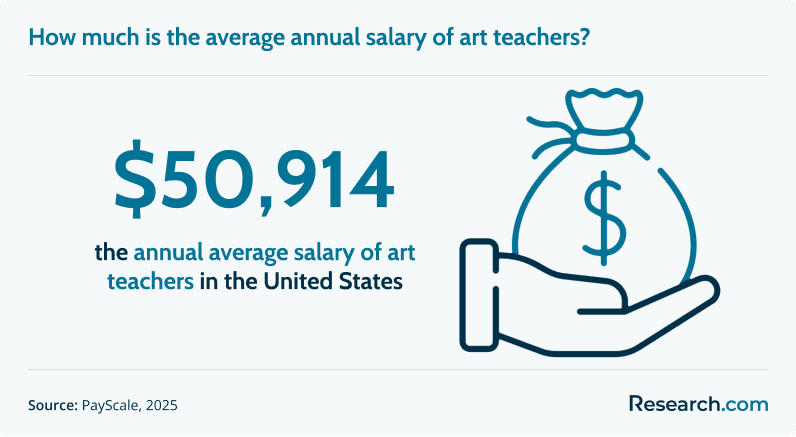
| PayScale | Average annual salary of approximately $50,914, with reported earnings from $35,000 to $79,000. |
| Zippia | Average salary of $50,188, with typical earnings between $40,000 and $62,000. |
| Salary.com | Average salary of $60,797, with a typical range between $50,346 and $84,827. |
| Indeed | Average hourly wage of $26.33 per hour for art teachers. |
| Glassdoor | For San Francisco, California, an estimated average salary of $72,704, with total compensation around $76,555 when additional benefits are included. |
When evaluating salary, do not compare numbers without context. A higher salary in a high-cost city may not go as far as a lower salary in a lower-cost district. Public school compensation may also include benefits, pension participation, contract protections, and step increases that are not reflected in a simple salary average.
For a realistic estimate, review local district salary schedules, state teacher pay data, union agreements where available, and job postings for the grade level you want to teach.
What does a typical day look like for an art teacher?
An art teacher’s day combines instruction, classroom management, studio logistics, assessment, and relationship-building. The work is creative, but it is also structured and physically active. Teachers may move between classes, manage wet materials, prepare demonstrations, clean up supplies, and adjust lessons for students at very different skill levels.
- Before classes begin: prepare materials, set up workstations, check safety needs, review lesson plans, and organize examples or slides.
- During instruction: demonstrate techniques, explain project goals, connect lessons to art history or visual culture, and circulate to coach students individually.
- Between classes: reset supplies, handle cleanup, answer student questions, document behavior or accommodations, and prepare for the next group.
- During planning time: grade artwork, update rubrics, communicate with families, collaborate with colleagues, order materials, and design future lessons.
- After school: support clubs, prepare exhibitions, attend meetings, complete professional development, or plan interdisciplinary projects.
Because teaching credentials can support many education roles, some art teachers eventually explore broader options and ask what jobs can I do with a teaching degree if they want to move into curriculum design, administration, instructional coaching, or education technology.
Can you teach art outside of public schools?
Yes. Public schools are only one path. Art educators also teach in private schools, charter schools, museums, nonprofit arts organizations, community centers, senior centers, camps, correctional education programs, private studios, online course platforms, and one-on-one lessons.
| Setting | Certification expectations | Best fit |
| Public K-12 schools | State teaching certification is typically required. | Candidates who want stable school-year employment and a standards-based curriculum. |
| Private schools | Requirements vary by school; certification may be preferred or required. | Teachers who want smaller communities or more curriculum flexibility. |
| Museums and galleries | Teaching license may not be required, but education experience is valuable. | Educators interested in public programming, tours, workshops, and arts outreach. |
| Community programs | Requirements vary; experience and portfolio may carry significant weight. | Artists who enjoy teaching mixed ages and skill levels. |
| Online teaching | Platform requirements vary; independent teachers must build their own audience. | Educators comfortable with digital tools, video instruction, and remote feedback. |
| Postsecondary institutions | Graduate degrees are commonly expected. | Artists or scholars who want to teach advanced studio, theory, or art history courses. |
If you do not want to pursue state licensure, non-public-school settings may be a better fit. However, they can also involve less predictable income, contract work, evening or weekend schedules, or the need to market your own classes.
Why are art programs often underfunded in schools?
Art programs may face funding pressure when districts prioritize tested subjects, mandated services, staffing shortages, facility needs, or programs tied to accountability metrics. Even when administrators value the arts, art classrooms often require consumable supplies, specialized equipment, storage, and maintenance that must compete with other budget needs.
- Limited district budgets: when funds are tight, schools may reduce supplies, delay equipment purchases, increase class sizes, or share one art teacher across multiple buildings.
- Accountability pressures: subjects tied directly to standardized testing may receive more instructional time and budget attention.
- Policy emphasis on STEM: science, technology, engineering, and math initiatives can be valuable, but arts programs may need active advocacy to remain visible.
- Weak community advocacy: art programs are often stronger when families, local artists, museums, nonprofits, and administrators actively support them.
- Economic downturns: budget cuts can hit elective or enrichment areas quickly because they may be viewed as less essential than required core subjects.
Art educators who understand budgeting, grants, partnerships, and leadership may be better positioned to protect and expand arts programming. Administrators and educators interested in systems-level leadership sometimes explore programs such as an online PhD organizational leadership, though school funding decisions still depend on local policy, community priorities, and available resources.
What is the step-by-step process to becoming a certified art teacher?
The exact process depends on the state, but most future public school art teachers follow a sequence like this.
- Choose your target teaching level and state. Decide whether you want elementary, middle school, high school, K-12, or postsecondary work. Licensure requirements depend heavily on this choice.
- Select a relevant degree path. For K-12, look for a bachelor’s degree in art education or a related degree that includes state-approved teacher preparation. Fine arts majors should confirm whether they will need alternative certification later.
- Complete a teacher preparation program. This usually includes coursework in pedagogy, classroom management, assessment, child or adolescent development, and teaching methods for visual arts.
- Build a strong art foundation. Develop skill across multiple media, understand art history and criticism, and create a portfolio that shows range and growth.
- Finish supervised fieldwork or student teaching. Work under an experienced educator, practice lesson delivery, manage a classroom, and receive formal evaluations.
- Pass required exams. States may require general teaching exams, art content exams, pedagogy exams, or state-specific assessments.
- Apply for licensure. Submit transcripts, exam scores, background checks, fees, and program verification to the state education agency.
- Apply for teaching jobs strategically. Prepare a teaching portfolio, sample lesson plans, classroom management philosophy, student work examples where appropriate, and a clear explanation of your certification status.
- Maintain your credential. Complete continuing education or professional development required for renewal. Consider graduate study or specialized credentials if they support your career goals.
| Common mistake | Better approach |
| Choosing a program because it is convenient without checking state approval. | Confirm in writing that the program leads to art teacher licensure in your target state. |
| Assuming a fine arts degree automatically qualifies you for public school teaching. | Ask whether you need alternative certification, exams, or supervised teaching experience. |
| Looking only at tuition. | Compare fees, supplies, travel for student teaching, exam costs, lost income, and time to completion. |
| Ignoring grade-level authorization. | Check whether the credential covers elementary, secondary, or K-12 art. |
| Waiting until graduation to study licensing requirements. | Map exams, application deadlines, and student teaching requirements early. |
Digital tools are also changing art education. Teachers increasingly use virtual galleries, interactive design tools, digital portfolios, multimedia critique, and online learning platforms. These tools do not replace studio practice, but they can expand access, support documentation, and help students connect traditional artmaking with contemporary creative industries.
How can art teachers advance their careers?
Career growth in art education can mean higher pay, more influence, a different work setting, or a more specialized teaching role. The best path depends on whether you want to stay in the classroom, move into leadership, teach college students, or work in a community or therapeutic-adjacent environment.
- Earn a graduate degree. A master’s in art education, curriculum, educational leadership, fine arts, or a related field may support advancement, especially where salary schedules reward graduate credits.
- Pursue advanced certification. National Board Certification, specialized art education credentials, museum education training, or digital media credentials can signal expertise.
- Move into leadership. Experienced teachers may become department chairs, curriculum coordinators, instructional coaches, arts integration specialists, or administrators.
- Teach at the postsecondary level. College roles often require graduate preparation and may prioritize studio achievement, research, exhibitions, teaching experience, or professional practice.
- Specialize in student support or interdisciplinary fields. Some educators become interested in child development, psychology, or therapeutic approaches. Those considering a major pivot may research how to become a child psychologist, while recognizing that psychology careers have separate degree and licensure requirements.
- Create education products or online instruction. Art teachers can build digital courses, curriculum resources, workshops, or portfolio coaching services, though income may vary.
Should art teachers pursue advanced doctoral programs for career growth?
A doctoral program can make sense for art teachers who want to move into higher education, research, district leadership, curriculum design, policy work, or senior administrative roles. It is usually not necessary for most K-12 classroom art teaching positions.
Before choosing a doctorate, compare the cost, dissertation or capstone expectations, faculty expertise, delivery format, and career outcome you want. Educators who want a faster or more flexible doctoral route may review options such as the easiest EdD programs, but “fast” should not be the only factor. Accreditation, state relevance, research fit, and employer recognition matter more than speed alone.
Can an interdisciplinary education elevate art teachers' instructional methods?
Interdisciplinary study can strengthen art teaching when it directly supports lesson design, critique, cultural context, writing, or student communication. For example, English coursework can help art educators teach visual analysis, artist statements, storytelling, critique language, and research-based projects. Teachers comparing humanities-based options may consider the most affordable bachelor's degree in English online if writing, literature, and communication are central to their instructional goals.
Can an online teaching degree enhance art educators' digital proficiency?
An online teaching degree can help art educators become more confident with digital pedagogy, learning management systems, online assessment, multimedia lessons, and remote feedback. This is especially useful for teachers who use digital portfolios, virtual critiques, online exhibitions, or hybrid instruction.
However, candidates seeking initial licensure should be careful. An online format is convenient, but the program must still meet state teacher preparation requirements, include required field experience, and lead to the correct art teaching credential.
Can affordable master’s programs accelerate career advancement for art teachers?
Affordable master’s programs can be valuable for art teachers who want graduate credits, deeper instructional training, leadership preparation, or salary advancement where district contracts recognize advanced education. The strongest programs connect theory to practical classroom problems: assessment in creative subjects, inclusive studio instruction, curriculum design, digital media integration, arts advocacy, and program leadership.
Cost matters, but it should not be the only measure. Compare accreditation, faculty background, practicum requirements, transfer credit policies, total fees, and whether the program aligns with your state or district goals. Teachers seeking budget-conscious graduate routes can explore cheap masters of education online as one starting point for comparison.
What additional certifications can further enhance art teachers’ career prospects?
Additional credentials can help art teachers specialize, but they should match a clear career goal. A credential is most useful when it improves your instructional practice, qualifies you for a role, or fills a documented skill gap.
| Credential or training area | How it may help | Who should consider it |
| Digital media or educational technology | Supports digital art, online portfolios, multimedia projects, and hybrid instruction. | Teachers in districts expanding technology-rich arts instruction. |
| Museum education | Builds skills in public programming, object-based learning, and community engagement. | Educators who want roles in museums, galleries, or outreach programs. |
| National Board Certification | Can demonstrate advanced teaching practice and professional commitment. | Experienced teachers seeking recognition or advancement where valued by employers. |
| Library and information science | May strengthen digital archiving, resource organization, curation, and information literacy. | Teachers interested in arts resources, media collections, or interdisciplinary school roles. Relevant options may include affordable MLIS programs. |
| Arts integration or curriculum leadership | Helps teachers collaborate across subjects and design schoolwide arts initiatives. | Teachers aiming for department leadership or curriculum roles. |
Can accelerated certification programs fast-track art teachers’ career entry?
Accelerated certification can shorten the route into teaching for candidates who already have a bachelor’s degree, especially those with fine arts training or professional art experience. These programs usually compress pedagogy coursework, field experience, and exam preparation into a more intensive timeline.
The risk is choosing speed over eligibility. Before enrolling, verify that the program is state-approved, accepted for art teacher licensure, compatible with your background, and realistic for your schedule. Candidates comparing timelines can review how fast can you obtain a teaching degree to understand how accelerated routes may differ from traditional teacher preparation.
Can interdisciplinary studies enrich art teacher pedagogy?
Yes, when interdisciplinary coursework helps students connect art to culture, history, civic life, identity, media, and social issues. Political science, for example, can help art teachers guide discussions about public art, propaganda, protest art, monuments, community design, and civic visual culture. Teachers who want to build this perspective might compare options such as an affordable online political science program, especially if they teach advanced secondary students or interdisciplinary humanities courses.
Can integrating communication strategies from speech pathology boost classroom effectiveness?
Communication strategies from speech pathology can help art teachers give clearer directions, support students with expressive or receptive language needs, structure critique conversations, and design more inclusive classroom routines. This does not make an art teacher a speech-language pathologist, but it can improve day-to-day instruction.
Educators interested in formal preparation in this area may explore online SLP masters programs, keeping in mind that speech-language pathology has separate clinical, accreditation, and licensure requirements.
Questions to ask before enrolling in an art teacher certification program
- Is the program approved for initial art teacher licensure in the state where I plan to teach?
- Does the credential cover the grade level I want: elementary, secondary, or K-12?
- Which exams will I need to pass, and does the program prepare students for them?
- How is student teaching arranged, and can placements be completed near where I live?
- What is the total cost, including tuition, fees, supplies, testing, background checks, and travel?
- Can I transfer previous fine arts or education credits?
- Does the program support alternative certification candidates?
- What kind of portfolio, lesson plan, or teaching sample will I graduate with?
- How does the program help graduates find teaching jobs?
- If the program is online, how are field experiences and licensure requirements handled?
References
- Glassdoor. (2025). How much does an art teacher make in San Francisco, CA? glassdoor.com
- Indeed. (2025). Art teacher salaries in the United States. indeed.com
- O*NET Online. Art, drama, and music teachers, postsecondary. onetonline.org
- PayScale. (2025). Average art teacher salary in 2025. payscale.com
- Salary.com. (2025). Art teacher salary. salary.com
- US Bureau of Labor Services. (2023, May). Art, drama, and music teachers, postsecondary. bls.gov
Other Things You Should Know About Art Teacher Certification Programs
Most state education departments require a fingerprint-based criminal background check before issuing art teacher certification in 2027. Applicants usually submit prints through the state board or an approved vendor, and any disqualifying offenses can delay or block licensure under state teacher-licensing rules.
Art teachers must complete professional development units approved by their state's education board, covering topics such as curriculum innovation and classroom management. Typically, they need 20-30 hours annually to maintain certification and stay updated with current teaching practices.
To maintain art teacher certification in 2027, educators must complete continuing education credits, partake in professional development, and meet any state-specific renewal criteria. Renewal intervals usually occur every five years, requiring educators to submit proof of completed requirements to their state's education board.


