
2027 Math Teaching Certification and Requirements

Co-Founder and Chief Data Scientist
Math teacher certification is the credential that allows you to teach mathematics in public schools, but the path is not identical in every state. You may need a specific degree, a state-approved teacher preparation program, subject exams, student teaching, fingerprinting, and ongoing professional development after you are licensed.
The stakes are higher now because student math performance has become a national concern. From 2018 to 2022, 25 of the 37 OECD countries saw at least a 10-point decline in average math scores, and the U.S. recorded a 13 percentage-point drop. Schools need educators who understand both math content and how students learn it.
This guide explains what math teaching certification means, how the requirements work, how long the process can take, what certification levels exist, whether credentials transfer between states, and how to choose a program that fits your goals. It is designed for future teachers, career changers, current educators seeking a math endorsement, and math majors deciding whether teaching is a practical career path.
Quick answer: what do you need to become a certified math teacher?
To become a certified math teacher, you typically need a bachelor’s degree in mathematics, math education, or education with a math concentration; completion of a state-approved teacher preparation program; passing scores on required certification exams; supervised student teaching; a background check; and a state-issued teaching license. Requirements differ by state, grade level, and route into teaching.
| Requirement | What it usually means | Why it matters |
| Bachelor’s degree | Usually mathematics, mathematics education, or education with a math focus | Shows you have the academic foundation required for classroom instruction |
| Teacher preparation program | State-approved coursework in teaching methods, assessment, classroom management, and pedagogy | Connects math knowledge with effective teaching practice |
| Certification exams | Often includes basic skills, professional knowledge, and math content tests | Verifies readiness to teach the subject and manage instruction |
| Student teaching | Supervised classroom experience with a licensed mentor teacher | Gives candidates real teaching practice before full responsibility |
| State license | Application, background check, transcripts, test scores, and state review | Legally authorizes you to teach in that state’s public schools |
What to know before starting math teacher certification
- A bachelor’s degree is usually the starting point. Most candidates major in mathematics, math education, or education with a concentration in mathematics. Some states require teachers to earn a master’s degree within a few years of initial certification.
- Math-specific testing is common. Many states require subject exams, such as the Praxis Mathematics Content Knowledge test, to confirm that candidates understand the math they will teach.
- Student teaching is not optional in most traditional pathways. Candidates usually complete a supervised practicum where they plan lessons, teach students, receive feedback, and learn school routines.
- State rules control the process. Coursework, exams, grade-band endorsements, background checks, and renewal rules vary, so your state Department of Education should be your final authority.
- Certification is not permanent without renewal. Certified teachers generally complete continuing education or professional development to keep their license active, with renewal periods typically ranging from 3 to 5 years.
- What is a math teaching certification, and why does it matter?
- What are the basic math teacher certification requirements for 2027?
- How is math certification different from a general teaching license?
- How long does it take to earn a math teaching certificate for 2027?
- What levels of math teaching certification are available?
- Are there national standards for math teacher certification?
- Is becoming a certified math teacher worth it?
- How can an advanced degree boost my math teaching career?
- Can online advanced degrees enhance my math teaching career?
- How do I choose the right math teaching certification program?
- Can I transfer my math teaching certification to another state?
- What career paths are available for certified math teachers?
- Is pursuing a master's degree in educational leadership a strategic move for math teachers?
- What is the average salary for certified math teachers?
- How can I stay updated on evolving math teaching certification standards?
- Can advanced leadership skills elevate a math teacher's career?
- Can interdisciplinary certifications broaden career avenues for math teachers?
- Can integrating library science enhance math teaching effectiveness?
- Can integrating insights from interdisciplinary studies enhance math teaching outcomes?
What is a math teaching certification, and why does it matter?
A math teaching certification is a state-issued credential that permits an educator to teach mathematics at an approved grade level, such as elementary, middle school, or high school. It confirms that the teacher has completed the education, training, testing, and background review required by the state agency that licenses teachers.
This credential is different from a short professional certificate or career-skills program. While some certificate programs that pay well can improve employability in other fields, math teacher certification is a licensure pathway tied to public school employment and state education rules.
Certification matters for five practical reasons:
- It is usually required for public school employment. Most public school districts cannot hire an uncertified teacher into a standard math teaching role unless the person qualifies under an emergency, provisional, or alternative route.
- It signals subject and teaching readiness. Certification shows that you have studied both mathematics and instructional practice, not just one or the other.
- It affects hiring and advancement. Districts often use certification area, grade band, experience, and advanced credentials when making hiring, assignment, and promotion decisions.
- It supports professional credibility. A valid teaching license shows students, families, administrators, and colleagues that you meet state-defined standards.
- It can improve instructional quality. Teachers with focused preparation are better positioned to diagnose misunderstandings, teach multiple solution strategies, and support students who struggle with math concepts.
Some certified math teachers also work with students who need individualized numeracy support in special education settings. In that case, understanding what do you need to teach special education can be important because additional endorsements, IEP knowledge, and differentiated instruction skills may be required.
What are the basic math teacher certification requirements for 2027?
Math teacher certification requirements vary by state, but most pathways include the same core components: a degree, approved educator preparation, required exams, classroom practice, and a license application. Many subject areas follow a similar structure; for example, the requirements to become an art teacher often include a bachelor’s degree, a preparation program, assessments, and state review.
For math teachers, the typical requirements include:
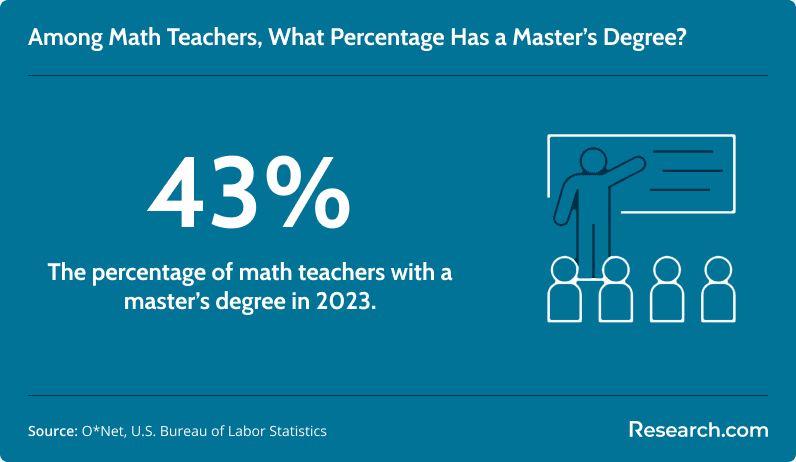
- Bachelor’s degree: A bachelor’s degree is generally the minimum requirement. Common majors include mathematics, mathematics education, or education with a concentration in mathematics. Among secondary school Math teachers in 2023, 43% have a master's degree.
- State-approved teacher preparation: Candidates usually complete an approved program that combines education coursework, math-specific pedagogy, assessment methods, classroom management, and supervised fieldwork.
- Required examinations: Most states require standardized assessments, which may include a basic skills test, a math content exam, and a professional teaching knowledge exam.
- Background check: School employment and licensure commonly require fingerprinting and criminal background screening to protect student safety.
- State licensure application: You must apply to the state where you want to teach and submit the required documents, test scores, transcripts, and fees.
| If your background is... | Common route | What to check first |
| High school graduate planning college | Bachelor’s degree in math education or education with math preparation | Whether the program is state-approved for the grade level you want to teach |
| Math major in college | Add teacher preparation, fieldwork, and certification exams | Whether your credits satisfy both math content and pedagogy requirements |
| Bachelor’s degree holder in math or related field | Alternative certification or post-baccalaureate teacher preparation | Whether you can teach while completing licensure requirements |
| Licensed teacher in another subject | Math endorsement, additional testing, or added certification area | Whether your state requires new coursework, exams, or supervised experience |
| Teacher moving states | Reciprocity or out-of-state license review | Whether the new state requires additional tests, training, or background checks |
How is math certification different from a general teaching license?
A math teaching certification is subject-specific. It authorizes you to teach mathematics within a defined grade range and usually requires deeper preparation in areas such as algebra, geometry, statistics, trigonometry, calculus, or quantitative reasoning, depending on the level.
A general teaching license is broader. It is most often associated with elementary education, where one teacher may teach reading, writing, math, science, and social studies. That license emphasizes general pedagogy, child development, classroom routines, and foundational instruction across multiple subjects.
If you are asking what teachers are most in demand right now, math is commonly discussed because schools need teachers who can teach a high-need academic subject. However, demand still depends on state, district, grade level, and local staffing conditions.
The main difference is depth versus breadth. Math certification requires stronger subject specialization, while a general license provides wider teaching flexibility, usually at earlier grade levels. Grades 7 to 12 Math teachers get paid more, about $10,000 to $15,000, after 15 years of service than most college teachers.
| Credential type | Typical teaching scope | Best fit for | Main limitation |
| General teaching license | Multiple subjects, often elementary grades | Teachers who want broad classroom responsibility with younger learners | May not qualify you for advanced middle or high school math roles |
| Middle school math certification | Math for early adolescents, often pre-algebra and introductory algebra | Teachers who prefer grades 5-9 or 6-8, depending on state rules | May not cover high school courses such as calculus or statistics |
| High school math certification | Secondary math courses such as Algebra I, Geometry, Algebra II, Statistics, and Calculus | Teachers who want subject-specialized instruction with older students | Requires stronger math content preparation and subject testing |
How long does it take to earn a math teaching certificate for 2027?
The timeline depends on where you are starting. A traditional undergraduate route usually takes four to five years because it combines a bachelor’s degree, teacher preparation coursework, field experiences, and student teaching. Certification exams and application processing can add additional time after graduation.
If you already hold a bachelor’s degree in math or a related discipline, an alternative certification pathway may take six months to two years. Some of these programs are offered through flexible or online formats, including options connected to affordable online courses. The exact timeline depends on your state, whether you study full time or part time, and whether your program allows employment while completing certification requirements.
Some states issue an initial or provisional credential first and require additional teaching experience, mentoring, testing, or graduate coursework before full certification. That means the time to enter the classroom may be shorter than the time to reach a standard or professional license.
Views on advanced education differ among math teachers. In 2023, 37% of certified math teachers believe that a doctorate degree is necessary, especially for those teaching in higher education. For 43% of math teachers, a master's degree is often considered enough for stronger pedagogy, deeper subject knowledge, and possible leadership opportunities.
| Pathway | Typical timeline stated | Best for | Important trade-off |
| Traditional bachelor’s route | Four to five years | Students starting college or changing majors early | Longer timeline but usually the most structured preparation |
| Alternative certification | Six months to two years | Bachelor’s degree holders with math or related preparation | Faster entry, but requirements can be intensive while working |
| Added endorsement | Varies by state and prior license | Licensed teachers adding math | May require exams, coursework, or both |
| Advanced degree plus certification | Varies by program | Career changers or teachers seeking long-term advancement | Can cost more and may go beyond minimum licensure needs |
What levels of math teaching certification are available?
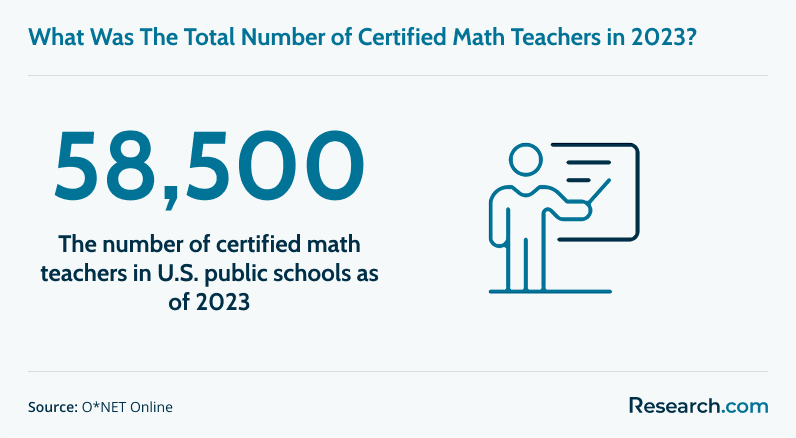
Math teaching certification is usually divided by grade level and sometimes by specialization. As of 2023, there were 58,500 certified Math teachers in U.S. public schools. The certification level you choose should match the students and courses you want to teach.
These levels also connect to the broader career path for secondary school teachers, especially for educators who want to move from classroom teaching into department leadership, curriculum work, or administration.
Elementary math authorization
- Grade range: Typically K-6 or K-5.
- Instructional focus: Foundational arithmetic, number sense, measurement, basic geometry, and early problem solving as part of a general elementary curriculum.
- Common preparation: An education degree with coursework in child development, elementary methods, and early mathematics instruction.
Middle school math certification
- Grade range: Typically 6-8 or 5-9, depending on the state.
- Instructional focus: Fractions, ratios, proportional reasoning, pre-algebra, introductory algebra, geometry basics, and data interpretation.
- Common preparation: A bachelor’s degree with a mathematics concentration or middle grades education focus, plus required state exams.
High school math certification
- Grade range: Typically 9-12.
- Instructional focus: Algebra I & II, Geometry, Trigonometry, Calculus, Statistics, and other advanced secondary math courses.
- Common preparation: A bachelor’s degree in mathematics or secondary education with a math emphasis, student teaching, and subject-specific assessments.
Specialized math credentials
- Advanced Placement math: Teachers who teach AP Calculus or AP Statistics may need additional training and course approval through the College Board.
- International Baccalaureate math: IB math instruction generally requires specialized workshops and authorization connected to the IB organization.
Special education math-related credentials
- Instructional focus: Adapted math instruction for students with disabilities or individualized learning needs.
- Common preparation: Additional special education coursework, state exams, and training in differentiated instruction and accommodations.
National Board Certification
- Purpose: This advanced voluntary credential recognizes accomplished teaching practice and is respected across states.
- Common requirements: At least three years of teaching experience, a rigorous assessment process, and a portfolio documenting teaching practice.
Are there national standards for math teacher certification?
There is no single federal math teaching license in the United States. Teacher certification is controlled primarily by states. However, national organizations and standards strongly influence how states and teacher preparation programs define high-quality math teaching.
This differs from some early childhood pathways. For example, preschool teacher certification requirements can be shaped by state rules, employer expectations, and early childhood program standards, but math teacher licensure remains tied closely to grade level and subject authorization.
National Council of Teachers of Mathematics
The National Council of Teachers of Mathematics influences math instruction by publishing standards and resources that shape teacher preparation, curriculum planning, and professional expectations. NCTM standards are not a license, but they affect how institutions design math teacher preparation programs.
NCTM standards are also relevant to programs seeking accreditation through the Council for the Accreditation of Educator Preparation. For future teachers, this means program quality is not only about completing credits; it is also about whether the training reflects accepted expectations for mathematical reasoning, problem solving, and effective instruction.
National Board for Professional Teaching Standards
The National Board for Professional Teaching Standards offers a voluntary advanced credential for experienced teachers who can document accomplished practice. It is not required for initial licensure, but it can strengthen professional standing and may help with mobility or compensation in some districts.
Public support for this type of quality marker is high. Like many other professions, 81% of Americans believe teachers should be required to achieve Board certification in addition to licensure.
Common Core State Standards
The Common Core State Standards for Mathematics focus on what students should learn, but they also influence teacher preparation because educators must know how to teach conceptual understanding, procedural fluency, modeling, and problem solving. Even in states that use different standards, math teachers are often expected to help students explain reasoning, apply concepts, and use multiple strategies.
The practical takeaway: your state license is the legal requirement, but national standards shape what strong math preparation looks like.
Is becoming a certified math teacher worth it?
Math teacher certification can be worth it if you want a stable education career, enjoy explaining complex ideas, and are prepared for the demands of classroom teaching. It is not the right path for everyone. The work involves lesson planning, assessment, parent communication, classroom management, state testing expectations, and continuous professional learning.
| Potential advantage | What it means in practice | What to consider before deciding |
| Public school eligibility | Certification opens access to standard public school math teaching roles | You must meet the requirements of the state where you teach |
| Meaningful student impact | You help students build problem-solving, quantitative reasoning, and confidence | Progress can be uneven, and some students arrive with major math gaps |
| Professional mobility | Experienced teachers can pursue department, curriculum, coaching, or administrative roles | Leadership roles may require graduate study or additional credentials |
| Benefits and compensation | Public school roles often include benefits such as health insurance, retirement plans, and paid time off | Salary varies widely by state, district, education level, and experience |
| Loan forgiveness opportunities | Perkins Loan cancellation is typically offered to Math and Science teachers | Eligibility rules depend on the loan program and teaching assignment |
This path is a strong fit for people who like working with adolescents or children, can communicate abstract ideas clearly, and are willing to adapt instruction for different learners. It may be a poor fit if you want a math career with little interpersonal work, prefer independent technical tasks, or are not interested in classroom management.
How can an advanced degree boost my math teaching career?
An advanced degree can help math teachers move beyond entry-level classroom roles into instructional leadership, curriculum design, educational research, teacher coaching, or administration. Graduate study can also deepen knowledge of assessment, equity in math education, learning science, and school improvement.
For working educators who need flexibility, online EdD programs may be worth comparing if the goal is leadership, applied research, or district-level influence. The key is to choose an advanced program because it supports a specific career goal, not simply because more education always guarantees a salary increase.
Can online advanced degrees enhance my math teaching career?
Online advanced degrees can help math teachers build skills in instructional technology, curriculum planning, digital resource evaluation, and research-based teaching. The best online option depends on whether you want to stay in the classroom, become a coach, lead a department, move into administration, or shift toward academic support roles.
Some teachers also pursue interdisciplinary graduate study to strengthen information literacy and digital learning. For example, a library science degree online may support work in digital resource management, research instruction, and school-based learning systems. This route makes the most sense when it aligns with a defined role, such as instructional technology support, school library leadership, or curriculum resource coordination.
How do I choose the right math teaching certification program?
The right certification program is the one that leads to the license you actually need in the state and grade band where you plan to teach. Cost, convenience, and speed matter, but they should not outweigh approval status, exam alignment, supervised teaching quality, and graduate outcomes.
Flexible formats, including an online teaching degree, can be useful for working adults and career changers. However, online coursework does not eliminate field placement, student teaching, or state testing requirements.
| Question to ask | Why it matters | Warning sign |
| Is the program state-approved for math certification? | Approval determines whether the program can lead to licensure | The school says it “prepares” teachers but does not confirm state approval |
| Which grade band does it cover? | Elementary, middle, and high school math credentials are not interchangeable | The program description is vague about grade levels |
| What exams will I need? | Testing affects cost, timeline, and eligibility for licensure | The advisor cannot identify the required state exams |
| How are field placements arranged? | Student teaching is a major part of preparation | You must find your own placement with little institutional support |
| What is the total cost? | Tuition is only one expense; fees, exams, travel, and lost work time also matter | The school advertises affordability without giving a full cost estimate |
| Does it meet out-of-state requirements? | This matters if you plan to move after graduation | The program assumes all states will accept the credential automatically |
Can I transfer my math teaching certification to another state?
You may be able to transfer a math teaching certification to another state, but the process is not always automatic. States often review your transcripts, current license, teaching experience, exam history, background check, and preparation program before deciding what credential to issue.
State rules come first
Teacher licensure is handled by individual states. A credential that qualifies you for high school math in one state may not fully satisfy another state’s coursework, testing, or grade-band requirements.
Reciprocity can help, but it is not a guarantee
- Many states participate in reciprocity agreements intended to reduce barriers for licensed teachers moving across state lines.
- Reciprocity usually means the state has a process for reviewing out-of-state credentials, not that your license transfers without conditions.
- You may still need additional testing, coursework, training, or background screening.
Factors that affect out-of-state transfer
- Education and experience: Degree level, program approval, years taught, and certification area can influence the review. Some teachers pursue masters in education online options to strengthen credentials, but a graduate degree does not automatically solve every state requirement.
- Testing: A receiving state may require its own exams even if you passed similar assessments elsewhere.
- Background checks: Expect to complete a new background check and fingerprinting process in the new state.
- National Board Certification: This advanced credential may make the process smoother because many states recognize its rigor.
National Board Certification is a voluntary advanced credential showing mastery of content knowledge and teaching practice. The following chart compares evidence of deeper learning for students taught by National Board Certified Teachers and students taught by non-NBCTs, illustrating why rigorous preparation can matter for outcomes.
Performance outcomes
What career paths are available for certified math teachers?
A math teaching certification can lead to classroom, leadership, curriculum, coaching, tutoring, and analytical roles. Through 2033, the projected job openings for secondary Match teachers are 4,600, with annual growth expected to remain about 5%. The demand is expected to be higher for those with math teaching certification.
School-based career paths
- Classroom math teacher: Teach math at the elementary, middle, or high school level, often specializing in courses such as algebra, geometry, statistics, or calculus.
- Math department head: Coordinate curriculum, support teachers, review assessment data, and help align instruction across courses.
- Curriculum specialist: Design, evaluate, and implement math curricula aligned with state and national expectations. Advanced preparation, such as masters in elementary math, may support this type of role.
- Instructional coach: Work with teachers to improve lesson design, questioning techniques, assessment practices, and student engagement in math.
- Educational administrator: With additional preparation, move into roles such as assistant principal, principal, or district administrator.
- Post secondary education: With advanced degrees, teach or support instruction at colleges and universities.
Career paths outside traditional school classrooms
- Tutoring: Provide individual or small-group support for students who need remediation, enrichment, or exam preparation.
- Test preparation: Work with students preparing for exams such as the SAT or ACT.
- Data analysis: Apply quantitative reasoning and analytical skills to interpret data in education, business, or public-sector settings.
- Finance and actuarial science: Use mathematical foundations in finance, risk analysis, or related quantitative fields.
- Technology: With additional training, transition into programming, software-related work, or educational technology roles.
- Government: Apply mathematical and analytical skills in local, state, or national agencies.
| Career direction | Additional preparation that may help | Best fit for |
| Classroom advancement | Mentoring, National Board Certification, graduate coursework | Teachers who want to remain student-facing |
| Curriculum or coaching | Master’s degree in math education, assessment training, instructional leadership | Teachers who enjoy supporting other educators |
| Administration | Educational leadership degree, administrator certification where required | Teachers interested in school operations and staff leadership |
| Higher education | Advanced graduate study in math, education, or related fields | Teachers who want college-level instruction or research roles |
| Private-sector transition | Technology, data, finance, or analytics training | Teachers who want to apply math skills outside schools |
Is pursuing a master's degree in educational leadership a strategic move for math teachers?
A master’s degree in educational leadership can be useful for math teachers who want to supervise teams, coordinate curriculum, lead departments, or pursue administrative roles. A masters in educational leadership may build skills in school management, strategic planning, instructional supervision, and policy implementation.
This degree is most strategic when your goal is broader school leadership rather than only stronger math instruction. Before enrolling, confirm accreditation, field requirements, whether the degree supports administrator licensure in your state, and whether the format fits your teaching schedule.
What is the average salary for certified math teachers?
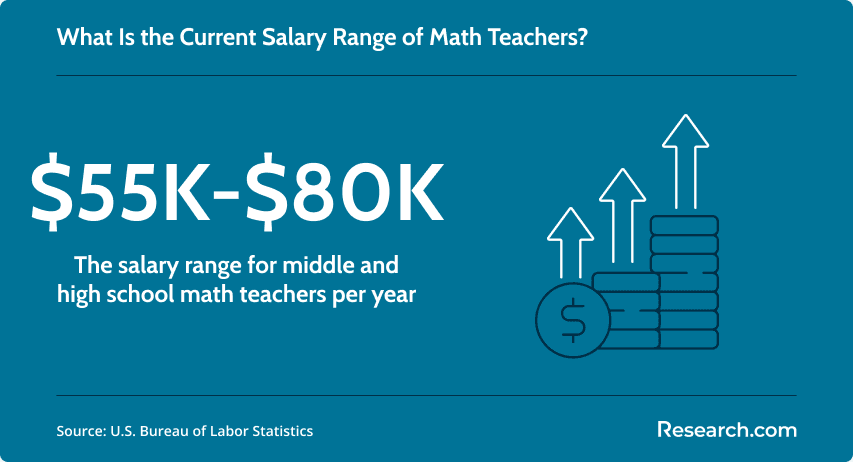
Certified math teacher salaries vary by location, grade level, education, district pay scale, and experience. In the United States, the national average salary for middle and high school math teachers typically ranges from $55,000 to $80,000 per year, according to data from the U.S. Bureau of Labor Statistics. High school math teachers generally earn slightly more than middle school math teachers.
Location can create large salary differences. Teachers in states such as California, New York, and Massachusetts often exceed $80,000 annually because of higher living costs and demand for qualified educators. In contrast, average salaries may be lower in parts of the Midwest and South. Advanced degrees, National Board Certification, and years of service can also affect pay, stipends, or bonuses in many districts.
Do not judge a teaching job only by the posted salary. Compare total compensation, including health insurance, retirement contributions, paid leave, loan forgiveness eligibility, class load, planning time, cost of living, and union or contract protections where applicable.
What certified math teachers say about the process
- The certification process was demanding, but it helped me understand what real classroom teaching requires. Passing the math exams made me feel prepared to explain difficult topics, and my students’ progress reminds me why the effort mattered. Sydney
- Balancing coursework with student teaching felt intimidating at first. Working with a mentor teacher turned out to be the most valuable part because I learned how to manage lessons, build relationships, and improve through feedback. Jason
- Certification gave me access to teaching opportunities I would not have had otherwise. Earning the credential improved my confidence and helped me feel respected as a professional educator. Ethan
How can I stay updated on evolving math teaching certification standards?
Certification rules, testing requirements, curriculum standards, and renewal expectations can change. The safest approach is to check your state education agency regularly, especially before applying to a program, registering for exams, renewing your license, or moving states.
Math teachers should also follow professional organizations, attend workshops, participate in professional learning communities, and review district updates on curriculum and assessment. Educators who want to connect classroom practice with applied research or leadership may also compare online Ed.D programs that fit their long-term goals.
Can advanced leadership skills elevate a math teacher's career?
Leadership skills can help math teachers move into roles where they influence instruction beyond their own classrooms. Skills in strategic planning, conflict resolution, teacher mentoring, data use, and collaborative decision-making are valuable for department heads, instructional coaches, curriculum leaders, and administrators.
Teachers considering broader leadership roles may explore an organizational leadership PhD online program if their goals extend into research, organizational change, policy, or executive-level education leadership. This type of degree should be evaluated carefully because it may not replace state administrator licensure requirements.
Can interdisciplinary certifications broaden career avenues for math teachers?
Interdisciplinary credentials can broaden a math teacher’s options when they support a clear professional direction. Educational technology, data literacy, instructional design, curriculum development, special education, and information management can all complement math instruction.
Some teachers also explore adjacent education fields, including library science jobs, when they want roles involving research support, digital learning resources, academic information systems, or school-based media programs. The best credential is one that adds a practical skill employers recognize, not one chosen only to collect additional titles.
Can integrating library science enhance math teaching effectiveness?
Library science and information management can support math teaching by improving how teachers locate, evaluate, organize, and share instructional resources. These skills are useful when building digital resource collections, guiding student research, curating math tools, or supporting project-based learning.
For educators interested in roles beyond the math classroom, jobs for masters in library science may offer alternative paths in school libraries, academic support, digital archives, or information services. This path is most relevant for teachers who enjoy resource management, research instruction, and technology-supported learning.
Can integrating insights from interdisciplinary studies enhance math teaching outcomes?
Interdisciplinary study can help math teachers connect quantitative reasoning with science, technology, social issues, economics, design, and real-world problem solving. This can make math instruction more relevant and help students see why mathematical thinking matters outside a textbook.
A degree in interdisciplinary studies may be useful for teachers who want to design flexible curricula, collaborate across departments, or create learning experiences that combine math with other academic fields. It is most valuable when paired with strong math pedagogy and a clear classroom or leadership purpose.
Common mistakes to avoid when pursuing math teacher certification
| Mistake | Why it causes problems | Better approach |
| Choosing a program before checking state approval | You may complete coursework that does not lead to licensure | Confirm approval with your state Department of Education before enrolling |
| Focusing only on tuition | Exam fees, background checks, travel, books, and unpaid student teaching can add cost | Compare the full cost of completion, not just per-credit pricing |
| Assuming online programs work in every state | Licensure rules are state-specific, especially for field placements and exams | Ask the program to confirm where graduates are eligible for certification |
| Ignoring grade-band differences | Middle school and high school math credentials may not authorize the same courses | Choose the certification level that matches your target job |
| Waiting too long to plan exams | Testing schedules and score reporting can delay your application | Create a testing timeline before your final semester or clinical placement |
| Assuming salary outcomes are guaranteed | Pay depends on district contracts, location, education, and experience | Review district salary schedules and total compensation before accepting a job |
How AI and technology are changing math teaching
AI tools, adaptive learning platforms, graphing technology, and digital assessment systems are changing how math teachers plan instruction and respond to student needs. These tools can help identify skill gaps, generate practice problems, visualize concepts, and support differentiated learning.
Technology does not replace strong math teaching. Teachers still need to evaluate whether tools are accurate, age-appropriate, accessible, aligned with standards, and useful for conceptual understanding. Future math teachers should be prepared to teach students how to use technology responsibly while still building reasoning, estimation, fluency, and problem-solving skills.
Practical steps to become a certified math teacher
- Choose your target grade level. Decide whether you want elementary, middle, or high school math because requirements differ.
- Check your state Department of Education website. Verify degree, testing, background check, student teaching, and application rules.
- Select a state-approved program. Confirm that the program leads to the specific math certification you need.
- Plan your exams early. Identify required basic skills, pedagogy, and math content exams, then build study time into your schedule.
- Complete fieldwork seriously. Use observations and student teaching to practice lesson design, questioning, classroom management, and assessment.
- Prepare your licensure application. Gather transcripts, test scores, background check documentation, recommendation forms, and fees.
- Compare job offers carefully. Review salary schedules, benefits, mentoring support, class sizes, planning time, and professional development.
- Track renewal requirements from day one. Keep records of professional development hours, graduate credits, and district training.
Key Insights
- Math teacher certification is a state-issued license, not a generic certificate. Always confirm requirements with the state where you plan to teach.
- The usual pathway includes a bachelor’s degree, approved teacher preparation, required exams, student teaching, a background check, and a state application.
- Traditional certification commonly takes four to five years, while alternative certification for bachelor’s degree holders can take six months to two years.
- Grade level matters. Elementary, middle school, and high school math credentials prepare teachers for different students, content depth, and course assignments.
- There is no single national math teaching license, but NCTM standards, National Board Certification, and student learning standards influence preparation and professional expectations.
- Salary and career outcomes vary by district, state, education level, experience, and credentials. The national average salary for middle and high school math teachers typically ranges from $55,000 to $80,000 per year.
- Advanced degrees can support leadership, curriculum, coaching, or administrative goals, but they should be chosen based on a specific career plan and state requirements.
- The strongest certification program is not always the fastest or cheapest. It is the one that is state-approved, aligned with your target grade level, transparent about costs, and effective at placing candidates into supervised teaching experiences.
References:
- Get the Facts Out. (n.d.). Facts and data.
- Hechinger Report. (2024). Proof points: Many high school math teachers cobble together their own instructional materials from the internet and elsewhere, a survey finds.
- Mathematical Association of America. (n.d.). Resources.
- National Center for Education Statistics. (2024). Mathematics, grade 4.
- National Center for Education Statistics. (2024). Mathematics, grade 8.
- National Council of Teachers of Mathematics. (2024). NAEP releases 2024 math scores.
- O*NET OnLine. (n.d.). Secondary school teachers, except special and career/technical education.
Other Things You Should Know About Math Teaching Certification and Requirements
Yes, many states allow a provisional or intern license while you complete certification. These licenses usually require a bachelor’s degree, supervised student teaching, and passing scores on required exams such as Praxis or state content tests within a set deadline, often 1 to 3 years.
To obtain math teaching certification in 2027, candidates must pass the Praxis Mathematics Content Knowledge exam. This exam assesses understanding of mathematical concepts typically taught in secondary education and is a key component of the certification process in many states.


