
2027 What Can You Do With an Environmental Science Degree?

Co-Founder and Chief Data Scientist
An environmental science degree opens the door to a wide range of careers at the intersection of science, policy, and sustainability, from protecting natural resources to shaping climate solutions. With employment for environmental scientists and specialists projected to grow 7% until 2033, according to the U.S. Bureau of Labor Statistics, graduates entering the field can expect steady demand for their skills.
This guide will walk you through what you can do with an environmental science degree, exploring career paths, salary potential, skills you’ll gain, and the long-term value of the degree, so you can make confident, informed decisions about your future.
Key things you should know about getting an environmental science degree:
- An environmental science degree typically takes about four years of full-time study to complete at the bachelor’s level.
- Graduates enter a field with strong demand, as the projected employment for environmental scientists and specialists is around 8,500 per year.
- The program equips students with both technical skills, like GIS and lab analysis, and transferable skills, such as critical thinking and problem-solving.
- What does an environmental scientist do on a daily basis? Job Overview
- How long does it usually take to obtain an environmental science degree? Completion Time
- What technical skills do you learn in an environmental science degree? Technical Skills
- What jobs can you get with an environmental science degree? Best Jobs
- How much can you earn in the top industries that hire environmental scientists? Top Industries
- What graduate degrees pair well with an environmental science background? Graduate Degrees
- How do undergraduate research and internships prepare you for grad school? How do undergraduate research and internships prepare you for grad school?
- What is the average salary for environmental science graduates? Average Salary
- How can integrating technology boost environmental science careers? How can integrating technology boost environmental science careers?
- What are alternative career options outside of traditional environmental science roles? What are alternative career options outside of traditional environmental science roles?
- What is the future job outlook for environmental science majors? Job Outlook
Environmental science degree and careers in 2026: what students should know before choosing this path
An environmental science degree can lead to work in conservation, environmental consulting, public agencies, sustainability, research, and data-driven climate or resource planning. The decision is not only about liking nature or science. Students need to understand the daily work, the technical skills employers expect, how long the degree takes, which jobs are realistic after graduation, and how salary can vary by sector.
This guide is for prospective students, current environmental science majors, career changers, and graduates deciding whether to continue into a master’s program. It explains what environmental scientists do, what you learn in the degree, where graduates work, how much professionals can earn, and how to choose the right academic and career path without relying only on broad claims about “green jobs.”
Quick answer: Is an environmental science degree useful?
Yes, an environmental science degree can be useful for students who want a science-based career focused on pollution, conservation, sustainability, environmental health, land use, water quality, or climate-related problem solving. The strongest outcomes usually come from pairing the degree with field experience, GIS, statistics, laboratory skills, internships, and a clear career direction. Students who want highly specialized engineering, law, public health, or corporate strategy roles may need additional credentials or graduate training.
What does an environmental scientist do every day?
Environmental scientists divide their time among field sampling, laboratory or software-based analysis, regulatory review, report writing, and communication with clients, agencies, or community stakeholders. The exact routine depends on whether they work in government, consulting, research, conservation, education, or corporate sustainability.
- Collect environmental samples in the field: Many professionals gather soil, water, air, plant, or wildlife data at project sites. These samples help identify contamination, monitor ecosystem health, or document environmental conditions before development or restoration work begins.
- Analyze information with lab and digital tools: Environmental scientists use laboratory methods, spreadsheets, statistical programs, and Geographic Information System (GIS) platforms to interpret patterns in environmental data. GIS is especially important for mapping pollution, land use, habitats, flood risk, and resource distribution.
- Write technical reports: A major part of the job involves turning raw data into clear findings. Reports may support permits, environmental impact reviews, remediation plans, conservation strategies, or public policy decisions.
- Check compliance with environmental rules: Some environmental scientists inspect sites, review records, or evaluate whether organizations are meeting federal, state, or local environmental standards. This work connects scientific evidence with public health, worker safety, and ecosystem protection.
- Recommend practical solutions: Environmental scientists may help reduce emissions, improve waste management, restore habitats, protect water quality, or design monitoring programs. The best solutions must be scientifically valid, legally defensible, and realistic for the organization or community involved.
| Work activity | What it looks like in practice | Why it matters |
| Fieldwork | Visiting wetlands, facilities, streams, construction sites, forests, farms, or urban areas to collect observations and samples | Provides direct evidence about environmental conditions |
| Laboratory testing | Analyzing water, soil, air, or biological samples using scientific procedures | Helps determine contamination, quality, risk, or ecosystem health |
| GIS and data analysis | Mapping locations, modeling patterns, and comparing environmental data over time | Supports decisions about land use, conservation, remediation, and planning |
| Compliance work | Reviewing permits, monitoring rules, and documenting whether standards are being followed | Helps organizations avoid harm, penalties, and public health risks |
| Communication | Preparing reports, briefings, public materials, or presentations for nontechnical audiences | Turns scientific findings into decisions people can act on |
How long does an environmental science degree take?
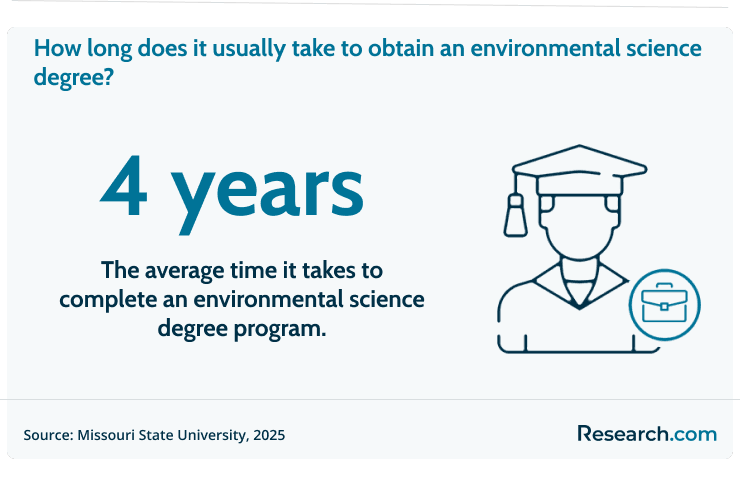
A bachelor’s degree in environmental science is commonly planned as a four-year, full-time program. In many programs, this equals about 120 semester credit hours completed across eight academic terms.
Missouri University of Science and Technology, for example, structures its Bachelor of Science in Environmental Science as a four-year program that combines core science courses with advanced work and a senior capstone project. That kind of structure is typical for students who enter as first-year undergraduates and follow the recommended course sequence.
The actual timeline can be shorter or longer. Students may finish in three years if they bring in transfer credits, take summer classes, carry heavier course loads, or enter with applicable prior coursework. Students planning ahead for graduate study may also compare options such as a fast track online master’s in environmental management if they want to move more quickly from undergraduate preparation into management-level training.
Other students take more than four years because they attend part time, switch majors, repeat required science courses, add a concentration, complete extended fieldwork, or balance school with employment and family responsibilities.
| Student situation | Possible effect on timeline | What to check before enrolling |
| Full-time first-year student | Often follows the standard four-year plan | Course sequence, lab requirements, field requirements, and capstone timing |
| Transfer student | May finish faster if science and general education credits apply | Transfer credit policy and whether previous lab courses meet major requirements |
| Part-time student | Usually needs more than four years | How often required courses are offered and whether labs are available online or in person |
| Student adding a concentration | May need extra electives or prerequisites | Whether the concentration improves career fit enough to justify added time |
| Student planning graduate school | May benefit from early research, internships, and prerequisite planning | Whether the bachelor’s curriculum supports the intended master’s or PhD pathway |
What technical skills do environmental science majors learn?
Environmental science programs combine biology, chemistry, geology, hydrology, ecology, statistics, and applied technology. The most employable graduates usually leave with more than classroom knowledge: they can collect defensible data, analyze it correctly, and explain what the results mean for a site, policy, project, or community.
- Laboratory analysis: Students learn to test soil, water, air, and biological samples using chemical, physical, and biological methods. These skills are used to evaluate pollution, water quality, ecosystem conditions, and resource health.
- GIS and spatial analysis: Students develop mapping and geospatial interpretation skills that support conservation planning, land-use analysis, habitat monitoring, and environmental risk assessment.
- Remote sensing and monitoring: Coursework may introduce satellite imagery, drones, sensors, and monitoring systems that help track large-scale environmental change, including deforestation, urban growth, water conditions, and climate-related impacts.
- Statistics and data analysis: Environmental science majors often use tools such as R, Python, and Excel to organize data, test hypotheses, build models, and communicate evidence-based findings.
- Environmental modeling: Students may learn to model air, water, soil, or ecosystem processes to estimate how natural systems respond to human activity, policy decisions, or remediation plans.
- Geology and hydrology field methods: Programs often teach soil classification, groundwater sampling, streamflow measurement, and site observation methods that are essential for water resource and land management work.
- Risk assessment and compliance testing: Students learn how to evaluate environmental hazards and assess whether conditions meet applicable requirements. Graduates who want to deepen their sustainability and consulting preparation may compare options such as the fastest master’s in environmental sustainability online.
Skills employers often value most
| Skill area | Why it matters for employment | How students can strengthen it |
| GIS | Many environmental problems are spatial, including habitat loss, contamination, flooding, and land use | Build a portfolio of maps, spatial analyses, and project examples |
| Data analysis | Employers need graduates who can interpret results rather than only collect data | Use R, Python, Excel, or statistical software in class projects and internships |
| Field sampling | Consulting, government, and conservation roles require reliable site data | Seek field courses, seasonal work, volunteer monitoring, or internships |
| Scientific writing | Reports drive permits, remediation decisions, grant proposals, and policy recommendations | Practice technical reports, executive summaries, and data visualizations |
| Regulatory awareness | Compliance roles require understanding how science is used in environmental rules | Take environmental policy, environmental law, or compliance-focused electives |
What jobs can you get with an environmental science degree?
Environmental science graduates work in public agencies, consulting firms, engineering-related organizations, nonprofits, research centers, schools, parks, and corporate sustainability teams. The degree is broad, so the best job fit depends on whether a student builds stronger skills in fieldwork, data analysis, policy, communication, education, or business operations.
Students comparing interdisciplinary options should look at the actual work required in each field, not just the title of the major. For example, guides on jobs you can do with a degree in communication disorders show how research, observation, documentation, and interpersonal skills can support very different career paths. Environmental science has a similar lesson: transferable skills matter, but students still need targeted preparation for the job they want.
- Environmental consultant: Consultants help businesses, local governments, and property owners evaluate environmental conditions, prepare reports, manage compliance, and plan remediation or sustainability improvements.
- Conservation scientist: These professionals protect forests, wetlands, grasslands, and other natural resources while working with landowners, agencies, and communities.
- Wildlife biologist: Wildlife biologists study animals, habitats, population trends, and conservation needs. They may conduct surveys, monitor endangered species, or support biodiversity planning.
- Environmental educator: Educators teach environmental science and sustainability in schools, parks, museums, nature centers, nonprofits, and public outreach programs.
- Environmental policy analyst: Policy analysts review laws, regulations, and programs to understand whether they are effective. They use scientific evidence to support recommendations for agencies, nonprofits, or research organizations.
- Sustainability specialist: Sustainability professionals help organizations reduce waste, improve energy efficiency, measure environmental impact, and prepare information related to Environmental, Social, and Governance (ESG) reporting.
- Research scientist or academic: Some graduates continue into advanced study and research roles in universities, laboratories, government agencies, or scientific institutions.
| Career path | Best fit for students who enjoy | Typical preparation that helps |
| Environmental consulting | Site visits, reports, deadlines, client work, and regulatory problem solving | Field sampling, GIS, technical writing, compliance coursework, internships |
| Conservation and wildlife | Outdoor work, habitat protection, ecology, and species monitoring | Ecology courses, seasonal field jobs, statistics, GIS, biology experience |
| Government environmental work | Public service, permitting, monitoring, inspections, and policy implementation | Regulatory knowledge, report writing, data analysis, public communication |
| Corporate sustainability | Business operations, reporting, waste reduction, energy use, and strategy | Data analysis, ESG familiarity, communication, project management, business electives |
| Research or graduate school | Scientific questions, experiments, modeling, and academic study | Faculty research, thesis projects, statistics, lab work, strong recommendations |
How much do environmental scientists earn in the top-hiring industries?
Pay for environmental scientists differs by employer type, responsibility level, location, experience, and specialization. The industries below are among the top employers of environmental scientists, and the salary figures show how compensation can vary by sector.
| Industry | Average annual earnings | What environmental scientists often do in this setting |
| Federal government, excluding postal service | $113,980 | Lead national programs, support regulatory enforcement, conduct large-scale research, and contribute to environmental policy implementation |
| Engineering services | $77,960 | Support pollution control, water systems, waste management, site assessment, and environmental planning for infrastructure or development projects |
| Management, scientific, and technical consulting services | $77,420 | Advise organizations on compliance, environmental risk, sustainability planning, reporting, and operational improvements |
| Local government, excluding education and hospitals | $77,390 | Work on community planning, land use, public health protection, inspections, natural resource programs, and local environmental review |
| State government, excluding education and hospitals | $76,840 | Monitor environmental quality, enforce state-level requirements, manage resources, and support parks, water, air, or land programs |
Students interested in the more applied engineering side of the field may compare environmental science with programs such as the fastest online environmental engineering degree. Engineering-focused roles may require a different curriculum and, in some cases, additional professional requirements.
Salary comparisons across unrelated fields should be used carefully. A specialized graduate degree can carry value when it matches market demand, but outcomes depend heavily on industry, role, portfolio, location, and experience. For example, Research.com’s guide to MFA degree salary illustrates how earnings can vary widely even among people with advanced education.
The federal government figure is the highest among the industries listed here, but that does not mean every graduate should target federal employment. Consulting, engineering services, and state or local agencies can offer strong experience, clearer entry points, or better alignment with a student’s preferred work style. The chart below provides a visual comparison of the listed industry earnings.
Which graduate degrees pair well with environmental science?
Graduate study can help environmental science majors specialize, move into leadership, qualify for research roles, or pivot into policy, public health, planning, business, or advanced technical work. The right graduate degree should match the job target, not just the broad interest in sustainability or the environment.
| Graduate option | Best for students who want to work in | Main value of the degree |
| Master’s in Environmental Science | Research, technical consulting, ecology, climate science, pollution control, or advanced scientific roles | Builds deeper scientific expertise and may include research or thesis work |
| Master of Public Health (MPH) | Environmental health, epidemiology, public health agencies, or international health organizations | Connects environmental conditions with human health outcomes |
| Master of Environmental Management (MEM) | Consulting, environmental policy, sustainability leadership, or resource management | Combines applied science with management and decision-making |
| Master of Urban and Regional Planning | Land use, transportation, climate adaptation, housing, infrastructure, and sustainable cities | Prepares students to connect environmental concerns with planning and development |
| PhD in Environmental Science or Ecology | University teaching, advanced research, government laboratories, or scientific leadership | Develops independent research expertise and academic specialization |
| MBA with a Sustainability Concentration | Corporate sustainability, ESG strategy, green innovation, or operations leadership | Adds business, finance, and management skills to environmental knowledge |
Students who want stronger mapping, spatial analysis, or resource planning skills may also consider a fast track online geography degree. Geography and environmental science can be a useful combination for careers involving GIS, urban planning, conservation, land management, and environmental data visualization.
When graduate school makes sense
- You want research-heavy roles: Many advanced research jobs expect graduate-level training, especially when the work involves independent study design, modeling, or publication.
- You need a specialized credential: Public health, planning, business leadership, and some technical environmental roles may favor specific graduate degrees.
- You are targeting leadership: Management roles often require more than technical competence; they may also demand budgeting, policy, supervision, and stakeholder communication.
- You know the role you want: Graduate school is usually a stronger investment when students can clearly connect the degree to a specific career path.
How do research projects and internships help environmental science students?
Undergraduate research and internships are often the difference between a general science degree and a competitive environmental science résumé. They show employers and graduate admissions committees that a student can apply methods, handle data, work independently, and communicate findings beyond the classroom.
- Research experience: Faculty-led or independent projects give students practice forming questions, collecting evidence, analyzing results, and drawing defensible conclusions.
- Technical skill development: Students become more comfortable with lab equipment, field instruments, GIS tools, environmental monitoring devices, and analytical software.
- Professional references: Professors, supervisors, graduate students, and agency partners can later provide recommendations, job leads, or research connections.
- Scientific communication: Presenting findings through posters, reports, presentations, or meetings helps students explain complex results clearly.
- Career testing: Internships let students compare specialties such as water quality, ecology, climate science, compliance, GIS, sustainability, or public outreach before committing to a long-term path.
- Project management: Balancing deadlines, field logistics, data quality, and coursework builds habits that are valuable in graduate school and professional roles.
- Graduate school readiness: Working with faculty and graduate students helps undergraduates understand the expectations of advanced study before applying.
Students trying to move quickly through their undergraduate preparation should still prioritize experience. Combining internships or research with the shortest online degree in environmental science can be more effective than simply finishing fast without building a portfolio of applied work.
How to make internships and research count
- Choose projects that produce work samples, such as maps, reports, datasets, presentations, or monitoring summaries.
- Ask supervisors what technical tools are used in the workplace and learn those tools before graduation.
- Keep a record of field methods, lab procedures, software used, and responsibilities handled.
- Request feedback on writing, data quality, and professional communication.
- Use each experience to narrow the next step: consulting, government, conservation, sustainability, education, or graduate school.
What is the average salary for environmental science graduates?
Environmental science earnings vary by role, location, employer, education level, and years of experience. A graduate entering a field technician role will not usually earn the same as a senior scientist, federal program specialist, project manager, or consultant with advanced credentials.
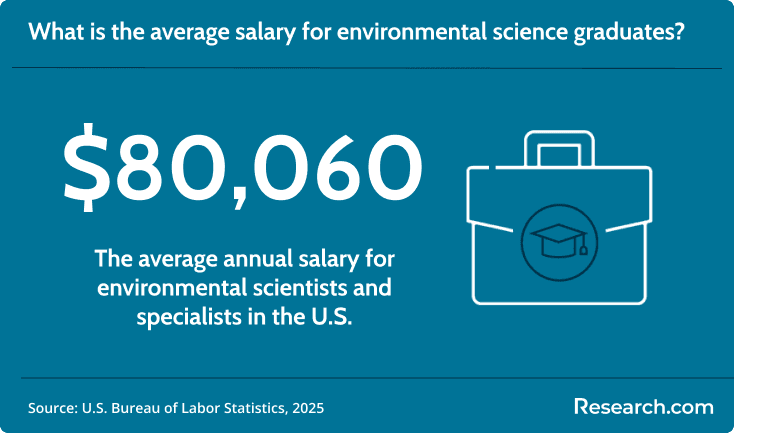
According to the U.S. Bureau of Labor Statistics, the median annual wage for environmental scientists and specialists was $80,060 in May 2024. The median is the midpoint: half of workers in the occupation earned more than that amount, and half earned less.
The wage range is broad. The lowest 10 percent earned less than $50,130, which may reflect entry-level roles, lower-paying regions, or positions with fewer advanced responsibilities. The highest 10 percent earned more than $134,830, often reflecting senior roles, leadership duties, specialized expertise, or employment in higher-paying sectors such as federal government or consulting.
Students considering mission-driven or nonprofit pathways should think carefully about how values, salary, and job duties fit together. Some graduates may also apply environmental knowledge in community or faith-based settings. Research.com’s guide to Christian leadership careers can help readers compare how leadership training may support nonprofit, community development, or stewardship-focused work.
What affects environmental science salary?
- Employer type: Federal, state, local, consulting, nonprofit, corporate, and research employers can pay differently.
- Technical specialization: GIS, statistics, modeling, compliance, remediation, environmental health, and sustainability reporting can influence opportunities.
- Education level: Some roles are accessible with a bachelor’s degree, while research, leadership, or specialized positions may favor graduate training.
- Experience: Field experience, internships, project management, and regulatory knowledge often matter as much as the degree title.
- Location: Pay and job availability can vary by region, cost of living, environmental regulations, and local industry activity.
How can technology skills improve environmental science career options?
Technology is reshaping environmental science work. Employers increasingly need professionals who can collect digital data, automate analysis, build maps, interpret sensor outputs, communicate with dashboards, and use software-supported models to guide decisions.
Students who combine environmental training with coding, GIS, databases, data visualization, or software fundamentals can compete for roles in environmental analytics, sustainability reporting, remote sensing, environmental modeling, and resource management. Those who want more formal technology training may compare environmental science electives with options such as the cheapest online software engineering pathway, especially if they are interested in data tools or software-supported environmental work.
| Technology skill | Environmental use case | Career advantage |
| GIS | Mapping habitats, contamination, land use, flood zones, or infrastructure risks | Useful across consulting, government, planning, and conservation |
| Python or R | Cleaning datasets, running statistics, modeling trends, and automating analysis | Helps graduates move beyond basic field roles into analytical positions |
| Remote sensing | Tracking vegetation, water conditions, urban growth, or landscape change | Supports climate, conservation, agriculture, and planning work |
| Data visualization | Turning technical findings into charts, maps, dashboards, or public-facing summaries | Improves communication with agencies, executives, clients, and communities |
| Environmental modeling | Estimating how systems may respond to development, remediation, or climate effects | Strengthens roles involving planning, risk assessment, and research |
What are career options outside traditional environmental science jobs?
Environmental science graduates do not have to work only as field scientists, government specialists, or conservation employees. The degree can also support roles that value scientific literacy, data interpretation, communication, public engagement, and sustainability awareness.
- Science communication and journalism: Graduates can explain climate, conservation, pollution, environmental health, and sustainability issues for general audiences through writing, audio, video, or digital media.
- Corporate social responsibility: Companies may hire sustainability-minded professionals to help design programs, track progress, support reporting, and communicate environmental initiatives.
- Green business or entrepreneurship: Graduates may build ventures around sustainable products, environmental services, waste reduction, or resource efficiency.
- Environmental outreach: Museums, aquariums, parks, nonprofits, and community organizations need people who can design programs that increase public understanding and action.
- Data science and analytics: Students with strong quantitative skills can move toward roles involving large datasets, geospatial analysis, environmental forecasting, or predictive modeling.
- Public policy and advocacy: Some graduates work with nonprofits, agencies, or advocacy organizations to translate science into legislation, public programs, or community campaigns.
Education is another practical pathway for graduates who enjoy teaching and public engagement. Programs in accelerated online STEM education may help science-focused graduates prepare for teaching, curriculum development, museum education, or outreach roles, depending on the credential requirements in their state or employer setting.
Who should choose environmental science—and who may need another path?
| Student goal | Environmental science may be a good fit if... | Consider another path if... |
| Work outdoors and collect data | You want fieldwork, sampling, ecology, water quality, or conservation work | You strongly prefer office-only work with little site travel |
| Design engineered systems | You want to understand environmental impacts and support technical teams | You want to become an engineer; environmental engineering may be more direct |
| Shape policy | You want a scientific base before moving into regulation, advocacy, or planning | You mainly want legal practice; law school or policy training may be necessary |
| Work in corporate sustainability | You want to combine environmental knowledge with data, reporting, and operations | You want finance-heavy or executive business roles without technical environmental work |
| Teach or communicate science | You enjoy translating scientific topics for students, communities, or the public | You need formal teacher licensure and the program does not meet that requirement |
What is the job outlook for environmental science majors?
The employment outlook for environmental scientists and specialists is favorable compared with many occupations. The U.S. Bureau of Labor Statistics projects employment for environmental scientists and specialists to grow 7% from 2023 to 2033, which is faster than the average for all occupations.
In job-count terms, employment is expected to increase from 84,600 in 2023 to about 90,700 in 2033. That represents a gain of 6,100 positions.
Several forces support demand for environmental science skills: environmental monitoring, regulatory compliance, climate adaptation, water and land management, conservation, energy-related work, and corporate sustainability. However, growth does not guarantee employment for every graduate. Students still need relevant experience, technical skills, strong writing, and a clear target role.
Environmental science also overlaps with social and cultural questions. Students interested in community-based conservation, human-environment relationships, or sustainability programs may find it useful to compare this field with guides on what can you do with an anthropology degree, since anthropology emphasizes fieldwork, cultural analysis, and community context.
The chart below shows the projected employment change for environmental scientists and specialists over the decade.
How to choose an environmental science program
Choosing the right environmental science program requires more than comparing tuition or scanning a ranking. The strongest program is the one that fits your career goal, offers the technical training you need, and provides access to fieldwork, research, internships, and advising.
- Check accreditation and institutional quality: Confirm that the college or university is properly accredited and that credits will be recognized by graduate schools or employers.
- Review the curriculum carefully: Look for biology, chemistry, ecology, geology, hydrology, statistics, GIS, environmental policy, and field or lab requirements.
- Ask about internships and research: Programs with agency, nonprofit, consulting, or faculty research connections can help students gain experience before graduation.
- Compare online and campus requirements: Online programs may still require labs, field experiences, or in-person components. Ask how those are completed.
- Evaluate career support: Look for advising, résumé help, employer connections, alumni outcomes, and support for graduate school applications.
- Understand transfer policies: If you have previous college credit, ask exactly which courses apply to the major, not only to general electives.
- Calculate total cost: Include tuition, fees, lab costs, travel for fieldwork, technology requirements, books, and time away from work.
Questions to ask before enrolling
- Does the program include GIS, statistics, lab science, and field methods?
- Are internships required, optional, or supported through partnerships?
- Can online students complete labs and fieldwork without relocating?
- What kinds of jobs have recent graduates pursued?
- Does the program prepare students for graduate school, employment, or both?
- Are there concentrations in sustainability, conservation, water resources, climate, environmental health, or policy?
- Will the degree meet any licensure, certification, or employer requirements for the specific role you want?
Common mistakes to avoid
| Mistake | Why it can hurt your outcome | Better approach |
| Choosing a program without checking accreditation | Credits, financial aid eligibility, graduate admission, or employer recognition may be affected | Verify institutional accreditation before applying |
| Focusing only on tuition | The cheapest listed tuition may not reflect fees, lab costs, travel, or lost work time | Compare total cost and expected time to completion |
| Ignoring GIS and data skills | Many environmental jobs require more than general science coursework | Build a technical portfolio with maps, datasets, reports, and analysis projects |
| Assuming online means fully remote | Science degrees may include labs, fieldwork, or site-based requirements | Ask exactly how hands-on requirements are completed |
| Waiting until senior year to seek experience | Graduating without internships or research can make entry-level competition harder | Start looking for fieldwork, volunteer monitoring, research, or internships early |
| Assuming salary outcomes are guaranteed | Pay depends on role, employer, region, experience, and specialization | Use salary data as a guide, then research specific roles and local employers |
| Picking a broad major without a career target | Environmental science can lead in many directions, but vague goals make course planning harder | Choose electives and experiences around consulting, conservation, policy, sustainability, education, or research |
What graduates say about environmental science degrees
- : "“Environmental science allowed me to work on practical climate solutions, including emissions reduction for local industries and wetland restoration. The work stays meaningful because I can see how the results affect both communities and ecosystems.” — Pearl"
- : "“My environmental science background helped me move into corporate sustainability. GIS, data analysis, and reporting skills now shape strategies that reduce waste and improve resource use.” — Miguel"
- : "“The degree led me to international work connected to clean water and community health. The technical training mattered, but so did the chance to collaborate with people who care about solving real problems.” — David"
Key Insights
- Environmental science is a practical, skills-based degree: The strongest graduates can collect data, analyze it, map it, write about it, and explain why it matters.
- A bachelor’s degree is often planned for four years: Many programs require about 120 semester credit hours, though transfer credits, part-time study, summer courses, and program structure can change the timeline.
- GIS, statistics, lab methods, and field experience are major career differentiators: Students who graduate with only general coursework may face more competition than those with technical portfolios and internships.
- Career options are broad but not automatic: Environmental science can lead to consulting, conservation, government, sustainability, education, policy, research, and analytics, but each path requires targeted preparation.
- Salary varies widely: The BLS reported a median annual wage of $80,060 in May 2024 for environmental scientists and specialists, with the lowest 10 percent earning less than $50,130 and the highest 10 percent earning more than $134,830.
- The federal government leads the listed industries in average annual earnings: Among the industries shown, federal government roles report $113,980, while engineering services, consulting, local government, and state government cluster around the high $76,000 to $77,000 range.
- The outlook is positive but competitive: Employment is projected to grow 7% from 2023 to 2033, increasing from 84,600 jobs to about 90,700 jobs, but students still need experience and specialization.
- Graduate school should be strategic: A master’s, MPH, MEM, planning degree, PhD, or sustainability-focused MBA can help, but only if it aligns with a clear career goal.
- Program choice matters: Before enrolling, check accreditation, fieldwork, labs, GIS training, internship support, transfer credit policies, online requirements, and total cost.
References:
- EnvironmentalScience.org. (n.d.). Careers in environmental science. Environmental Science. Retrieved August 18, 2025, from EnvironmentalScience.org careers resource
- Missouri State University. (2025). Earn a Bachelor's Degree in Environmental Science. MSU
- Oregon State University Ecampus. (n.d.). Environmental sciences – online bachelor’s degree. Oregon State University. Retrieved August 18, 2025, from Oregon State University Ecampus environmental sciences program
- University of Arizona Online. (n.d.). Bachelor of Science in environmental science (online). The University of Arizona. Retrieved August 18, 2025, from University of Arizona Online environmental science program
- U.S. Bureau of Labor Statistics. (2025). Occupational Outlook Handbook: Environmental Scientists and Specialists. U.S. BLS
Other Things You Should Know About Pursuing an Environmental Science Degree
In 2027, a specialized environmental science degree is often more beneficial due to growing demands for expertise in areas like renewable energy and climate policy. However, a generalist degree offers adaptability and wider career options, making it valuable for diverse roles in both public and private sectors.
Certifications like the Certified Environmental Professional (CEP) or Leadership in Energy and Environmental Design (LEED) can enhance an environmental science degree in 2027, providing specialized skills and improving career prospects in areas like sustainable building, waste management, and pollution control.
Federal agencies such as the Environmental Protection Agency, U.S. Geological Survey, and National Park Service hire environmental science graduates for monitoring, compliance, and field research jobs. Many entry-level roles require a bachelor’s degree, and some scientific or regulatory positions also ask for GIS, statistics, or lab experience.


