
2027 Geography Careers: Guide to Career Paths, Options & Salary

Co-Founder and Chief Data Scientist
Choosing a geography career in 2026 is not about deciding whether you “like maps.” It is about deciding whether you want work that connects people, places, climate, data, planning, and technology. Geography now reaches into GIS, remote sensing, urban planning, disaster response, conservation, public health, and environmental policy. That makes it a practical major for students who want a field with clear real-world use, but it also means success usually depends on more than subject interest alone.
This guide is built for students, career changers, and professionals who want a clear answer on whether geography is a smart career choice. You will learn what geography jobs actually involve, which degree level fits different goals, what employers expect, which skills matter most, how pay varies across related roles, and how to choose a program that matches your budget, schedule, and long-term plans.
Quick Answer: Is Geography a Good Career Path in 2026?
Yes, geography can be a strong career path if you enjoy spatial problem-solving, environmental issues, data analysis, fieldwork, and technology-driven decision-making. The field is broader than “geographer” as a job title. Many graduates move into GIS, cartography, planning, environmental analysis, emergency management, research, and policy work. A bachelor’s degree is the usual entry point, while a master’s degree or doctorate can improve access to specialized, supervisory, research, or academic roles. The most competitive candidates usually combine geography knowledge with GIS, remote sensing, writing, analysis, and project management skills.
Geography Careers Table of Contents
- Why pursue a career in Geography?
- Geography Career Outlook
- Required Skills for Geography
- How can I balance a successful geography career with family responsibilities?
- What Emerging Technology Trends are Reshaping Geography Careers?
- How to Start Your Career in Geography
- What factors should I consider when choosing a geography degree program?
- How can online learning expedite my entry into the geography field?
- How can I finance my geography education?
- Can an accelerated bachelor's program fast track your geography career?
- How can I gain practical field experience in geography?
- How can I advance my career in Geography?
- Alternative Career Options for Geography
- How is remote sensing used in modern geography?
- What are the ethical considerations in geography research?
Why Pursue a Career in Geography?
Geography examines how people, environments, and places influence one another. On the human side, it overlaps with the liberal arts through culture, migration, politics, inequality, health, and economic activity. On the physical and technical side, it covers landforms, climate, ecosystems, mapping, remote sensing, and spatial data.
For many students, geography is appealing because it combines analysis with visible impact. The work often involves interpreting location-based data, identifying patterns, supporting planning or policy decisions, and explaining why problems happen in certain places and how those problems can be addressed.
| Reason to Choose Geography | What It Means for Your Career | Best Fit for Students Who... |
| It blends office work with fieldwork | Many geography jobs involve site visits, surveying, interviewing, environmental sampling, mapping, or community research. | Prefer applied work over a purely desk-based role |
| It strengthens spatial thinking | You learn to analyze scale, movement, distance, networks, and relationships across locations. | Enjoy maps, systems, data, and visual problem-solving |
| It supports environmental careers | Geographers contribute to sustainability, restoration, land-use planning, and environmental policy. | Want a pathway into sustainability careers |
| It helps explain climate and hazard risk | Geographic training can support flood mapping, wildfire risk analysis, climate communication, and emergency planning. The Yale Program on Climate Change has reported that three in ten still do not believe that climate change is happening, which makes clear communication especially important. | Care about resilience, climate response, and science-based public policy |
| It contributes to public safety | Geographic methods support disaster response, disease mapping, evacuation planning, and resource allocation. Geography was also discussed as a key part of fighting the COVID-19 pandemic. | Want work with direct community impact |
| It can support biodiversity protection | Conservation geographers help assess habitat loss, land-use pressure, and protected-area priorities. The IUCN Red List of Threatened Species records more than 37,000 species nearing extinction. | Are interested in ecosystems, wildlife, or natural resources |
| It develops transferable skills | Geography builds research, writing, GIS, visualization, statistical, and communication skills that apply across industries. | Want flexibility and value career exploration |
| It can lead to public-sector stability | Many geography-related jobs are found in local, state, and federal agencies, including planning, environmental protection, emergency management, and natural resources. | Prefer mission-driven work and structured career paths |
| It can offer strong pay in specialized roles | The federal executive branch in the U.S. pays geographers an average of $92,390 yearly. | Are willing to build technical expertise and move into advanced roles |
Geography Career Outlook
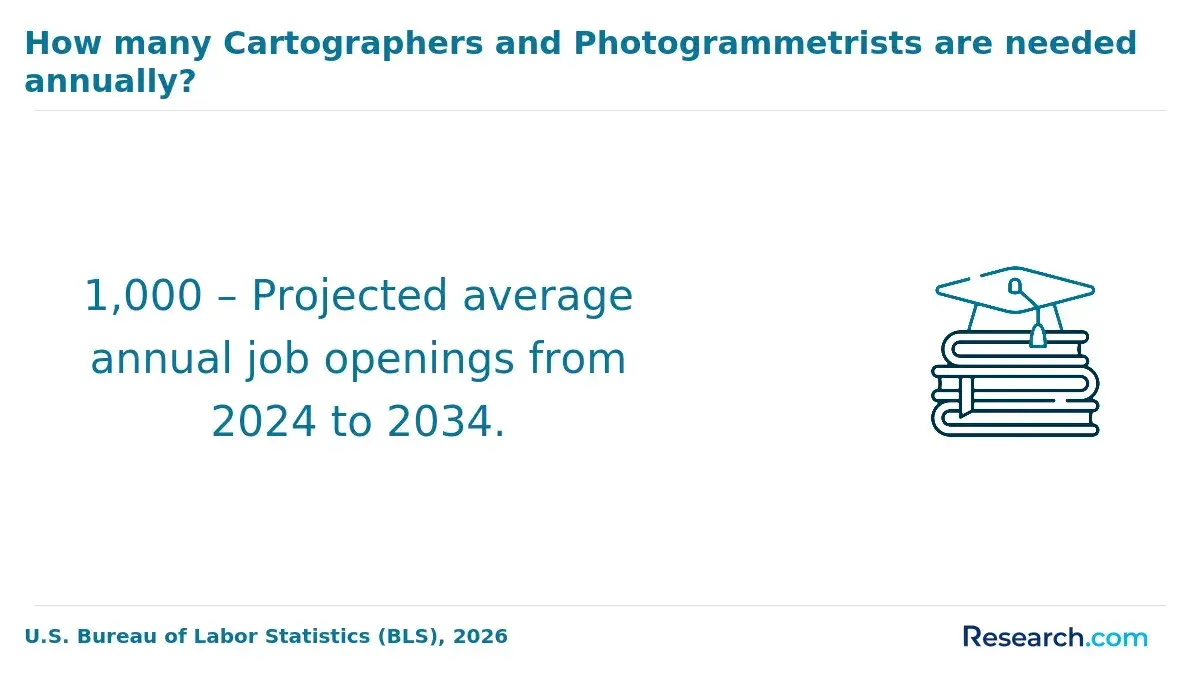
The U.S. Bureau of Labor Statistics projected 1 percent employment growth for geographers by 2033. That number is useful, but it does not tell the full story. “Geographer” is a narrow occupational title, while many geography graduates work in related jobs such as GIS analyst, planner, environmental scientist, cartographer, emergency management director, or conservation scientist.
The better way to judge the field is to look at the wider geospatial, environmental, planning, and data-analysis job market. The table below shows geography-related jobs and the salary and growth figures stated in the source article.
| Job Title | Annual Median Salary | Projected Growth |
| Surveying and Mapping Technicians | $46,200 | 1% |
| Environmental Science and Protection Technicians | $46,850 | 8% |
| Geological and Hydrologic Technicians | $50,630 | 5% |
| Conservation Scientist | $64,010 | 5% |
| Cartographer | $68,380 | 4% |
| Environmental Scientists and Specialist | $73,230 | 8% |
| Urban and Regional Planners | $75,950 | 11% |
| Emergency Management Directors | $76,250 | 4% |
| Geopolitical Analyst | $76,304 | 6% |
| Geoscientists | $93,580 | 5% |
| Natural Sciences Managers | $137,940 | 5% |
Required Skills for Geography
Geography careers reward people who can turn location-based evidence into decisions. In research published in The Professional Geographer and in recent workforce analysis, employers and educators in 2025 highlighted the mix of technical and professional skills most closely tied to success.
Core Technical Skills for Geographers
| Skill | Why It Matters | How to Build It |
| Spatial thinking | This is the core of geography. Professionals need to understand how location, scale, movement, patterns, and relationships shape a problem. | Take courses in human geography, physical geography, spatial analysis, and research methods. |
| Interdisciplinary analysis | Geography often addresses problems that combine economics, politics, ecology, public health, infrastructure, and community behavior. | Choose electives in environmental science, sociology, economics, public policy, or data analytics. |
| Geographic Information Systems | GIS is widely used to store, analyze, map, and communicate spatial information. | Complete GIS labs, portfolio projects, internships, and software-based assignments. |
| Cartography | Even when mapmaking is not the main job, geographers must understand how maps communicate evidence and how design choices shape interpretation. | Practice map design, data classification, scale selection, and visual storytelling. |
| Field methods | Fieldwork may include surveying, sampling, measurement, interviews, observation, or environmental monitoring. | Look for programs with field courses, research projects, service learning, or internships. |
Professional Skills Employers Expect
- Time management. O*NET Online reports that half of geographers worked 40 hours a week while the other half worked more than that, so planning and workload control matter.
- Writing. Geography professionals produce technical reports, grant materials, policy briefs, research papers, field notes, and public-facing summaries.
- Critical thinking. Strong geographers define the problem, evaluate evidence, ask better questions, and avoid drawing conclusions from weak data.
- Problem-solving. Whether the work involves emergency response, conservation, urban development, or business location strategy, geographers compare options and explain trade-offs.
- Computer and technology fluency. Geography work often uses software, sensors, databases, dashboards, GPS equipment, satellite imagery, and data visualization tools.
How Can I Balance a Successful Geography Career with Family Responsibilities?
A geography career can fit family life, but the schedule depends on the role. Some jobs involve travel, fieldwork, irregular hours, or emergency response, while others are more predictable and easier to do from home, such as GIS analysis, mapping, research support, and planning documentation.
If you are a parent or caregiver, compare programs and jobs based on schedule control, fieldwork requirements, internship format, online access, and employer flexibility. Accredited online programs can help students build GIS, research, and analytical skills without relocating or leaving work. If you are weighing education options with family obligations in mind, Research.com’s guide to the best online degrees for moms may help you compare practical pathways.
What Emerging Technology Trends Are Reshaping Geography Careers?
Geography is becoming more technical because employers rely heavily on geospatial data to study climate risk, transportation, supply chains, migration, environmental change, public health, and urban growth. Artificial intelligence, machine learning, drones, high-resolution satellite imagery, mobile data collection, IoT sensors, and real-time dashboards are changing how spatial information is collected and used.
These tools do not eliminate the need for geographers. They increase the value of judgment, because professionals still have to evaluate data quality, scale, bias, uncertainty, ethics, and the social effects of decisions made from spatial evidence. For working adults, short courses and credentials can help keep skills current; students comparing focused training may want to review certificate programs that pay well alongside degree options.
How to Start Your Career in Geography
The most common starting point is an associate or bachelor’s degree, depending on the job you want. An associate degree may lead to technician-level work, while a bachelor’s degree gives you a stronger base for GIS, planning support, conservation, cartography, environmental analysis, and graduate study.
| Education Level | Typical Career Use | Best For |
| Certificate | Skill-building in GIS, mapping, data tools, or a specialized topic | Degree holders adding technical skills or students preparing for college admission |
| Associate degree | Technician roles in surveying, mapping, environmental sampling, or field support | Students looking for a faster, lower-cost starting point |
| Bachelor’s degree | Entry-level professional roles and preparation for graduate study | Students aiming for GIS, planning, conservation, cartography, or environmental work |
| Master’s degree | Advanced planning, analysis, research, policy, and leadership roles | Professionals who want specialization or advancement |
| Doctorate | Research, academic, advanced scientific, and senior leadership paths | Students targeting top-level research or university teaching |
What Can I Do With an Associate Degree in Geography?
Surveying and Mapping Technicians
Surveying and mapping technicians support surveyors by going to project sites, setting up equipment, taking measurements, recording location data, and entering information into computer systems. Fifty-nine percent work in architectural, engineering, and related services.
Median Annual Salary: $53,458
Environmental Science and Protection Technicians
Environmental science and protection technicians collect samples, document conditions, assist scientists, and help prepare technical reports. The largest share, 24%, works in management, scientific, and technical consulting services. This can be a good fit for students who want applied environmental work early in their careers.
Medial Annual Salary: $44,940
Geological and Hydrologic Technicians
Geological and hydrologic technicians work with scientists and engineers in lab and field settings. They operate equipment, collect samples, analyze materials, and record data. Employment for geological and hydraulic technicians is expected to grow faster than average at 5%.
Median Annual Salary: $59,150
What Can I Do With a Bachelor’s Degree in Geography?
Conservation Scientist
Conservation scientists study land, forests, water, habitats, and natural resources. They collect and interpret environmental data, monitor resource use, and help shape policies that support long-term ecological health.
Median Annual Salary: $55,305
Cartographer
Cartographers design, update, and analyze maps and spatial data products. Their work supports transportation, public safety, land-use planning, national security, emergency response, and environmental management.
Medial Annual Salary: $57,045
Environmental Scientists and Specialist
Environmental scientists and specialists identify environmental risks, investigate pollution or resource problems, and recommend solutions. The source article notes that 7,100 more people will be needed for this job through 2029.
Medial Annual Salary: $62,563
Can You Get a Geography Job With Just a Certificate?
A certificate by itself is usually not enough for geographer positions. Most geography-related professional roles expect at least a bachelor’s degree, and more than 4 in 10 geographers hold a master’s degree. Because geography work can be technical and research-heavy, employers often screen for degree completion first.
That said, certificates can still add value. A GIS, remote sensing, cartography, data visualization, or environmental methods certificate can strengthen a resume when paired with a degree. Certificates can also help students show readiness for college-level coursework or update their skills after graduation.
What Factors Should I Consider When Choosing a Geography Degree Program?
The best geography program is the one that fits your career target, gives you relevant technical training, includes practical experience, and stays within your budget and schedule. Before enrolling, compare the curriculum, GIS access, fieldwork, faculty expertise, internship support, accreditation, transfer policies, and graduate outcomes.
| Factor | Why It Matters | Question to Ask |
| Curriculum | Geography is broad, so your coursework should align with GIS, planning, environment, sustainability, or research goals. | Does the program offer courses in the specialization I want? |
| GIS and technology access | Employers often expect experience with geospatial tools, databases, remote sensing, and visualization. | Will I complete hands-on projects using current geospatial software? |
| Fieldwork and research | Applied experience helps you connect theory to evidence-based decisions. | Are field courses, internships, labs, or faculty research opportunities required or optional? |
| Accreditation and institutional quality | Accreditation affects credit transfer, financial aid eligibility, and employer confidence. | Is the institution properly accredited? |
| Flexibility | Working adults and parents may need online, evening, part-time, or accelerated options. | Can I complete the program without disrupting work or family responsibilities? |
| Time to completion | Some students benefit from faster formats, but accelerated programs require strong time management. | Would an accelerated college degree help me meet my career timeline? |
How Can Online Learning Expedite My Entry Into the Geography Field?
Online learning can speed up entry into geography when it allows students to finish prerequisites, GIS courses, general education requirements, or associate-level coursework without relocating. Some online programs use virtual labs, mapping projects, collaborative assignments, and remote data exercises to build practical research and spatial-analysis skills.
Online study tends to work best for self-directed learners who can manage deadlines and find applied experience outside class. If you want a faster starting point, compare options like How fast can you get an associate's degree online? and confirm whether the credits transfer into a bachelor’s program.
How Can I Finance My Geography Education?
When you plan for geography school, compare the total cost rather than tuition alone. Add fees, software, equipment, field course expenses, books, transportation, housing, and the income you may lose while studying. Scholarships, grants, federal loans, employer tuition assistance, transfer credits, and community college pathways can all reduce borrowing.
Online programs can lower costs if they help you avoid relocation or stay employed, but affordability should never replace quality or accreditation. If price is your main concern, review accredited options such as cheap online bachelors degree programs and make sure the curriculum still covers the geography or GIS training you need.
Can an Accelerated Bachelor’s Program Fast Track Your Geography Career?
An accelerated bachelor’s program can help motivated students enter the field sooner, especially if they already have transfer credits, military credits, prior college coursework, or a clear career target. For geography students, the biggest advantage is speed: finishing sooner can mean applying earlier for GIS, planning, environmental, or mapping roles.
The trade-off is intensity. Accelerated formats usually mean heavier weekly reading, more frequent assignments, compressed labs, and tighter organization. Before choosing a bachelor's degree fast track, check whether the program still includes GIS practice, field learning, research assignments, and career support.
How Can I Gain Practical Field Experience in Geography?
Field experience can make a geography resume much stronger. Employers want proof that you can collect data, work with maps, write reports, participate in field research, and complete real projects. Good places to look for internships include planning departments, environmental consulting firms, conservation groups, utilities, transportation agencies, emergency management offices, and research centers.
Students in online programs should be especially intentional about this. An accredited online bachelor program can offer flexibility, but you may still need local internships, volunteer work, or independent mapping projects to build practical experience.
How Can I Advance My Career in Geography?
Advancement in geography often comes from specialization. A master’s degree can support movement into urban planning, policy, research, GIS leadership, emergency management, or advanced environmental roles. A doctorate is most useful for people pursuing research, academic teaching, senior scientific work, or highly specialized leadership positions.
What Can I Do With a Master’s in Geography?
Urban and Regional Planners
Urban and regional planners help communities decide how land, infrastructure, housing, transportation, and public spaces should develop. A large share, 72%, work for local government, where they collaborate with public officials and community stakeholders.
Median Annual Salary: $75,950
Emergency Management Directors
Emergency management directors coordinate preparation, response, and recovery for disasters and emergencies. They help ensure that people, facilities, equipment, and plans are ready before crises occur. By 2029, employment in this role is seen to grow by 5%.
Median Annual Salary: $76,250
Geopolitical Analyst
Geopolitical analysts study how political power, territory, resources, borders, conflict, trade, and regional conditions affect organizations and governments. Their work can support policy, risk analysis, international strategy, and security planning.
Medial Annual Salary: $76,304
What Kind of Job Can I Get With a Doctorate in Geography?
Geoscientists
Geoscientists study Earth’s physical systems and materials. The Bureau of Labor Statistics identifies several types, including geologists, geochemists, geophysicists, oceanographers, paleontologists, petroleum geologists, and seismologists. Employment growth in these job positions is faster than average at 5%.
Median Annual Salary: $93,580
Geographic Information Systems Manager
GIS managers oversee geospatial projects, staff, software, databases, workflows, and stakeholder communication. This role requires advanced knowledge of GIS platforms, spatial data management, project planning, and organizational needs.
Median Annual Salary: $95,568
Natural Sciences Managers
Natural sciences managers lead teams of scientists working on research, development, testing, analysis, or applied scientific projects. They manage resources, review findings, oversee project direction, and communicate results to senior leaders. By 2029, 3,400 more natural sciences manager positions will be open.
Medial Annual Salary: $137,940
Which Certification Is Best for Geography?
The best certification depends on your target role. GIS-focused professionals may benefit from GIS credentials, remote sensing specialists may prefer photogrammetry or lidar credentials, and survey researchers may choose research-focused certifications. Certifications are most useful when they validate skills employers already list in job postings.
The Certified GIS Professional Certification
The Certified GIS Professional credential requires candidates to take and pass the GISCI Geospatial Core Technical Knowledge Exam. The exam measures knowledge in these areas:
- Conceptual Foundations
- Geospatial Data Fundamentals
- Cartography and Visualization
- Data Acquisition
- Data Manipulation
- Analytical Methods
- Database Design and Management
- Application Development
- Systems Design and Management
- Professional Practice
The GIS Certification Institute provides a practice exam as well as information about applications, testing locations, and fees.
American Society for Photogrammetry and Remote Sensing Certification
The certification program from ASPRS is accredited by the Council of Scientific and Engineering Specialty Boards. It includes several professional certification options:
- ASPRS Mapping Scientist
- ASPRS Mapping Technologist
- Certified Photogrammetrist
- Certified Mapping Scientist, Remote Sensing
- Certified Mapping Scientist, GIS/LIS
- Certified Mapping Scientist, Lidar
The Insights Professional Certification
The Insights Association offers this certification for survey researchers. Eligibility varies by experience level:
- IPC Principal: Three years
- IPC Master: 10 years
- IPC Laureate: by invitation
Alternative Career Options for Geography
A geography degree can lead to more than traditional geographer roles because it develops research, data interpretation, mapping, writing, visual analysis, and systems-thinking skills. If the standard geography job path feels too narrow, look at adjacent careers where spatial reasoning and analysis are valued.
What Else Can a Geographer Do?
Market Research Analysts
Human geography training can transfer well into market research because both fields study people, behavior, place, demographics, and decision-making. Market research analysts gather and interpret data to help organizations improve products, services, pricing, and customer strategy. BLS reports an 18% increase in employment in this job position by 2029.
Medial Annual Salary: $57,214
Atmospheric Scientists
Students with strong physical geography preparation may move toward atmospheric science, especially if they are interested in weather, climate, hazards, and environmental systems. The projected growth in employment of atmospheric scientists is 6%.
Annual Median Salary: $67,000
Postsecondary Teachers
Postsecondary teachers design courses, teach students, assess learning, supervise research, and contribute to academic programs. Geography graduates may choose this path if they want to educate future professionals or pursue research. As of 2025, there are over 5,349 geography teachers currently employed in America, according to Zippia.
Median Annual Salary: $41,000
How Is Remote Sensing Used in Modern Geography?
Remote sensing uses satellite, aerial, drone, or sensor-based imagery to collect information about Earth’s surface without direct physical contact. In modern geography, it helps researchers and decision-makers observe large areas, compare change over time, and identify patterns that would be difficult to measure through fieldwork alone.
- Environmental monitoring: Geographers use remote sensing to track deforestation, desertification, habitat change, coastal erosion, and polar ice loss.
- Climate change analysis: Satellite and aerial data can support research on land surface temperature, sea level, atmospheric conditions, vegetation stress, and other climate-related indicators.
- Urban planning and development: Remote sensing helps planners study land-use change, urban expansion, transportation corridors, and infrastructure needs.
- Disaster management: After hurricanes, earthquakes, floods, wildfires, or other disasters, imagery can help identify affected areas and guide response efforts.
- Agricultural monitoring: Spatial imagery can support crop health assessment, soil condition monitoring, irrigation planning, and resource management.
- Biodiversity and conservation: Remote sensing helps track habitats, identify conservation priorities, and detect activities such as illegal logging or land clearing.
- Geological surveys: Remote sensing data can help identify landforms, geological structures, mineral resources, oil, gas, and other subsurface indicators.
What Are the Ethical Considerations in Geography Research?
Geography research often involves people, communities, land, resources, and sensitive location data. Ethical practice is about more than producing accurate maps. Researchers also need to think about privacy, consent, representation, environmental justice, Indigenous rights, community impact, data security, and the risk that spatial data could be misused.
Responsible geographers explain how data is collected, protect identifiable information, avoid reinforcing harmful stereotypes, and involve affected communities when research may influence policy or resource decisions. Students planning advanced research should look for programs that teach ethics alongside technical methods. Those comparing doctoral options may also want to review the shortest doctoral programs while checking whether the curriculum includes research ethics and institutional review requirements.
Common Mistakes to Avoid When Preparing for a Geography Career
| Mistake | Why It Can Hurt You | Better Approach |
| Picking a program only because it is convenient | A convenient school may not give you the GIS training, fieldwork, or specialization you need. | Compare curriculum, technology access, internships, and faculty expertise before enrolling. |
| Skipping accreditation checks | Accreditation can affect transfer credit, financial aid, graduate admission, and employer recognition. | Verify institutional accreditation before applying. |
| Assuming every certificate can replace a degree | Many professional geography roles still expect at least a bachelor’s degree. | Use certificates to strengthen a degree, not replace one. |
| Looking only at salary | Pay varies by role, location, experience, degree level, employer, and technical skill set. | Evaluate duties, advancement paths, work setting, and skill requirements too. |
| Graduating without a portfolio | Employers often want proof that you can work with maps, data, reports, and real problems. | Build a portfolio with GIS maps, field reports, research summaries, dashboards, or spatial analysis projects. |
| Ignoring field experience | Coursework alone may not show that you can collect data, work outdoors, or manage applied projects. | Pursue internships, research assistantships, volunteer mapping, or community projects. |
Map Your Future in Geography
Geography helps explain complex events by connecting physical places with social systems. In The Geography Teacher, Helen Hazen wrote in “Teaching COVID-19 Topics in a Geographic Framework” that “Geographic methods were integral to improving our understanding of the HIV pandemic, the origins and spread of avian flu and Ebola, and the potential role of the global airline network in the spread of SARS, among numerous other examples.” The larger point still matters: location, movement, distance, and networks influence real outcomes.
Hazen also wrote that “Geography is ideally placed to help students make sense of the pandemic, sitting as it does at a critical point of intersection between the physical and social world.” That same intersection makes the field relevant to climate resilience, public health, conservation, planning, infrastructure, and emergency preparedness.
If you are still deciding what degree you should do, geography is worth a close look if you want a career that combines data, maps, people, environment, and decision-making. The strongest candidates will be those who pair geographic knowledge with practical technology skills and real applied experience.
Key Insights
- Geography is broader than mapmaking. The field connects people, environments, technology, policy, and spatial data to solve real problems.
- A bachelor’s degree is the typical entry point. Certificates can help, but they rarely replace a degree for professional geography roles.
- GIS and remote sensing are high-value skills. Students who can analyze, map, and explain spatial data are better prepared for modern geography work.
- Career options extend beyond the title “geographer.” Graduates may work in planning, conservation, environmental science, emergency management, cartography, market research, geoscience, or education.
- Graduate study can improve advancement. A master’s degree can support growth into planning, policy, research, and leadership, while a doctorate is most relevant for advanced research and academic roles.
- Program choice should be practical. Compare accreditation, fieldwork, GIS access, internships, cost, transfer policies, and schedule flexibility before enrolling.
- Experience makes graduates more competitive. Internships, field projects, GIS portfolios, research work, and community mapping can strengthen job prospects.
- Ethics matter in geography. Location data, community research, environmental decisions, and mapping all require attention to privacy, consent, bias, and justice.
References:
- American Association of Geographers. (2025). What is geography? https://www.aag.org/what-is-geography/
- Bureau of Labor Statistics. (2025). Geographers. U.S. Department of Labor. https://www.bls.gov/ooh/life-physical-and-social-science/geographers.htm
- Bureau of Labor Statistics. (2025). Cartographers and photogrammetrists. U.S. Department of Labor. https://www.bls.gov/ooh/architecture-and-engineering/cartographers-and-photogrammetrists.htm
- Bureau of Labor Statistics. (2025). Surveying and mapping technicians. U.S. Department of Labor. https://www.bls.gov/ooh/architecture-and-engineering/surveying-and-mapping-technicians.htm
- Indeed. (2026). GIS analyst salary in the United States. https://www.indeed.com/career/gis-analyst/salaries
- National Center for Education Statistics. (2025). Geography and cartography (CIP 45.0701). U.S. Department of Education. https://nces.ed.gov/ipeds/cipcode/cipdetail.aspx?y=55&cip=45.0701
- National Oceanic and Atmospheric Administration. (2025). NOAA careers. https://www.noaa.gov/work-with-us
- National Science Foundation. (2025). National Center for Science and Engineering Statistics: Geography fields. https://ncses.nsf.gov/
- National Aeronautics and Space Administration. (2025). Earth science careers. https://science.nasa.gov/earth-science/
- O*NET Online (n.d.). Geographers. Retrieved from https://www.onetonline.org/link/summary/19-3092.00
- Payscale (n.d.). Average Geographer Salary. Retrieved from https://www.payscale.com/research/US/Job=Geographer/Salary
- U.S. Geological Survey. (2025). Careers at USGS. https://www.usgs.gov/human-capital/careers
- U.S. Office of Personnel Management. (2025). Geography Series 0150. https://www.opm.gov/policy-data-oversight/classification-qualifications/general-schedule-qualification-standards/0100/geography-series-0150/
- ZipRecruiter. (2026). Geographer salary. https://www.ziprecruiter.com/Salaries/Geographer-Salary
- ZipRecruiter. (2026). GIS analyst salary. https://www.ziprecruiter.com/Salaries/GIS-Analyst-Salary
Other Things You Should Know About Geography Careers
ArcGIS Pro and QGIS are the most useful starting tools for geography graduates in 2027. Employers also value basic remote sensing with ENVI or Google Earth Engine, plus spreadsheet and data-cleaning skills for mapping, spatial analysis, and field data work.
Certifications such as the Geographic Information Systems (GIS) Professional (GISP) certification, Remote Sensing Certification, and Environmental Planning Certification can enhance a geography professional's skills, increase job prospects, and potentially lead to higher salaries in 2027. These certifications demonstrate expertise in specialized areas within the field of geography.
In 2027, geography graduates are entering industries like urban planning, transportation, environmental consultancy, and geospatial technology. Environmental and energy sectors also seek geography experts due to the growing emphasis on sustainable development and climate change solutions.
Essential skills for a geography career include spatial thinking, proficiency in Geographic Information Systems (GIS), cartography, time management, critical thinking, problem-solving, and strong writing skills.
Starting a career in geography typically involves earning an associate or bachelor’s degree in geography or a related field. Higher education degrees, such as a master’s or doctorate, are often required for advanced positions.


