2027 Environmental Careers: Guide to Career Paths, Options & Salary

Co-Founder and Chief Data Scientist
Environmental careers now span far more than field biology and park services. If you are trying to decide whether to study environmental science, pursue sustainability work, or move into clean energy, the real question is not whether the field matters. It does. The question is which path fits your strengths, budget, timeline, and long-term goals.
This guide breaks down the most practical environmental career options, the education levels they usually require, the skills employers look for, and the trade-offs between certificates, associate degrees, bachelor’s degrees, and graduate study. It is built for students choosing a major, career changers who want mission-driven work, and professionals who want to move into environmental or sustainability roles without choosing the wrong credential.
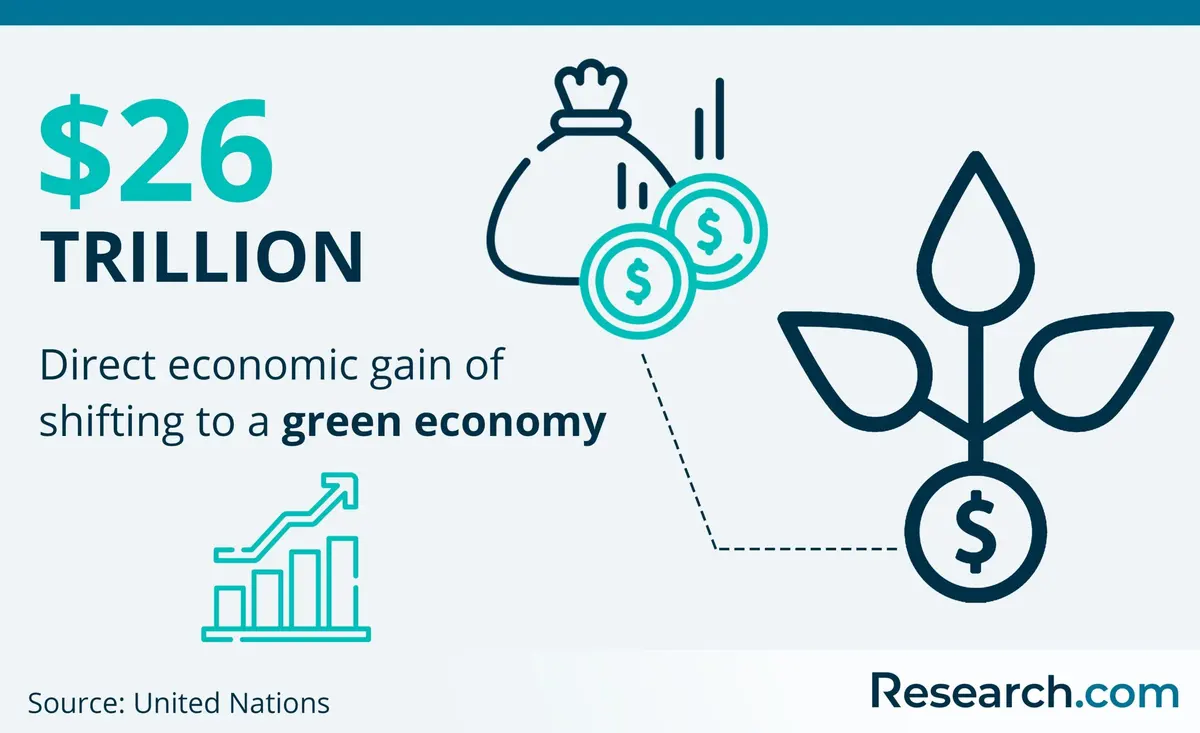
Environmental hiring is being influenced by clean energy growth, climate risk, conservation needs, sustainability reporting, and demand for lower-impact business practices. There are over 3.6 million clean jobs in the United States, and the clean economy sector grew by 2.8% annually (E2, 2025). Consumer demand is also pushing organizations to respond more seriously to sustainability expectations, as discussed in reporting on the demand for sustainable products and services. For most readers, the key issue is finding the environmental path that is realistic, affordable, and respected by employers.
You will also see how college degree types, certificates, internships, technical training, and graduate study can affect the jobs you qualify for and how quickly you can move forward.
Quick Answer: Are environmental careers worth it?
Environmental careers are worth considering if you want work tied to clean energy, conservation, sustainability, public health, climate resilience, natural resource management, or environmental compliance. They can be a strong fit for people who enjoy science, data, engineering, policy, fieldwork, technical writing, or project coordination. Some entry-level roles are open to certificate or associate degree holders, but many specialist, analyst, engineering, research, and leadership positions require a bachelor’s degree or higher.
The U.S. Bureau of Labor Statistics (2024) projects employment of environmental scientists and specialists to grow by 4% between 2024 and 2034, with around 8,500 more positions needed annually. Job growth is not uniform across the field, though. Some technician and conservation roles are slower-growing or declining, while renewable energy roles such as wind turbine technicians are expected to grow much faster.
Environmental Careers Table of Contents
- Why environmental careers matter
- Environmental careers outlook for 2027
- Skills needed for environmental careers
- How to start an environmental career
- How to choose the right education path
- Degree and certificate options
- Best entry-level jobs for environmental science graduates
- Trends shaping environmental career opportunities
- How to advance in environmental careers
- Targeted certifications for environmental professionals
- Challenges environmental professionals face
- Affordable education for environmental careers
- Accelerated online bachelor’s programs
- Fast-track education pathways
- Advanced research and career growth
- How technology is changing environmental work
- Sustainable practices in environmental careers
- Alternative environmental careers
Why environmental careers matter
Environmental work appeals to people who want their job to have a direct connection to the health of communities, ecosystems, and infrastructure. The work can be highly practical, such as testing water samples, maintaining clean energy systems, mapping habitats, or inspecting contaminated sites. It can also be analytical, legal, policy-driven, or managerial depending on the career path.
The field exists because environmental problems need different kinds of expertise. Engineers build treatment systems. Scientists collect and interpret data. Technicians monitor sites and equipment. Planners shape land use. Lawyers and policy specialists interpret rules and regulations. Sustainability professionals help organizations reduce waste, report performance, and make better operational decisions.
For students, education can also shape how they understand environmental responsibility. A study published in Psychology and Cognitive Sciences, “Relationship of Sustainable Behavior, World-Mindedness, National and Global Identities, Perceived Environmental Risk and Globalization Impact Among College Students in the United States,” found that greater concern about climate and environmental harm, along with a stronger sense of shared global identity, tends to support more sustainable behavior. That means environmental study can affect both career direction and civic perspective.
This field is best suited to people who can work across disciplines, handle regulation and uncertainty, and explain technical ideas to people outside their specialty. If that sounds like you, environmental careers can offer meaningful work in government, nonprofit organizations, consulting firms, utilities, energy companies, educational institutions, and private industry.
Environmental careers outlook for 2027
There is no single environmental job market. Outlook depends on the occupation, the industry, and the region. The U.S. Bureau of Labor Statistics (2024) projects employment of environmental scientists and specialists to grow by 4% between 2024 and 2034, or about 8,500 more positions annually. Other environmental occupations follow different patterns: some conservation and technician jobs are projected to grow slowly or decline, while clean energy jobs such as solar photovoltaic installers and wind turbine service technicians are projected to expand much faster over the same period.
Use the table below as a comparison tool, not a promise. Salaries and growth rates vary by location, employer, experience, degree level, and whether the role is in government, consulting, utilities, energy, or research.
| Environmental role | Salary | Demand |
| Forest and Conservation Technicians | $40,000 | -8% |
| Environment Science and Protection Technicians | $41,437 | 11% |
| Wind Turbine Technicians | $72,724 | 68% |
| Soil and Water Conservationists | $45,440 | 7% |
| Wildlife Biologists | $51,620 | 5% |
| Environmental Engineers | $81,213 | 4% |
| Industrial Ecologists | $76,530 | 8% |
| Climate Change Analysts | $73,217 | 8% |
| Atmospheric Scientists | $71,000 | 8% |
| Environmental Biotechnologists | $73,728 | 8% |
| Environmental Physicists | $73,000 | 8% |
| Environmental Statistician | $98,027 | 33% |
What environmental professionals actually do
Environmental careers cluster into several categories. Seeing the structure of the field makes it easier to choose a major, certificate, internship, or graduate concentration that matches the kind of work you want to do.
| Career area | Typical work | Best fit for people who enjoy |
| Environmental science and protection | Sampling, monitoring, compliance support, field reporting, laboratory testing, and risk identification | Fieldwork, science, procedures, and practical problem-solving |
| Conservation and ecology | Habitat assessment, wildlife monitoring, land management, restoration planning, and natural resource protection | Biology, outdoor work, ecosystems, and public lands |
| Clean energy | Installing, inspecting, repairing, or improving renewable energy systems and supporting energy efficiency | Technical systems, hands-on work, troubleshooting, and applied technology |
| Environmental engineering | Designing systems for pollution control, water treatment, waste management, remediation, and public health protection | Math, engineering design, infrastructure, and regulation |
| Sustainability and ESG | Tracking sustainability goals, preparing reports, reducing waste, supporting procurement decisions, and advising organizations | Business, communication, metrics, and cross-functional work |
| Policy, law, and planning | Interpreting regulations, drafting plans, advising agencies, managing land use, and supporting legal or policy decisions | Writing, negotiation, public systems, and long-term planning |
| Research and data | Modeling, statistical analysis, climate research, GIS mapping, forecasting, and technical publication | Data, coding, mathematics, research design, and specialized study |
Skills needed for environmental careers
Different roles require different abilities. A wind turbine technician needs mechanical skill and safety training. A climate analyst needs data and modeling experience. An environmental lawyer needs legal reasoning and regulatory knowledge. Even so, several core skills show up again and again across the field.
Technical and scientific skills
- Environmental literacy. Employers expect candidates to understand major issues such as pollution, conservation, climate risk, public health, land use, waste, and natural resource management. You do not need to master every subfield at once, but you do need to understand how your work connects to larger environmental outcomes.
- Scientific reasoning. Many jobs depend on observation, measurement, testing, and evidence-based conclusions. Reasoning skills help professionals design studies, interpret results, and avoid unsupported claims.
- Risk and systems analysis. Environmental work often involves trade-offs. Professionals may need to assess exposure, safety risks, ecological effects, compliance issues, and likely outcomes across multiple systems.
- Data skills. More environmental work now depends on collecting, cleaning, analyzing, and presenting data. That may include spreadsheets, GIS, statistics tools, dashboards, remote sensing, or models. Students who want advanced analytics may also benefit from learning what is involved in becoming a data scientist.
Transferable professional skills
- Project management. Environmental projects often involve budgets, schedules, permits, field staff, contractors, agencies, and community stakeholders. Project management helps keep work on time and within scope. It overlaps with skills used in public administration, especially when projects involve government agencies or public programs. Understanding project management scope is especially useful when responsibilities expand from isolated tasks to full project coordination.
- Technical writing. Reports, environmental assessments, grant applications, compliance documents, research summaries, and public-facing materials all depend on clear writing. In many roles, the ability to explain findings matters as much as the ability to collect them.
- Critical thinking. Environmental professionals must judge evidence, identify weak assumptions, weigh political and economic limits, and communicate uncertainty honestly.
- Communication with nonexperts. Many decisions involve communities, clients, regulators, executives, landowners, or elected officials. Professionals who can translate technical findings into practical recommendations have an advantage.
How to start an environmental career
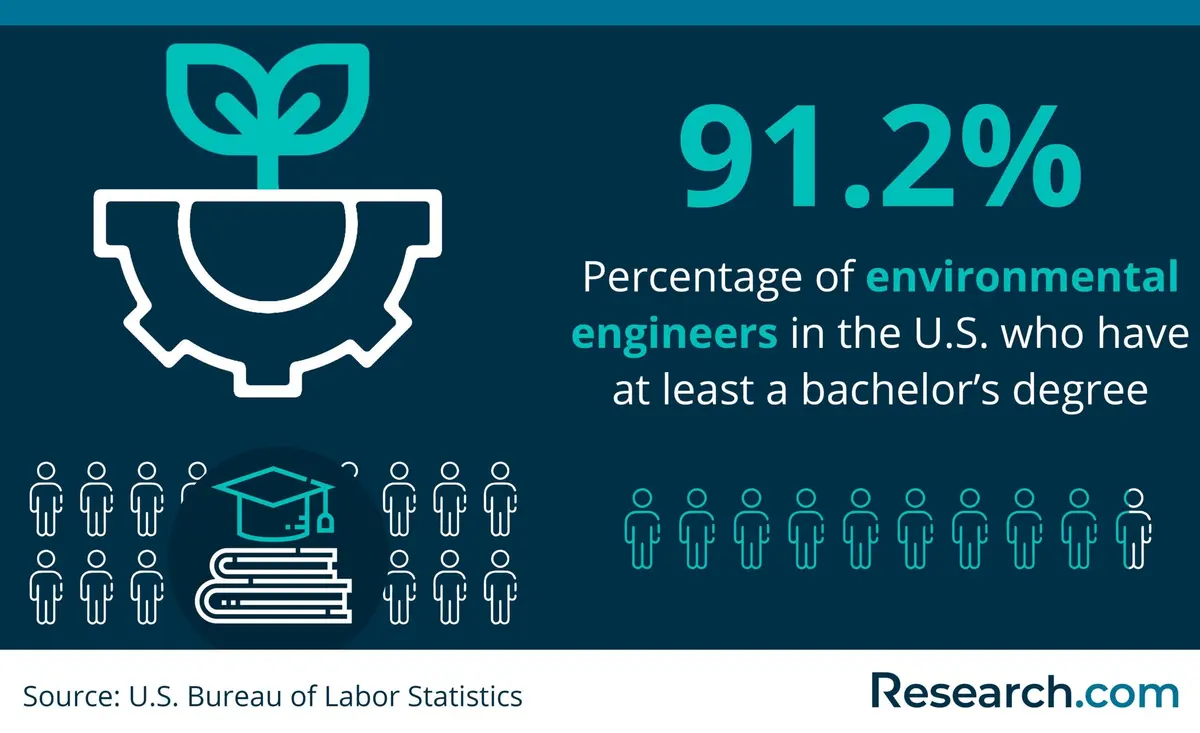
The right starting point depends on the role you want. Some jobs are available through certificates or technical training, while others require an associate, bachelor’s, master’s, or doctorate. In STEM fields, associate degree holders often begin in technician roles. A bachelor’s degree is commonly needed for analyst, specialist, conservation, biology, and engineering-related work, while graduate education is more common for research, policy leadership, and advanced scientific roles.
| Education level | Common starting point | When it makes sense |
| Certificate or short technical training | Solar photovoltaic installation, energy auditing, conservation work, or other skills-based entry roles | You want to enter the workforce quickly or test the field before committing to a degree |
| Associate degree | Environmental technician, forest and conservation technician, field assistant, laboratory assistant, or monitoring support role | You want a lower-cost academic credential with practical training and possible transfer options |
| Bachelor’s degree | Environmental scientist, conservation specialist, wildlife biology assistant, sustainability analyst, environmental compliance support, or engineering pathway | You want broader career access and the option to move into specialist or professional roles |
| Master’s degree | Climate analyst, industrial ecologist, senior specialist, project manager, policy analyst, or technical consultant | You want specialization, leadership preparation, or a stronger position in competitive roles |
| Doctorate | Research scientist, professor, advanced statistician, environmental physicist, or specialized biotechnology researcher | You want to conduct independent research, teach at a high level, or lead complex scientific inquiry |
Associate degree environmental roles
An associate degree can prepare students for technician-level environmental work. These positions often involve sampling, equipment operation, field notes, mapping support, safety procedures, and assisting scientists or managers.
Forest and Conservation Technicians
Forest and conservation technicians support scientists, foresters, and conservation teams. They may collect field data, assist with experiments, supervise workers, maintain records, and help manage land or forest resources. This role is practical and field-oriented, which makes it a good match for people who want outdoor work and structured technical tasks.
Median Annual Salary: $40,000
Environment Science and Protection Technicians
Environmental science and protection technicians help identify and reduce risks to public health and the environment. According to the Bureau of Labor Statistics, management, scientific, and technical consulting services is the largest employment sector for environmental science and protection technicians, accounting for approximately 7,020 jobs (U.S. Bureau of Labor Statistics, 2024). Employment in this occupation is projected to grow 4 percent between 2024 and 2034, about as fast as the average for all occupations (U.S. Bureau of Labor Statistics, 2024).
Median Annual Salary: $41,437
Wind Turbine Technicians
Wind turbine technicians inspect, maintain, troubleshoot, and repair wind turbines. Many work for electric power generation companies; 31% are employed in that setting. This career is a good option for people who want hands-on clean energy work and are comfortable with safety procedures, mechanical systems, and physically demanding conditions.
Median Annual Salary: $72,724
Bachelor’s degree environmental roles
A bachelor’s degree usually opens the door to more specialized environmental work. Depending on the major, students may study environmental science, biology, geology, chemistry, engineering, sustainability, geography, public policy, or data analysis.
Soil and Water Conservationists
Soil and water conservationists work on land use, watershed management, erosion control, soil health, water quality, and conservation planning. They often collaborate with landowners, government agencies, agricultural stakeholders, and environmental organizations. Students considering related earth science paths may also explore geology careers.
Median Annual Salary: $45,440
Wildlife Biologists
Wildlife biologists study animals, plants, habitats, population trends, and species interactions. More than six in 10 wildlife biologists work for state or federal governments. That is one reason many biology majors move into environmental or conservation work after graduation.
Annual Median Salary: $51,620
Environmental Engineers
Environmental engineers apply engineering, chemistry, biology, and environmental science to problems such as pollution control, water treatment, waste management, remediation, and public health protection. This path is more structured than many environmental science routes because engineering programs may need accreditation from the Accreditation Board for Engineering and Technology, Inc. Graduates may also pursue professional engineering licensure, depending on their goals and state requirements.
Median Annual Salary: $81,213
Can you get an environmental job with only a certificate?
Yes, some environmental jobs are open to people without a degree. A certificate or short technical training program may be enough for certain entry-level roles, especially when employers care most about hands-on ability, safety procedures, and job-specific skills.
- Solar Photovoltaic Installers
- Energy Auditor
- Forest and Conservation Workers
A certificate can be a useful starting point, but it may limit advancement if you later want specialist, analyst, engineering, management, or research roles. If you want to keep costs down while preserving transfer options, an associate degree can work well as a bridge between short training and a bachelor’s program.
How to grow your environmental career
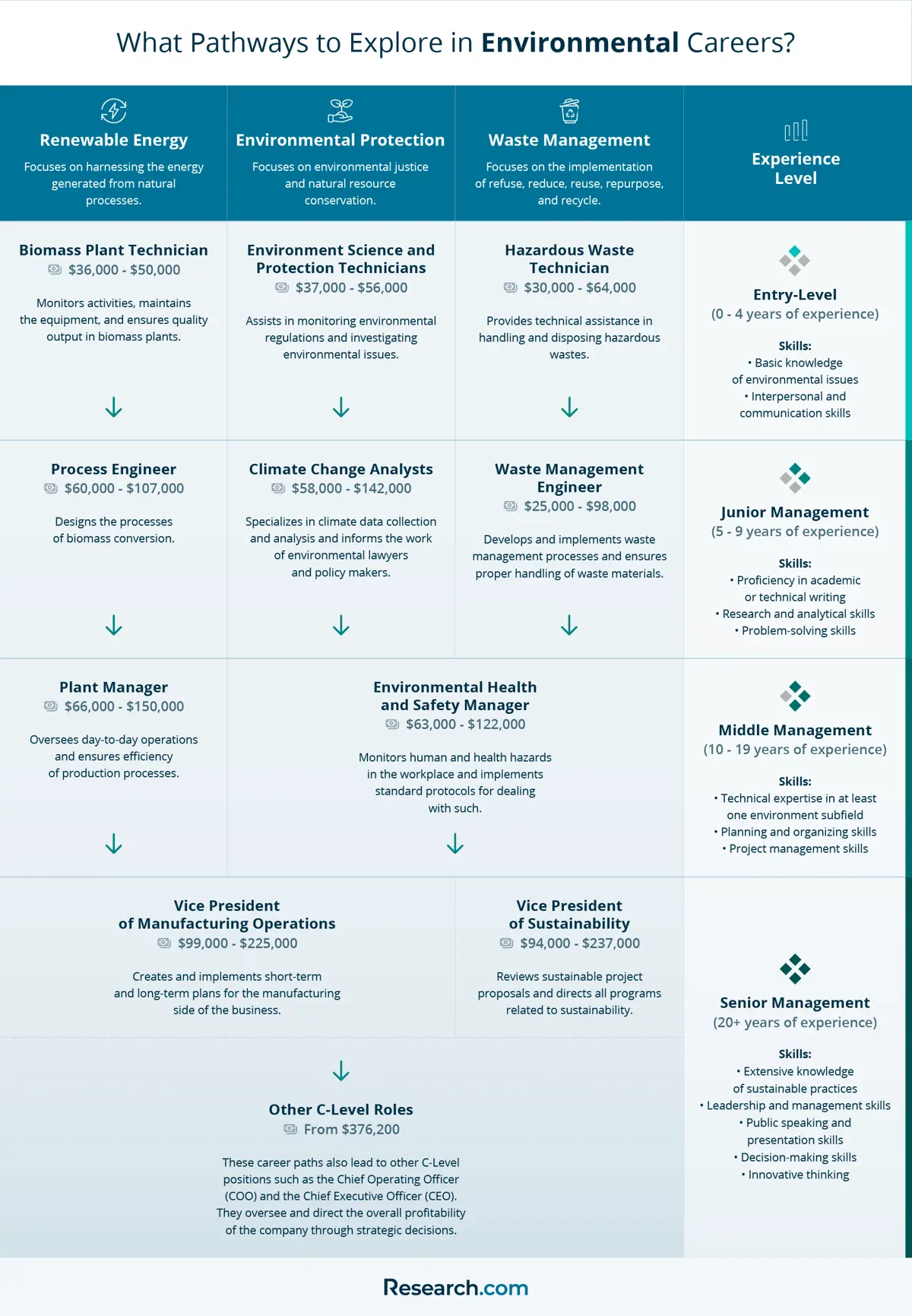
Career growth usually comes from combining education, experience, technical skill, and professional credibility. The strongest candidates do not rely on a credential alone. They build a record of internships, projects, certifications, tools, and references that show they can solve real environmental problems.
Gain practical experience early
Internships, volunteer projects, field assistant positions, apprenticeships, and part-time lab work can help you try different settings. Local conservation groups, municipal sustainability offices, environmental consulting firms, utility companies, and campus research labs can all provide useful exposure.
Choose credentials that match your target role
An accredited online bachelor degree can be a good option if you need flexibility, but the curriculum still has to match the job you want. A future wildlife biologist will need more biology and field methods, while a sustainability analyst will need stronger data, reporting, and business coursework.
Learn the tools employers actually use
GIS, spreadsheet modeling, data visualization, environmental sampling protocols, permitting knowledge, remote sensing, and technical writing can make you more competitive. The tools matter most when they match the needs of specific job postings, so review listings before choosing electives or certificates.
Build a professional network
Professional associations, environmental conferences, faculty mentors, alumni contacts, and local sustainability organizations can lead you to roles that never show up clearly on job boards. Networking is especially valuable in consulting, conservation, policy, and nonprofit work, where referrals and project experience carry weight.
How to choose the right education path for environmental careers
Start with the job, not the credential. A doctorate is unnecessary for many field, compliance, renewable energy, and sustainability positions. A certificate may be too narrow if your goal is environmental engineering, wildlife biology, climate analysis, or university research. Before enrolling, compare curriculum, accreditation, fieldwork, transfer policies, cost, and career outcomes.
If you want a broad undergraduate starting point, compare environmental science, biology, chemistry, geology, engineering, geography, sustainability, public policy, and data-focused majors. If flexibility matters because you are working or returning to school, it can help to review options such as what is the easiest degree to get online, but only if the program still includes the science and technical requirements your target job needs.
Master’s and doctorate programs make the most sense when you already know your specialization. Graduate study can support climate analysis, atmospheric science, industrial ecology, environmental statistics, policy leadership, and advanced research. It may not be the best first move if you do not yet have field experience or if you have not compared the financial return.
| If your goal is... | Consider this path | Be careful about... |
| Fast entry into hands-on environmental work | Certificate, apprenticeship, or associate degree | Limited advancement without additional education |
| Environmental science or conservation specialist roles | Bachelor’s degree with fieldwork, lab work, GIS, and internships | Programs with too little applied science or field experience |
| Engineering-focused environmental work | Environmental engineering or a related engineering degree | Ignoring accreditation and licensure requirements |
| Sustainability or corporate environmental work | Bachelor’s degree plus data, reporting, project management, and business knowledge | Choosing a program with broad sustainability language but weak technical training |
| Climate, research, or advanced analytics roles | Master’s degree or doctorate with strong quantitative training | Taking on graduate debt without a clear career target |
What are the best entry-level jobs for environmental science graduates?
Good entry-level jobs for environmental science graduates include environmental technician, environmental compliance assistant, field technician, laboratory technician, sustainability coordinator, GIS technician, conservation assistant, water quality technician, and environmental consulting support roles. The best fit depends on whether you want fieldwork, office-based analysis, public agency work, private consulting, or clean energy operations.
If you want a more focused list of post-graduation options, Research.com’s guide to entry level jobs with environmental science degree can help you compare roles that match environmental science training.
What emerging trends are shaping environmental career opportunities?
Environmental careers are being reshaped by technology, clean energy deployment, climate adaptation, sustainability reporting, environmental risk management, and the need for better data. Employers increasingly want candidates who can connect environmental knowledge with practical decisions. That might mean using GIS to map habitat changes, analyzing climate risk for infrastructure, supporting compliance documentation, or helping organizations measure sustainability goals.
Education is also becoming more flexible. Students who want a faster academic route may consider an accelerated associates degree online, especially if they plan to enter technician work first and transfer later. The important part is not speed for its own sake, but whether the program teaches skills employers actually value.
How can I advance my environmental career?
Advancement usually comes from a mix of deeper technical knowledge, management experience, a graduate degree, a license, a certification, or a strong record of successful projects. A master’s degree can help professionals specialize in ecology, climate change, atmospheric science, sustainability, environmental policy, or data analysis. A doctorate degree is more relevant for independent research, university teaching, and highly specialized scientific work.
Before enrolling in graduate school, ask whether the degree is required, preferred, or optional for the jobs you want. Also weigh tuition support, assistantships, part-time study, and the income you may give up while studying.
Master’s-level environmental roles
Industrial Ecologists
Industrial ecologists study how industrial systems interact with environmental and social systems. Their work may include lifecycle thinking, technical reporting, environmental impact analysis, and recommendations for more sustainable products or processes. According to a survey by O*NET Online, 65% of industrial ecologists have a master’s degree.
Median Annual Salary: $76,530
Climate Change Analysts
Climate change analysts collect and interpret data on climate impacts, vulnerability, mitigation, and adaptation. Their findings may support public policy, organizational planning, advocacy, regulation, or education.
Median Annual Salary: $73,217
Atmospheric Scientists
Atmospheric scientists study weather, climate, and atmospheric conditions using satellites, radar, models, instruments, and observational data. Their work may appear in forecasts, research reports, maps, and risk assessments.
BLS (2024) lists several types of atmospheric scientists: (1) Atmospheric chemists, (2) Atmospheric physicists and dynamists, (3) Broadcast meteorologists, (4) Climatologists, (5) Climate scientists, (6) Forensic meteorologists, and (7) Research meteorologists.
Median Annual Salary: $71,000
Doctorate-level environmental roles
Environmental Biotechnologists
Environmental biotechnologists use biology and engineering to address environmental problems. Their work may include pollution prevention, contaminated site treatment, biological processes, and research aimed at reducing environmental harm.
Medial Annual Salary: $73,200
Environmental Physicists
Environmental physicists apply physical principles to environmental systems and technologies. Their work can support renewable energy, environmental monitoring, heat transfer analysis, and scientific instrumentation.
Median Annual Salary: $73,728
Environmental Statisticians
Environmental statisticians design studies, analyze environmental datasets, build models, prepare forecasts, and communicate uncertainty. Their work can influence policy, regulation, risk assessment, and scientific decision-making.
Median Annual Salary: $98,027
Which certification is best for environmental careers?
The best certification depends on your specialization. A sustainability professional may need a different credential than a wetland scientist, environmental manager, ecologist, or compliance consultant. Certifications are most useful when they confirm skills employers already request in job listings.
Organizations that offer environmental or sustainability-related credentials include The Ecological Society of America, the Academy of Board Certified Environmental Professionals, the Institute of Professional Environmental Practice, and the International Society of Sustainability Professionals.
Are targeted certifications a game-changer in environmental careers?
Targeted certifications can be valuable when they cover a skill your degree did not fully include or when they match the requirements of your target role. Examples include credentials in environmental management, sustainability, GIS, health and safety, energy auditing, compliance, or specialized ecological work. They do not replace required degrees or licenses, but they can strengthen a resume when combined with experience.
If you are comparing short credentials, look at cost, recognition, renewal rules, employer demand, and whether the certificate gives you something concrete to show in a portfolio or project. Research.com’s guide to online certificates that pay well can help you think through the wider value of certificate-based training.
What challenges do environmental professionals face in a rapidly evolving industry?
Environmental work can be satisfying, but it also comes with real constraints. Professionals often work under changing regulations, tight budgets, political pressure, incomplete data, public scrutiny, and competing stakeholder interests. Field roles can require travel, difficult weather, safety awareness, and physically demanding conditions. Consulting roles may involve billable-hour targets and short deadlines. Government roles may move more slowly and operate with limited resources.
Technology also creates pressure to keep learning. GIS, remote sensing, analytics, digital reporting, and modeling tools are now part of more jobs across the field. Short training options, including high paying jobs with short courses, may help fill skill gaps, but only if the credential fits real employer expectations.
How can affordable education shape environmental career success?
Cost matters because salaries and advancement timelines vary across environmental careers. A low-cost program can improve return on investment if it offers transfer credit, field experience, employer-recognized coursework, and strong career services. Students should compare the total cost, not just tuition. Fees, books, travel, labs, internships, technology, and lost work time all affect affordability.
If you need flexible and lower-cost options, an online bachelor's degree cheap may be worth reviewing. Just do not trade away accreditation, lab access, field methods, or licensure preparation when those matter for your goals.
Can accelerated online bachelor's programs speed up an environmental career?
Accelerated online bachelor’s programs can help motivated students finish sooner, especially if they already have transfer credits or prior college experience. They can be useful for working adults who need a degree to move into environmental compliance, sustainability, operations, or management-support roles.
The trade-off is workload. Faster programs usually mean more compressed schedules, fewer breaks, and careful planning around labs, fieldwork, internships, and transfers. If you are comparing the fastest online bachelor's degree programs, make sure the curriculum still matches environmental career requirements instead of focusing only on speed.
Can fast-track education pathways accelerate environmental career advancement?
Fast-track pathways can make sense when they serve a clear goal. A working technician might use an accelerated bachelor’s program to qualify for specialist roles, while a sustainability employee might earn a focused certificate to build reporting or project management skills. These routes can save time, but only if the credential is recognized and the coursework develops usable skills.
When reviewing fast track programs, check transfer rules, accreditation, course sequence, internship options, faculty access, and whether the program gives you enough time to learn technical material well.
What role does advanced research play in environmental career growth?
Advanced research matters most for people who want to lead original studies, develop new methods, teach at the postsecondary level, influence policy with evidence, or work in highly specialized scientific positions. Doctoral training can strengthen research design, statistical analysis, publication skills, and subject expertise.
Working professionals who want research training without leaving the workforce may compare online PhD programs for working professionals. They should pay close attention to research supervision, dissertation expectations, faculty expertise, and whether the structure fits their intended environmental focus.
How technology is changing environmental work
Technology is changing what environmental professionals can measure, model, and communicate. It does not replace scientific judgment, but it does expand the scale and precision of the work.
- Remote sensing, drones, and GIS. These tools help professionals monitor land use, map ecosystems, track change, and visualize environmental risks over large areas.
- Data analytics and modeling. Teams use data to forecast trends, compare solutions, identify risks, and explain uncertainty to decision-makers.
- AI-supported analysis. AI can help with pattern recognition, document review, modeling support, and large-scale data processing, but environmental professionals still need to check outputs and understand the limits.
- Renewable energy technology. Improvements in wind, solar, geothermal, storage, and grid systems are creating technical roles for workers who can install, maintain, analyze, or improve clean energy infrastructure.
- Waste and resource management tools. Automation, tracking systems, and waste-to-energy technologies can support more efficient waste reduction and recycling strategies.
- Digital outreach. Social media, dashboards, mapping platforms, and online education tools help environmental professionals communicate findings and engage communities.
How sustainable practices shape environmental careers
Sustainability is now part of many environmental jobs, but it means different things depending on the setting. In engineering, it may mean designing lower-impact systems. In business, it may mean tracking waste, energy use, supply-chain risks, or sustainability goals. In planning, it may mean working on transportation, land use, housing, and resilience. In conservation, it may mean protecting and restoring ecosystems.
Students interested in sustainability should look for programs that combine environmental science with applied skills such as data analysis, policy, project management, communication, and systems thinking. A program that uses sustainability language without enough technical coursework may not prepare you for competitive jobs.
If affordability is a major concern, compare environmental science options carefully. Research.com’s guide to the cheapest online environmental science degree can help students evaluate lower-cost pathways.
Alternative environmental careers
You do not need to become an environmental scientist or engineer to work on environmental issues. Many people enter the field through writing, planning, law, education, emergency management, public administration, communications, or business operations. These paths can be a strong fit if you care about environmental outcomes but prefer policy, advocacy, teaching, planning, or organizational work over lab or field science.
Environmental Writers
Environmental writers turn scientific, policy, and community issues into articles, reports, essays, educational materials, and advocacy content. They may work for media organizations, nonprofits, agencies, research institutions, or companies.
Median Annual Salary: $58,493
Urban Planners
Urban planners shape how communities grow, use land, move people, protect resources, and prepare for environmental risks. Their decisions can influence energy use, housing patterns, green space, stormwater management, and resilience.
Median Annual Salary: $60,858
Emergency Management Directors
Emergency management directors prepare for and respond to disasters, including events influenced by environmental conditions. Their work can involve risk assessment, response coordination, recovery planning, and analysis of human and environmental factors.
Median Annual Salary: $72,629
Post-secondary Teachers
Postsecondary environmental science teachers educate future professionals and may also conduct research. There are 7,100 environmental science teachers, postsecondary, in America (U.S. Bureau of Labor Statistics, 2024).
Median Annual Salary: $89,446
Environmental Lawyers
Environmental lawyers handle legal matters involving pollution control, natural resource management, climate policy, land use, permitting, compliance, and environmental regulation. They may represent agencies, companies, nonprofits, communities, or other stakeholders.
Median Annual Salary: $73,335
Common mistakes to avoid when choosing an environmental career path
| Mistake | Why it can hurt you | Better approach |
| Choosing a degree only because it sounds meaningful | Some programs are broad and do not prepare you for specific jobs | Start with target job postings and match coursework to employer expectations |
| Ignoring accreditation or licensure issues | Engineering and some regulated roles may have specific education requirements | Check accreditation, state rules, and licensing expectations before enrolling |
| Assuming every online program includes field preparation | Some environmental jobs require labs, field methods, internships, or equipment experience | Ask how the program handles labs, fieldwork, and applied projects |
| Focusing only on tuition | Fees, travel, books, technology, and lost work time can change the real cost | Compare total program cost and available financial support |
| Skipping internships | Employers often value applied experience, field judgment, and references | Seek internships, volunteer work, research assistantships, or technician roles early |
| Expecting salary outcomes to be guaranteed | Pay varies by region, employer, degree level, experience, and specialization | Use salary data as a guide and research your local labor market |
| Choosing the fastest credential without checking job fit | A quick program may not teach the technical skills your target role requires | Prioritize recognized credentials, relevant coursework, and practical skill development |
Questions to ask before enrolling in an environmental program
- Is the program accredited, and does that accreditation matter for my target role?
- Does the curriculum include fieldwork, labs, GIS, data analysis, technical writing, or internships?
- What jobs have recent graduates obtained, and in which industries?
- Can credits transfer if I begin with an associate degree?
- Does the program prepare students for certifications, licenses, or graduate study?
- What is the total cost after fees, books, travel, and technology requirements?
- Do online students receive career services, faculty access, research opportunities, and internship support?
- Will the program help me build a portfolio, capstone project, research experience, or professional references?
Is an environmental career the right fit for you?
An environmental career is a good fit if you want work that combines technical skill with public value. The field includes clean energy technicians, conservation workers, scientists, engineers, analysts, planners, teachers, lawyers, and sustainability professionals. The best choice depends on your preferred work setting, education budget, tolerance for fieldwork, and interest in science, policy, technology, or communication.
Employer attention to sustainability is also increasing. In fact, 74% of organizations have increased their sustainability staffing over the past two years, reflecting job seekers' interest in companies' environmental commitments (Enable.green, 2024). That does not mean every environmental job is easy to land or highly paid, but it does show that environmental knowledge now matters in more workplaces.
If you are unsure where to begin, set practical career goals: choose three target job titles, review their education requirements, compare salary and demand in your area, and pick the lowest-cost credential that still leads toward those roles.
Key Insights
- Environmental careers are broad. The field includes science, clean energy, conservation, engineering, law, planning, policy, education, data, and sustainability work.
- Education needs vary by role. Certificates can help with some entry-level technical jobs, associate degrees often support technician roles, bachelor’s degrees are common for specialist positions, and graduate degrees are most useful for advanced research, analysis, leadership, or teaching.
- Outlook depends on the occupation. Environmental scientists and specialists are projected to grow by 4% between 2024 and 2034, while some clean energy jobs grow faster and some conservation technician roles decline.
- Transferable skills matter. GIS, data analysis, remote sensing, project management, technical writing, and regulatory knowledge can make candidates more flexible across the field.
- Speed and price should not be the only deciding factors. Accreditation, fieldwork, labs, transfer credit, career support, and alignment with target job postings matter just as much.
- Certifications are most useful as add-ons. A targeted credential can strengthen your profile, but it should match employer demand and not replace required degrees, licenses, or experience.
- Start with the job and work backward. Pick the roles you want first, then choose the most affordable education and experience path that gets you there.
References:
- Credence Research. (2025). Ecological Restoration Market Size, Share and Forecast 2032. Retrieved from https://www.credenceresearch.com/report/eological-restoration-market/
- Data USA (n.d.). Environmental Studies. Retrieved from https://datausa.io/profile/cip/environmental-studies
- O*NET Online. Industrial Ecologists. Retrieved from https://www.onetonline.org/link/summary/19-2041.03
- United Nations (n.d.). Climate Action Fast Facts. Retrieved from https://www.un.org/en/climatechange/science/key-findings
- U.S. Bureau of Labor Statistics (2025). Occupational Outlook Handbook. Retrieved from https://www.bls.gov/ooh/
- U.S. Bureau of Labor Statistics (2025). Occupational Employment and Wage Statistics. Retrieved from https://www.bls.gov/oes/
Other Things You Should Know About Environmental Careers
Environmental consulting careers in 2027 typically require a bachelor's degree in environmental science, biology, or a related field. Some roles may necessitate advanced degrees or certifications, such as LEED accreditation or proficiency in GIS software, to meet specific job demands and industry standards.
Most environmental scientist and conservation jobs do not require licensure, but environmental consultants, asbestos inspectors, and underground storage tank specialists may need state credentials. EPA-approved asbestos training typically includes an initial 3- to 5-day course, plus annual refreshers and state registration in some jurisdictions.
In 2027, environmental science careers offer varied earning potential, reflecting increased demand for sustainability skills. Environmental engineers can expect salaries ranging from $70,000 to $120,000 annually. Conservation scientists might make between $60,000 and $80,000. Emerging roles in renewable energy often offer competitive pay in excess of $100,000, depending on expertise and experience.
Effective leadership training contributes to a 25% increase in organizational outcomes and can significantly improve financial performance when training is inclusive and extends to all levels of the organization. It also reduces employee turnover rates and increases engagement by fostering better relationships between leaders and their teams.
Modern leadership training should incorporate technology, such as project management and collaboration software, leverage data analytics, emphasize purposeful leadership, and develop leaders as mentors or coaches. These approaches address the evolving needs of today's digital age and the preferences of younger workforce generations.
Millennials and Gen Zers make up nearly half of the global workforce and place high importance on career progression, meaningful work, and coaching-oriented leadership. Tailoring leadership training to meet their preferences ensures better engagement, retention, and the development of future leaders.
In 2027, careers in renewable energy, sustainable agriculture, and environmental data analysis are expected to offer high growth potential. These paths reflect increasing global focus on sustainability, climate change mitigation, and responsible resource management, driving demand for skilled professionals across these sectors.
Individuals can pursue advanced leadership courses, online doctorate degrees in organizational leadership, or the best online doctorate in educational leadership for those aiming to advance within academic institutions. These pathways provide comprehensive training and credentials to enhance leadership skills and career prospects.
Technology can enhance leadership training by providing tools for collaboration, data analytics, and learning management systems. These tools help leaders visualize the big picture, track performance, and continuously improve their leadership practices based on real-time data and feedback.