2027 What Can You Do With a Bioinformatics Degree?

Co-Founder and Chief Data Scientist
A bioinformatics degree prepares you to work where biology, computing, statistics, and data science meet. If you are deciding whether this major is worth pursuing, the real question is not only “What jobs can I get?” but also “Which degree level, skills, and career path make sense for my goals?” Bioinformatics can lead to roles in genomics, drug discovery, clinical research, health data, software development, and data analytics, but the best path depends on how technical, research-focused, or industry-oriented you want your career to be.
This guide explains what you can do with a bioinformatics degree, what employers typically look for, how long the path can take, which jobs align with associate, bachelor’s, master’s, and doctoral training, and how salaries compare with related fields. It also covers certifications, specializations, common mistakes, and practical steps for choosing a cost-effective education route.
Quick answer: What can you do with a bioinformatics degree?
With a bioinformatics degree, you can work in roles such as bioinformatics analyst, computational biologist, genomics data analyst, bioinformatics software developer, research scientist, health informatics specialist, or data analyst. Entry-level roles may be available with a bachelor’s degree, while many research, clinical genomics, pharmaceutical, and senior industry positions prefer or require a master’s degree or PhD. CareerExplorer reports that most bioinformaticians are doctoral graduates, with 46% holding that credential.
Key things to know before choosing bioinformatics
- Bioinformatics careers commonly lead to academic research, biotechnology, pharmaceutical development, clinical genomics, healthcare analytics, software development, and data science roles.
- The median annual salary for bioinformaticians in the U.S. was around $94,000 as of a 2025 report, with stronger earnings often associated with biotechnology, pharmaceutical, advanced research, and leadership roles.
- Most bioinformatics roles require at least a bachelor’s degree in bioinformatics, biology, computer science, informatics, or a related field, while many advanced roles prefer a master’s degree or PhD.
- The field rewards people who can translate biological questions into computational workflows, clean and analyze large datasets, and explain technical results to scientists, clinicians, or business teams.
- Why choose a bioinformatics career in 2027?
- Bioinformatics career value and fit
- What is the job outlook for bioinformaticians?
- What skills do bioinformaticians need?
- How do you start a career in bioinformatics?
- How long does it take to become a bioinformatician?
- What are the main bioinformatics specializations?
- Bioinformatics education timeline
- Degree options and entry routes
- Advanced training options
- How to build experience
- Specialization choices
- Getting your first role
- How can you advance your bioinformatics career?
- What trends are changing bioinformatics?
- Can an online technology degree help a bioinformatics career?
- How can you find a cost-effective advanced degree?
- What challenges do bioinformatics professionals face?
- How do bioinformatics salaries compare with related fields?
- Which bioinformatics certifications can improve your prospects?
- What are alternative careers for bioinformaticians?
- Other career directions for bioinformatics graduates
Why choose a bioinformatics career in 2027?
Bioinformatics is a strong fit for people who want to use computation to answer biological and medical questions. Instead of working only at a lab bench, bioinformaticians analyze biological data, build pipelines, develop software, and interpret patterns in genomes, proteins, clinical datasets, and experimental results. Their work can support genetics research, disease studies, drug development, diagnostics, and personalized medicine.
A major reason students consider this field is its direct connection to scientific discovery. Bioinformaticians may analyze DNA sequencing data, compare gene expression patterns, identify variants linked to disease, or help researchers understand how biological systems behave. That makes the field especially appealing if you want technical work with a clear health, research, or biotechnology purpose.
The career is also flexible. Some professionals focus on algorithm design or software engineering. Others work closely with biologists and clinicians to interpret results. Some move into health informatics, data science, research management, or technical consulting. The same foundation can support careers in universities, hospitals, biotech firms, pharmaceutical companies, government labs, diagnostics companies, and remote data-focused roles.
Bioinformatics is not the easiest path for students who dislike math, coding, or ambiguity. Projects can involve messy datasets, incomplete documentation, changing tools, and collaboration across disciplines. However, for students who enjoy biology and technology, it offers a rare combination: scientific purpose, analytical challenge, and career mobility.
| Bioinformatics may be a good fit if... | You may want another path if... |
| You enjoy both biology and programming. | You want a career focused mostly on patient care or wet-lab work. |
| You like solving open-ended data problems. | You prefer routine tasks with clearly defined procedures every day. |
| You are willing to keep learning new tools and methods. | You do not want to study statistics, databases, or coding. |
| You want options in research, healthcare, biotech, pharma, or software. | You want a career path that usually requires only one fixed credential. |
What is the job outlook for bioinformaticians?
The employment outlook for bioinformatics is closely tied to the growth of genomics, precision medicine, biological data analysis, and computational research. As more organizations rely on large-scale biological datasets, professionals who can combine programming, statistics, and biological interpretation are increasingly important to research and development. This demand can support roles across universities, hospitals, government agencies, biotech companies, pharmaceutical firms, and diagnostics organizations.
A BLS 2025 data indicates that employment for computer and information research scientists, including bioinformatics scientists, is projected to grow by 26% until 2033. We also learned that the broader field of computer-based analysis, encompassing bioinformatics, is expected to experience a 22% growth rate by 2030, four times higher than the average industry growth rate. These projections reflect the expanding use of computation in genomics, clinical research, precision medicine, and other data-intensive areas of biology.
The global bioinformatics market also reflects strong expansion. Projections estimate growth from $18.69 billion this year to $52.01 billion by 2034, representing a compound annual growth rate (CAGR) of 12.05%. Reported drivers include next-generation sequencing, increased public and private funding, and the use of AI and machine learning in bioinformatics tools.
Many graduates with a bioinformatics degree work in or near healthcare, especially in research, diagnostics, genomics, pharmaceutical development, and clinical data environments. The biologist career path is becoming more data-driven, which makes computational biology and bioinformatics training useful even for students who began in traditional life sciences.
What skills do bioinformaticians need?
Bioinformaticians need a practical mix of biological knowledge, computational ability, statistical reasoning, and communication skills. Employers usually do not expect every candidate to be equally strong in all areas, but successful professionals can move comfortably between scientific questions and technical execution.
Core technical skills
| Skill area | Why it matters in bioinformatics | Examples |
| Programming | Bioinformaticians use code to automate analysis, build pipelines, clean datasets, and create reproducible workflows. If you are comparing related tech roles, it can help to understand what a computer programmer does. | Python, R, Perl, scripting, workflow automation |
| Statistics and data analysis | Biological datasets are often noisy and complex. Statistical reasoning helps professionals avoid false conclusions and produce defensible results. | Hypothesis testing, regression, clustering, visualization |
| Molecular biology and genetics | Without biological context, computational outputs can be misleading. Bioinformaticians need to understand the scientific meaning of the data they analyze. | Genomics, gene expression, proteins, biochemistry |
| Database management | Large biological datasets require organized storage, retrieval, querying, and documentation. | SQL, NoSQL, GenBank, ENSEMBL |
| Bioinformatics tools | Employers often look for candidates who can use established platforms and analysis packages rather than building every workflow from scratch. | BLAST, Bioconductor, Galaxy |
Professional skills that matter
- Problem-solving: Bioinformatics projects often begin with unclear questions, incomplete data, or conflicting results. The ability to test assumptions and troubleshoot is essential.
- Communication: Professionals must explain computational findings to biologists, clinicians, managers, or clients who may not share the same technical background.
- Time management: Research deadlines, large datasets, and long-running analyses require organized planning and realistic timelines.
- Collaboration: Bioinformatics is usually team-based. A single project may involve lab scientists, statisticians, software engineers, clinicians, and project managers.
- Reproducibility: Employers value clean code, documentation, version control, and workflows that another person can repeat and verify.
How do you start a career in bioinformatics?
The most common starting point is a bachelor’s degree in bioinformatics, biology, computer science, informatics, statistics, or a related discipline. Students from biology backgrounds usually need to strengthen coding and quantitative skills. Students from computer science backgrounds usually need more genetics, molecular biology, and laboratory context. Either route can work if you deliberately fill the gaps.
Hands-on experience matters as much as coursework. Employers and graduate programs often want evidence that you can work with real datasets, not just complete exams. Useful experience can include internships, research assistantships, lab data projects, GitHub repositories, open-source contributions, documented analysis notebooks, posters, or publications.
A portfolio can help you stand out. Strong portfolio projects usually include a clear research question, a dataset, the methods used, code or workflow documentation, visualizations, and a short explanation of what the results mean biologically. A simple, well-documented project is often more persuasive than a complex project that cannot be reproduced.
Step-by-step path to your first bioinformatics role
- Choose your starting lane. Decide whether you are entering from biology, computer science, data analytics, health informatics, or another field.
- Build missing foundations. Biology students should prioritize programming, statistics, and databases. Computing students should study genetics, molecular biology, and genomics.
- Learn common tools. Practice with Python, R, BLAST, Bioconductor, Galaxy, SQL, and biological databases.
- Work with public datasets. Use real sequencing, gene expression, or clinical research datasets to create portfolio projects.
- Get practical experience. Look for internships, undergraduate research, lab informatics roles, or junior data positions in healthcare or life sciences.
- Document your work. Keep clean code, write project summaries, and explain both technical methods and biological meaning.
- Apply strategically. Entry-level job titles may include bioinformatics analyst, research data analyst, junior computational biologist, health informatics specialist, or scientific programmer.
What can you do with an associate degree in informatics?
An associate degree is usually not enough for full bioinformatician roles, but it can lead to support positions in health data, IT, clinical systems, or junior analytics. These roles can help you gain experience while deciding whether to continue into a bachelor’s program.
| Role | What the role usually does | Median salary |
| Health Information Technician | Organizes and maintains medical data in paper and electronic systems for hospitals, clinics, insurers, and related organizations. | $48,780 |
| Data Analyst (Junior Level) | Collects, cleans, and summarizes datasets for business, healthcare, operations, or marketing decisions using tools such as Excel, SQL, or Tableau. | $56,000 |
| Computer Support Specialist | Helps users resolve hardware, software, and network problems in offices, schools, healthcare settings, and other organizations. | $59,660 |
| Clinical Informatics Assistant | Supports health IT systems and helps connect clinical workflows with information technology needs. | $52,000 |
What can you do with a bachelor’s degree in informatics or bioinformatics?
A bachelor’s degree can qualify you for entry-level or early-career positions, especially if you have strong programming, statistics, and project experience. For research-heavy roles, a bachelor’s degree may be a starting point rather than the final credential.
| Role | What the role usually does | Median salary |
| Bioinformatics Analyst | Uses computational tools to analyze biological datasets involving genes, proteins, diseases, or experimental results, often in biotech or pharmaceutical research teams. | $94,000 |
| Data Analyst | Interprets complex datasets to support decisions in sectors such as healthcare, finance, retail, and operations. | $74,200 |
| UX Designer | Improves digital product usability by combining technology skills, user research, and interface design. | $90,000 |
| Health Informatics Specialist | Manages health data systems and supports digital tools such as electronic health records to improve care quality and operational efficiency. | $88,300 |
Can you get a bioinformatics job with only a certificate?
A certificate can help, but it is rarely a complete substitute for a degree in full bioinformatician roles. It may be enough for some entry-level technician, research support, or informatics assistant jobs if you already have a background in biology, computer science, statistics, healthcare, or laboratory work. Certificates are most useful when they add practical skills to an existing degree or professional experience.
Students comparing bioinformatics with adjacent life science fields often ask, is a master’s in biotechnology worth it? The distinction matters: bioinformatics centers on computational analysis of biological data, while biotechnology more often focuses on using biological systems, organisms, or laboratory methods to develop products. The two fields overlap, but they are not interchangeable.
How long does it take to become a bioinformatician?
The timeline usually ranges from 4 to 8 years, depending on the level of responsibility you want. A bachelor’s degree typically takes four years and may be enough for junior roles such as lab technician, data analyst, research assistant, or junior bioinformatics developer. However, many employers prefer graduate training for roles that involve advanced modeling, independent research, clinical genomics, or leadership.
A master’s degree in bioinformatics, computational biology, data science, or a related field typically adds another 1.5 to 2 years. This path can be a practical option if you want stronger analytical training without committing to a long doctoral program. Master’s programs often emphasize algorithmic thinking, biological data analysis, statistics, and applied research.
A PhD can add another 4 to 6 years and is most relevant for academic research, principal investigator roles, senior scientist positions, or high-level industry R&D. Doctoral training is usually centered on independent research, original methods, publications, and deep specialization.
| Education path | Typical time | Best for | Possible roles |
| Bachelor’s degree | Four years | Students seeking entry-level bioinformatics, informatics, or data roles | Bioinformatics analyst, junior data analyst, research assistant, junior developer |
| Master’s degree | Additional 1.5 to 2 years | Students who want more advanced analysis, better specialization, or stronger industry competitiveness | Bioinformatics scientist, computational biologist, genomics data analyst, software developer |
| PhD | Additional 4 to 6 years | Students aiming for independent research, academic roles, senior scientific leadership, or advanced R&D | Principal investigator, senior computational biologist, director of bioinformatics, scientific consultant |
What are the main bioinformatics specializations?
Specialization helps bioinformatics graduates compete for roles that match specific research questions, datasets, or industries. The right focus depends on whether you want to work in medicine, drug discovery, agriculture, software, research, or clinical analytics.
| Specialization | What it focuses on | Where it may be useful |
| Genomics and Transcriptomics | Analyzing DNA and RNA sequences to study gene function, regulation, expression, variation, and disease links. | Personalized medicine, disease gene discovery, evolutionary biology, clinical genomics |
| Proteomics | Studying proteins at scale, including structure, function, expression, and interactions. | Drug discovery, biomarker research, molecular biology, systems-level analysis |
| Systems Biology | Modeling biological networks and pathways to understand how genes, proteins, and metabolites interact. | Metabolic research, disease modeling, computational simulations, systems medicine |
| Clinical Bioinformatics | Connecting genomic and molecular data with patient information to support diagnostics and treatment planning. | Hospitals, diagnostics companies, precision medicine programs, clinical research |
| Computational Drug Discovery | Using simulations, predictive models, and computational screening to identify possible therapeutic compounds. | Pharmaceutical companies, biotech firms, AI drug discovery, R&D teams |
How can you advance your career in bioinformatics?
Career advancement in bioinformatics usually depends on three things: deeper technical expertise, stronger biological domain knowledge, and evidence that you can lead projects. Advanced degrees can help, but they are not the only way to move up. Employers also value reproducible workflows, publications, open-source contributions, conference presentations, team leadership, and the ability to translate scientific goals into working computational solutions.
As you gain experience, you may move from analyst or developer roles into senior scientist, lead bioinformatician, data science manager, principal investigator, director, or consultant positions. The best advancement strategy depends on whether you want to remain hands-on technically, lead research, manage teams, build products, or advise clients.
What can you do with a master’s degree in bioinformatics?
| Role | What the role usually does | Median salary |
| Bioinformatics Scientist | Designs algorithms, builds tools, and interprets genomic or molecular datasets for disease research, drug discovery, or biotechnology projects. It can be one of the jobs that pay 100k with a degree. | $103,500 |
| Computational Biologist | Creates mathematical models and simulations to understand biological systems, including evolution, metabolism, immune response, or disease processes. | $101,200 |
| Genomics Data Analyst | Analyzes sequencing data to identify genetic variation and interpret biological significance. Bioinformatics is closely aligned with some of the best master’s degree programs for data analysis careers. | $95,000 |
| Bioinformatics Software Developer | Builds, maintains, and improves tools that store, visualize, process, and analyze biological data in research or clinical pipelines. | $99,800 |
What jobs can you get with a doctorate in bioinformatics?
| Role | What the role usually does | Median salary |
| Principal Investigator (PI) | Leads independent research, manages teams, applies for grants, and investigates advanced questions in genomics or computational biology. | $120,000/year |
| Director of Bioinformatics | Oversees a bioinformatics department or program, sets scientific strategy, manages budgets, supervises staff, and aligns data initiatives with organizational goals. | $145,000/year |
| Senior Computational Biologist | Leads analysis pipelines for large-scale studies such as cancer genomics, drug target identification, or complex biological systems research. | $115,000 |
| Scientific Consultant (Bioinformatics) | Advises biotech companies, research organizations, or clients on data strategy, software tools, study design, and scientific interpretation. | $125,000 |
What trends are changing bioinformatics?
Bioinformatics is being reshaped by larger datasets, faster sequencing technologies, cloud-based computing, and the growing use of artificial intelligence and machine learning. Single-cell sequencing, multi-omics integration, and CRISPR-based screening are creating more complex data environments, which increases the need for professionals who can design scalable workflows and interpret results responsibly.
AI and machine learning can help identify patterns, prioritize variants, improve drug discovery workflows, and support prediction tasks. However, these tools do not remove the need for biological judgment. Bioinformaticians still need to understand data quality, bias, reproducibility, model limitations, and whether computational results make scientific sense.
Professionals who want stronger large-scale analytics training may consider related programs such as an online master of data science, especially if they want to work at the intersection of bioinformatics, machine learning, and healthcare data.
Can an online technology degree help a bioinformatics career?
An online technology degree can be useful if it fills a real skills gap. For example, a biology graduate may use an online program to strengthen programming, databases, cloud computing, software engineering, or machine learning. A working bioinformatics professional may use online study to prepare for more technical roles in pipeline development, data engineering, or computational infrastructure.
The key is alignment. A general technology degree is most valuable when the curriculum connects to the tools used in bioinformatics work, such as algorithm design, data management, cloud platforms, reproducible workflows, and machine learning. Students comparing flexible options can review the quickest information technology degree online, but speed should not outweigh program quality, relevance, or employer recognition.
How can you find a cost-effective advanced degree in bioinformatics?
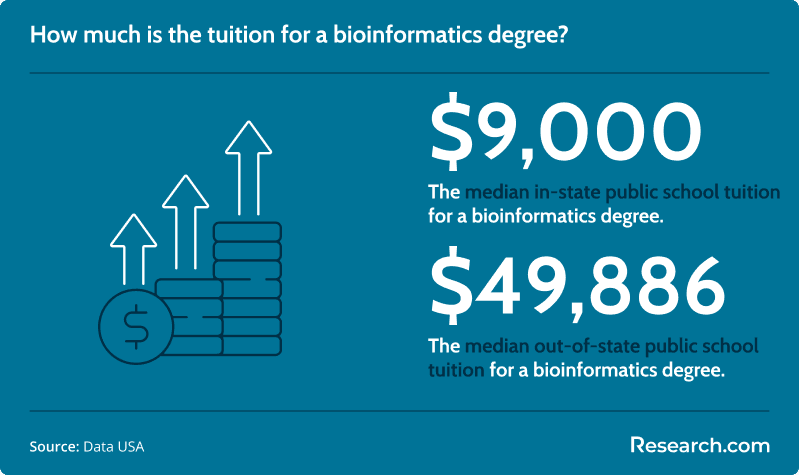
A graduate degree can improve your prospects in bioinformatics, but cost matters. Before enrolling, compare total tuition, fees, course delivery format, transfer policies, assistantship options, employer tuition support, scholarships, and the time you may need to reduce work hours. The cheapest program is not always the best value if it lacks relevant coursework, research access, career support, or faculty expertise in your target specialization.
Students seeking lower-cost graduate options can compare programs such as the cheapest online master’s degree in bioinformatics. When evaluating any program, look for coursework in genomics, statistics, programming, databases, machine learning, and applied biological data analysis. If you plan to work while studying, ask whether the program supports part-time enrollment and whether courses include real datasets or capstone projects.
Questions to ask before choosing a bioinformatics program
- Is the program focused on bioinformatics, computational biology, informatics, data science, or biotechnology?
- Does the curriculum include programming, statistics, genomics, databases, and biological data analysis?
- Will you build portfolio-ready projects using real datasets?
- Are faculty members active in the specialization you want, such as clinical genomics, drug discovery, or systems biology?
- Does the program offer internships, research assistantships, capstones, or employer partnerships?
- Can you study part time if you are working?
- What is the full cost after tuition, fees, software, books, and lost work time?
- Will credits transfer if you later pursue another degree?
What challenges do bioinformatics professionals face?
Bioinformatics work can be rewarding, but it is also demanding. Tools change quickly, datasets can be large and inconsistent, and workflows must be accurate enough for research or clinical use. Professionals often need to balance speed with quality, especially when research teams or business stakeholders want fast answers from complicated data.
Communication is another challenge. Bioinformaticians frequently work with people who have different assumptions, vocabulary, and goals. A computational result may be technically correct but still not useful unless it answers the biological or clinical question. Strong professionals learn to ask better questions, document their methods, and explain limitations clearly.
Some students also underestimate how transferable analytical thinking can be across scientific domains. Even unrelated scientific programs, such as online geology degree programs, can illustrate how data modeling, visualization, and interdisciplinary problem-solving appear in multiple research fields, though bioinformatics itself requires specific biological and computational preparation.
Common mistakes to avoid
| Mistake | Why it can hurt you | Better approach |
| Choosing a program based only on the title | Programs with similar names may emphasize biology, software, health informatics, or statistics differently. | Review course requirements, faculty expertise, capstone options, and job outcomes. |
| Ignoring programming until late in the degree | Bioinformatics employers often expect practical coding ability, not just conceptual knowledge. | Start building Python, R, SQL, and workflow skills early. |
| Relying only on coursework | Employers want evidence that you can work with real data and solve real problems. | Create portfolio projects, pursue internships, and document your analysis workflows. |
| Assuming a certificate replaces a degree | Certificates can strengthen skills, but many full bioinformatics roles require a bachelor’s, master’s, or PhD. | Use certificates to supplement your degree or transition from a related field. |
| Focusing only on salary | Higher-paying roles may require more technical depth, graduate education, or industry experience. | Compare salary with degree cost, time, research expectations, and job fit. |
| Neglecting communication skills | Good analysis has limited value if collaborators cannot understand or use it. | Practice writing short summaries, explaining limitations, and presenting findings to nontechnical audiences. |
How do bioinformatics salaries compare with related fields?
Bioinformatics salaries are often competitive because the field combines life science expertise with programming, statistics, and data analysis. Entry-level positions may start in the $59,500–$75,000 range, while experienced professionals with advanced degrees can earn well above $100,000 per year. Pay varies by degree level, industry, location, technical specialization, and whether the role is academic, clinical, pharmaceutical, or technology-focused.
Compared with many traditional biology or lab-based roles, bioinformatics can offer higher compensation because computational skills are in demand. For example, a molecular biologist with a master’s degree might earn around $75,000 annually, while a bioinformatician with similar credentials and experience could earn $85,000–$100,000 or more. The difference reflects the value employers place on coding, statistical modeling, and large-scale biological data interpretation.
Compared with software engineering, bioinformatics pay can be lower in some cases. A software engineer in biotech may earn $110,000–$130,000 or more, depending on role and experience. However, bioinformaticians who specialize in AI-driven drug discovery, clinical genomics, or senior leadership can compete with or exceed those ranges.
Data science is another close comparison. Data scientists may start around $90,000 and move to $130,000 or higher. Bioinformaticians with strong machine learning, deep learning, and applied data science skills can transition into data science roles or combine both disciplines in healthcare AI, biotech, or pharmaceutical settings. Readers comparing healthcare-related roles can also review pharmaceutical scientist work and pharmacy tech salary information for broader context.
| Field or role | Salary information stated | How it compares with bioinformatics |
| Bioinformatician | Median annual salary around $94,000 as of a 2025 report | Strong option for professionals combining biology, coding, and analytics |
| Entry-level bioinformatics roles | $59,500–$75,000 range | May be accessible with a bachelor’s degree and strong project experience |
| Advanced bioinformatics professionals | Well above $100,000 per year | Often linked to graduate education, specialization, and experience |
| Molecular biologist with a master’s degree | Around $75,000 annually | Often lower than comparable bioinformatics roles due to less emphasis on computation |
| Software engineer in biotech | $110,000–$130,000 or more | Can exceed many bioinformatics salaries, especially in engineering-heavy roles |
| Data scientist | Starting around $90,000 and climbing to $130,000 or higher | Comparable path for bioinformaticians with strong machine learning and analytics skills |
Which bioinformatics certifications can improve your prospects?
Certifications can help validate specific skills, especially when you are changing fields, strengthening a weak area, or showing employers that you can use current tools. They are most effective when paired with a degree, portfolio, internship, or relevant work experience. A credential alone rarely guarantees a bioinformatics job.
- HarvardX Professional Certificate in Data Science (edX): Provides training in R programming, statistics, and data science foundations that can also support students exploring how to start a career in machine learning.
- Certified Bioinformatics Professional (CompTIA & Bioinformatics.org): Covers bioinformatics tools, databases, and computational methods used in the field.
- NCBI Genomic Data Science Certificate (Johns Hopkins University): Focuses on genomic data tools, statistical methods, and platforms such as Galaxy and Bioconductor.
- Rosalind Bioinformatics Programming Track: Offers interactive programming practice for solving biological problems with algorithms and Python.
How to choose a certification
- Choose data science certifications if you need stronger statistics, visualization, or machine learning foundations.
- Choose genomics-focused training if you want clinical genomics, sequencing, or variant analysis roles.
- Choose programming-based tracks if your main weakness is coding fluency.
- Prioritize certifications that require projects, reproducible workflows, or applied analysis rather than passive lecture completion.
What are alternative careers for bioinformaticians?
A bioinformatics background can transfer into several adjacent careers because the field develops coding, analytics, modeling, database, and scientific communication skills. If you later decide not to stay in a traditional bioinformatics role, you may still be competitive for jobs in data science, software development, health informatics, product management, technical consulting, or pharmaceutical science.
What else can a bioinformatician do?
Data science is one of the most common alternatives. Bioinformaticians already work with large, messy datasets and statistical models, which are central to data science jobs in healthcare, finance, marketing, e-commerce, and technology. Additional training in business analytics tools or machine learning frameworks can help make the transition easier.
Software engineering and scientific programming are also realistic options. Many bioinformaticians build pipelines, write scripts, and create tools for data processing. Those skills can transfer into scientific computing, health technology, research software, or even the app developer career path if you expand your software engineering portfolio.
Some graduates move into technical consulting or product management for genomics, life sciences, or healthcare software companies. These roles suit professionals who can translate scientific problems into technical requirements, communicate with clients, and help product teams design tools that researchers or clinicians can actually use.
Pharmaceutical science is another related direction. If you are curious about laboratory and drug development careers, it can help to explore what pharmaceutical scientists do and compare that work with computational drug discovery and bioinformatics roles.
What graduates say about bioinformatics careers
"Studying bioinformatics opened up a whole new world of possibilities for me—I learned how to code, analyze genetic data, and contribute to real-world research. It was challenging but incredibly rewarding to see my skills applied in cutting-edge healthcare projects." – Mel
"The degree gave me the perfect mix of biology and tech, which helped me land a job in biotech right after graduation. I loved how hands-on the coursework was, especially the chance to work on real datasets and publish my findings." – Ray
"I was drawn to the idea of using data to solve biological problems, and the program delivered exactly that. What surprised me most was how collaborative and fast-paced the field is—it felt amazing to be part of something so innovative." – Lena
Key Insights
- A bioinformatics degree can lead to careers in genomics, clinical research, biotechnology, pharmaceuticals, software development, health informatics, and data science.
- The field is strongest for students who genuinely want both biology and computation; avoiding either side can limit career options.
- Entry-level roles may be possible with a bachelor’s degree, but many advanced research, clinical, and leadership positions prefer a master’s degree or PhD.
- Employment for computer and information research scientists, including bioinformatics scientists, is projected to grow by 26% until 2033, according to BLS 2025 data cited in the article.
- The typical timeline to become a bioinformatician is 4 to 8 years, depending on whether you stop at a bachelor’s degree or continue into graduate study.
- Salaries are competitive because bioinformatics combines biology, programming, statistics, and data analysis, but pay varies widely by role, degree level, industry, and specialization.
- The best way to improve employability is to build real projects with biological datasets, document your code, learn common tools, and gain internship or research experience.
- Do not choose a program based only on price, speed, or title. Compare curriculum depth, faculty expertise, applied projects, career support, and whether the program matches your target role.
- In drug development, NDA submission alone already takes a maximum of 2 years, which shows how long and complex life science innovation pipelines can be.
References:
- BLS. (2025, April 18). Computer and Information Research Scientists. Retrieved May 8, 2025, from BLS.
- CareerExplorer. (n.d.). What education do bioinformatics scientists have? Retrieved May 8, 2025, from CareerExplorer.
- Fios Genomics. (n.d.). Bioinformatics 2025 Outlook: Thoughts from Bioinformaticians. Retrieved May 8, 2025, from Fios Genomics.
- ZipRecruiter. (n.d.). Bioinformatics Salary. Retrieved May 8, 2025, from ZipRecruiter.
Other Things You Should Know About Becoming a Bioinformatician
CLIA and CAP familiarity strengthens applications for clinical data roles, and some employers also prefer ASCP certification for laboratory work. Bioinformatics graduates should know Python, R, SQL, and basic Linux, because many clinical genomics jobs require secure handling of patient data and variant analysis workflows.
With a bioinformatics degree in 2027, typical career paths include bioinformatics scientist, computational biologist, data analyst, and roles in pharmaceutical research. These positions often require proficiency in coding and data analysis and are central to advancing research in genomics and biotechnology.
In 2027, essential coding skills for bioinformatics include proficiency in languages like Python and R for data analysis, SQL for database management, and familiarity with machine learning frameworks. These skills are crucial for managing and interpreting large biological datasets, a core function of bioinformatics.