2027 Best Online MBA in Operations Management Programs

Co-Founder and Chief Data Scientist
With 95% of recruiters planning to hire MBA graduates, the market is sending a clear signal. You're an expert at managing the complex engine of your business, but you've likely realized that tactical skill alone doesn't translate to an executive role. Making that jump isn't about leaving your expertise behind; it's about elevating it with a new strategic toolkit.
That's exactly what this guide is for. Created by career planning experts with over 10 years of experience, it is your definitive resource for using an online MBA in operations management to make that leap from tactical expert to strategic leader.
What are the benefits of getting an online MBA in operations management?
- Secure executive roles like Director of Operations or VP of Supply Chain, and even lead high-impact sustainable operations initiatives.
- Command a higher salary, with the average starting pay for MBA graduates exceeding $105,000.
- Earn your degree online without pausing your career, allowing you to apply new strategic skills at your job in real time.
What can I expect from an online MBA in operations management?
You can expect a demanding, data-driven curriculum that teaches you to think like an executive. This is very different from a technical certification, which teaches you a specific tool. An MBA teaches you how to apply those tools within the larger context of the business, using case studies and simulations to guide your learning.
You’ll learn to analyze operational challenges from a financial and strategic perspective. The program is designed to shift your focus from the "how" of your current role to the "why" that drives the entire enterprise.
Where can I work after completing an online MBA in operations management?
You can work in a senior leadership role in virtually any industry. Strategic operations is a universal business function, and your skills will be highly portable.
While manufacturing and logistics are common paths, graduates are in high demand across the entire economy. You’ll find them leading teams in technology, optimizing systems in healthcare, streamlining processes for e-commerce giants, and advising top-tier consulting firms. Essentially, any company that delivers a product or a service needs a leader with your expertise.
How much can I make with an online MBA in operations management?
You should be looking at a significant increase in your earning potential. The average annual salary for an MBA graduate in the U.S. is around $115,000.
But the real financial benefit comes from leaping to an executive salary band. It’s about qualifying for senior roles where total compensation often includes substantial performance bonuses and equity. In a market with a shortage of leaders who have both technical and strategic skills, this degree gives you the leverage to access a new tier of earning potential.
- List of the Best Online MBA in Operations Management Programs for 2027 List of Programs
- How long does it take to complete an online MBA in operations management? Completion Time
- How does an online MBA in operations management program compare to an on-campus program? How does an online MBA in operations management program compare to an on-campus program?
- What is the average cost of an online MBA in operations management program? Program Cost
- What financial aid options are available for students enrolling in an online MBA in operations management program? Financial Aid
- What are the prerequisites for enrolling in an online MBA in operations management program? What are the prerequisites for enrolling in an online MBA in operations management program?
- What courses are typically included in an online MBA in operations management program? What courses are typically included in an online MBA in operations management program?
- What types of specializations are available in an online MBA in operations management program? Specializations
- How to Choose the Best Online MBA in Operations Management Program How to Choose the Best Online MBA in Operations Management Program
- What career paths are available for graduates of online MBA in operations management program? Career Paths
- What is the job market for graduates of online MBA in operations management program? Job Market
- What are the potential challenges of pursuing an online MBA in operations management? What are the potential challenges of pursuing an online MBA in operations management?
Best Online MBA in Operations Management Programs for 2026
An online MBA in operations management is designed for professionals who want to lead supply chains, improve business processes, manage complex operations, and move into senior leadership without leaving the workforce. The decision is not only about finding a respected business school. You also need to compare cost, accreditation, program pace, curriculum depth, employer support, networking access, and whether the degree matches your target role.
This guide rebuilds the decision process around what prospective MBA students actually need to know: which programs stand out, how online and campus formats differ, how long the degree takes, what it may cost, which admissions requirements to expect, and how the credential can support roles such as director of operations, operations consultant, VP of supply chain, or chief operating officer.
Use this ranking as a starting point, then compare each program against your career plan, work schedule, budget, and preferred learning format.
Quick Answer: Is an Online MBA in Operations Management Worth Considering?
An online MBA in operations management can be a strong option if you already have professional experience and want to move from technical or functional operations work into strategic management. The degree is most useful for candidates who need broader business training in finance, strategy, leadership, analytics, and supply chain decision-making.
It may not be the best fit if you want a highly technical graduate degree focused only on analytics, engineering, logistics modeling, or supply chain science. In that case, a specialized Master of Science may be more appropriate. For leadership-focused professionals, however, the online MBA format offers a practical way to earn a graduate business credential while continuing to work.
How Research.com Ranks Online MBA in Operations Management Programs
Because an MBA can require a major financial and time commitment, rankings should be read carefully. Our program evaluation uses data from established education sources, including the IPEDS database, Peterson's database, the College Scorecard database, and The National Center for Education Statistics.
These sources help support a more transparent comparison of online MBA programs by using available information on institutions, costs, program characteristics, and student outcomes. You can review the broader ranking approach on the Research.com methodology page.
Top Online MBA in Operations Management Programs
| Rank | School and Program | Program Length | Credits or Credit Units | Total Tuition | Institutional Accreditation |
| 1 | University of Florida — Master of Business Administration | 16-24 months | 32-48 | $59,808 | Southern Association of Colleges and Schools Commission on Colleges (SACSCOC) |
| 2 | Rice University — Master of Business Administration | 24 months | 54 | $123,228 | Southern Association of Colleges and Schools Commission on Colleges (SACSCOC) |
| 3 | Western Governors University — Master of Business Administration | 1-2 years | 34 credit units | Approximately $20,020 | Northwest Commission on Colleges and Universities (NWCCU) |
| 4 | University of Minnesota-Twin Cities — Master of Business Administration | 2 years | 52 | $93,444 | Higher Learning Commission (HLC) |
| 5 | Texas A & M International University — Master of Business Administration | As few as 12 months | 30 | $11,010 | Southern Association of Colleges and Schools Commission on Colleges (SACSCOC) |
| 6 | Florida Atlantic University — MBA in Operations Management | 16-23 months | 40-46 | $32,000 - $36,800 | Southern Association of Colleges and Schools Commission on Colleges (SACSCOC) |
| 7 | University of Illinois Springfield — MBA with Operations & Supply Chain Management Certificate | 1 year | 30 | $16,500 | Higher Learning Commission (HLC) |
| 8 | Northern Arizona University — MBA in Operations Management | 1 year | 30 | $12,488 | Higher Learning Commission (HLC) |
1. University of Florida — Master of Business Administration
The University of Florida offers an online MBA built for professionals who want flexibility without stepping away from full-time employment. The program includes business leadership coursework and an experiential requirement, such as a global immersion course, that helps students connect management theory with practical business environments.
- Program Length: 16-24 months
- Required Credits to Graduate: 32-48
- Total Tuition: $59,808
- Accreditation: Southern Association of Colleges and Schools Commission on Colleges (SACSCOC)
2. Rice University — Master of Business Administration
Rice University’s online MBA is STEM-designated and emphasizes live online learning, peer interaction, and applied projects. Students can shape the program through electives and career-oriented options in areas such as corporate strategy, energy, or healthcare.
- Program Length: 24 months
- Required Credits to Graduate: 54
- Total Tuition: $123,228
- Accreditation: Southern Association of Colleges and Schools Commission on Colleges (SACSCOC)
3. Western Governors University — Master of Business Administration
Western Governors University uses a competency-based model, which allows students to move through coursework as they demonstrate mastery. The program ends with a capstone project that requires students to apply MBA concepts to a real workplace challenge.
- Program Length: 1-2 years
- Required Credit Units to Graduate: 34
- Total Tuition: Approximately $20,020
- Accreditation: Northwest Commission on Colleges and Universities (NWCCU)
4. University of Minnesota-Twin Cities — Master of Business Administration
The University of Minnesota-Twin Cities delivers an online MBA that combines core business training with electives connected to different industries and functions. Students also have access to academic advising and career coaching, which can be especially valuable for professionals planning a move into higher-level management.
- Program Length: 2 years
- Required Credits to Graduate: 52
- Total Tuition: $93,444
- Accreditation: Higher Learning Commission (HLC)
5. Texas A & M International University — Master of Business Administration
Texas A & M International University offers an accelerated online MBA with 7-week courses and several start dates. The format may appeal to students who want a shorter completion timeline and a lower listed tuition than many other programs in this ranking.
- Program Length: As few as 12 months
- Required Credits to Graduate: 30
- Total Tuition: $11,010
- Accreditation: Southern Association of Colleges and Schools Commission on Colleges (SACSCOC)
6. Florida Atlantic University — MBA in Operations Management
Florida Atlantic University offers an MBA concentration in Operations Management for students who want to study business process improvement, supply chain management, and operational decision-making. The curriculum is designed to help students diagnose operational problems, introduce process changes, and evaluate results.
- Program Length: 16-23 months
- Required Credits to Graduate: 40-46
- Total Tuition: $32,000 - $36,800
- Accreditation: Southern Association of Colleges and Schools Commission on Colleges (SACSCOC)
7. University of Illinois Springfield — MBA with Operations & Supply Chain Management Certificate
The University of Illinois Springfield pairs MBA coursework with an Operations & Supply Chain Management Certificate. Students focus on data-informed operations, global supply chain performance, Lean Management, and Six Sigma concepts.
- Program Length: 1 year
- Required Credits to Graduate: 30
- Total Tuition: $16,500
- Accreditation: Higher Learning Commission (HLC)
8. Northern Arizona University — MBA in Operations Management
Northern Arizona University’s MBA concentration in Operations Management covers the way organizations convert resources into goods and services. Students study topics such as procurement, logistics, distribution, quality management, collaboration, and sustainability.
- Program Length: 1 year
- Required Credits to Graduate: 30
- Total Tuition: $12,488
- Accreditation: Higher Learning Commission (HLC)
How Long Does an Online MBA in Operations Management Take?
Most online MBA programs in operations management take about 18 to 24 months, although completion time varies by course load, transfer policies, prerequisites, and whether the program uses accelerated terms. Some programs in this ranking can be completed in as few as 12 months, while others are designed around a 2-year schedule.
Students comparing flexible MBA formats may also find it helpful to review how other online institutions structure access and scheduling, such as affordable open admission online colleges. The key question is not only how fast you can finish, but whether the pace is realistic while working.
Choosing Between Accelerated, Full-Time, and Part-Time Study
| Format | Best For | Main Advantage | Main Risk |
| Accelerated online MBA | Students with strong time management, employer support, and clear career goals | Faster completion and earlier potential career return | Heavy weekly workload and less room for unexpected work or family demands |
| Full-time online MBA | Students who can temporarily reduce work commitments | More focused academic experience | May reduce current income or work flexibility |
| Part-time online MBA | Working professionals balancing career, family, and school | More manageable schedule and immediate workplace application | Longer time before graduation |
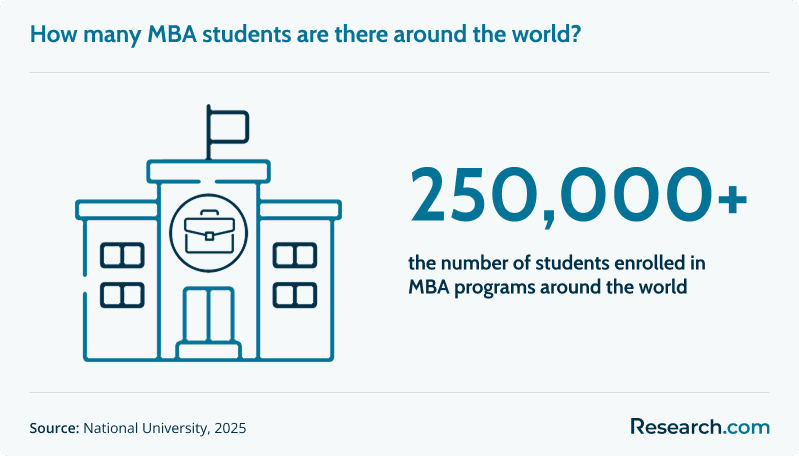
The degree remains a major graduate pathway for business professionals. You would be entering a market with over 250,000 students currently enrolled in MBA programs worldwide.
Online vs. On-Campus MBA in Operations Management: Which Format Fits You?
The biggest advantage of an online MBA is schedule flexibility. That matters for managers, analysts, engineers, logistics professionals, and operations specialists who cannot relocate or pause their careers. By contrast, an on-campus MBA often provides a more immersive experience with face-to-face networking, in-person recruiting, and structured campus events.
Online learning is now common across many professional fields. Students who compare flexible healthcare programs, such as RN to BSN online programs no statistics, often evaluate similar trade-offs: convenience, faculty access, clinical or experiential requirements, and whether the format fits their work schedule.
Online and Campus MBA Comparison
| Factor | Online MBA | On-Campus MBA |
| Schedule | Often designed for working adults who need evening, asynchronous, or flexible coursework | Usually follows a more fixed academic and campus-based schedule |
| Networking | Depends heavily on live sessions, group projects, residencies, alumni access, and virtual events | Often stronger for spontaneous interaction, clubs, and local employer recruiting |
| Employer perception | Can be strong when the institution is reputable and the curriculum is rigorous | May offer traditional brand visibility and campus recruiting channels |
| Best fit | Professionals who need to keep working while earning the degree | Students who want a residential experience and can commit to campus attendance |
Leadership Skills in a Remote and Hybrid Workplace
An online MBA can also demonstrate skills that are increasingly relevant in modern operations roles: digital collaboration, remote team leadership, written communication, virtual presentation, and project coordination across locations. These abilities overlap with communication-heavy fields, including many organizational communication jobs.
Employers typically focus less on whether coursework was online or on campus and more on the reputation of the school, the relevance of the curriculum, your professional experience, and your ability to produce measurable business results.
What Is the Average Cost of an Online MBA in Operations Management?
Based on the programs included in this ranking, the average tuition is about $46,662. This figure reflects only the listed programs and should not be treated as the average price for every online MBA in the market.
Tuition is also only one part of the cost. Students should ask about technology fees, books, residencies, travel, graduation fees, payment plans, and whether tuition differs by residency status. Candidates focused on supply chain and logistics may also explore external awards, including a supply chain management scholarship.
How to Evaluate MBA Cost Against Career Return
A high-priced MBA is not automatically better, and a low-priced MBA is not automatically the best value. The right financial decision depends on your career goal, employer support, current salary, expected debt, program reputation, and whether the school has a track record of helping working professionals move into operations leadership.
| Cost Factor | Why It Matters | Question to Ask |
| Total tuition | Shows the core academic price before other expenses | Is the quoted amount for the entire program or only one academic year? |
| Fees and travel | Residencies, immersions, software, and course materials can increase the final cost | Are any campus visits, international trips, or in-person sessions required? |
| Employer assistance | Tuition support can substantially reduce out-of-pocket cost | Does my employer require me to stay for a certain period after receiving support? |
| Career services | Strong coaching and employer relationships can improve the practical value of the degree | Does the program support online MBA students as actively as campus students? |
| Debt load | Borrowing can affect your finances long after graduation | What monthly payment would I face under likely loan terms? |
The degree can support advancement into roles such as operations consultant, director of operations, or senior supply chain leader, but salary gains are never guaranteed. Treat the MBA as a strategic investment that must be tested against realistic career scenarios.
Financial Aid Options for Online MBA in Operations Management Students
MBA students usually combine several funding sources rather than relying on one option. Start early, because employer reimbursement deadlines, scholarship applications, federal aid forms, and payment-plan requirements may not align with the admissions calendar. Students comparing public administration degrees, such as NASPAA-accredited online MPA programs, face a similar need to evaluate accreditation, cost, and aid before enrolling.
- Employer sponsorship or tuition reimbursement: Many companies help fund graduate business education when the degree supports leadership development. About 68% of MBA students receive some form of company sponsorship.
- Federal student aid: Complete the FAFSA before considering private loans so you can review federal aid options first.
- Private loans: These may help cover gaps, but compare interest rates, repayment terms, and borrower protections carefully.
- School scholarships and grants: Business schools may award merit aid based on work experience, academic history, leadership potential, or professional achievements.
- Veteran education benefits: Eligible students may be able to use benefits such as the Post-9/11 GI Bill and the Yellow Ribbon Program.
Admissions Requirements for an Online MBA in Operations Management
Most online MBA programs expect applicants to have a bachelor’s degree, a professional resume, recommendations, essays or statements of purpose, and official transcripts. Some schools may request standardized test scores, while others offer GMAT or GRE waivers for candidates with strong work histories.
Work experience is often central to the application. The average incoming MBA student has 50-75 months of work experience, so admissions committees commonly look for applicants who can contribute practical workplace insight to class discussions and projects.
Can You Apply Without a Traditional Business Background?
Yes. Many operations management MBA students come from engineering, logistics, manufacturing, healthcare, military, technology, analytics, or general management roles. A non-business background can strengthen your application if you show evidence of leadership, problem-solving, quantitative ability, and career direction.
Applicants with broad or cross-functional experience can frame their background as an advantage. Similar to graduates exploring interdisciplinary studies jobs, MBA candidates can use a varied professional history to show adaptability and systems-level thinking.
Application Materials to Prepare
- Resume: Emphasize leadership, operational improvements, project outcomes, team management, and measurable business results.
- Statement of purpose: Explain why operations management matters to your career and why an MBA is the right degree.
- Recommendations: Choose supervisors or senior colleagues who can describe your judgment, leadership potential, and impact.
- Transcripts: Be ready to explain any weak academic areas and highlight later professional growth.
- Test scores or waiver request: If eligible, prepare a strong waiver case based on work experience, prior graduate study, certifications, or quantitative responsibilities.
Typical Courses in an Online MBA in Operations Management
An operations management MBA usually combines core business administration coursework with specialized study in supply chain, process improvement, quality, logistics, analytics, and leadership. The purpose is to help students move beyond day-to-day execution and make higher-level decisions about people, systems, money, risk, and strategy.
- Advanced Operations and Supply Chain Management: Students examine logistics, sourcing, quality systems, global operations, process design, and performance improvement.
- Corporate Finance: Coursework helps managers evaluate investments, build financial arguments, and communicate operational proposals in terms executives understand.
- Business Strategy: Students learn how operational choices connect to competitive positioning, growth plans, market conditions, and organizational priorities.
- Change Management: This area focuses on leading teams through redesigns, technology adoption, restructuring, and process changes. It connects closely with many organizational leadership master's careers.
- Data Analytics for Managers: Students may learn to interpret operational data, identify trends, evaluate performance, and support evidence-based decisions.
- Project Management: Coursework may cover scope, timelines, budgets, stakeholder communication, and implementation risk.
How Coursework Creates Practical Career Value
Employers often need leaders who understand both operational detail and enterprise-level strategy. MBA coursework can help students translate process improvements into financial outcomes, communicate with executives, and lead cross-functional teams. This combination is one reason MBA graduates often pursue management roles, and 86% of MBA graduates are employed by the time they finish their program.
MBA Graduates' Employment Status

Common Specializations in Online MBA in Operations Management Programs
Specializations help you align the MBA with a specific career direction. Before choosing one, compare the courses, faculty expertise, project requirements, and industries represented in the program’s employer network. Students evaluating other graduate pathways, such as online MSW programs that accept low GPA, face a similar principle: the best program is the one that matches both admission realities and long-term goals.
| Specialization | Best For | Typical Focus |
| Supply Chain Management | Professionals in logistics, sourcing, procurement, distribution, or global operations | Supplier strategy, transportation, inventory, risk, and end-to-end supply chain performance |
| Process Improvement | Managers responsible for efficiency, workflow redesign, or operational excellence | Lean methods, Six Sigma concepts, quality improvement, and productivity measurement |
| Quality Management | Professionals in regulated or precision-driven industries | Compliance, standards, continuous improvement, performance monitoring, and risk reduction |
| Sustainable Operations | Leaders interested in responsible supply chains and ESG-related operations work | Resource use, sustainability initiatives, supplier responsibility, and long-term operational resilience |
The best specialization should point toward a specific job outcome. If you want to lead global logistics, supply chain management is the clearer fit. If you want to become an internal transformation leader, process improvement may be more useful.
How to Choose the Best Online MBA in Operations Management Program
Start with the career outcome, not the school name. An MBA is generally designed for business leadership, while a specialized Master of Science is usually more technical. If your goal is to lead departments, manage budgets, guide teams, and influence company strategy, the MBA structure is likely the better match.
A strong MBA should combine operations-focused coursework with the broader business administration subjects that executives use daily, including finance, strategy, marketing, accounting, analytics, and leadership.
Program Selection Checklist
- Confirm accreditation. Make sure the institution is properly accredited and that the business school’s reputation fits your goals.
- Compare the curriculum. Look for a balance of operations, supply chain, analytics, finance, strategy, and leadership.
- Review faculty experience. Prioritize programs with instructors who understand real operational decisions, not only theory.
- Ask about applied learning. Capstones, consulting projects, simulations, and employer-based assignments can make the degree more useful.
- Evaluate career support. Online students should receive access to coaching, alumni networks, job boards, and employer events.
- Calculate the full cost. Include tuition, fees, books, residencies, travel, and interest if you borrow.
- Check scheduling expectations. Confirm whether courses are asynchronous, live, hybrid, or residency-based.
- Assess networking opportunities. Group work, live sessions, alumni events, and industry projects matter more than many students expect.
MBA vs. Master of Science in Operations or Supply Chain
| Degree Path | Choose This If You Want To | Best Career Direction |
| Online MBA in Operations Management | Build broad leadership, finance, strategy, and management skills alongside operations expertise | Director of operations, operations consultant, general manager, VP of supply chain, COO track |
| MS in Operations Management or Supply Chain | Develop deeper technical expertise in logistics, analytics, modeling, or supply chain systems | Supply chain analyst, logistics specialist, operations analyst, technical operations manager |
| Graduate certificate | Add targeted skills without completing a full master’s degree | Process improvement, procurement, logistics, Lean Six Sigma-related roles |
Career Paths for Online MBA in Operations Management Graduates
An online MBA in operations management can support progression into senior roles that require both business judgment and operational expertise. The exact outcome depends on your previous experience, industry, geography, employer, and ability to show measurable results.
- Director of Operations: Leads major operational functions, manages teams, improves processes, and aligns daily execution with company goals.
- VP of Supply Chain: Oversees sourcing, logistics, vendor relationships, distribution strategy, and supply chain resilience. Salaries in this role often exceed $100,414.
- Operations Consultant: Advises organizations on performance improvement, cost reduction, process redesign, technology adoption, and supply chain challenges.
- Chief Operating Officer: Serves as a top executive responsible for turning business strategy into operational execution across the organization.
Possible Advancement Path
| Career Stage | Common Role Examples | What Employers Usually Expect |
| Early management | Operations supervisor, logistics manager, project manager | Team leadership, process ownership, reporting, and execution discipline |
| Mid-career leadership | Operations manager, supply chain manager, continuous improvement manager | Budget responsibility, cross-functional work, performance improvement, and data-based decisions |
| Senior leadership | Director of operations, senior operations manager, operations consultant | Strategic planning, financial fluency, stakeholder management, and enterprise-level problem-solving |
| Executive level | VP of supply chain, chief operating officer | Organizational leadership, long-term strategy, risk management, and accountability for major business outcomes |
Some professionals continue into doctoral or advanced leadership study later in their careers. For readers researching the top end of leadership education, Research.com also covers PhD in organizational leadership salary considerations.
Job Market Outlook for Online MBA in Operations Management Graduates
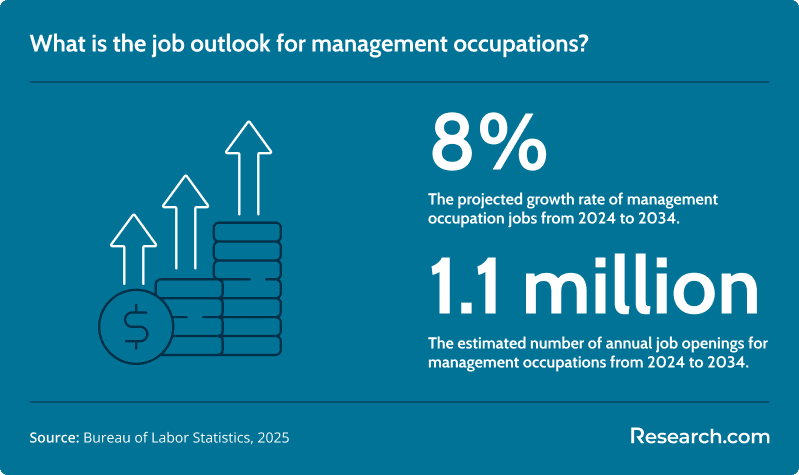
The job market for experienced operations leaders remains favorable because organizations need managers who can improve efficiency, control costs, strengthen supply chains, adopt technology, and respond to disruption. Management occupations are projected to grow 8% over the next decade, creating about 1.1 million openings each year.
Operations leadership has also become more visible since supply chain disruptions, inflation pressures, global sourcing challenges, and technology adoption have made operational resilience a board-level concern. Candidates who combine hands-on operations experience with MBA-level finance, strategy, and leadership training may be well positioned for competitive roles.
Why Employers Value Operations-Focused MBA Graduates
Many companies need leaders who can connect operational choices to revenue, margin, customer experience, risk, and long-term strategy. That blend is not always easy to find. The demand for graduate business talent is reflected in the finding that 95% of recruiters plan on hiring MBA graduates.
Still, an MBA is not a guarantee of promotion. The strongest candidates usually combine the degree with measurable achievements, strong communication, industry knowledge, and the ability to lead change across teams.
What Graduates Say About Their MBA in Operations Management Experience
- Ethan: "I was worried about taking on the cost, so I compared the tuition against the roles I wanted after graduation. Before the program ended, I had two offers with higher pay, which made the decision feel much more practical than theoretical."
- Daphne: "Before the MBA, I could identify process problems, but I struggled to get executive buy-in. The finance and strategy courses helped me present operational improvements as business cases with clear returns. That changed how senior leaders responded to my proposals."
- Stewart: "I had a demanding job and two children, so I needed a program that worked around my schedule. The online format let me study at night and keep moving forward professionally. It was challenging, but it was possible because I did not have to leave work or commute to campus."
Challenges of Pursuing an Online MBA in Operations Management
An online MBA can be flexible, but it is not easy. Students must manage graduate coursework, team projects, deadlines, job responsibilities, family obligations, and networking from a distance. The students who succeed usually plan their time before classes begin and communicate expectations clearly with employers and family members.
Cost is another major challenge. Candidates who need a lower-cost pathway should compare total program price, aid, employer reimbursement, and outcomes rather than looking at tuition alone. Research.com’s guide to the cheapest online MBA in USA can be a useful starting point for cost-conscious students.
Common Mistakes to Avoid
| Mistake | Why It Can Hurt You | Better Approach |
| Choosing only by ranking | A highly ranked program may not fit your schedule, budget, or target industry | Use rankings as one input, then compare curriculum, cost, format, and career services |
| Ignoring accreditation | Accreditation affects credibility, aid eligibility, and employer confidence | Verify institutional accreditation before applying |
| Focusing only on tuition | Fees, travel, books, and interest can change the real cost | Ask for a full cost estimate from the school |
| Assuming online means easier | Online MBA programs still require graduate-level reading, projects, exams, and collaboration | Review weekly time expectations before enrolling |
| Overlooking networking | Operations leadership roles often depend on relationships and visibility | Choose programs with live sessions, alumni access, group work, and employer engagement |
| Expecting guaranteed salary gains | Outcomes vary by experience, location, industry, and performance | Evaluate the degree against realistic role targets and your current career position |
Questions to Ask Before Enrolling
- Is the institution accredited, and does the business school have the reputation I need for my target employers?
- Does the program include enough operations, supply chain, analytics, and process improvement coursework?
- Are courses live, asynchronous, hybrid, or residency-based?
- How much time should I expect to spend each week on coursework?
- What career services are available specifically to online MBA students?
- Are there capstone projects, consulting assignments, simulations, or employer-connected experiences?
- Can I use employer tuition reimbursement, scholarships, grants, veteran benefits, or federal aid?
- What is the total cost after tuition, fees, books, travel, and loan interest?
- Will the program help me move toward the exact role I want, or am I choosing it mainly because it is convenient?
Key Insights
- An online MBA in operations management is best for professionals who want to move from operational execution into strategic leadership.
- Program length varies widely, from accelerated options that can be completed in as few as 12 months to schedules designed around 2 years of study.
- Among the ranked programs, the average tuition is about $46,662, but students should calculate the full cost before borrowing or enrolling.
- Accreditation, curriculum quality, applied projects, career services, and networking access are more important than choosing by price or ranking alone.
- The online format can work well for working adults, but students must be proactive about time management and relationship-building.
- Career outcomes are strongest when the MBA builds on relevant experience in operations, supply chain, logistics, engineering, manufacturing, healthcare, technology, or management.
- The degree can support roles such as director of operations, operations consultant, VP of supply chain, and COO, but salary and promotion outcomes depend on the individual candidate and labor market.
References:
- AACSB. (2024). Masters enrollment trends at AACSB schools. Retrieved September 30, 2025, from AACSB masters enrollment trends report
- Indeed Editorial Team. (n.d.). How much does an MBA make? Indeed. Retrieved September 30, 2025, from Indeed MBA salary guide
- Indeed Editorial Team. (n.d.). What is an MBA in operations management? Indeed. Retrieved September 30, 2025, from Indeed MBA in operations management overview
- National Center for Education Statistics. (n.d.). Graduate degree fields. Retrieved September 30, 2025, from NCES graduate degree fields data
- National University. (n.d.). MBA statistics: Is an MBA worth it? Retrieved September 30, 2025, from National University MBA statistics
- U.S. Bureau of Labor Statistics. (n.d.). Business and financial occupations. Occupational Outlook Handbook. Retrieved September 30, 2025, from BLS business and financial occupations outlook
- U.S. Bureau of Labor Statistics. (n.d.). Management occupations. Occupational Outlook Handbook. Retrieved September 30, 2025, from BLS management occupations outlook
- Zippia. (n.d.). 20 jobs that require an MBA. Retrieved September 30, 2025, from Zippia MBA jobs overview
- Zippia. (n.d.). Essential MBA statistics: Is an MBA worth it? Retrieved September 30, 2025, from Zippia MBA statistics
Other Things You Should Know About MBA in Operations Management Programs
The best online MBA in Operations Management programs report job placement rates of over 90% for their 2027 graduates. These programs often have strong industry connections and dedicated career services to support students in securing employment post-graduation.
To select the best online MBA in Operations Management for 2027, consider accreditation status, curriculum relevance to current industry trends, flexibility and delivery method of the program, networking opportunities, and the program’s reputation based on rankings and alumni outcomes.
Most online MBA in Operations Management programs use a mixed format. Core lectures are often asynchronous, while live sessions, group projects, or proctored exams may be scheduled weekly. Many programs require a reliable computer, webcam, microphone, and stable internet for virtual class participation and assessment.