
2027 Best Online MBA Programs in Management

Co-Founder and Chief Data Scientist
Strong managers play a central role in the success and stability of organizations. In 2024, the U.S. Bureau of Labor Statistics reported 10,966,830 professionals working in management roles across the country. This large and diverse workforce reflects how essential skilled leaders are to overseeing people, budgets, operations, and performance in nearly every industry.
Pursuing an online MBA in management gives students the tools to advance into higher-level leadership roles or transition into entirely new fields. Moreover, the flexibility of online study allows working professionals to earn their degree while continuing to build career experience.
In this article, I will feature the best online MBA programs in management to help you compare your options. I will also explore admission standards, expected salaries, employment outlook, and the many career opportunities available to graduates of these programs.
What are the benefits of getting into online MBA programs in management?
- Online MBA programs in management strengthens abilities in decision-making, communication, team management, and organizational planning.
- Online programs allow students to complete coursework at their own pace while managing personal and professional responsibilities.
- Across industries, various management roles can provide annual salaries ranging from $57,000 to $239,000 or more each year.
What can I expect from an online MBA in management program?
An online MBA in management program is a graduate degree that aims to strengthen students’ leadership capabilities and strategic decision-making skills across business functions. The curriculum typically covers key areas in finance, marketing, operations, organizational behavior, and project management.
This program is ideal for those seeking to move into leadership roles, transition into a new business field, or enhance their ability to manage teams and operations effectively. It attracts early- to mid-career professionals who want to deepen their business knowledge while continuing to meet work and personal commitments.
Online programs offer a flexible and collaborative learning environment through a blend of live virtual sessions, self-paced modules, and interactive projects. Students also engage with peers and faculty through modern digital learning platforms, and they explore real-world business scenarios to apply theory to practical business challenges.
Where can I work with an online MBA in management?
Graduates with an online MBA in management can pursue careers across a wide range of industries that require strategic leadership, operational oversight, and team coordination. The degree opens doors to management-level roles across sectors.
- Corporations: Graduates often hold roles in operations, human resources, or general management, and they oversee departments, lead strategic initiatives, and improve internal processes.
- Healthcare Organizations: Management professionals in hospitals, private practices, or healthcare networks are needed to lead departments, streamline services, and coordinate interdisciplinary teams.
- Government Agencies: Graduates in hospitals, private practices, or healthcare networks may manage programs, develop policies, or supervise administrative teams.
- Nonprofit Organizations: Graduates in advocacy groups, foundations, and community service organizations contribute by managing operations, fundraising, or program development.
- Financial Institutions: Professionals work in banks, investment firms, and insurance companies and focus on risk management, growth strategies, and regulatory compliance.
- Technology Companies: Managers are needed to lead product teams, manage operations, or oversee talent development in startups, software firms, or IT service providers.
How much can I make with an online MBA in management?
Based on BLS data, the average income for management positions was $141,760, and the median wage for the profession was $122,090, which was higher than the median salary for all jobs in 2024. The range also lands between $57,010 annually at the 10th percentile to $239,200 or more at the 90th percentile. However, several factors influence wages, leading to significant variation in earnings across different roles and regions.
Usually, professionals with more experience or advanced qualifications qualify for higher-level positions with greater responsibilities and compensation. Industry also plays a critical role, with roles in finance, technology, and healthcare typically offering higher salaries compared to roles in the public or nonprofit sectors.
Additionally, location can affect earnings, as major metropolitan areas or high-cost-of-living regions tend to offer higher pay to remain competitive.
An online MBA in management provides the foundation to pursue well-paying leadership roles in a wide range of fields. While salary potential depends on individual circumstances and career paths, the degree can significantly increase long-term earning potential and open the door to advancement opportunities in both established and emerging industries.
- List of Best Online MBA Programs in Management for 2027 List of Programs
- How long does it take to complete an online MBA in management program? Completion Time
- How does an online MBA in management program compare to an on-campus program? How does an online MBA in management program compare to an on-campus program?
- What is the average cost of an online MBA in management program? Program Cost
- What are the financial aid options for students enrolling in an online MBA in management program? Financial Aid
- What are the prerequisites for enrolling in an online MBA in management program? Prerequisites
- What courses are typically in an online MBA in management program? What courses are typically in an online MBA in management program?
- What types of specializations are available in online MBA in management programs? Specializations
- How to choose the best online MBA in management program? How to choose the best online MBA in management program?
- What career paths are available for graduates of online MBA in management programs? Career Paths
- What is the job market for graduates with an online MBA in management? Job Outlook
- What challenges should I consider before enrolling in an online MBA in management program? What challenges should I consider before enrolling in an online MBA in management program?
- Are there common misconceptions about online MBA in management programs? Are there common misconceptions about online MBA in management programs?
Best Online MBA Programs in Management for 2027
An online MBA in management is designed for working professionals who want to move from functional expertise into broader leadership roles without leaving their jobs. The right program can strengthen your ability to manage teams, evaluate business strategy, improve operations, and make decisions using financial and organizational data. The wrong program, however, can leave you with high debt, limited career support, or a credential that does not match your goals.
This guide helps you compare online MBA in management programs by cost, credits, accreditation, flexibility, concentrations, and career value. It is especially useful if you already have a business, technical, healthcare, human resources, or operations background and want a graduate degree that can support advancement into management. Students who began with a bachelor’s degree in organizational leadership may also find that an MBA adds stronger finance, strategy, analytics, and executive decision-making training.
Quick answer: What is the best online MBA in management?
The best online MBA in management is the one that is accredited, fits your schedule, has a curriculum aligned with your target leadership role, and offers a total cost you can justify through realistic career outcomes. AACSB-accredited programs are often preferred by students seeking broad employer recognition, while IACBE-accredited options may offer strong professional relevance and affordability. Applicants should compare tuition, required credits, concentration options, live class expectations, alumni support, and whether the program serves working adults well.
How this ranking was developed
Choosing an online MBA in management is a major academic and financial decision, so the ranking should be viewed as a starting point rather than a final answer. Research.com evaluates programs using its published ranking methodology and data from trusted education sources.
The analysis draws on the Integrated Postsecondary Education Data System, Peterson’s database and its Distance Learning Licensed Data Set, College Scorecard, and the National Center for Education Statistics (NCES). These sources help verify institutional data, program availability, cost information, and distance learning details so prospective students can compare options more confidently.
| Rank | School | Management-focused option | Credits | Cost information | Accreditation |
| 1 | Indiana University | Strategy & Leadership | 54 | $94,944.42 estimated total cost | AACSB |
| 2 | Wayne State University | Management | 36 | $966.47 in-state per credit; $1,937.40 out-of-state per credit | AACSB |
| 3 | University of North Carolina at Chapel Hill | Personal Leadership Track; Team Leadership Track | 62 | $125,589.06 estimated total cost | AACSB |
| 4 | Johns Hopkins University | Leadership | 54 | $1,985 per credit | AACSB |
| 5 | Florida Gulf Coast University | Management/Leadership | 33 | $373 per credit | AACSB |
| 6 | Eastern Illinois University | Applied Management | 33 | $21,642 in-state per year; $30,449 out-of-state per year | AACSB |
| 7 | University of the Cumberlands | Project Management; Strategic Management | 31 | $355 per credit | IACBE |
| 8 | University of Arizona | Management and Organizations | 45 | $1,250 per credit | AACSB |
| 9 | West Texas A&M University | Management | 37 | $500 per credit | AACSB |
| 10 | Temple University | Multiple management-related concentrations | 48 | $1,250 per credit | AACSB |
1. Indiana University
Indiana University offers the Kelley Direct Online MBA in Strategy and Leadership for students who want a structured core plus room to customize. The program starts with a 12-week Integrated Core made up of three six-credit modules, giving students a shared foundation in business fundamentals before they move into major requirements and electives.
The 50/50 split between required coursework and electives is useful for professionals who want a broad MBA but also need targeted leadership and strategy training. Live online classes meet twice weekly, which can be valuable for students who want real-time faculty and peer interaction but may be less convenient for those who need a fully asynchronous schedule.
- Program length: 1–3 years
- Tracks/concentrations: Strategy & Leadership, Digital Technology Management
- Estimated total cost: $94,944.42
- Required credits to graduate: 54
- Accreditation: Association to Advance Collegiate Schools of Business (AACSB)
2. Wayne State University
Wayne State University provides an online MBA with coverage across accounting, analytics, financial management, and strategic planning. Students can choose live instruction or recorded lectures, making the program practical for professionals whose schedules vary from week to week.
The program’s 13 concentration choices allow students to shape the degree around a specific career direction. For management-focused students, the three-course concentration model can be a good fit if they want specialization without committing to a longer or more expensive program.
- Program length: 1–3 years
- Tracks/concentrations: Management
- Cost per credit: $966.47 (in-state), $1,937.40 (out-of-state)
- Required credits to graduate: 36
- Accreditation: AACSB
3. University of North Carolina at Chapel Hill
The University of North Carolina at Chapel Hill offers a Management and Leadership concentration for students who want to build executive-level people management and organizational leadership skills. Coursework emphasizes leading teams, managing change, improving collaboration, and making strategic decisions.
Students can pursue learning in areas such as negotiation, inclusive leadership, and cross-functional leadership. The optional Leadership Academy Certificate may appeal to professionals who want an additional credential that signals focused leadership development alongside the MBA.
- Program length: 1–3 years
- Tracks/concentrations: Personal Leadership Track, Team Leadership Track
- Estimated total cost: $125,589.06
- Required credits to graduate: 62
- Accreditation: AACSB
4. Johns Hopkins University
Johns Hopkins University delivers a Flexible MBA with a Leadership option that covers team leadership, project management, global strategy, crisis response, and social impact. The curriculum is designed for professionals who want to lead across complex organizations rather than focus only on one business function.
The program combines behavioral science concepts with applied leadership practice. Students may choose asynchronous or synchronous online courses, which gives them more control over how they balance class participation with work and personal obligations.
- Program length: 1–3 years
- Tracks/concentrations: Leadership, Business Analytics and Risk Management, Health Care Management
- Cost per credit: $1,985
- Required credits to graduate: 54
- Accreditation: AACSB
5. Florida Gulf Coast University
Florida Gulf Coast University offers an online MBA in Management/Leadership for students who want a shorter, management-centered program with a practical business foundation. The curriculum addresses organizational growth, global business issues, human resource strategy, teamwork, ethics, and the use of technology in management.
Core courses include accounting, economics, financial management, data-informed strategy, and global supply chain operations. The Business Strategy capstone gives students an opportunity to apply what they have learned to value creation and market expansion decisions.
- Program length: 12 months
- Tracks/concentrations: Management/Leadership
- Cost per credit: $373
- Required credits to graduate: 33
- Accreditation: AACSB
6. Eastern Illinois University
Eastern Illinois University offers an online MBA in Applied Management that focuses on leadership in changing business environments. Students use case analysis, group assignments, and applied projects to connect management theory with workplace decisions.
The program can work well for professionals seeking a flexible schedule and a team-based learning environment. Its emphasis on strategic thinking, leadership, and analytical decision-making supports students who want to move into supervisory, operational, or cross-functional management roles.
- Program length: 1–3 years
- Tracks/concentrations: Applied Management
- Cost per year: $21,642 (in-state), $30,449 (out-of-state)
- Required credits to graduate: 33
- Accreditation: AACSB
7. University of the Cumberlands
The University of the Cumberlands offers an online MBA in Management that connects business theory with practical workplace application. It is designed for students who want to build on prior education and professional experience while preparing for future management responsibilities.
Coursework covers leadership, managerial accounting, strategy, and current business issues. The fully online structure is useful for students who need to continue working while completing graduate study.
- Program length: 1–3 years
- Tracks/concentrations: Project Management, Strategic Management
- Cost per credit: $355
- Required credits to graduate: 31
- Accreditation: International Accreditation Council for Business Education (IACBE)
8. University of Arizona
The University of Arizona gives online MBA students multiple pacing options, with six entry points during the year. Students may finish in as little as 14 months or extend their studies up to six years depending on their course load and availability.
The program includes finance, marketing, operations, leadership, and information systems, while also developing communication and collaboration through experiential learning. Students who want global exposure may consider the optional Global Business Experience trip.
- Program length: 1–3 years
- Tracks/concentrations: Management and Organizations
- Cost per credit: $1,250
- Required credits to graduate: 45
- Accreditation: AACSB
9. West Texas A&M University
The online MBA in Management at West Texas A&M University is built for working professionals who want to strengthen their business knowledge while maintaining career momentum. The program emphasizes practical skills, professional growth, and peer networking.
Its flexible format can help students balance graduate school with full-time employment and family commitments. Course examples include Strategic Human Resource Management, Econometrics, Cultural Intelligence, and International Human Resource Management.
- Program length: 1–3 years
- Tracks/concentrations: Management
- Cost per credit: $500
- Required credits to graduate: 37
- Accreditation: AACSB
10. Temple University
Temple University offers an MBA in Management for professionals who want to improve leadership, strategy, and decision-making skills in a fully online format. Evening classes can make the program more manageable for students who work during the day.
The curriculum combines business theory with applied learning through projects, case studies, and internship opportunities. Students study current business topics such as analytics, digital marketing, and sustainable business, and may also participate in international learning experiences.
- Program length: 1–3 years
- Tracks/concentrations: Healthcare Management, HR Management, Innovation Management and Entrepreneurship, Marketing Management, Strategic Management, Supply Chain Management, IT Management
- Cost per credit: $1,250
- Required credits to graduate: 48
- Accreditation: AACSB
How long does it take to complete an online MBA in management?
Most online MBA in management programs take one to two years, but the actual timeline depends on credits, course load, term length, and required experiential components. A 30- to 36-credit program can often be completed by full-time students in 12 to 18 months. Part-time students may take around 20 months, while programs with heavier credit requirements may take two years or, in some cases, up to three years.
Pacing matters as much as program design. Students who enroll continuously and take more courses per term can finish faster, while those balancing demanding jobs may prefer a slower schedule. Asynchronous programs may offer more control over study time, but they also require stronger self-management because there are fewer fixed class meetings to keep students on track.
Capstone projects, practicums, consulting projects, and bootcamps can also affect completion time. These experiences often happen near the end of the MBA and may last from a few weeks to a full semester. They can be valuable, but students should confirm whether they require live participation, group coordination, travel, or additional fees.
Students who want the shortest possible route should compare accelerated formats carefully. For example, professionals researching the fastest online MBA programs in nonprofit management may find compressed terms and intensive schedules that work best for people with prior business experience. Speed should not be the only factor, however. The best timeline is one you can complete without sacrificing learning quality, job performance, or financial stability.
| Enrollment pace | Typical completion time | Best for | Trade-off to consider |
| Accelerated full-time | 12 to 18 months for many 30- to 36-credit programs | Students with strong time availability and prior business exposure | Higher weekly workload and less room for schedule disruptions |
| Standard full-time | Often close to two years for programs with more credits | Students who want steady progress and a manageable academic rhythm | May still be demanding alongside full-time employment |
| Part-time | May extend to 20 months or up to three years in some programs | Working professionals with family, travel, or leadership responsibilities | Longer time before graduation and possible tuition changes over time |
| Highly flexible/asynchronous | Varies by course load and school policy | Students who need control over when they study | Requires discipline, planning, and consistent progress tracking |
How does an online MBA in management compare with an on-campus MBA?
The main difference between an online MBA in management and an on-campus MBA is delivery format, not necessarily academic quality. Many universities use the same faculty, learning outcomes, and core curriculum across both formats. The better choice depends on how you learn, how much networking you want in person, and whether you can attend scheduled campus classes.
Employer acceptance of online business education has improved. A Graduate Management Admission Council (GMAC) report found that 55% of global companies value graduates from online and in-person MBA programs equally (Walker et al., 2025a). Still, students should check each school’s reputation, accreditation, career services, and alumni network rather than assuming all online MBAs carry the same market value.
| Factor | Online MBA in management | On-campus MBA in management | Decision tip |
| Class format | Uses synchronous live sessions, asynchronous coursework, or both | Relies on in-person classes at scheduled times | Choose online if flexibility is essential; choose campus if face-to-face learning keeps you engaged |
| Start dates | Often offers several entry points during the year | Usually follows a more traditional academic calendar | Online formats may help students begin sooner |
| Interaction | Uses video meetings, discussion boards, team platforms, and virtual office hours | Offers in-person classroom discussion, campus events, and direct access to facilities | Ask how group work, faculty access, and live participation are handled |
| Networking | May include virtual networking, alumni panels, online cohorts, and remote career events | Often provides stronger spontaneous networking through campus events and local employer visits | Review career services and alumni engagement before enrolling |
| Best fit | Working professionals, frequent travelers, caregivers, and students far from campus | Students who can relocate or commute and want a more immersive business school experience | Match the format to your life, not just the school brand |
Both formats can prepare students for leadership roles. The decision is similar to comparing online and campus options in fields such as online technology management programs: format matters, but accreditation, curriculum, faculty, and career outcomes matter more.
The following chart shows recruiter views of online and traditional graduate business education.
What is the average cost of an online MBA in management?
MBA costs vary widely, and students should evaluate the full price rather than relying on advertised tuition alone. According to Business Because, the total cost of completing an MBA program in the U.S. reached $243,267 in 2024. Tuition for two-year MBA programs averages around $165,500, compared with $167,529 for top business schools.
Online MBA in management programs can be less expensive than campus-based programs because students may avoid relocation, commuting, parking, and some campus-related costs. However, online tuition at well-known business schools can still be comparable to in-person tuition. Some institutions charge lower online rates, while others use the same tuition model across formats.
Students should examine whether tuition is charged per credit, per course, per term, or as a flat program rate. Extra charges may include technology fees, online learning fees, proctoring fees, graduation fees, books, software, residencies, travel, or international experience costs. A lower tuition rate may not be the lowest total cost if the program requires more credits or adds mandatory fees.
Cost should be weighed against career support, accreditation, curriculum quality, alumni network, and realistic earnings potential. This is similar to comparing graduate healthcare administration options, where students reviewing online MHA programs must look beyond tuition to assess long-term value.
| Cost factor | Why it matters | Question to ask before enrolling |
| Tuition structure | Per-credit and flat-rate models can produce very different totals | What is the total tuition for the exact number of credits required? |
| Fees | Technology, proctoring, and online course fees can add up | Which fees are mandatory, and are they included in the published cost? |
| Residencies or travel | Some online MBAs include required or optional in-person components | Will I need to pay for travel, lodging, meals, or international experiences? |
| Books and software | Business courses may require paid platforms, cases, or analytics tools | What are the estimated annual materials and software costs? |
| Time away from work | Intensive formats may affect income or promotion opportunities during study | Can I maintain my job responsibilities while meeting course expectations? |
| Career support | Strong coaching and employer access can improve practical value | Are online students eligible for the same career services as campus students? |
What financial aid options are available for online MBA in management students?
Financing is one of the biggest barriers to graduate business education. A GMAC report found that 48% of global management students identified program cost as the main barrier to enrolling in a graduate management degree, while 26% cited lack of financial aid and 18% were concerned about future debt (Walker et al., 2025b).
Among aspiring graduate management education students in 2024, 30% planned to use grants, fellowships, or scholarships, 19% expected to rely on loans, and 13% intended to use personal savings. These figures show why MBA applicants should build a funding plan before applying, not after admission.
- Scholarships and fellowships: Universities, employers, professional associations, nonprofits, and private foundations may offer merit-based or need-based awards for MBA students. Fellowships may include tuition assistance, stipends, or recognition tied to leadership, academic performance, or professional experience.
- Grants: Some business organizations and nonprofit groups provide competitive awards for graduate students, often connected to specific industries, demographic groups, or professional missions.
- Employer tuition assistance: Many working professionals start with employer reimbursement or professional development benefits. Before relying on this funding, ask whether repayment is required if you leave the company within a certain period.
- Federal student aid: Eligible U.S. citizens enrolled in accredited programs may apply for federal student loans through the FAFSA process. Some programs may also offer work-study opportunities.
- Private student loans: Banks and private lenders may cover tuition and related expenses, but rates and repayment terms vary based on lender policies and borrower creditworthiness.
Students should apply for multiple funding sources and compare net cost, not just sticker price. The chart below shows how prospective graduate business students planned to finance their education, which can be compared with funding patterns in other online professional programs such as fast-track online nursing informatics certificate programs.
What are the prerequisites for an online MBA in management?
Admissions requirements for online MBA in management programs vary, but most schools want evidence that applicants can handle graduate-level quantitative, analytical, and leadership-focused coursework. Some programs offer GMAT waivers, conditional admission, or accelerated pathways for experienced professionals, including options similar to a fast-track online MBA in HRM.
| Requirement | What schools usually review | How to strengthen your application |
| Bachelor’s degree and transcripts | Completion of an undergraduate degree from an accredited institution | Submit official transcripts early and explain any academic gaps if requested |
| Prerequisite coursework | Prior exposure to accounting, finance, statistics, economics, or other business subjects | Ask whether foundation courses are required if your degree was outside business |
| Minimum GPA | Many programs look for a cumulative undergraduate GPA of 3.0 or higher | If your GPA is lower, highlight professional results, certifications, or recent coursework |
| GMAT scores | Some schools use scores to assess analytical and quantitative readiness | Check waiver policies for applicants with significant work experience or advanced degrees |
| Resume or CV | Career history, leadership responsibilities, promotions, projects, and measurable achievements | Use specific outcomes rather than listing tasks only |
| Letters of recommendation | Input from supervisors, colleagues, or academic mentors | Choose recommenders who can discuss leadership potential and graduate readiness |
| Personal statement | Motivation, career goals, leadership background, and fit with the program | Connect the MBA directly to realistic next steps in your career |
Admissions preparation is also a chance to clarify whether management is the right focus. In Randstad’s Workmonitor 2025 Report, 29% of employees reported leaving a job because of misalignment with their organization’s leadership. That statistic underscores why management education should go beyond technical business knowledge. Strong MBA applicants should be ready to discuss how they lead, communicate, make ethical decisions, and build trust across teams.
A clear application plan can improve your chances of admission and help you enter the program with stronger goals. Before applying, confirm application deadlines, test waiver policies, transfer credit rules, required work experience, and whether online students receive the same advising and career resources as other MBA students.
What courses are included in an online MBA in management?
An online MBA in management usually combines core business courses with advanced leadership, organizational, and strategy coursework. The goal is to help students understand how business functions connect, how managers make decisions with imperfect information, and how teams execute strategy.
Course names vary by school, but many programs include subjects that overlap with operations, analytics, technology, and workforce management. These areas also appear in programs such as the fastest online health information management degree programs, especially where leadership, systems, and process improvement intersect.
- Operations management: Students learn how organizations design workflows, improve productivity, manage capacity, and deliver products or services more efficiently.
- Project management: This course focuses on planning, scheduling, budgeting, risk control, stakeholder communication, and project execution.
- Negotiations: Students study persuasion, conflict resolution, bargaining strategy, and decision-making in high-pressure or multicultural settings.
- Management of information systems: Coursework examines how technology supports business operations, including enterprise systems, cybersecurity, digital tools, and data-informed decisions.
- Organizational behavior and group dynamics: This subject explores motivation, team development, leadership influence, workplace culture, and inclusive collaboration.
- Strategic human resource management: Students study workforce planning, talent development, performance systems, compensation, and alignment between people strategy and business goals.
The strongest curricula do more than teach concepts. They ask students to apply management tools through case studies, simulations, consulting-style projects, capstones, and team assignments. When comparing programs, look for evidence that coursework reflects current workplace challenges such as hybrid teams, data-driven operations, ethical leadership, and technology-enabled decision-making.
What specializations are available in online MBA in management programs?
Specializations allow MBA students to tailor a general management degree toward a specific leadership path. The best concentration depends on your background, target industry, and whether you want to manage people, projects, technology, healthcare operations, strategy, or business growth.
| Specialization | What it emphasizes | Best fit |
| Management and Leadership | Leadership behavior, decision-making, organizational change, team performance, and executive communication | Professionals moving into people management, department leadership, or senior management roles |
| Human Resource Management | Talent acquisition, employee relations, compensation, labor law, performance management, and workforce planning | HR professionals and managers responsible for people strategy |
| Healthcare Management | Healthcare operations, policy, compliance, patient systems, and organizational leadership in healthcare settings | Students targeting hospitals, clinics, public health organizations, or healthcare administration roles |
| Information Technology Management | Digital systems, data governance, information systems, technology teams, and digital transformation | Technical professionals preparing to lead IT departments or technology initiatives |
| Strategic Management | Competitive analysis, growth planning, market positioning, implementation, and long-term organizational performance | Professionals interested in consulting, corporate strategy, or executive leadership |
| Project Management | Project planning, execution, budgeting, risk management, and stakeholder coordination | Managers in industries where work is organized around projects, launches, implementations, or client delivery |
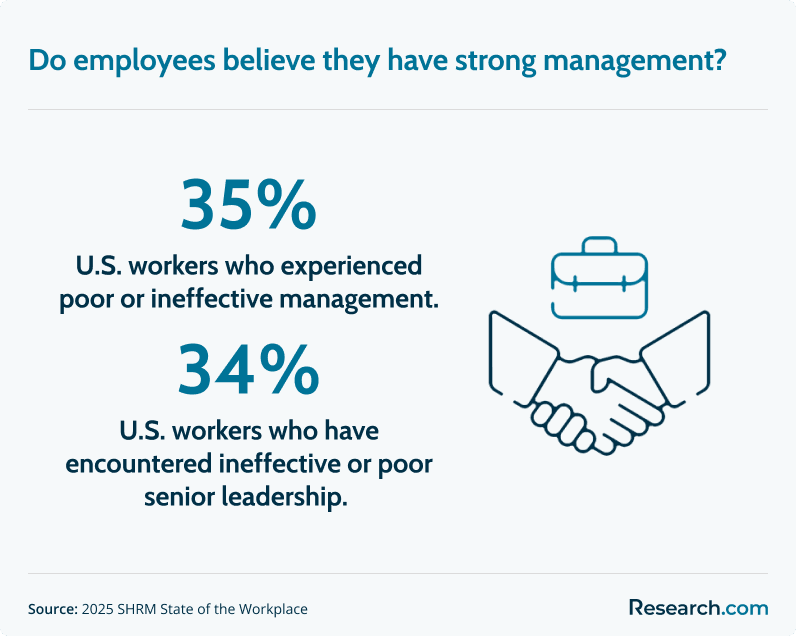
Leadership remains a major workplace concern. According to the 2025 SHRM State of the Workplace, 35% of U.S. workers experienced poor management, and 34% cited ineffective senior leadership. A management-focused MBA can help students address these gaps, but only if the program includes practical leadership development rather than relying only on broad business theory.
Some students may benefit from a narrower industry-focused MBA. For example, professionals pursuing athletic administration or franchise leadership may compare accelerated online MBA sports management programs instead of a general management track. Choose a specialization that supports the role you want next, not simply the one that sounds most impressive.
How should you choose the best online MBA in management?
The best online MBA in management should match your career target, budget, learning style, and available time. Rankings can help you build a shortlist, but they should not replace your own due diligence. A program that is excellent for one student may be a poor fit for another if it lacks the right concentration, schedule, career support, or affordability.
- Verify accreditation: Look for recognized business accreditation such as AACSB, Accreditation Council for Business Schools and Programs (ACBSP), or IACBE. Accreditation helps signal that the school follows established academic and quality standards.
- Compare curriculum depth: Review whether the program covers leadership, strategy, operations, analytics, finance, and organizational behavior. Give extra weight to programs with case studies, simulations, consulting projects, or capstones.
- Evaluate faculty qualifications: Strong programs use faculty with relevant academic credentials, research expertise, executive experience, or industry practice. Faculty who understand current business challenges can make online coursework more practical.
- Calculate total cost: Add tuition, fees, books, software, residency costs, travel, and potential income disruption. Then compare that total against realistic career outcomes.
- Check concentration options: A useful specialization should support your target role, whether that is human resources, healthcare, IT, strategy, project management, marketing, or operations.
- Review career services: Ask whether online MBA students receive coaching, resume review, interview preparation, employer events, alumni networking, and access to the same job resources as campus students.
- Ask about online engagement: Find out whether classes are live, recorded, asynchronous, or hybrid. Also ask how group work is managed across time zones.
| Question to ask | Why it matters |
| Is the business school accredited by AACSB, ACBSP, or IACBE? | Accreditation can affect academic credibility, employer perception, and financial aid eligibility. |
| What is the total program cost, including fees? | Sticker tuition may not reflect the real amount you will pay. |
| Are online students included in career fairs, coaching, and alumni events? | Career support is a major part of MBA value, especially for students seeking advancement or career change. |
| How often are live sessions required? | Live attendance can improve interaction but may conflict with work schedules. |
| Can I change concentrations or take electives outside my track? | Flexibility matters if your career goals shift during the program. |
| What outcomes do graduates report? | Employment results, promotions, and alumni stories can help you judge fit, but they should not be treated as guarantees. |
Common mistakes include choosing only by rank, ignoring accreditation, comparing tuition without checking credits and fees, assuming every online MBA has the same employer recognition, and enrolling before confirming whether the program schedule is realistic. If price is a top concern, compare the degree against options such as the most affordable online MBA programs while still checking quality and outcomes.
What career paths are available after an online MBA in management?
Graduates of online MBA in management programs can pursue leadership roles in consulting, operations, human resources, healthcare, technology, marketing, and executive administration. Actual outcomes depend on prior experience, industry, location, employer needs, and the reputation and support of the MBA program. An MBA can strengthen advancement potential, but it does not guarantee a specific title or salary.
| Career path | Average wage or salary listed | What the role typically involves |
| Management Consultants | $100,495 | Analyze organizational problems, evaluate operations, identify growth opportunities, and recommend performance improvements. |
| Senior Project Managers | $104,496 | Lead cross-functional teams, manage timelines and budgets, control risk, and keep projects aligned with scope. |
| Operations Managers | $133,120 | Oversee daily business operations, improve processes, manage resources, and supervise teams. |
| Healthcare Administrators | $137,730 | Manage healthcare organization operations, budgets, staffing, patient experience, and strategic planning. Students comparing this path may also review MBA healthcare management salary information. |
| Human Resources Managers | $160,480 | Direct recruiting, training, compensation, employee relations, compliance, and workplace culture initiatives. |
| Marketing Managers | $171,520 | Plan campaigns, manage brand strategy, coordinate advertising, and guide customer engagement efforts. |
| IT Managers | $187,990 | Oversee technology infrastructure, cybersecurity, systems implementation, data management, and IT-business alignment. |
| Chief Executives | $262,930 | Set organizational strategy, guide senior leadership, manage enterprise-wide goals, and represent the organization to stakeholders. |
Management MBA graduates are most competitive when they combine the degree with relevant experience, measurable leadership accomplishments, and technical fluency in their industry. Students hoping to pivot into a new field should look for programs with internships, consulting projects, employer partnerships, and strong alumni connections in that sector.
The following chart shows average wages for selected management occupations.
What is the job market for online MBA in management graduates?
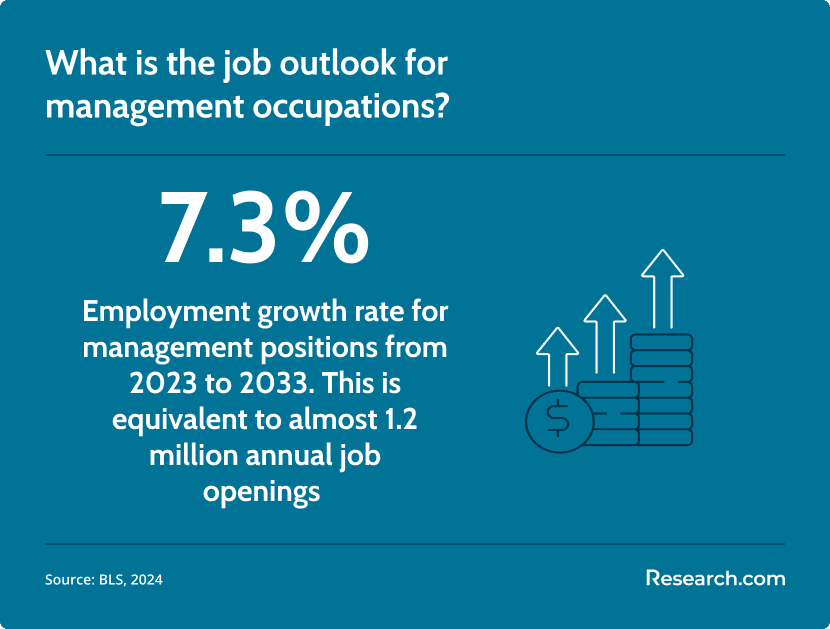
The management job market is broad because almost every industry needs professionals who can plan, coordinate, supervise, allocate resources, and lead change. According to the BLS, management occupations are projected to generate about 1.2 million job openings each year from 2023 to 2033, including new jobs and openings created when workers leave the labor force or change occupations.
Demand does not mean every MBA graduate will move directly into a senior role. Employers often look for a combination of education, work history, leadership evidence, industry knowledge, and results. An online MBA in management can be valuable when it helps students demonstrate stronger strategic thinking, financial judgment, team leadership, and operational problem-solving.
Several workplace trends are changing what managers need to know. AI is reshaping workflows, reporting, analytics, staffing models, and decision-making processes. Managers increasingly need to understand how to use automation responsibly, evaluate data quality, and lead employees through technology-driven change.
Economic uncertainty and rising costs also make financial agility important. Managers are expected to do more than motivate teams; they must make resource decisions, manage budgets, and adapt strategy when markets change.
Sustainability is another factor influencing leadership roles. As organizations respond to climate concerns, environmental regulations, and green business models, some professionals may prefer targeted programs such as fast-track online MBA programs in environmental management. Workplace dynamics are shifting as well, with hybrid teams, changing employee expectations, talent shortages, and retention challenges requiring more adaptive leadership.
For students, the key is to choose an MBA that teaches both durable management fundamentals and current business realities. Programs that include analytics, ethics, digital transformation, change management, and applied strategy can be more relevant to the modern labor market.
What challenges should you consider before enrolling in an online MBA in management?
Online MBA programs offer flexibility, but they are not easier by default. Students must manage deadlines, group projects, readings, exams, and career responsibilities with less physical separation between school and home life. Asynchronous courses can be convenient, but they require disciplined weekly planning.
Networking can also require more intentional effort. Online students may need to attend virtual events, contact alumni, participate in discussion boards, and schedule meetings with faculty rather than relying on casual campus interactions. Technology issues, time zone differences, and group coordination can also affect the learning experience.
Before enrolling, confirm the level of student support. Ask about tutoring, faculty office hours, technical support, career coaching, alumni access, mental health resources, and academic advising. Compare these services with program cost and expected career progression. If affordability is a central issue, use resources such as the most affordable online MBA guide as one reference point, but do not choose on cost alone.
What misconceptions about online MBA in management programs should you avoid?
One common misconception is that all online MBAs are less rigorous than campus programs. In reality, accredited online MBA programs may use the same faculty, assignments, learning outcomes, and grading standards as on-campus versions. The real question is not whether the program is online, but whether it is accredited, well-designed, interactive, and respected by the employers you care about.
Another misconception is that online students cannot build meaningful networks. Networking is different online, but it can still be useful when programs offer live sessions, cohort models, alumni panels, career events, and collaborative projects. Students who want stronger outcomes must participate actively rather than treating the MBA as a set of isolated courses.
A third misconception is that an MBA automatically guarantees a promotion or salary increase. Career results depend on prior experience, employer needs, industry conditions, geography, and how effectively students use the program. When comparing options, review institutions included among the best online MBA programs, but also investigate outcomes, support services, and curriculum fit for your own goals.
What graduates say about online MBA in management programs
- Justine: "I was unsure about returning to school, but the online structure made the workload possible while still feeling connected. The classes improved how I make decisions and manage teams, and that helped me step into a senior role. The most important part was the instructor support; they were responsive and genuinely focused on student growth. Studying from home while managing family responsibilities made the degree realistic for me."
- : "Students should think carefully about long-term return on investment before choosing an online MBA in management. ROI means comparing tuition, fees, and time commitment with possible benefits such as career mobility, stronger leadership skills, salary growth, and a wider professional network. Applicants should review employment outcomes, reported salary changes, curriculum relevance, and industry trends before deciding whether the degree is worth the cost. Cost-conscious students often begin by comparing programs listed among the most affordable online MBA options, then narrow the list by quality and fit."
- Iman: "I enrolled online because I needed flexibility, but I did not expect the program to be as demanding or collaborative as it was. The MBA changed how I handle conflict, motivate employees, and improve operations. Weekly conversations with classmates from different industries helped me see problems from new angles. The degree gave me more confidence and helped me compete for better opportunities."
Key Insights
- Accreditation should be nonnegotiable. Prioritize programs with recognized business accreditation such as AACSB, ACBSP, or IACBE, and verify that online students are enrolled in the same accredited business school or program structure.
- Cost comparisons must include credits and fees. A low per-credit price may not be the lowest total cost if the program requires more credits, mandatory fees, travel, or extra technology expenses.
- Online and campus MBAs can both be credible. GMAC reported that 55% of global companies value online and in-person MBA graduates equally, but school reputation, career support, and curriculum quality still matter.
- The best specialization depends on your next role. Choose management, leadership, HR, healthcare, IT, strategy, or project management based on the work you want to do after graduation.
- Flexibility has trade-offs. Asynchronous learning helps working adults, but students need strong time management, proactive networking, and consistent communication with faculty and peers.
- An MBA can support advancement, but outcomes are not guaranteed. Career results depend on your experience, industry, location, employer demand, and how well you use the program’s network and career resources.
- Ask practical questions before applying. Confirm total cost, live class requirements, GMAT waiver rules, career services for online students, alumni access, concentration flexibility, and capstone or residency obligations.
References
- PayScale. (2025a, June 4). Average Senior Project Manager Salary. Retrieved July 29, 2025, from https://www.payscale.com/research/US/Job=Senior_Project_Manager/Salary
- PayScale. (2025b, July 14). Average Management Consultant Salary. Retrieved July 29, 2025, from https://www.payscale.com/research/US/Job=Management_Consultant/Salary
- Randstad. (2025). Workmonitor 2025: A New Workplace Baseline. https://www.randstad.com/workmonitor
- U.S. Bureau of Labor Statistics. (2024a). Occupational Employment and Wage Statistics: Cross-industry, Private, Federal, State, and Local Government, May 2024. Occupational Employment and Wage Statistics Query System. Retrieved July 29, 2025, https://data.bls.gov/oes/#/industry/000000
- U.S. Bureau of Labor Statistics. (2024b). Management Occupations, May 2024 OEWS Profiles [Interactive data]. Occupational Employment and Wage Statistics (OEWS) Profiles. Retrieved July 29, 2025, from https://data.bls.gov/oesprofile
- U.S. Bureau of Labor Statistics. (2025, April 18). Occupational projections, 2023–33, and worker characteristics, 2023 (Numbers in thousands). Employment Projections. https://www.bls.gov/emp/tables/occupational-projections-and-characteristics.htm
- Walker, A., Jarvis, S., Bao, K., & White, S. (2025a). Corporate Recruiters Survey 2025 Report. Graduate Management Admission Council. https://www.gmac.com/-/media/files/gmac/research/employment-outlook/2025-corporate-recruiters-survey/summary-report.pdf
- Walker, A., Yuan, Q., Yuan, K., & White, S. (2025b). Prospective Students Survey 2025. Graduate Management Admission Council. https://www.gmac.com/-/media/files/gmac/research/prospective-student-data/2025/2025_pss_final.pdf
Other Things You Should Know About Online MBA in Management Programs
In 2027, admission requirements for top online MBA programs in management generally include a Bachelor's degree from an accredited institution, relevant work experience, GMAT or GRE scores, a statement of purpose, and letters of recommendation. Some schools may also conduct interviews to assess candidates' leadership potential and fit for the program.
The top online MBA programs in management for 2027 offer specializations such as Strategic Management, Leadership & Innovation, Global Business, and Human Resources Management. These programs provide students with advanced skills to effectively lead and manage teams in diverse and dynamic environments.





