2027 Fastest Online Graduate Certificate Nursing Informatics Programs

Co-Founder and Chief Data Scientist
As a career and education specialist, I understand that researching online graduate certificates in nursing informatics can be a frustrating process. The digital space is crowded with conflicting program details, unclear cost breakdowns, and promotional content that often obscures the essential facts you need. This abundance of information can make it difficult to distinguish between programs and identify the best fit for your specific career objectives.
My goal is to cut through that complexity. This guide is designed to provide a clear, expertly curated overview, helping you make a well-informed decision about your professional future in this dynamic and rewarding field.
What are the benefits of getting an online graduate certificate in nursing informatics?
- Career Advancement: Opens pathways to specialized roles like Clinical Informatics Specialist, Clinical Analyst, EHR Implementation Specialist, and Health IT Project Manager.
- Earning Potential: Professionals with this graduate-level qualification can command higher salaries than with a BSN alone, moving into a new pay bracket for specialized skills.
- Flexible Learning: The online format provides the convenience of studying from anywhere, allowing you to balance advanced education with your current nursing career and personal commitments.
What can I expect from an online graduate certificate program in nursing informatics?
- Focused Advanced Topics: Expect an intensive curriculum centered on key areas like clinical information systems, data analytics, project management, and workflow optimization.
- Structured Curriculum: Delivery typically combines recorded video lectures, live online class sessions, case studies, and team projects focused on healthcare IT challenges.
- Applied Strategic Knowledge: Emphasis on using data and technology to improve patient safety, quality of care, and operational efficiency in clinical settings.
- Condensed Timeline: Programs are designed to be completed quickly, often in under 12 months, to accelerate your transition into an informatics role.
- Networking Opportunities: Connect with experienced faculty and a diverse cohort of fellow nursing professionals moving into the technology space.
Where can I work with an online graduate certificate in nursing informatics?
- Hospitals & Health Systems: Work within healthcare organizations to manage and optimize clinical information systems like electronic health records (EHRs).
- Healthcare Technology Companies: Join vendors like Epic, Cerner, or other health-tech startups to help develop, implement, or support clinical software.
- Consulting Firms: Advise various healthcare clients on informatics strategy, system selection, and process improvement.
- Public Health Organizations: Apply informatics principles to manage population health data, disease surveillance, and community health initiatives.
- Pathway to Leadership: The certificate provides a strong foundation for moving into senior roles like Director of Clinical Informatics or Chief Nursing Information Officer (CNIO).
How much can I make with an online graduate certificate in nursing informatics?
- Analyst-Level Roles: According to Salary.com, professionals transitioning into positions like Informatics Nurse Specialist can expect salaries around $115,722 annually.
- Management-Level Roles: Experienced individuals in positions like Clinical Informatics Manager can see salaries ranging from approximately $110,000 to $140,000, as reported by sources like Indeed.com.
- Senior & Specialized Roles: Senior leadership positions, such as Director of Clinical Informatics, can command salaries well over $150,000 annually.
- Fastest Online Graduate Certificate Nursing Informatics Programs for 2027 List of Programs
- What is the average cost of an online nursing informatics graduate certificate program? Average Cost
- What are the financial aid options for an online nursing informatics graduate certificate program? Financial Aid
- What are the prerequisites for enrolling in an online nursing informatics graduate certificate program? What are the prerequisites for enrolling in an online nursing informatics graduate certificate program?
- What courses are typically in an online nursing informatics graduate certificate program? What courses are typically in an online nursing informatics graduate certificate program?
- What types of specializations are available for nursing informatics graduates? Specializations
- How do you choose the best among the fastest online nursing informatics graduate certificate programs? How do you choose the best among the fastest online nursing informatics graduate certificate programs?
- What career paths are available for graduates of online nursing informatics graduate certificate programs? Career Paths
- How much can I earn with an online nursing informatics graduate certificate? Salaries
- What is the job market like for graduates of an online nursing informatics graduate certificate program? Job Market
- How can I ensure the quality and credibility of an online nursing informatics graduate certificate program? How can I ensure the quality and credibility of an online nursing informatics graduate certificate program?
- What are some current and future trends in nursing informatics? What are some current and future trends in nursing informatics?
- What additional academic pathways can enhance my nursing informatics career? What additional academic pathways can enhance my nursing informatics career?
- What support services and technical resources can enhance my online learning experience? What support services and technical resources can enhance my online learning experience?
Fastest Online Graduate Certificate in Nursing Informatics Programs for 2027
Nurses who understand both clinical care and health technology are increasingly important as hospitals, clinics, telehealth providers, and health IT vendors rely on electronic records, analytics, artificial intelligence, and data-driven quality improvement. An online graduate certificate in nursing informatics can help registered nurses move from bedside or administrative roles into work that improves systems, workflows, documentation, decision support, and patient safety.
This guide is for nurses comparing fast online nursing informatics certificate programs, especially those who want a shorter credential instead of a full graduate degree. You will learn which programs are among the fastest options, what they cost, what admission requirements to expect, how to compare accreditation and practicum expectations, and what career paths may follow. If you are also weighing broader leadership tracks, compare this route with options such as online MBA in management programs, which focus more on business operations than clinical technology.
Quick Answer: What Is the Fastest Online Nursing Informatics Graduate Certificate?
The fastest online graduate certificates in nursing informatics can typically be completed in about one year, although some programs allow completion in as few as two semesters and others take 12-16 months or 1–1.5 years. The best choice is not always the shortest program. Nurses should compare credits, tuition, accreditation, practicum requirements, certification alignment, and whether the certificate is designed for BSN-prepared, MSN-prepared, or post-master’s students.
| Program | Typical Time to Complete | Credits | Tuition Listed | Best Fit |
| Jacksonville University | Typically 1 year when taken full-time | 12 credits | $750/credit | MSN-prepared nurses who want a compact post-graduate certificate with practicum support |
| Thomas Edison State University | 1 year, as few as two semesters | 9 credits | $/credit | Experienced nurses seeking a short theory-based informatics certificate |
| Texas Woman’s University | 1 year full-time | 15 credits/5 courses | $323/credit | Nurses and health professionals seeking a health informatics-focused online option |
| Millersville University of Pennsylvania | As few as 12 months | 18 credits | $10,890 total program | MSN-prepared RNs seeking ANCC and CAHIMS preparation |
| Nebraska Methodist College of Nursing & Allied Health | 12-16 months | 17 credits | $429/credit | Post-master’s nurses who want 200 clinical hours and ANCC eligibility |
How We Rank Schools
Because graduate certificates require time, tuition, and career planning, Research.com evaluates programs using a transparent review process. Our ranking methodology considers publicly available education data, program features, affordability indicators, and online learning factors. Sources used in our research include:
- IPEDS database
- Peterson's database, including its Distance Learning Licensed Data Set
- College Scorecard database
- National Center for Education Statistics
The programs below are presented as fast online options for nurses interested in graduate-level informatics training. Always confirm the latest tuition, course sequence, licensure requirements, and practicum rules directly with the school before applying.
1. Millersville University of Pennsylvania
Millersville University of Pennsylvania offers an online Graduate Certificate in Nursing Informatics for nurses who want to connect clinical practice with health information systems, data use, workflow design, and technology-supported care. The program emphasizes the practical role of informatics in improving communication, decision-making, documentation, and organizational processes.
The certificate includes six required online courses. Topics include healthcare technology, data analysis, workflow processes, regulatory issues, and healthcare information systems design. The curriculum is built for nurses who need to communicate effectively with IT professionals, clinical leaders, vendors, and frontline care teams.
Graduates may pursue roles such as Chief Nursing Informatics Officer, Electronic Health Record System Integration Specialist, and Telehealth Clinical Coordinator. The program is also designed to prepare students for industry-recognized certification exams, including the ANCC Informatics Nursing certification and the CAHIMS exam. Applicants do not need the GMAT or GRE, but they must have an MSN degree, an active RN license, and at least one year of clinical nursing experience.
- Program Length: As few as 12 months
- Tracks/Concentrations: Nursing Informatics
- Tuition Cost: $10,890 total program
- Required Credits to Graduate: 18 credits
- Accreditation: Commission on Collegiate Nursing Education (CCNE)
2. University of South Carolina-Columbia
The Certificate of Graduate Study in Nursing Informatics at the University of South Carolina-Columbia is a fully online program focused on using information and technology to support quality, safety, and efficiency in healthcare. The curriculum combines nursing science, computer science, and informatics science so students can manage, interpret, and communicate data in clinical environments.
Students study system design life cycles, healthcare technology, data analysis, database management, leadership, project management, and the conceptual basis of health systems. The program also emphasizes pattern recognition, systems thinking, and innovation, which are important for nurses working on workflow redesign or technology implementation.
A required practicum helps students apply coursework to real clinical or organizational problems. Graduates may pursue positions such as Clinical Analyst, Director of Clinical Informatics, or Chief Nursing Informatics Officer. Completion may also support eligibility for the national certification examination in nursing informatics through the American Nurse Credentialing Center.
- Program Length: 3–6 semesters
- Tracks/Concentrations: Nursing Informatics
- Tuition Cost: $572.25/credit
- Required Credits to Graduate: 18
- Accreditation: Commission on Collegiate Nursing Education (CCNE)
3. Walden University
Walden University offers a Post-Master’s Certificate in Nursing Informatics for nurses who want to use data, information, and knowledge to improve decision-making for patients, practitioners, and healthcare organizations. The coursework introduces information systems, database concepts, workflow support, and health IT project management.
The program is designed for nurses who want to guide digital solutions that improve nursing workflows and support healthcare technology adoption. Students may also apply their learning through an optional capstone practicum, which can be useful for those who want a portfolio project or workplace-based informatics experience.
Faculty members hold doctorates and bring nursing experience into the online learning environment. The certificate prepares students for the American Nurses Credentialing Center (ANCC) Informatics Nursing board certification exam, which evaluates entry-level clinical knowledge for registered nurses in this specialty.
- Program Length: Varies per student
- Tracks/Concentrations: Nursing Informatics
- Tuition Cost: $14,540 total program cost
- Required Credits to Graduate: 28 total quarter credits
- Accreditation: Commission on Collegiate Nursing Education (CCNE)
4. Nebraska Methodist College of Nursing & Allied Health
Nebraska Methodist College of Nursing & Allied Health offers an online Nursing Informatics Post Master’s Certificate for nurses who already hold a master’s degree and want a focused credential in healthcare data, clinical information systems, and technology-supported care improvement.
The program is structured for working nurses and can be completed online in 12-16 months. Courses are offered in flexible five or ten-week formats, allowing students to access coursework at any time with an internet connection. Key areas include clinical information systems, computer science, project management, and evidence-based practice.
Students complete 200 clinical hours, which can help them demonstrate applied informatics competence. Graduates are eligible for the informatics certification from the American Nurses Credentialing Center. Admission requires a Master of Science in Nursing from a regionally accredited institution, although applicants with master’s degrees in other healthcare fields may be reviewed individually.
- Program Length: 12-16 months
- Tracks/Concentrations: Nursing Informatics
- Tuition Cost: $429/credit
- Required Credits to Graduate: 17 credits
- Accreditation: Commission on Collegiate Nursing Education (CCNE)
5. Jacksonville University
Jacksonville University offers a fully online Nursing Informatics Post-Graduate Certificate for working nurses who want advanced preparation in health information technology. The curriculum covers foundational and advanced informatics, clinical systems, technology-supported care, and the use of digital tools to improve healthcare outcomes.
Students study project management, system implementation, regulatory standards, evidence-based practice, data use, and patient safety. The program aligns with requirements for the American Nurses Credentialing Center (ANCC) Informatics Certification, which may strengthen a graduate’s professional profile.
The program begins in the Fall term and is designed to fit around professional responsibilities. Admission requires a master’s degree in nursing, a minimum 3.0 GPA, an active U.S. nursing license, and eligibility for licensure in Florida. Practicum experiences support hands-on skill development, and the university provides faculty advising and clinical placement services.
- Program Length: Typically 1 year when taken full-time
- Tracks/Concentrations: Nursing Informatics
- Tuition Cost: $750/credit
- Required Credits to Graduate: 12 credits
- Accreditation: Commission on Collegiate Nursing Education (CCNE)
6. Texas Woman’s University
Texas Woman’s University offers an online Graduate Certificate in Health Informatics for nurses and health professionals who want stronger skills in health information management, healthcare data, clinical systems, and digital innovation. The online format allows students to continue working while completing graduate-level coursework.
The curriculum includes healthcare data analytics, clinical information systems, legal and ethical issues in informatics, and evidence-based technology solutions for clinical settings. Students also gain exposure to health IT tools and implementation strategies used across healthcare organizations.
The certificate is open to graduates with a bachelor’s or master’s degree in nursing and an active RN license. It may also help prepare students for national certification exams in nursing informatics. Faculty members include informatics practitioners who bring current professional knowledge into the program.
- Program Length: 1 year full-time
- Tracks/Concentrations: Nursing Informatics
- Tuition Cost: $323/credit
- Required Credits to Graduate: 15 credits/5 courses
- Accreditation: Commission on Collegiate Nursing Education (CCNE)
7. Thomas Edison State University
Thomas Edison State University offers an online Nursing Informatics Certificate Program for experienced nurses who want graduate-level preparation in health data, information systems, privacy, data standards, and technology-enabled care improvement.
The certificate is offered through the W. Cary Edwards School of Nursing and Health Professions. It includes three theory courses totaling 9 credits and focuses on preparing students to work as Nursing Informatics Specialists in academic and healthcare settings.
Coursework emphasizes person-centered informatics, evidence-based practice, quality and safety, interprofessional collaboration, health promotion, and population outcomes. Because this is one of the shorter credit requirements on the list, students should review whether its scope matches their certification, practicum, and career goals.
- Program Length: 1 year, as few as two semesters
- Tracks/Concentrations: Nursing Informatics
- Tuition Cost: $/credit
- Required Credits to Graduate: 9 credits
- Accreditation: Commission on Collegiate Nursing Education (CCNE)
8. University of Colorado Anschutz Medical Campus
The University of Colorado offers a Post-Graduate Certificate in Health Care Informatics for master’s-prepared nurses who want to move into systems-level work. The program is fully remote and prepares nurses to serve as translators between clinical teams and technology teams.
Students can complete the program in about 1-1.5 years. Coursework covers knowledge management, decision support, human-computer interaction design, health technology, and systems change. Although the program does not include formal clinical hours, students are expected to apply concepts in real-world environments, potentially including their current workplace.
Graduates may pursue roles such as clinical informatics specialist or data analyst in hospitals, government agencies, healthcare organizations, and technology companies. The program also gives students access to virtual meetings, discussion boards, peers, and faculty recognized for excellence.
- Program Length: 1-1.5 years
- Tracks/Concentrations: Health Care Informatics
- Program Tuition Cost: Colorado residents $12,560; Nonresidents $12,560
- Required Credits to Graduate: 16 credits
- Accreditation: Commission on Collegiate Nursing Education (CCNE)
9. University of North Carolina at Charlotte
The University of North Carolina at Charlotte offers an online Graduate Certificate in Applied Nursing Informatics for nurses who want practical preparation in health information systems, clinical data analytics, and informatics-supported decision-making. The fully online format is designed for working professionals.
The certificate includes four courses that can be completed over a calendar year. Coursework focuses on implementing and managing clinical information systems, analyzing healthcare data, supporting strategic planning, and managing financial, human, and IT resources in complex healthcare systems.
The program can benefit administrative nurses who need informatics knowledge for leadership roles as well as nurses pursuing a more specialized informatics path. Students may also integrate certificate coursework into existing MSN studies.
- Program Length: 1–1.5 years
- Tracks/Concentrations: Applied Nursing Informatics
- Tuition Cost: Resident: $288.82/credit hour; Outside NC Non-Resident: $536.98/credit hour; Non-Resident: $1,098.21/credit hour
- Required Credits to Graduate: 12 credits
- Accreditation: Commission on Collegiate Nursing Education (CCNE)
10. University of Utah
The University of Utah offers an online Nursing Informatics Graduate Certificate for nurses who want to build competency in the connection between clinical care and information technology. The program covers health data systems, informatics applications, workflow redesign, health analytics, and innovation in healthcare organizations.
Students complete at least fifteen credit hours and begin by selecting one foundational course from approved options in health, biomedical, or public health informatics. A faculty advisor helps students choose courses that support individual learning goals and career interests.
At least 12 of the 15 required hours are expected to come from the Nursing Informatics or Biomedical Informatics Department course lists, and standard course prerequisites apply. Students may also gain theoretical and practical exposure through practicum experiences coordinated through local clinical sites.
- Program Length: 1–1.5 years
- Tracks/Concentrations: Informatics
- Tuition Cost: Resident: $321.60/credit; Non-resident: $1,131.89/credit
- Required Credits to Graduate: 15 credits
- Accreditation: Commission on Collegiate Nursing Education (CCNE)
How Much Does an Online Nursing Informatics Graduate Certificate Cost?
The price of an online nursing informatics graduate certificate depends on the school, credit requirement, residency status, public or private status, technology fees, books, software, and practicum-related costs. Most schools charge by the credit, so a shorter certificate is not automatically cheaper if the per-credit tuition is high.
- Public universities: These may be lower-cost choices, especially for in-state students, with total program costs often ranging from $8,000 to $15,000.
- Private universities: Private non-profit and for-profit institutions often charge more, with total costs frequently between $15,000 and $25,000 or more.
- Per-credit tuition: Many programs list tuition by credit hour, with rates anywhere from $500 to over $1,200 per credit hour.
- Extra charges: Students should ask about technology fees, application fees, graduation fees, digital textbook costs, software subscriptions, and practicum expenses.
| Cost Factor | Why It Matters | Question to Ask |
| Total credits | A 9-credit certificate may cost less than an 18-credit certificate, but only if tuition and fees are comparable. | How many credits are required, and can any credits transfer into a future MSN or DNP? |
| Residency pricing | Some public universities charge different rates for residents and nonresidents. | Do online students pay in-state, out-of-state, or special distance-learning tuition? |
| Practicum requirements | Clinical or applied hours can create travel, documentation, or preceptor coordination costs. | Does the school help arrange practicum sites, and are there placement fees? |
| Certification preparation | Programs aligned with ANCC or CAHIMS expectations may reduce the need for separate prep resources. | Does tuition include certification preparation materials or exam support? |
To compare programs accurately, calculate the full cost rather than relying on tuition alone. Nurses comparing different certificate types may also want to review accelerated online WHNP graduate certificate programs, since clinical certificates may have different practicum, licensure, and cost structures.
What Financial Aid Can Help Pay for an Online Nursing Informatics Certificate?
Financial aid for graduate certificate students varies by school and program eligibility. Some certificates qualify for federal student loans, while others may have more limited aid options. Nurses should confirm aid eligibility before assuming a certificate can be funded the same way as a full degree.
- Federal student aid: Completing the Free Application for Federal Student Aid, or FAFSA, may allow eligible students to access federal loans, although grant eligibility for certificate programs can be limited.
- Employer tuition reimbursement: Hospitals and healthcare systems may help pay for informatics education when the training supports organizational needs such as EHR optimization, analytics, quality improvement, or telehealth.
- Private loans: Banks, credit unions, and online lenders may provide education loans, but repayment terms and interest rates should be reviewed carefully.
- Scholarships and grants: Nursing organizations, universities, healthcare systems, and professional associations may offer awards for graduate nursing or informatics students.
- Military and veteran benefits: Eligible service members and veterans may use benefits such as the GI Bill® for approved programs.
Start with the school’s financial aid office, then ask your employer whether informatics coursework qualifies for reimbursement. If you are comparing healthcare technology with other helping-profession graduate routes, resources such as accredited online counselor education programs can help you understand how program costs and career outcomes differ across fields.
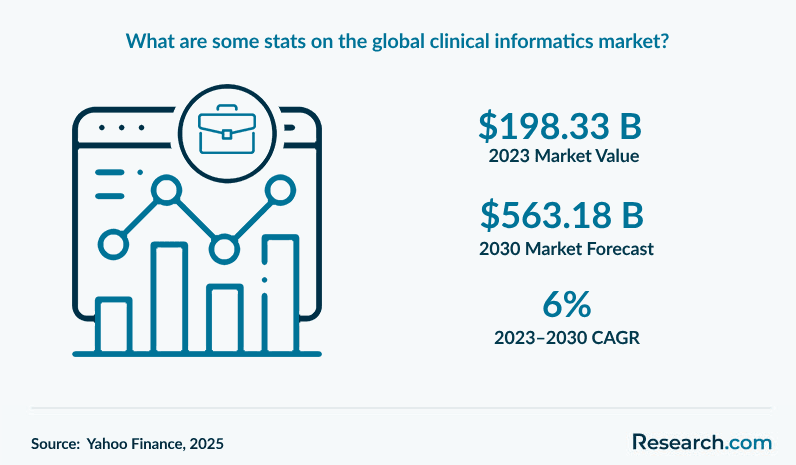
The global clinical informatics market is experiencing substantial growth, projected to climb from a value of $198.33 billion in 2023 to an estimated $563.18 billion by 2030, reflecting a robust compound annual growth rate (CAGR) of 16.0%, shown in the graphic below. This expansion is tied to the growing use of advanced technologies in healthcare, especially artificial intelligence and big data.
Electronic health records, connected medical devices, digital documentation, and remote care platforms generate large datasets. Informatics professionals help healthcare organizations turn that data into safer workflows, clearer decisions, and more efficient operations.
Generative AI is also affecting clinical informatics. For example, Cognizant's June 2024 launch of AI solutions to streamline administrative tasks illustrates how vendors are building tools that reduce repetitive work and support healthcare operations.
The World Health Organization uses AI to improve epidemic prediction and early warning systems. In 2023, the oncology segment represented the largest share of the market, driven by demand for data management systems that support personalized cancer treatments and integrate complex genetic information.
What Are the Admission Requirements for an Online Nursing Informatics Graduate Certificate?
Admission requirements differ by school, but nursing informatics certificates usually expect applicants to have clinical nursing preparation, an active nursing license, and the academic readiness for graduate coursework. Post-master’s certificates often require an MSN, while some graduate certificates accept BSN-prepared nurses.
- Education: Many programs require a Bachelor of Science in Nursing from an accredited institution, while post-master’s certificates may require an MSN. Some schools may consider an ADN plus a bachelor’s degree in another field.
- RN licensure: Applicants generally need a current, unencumbered Registered Nurse license in the United States.
- Clinical experience: Most programs prefer or require at least one to two years of registered nursing experience.
- GPA: A minimum GPA is commonly required, often a 3.0 on a 4.0 scale.
- Application materials: Schools typically ask for official transcripts, a resume, a statement of purpose or personal essay, and letters of recommendation.
If you do not yet meet graduate certificate requirements, ask whether the school offers a bridge pathway. Nurses who want a full graduate degree rather than a certificate may also compare RN to MSN programs offered by nursing schools across the USA.
What Courses Are Common in Online Nursing Informatics Graduate Certificate Programs?
Nursing informatics coursework sits at the intersection of nursing science, information science, computer science, data management, and healthcare operations. The goal is not to turn nurses into software engineers. The goal is to prepare nurses to improve clinical systems, translate workflow needs, evaluate data, and support safer technology use.
- Foundations of nursing informatics: Introduces the field, major concepts, professional roles, and the relationship between nursing practice and information systems.
- Healthcare information systems: Covers selection, implementation, maintenance, optimization, and evaluation of systems such as electronic health records.
- Data management and analytics: Focuses on databases, data standards, reporting, and converting raw healthcare data into useful information for clinical decisions.
- Clinical decision support: Examines tools that give clinicians patient-specific information, alerts, reminders, and evidence-based guidance at the point of care.
- Healthcare IT leadership and project management: Builds skills in change management, stakeholder communication, implementation planning, and technology project oversight.
These courses are specialized and career-focused, similar in structure to other applied analytics programs such as online crime analysis degree programs, where students learn to use data and systems to improve decisions in a specific professional setting.
As shown in the graph below, the employment landscape for health information technologists and medical registrars is heavily concentrated in hospitals. Hospitals employ 47% of these professionals across state, local, and private facilities. Physicians' offices account for 9% of jobs, the management of companies and enterprises accounts for 7%, professional, scientific, and technical services account for 6%, and administrative and support services account for 4%.
This pattern shows that hospitals remain the primary employer for many health information technology roles, although opportunities also exist in physician groups, corporate healthcare organizations, technical services, and administrative support settings. Regardless of employer, these professionals often work in office-based roles and spend significant time using computers and data systems.
What Nursing Informatics Specializations Can You Pursue?
A graduate certificate usually provides broad preparation, but students can use electives, practicum projects, work assignments, or future graduate study to build expertise in a narrower area of informatics. The right focus depends on whether you prefer systems implementation, data analysis, education, compliance, patient-facing technology, or population health.
- Artificial intelligence in nursing: Focuses on machine learning, predictive analytics, risk scoring, documentation automation, and AI-supported clinical decisions.
- Clinical decision support: Involves designing, testing, and improving tools that give clinicians evidence-based guidance during care delivery.
- Consumer health informatics: Centers on patient portals, mobile health apps, patient engagement tools, and self-management technologies.
- Data analytics: Uses data mining, statistical analysis, dashboards, and predictive modeling to identify patterns and improve outcomes. Nurses who want a broader analytics career can compare online data analytics programs.
- Informatics education: Prepares nurses to train clinicians, support super-users, and help teams adopt new systems.
- Interoperability and health information exchange: Focuses on secure data sharing across different systems and providers.
- Public health informatics: Applies informatics to disease surveillance, emergency preparedness, health promotion, and population health programs.
- Regulatory and compliance informatics: Emphasizes HIPAA, privacy, security, documentation integrity, and compliance with healthcare data standards.
- System implementation and optimization: Supports EHR rollouts, upgrades, workflow redesign, testing, training, and ongoing improvement.
- Workflow redesign: Analyzes clinical processes and restructures them to improve safety, efficiency, documentation, and user experience.
How Do You Choose the Best Fast Online Nursing Informatics Certificate?
The best program is the one that fits your current credentials, timeline, budget, career target, and preferred learning format. A short program can be attractive, but it may not be the best option if it lacks practicum support, certification alignment, or transferability into a future degree.
| Decision Factor | Why It Matters | What to Verify |
| Accreditation | Accreditation helps confirm that the institution and nursing program meet recognized standards. | Look for nursing accreditation such as CCNE or ACEN and institutional recognition. You can also review guidance on U.S.-accredited online degree programs. |
| Admission level | Some certificates require an MSN, while others may admit BSN-prepared nurses. | Confirm whether the certificate is graduate, post-graduate, or post-master’s. |
| Certification alignment | Some programs explicitly prepare students for ANCC Informatics Nursing certification or CAHIMS. | Ask which certification exams the curriculum supports and whether graduates meet eligibility requirements. |
| Practicum | Applied experience can help you build a portfolio and transition into an informatics role. | Ask whether clinical hours are required, optional, or absent, and how placement is handled. |
| Transferability | Certificate credits may or may not count toward an MSN, DNP, or related degree. | Ask whether credits can be applied to a future graduate program at the same school. |
Who Should Choose a Fast Nursing Informatics Certificate?
- Nurses who already have strong clinical experience and want to move into EHR, analytics, workflow, telehealth, or quality improvement roles.
- MSN-prepared nurses who want a post-master’s specialization without completing another full degree.
- Nurses whose employer supports tuition reimbursement for informatics, health IT, or quality improvement education.
- Working professionals who need online flexibility and a credential that can be completed in about one year.
Who Should Consider a Different Path?
- Nurses who need advanced practice licensure should choose the appropriate NP, CNS, or other licensure-focused program instead of an informatics certificate.
- Students without an RN license may need a nursing degree pathway before they can enter a nursing informatics program.
- Nurses aiming for executive-level leadership may eventually need an MSN, DNP, MBA, or health administration degree.
- Students who want deep technical roles in programming, data engineering, or bioinformatics may need a more technical degree.
What Jobs Can You Get With an Online Nursing Informatics Graduate Certificate?
A nursing informatics certificate can support movement into roles that connect clinical practice, technology, data, education, implementation, and quality improvement. Job titles vary by employer, and some positions may require additional experience, certification, or a graduate degree.
- Bioinformatician: Uses computational tools and data analysis to interpret biological and clinical data for research, genomics, precision medicine, and evidence-based practice. Nurses interested in this research-focused path may compare affordable online master’s in bioinformatics programs.
- Clinical informatics specialist: Works with clinicians to improve EHR use, digital workflows, patient safety, and documentation processes.
- EHR implementation specialist: Supports planning, testing, training, and rollout of electronic health record systems.
- Clinical analyst: Reviews clinical data for quality improvement, research support, reporting, and evidence-based practice.
- Health IT project manager: Leads system upgrades, software rollouts, vendor coordination, and organizational change efforts.
- Nurse informaticist: Serves as a bridge between nurses, IT teams, administrators, and vendors to improve digital tools and workflows.
- Nursing informatics consultant: Advises healthcare organizations on system selection, implementation, informatics strategy, and process improvement.
- Healthcare data analyst: Uses clinical and administrative data to identify trends, support decisions, and improve care delivery.
- Clinical documentation improvement specialist: Helps ensure documentation supports coding, billing, quality reporting, and accurate clinical communication.
- Informatics nurse educator: Trains staff on health IT tools, supports adoption, and develops learning resources.
- Quality improvement analyst: Applies data and informatics tools to track patient safety, quality measures, and process improvement projects.
- Telehealth coordinator: Supports virtual care platforms, remote workflows, patient access, and technology integration.
- Population health analyst: Uses informatics to analyze community health data and support population health strategies.
These jobs allow nurses to influence care beyond individual patient encounters. Many roles require collaboration with clinicians, administrators, analysts, compliance teams, and software vendors.
How Much Can You Earn With a Nursing Informatics Graduate Certificate?
Pay in nursing informatics depends on role, employer, state, experience, education, certification, and leadership responsibility. A certificate can strengthen a nurse’s qualifications, but it does not guarantee a specific salary. Nurses who want a quick entry point may also compare nursing informatics online programs that are easier to get into.
- Entry-level positions: Nurses moving into their first informatics role can typically expect to earn between $75,000 and $90,000 annually.
- Mid-career professionals: Informatics nurses with several years of experience may earn between $90,000 and $115,000.
- Senior and leadership roles: Experienced professionals in management, senior analyst, or leadership jobs can earn well over $120,000, with some earning upwards of $150,000.
- Location: Major metropolitan areas and high-cost regions may offer higher pay, although competition and living costs may also be higher.
- Certification: Credentials such as ANCC Informatics Nursing Certification (RN-BC) can support career mobility and may influence compensation.
Salaries for nursing informatics professionals show meaningful growth with experience. The graph below shows entry-level positions starting from around $82,500 and mid-career professionals increasing to $102,500.
Additional experience and specialization can raise compensation further. An intermediate-level informatics nurse earns approximately $109,877, while a senior-level informatics nurse earns $111,772. Senior and leadership roles can expect around $115,000, a specialist-level informatics nurse earns about $115,722, and an expert-level informatics nurse commands a salary of $117,920.
The overall salary distribution shows that 25 percent of earners make around $100,356, the median or 50th percentile salary is $111,083, and the 75th percentile earns approximately $119,908 annually.
Compensation also differs by state. Arkansas offers the highest salary at $166,566, followed by Oregon at $145,904, Washington at $145,578, California at $139,307, and Nevada at $137,552. Lower salaries in the provided list include Louisiana at $103,617, Mississippi at $113,469, South Carolina at $113,932, Pennsylvania at $115,118, and Florida at $115,244.
The salary pattern shows that nursing informatics can be financially rewarding, especially for professionals who combine clinical credibility, technical fluency, project experience, and leadership skills. However, local job markets, employer budgets, and job scope can significantly affect actual pay.
What Is the Job Market Like for Nursing Informatics Certificate Graduates?
The job market for nurses with informatics training is supported by healthcare’s continued reliance on electronic records, data reporting, telehealth, AI tools, quality metrics, and digital workflows. Informatics roles are not limited to hospitals, but hospitals remain a major employment setting.
- Digital health adoption: EHRs, clinical documentation systems, patient portals, and remote monitoring create demand for professionals who understand both nursing practice and technology.
- Related occupational growth: The U.S. Bureau of Labor Statistics projects strong growth for health information technologists and medical registrars, and related information can help nurses evaluate health informatics salary and career paths.
- Employer variety: Jobs can be found in hospitals, clinics, public health organizations, academic institutions, consulting firms, technology vendors, and healthcare corporations.
- Bridge role: Informatics nurses help translate clinical needs into technology requirements and help teams use systems safely and effectively.
- Long-term relevance: Healthcare organizations need staff who can manage data integrity, user adoption, workflow change, patient safety, and regulatory expectations.
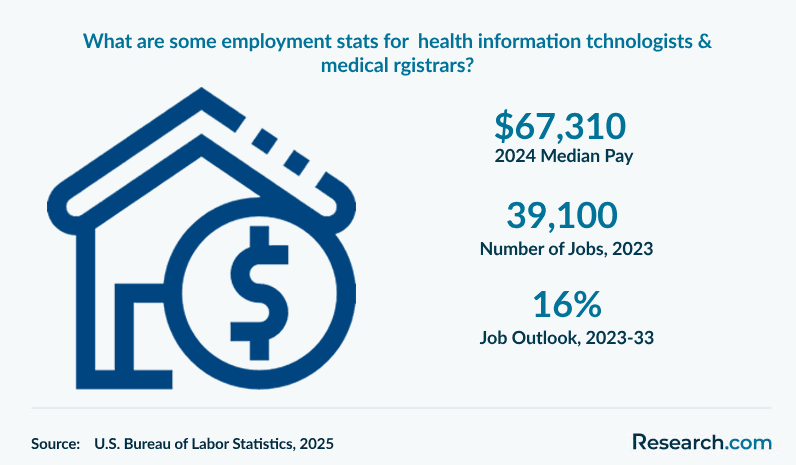
As shown in the graphic below, the median annual wage for health information technologists and medical registrars was $67,310 as of May 2024, with an average hourly wage of $32.36. In 2023, approximately 39,100 individuals were employed in this occupation. Employment is projected to grow by 16% from 2023 to 2033, described as much faster than average, with about 6,400 new jobs expected over the decade.
There are roughly 3,200 openings per year on average, mainly due to workers retiring or changing occupations. The typical entry-level education requirement is an associate’s degree, and no prior work experience or on-the-job training is generally required.
For nurses, these figures should be interpreted as related labor-market evidence rather than a direct guarantee of nursing informatics employment. Clinical background, graduate coursework, informatics projects, certification, and employer needs all affect job competitiveness.
How Can You Check the Quality of an Online Nursing Informatics Certificate?
Quality matters because informatics work affects patient safety, privacy, documentation, clinical decisions, and organizational performance. Before enrolling, verify that the institution is properly accredited and that the nursing program has relevant healthcare education accreditation. Also review faculty credentials, practicum support, student services, certification preparation, graduate outcomes, and employer connections.
- Confirm institutional accreditation and nursing program accreditation.
- Ask whether the curriculum aligns with ANCC Informatics Nursing certification expectations.
- Review faculty experience in nursing informatics, health IT, analytics, quality improvement, or clinical systems.
- Ask how practicum placements are arranged and whether you may use your workplace.
- Request recent information on completion rates, student support, and career services.
- Check whether credits can transfer into a future MSN, DNP, or related graduate program.
If you are still building your nursing academic foundation, you may also review accelerated BSN programs to understand pathways into professional nursing before specializing.
What Trends Are Changing Nursing Informatics?
Nursing informatics is changing quickly as healthcare organizations adopt more digital tools and face pressure to improve access, safety, efficiency, and personalization. Nurses entering this field should be ready for continuous learning.
- Artificial intelligence and machine learning: Artificial Intelligence is increasingly used in predictive analytics, clinical decision support, risk detection, imaging analysis, and administrative automation.
- Telehealth and remote patient monitoring: Virtual care requires secure data exchange, usable platforms, reliable workflows, and integration with the broader medical record.
- Genomics and personalized medicine: Informatics helps organize and interpret complex data used to tailor care to patients’ genetic profiles and medical histories.
- Interoperability and data exchange: Healthcare organizations continue working toward secure, seamless information sharing among different EHRs, providers, and systems.
- Cybersecurity and privacy: More digital care creates more responsibility for protecting sensitive patient information and maintaining trust.
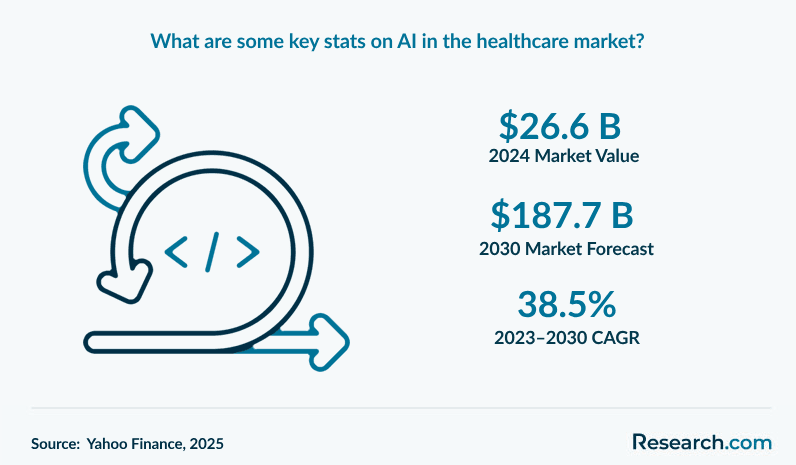
The global AI in Healthcare market is projected to expand from $26.6 billion in 2024 to $187.7 billion by 2030, at a compound annual growth rate (CAGR) of 38.5%, as shown in the graphic below. Growth is connected to pressure on healthcare systems from chronic illness, aging populations, and the need for earlier detection of conditions such as dementia and cardiovascular disease.
Early diagnosis can improve survival rates and reduce treatment costs, especially in resource-poor areas where diseases are often identified late. AI’s ability to analyze patterns in imaging data is one reason healthcare organizations are investing in these tools.
AI systems can identify patterns in imaging scans quickly and accurately, supporting early detection of cancer and stroke. The move toward patient-centered care also increases demand for AI tools that support personalized medicine, which uses genetic profiles and medical histories to create customized treatment approaches rather than one-size-fits-all protocols.
What Academic Pathways Can Strengthen a Nursing Informatics Career?
A certificate can be a practical first step, but some nurses later add a degree to expand their leadership options. Depending on your current education and goals, useful pathways may include an MSN, DNP, healthcare administration degree, data analytics degree, public health degree, or specialized post-master’s certificate.
Registered nurses who still need a bachelor’s degree can compare online RN to BSN programs before pursuing graduate informatics coursework. Nurses who already have graduate preparation may use a certificate to add a focused specialty without completing another full degree.
What Online Support Services Should Nursing Informatics Students Look For?
Strong online support can make a major difference for working nurses. Because nursing informatics programs require comfort with digital platforms, data tools, and remote collaboration, students should evaluate the technology and support environment before enrolling.
- Technical support: Look for responsive IT help, learning platform tutorials, and support for required software.
- Academic advising: Advisors should help plan course sequencing, practicum timing, and certificate-to-degree options.
- Faculty access: Online students should have clear ways to reach instructors for feedback and guidance.
- Library and research tools: Graduate students need access to databases, evidence-based practice resources, and citation support.
- Career services: Resume help, interview preparation, and job-search support can be valuable for nurses transitioning into informatics roles.
- Clinical placement guidance: If a practicum is required, ask whether the school helps secure placements or expects students to find their own sites.
Nurses planning for doctoral leadership roles can also compare support services across short online DNP programs, where practicum coordination and online student resources can be especially important.
Common Mistakes to Avoid When Choosing a Nursing Informatics Certificate
| Mistake | Why It Can Hurt You | Better Approach |
| Choosing only the shortest program | A very short certificate may not include practicum experience, certification preparation, or enough depth for your target role. | Compare time, credits, applied learning, and career alignment together. |
| Ignoring accreditation | Accreditation can affect credibility, transfer credit, employer recognition, and financial aid eligibility. | Verify institutional and nursing accreditation before applying. |
| Looking only at tuition | Fees, software, books, practicum costs, and certification exam preparation can increase total cost. | Ask for a full estimated cost of attendance. |
| Assuming all online programs fit your state or license situation | Some programs have state authorization, licensure, or practicum restrictions. | Confirm eligibility with the admissions office and your state board when relevant. |
| Skipping certification questions | Not every certificate automatically makes you eligible for ANCC or CAHIMS exams. | Ask exactly which certification requirements the program supports. |
| Relying only on rankings | A highly ranked program may not match your schedule, budget, prerequisites, or career goals. | Use rankings as a starting point, then evaluate fit. |
What Graduates Say About Online Nursing Informatics Certificate Programs
- Laura: "The certificate changed how I think about patient care. I learned how data, EHR design, and workflow decisions affect safety, and the online format made it possible to study while working full time."
- Ashley: "The coursework helped me move into a clinical informatics specialist role and contribute to a major system upgrade. What I learned was practical enough to use immediately at work."
- Marisol: "I enrolled to understand healthcare technology better, but the program also helped me see how data can guide leadership decisions. It opened new opportunities beyond my previous nursing role."
References
- Bureau of Labor Statistics, U.S. Department of Labor. (2025, April 18). Health information technologists and medical registrars. Occupational Outlook Handbook. Bureau of Labor Statistics.
- Indeed. (2025). Nursing informatics salary guide, salaries in every state. Indeed.
- Salary.com. (2025). Informatics nurse salary in the United States. Salary.com.
- Yahoo Finance. (2025). AI in healthcare market revenue worth $187.7 billion by 2030. Yahoo Finance.
- Yahoo Finance. (2025). Clinical informatics market to hit USD 563.18 billion by 2030. Yahoo Finance.
- ZipRecruiter. (2025). What is the average informatics nurse salary by state. ZipRecruiter.
- ZipRecruiter. (2025). Informatics nurse salary. ZipRecruiter.
Key Insights
- The fastest online nursing informatics graduate certificates can often be completed in about one year, but the best program depends on credits, cost, accreditation, practicum structure, and certification alignment.
- Post-master’s certificates are usually designed for MSN-prepared nurses, while some graduate certificates may accept BSN-prepared applicants. Always verify the required degree level before applying.
- CCNE accreditation appears across the listed programs and is an important quality marker, but students should also check institutional accreditation, state authorization, and financial aid eligibility.
- Practicum requirements vary. Some programs include clinical or applied hours, some make practicum optional, and some do not require formal clinical hours. This can affect both learning experience and career readiness.
- Nursing informatics graduates may pursue roles in clinical informatics, EHR implementation, healthcare analytics, quality improvement, telehealth, documentation improvement, consulting, and health IT project management.
- Salary potential can be strong, but outcomes vary by location, role, experience, certification, and employer. A certificate can improve qualifications but does not guarantee a specific job or wage.
- AI, telehealth, interoperability, cybersecurity, genomics, and data analytics are shaping the field. Nurses who continue building both clinical and technical skills will be better positioned for long-term opportunities.
Other Things You Should Know About the Fastest Online Graduate Certificate Nursing Informatics Programs
Many 2027 online graduate certificate nursing informatics programs include a capstone or practicum in the final term. Common requirements are 1–3 credit hours, completion of core informatics courses first, and a supervised project using EHR data, workflow analysis, or clinical decision-support tools.
The fastest online graduate certificate nursing informatics programs in 2027 are typically structured in accelerated formats, allowing completion in as short as five to seven months. These programs often feature an intensive blend of core informatics courses and practical applications, designed for rapid skill acquisition and career advancement.
Yes, most programs require a bachelor's degree in nursing or a related field. Some may also require coursework in statistics or health informatics prior to enrollment. Specific prerequisites vary by institution and should be confirmed with each program.