2027 Best Online RN to MSN (No ADN Required) Bridge Programs

Co-Founder and Chief Data Scientist
The demand for advanced practice registered nurses (APRNs) is on the rise, with employment projected to grow 40% from 2023 to 2033—far faster than the average for all occupations. Yet, many experienced RNs without an Associate Degree in Nursing (ADN) face barriers when advancing their education.
Online RN to MSN bridge programs that don’t require an ADN remove this roadblock, allowing nurses to seamlessly transition into graduate-level nursing education. This article explores how these programs work, their benefits, and the career opportunities they unlock.
What are the benefits of getting an online RN to MSN?
- Qualifies you for leadership, advanced clinical, and specialized roles such as nurse practitioner, nurse educator, or nurse administrator.
- APRNs earn a median salary of $132,050 annually, while MSN-trained professionals in other roles average around $108,000.
- Online programs let you complete coursework on your schedule, making it easier to balance work, study, and personal commitments.
What can I expect from an online RN to MSN program?
An online RN to MSN bridge program without an ADN requirement is designed for working nurses who want to advance directly into graduate-level coursework. These programs typically integrate bachelor’s-level nursing content with master’s-level studies, eliminating the need to complete a separate BSN first. Coursework often covers advanced health assessment, pathophysiology, pharmacology, leadership, and evidence-based practice.
Most programs also include clinical practicum hours that can often be completed locally. Flexible online delivery allows students to study from anywhere, while interactive learning tools and virtual simulations enhance understanding. Depending on prior education and chosen specialty, completion time can range from two to four years.
Where can I work with an MSN?
Graduates with an MSN can find opportunities across diverse healthcare settings. Hospitals and specialized clinics are among the top employers, with MSN-prepared nurses often stepping into leadership roles in patient care units or serving as nurse practitioners in high-demand specialties like family, psychiatric-mental health, and acute care. Many also work in outpatient care centers, community health organizations, and long-term care facilities, delivering advanced patient care and managing complex health needs.
Beyond traditional clinical settings, MSN holders can work in non-clinical or hybrid roles that influence policy, education, and healthcare administration. Universities and nursing schools hire MSN-trained educators to teach the next generation of nurses, while public health agencies employ them to design and implement community health programs. Opportunities also extend to research institutions, insurance companies, and telehealth providers—fields that increasingly rely on advanced nursing expertise.
How much can I make with an MSN?
Earning potential for MSN graduates is among the highest in nursing, particularly for those who become APRNs. According to the U.S. Bureau of Labor Statistics (BLS), nurse practitioners, nurse midwives, and nurse anesthetists—roles commonly held by MSN graduates—earn a median salary of $132,050 per year as of 2024. Certain specializations, such as nurse anesthetists, can earn significantly more, with salaries often exceeding $200,000 annually.
Those pursuing non-APRN career paths with an MSN still enjoy strong earnings. Nurse educators, administrators, and informatics specialists often command salaries in the range of $90,000 to $120,000, depending on experience and location. Geographic region, healthcare setting, and level of specialization all influence pay, with urban medical centers and specialized practices typically offering the highest compensation. This earning potential, coupled with strong job security, makes the MSN a highly valuable investment.
- List of the Best Online RN to MSN (No ADN Required) Bridge Programs for 2027 List of Programs
- How long does it take to complete an online RN to MSN program? Completion Time
- How does an online RN to MSN compare to an on-campus program? How does an online RN to MSN compare to an on-campus program?
- What is the average cost of an online RN to MSN program? Program Cost
- What are the financial aid options for students enrolling in an online RN to MSN program? What are the financial aid options for students enrolling in an online RN to MSN program?
- What are the prerequisites for enrolling in an online RN to MSN program? Prerequisites
- What courses are typically in an online RN to MSN program? What courses are typically in an online RN to MSN program?
- What types of specializations are available in an online RN to MSN program? What types of specializations are available in an online RN to MSN program?
- How do you choose the best online RN to MSN program? How do you choose the best online RN to MSN program?
- What career paths are available for graduates of online RN to MSN programs? Career Paths
- What is the job market like for graduates of online RN to MSN programs? Job Outlook
- How do online RN to MSN programs compare with online accelerated BSN programs? How do online RN to MSN programs compare with online accelerated BSN programs?
- Is an Online RN to MSN Program a Cost-Effective Investment? Is an Online RN to MSN Program a Cost-Effective Investment?
- What advanced nursing opportunities are available beyond an MSN? What advanced nursing opportunities are available beyond an MSN?
Best Online RN to MSN Bridge Programs With No ADN Required for 2027
Choosing an online RN to MSN bridge program is a major career decision for licensed registered nurses who want to move into advanced practice, nursing education, clinical leadership, or administration without completing separate undergraduate and graduate nursing degrees one step at a time. These programs are designed to combine missing bachelor’s-level nursing preparation with MSN coursework, helping eligible RNs shorten the route to a graduate credential.
This guide is for current RNs comparing online RN to MSN programs that do not require a separate ADN pathway before graduate study. You will find a ranked program list, cost and timeline details, admission expectations, specialization options, career outcomes, financial aid considerations, and practical questions to ask before applying.
Quick answer: What is an online RN to MSN bridge program?
An online RN to MSN bridge program allows licensed RNs to complete bachelor’s-equivalent nursing coursework and master’s-level MSN requirements in one connected curriculum. Most programs take two to four years, include online coursework, and require local clinical or practicum experiences. The best choice depends on your RN background, state licensure goals, specialty track, clinical placement support, tuition, accreditation, and whether the program prepares you for certification in your intended role.
How to use this ranking
Start by matching each program’s specialization options with your intended career path. A nurse educator track will not prepare you for the same roles as a family nurse practitioner track, and an administration-focused MSN will have different clinical requirements than an advanced practice concentration. Then compare cost per credit, total required credits, program length, accreditation, and clinical placement expectations before narrowing your list.
How do we rank schools?
Research.com created this ranking to help nurses compare online RN to MSN bridge programs using transparent and consistent criteria. Because graduate nursing education affects your finances, time, licensure options, and long-term career mobility, the ranking emphasizes program quality, accessibility, affordability, and institutional reliability. You can review Research.com’s ranking process here.
The ranking uses institutional data from established sources, including the IPEDS database, Peterson’s database and its Distance Learning Licensed Data Set, the College Scorecard database, and the National Center for Education Statistics (NCES). These sources help keep institutional comparisons consistent across tuition, enrollment, and program-level indicators.
| Rank | School | Program Length | Tracks or Concentrations | Cost per Credit | Credits Required | Accreditation |
| 1 | University of Central Florida | Three to four years | Nurse Educator, Nursing Leadership & Management, Clinical Nurse Specialist | $327 (in-state); $1,151 (out-of-state) | 51 to 60 | CCNE |
| 2 | Ohio State University | Two and a half to four years | Family Nurse Practitioner, Psychiatric Mental Health Nurse Practitioner, Neonatal Nurse Practitioner | $990 | 60 to 75 | CCNE |
| 3 | University of Alabama | Three years | Nurse Administrator, Nurse Practitioner, Clinical Nurse Leader | $440 | 50 to 65 | CCNE |
| 4 | University of South Carolina | Two and a half to three and a half years | Family Nurse Practitioner, Adult-Gerontology Acute Care Nurse Practitioner | $572 (in-state); $1,438 (out-of-state) | 55 to 70 | CCNE |
| 5 | University of Texas at Arlington | Two to three years | Nurse Educator, Administration, Family Nurse Practitioner | $654 | 51 to 60 | CCNE |
| 6 | Ball State University | Three years | Nurse Educator, Nurse Administrator | $446 (in-state); $662 (out-of-state) | 36 to 53 | CCNE |
| 7 | Drexel University | Two and a half to three years | Clinical Nurse Leader, Nursing Education, Leadership in Health Systems Management | $1,069 | 45 to 60 | CCNE |
| 8 | Regis University | Three years | Nursing Leadership in Health Care Systems, Education, Family Nurse Practitioner | $636 | 54 to 60 | CCNE |
| 9 | Southern New Hampshire University | Two and a half to three years | Nursing Education, Clinical Nurse Leader | $627 | 36 to 54 | CCNE |
| 10 | Chamberlain University | Two to three years | Nurse Educator, Executive Leadership, Family Nurse Practitioner | $665 | 45 to 60 | CCNE |
1. University of Central Florida
University of Central Florida offers a fully online RN to MSN bridge pathway for working RNs who want to move from registered nursing practice into graduate-level clinical, instructional, or leadership preparation without completing a separate degree sequence. Introduced in the early 2010s, the curriculum begins with BSN-level bridge coursework and then advances into MSN study. Courses are delivered primarily asynchronously, with optional live components, and clinical experiences are arranged locally when required.
- Program Length: Three to four years
- Tracks/concentrations: Nurse Educator, Nursing Leadership & Management, Clinical Nurse Specialist
- Cost per Credit: $327 (in-state); $1,151 (out-of-state)
- Required Credits to Graduate: 51 to 60
- Accreditation: CCNE
2. Ohio State University
Ohio State University’s College of Nursing provides an RN to MSN route that combines undergraduate bridge requirements with graduate nursing coursework. Established in 2012, the program is structured for RNs in different practice settings, including rural, suburban, and urban communities. Online coursework is paired with supervised clinical hours that students typically complete near where they live, making it a practical option for nurses who cannot relocate.
- Program Length: Two and a half to four years
- Tracks/concentrations: Family Nurse Practitioner, Psychiatric Mental Health Nurse Practitioner, Neonatal Nurse Practitioner
- Cost per Credit: $990
- Required Credits to Graduate: 60 to 75
- Accreditation: CCNE
3. University of Alabama
The University of Alabama offers an RN to MSN bridge option for registered nurses who want a direct graduate pathway that includes the needed bachelor’s-level preparation. Available since 2011, the program focuses on preparing nurses for advanced clinical practice, management, and leadership responsibilities. Students complete online coursework through the university’s learning platform and fulfill clinical practicum expectations in their own communities.
- Program Length: Three years
- Tracks/concentrations: Nurse Administrator, Nurse Practitioner, Clinical Nurse Leader
- Cost per Credit: $440
- Required Credits to Graduate: 50 to 65
- Accreditation: CCNE
4. University of South Carolina
University of South Carolina’s accelerated RN to MSN option is designed for licensed RNs who are ready to pursue advanced nursing preparation without completing each degree separately. Since 2014, the program has offered a blended undergraduate-to-graduate curriculum. Students complete didactic courses online and meet hands-on clinical requirements through approved placements in their local areas.
- Program Length: Two and a half to three and a half years
- Tracks/concentrations: Family Nurse Practitioner, Adult-Gerontology Acute Care Nurse Practitioner
- Cost per Credit: $572 (in-state); $1,438 (out-of-state)
- Required Credits to Graduate: 55 to 70
- Accreditation: CCNE
5. University of Texas at Arlington
University of Texas at Arlington offers a fully online RN to MSN pathway for RNs seeking a compressed route to graduate nursing education. Offered since 2010, the program supports continuous enrollment throughout the year, which can appeal to nurses who want fewer breaks between terms. The curriculum includes both BSN and MSN-level coursework, and clinical rotations are generally completed close to the student’s residence.
- Program Length: Two to three years
- Tracks/concentrations: Nurse Educator, Administration, Family Nurse Practitioner
- Cost per Credit: $654
- Required Credits to Graduate: 51 to 60
- Accreditation: CCNE
6. Ball State University
Ball State University’s RN to MSN program is built for licensed nurses who need a flexible graduate bridge with online coursework and local clinical experiences. Available fully online since 2013, the program uses individualized learning plans to help students balance school with work schedules. The curriculum covers BSN-equivalent content before students enter MSN specialization coursework.
- Program Length: Three years
- Tracks/concentrations: Nurse Educator, Nurse Administrator
- Cost per Credit: $446 (in-state); $662 (out-of-state)
- Required Credits to Graduate: 36 to 53
- Accreditation: CCNE
7. Drexel University
Drexel University offers an accelerated online RN to MSN option for experienced nurses who want graduate preparation in leadership, education, research, or advanced clinical practice. Launched in 2011, the program uses asynchronous coursework and optional live sessions to support interaction with faculty. Students choose from several concentrations and complete clinical expectations in approved community-based settings.
- Program Length: Two and a half to three years
- Tracks/concentrations: Clinical Nurse Leader, Nursing Education, Leadership in Health Systems Management
- Cost per Credit: $1,069
- Required Credits to Graduate: 45 to 60
- Accreditation: CCNE
8. Regis University
Regis University provides an online RN to MSN bridge program grounded in a Jesuit educational model that emphasizes service, ethics, and leadership. Since 2009, the program has served RNs who want to move through BSN-equivalent coursework and into an MSN concentration. Students complete online classes while arranging required clinical or practicum experiences locally.
- Program Length: Three years
- Tracks/concentrations: Nursing Leadership in Health Care Systems, Education, Family Nurse Practitioner
- Cost per Credit: $636
- Required Credits to Graduate: 54 to 60
- Accreditation: CCNE
9. Southern New Hampshire University
Southern New Hampshire University offers a 100% online RN to MSN pathway for nurses who need a flexible format while continuing to work. Launched in 2015, the program emphasizes leadership, evidence-based practice, quality improvement, and practical application. Clinical experiences are completed locally through arrangements with healthcare organizations.
- Program Length: Two and a half to three years
- Tracks/concentrations: Nursing Education, Clinical Nurse Leader
- Cost per Credit: $627
- Required Credits to Graduate: 36 to 54
- Accreditation: CCNE
10. Chamberlain University
Chamberlain University offers a flexible online RN to MSN bridge program that does not require students to complete a separate ADN-to-BSN-to-MSN sequence. Offered fully online since 2010, the curriculum integrates BSN and MSN-level requirements and provides multiple start points throughout the year. The program focuses on advanced nursing competencies, leadership, and patient-centered care, with clinical hours completed locally when required.
- Program Length: Two to three years
- Tracks/concentrations: Nurse Educator, Executive Leadership, Family Nurse Practitioner
- Cost per Credit: $665
- Required Credits to Graduate: 45 to 60
- Accreditation: CCNE
How long does it take to complete an online RN to MSN program?
Most online RN to MSN bridge programs take two to four years. Your actual timeline depends on your prior credits, whether you enter with a nursing diploma or previous college coursework, your specialty track, clinical hour requirements, and whether you study full time or part time. Nurse practitioner tracks often require more credits and clinical hours than leadership or education tracks, which can affect the completion date.
Students with transferable nursing coursework may finish faster, while students who need additional undergraduate prerequisites may need more time. Some year-round or accelerated formats reduce breaks between terms. Nurses comparing speed-focused nursing pathways may also review accelerated LVN to BSN programs online, although those programs serve a different starting point and career stage.
| Enrollment Factor | How It Affects Completion Time | What to Ask Before Applying |
| Prior credits | Approved transfer credits may reduce the number of bridge courses required. | How many credits can I transfer, and will they apply to nursing requirements or only electives? |
| Specialization | Advanced practice tracks may require more clinical hours and credits than education or leadership tracks. | Does this concentration meet certification and state practice requirements? |
| Full-time or part-time study | Full-time enrollment can shorten the timeline but may be difficult while working full time. | Can I switch between full-time and part-time enrollment if my work schedule changes? |
| Clinical placement | Delayed placements can extend graduation timelines. | Does the school help secure clinical sites, or am I responsible for finding preceptors? |
| Academic calendar | Programs with multiple start dates or year-round terms may reduce waiting time between courses. | How many start dates are available each year? |
How does an online RN to MSN compare to an on-campus program?
Online and campus-based RN to MSN programs can lead to the same degree, but the experience is different. The better option depends on your schedule, learning style, access to clinical sites, and need for in-person support.
| Factor | Online RN to MSN | On-Campus RN to MSN |
| Best for | Working nurses, rural students, military spouses, parents, and learners who need geographic flexibility. | Students who prefer scheduled in-person classes, campus resources, and face-to-face faculty access. |
| Course delivery | Often asynchronous, sometimes with optional or required live sessions. | Usually follows set class times and in-person attendance requirements. |
| Clinical requirements | Typically completed in the student’s local area, subject to school approval. | May use university-affiliated sites, although local placements can still vary. |
| Pace | Some of the shortest RN to MSN online nursing programs use accelerated schedules. | Often follows a traditional semester structure, which may feel more predictable but less flexible. |
| Networking | Relies on virtual advising, online discussion, faculty messaging, and remote peer interaction. | Offers more immediate access to classmates, campus events, faculty offices, and simulation labs. |
When online programs make sense
- You need to keep working while completing your MSN.
- You live far from a university that offers your desired concentration.
- You are comfortable learning through online platforms, recorded lectures, and virtual discussions.
- You can manage deadlines without the structure of weekly in-person classes.
When campus programs may be better
- You learn best through in-person labs, direct discussion, and face-to-face faculty feedback.
- You want access to campus-based simulation facilities and local university clinical partnerships.
- Your schedule allows regular travel to campus.
- You prefer a fixed semester calendar over flexible online pacing.
What is the average cost of an online RN to MSN program?
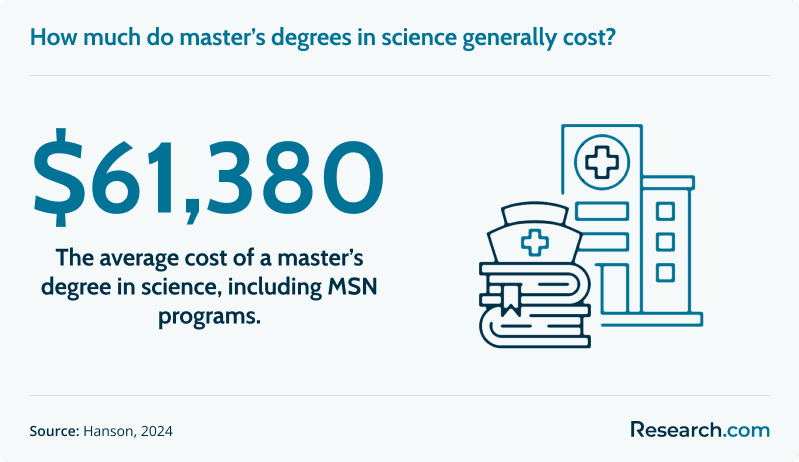
Online RN to MSN costs vary by school, residency status, credit load, program length, and specialization. According to recent data, the average cost of a master’s degree in science is about $61,380. That figure is a useful benchmark, but it does not replace a program-specific calculation based on total credits, fees, books, clinical travel, technology costs, and any required campus intensives.
Some online programs charge different tuition for in-state and out-of-state students, while others use one online rate. Students looking for a more compressed route may compare fast track RN to BSN to MSN online programs, which can reduce duplicated coursework by combining degree steps.
| Cost Item | Why It Matters | How to Evaluate It |
| Tuition per credit | The advertised rate does not show the full cost unless you multiply it by required credits. | Calculate total tuition using the full credit range for your chosen track. |
| Residency pricing | Some public universities charge higher out-of-state tuition. | Confirm whether online students qualify for in-state, out-of-state, or special online rates. |
| Fees | Technology, graduation, clinical, background check, and platform fees can add up. | Ask for a full fee schedule before enrolling. |
| Clinical expenses | Travel, immunizations, testing, and site requirements can create out-of-pocket costs. | Ask whether clinical placements may require travel outside your local area. |
| Lost work hours | Clinical rotations and intensive coursework may reduce your ability to work overtime or full time. | Build opportunity cost into your ROI estimate. |
What financial aid options are available for online RN to MSN students?
Online RN to MSN students may qualify for several funding sources, but eligibility depends on the school, enrollment status, citizenship or residency requirements, employer policies, and program accreditation. Before borrowing, compare grants, scholarships, employer benefits, and repayment obligations.
- Federal Student Aid: Students can begin by completing the Free Application for Federal Student Aid (FAFSA) to determine eligibility for federal aid options.
- Institutional scholarships: Many universities offer awards for graduate nursing students based on academic record, financial need, specialty area, or service commitment.
- Nursing association scholarships: Professional organizations and healthcare foundations may fund students pursuing advanced nursing roles.
- Employer tuition reimbursement: Hospitals and healthcare systems may help pay tuition for nurses who commit to continued employment or move into shortage-area roles.
- State-based grants or loan forgiveness: Some states support nurses who practice in underserved communities or high-need specialties.
- Private loans: Private borrowing can cover gaps, but interest rates, repayment terms, and borrower protections can differ from federal options.
Questions to ask before using financial aid
- Is the program accredited in a way that supports federal financial aid eligibility?
- Will I remain eligible for aid if I attend part time?
- Does employer reimbursement require a minimum grade or post-graduation work commitment?
- Can scholarships be renewed each year, or are they one-time awards?
- What happens to my aid if I change concentrations or take a leave of absence?
What are the prerequisites for enrolling in an online RN to MSN program?
Admission requirements vary, but most online RN to MSN bridge programs expect applicants to be licensed registered nurses with an approved nursing education background. According to Zippia, nearly half (49%) of APRNs hold a master’s degree, making it the most common educational path, followed by a bachelor’s degree (34%) and an associate degree (11%). That context matters because MSN-level study assumes a strong foundation in professional nursing practice.
Common prerequisites include:
- A current and unencumbered RN license.
- Completion of an accredited nursing diploma or associate degree in nursing.
- A minimum GPA, often 3.0 or higher.
- Professional nursing experience, typically one to two years.
- Completion of prerequisite courses in anatomy, physiology, and statistics.
Some schools may also require a resume, statement of purpose, references, background check, undergraduate transcripts, proof of clinical hours, or an interview. Nurses who already hold a BSN and want a direct graduate path may be better served by fast track BSN to MSN online programs instead of an RN to MSN bridge.
What courses are typically included in an online RN to MSN program?
An online RN to MSN curriculum usually includes bridge coursework that covers BSN-level competencies, followed by graduate courses in research, leadership, evidence-based practice, healthcare policy, advanced assessment, and specialty practice. The exact course sequence depends on whether you choose an advanced practice, education, administration, or clinical leadership concentration.
Students interested in executive or administrative roles may also compare online MSN programs with executive nurse leadership focus to see whether a dedicated leadership MSN better matches their goals.
| Course Area | Typical Topics | Why It Matters |
| Advanced clinical foundations | Advanced Health Assessment, Pathophysiology, Pharmacology for Advanced Practice Nurses | Builds the clinical reasoning needed for advanced nursing roles. |
| Research and evidence-based practice | Evidence-Based Practice and Research, quality improvement, data interpretation | Prepares nurses to evaluate evidence and improve patient care systems. |
| Leadership and systems | Nursing Leadership and Management, healthcare finance, organizational change | Supports roles in administration, care coordination, and team leadership. |
| Population and policy | Population Health and Policy, ethics, health equity, regulatory issues | Helps nurses understand broader healthcare delivery challenges. |
| Capstone or practicum | Specialty clinical hours, final project, thesis, or applied practice experience | Connects coursework to real healthcare settings and career goals. |
Students still deciding between bridge formats can review the best online BSN to MSN bridge programs to compare how curricula differ for nurses who already have a bachelor’s degree.
What specializations are available in an online RN to MSN program?
Specializations determine what you can do after graduation, what clinical hours you need, and whether you will be eligible for certification or licensure in an advanced role. According to BLS, nurse anesthetists, nurse midwives, and nurse practitioners collectively held about 349,600 jobs in 2023. Of these, nurse practitioners accounted for 292,500 positions, nurse anesthetists for 49,900, and nurse midwives for 7,200.
Common RN to MSN specializations include:
- Family Nurse Practitioner (FNP): Prepares nurses to provide primary care across the lifespan.
- Psychiatric Mental Health Nurse Practitioner: Focuses on mental health assessment, treatment planning, and psychiatric care.
- Nurse Anesthetist (CRNA): Prepares nurses to administer anesthesia and monitor patients during procedures.
- Nurse Midwife (CNM): Centers on prenatal, childbirth, postpartum, and reproductive care.
- Clinical Nurse Leader: Emphasizes care coordination, quality improvement, and outcomes management.
- Nursing Education: Supports roles teaching in academic, clinical, or staff development settings.
- Nurse Administrator: Prepares nurses for operations, staffing, budgeting, compliance, and unit or system leadership. Nurses comparing leadership credentials can explore graduate certificate nurse administration job opportunities.
- Dual-degree options: Programs such as the accelerated online MSN MBA dual degree combine nursing leadership with business and management coursework.
How do you choose the best online RN to MSN program?
The best online RN to MSN program is the one that fits your license status, career goal, state requirements, budget, schedule, and preferred level of clinical placement support. Rankings can help you build a shortlist, but they should not replace a program-by-program fit check.
| Selection Factor | Why It Matters | Red Flag |
| Accreditation | Accreditation affects transferability, financial aid, employer recognition, and certification eligibility. Check for recognized nursing accreditation such as CCNE or ACEN. | The program cannot clearly explain its nursing accreditation status. |
| State authorization and licensure fit | Online programs may not be approved for every state, especially for advanced practice tracks. | The school gives only a generic answer about whether the program meets your state’s requirements. |
| Clinical placement support | Finding preceptors can be one of the hardest parts of an online nursing program. | The school says students are fully responsible for clinical sites but offers little support. |
| Specialization match | Your track determines your coursework, practicum, certification pathway, and job options. | The program does not offer the specialty connected to your desired role. |
| Total cost | Per-credit tuition can be misleading without total credits and fees. | The school advertises affordability but does not provide a complete cost estimate. |
| Student support | Online students need advising, technical help, library access, faculty responsiveness, and career services. | Advising is difficult to reach before enrollment. |
| Outcomes | Graduation rates, certification pass rates, and employment support can signal program effectiveness. | The program will not share available outcomes data. |
Step-by-step checklist before applying
- Confirm that the school accepts your current RN education background.
- Verify institutional and nursing accreditation.
- Ask whether the program is authorized in your state.
- Match the concentration to your intended career and certification pathway.
- Calculate total tuition using required credits, not only cost per credit.
- Ask who finds clinical placements and what happens if a site falls through.
- Compare full-time and part-time study plans against your work schedule.
- Request details on graduation, certification, and student support outcomes when available.
What career paths are available for online RN to MSN graduates?
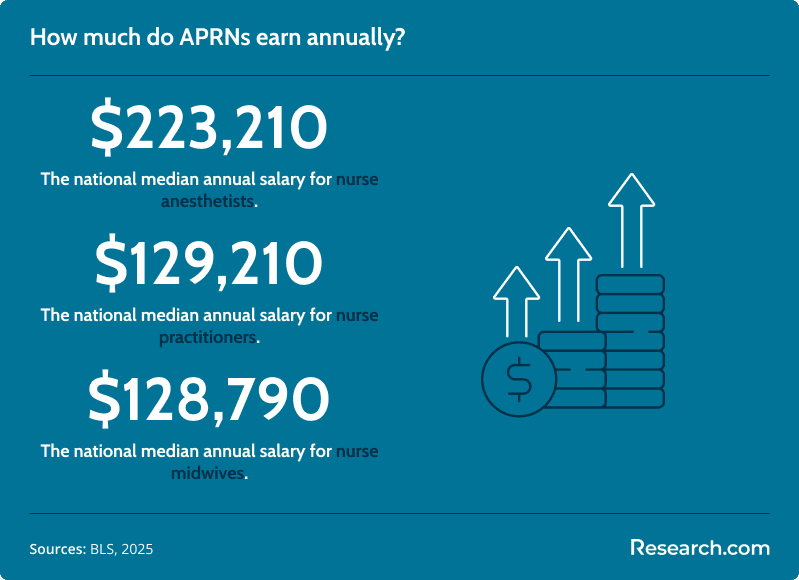
Online RN to MSN graduates may qualify for advanced clinical, education, leadership, and administrative roles, depending on their specialization and state requirements. BLS reports that as of May 2024, nurse anesthetists earned a median annual wage of $223,210, nurse practitioners earned $129,210, and nurse midwives earned $128,790. These figures show the earning potential of advanced nursing roles, but individual salaries vary by specialty, employer, location, experience, certification, and scope of practice.
| Career Path | Typical Focus | Best-Fit MSN Track |
| Nurse Practitioner | Assessment, diagnosis, treatment planning, prescribing where permitted, and ongoing patient care. | Family Nurse Practitioner, Psychiatric Mental Health Nurse Practitioner, Neonatal Nurse Practitioner, Adult-Gerontology Acute Care Nurse Practitioner |
| Nurse Anesthetist | Anesthesia administration and monitoring during surgical and procedural care. | Nurse Anesthetist |
| Nurse Midwife | Prenatal, birth, postpartum, and reproductive health care. | Nurse Midwife |
| Nurse Educator | Teaching nursing students, training clinical staff, curriculum development, and competency assessment. | Nursing Education, Nurse Educator |
| Nurse Administrator | Staffing, budgeting, compliance, operations, quality improvement, and department leadership. | Nurse Administrator, Executive Leadership, Nursing Leadership & Management |
| Clinical Nurse Leader | Care coordination, patient safety, outcomes improvement, and interprofessional collaboration. | Clinical Nurse Leader |
Nurses who want leadership preparation without completing a full additional degree may consider a nursing leadership graduate certificate online, especially if they already hold a graduate nursing credential or want targeted management training.
What is the job market like for online RN to MSN graduates?
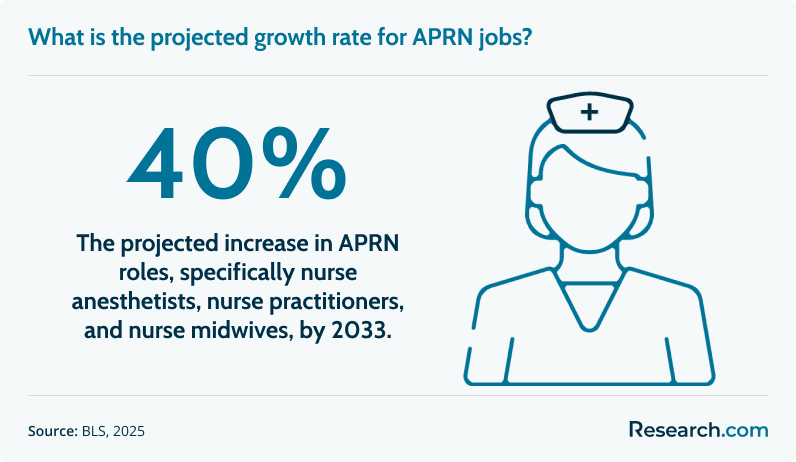
The labor market for MSN-prepared advanced practice nurses is strong. Employment for APRNs is projected to grow by 40% from 2023 to 2033. Demand is tied to primary care needs, specialty care access, an aging population, and broader use of APRNs in hospitals, clinics, telehealth, community health, and outpatient settings.
Job prospects still depend on your specialization, certification, state scope-of-practice rules, local competition, and clinical experience. For example, an FNP program may support different employment options than a psychiatric mental health track or nurse educator concentration. Nurses interested in mental health specialization can compare online PMHNP graduate certificate programs if they already have graduate nursing preparation and want to add a focused credential.
Current trends affecting RN to MSN students
- More online nursing options: Online delivery has expanded access for working RNs, but students still need to verify clinical placement expectations and state authorization.
- Higher employer expectations: Advanced roles often require certification, documented clinical competencies, leadership skills, and comfort with data-driven care improvement.
- Telehealth and digital care: MSN-prepared nurses may need stronger skills in virtual assessment, patient education, electronic health records, and remote care coordination.
- Ongoing demand for primary and behavioral health care: APRN roles remain important in settings that need expanded patient access.
- Greater scrutiny of outcomes: Students should ask schools about certification pass rates, graduation outcomes, and clinical support rather than relying only on marketing language.
How do online RN to MSN programs compare with online accelerated BSN programs?
Online RN to MSN programs and online accelerated BSN programs serve different students. An RN to MSN bridge is for licensed RNs who want to move into graduate nursing preparation. An accelerated BSN is generally intended for students who need undergraduate nursing preparation and do not yet have the same RN-to-graduate pathway.
| Program Type | Best For | Main Outcome | Key Decision Point |
| Online RN to MSN | Licensed RNs seeking graduate-level nursing roles. | MSN preparation with bridge coursework included. | Choose this if you are already an RN and want advanced practice, education, or leadership options. |
| Online accelerated BSN | Students who need a faster undergraduate nursing route. | BSN-level preparation. | Choose this if your immediate goal is undergraduate nursing preparation rather than an MSN. |
Is an online RN to MSN program a cost-effective investment?
An online RN to MSN program can be cost-effective when it shortens the path to a role that requires or rewards graduate nursing education. The value depends on your total program cost, financial aid, employer reimbursement, certification eligibility, clinical placement reliability, and expected career change after graduation. It is not automatically the best option for every RN.
Compare the RN to MSN route with alternatives such as the easiest RN to BSN online program if you want a lower-cost undergraduate step before deciding on graduate school. A slower RN-to-BSN-then-MSN path may be more affordable or manageable for some nurses, while a bridge program may be more efficient for nurses who are certain they need the MSN.
Common mistakes to avoid
- Choosing only by ranking: A highly ranked program may not offer your needed specialization or state authorization.
- Ignoring accreditation: Accreditation can affect certification eligibility, financial aid, transfer credits, and employer recognition.
- Looking only at cost per credit: Total cost depends on credits, fees, residency rules, books, clinical expenses, and time away from work.
- Assuming online means no clinical work: Most MSN tracks still require supervised clinical or practicum experiences.
- Overlooking state rules: Advanced practice requirements vary, and not every online program meets every state’s requirements.
- Underestimating workload: Bridge programs combine advanced coursework with professional responsibilities and can be demanding.
- Waiting too long to plan clinical placements: Securing qualified preceptors can take time, especially in competitive markets.
What advanced nursing opportunities are available beyond an MSN?
After earning an MSN, nurses may pursue doctoral education, post-master’s certificates, executive roles, faculty positions, advanced clinical specialization, healthcare policy work, or quality and systems leadership. A Doctor of Nursing Practice can support advanced clinical leadership, evidence-based practice implementation, executive decision-making, and system-level improvement.
Nurses who want to build on MSN-level preparation quickly may compare options such as a 1 year DNP program online, although admissions requirements, clinical expectations, and completion timelines vary by school and prior preparation.
Key Insights
- Online RN to MSN bridge programs are designed for licensed RNs who want a direct route into graduate nursing study without completing separate degree steps.
- Most programs take two to four years, but timelines vary by transfer credits, enrollment pace, specialization, and clinical placement requirements.
- Accreditation, state authorization, and certification alignment are non-negotiable checks before enrolling, especially for nurse practitioner and other advanced practice tracks.
- Cost comparisons should include total credits, fees, clinical expenses, technology costs, and potential lost work hours—not just tuition per credit.
- Clinical placement support can make or break the online student experience. Ask whether the school helps secure sites and preceptors before applying.
- The job outlook for APRNs is strong, with employment projected to grow by 40% from 2023 to 2033, but outcomes still depend on specialty, location, certification, and experience.
- An RN to MSN bridge is most worthwhile for nurses who are confident they need a graduate credential for their target role. Nurses who are unsure may compare RN to BSN, BSN to MSN, certificate, and DNP options before committing.
References:
- BLS. (2025, August 28). Nurse anesthetists, nurse midwives, and nurse practitioners. bls.gov.
- Hanson, M. (2024, November 24). Average Cost of a Master’s Degree: 2024 analysis. Education Data Initiative. educationdata.org.
- PayScale. (2025). Master of Science in Nursing (MSN) salary. payscale.com.
- Zippia. (2025, January 8). Best Colleges and Degrees for Advanced Practice Registered Nurses. zippia.com.
Other Things You Should Know About the Best Online RN to MSN (No ADN Required) Bridge Programs
Programs must be authorized to enroll students in each state where they operate, and some also need nursing board approval. Before enrolling, students should verify the school’s state authorization, clinical placement permissions, and whether the program meets requirements in their own state of residence.
To participate in 2027 online RN to MSN programs, students need a reliable computer, high-speed internet access, and software such as Microsoft Office. Some programs may also recommend specific browsers or proctoring software for exams, ensuring successful engagement in online coursework.